Apr 27 2026

AI Governance in the Age of Mythos: Why Small Business Owners Can’t Afford to Wait

AI Governance in the Age of Mythos: Why Small Business Owners Can’t Afford to Wait

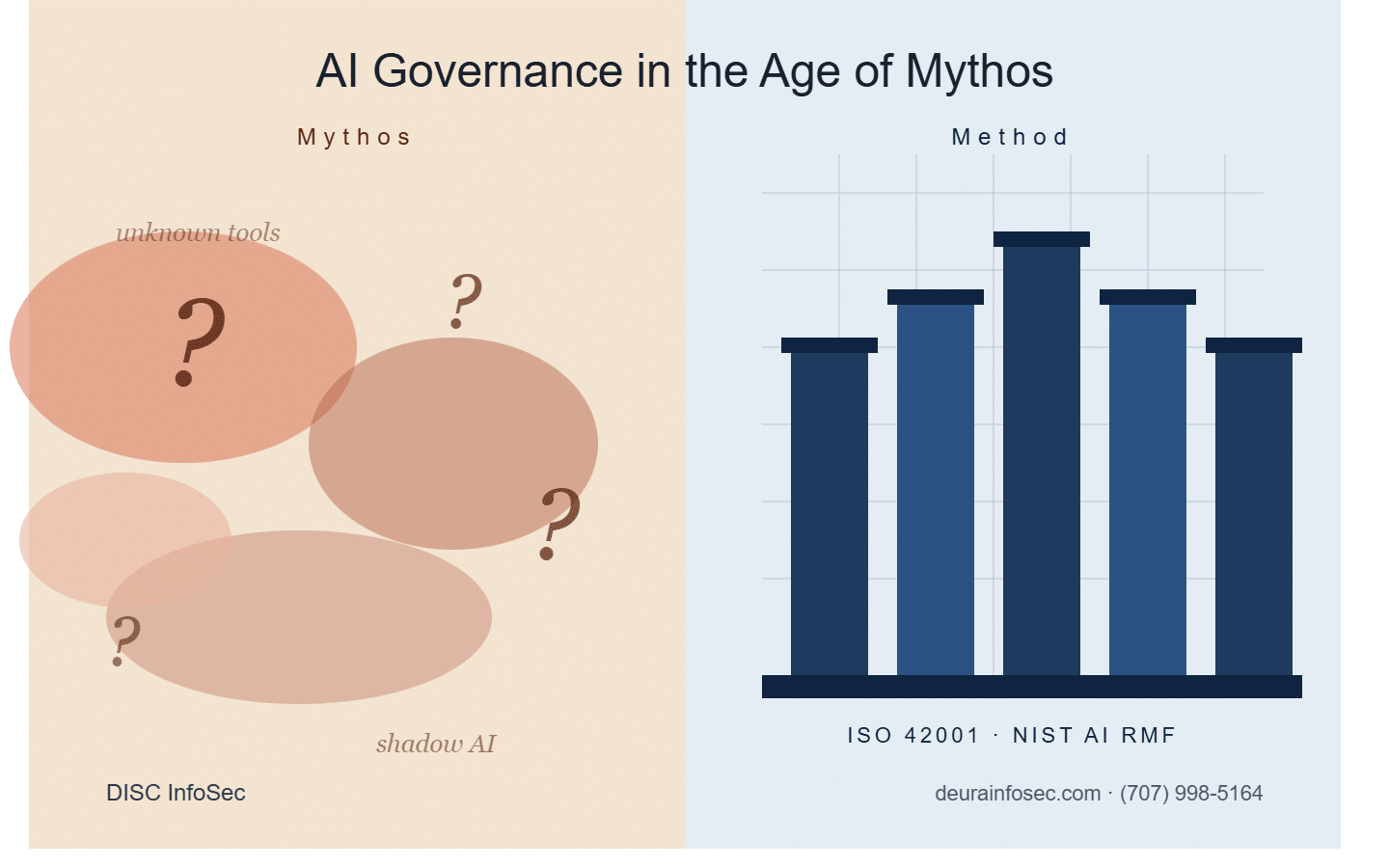
We are living in the age of mythos. Every week brings a new AI story: the tool that will replace your accountant, the chatbot that cost a company $10,000 in refunds, the startup that 10x’d its revenue with a single prompt. Small business owners are drowning in contradictory narratives — AI is a savior, AI is a threat, AI is a gimmick, AI is inevitable.

Here is the truth behind the noise: your employees are already using AI. Probably ChatGPT. Possibly Claude. Likely a half-dozen free tools they signed up for with a company email and a personal phone number. That is not a hypothetical — it is happening right now, in your business, without a policy, without a record, and without a safety net.

This is why AI Governance is no longer a Fortune 500 concern. It is a small business survival issue.

Five Benefits Small Business Owners Should Care About

1. Protect the customer trust you spent years building. One employee pasting client data into a public AI tool can undo a decade of reputation work. Governance puts guardrails in place before the incident, not after.

2. Stay ahead of regulation, not buried by it. The EU AI Act is live. Colorado, California, and New York have active AI laws on the books. The FTC is enforcing. Governance today means you are not scrambling when a client sends you an AI vendor questionnaire — or when a regulator does.

3. Eliminate shadow AI. Most small businesses have no idea which AI tools their people are actually using. An inventory, a policy, and a lightweight approval process turn chaos into visibility — and visibility is the foundation of every control that follows.

4. Win bigger deals. Enterprise buyers — banks, healthcare, government — are now asking small vendors for AI governance attestations. A documented AI Management System is no longer a nice-to-have. It is a procurement gate.

5. Lower your liability exposure. Cyber insurers are quietly adding AI exclusions. Courts are treating “the AI did it” as a non-defense. Written policies, training records, and risk assessments are what stand between your business and a claim denial.

“We’re Too Small for This” — The Most Expensive Myth

The most common objection I hear from small business owners sounds like this:

“AI governance is for big companies. We don’t have a CISO or a compliance team. This is overkill for us.”

Here is the rebuttal: small businesses are more exposed, not less. A Fortune 500 can absorb a $2M AI incident. You cannot. You do not need a CISO — you need a right-sized AI Management System that fits a 10, 50, or 200-person operation. That is exactly what ISO 42001 was designed for, and it is exactly what practitioners like DISC InfoSec deliver every day. One expert. No coordination overhead. No bloated committees. Governance that matches the size of your business and the seriousness of your risk.

If we can make it work in the hard-mode compliance environment of financial data rooms serving M&A transactions, we can make it work for you.

Start Your AI Governance Journey Today

You do not need to boil the ocean. You need a starting point.

Begin with a rapid AI attack surface assessment. Build an AI inventory. Draft an acceptable use policy. Train your team. Each step compounds — and each step moves you from mythos to method.

DISC InfoSec helps small and mid-sized businesses across the USA design, implement, and operate AI governance programs anchored in ISO 42001 and the NIST AI RMF. We have done it. We can do it for you.

Book a 30-minute strategy call:

Visit: www.DeuraInfoSec.com | info@DeuraInfoSec.com | (707) 998-5164

Do not wait for the incident. Start the governance.

The 2026 AI Compliance Checklist: 60 Controls Across 10 Domains

AI Attack Surface ScoreCard

AI Vulnerability Scorecard: Discover Your AI Attack Surface Before Attackers Do

Your Shadow AI Problem Has a Name-And Now It Has a Score

Drop a note below: info@deurainfosec.com or Visit a DISC InfoSec Data Governance and Privacy Progarm

InfoSec services | InfoSec books | Follow our blog | DISC llc is listed on The vCISO Directory | ISO 27k Chat bot | Comprehensive vCISO Services | ISMS Services | AIMS Services | Security Risk Assessment Services | Mergers and Acquisition Security

Tags: Age of Mythos, AI Governance, SMBs


Apr 23 2026

AI Governance That Works: From Frameworks to Audit-Ready Controls with DISC


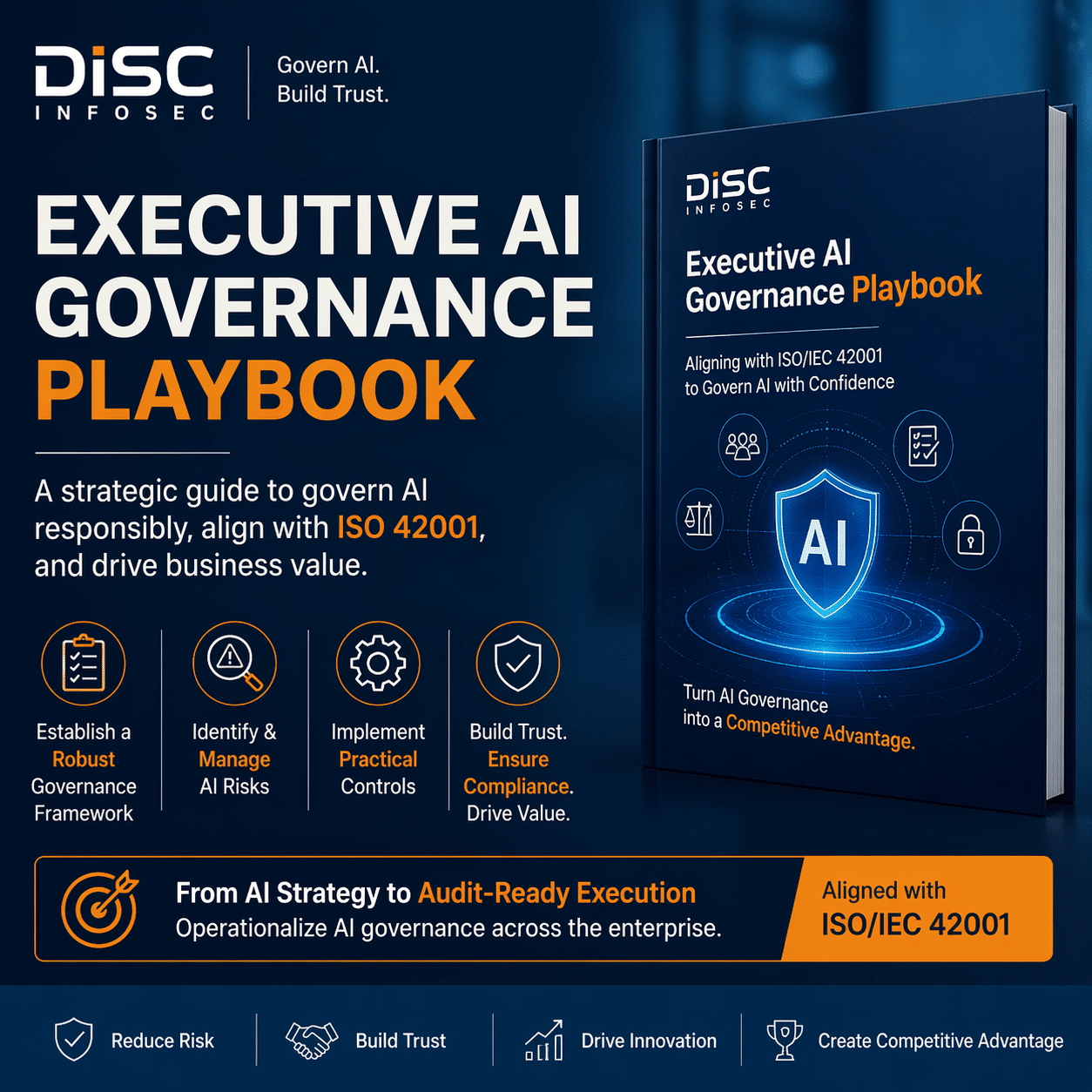
The executive AI governance positions AI not just as a technology shift, but as a strategic business transformation that requires structured oversight. It emphasizes that organizations must balance innovation with risk by embedding governance into how AI is designed, deployed, and monitored—not as an afterthought, but as a core operating principle.

At its foundation, the post highlights that effective AI governance requires a clear operating model—including defined roles, accountability, and cross-functional coordination. AI governance is not owned by a single team; it spans leadership, risk, legal, engineering, and compliance, requiring alignment across the enterprise.

A central theme AI governance enforcement is the need to move beyond high-level principles into practical controls and workflows. Organizations must define policies, implement control mechanisms, and ensure that governance is enforced consistently across all AI systems and use cases. Without this, governance remains theoretical and ineffective.

Importance of building a complete inventory of AI systems. Companies cannot manage what they cannot see, so maintaining visibility into all AI models, vendors, and use cases becomes the starting point for risk assessment, compliance, and control implementation.

Risk management is presented as use-case specific rather than generic. Each AI application carries unique risks—such as bias, explainability issues, or model drift—and must be assessed individually. This marks a shift from traditional enterprise risk models toward more granular, AI-specific governance practices.

Another key focus is aligning governance with emerging standards like ISO/IEC 42001, NIST AI RMF, EU AI Act, Colorado AI Act which provides a structured framework for managing AI responsibly across its lifecycle. Which explains that adopting such standards helps organizations demonstrate trust, improve operational discipline, and prepare for evolving global regulations.

Technology plays a critical role in scaling governance. The post highlights how platforms like DISC InfeSec can centralize AI intake, automate compliance mapping, track risks, and monitor controls continuously, enabling organizations to move from manual processes to scalable, real-time governance.

Ultimately, the AI governance as a business enabler rather than a compliance burden. When done right, it builds trust with customers, reduces operational surprises, and creates a competitive advantage by allowing organizations to scale AI confidently and responsibly.


My perspective

Most guides—get the structure right but underestimate the execution gap. The real challenge isn’t defining governance—it’s operationalizing it into evidence-based, audit-ready controls, AI governance enforcement. In practice, many organizations still sit in “policy mode,” while regulators are moving toward proof of control effectiveness.

If DISC positions itself not just as a governance framework but as a control execution + evidence engine (AI risk → control → proof), that’s where the real market differentiation is.

The 2026 AI Compliance Checklist: 60 Controls Across 10 Domains

AI Attack Surface ScoreCard

AI Vulnerability Scorecard: Discover Your AI Attack Surface Before Attackers Do

Your Shadow AI Problem Has a Name-And Now It Has a Score

Schedule a consultation or drop a note below: info@deurainfosec.com

InfoSec services | InfoSec books | Follow our blog | DISC llc is listed on The vCISO Directory | ISO 27k Chat bot | Comprehensive vCISO Services | ISMS Services | AIMS Services | Security Risk Assessment Services | Mergers and Acquisition Security

Tags: AI Governance, AI Governance Enforcement


Apr 23 2026

The 2026 AI Compliance Checklist: 60 Controls Across 10 Domains

Published by DISC InfoSec · AI Governance & Cybersecurity

The 2026 AI Compliance Checklist: 60 Controls Across 10 Domains

If you run security, compliance, or AI at a B2B SaaS or financial services company, you have probably noticed something uncomfortable in the last six months: every framework you used to live by has grown an AI annex, every enterprise customer has added an AI section to their vendor questionnaire, and every regulator has decided 2026 is the year they stop asking nicely.

The EU AI Act’s high-risk obligations begin enforcement in August 2026. ISO/IEC 42001 has gone from “interesting standard” to “procurement requirement” inside eighteen months. The NIST AI RMF is quietly becoming the lingua franca of U.S. enterprise buyers. Article 22 of the GDPR is being dusted off and pointed at automated decisions that nobody bothered to call “AI” two years ago.

And most AI compliance programs we walk into are still a binder of policies and a hopeful Notion page.

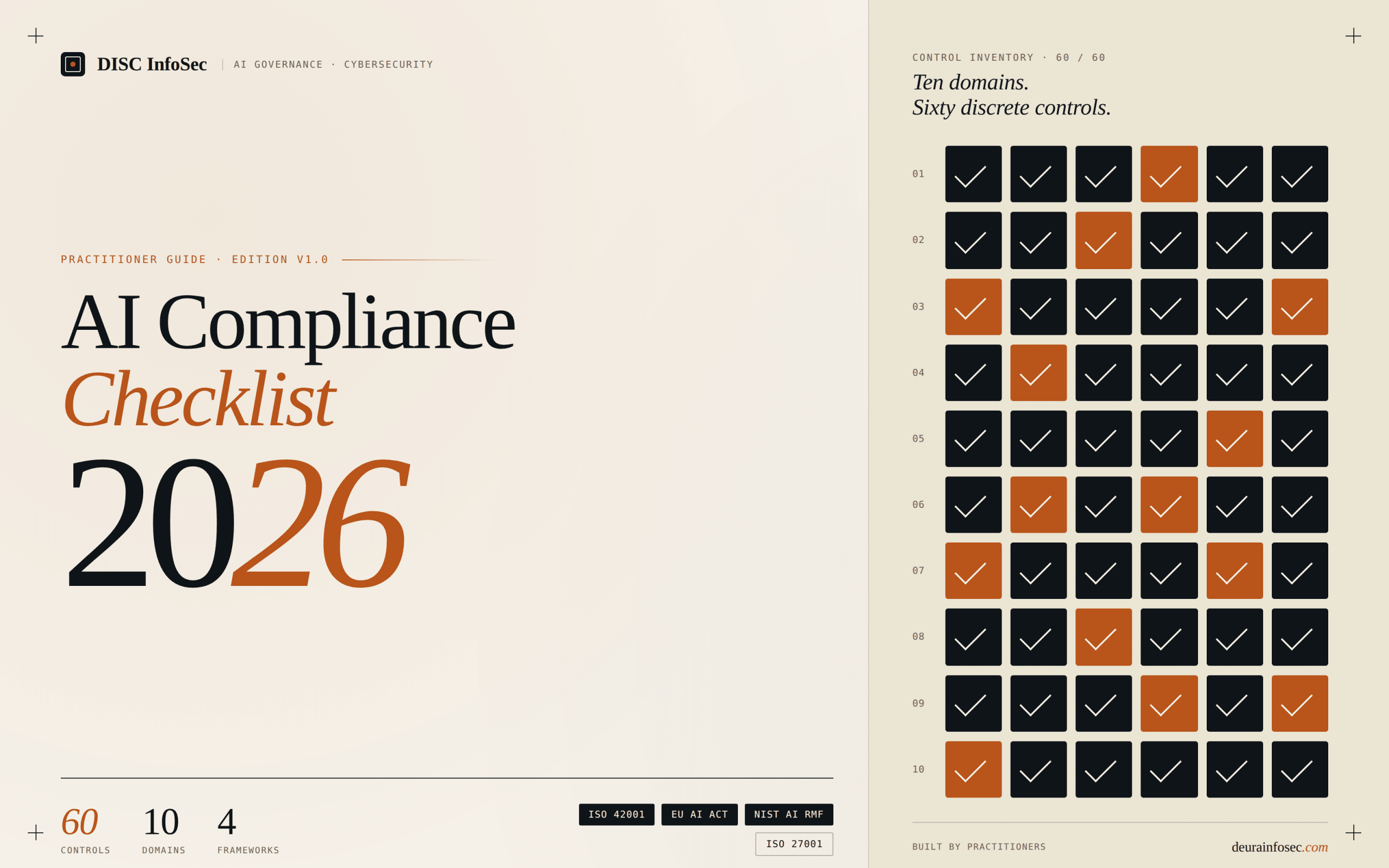
We built the 2026 AI Compliance Checklist because the gap between having a policy and having a program an auditor will defend is where every consulting engagement we run actually lives. Sixty controls. Ten domains. Mapped to the four frameworks that matter — ISO/IEC 42001, the EU AI Act, NIST AI RMF, and ISO/IEC 27001 — with cross-references to GDPR, HIPAA, and SOC 2 where they apply.

Open the checklist →


Why most AI compliance efforts stall

The pattern is consistent enough that we can name it. Companies start with enthusiasm: leadership signs an AI policy, someone is named “AI lead,” a vendor questionnaire gets updated. Six months later the same company cannot answer four questions:

  1. Which of our AI systems are high-risk under the EU AI Act, and who decided?
  2. What is our Statement of Applicability for ISO 42001, and is it defensible?
  3. If a customer asks for our AI sub-processor list tomorrow, can we produce it?
  4. If a regulator asks for our serious-incident reporting procedure, is it written down?

These are not exotic questions. They are the first four questions in any audit. The reason programs stall on them is not that the standards are unclear — the standards are perfectly clear. The reason they stall is that nobody owns the implementation work, and nobody on the team has done it before.

That’s the gap the checklist is built around.

The 10 domains

Each domain reflects something we have implemented in production for a real client. Not theory. Not what we read in a study guide.

1. AI Governance Foundation

The boring stuff that determines whether anything else matters. A board-approved AI policy. A named, accountable AI owner — CAIO, vCAIO, or equivalent — with the authority to halt deployments. A cross-functional AI council with a written charter. A live AI system inventory that includes the shadow IT your engineers haven’t told you about. An Acceptable Use Policy with annual acknowledgment. And as of February 2025, an AI literacy program under EU AI Act Article 4 if you operate in the EU market.

If these six controls are not in place, the rest of your program is decorative.

2. EU AI Act Risk Classification

The single most consequential decision in your entire program is how you classify each AI system. Get it wrong and the rest of your effort is misallocated — over-investing in low-risk systems, under-investing in the ones that will get you fined. The checklist walks you through prohibited use cases (Article 5), high-risk Annex III mappings, GPAI obligations under Article 53 if you deploy or fine-tune foundation models, and the post-market monitoring plan that everyone forgets until they need it.

3. ISO/IEC 42001 AIMS

The certifiable AI Management System scaffolding. Scope statement. Context analysis. Measurable objectives. Statement of Applicability covering all 38 Annex A controls. Internal audit cycle. Management review. Six controls — and the difference between a program that passes a Stage 2 audit and one that doesn’t.

We know this domain particularly well because we are currently deploying it at ShareVault, a virtual data room platform serving M&A and financial services clients. ShareVault achieved ISO 42001 certification with DISC InfoSec serving as internal auditor and SenSiba conducting the Stage 2 audit. The same playbook is in the checklist.

4. NIST AI RMF Alignment

The four functions — GOVERN, MAP, MEASURE, MANAGE — give you a vocabulary U.S. enterprise buyers already understand. Most of the GOVERN function maps cleanly onto your ISO 42001 work, so you can reuse artifacts. The GenAI Profile (NIST AI 600-1) lists twelve risks specific to generative AI; if you deploy LLM-based systems and you have not reviewed it, you are flying blind.

5. Data Governance for AI

Most AI failures are data failures wearing a model’s clothes. Training, validation, and test data lineage. Bias and representativeness assessment. Pre-training data quality controls. PII and PHI handling per GDPR or HIPAA. Retention and right-to-deletion procedures that actually cover model artifacts — because embeddings and fine-tuned weights derived from personal data are personal data, and a deletion request that doesn’t reach them is incomplete.

6. Third-Party & Vendor AI Risk

Most of your AI risk lives in someone else’s data center. A standard SIG questionnaire does not cover training-on-customer-data, model lineage, or sub-processor changes. Your DPAs probably need new clauses. Your sub-processor list almost certainly needs to include AI providers — and to track when they change. Model cards or system cards should be on file for each vendor model in use; if a vendor refuses to share one, that is itself a risk signal.

7. Transparency & Documentation

If you cannot explain a system to a regulator in writing, you do not actually understand it. System cards. User-facing AI disclosure where Article 50 of the EU AI Act requires it (chatbots must self-identify; synthetic media must be labeled). Watermarking or provenance signals for synthetic content. Decision logs for high-risk automated decisions. A public-facing trust center page — because procurement teams will look for it before they ask you for it.

8. Human Oversight

“Human-in-the-loop” loses meaning when the human is rubber-stamping at scale. The checklist forces you to define oversight roles, document and rehearse override procedures, build unambiguous escalation paths, and train reviewers — including on automation bias, which is the number one failure mode of HITL systems. Where decisions are wholly automated, GDPR Article 22 rights to explanation and contest must be honored with documented procedures.

9. Security & Adversarial Testing

Your existing AppSec program does not cover prompt injection, model extraction, or training data poisoning. STRIDE does not cover evasion or membership inference attacks. You need a threat-modeling framework built for AI — MITRE ATLAS is the current best-of-breed — and you need red-teaming with current attack libraries, not last year’s. Output filtering and PII-leak detection at inference time are now essential, especially for any RAG pipeline pulling from internal data.

10. Incident Response & Monitoring

Drift is silent. Failure is loud. The checklist closes with the AI-specific incident response plan most companies don’t have, production drift monitoring with thresholds reviewed quarterly, the Article 73 serious-incident reporting criteria (15-day clock for high-risk systems), model change management with documented approvals, and a post-incident review process that actually feeds back into your AI risk register.

If your incidents don’t change anything, you are not learning. You are just absorbing.


Why DISC InfoSec

We are not a generalist firm with an AI practice grafted on. AI governance and cybersecurity are the practice. The principal consultant — backed by 16+ years across NASA, Dell, Lam Research, and O’Reilly Media, with CISSP, CISM, ISO 27001 Lead Implementer, and ISO 42001 certifications — is the person you actually work with. No partner-and-pyramid model. No junior consultants billing hours to learn ISO 42001 on your engagement.

This matters more than it sounds. AI governance is one of those domains where coordination overhead inside a consulting firm consumes most of the value the firm could deliver. Our vCAIO model is the structural answer: one expert, embedded, accountable.

And we are doing the work, not just teaching it. The ShareVault ISO 42001 deployment is live. The Annex A controls are operational. The Stage 2 audit is closed. Every control in the 2026 checklist is in the checklist because we have implemented it ourselves or watched someone else fail to implement it.

What to do this week

If you have not started: open the checklist, share it with your AI council (or convene one), and run through Section 1. Most companies discover their gap inside the first six controls.

If you are mid-program and stuck: Sections 2 and 3 are usually where we find the load-bearing problems. EU AI Act classification disagreements and ISO 42001 scope drift kill more programs than any other two issues combined.

If you want a second set of eyes — a senior practitioner who has done this end-to-end — that is exactly what the vCAIO engagement is built for.


→ Open the 2026 AI Compliance Checklist

DISC InfoSec — AI Governance & Cybersecurity for B2B SaaS and Financial Services https://deurainfosec.com · info@deurainfosec.com · 707-998-5164


AI Attack Surface ScoreCard

AI Vulnerability Scorecard: Discover Your AI Attack Surface Before Attackers Do

Your Shadow AI Problem Has a Name-And Now It Has a Score

Schedule a consultation or drop a note below: info@deurainfosec.com

InfoSec services | InfoSec books | Follow our blog | DISC llc is listed on The vCISO Directory | ISO 27k Chat bot | Comprehensive vCISO Services | ISMS Services | AIMS Services | Security Risk Assessment Services | Mergers and Acquisition Security

Tags: The 2026 AI Compliance Checklist


Apr 22 2026

Your Shadow AI Problem Has a Name-And Now It Has a Score

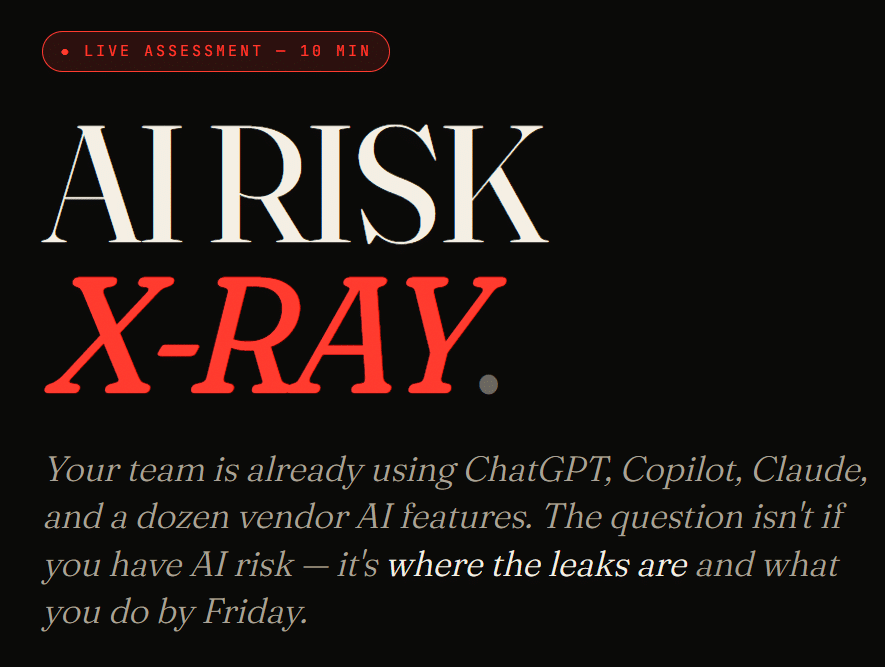
Your Shadow AI Problem Has a Name. And Now It Has a Score.

A 10-minute CMMC-aligned AI Risk X-Ray for SMBs who are done pretending they have this under control.


Nobody is flying this plane

Right now, somebody at your company is pasting a customer contract into ChatGPT to “summarize the key terms.” Somebody else just asked Copilot to draft a reply to a vendor — and the reply quoted a line from an internal doc they didn’t mean to share. A third employee installed a browser extension that promises “AI meeting notes” and quietly streams your entire Zoom call to a server you’ve never heard of.

You probably don’t know any of their names. You probably don’t have a policy that says they can’t. And if a client emailed you today asking “How are you using AI safely with our data?” — you’d stall, draft something vague, and hope they don’t press.

This is the AI risk posture of most SMBs in 2026. Not because they’re negligent. Because they’re busy, the tools are free, the guidance is overwhelming, and the frameworks everyone points at (NIST AI RMF, ISO 42001, the EU AI Act) were written for companies with a governance team and a legal budget you don’t have.

The result: shadow AI, quietly compounding. Every week you don’t address it, the blast radius of the eventual incident gets bigger.

We built the AI Risk X-Ray to fix that — specifically for SMBs who want an honest answer in 10 minutes, not a six-week consulting engagement.


What the AI Risk X-Ray actually does

It’s a free, self-service assessment. Ten questions. Each one scored on the CMMC 5-level maturity scale (Initial → Managed → Defined → Measured → Optimizing). No fluff, no framework jargon, no pretending you need to “align with ISO 42001 Annex A” before you can answer a client’s basic AI question.

You walk through ten risk domains that cover the immediate, day-to-day AI exposure every SMB has right now:

  1. Shadow AI Inventory — Do you actually know which AI tools your employees are using? Not just the ones you approved. The ones they’re using.
  2. Acceptable Use Policy — Is there a written AI policy staff have read, or did you send a Slack message in 2024 and call it done?
  3. Data Leakage Controls — Are employees trained on what data must never be pasted into public AI tools? (Hint: customer PII, contracts, source code, credentials — the stuff that gets you sued.)
  4. Vendor AI Risk — Your CRM, HR platform, and helpdesk have all quietly added AI features. Do you know which of them are processing your data for model training?
  5. Client / Contract Readiness — Can you answer “how are you using AI safely?” with a documented response, or do you freeze?
  6. AI Output Review — Is anyone checking the AI-generated emails, code, and contracts before they leave the building?
  7. Access & Accounts — Are employees on enterprise AI plans with data retention turned off, or on personal free accounts that may be training on your prompts?
  8. Regulatory Awareness — Colorado AI Act. EU AI Act. California AB 2013. “We’re too small” is no longer a defense.
  9. Incident Response — If someone leaked sensitive data into an AI tool tomorrow, what happens in the next four hours?
  10. Accountability — Is there a specific named person responsible for AI risk, or does it live in the gap between IT, legal, and “someone should probably own this”?

That’s it. Ten questions. Nothing esoteric. No 47-page NIST crosswalk.


What you get at the end

Three things land in your browser the moment you finish the assessment:

A maturity score out of 100. Animated ring, big number, tier label — Critical Exposure, High Risk, Moderate, Strong, or Optimized. No hand-waving. Your score is the arithmetic of your answers.

Your top 5 priority gaps. Not all ten. The five lowest-maturity domains, ranked by where you’d get hurt first. Each one ships with a concrete remediation you can execute inside a week — not a framework reference, an actual sentence telling you what to do Monday morning.

A detailed PDF report you can download, forward to your CEO, or attach to the board deck. It includes the executive summary, the top-5 fix list, a full breakdown of all ten domains, and a 30/60/90-day plan that walks you from “we have nothing” to “we can pass a client’s AI due-diligence questionnaire.”

Ten minutes. A number you can defend. A list of fixes you can actually do.

Get Instant Clarity on Your AI Risk — Free

Launch your Free AI Risk X-Ray Tool and uncover hidden vulnerabilities, compliance gaps, and governance blind spots in minutes. No fluff, just actionable insight.

👉 Click the link or image above to start your assessment now.


Who this is for (and who it isn’t)

This is for you if:

  • You’re at an SMB (roughly 50 to 1500 employees) using AI tools with informal or zero governance.
  • You’re in B2B SaaS, financial services, healthcare, legal, or professional services — any sector where client data sensitivity is high and AI questions are already arriving in RFPs.
  • Your CEO asked “are we safe with AI?” last quarter and you said “yeah, we’re fine” and have been vaguely uncomfortable about it ever since.
  • A client, prospect, or investor has asked you an AI-specific question and you didn’t have a clean answer.

This isn’t for you if:

  • You already run a formal AI governance program with an AI risk committee, quarterly audits, and ISO 42001 certification. (If that’s you — we should probably talk anyway, because you’re the exception, not the rule.)
  • You want a comprehensive enterprise AI risk assessment. This is a 10-minute snapshot, not a 6-week engagement. It surfaces the pain. It doesn’t replace deep work.

Where DISC InfoSec comes in

Here’s what happens after the score.

Most SMBs run the X-Ray, see a 38/100, and go through predictable stages: disbelief, defensiveness, then the uncomfortable realization that they’ve been playing Russian roulette with their client data. Then comes the harder question: who’s going to fix this?

Internal IT is already at capacity. Traditional Big-4 consultants show up with a $150K proposal and a six-month timeline. Framework vendors sell software that assumes you already have the governance program their software is supposed to manage. None of it fits the SMB reality.

This is exactly the gap DISC InfoSec was built to close. We specialize in SMBs — B2B SaaS, financial services, and regulated industries — who need practical AI governance implemented this month, not theorized about for the next fiscal year.

Here’s what that looks like in practice:

  • A 1-page AI Acceptable Use Policy your staff will actually read and your lawyers will sign off on — drafted in days, not weeks.
  • Shadow AI discovery using the tools and logs you already have, producing a living AI inventory with owners, data sensitivity, and approval status.
  • Vendor AI questionnaires pre-built for your top SaaS tools, ready to send, with contract language you can paste into renewal negotiations.
  • An AI Trust Brief you can put on your website or hand to a prospect — the document that turns “how are you using AI safely?” from a deal-killer into a deal-accelerator.
  • Migration from personal AI accounts to enterprise plans with zero-data-retention, SSO, and admin visibility — budgeted and sequenced so it doesn’t blow up your P&L.
  • ISO 42001 readiness for the subset of clients who need to formalize what they’ve built. We implemented ISO 42001 at ShareVault (a virtual data room platform serving M&A and financial services), which passed its Stage 2 audit with SenSiba. The playbook is real, battle-tested, and portable.
  • A fractional vCAIO / vCISO model — the “one expert, no coordination overhead” approach. You get a named person accountable for your AI risk who has done this at scale, without hiring a full-time executive or coordinating across three consulting firms.

The remediation isn’t theoretical. The 30/60/90-day plan in your X-Ray report is the exact sequence we’ve used with other SMBs. Most of our engagements close the first four of your five priority gaps inside 60 days.


Why this matters more for SMBs than for enterprises

Big companies have entire AI governance teams now. They have budget. They have legal review. They have the ability to absorb an AI-related incident without it being existential.

SMBs don’t have any of that. One leaked customer dataset can end a relationship that represents 30% of your revenue. One regulatory inquiry can consume the next two quarters of your senior team’s attention. One bad AI-generated output in a contract can trigger litigation you can’t afford to defend.

The asymmetry is brutal: smaller surface area, but every hit lands with more force. Which is exactly why the “we’re too small to need AI governance” reflex is the most dangerous belief in the SMB security world right now.

You don’t need to out-govern Google. You need to not be the easiest target in your vertical. A 70/100 on the AI Risk X-Ray puts you comfortably above most SMB peers and answers 80% of the client AI questions you’ll get this year. That’s achievable in under 90 days with the right help.


Take 10 minutes. See the number.

The AI Risk X-Ray is free. No email gate for marketing spam, no paywall, no “enter your credit card to see results.” You get the score, the top 5 gaps, the PDF, and the 30/60/90-day plan the moment you finish.

A copy of your report lands with us too — at info@deurainfosec.com — so if you want to talk through it, we already have the context. No introductory deck, no “let me get familiar with your situation” call. We already know your score, your gaps, and your sector. We’ll email you within one business day with the three things we’d fix first.

If you’d rather just take the assessment and keep the conversation for later, that’s fine too. The tool stands on its own.

[Take the AI Risk X-Ray →] (link to the hosted tool on deurainfosec.com)


Perspective on this tool

I’ll be direct, because the whole point of this thing is directness.

Most AI risk assessments on the market right now are either (a) thinly-disguised lead-capture forms that score every answer as “you need to buy our platform,” or (b) 200-question enterprise instruments that take six hours and score you against a framework your SMB will never realistically adopt. Both are useless if you’re trying to make a decision this week.

The X-Ray is deliberately neither. Ten questions is the minimum you need to get a defensible maturity picture across the domains that actually matter for SMBs in 2026. Anything shorter is a marketing quiz. Anything longer is a consulting engagement pretending to be an assessment.

Is the score perfect? No. A real audit looks at evidence — policy documents, access logs, training records, vendor contracts. Self-assessment has an inherent generosity bias; people rate themselves a level higher than reality warrants. I’d expect most scores to be slightly inflated, which means if you score a 55, you’re probably actually a 45, and you should act accordingly.

But here’s what the X-Ray does that a perfect audit doesn’t: it gets answered. The perfect audit sits in someone’s queue for two months. The X-Ray gets finished in a coffee break, produces a number you can put on a slide, and gives you enough clarity to make a decision about what to do next. That’s the trade I’d make every time for an SMB who hasn’t even started.

If you score below 60, you have real work to do and you should stop scrolling LinkedIn AI think-pieces and actually fix something. If you score between 60 and 80, you’re in decent shape but there are specific gaps that will cost you deals when your next enterprise client sends an AI questionnaire. If you score above 80, you’re ahead of 90% of your peers — audit it, formalize it, and turn it into a sales asset.

Whatever your score, the next move isn’t to read another article about AI governance. It’s to close one gap this week. Then another next week. Then another. That’s how AI risk actually gets managed at an SMB — not by reading frameworks, but by doing one unglamorous thing at a time until the score moves.

We can help with that. Or you can do it yourself with the 30/60/90 plan in the PDF. Either way, stop guessing.

10 minutes. 10 questions. The honest answer.


DISC InfoSec is an AI governance and cybersecurity consulting firm serving B2B SaaS, financial services, and other regulated SMBs. We’re a PECB Authorized Training Partner for ISO 27001 and ISO 42001, and we served as internal auditor on ShareVault’s ISO 42001 certification. One expert. No coordination overhead. Email info@deurainfosec.com or visit deurainfosec.com.

AI Attack Surface ScoreCard

AI Vulnerability Scorecard: Discover Your AI Attack Surface Before Attackers Do

Schedule a consultation or drop a note below: info@deurainfosec.com

InfoSec services | InfoSec books | Follow our blog | DISC llc is listed on The vCISO Directory | ISO 27k Chat bot | Comprehensive vCISO Services | ISMS Services | AIMS Services | Security Risk Assessment Services | Mergers and Acquisition Security

Tags: AI Data leaks, AI risks, ChatGPT, Claude, Copilot, Shadow AI


Apr 20 2026

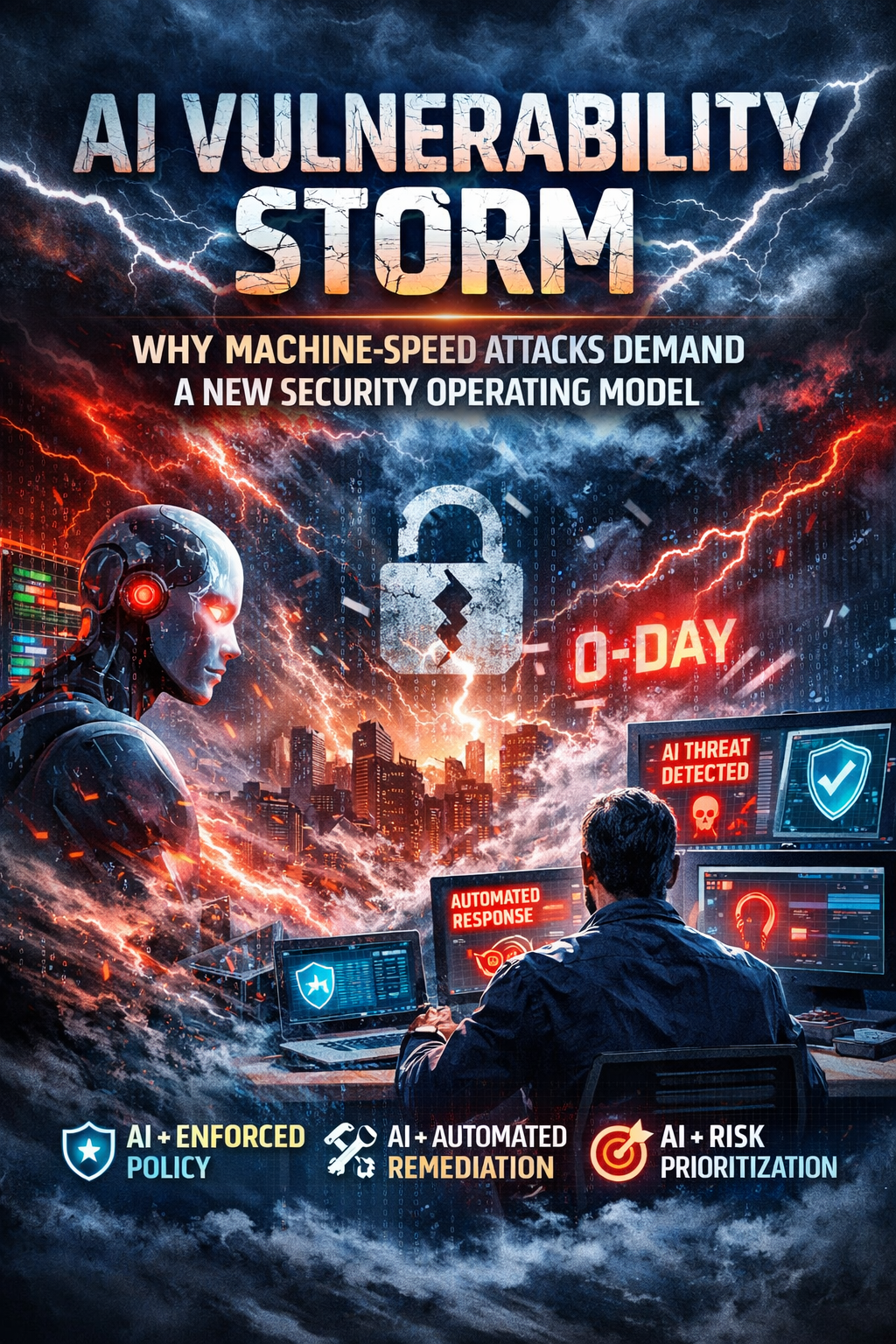
AI Vulnerability Storm: Why Machine-Speed Attacks Demand a New Security Operating Model

Source: The Mythos Zero-Day Flood Is Here. Only AI Can Fix It.


The article argues that cybersecurity has entered a new phase driven by advanced AI systems like Claude Mythos Preview. These systems are capable of autonomously discovering zero-day vulnerabilities across major operating systems and browsers—something that previously required elite, well-funded research teams. This marks a fundamental shift in how vulnerabilities are found and exploited.

A key driver of this shift is the explosion in vulnerability discovery combined with shrinking exploit timelines. What once took years to weaponize can now happen in less than a day. AI can even reverse-engineer patches to uncover the underlying flaw within hours, effectively accelerating both offense and exploitation at unprecedented speed.

The post highlights a dramatic leap in capability: Mythos can not only find vulnerabilities but also chain multiple bugs into working exploits without human involvement. In testing, it vastly outperformed earlier models, demonstrating that AI has crossed from assistive tooling into autonomous offensive capability.

This evolution reshapes the attacker landscape. Capabilities once limited to nation-state actors are becoming accessible to a much broader audience. Even less-skilled attackers can now automate reconnaissance, generate exploits, and execute attacks—ushering in what the article calls a “vibe-hacking” era where barriers to entry collapse.

At the same time, these capabilities are not likely to remain restricted. The article stresses a familiar pattern: what is cutting-edge and controlled today will likely become widely available—possibly even open-source—within 12 to 18 months. That means mass-scale autonomous exploit development could soon be democratized.

This creates a widening gap between defenders and attackers. Security teams are already overwhelmed by vulnerability volume, and AI dramatically increases both the number and complexity of threats. The traditional vulnerability management lifecycle—discover, patch, remediate—is no longer keeping pace with the speed of AI-driven discovery.

The article’s core conclusion is blunt: only AI can counter AI. Human-driven security operations cannot scale to match machine-speed attacks. The future of defense must rely on autonomous systems capable of identifying, prioritizing, and fixing vulnerabilities at the same speed they are discovered.


Perspective (What this really means)

The article is directionally right—but slightly oversimplified.

Yes, AI is compressing the timeline between discovery and exploitation, and it’s creating what you’ve been calling an “AI Vulnerability Storm.” But the idea that “only AI can fix it” is incomplete. The real issue isn’t just speed—it’s operational maturity.

Most organizations don’t fail because they lack detection—they fail because:

  • They can’t prioritize what matters
  • They can’t fix at scale
  • They lack visibility into their actual attack surface

AI will help—but without governance, enforcement, and runtime controls, it just becomes another noisy tool.

The real winning strategy isn’t AI vs AI. It’s:

  • AI + enforced policy
  • AI + automated remediation workflows
  • AI + business-aligned risk prioritization

In other words, this isn’t just a tooling shift—it’s a security operating model shift.

If companies respond by just “adding AI tools,” they’ll fall behind faster. If they redesign security around continuous, enforced, and measurable control systems, they’ll stay ahead.


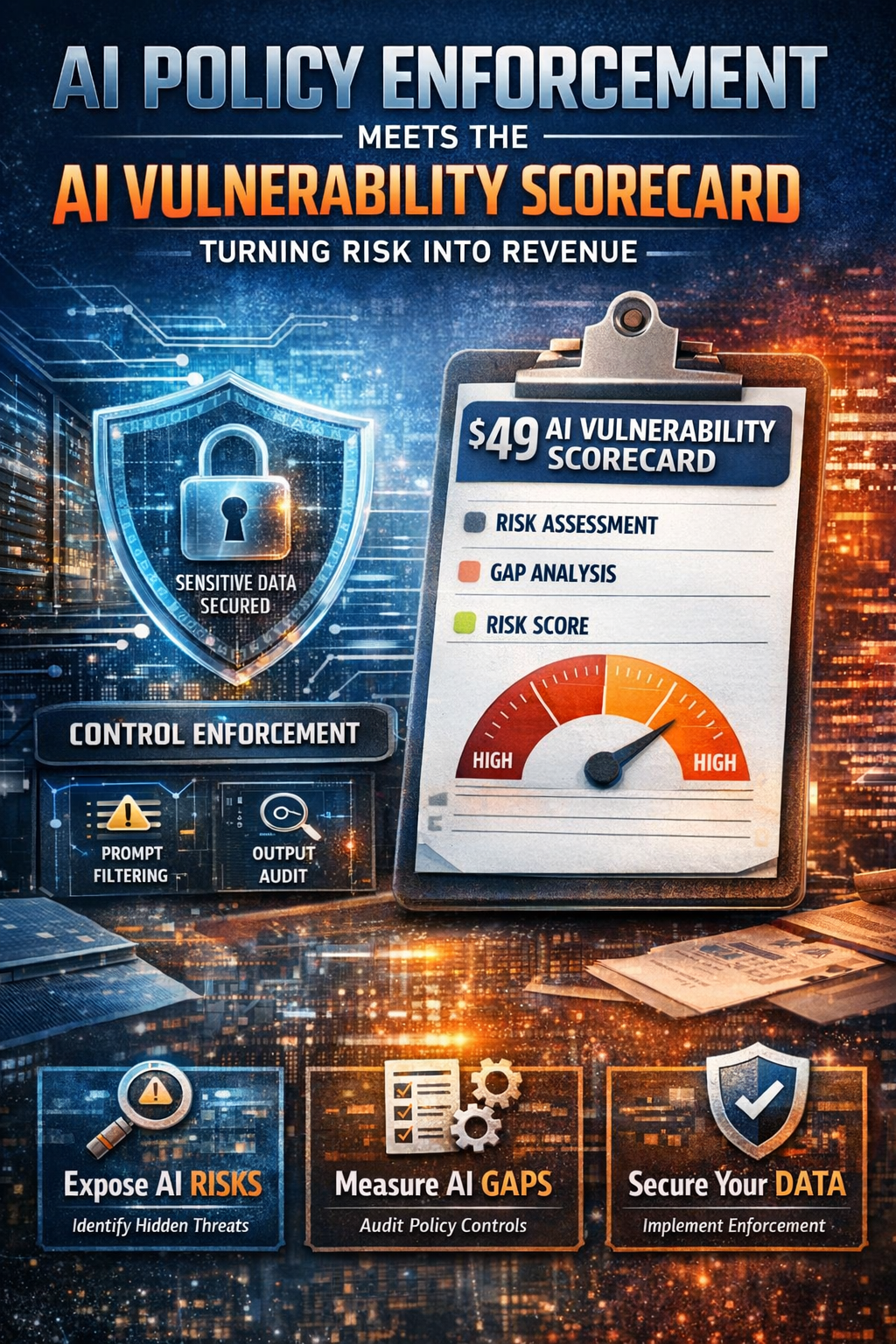
 $49 AI Vulnerability Scorecard

Identify Your AI Attack Surface in 15 Minutes

 What It Is

The AI Vulnerability Scorecard is a rapid, expert-designed assessment that identifies where your organization is exposed to AI-driven attacks, agent risks, and API vulnerabilities—before attackers do.

Built for speed, this 20-question assessment maps your security posture against:

  • AI attack surface exposure
  • LLM / agent risks
  • API and application vulnerabilities
  • Third-party and supply chain weaknesses

 Why This Matters (Right Now)

We are in the middle of an AI Vulnerability Storm:

  • Vulnerabilities are discovered faster than you can patch
  • Exploits are generated in hours, not weeks
  • AI agents are expanding your attack surface silently

 If you’re using AI tools, APIs, or automation—you already have exposure.


 What You Get

 AI Risk Score (0–100)
Clear snapshot of your current exposure

 10-Page Executive Scorecard (PDF)

  • Top vulnerabilities
  • Risk heatmap
  • Business impact summary

 AI Attack Surface Breakdown

  • APIs
  • AI agents
  • Shadow AI usage
  • Third-party dependencies

 Top 5 Immediate Fixes
What to prioritize in the next 30 days

 Mapped to Industry Frameworks
Aligned to:

  • ISO 27001
  • NIST CSF
  • ISO 42001 (AI Governance)

 Who It’s For

  • Startups using AI tools or APIs
  • SaaS companies and product teams
  • Mid-size businesses without a dedicated AI security strategy
  • CISOs needing a quick risk snapshot for leadership

 How It Works

  1. Answer 20 simple questions (10–15 mins)
  2. Get instant AI risk scoring
  3. Receive your detailed report within 24 hours

 Sample Questions

  • Do you use AI agents with access to internal systems?
  • Are your APIs protected against automated abuse?
  • Do you scan AI-generated code before deployment?
  • Can you detect AI-driven attacks in real time?

 Pricing

 $49 (one-time)
No subscriptions. No complexity. Immediate value.

Identify Your AI Attack Surface in 15 Minutes

Tags: AI Vulnerability Storm, Claude Mythos


Apr 20 2026

AI Policy Enforcement in Practice: From Theory to Control


AI Policy Enforcement in Practice: From Theory to Control

What is AI Policy Enforcement?

AI policy enforcement is the operationalization of governance rules that control how AI systems are used, what data they can access, and how outputs are generated, stored, and shared. It moves beyond written policies into real-time, technical controls that actively monitor and restrict behavior.

In simple terms:
AI policy defines what should happen. Enforcement ensures it actually happens.


Example: AI Policy Enforcement with Dropbox Integration

Consider a common enterprise scenario where employees use AI tools alongside cloud storage platforms like Dropbox.

Here’s how enforcement works in practice:

1. Data Access Control

  • AI systems are restricted from accessing sensitive folders (e.g., legal, financial, PII).
  • Policies define which datasets are “AI-readable” vs. “restricted.”
  • Integration enforces this automatically—no manual user decision required.

2. Content Monitoring & Classification

  • Files uploaded to Dropbox are scanned and tagged (confidential, internal, public).
  • AI tools can only process content based on classification level.
  • Example: AI summarization allowed for “internal” docs, blocked for “confidential.”

3. Prompt & Output Filtering

  • User prompts are inspected before being sent to AI models.
  • If a prompt includes sensitive data (customer info, IP), it is blocked or redacted.
  • AI-generated outputs are also scanned to prevent leakage or policy violations.

4. Activity Logging & Audit Trails

  • Every AI interaction tied to Dropbox data is logged.
  • Security teams can trace: who accessed what, what AI processed, and what was generated.
  • Enables compliance with regulations and internal audits.

5. Automated Policy Enforcement Actions

  • Block unauthorized AI usage on sensitive files.
  • Alert security teams on risky behavior.
  • Quarantine outputs that violate policy.


Why This Matters Now

The shift to AI-driven workflows introduces a new risk layer:

  • Employees unknowingly expose sensitive data to AI models
  • AI systems generate outputs that bypass traditional controls
  • Data flows faster than governance frameworks can keep up

Without enforcement, AI policies are just documentation.


Key Components of Effective AI Policy Enforcement

To make enforcement real and scalable:

  • Integration-first approach (Dropbox, Google Drive, APIs, SaaS apps)
  • Real-time controls instead of periodic audits
  • Data-centric security (classification + tagging)
  • AI-aware monitoring (prompts, responses, model behavior)
  • Automation at scale (alerts, blocking, remediation)

My Perspective: AI Policy Without Enforcement is a False Sense of Security

Most organizations today are writing AI policies faster than they can enforce them. That gap is dangerous.

Here’s the reality:

  • AI accelerates both productivity and risk
  • Traditional security controls (DLP, IAM) are not AI-aware
  • Users will adopt AI tools regardless of policy maturity

So the strategy must shift:

1. Treat AI as a New Attack Surface

Not just a tool—AI is a data processing layer that needs the same rigor as APIs and cloud infrastructure.

2. Move from Policy to Control Engineering

Policies should map directly to enforceable controls:

  • “No PII in AI prompts” → prompt inspection + redaction
  • “Restricted data stays internal” → storage-level enforcement

3. Integrate Where Data Lives

Enforcement must sit inside:

  • File systems (Dropbox, SharePoint)
  • APIs
  • Collaboration tools

Not as an external overlay.

4. Assume Continuous Drift

AI usage evolves daily. Controls must adapt dynamically—not annually.


Bottom Line

AI policy enforcement is no longer optional—it’s the difference between controlled adoption and unmanaged exposure.

Organizations that succeed will:

  • Embed enforcement into workflows
  • Automate governance decisions
  • Continuously monitor AI interactions

Those that don’t will face an AI vulnerability storm—where speed, scale, and automation work against them.


AI Governance Enforcement: The Foundation for Scaling AI Governance Effectively

Perspective: Why AI Governance Enforcement Is the Key

AI governance fails when it remains theoretical. Policies, frameworks, and ethics statements mean little unless they are enforced at execution time. The shift happening now—driven by regulations and real-world risk—is from “intent” to “proof.” Organizations are no longer judged by what policies they publish, but by what they can demonstrably enforce and audit.

Enforcement is the missing link because it creates accountability, consistency, and evidence:

  • Accountability: Every AI decision is evaluated against rules.
  • Consistency: Policies apply uniformly across all systems and channels.
  • Evidence: Audit trails are generated automatically, not reconstructed later.

In simple terms:
 Without enforcement, governance is documentation.
 With enforcement, governance becomes control.

That’s why AI governance enforcement is not just a feature—it’s the foundation for making AI governance actually work at scale.

##  Ready to Operationalize AI Governance?

If you’re serious about moving from **AI governance theory → real enforcement**,
DISC InfoSec can help you build the control layer your AI systems need.

 Book a free consultation: [info@deurainfosec.com]

AI Vulnerability Scorecard

This is where your DISC InfoSec AI Vulnerability Scorecard becomes powerful.

Instead of overwhelming organizations with complex frameworks, the scorecard:

Quickly Identifies AI Risk Exposure

  • Where AI is accessing sensitive data (e.g., Dropbox, APIs)
  • Gaps in policy enforcement
  • Shadow AI usage across teams

Maps Policy to Reality

  • Are controls actually enforced—or just documented?
  • Are prompts and outputs being monitored?
  • Is data classification driving AI access decisions?

Delivers a Clear Risk Score

  • Simple, executive-friendly scoring
  • Immediate visibility into AI security posture
  • Prioritized risk areas

Provides Actionable Recommendations

  • What to fix first
  • Where to implement enforcement controls
  • How to reduce exposure quickly

InfoSec services | InfoSec books | Follow our blog | DISC llc is listed on The vCISO Directory | ISO 27k Chat bot | Comprehensive vCISO Services | ISMS Services | AIMS Services | Security Risk Assessment Services | Mergers and Acquisition Security

Tags: AI Policy enforcement


Apr 16 2026

AI Vulnerability Scorecard: Discover Your AI Attack Surface Before Attackers Do

The Mythos Ready Security Program

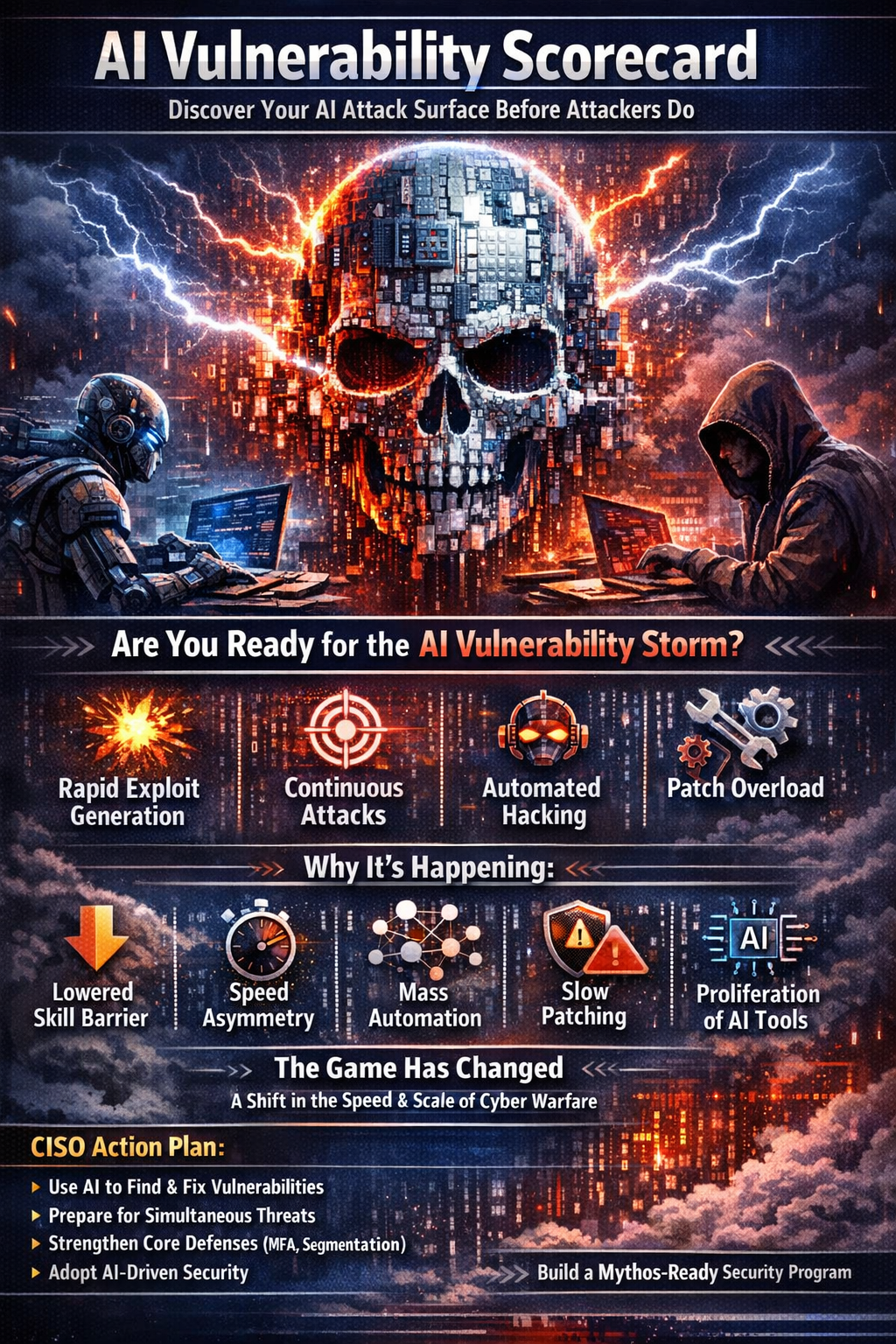
What is an “AI Vulnerability Storm”?

An AI Vulnerability Storm is a rapid, large-scale surge in vulnerability discovery, exploitation, and attack execution driven by advanced AI systems. These systems can autonomously find flaws, generate exploits, and launch attacks faster than organizations can respond.

Why it’s happening (root causes)

  • AI lowers the skill barrier → more attackers can find and exploit vulnerabilities
  • Speed asymmetry → discovery → exploit cycle has collapsed from weeks to hours
  • Automation at scale → thousands of vulnerabilities can be found simultaneously
  • Patch limitations → defenders still rely on slower, human-driven processes
  • Proliferation of AI tools → offensive capabilities are spreading quickly

Bottom line: This is not just more vulnerabilities—it’s a fundamental shift in the tempo and economics of cyber warfare.


I. Initial Thoughts

AI is dramatically increasing the volume, speed, and sophistication of cyberattacks. While defenders also benefit from AI, attackers gain a stronger advantage because they can automate discovery and exploitation at scale.

The first wave (e.g., Project Glasswing) signals a future where:

  • Vulnerabilities are discovered continuously
  • Exploits are generated instantly
  • Attacks are orchestrated autonomously

Organizations must:

  • Rebalance risk models for continuous attack pressure
  • Prepare for patch overload and faster remediation cycles
  • Strengthen foundational controls like segmentation and MFA
  • Use AI internally to keep pace

II. CISO Takeaways

CISOs must shift from reactive security to AI-augmented operations.

Key priorities:

  • Use AI to find and fix vulnerabilities before attackers do
  • Prepare for multiple simultaneous high-severity incidents
  • Update risk metrics to reflect machine-speed threats
  • Double down on basic controls (IAM, segmentation, patching)
  • Accelerate teams using AI agents and automation
  • Plan for burnout and capacity constraints
  • Build collective defense partnerships

Core message: You cannot scale humans to match AI—you must scale with AI.


III. Intro to Mythos

AI-driven vulnerability discovery has been evolving, but systems like Mythos represent a step-change in capability:

  • Autonomous exploit generation
  • Multi-step attack chaining
  • Minimal human input required

The key disruption:

  • Time-to-exploit has dropped to hours
  • Attack capability is becoming widely accessible

This creates a structural imbalance:

  • Attackers move faster than patching cycles
  • Risk models and processes are now outdated

Organizations that succeed will:

  • Adopt AI deeply
  • Rebuild processes for speed
  • Accept continuous disruption as the new normal

IV. The Mythos-Aligned Security Program

A modern security program must evolve into a continuous, AI-driven resilience system.

Core shifts:

  • From periodic defense → continuous operations
  • From prevention → containment and recovery
  • From manual work → automated workflows

Key realities:

  • Patch volumes will surge dramatically
  • Risk management becomes less predictable
  • Governance must accelerate technology adoption

Strategic focus:

  • Build minimum viable resilience
  • Measure:
    • Cost of exploitation
    • Detection speed
    • Blast radius containment

Human factor:

  • Security teams face:
    • Burnout
    • Skill anxiety
    • Increased workload

But also:

  • Opportunity to become AI-augmented operators

Critical insight:
Every security role is evolving into an “AI-enabled builder role.”


V. Board-Level AI Risk Briefing

AI is now a board-level risk and opportunity.

Key message to leadership:

  • AI accelerates business—but also accelerates attackers
  • Time to major incidents is shrinking rapidly
  • Risk must shift from prevention → resilience and recovery

What leadership must support:

  • Increased staffing and capacity
  • Deployment of AI-driven security tooling
  • Faster procurement and governance cycles
  • Infrastructure hardening (Zero Trust, segmentation)
  • Updated incident response playbooks

90-day focus:

  • Scale people
  • Deploy AI
  • Harden environment
  • Accelerate decisions
  • Track measurable progress

VI. Recommendations

AI-driven attacks represent a permanent structural shift, not a temporary spike.

What “Mythos-ready” means:

  • Build resilient architectures that limit damage
  • Discover vulnerabilities before attackers do
  • Respond to incidents at scale and speed
  • Use AI across the security lifecycle

Strategic takeaway:

This is similar to Y2K-level urgency, but:

  • Faster
  • More complex
  • Continuous (no fixed deadline)

The goal is not perfection—it’s closing the speed gap between attackers and defenders.

Source: Building a Mythos-ready Security Program


Perspective (Practical + Strategic)

1. This is NOT a vulnerability problem — it’s a velocity problem

Traditional security assumes:

  • You have time to assess → decide → act

That assumption is now broken.

👉 Strategy shift:

  • Optimize for decision speed, not just control coverage

2. Vuln Management → “VulnOps” is inevitable

Quarterly scans and patch cycles are dead.

👉 You need:

  • Continuous discovery
  • AI triage
  • Automated remediation pipelines

This is essentially:

DevSecOps → VulnOps (AI-native)


3. Your biggest gap is NOT tools — it’s operational design

Most orgs fail because:

  • Governance is slow
  • Teams are siloed
  • AI adoption is optional

👉 Fix:

  • Mandate AI usage in security workflows
  • Redesign processes for machine-speed execution

4. The real risk: security team collapse

The document hints at it, but undersells it.

  • Alert fatigue → exponential
  • Patch volume → unsustainable
  • Talent → limited

👉 If you don’t automate:
You don’t just fall behind—you burn out your team and lose capability


5. New Strategy Blueprint (What I’d implement)

Immediate (0–30 days)

  • AI-driven vulnerability scanning (LLM agents)
  • Rapid attack surface inventory
  • Patch prioritization automation

Mid (30–90 days)

  • Build AI-assisted SOC workflows
  • Introduce automated incident playbooks
  • Implement segmentation + Zero Trust

Strategic (90+ days)

  • Stand up VulnOps function
  • Create AI Security Scorecard (your product opportunity)
  • AI Attack Surface Assessments (huge market gap)

Final Thought

This isn’t just another evolution in cybersecurity.

It’s the moment where:

Security stops being human-scaled and becomes machine-scaled.

Organizations that adapt will operate faster than attackers.
Those that don’t will be permanently behind.


💰 $49 AI Vulnerability Scorecard

Identify Your AI Attack Surface in 15 Minutes

🔍 What It Is

The AI Vulnerability Scorecard is a rapid, expert-designed assessment that identifies where your organization is exposed to AI-driven attacks, agent risks, and API vulnerabilities—before attackers do.

Built for speed, this 20-question assessment maps your security posture against:

  • AI attack surface exposure
  • LLM / agent risks
  • API and application vulnerabilities
  • Third-party and supply chain weaknesses

⚠️ Why This Matters (Right Now)

We are in the middle of an AI Vulnerability Storm:

  • Vulnerabilities are discovered faster than you can patch
  • Exploits are generated in hours, not weeks
  • AI agents are expanding your attack surface silently

👉 If you’re using AI tools, APIs, or automation—you already have exposure.


📊 What You Get

✔️ AI Risk Score (0–100)
Clear snapshot of your current exposure

✔️ 10-Page Executive Scorecard (PDF)

  • Top vulnerabilities
  • Risk heatmap
  • Business impact summary

✔️ AI Attack Surface Breakdown

  • APIs
  • AI agents
  • Shadow AI usage
  • Third-party dependencies

✔️ Top 5 Immediate Fixes
What to prioritize in the next 30 days

✔️ Mapped to Industry Frameworks
Aligned to:

  • ISO 27001
  • NIST CSF
  • ISO 42001 (AI Governance)

🎯 Who It’s For

  • Startups using AI tools or APIs
  • SaaS companies and product teams
  • Mid-size businesses without a dedicated AI security strategy
  • CISOs needing a quick risk snapshot for leadership

⚡ How It Works

  1. Answer 20 simple questions (10–15 mins)
  2. Get instant AI risk scoring
  3. Receive your detailed report within 24 hours

💡 Sample Questions

  • Do you use AI agents with access to internal systems?
  • Are your APIs protected against automated abuse?
  • Do you scan AI-generated code before deployment?
  • Can you detect AI-driven attacks in real time?

💵 Pricing

👉 $49 (one-time)
No subscriptions. No complexity. Immediate value.

Identify Your AI Attack Surface in 15 Minutes


After the scorecard, offer:

  • $499 Deep-Dive Assessment
  • $2,500 AI Security Gap Analysis
  • $5K–$15K vCISO / AI Governance Program

🔥 Position

“Most companies don’t know their AI attack surface.
We show you—in 24 hours—for $49.”


Schedule a consultation or drop a note below: info@deurainfosec.com

InfoSec services | InfoSec books | Follow our blog | DISC llc is listed on The vCISO Directory | ISO 27k Chat bot | Comprehensive vCISO Services | ISMS Services | AIMS Services | Security Risk Assessment Services | Mergers and Acquisition Security

Is your AI strategy truly audit-ready today?

AI governance is no longer optional. Frameworks like ISO/IEC 42001 AI Management System Standard and regulations such as the EU AI Act are rapidly reshaping compliance expectations for organizations using AI.

DISC InfoSec brings deep expertise across AI, cybersecurity, and regulatory compliance to help you build trust, reduce risk, and stay ahead of evolving mandates—with a proven track record of success.

Ready to lead with confidence? Let’s start the conversation.

At DISC InfoSec, we help organizations navigate this landscape by aligning AI risk management, governance, security, and compliance into a single, practical roadmap. Whether you are experimenting with AI or deploying it at scale, we help you choose and operationalize the right frameworks to reduce risk and build trust. Learn more at DISC InfoSec.


Apr 10 2026

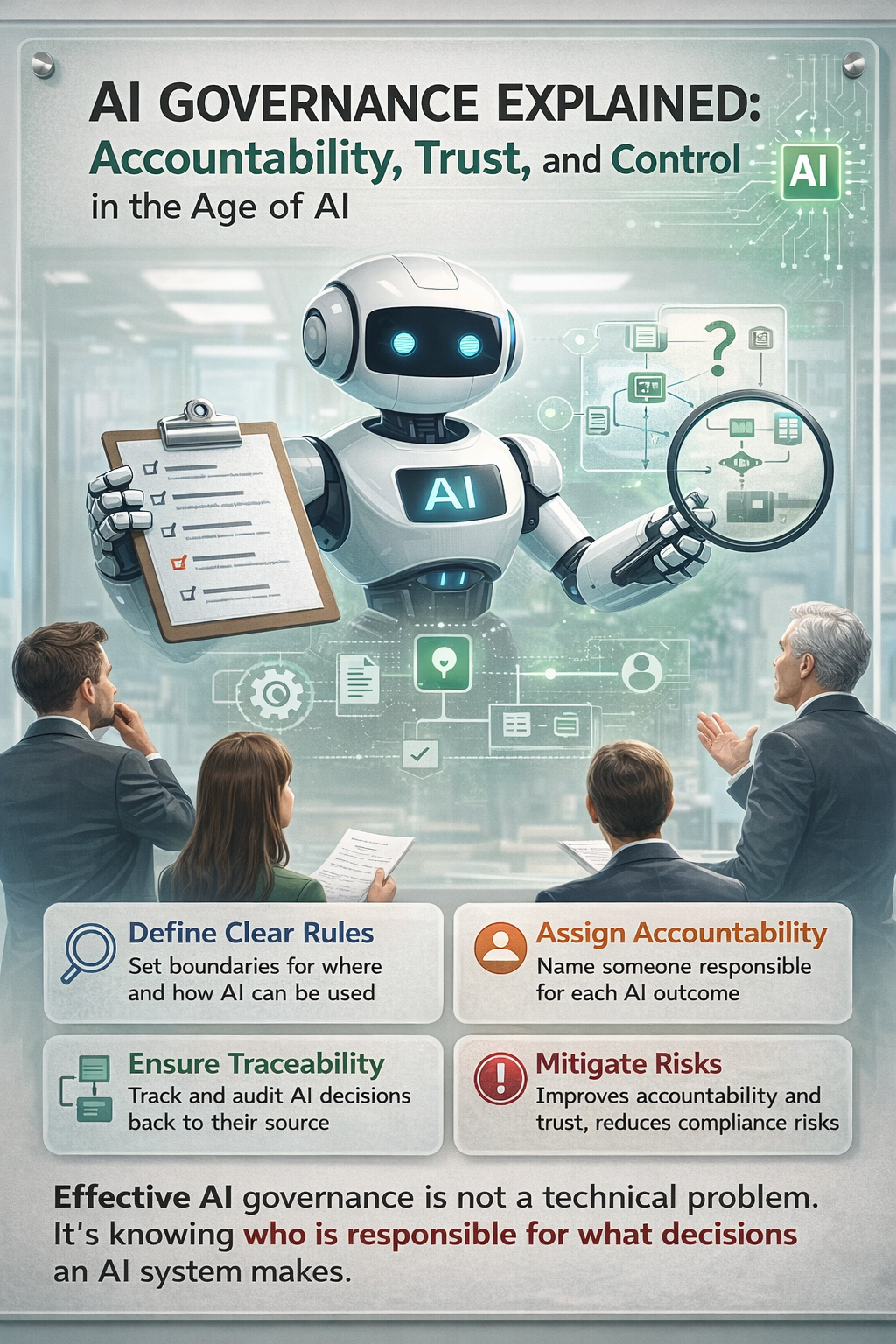
AI Governance Explained: Accountability, Trust, and Control in the Age of AI

Category: AI,AI Governance,AI Governance Enforcementdisc7 @ 1:52 pm

AI isn’t a tech problem—it’s about ownership, accountability, and trust at scale.

AI Governance
AI governance is about setting clear rules for how AI uses data, assigning accountability for every decision it makes, and ensuring you can trace and explain outcomes—especially when something goes wrong. It’s not complex in principle: define what AI is allowed to do, who is responsible for it, and how decisions can be audited. Everything else is detail. Without this structure, organizations risk inconsistent outputs, compliance failures, and loss of trust at scale.


What is AI Governance

AI governance is the framework that defines how AI systems operate responsibly within an organization. It establishes boundaries for data usage, assigns ownership to AI-driven decisions, and ensures traceability so outcomes can be explained and audited. At its core, it answers three simple questions: What is the AI allowed to do? Who is accountable for its decisions? And how do we investigate failures?


Why the Board Should Care

Boards should care because AI failures scale quickly and publicly. If an AI system uses incorrect or inconsistent data, it can produce flawed decisions across thousands of customers instantly. Misaligned metrics across departments can lead to conflicting outputs, while unauthorized data access can trigger regulatory violations. Most critically, if no one can explain how the AI reached a decision, audits fail and trust erodes. These are not hypothetical risks—they are already happening.


What It Actually Looks Like

In practice, AI governance is operational and straightforward. Organizations must define which data AI systems can access, standardize metrics so everyone uses the same definitions, and assign a responsible owner for each AI decision. They must also control what outputs AI can show to different users and maintain logs that allow every decision to be traced back to its source. This is not about building new technology—it’s about enforcing discipline and clarity in how AI is used.


What Happens Without It

Without governance, AI deployments follow a predictable failure cycle: systems go live quickly, generate incorrect or misleading outputs, and no one can explain why. Issues escalate publicly before leadership is even aware, leading to reputational damage and reactive decision-making. The absence of governance turns AI from a competitive advantage into a liability.


What the Board Needs to Ask

Boards should focus on accountability and visibility. Key questions include: Do we know what data our AI systems use? Is there a clearly assigned owner for each AI outcome? Can we trace decisions back to their source? Are there defined limits on what AI is allowed to do? And will we detect issues before customers do? Any “no” answer highlights a governance gap that needs immediate attention.


Without Governance vs. With Governance

Without governance, organizations get speed without control, scale without accountability, and AI decisions that cannot be explained. With governance, they achieve speed with trust, scale with traceability, and AI systems that build confidence over time. Governance transforms AI from a risk into a reliable business capability.


Perspective: AI Governance Is Not a Technical Problem

AI governance is fundamentally not a technology issue—it’s a leadership and accountability problem. Most organizations already have the tools to build and deploy AI. What they lack is clarity on ownership, decision rights, and accountability. Governance forces organizations to answer a simple but uncomfortable question: Who is responsible for what the AI says or does?

Until that question is clearly answered, no amount of technology, models, or controls will reduce risk. AI doesn’t fail because of algorithms—it fails because no one owns the outcome.

Is Your AI Governance Strategy Audit-Ready—or Just Documented?

AI Security = API Security: The Case for Real-Time Enforcement

AI-Native Risk: Why AI Security Is Still an API Security Problem

AI Governance Enforcement: The Foundation for Scaling AI Governance Effectively

That’s the level where security leadership becomes strategic—and where vCISOs deliver the most value. Feel free to drop a note below if you have any questions.

InfoSec services | InfoSec books | Follow our blog | DISC llc is listed on The vCISO Directory | ISO 27k Chat bot | Comprehensive vCISO Services | ISMS Services | AIMS Services | Security Risk Assessment Services | Mergers and Acquisition Security

At DISC InfoSec, we help organizations navigate this landscape by aligning AI risk management, governance, security, and compliance into a single, practical roadmap. Whether you are experimenting with AI or deploying it at scale, we help you choose and operationalize the right frameworks to reduce risk and build trust. Learn more at DISC InfoSec | ISO 27001 | ISO 42001


Apr 07 2026

Claude Mythos and the Future of Cybersecurity: Powerful—and Potentially Dangerous

Too Powerful to Release? The AI Model That’s Exposing Hidden Cyber Risk


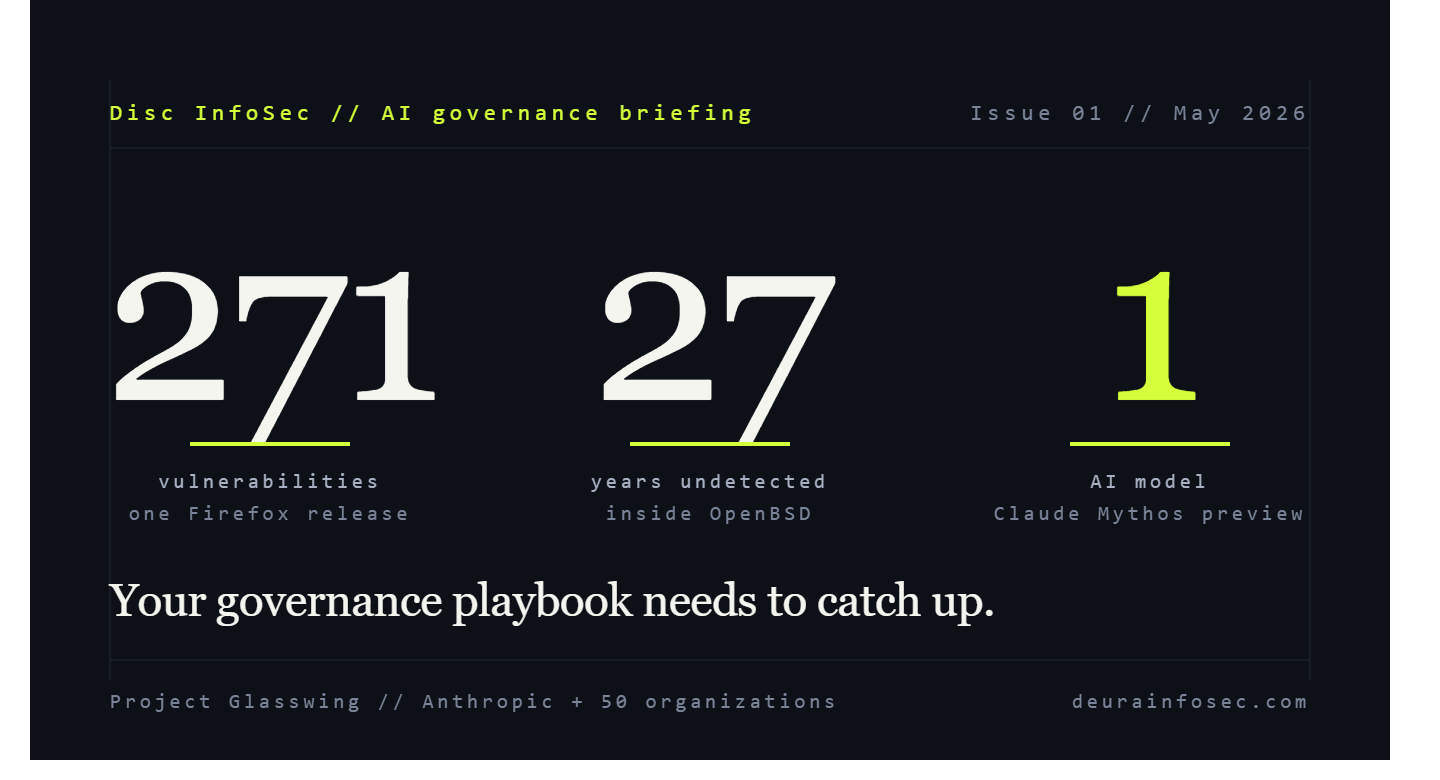
This development is one that deserves close attention. Anthropic has introduced Project Glasswing, a new industry coalition that brings together major players across technology and financial services. At the center of this initiative is a highly advanced frontier model known as Claude Mythos Preview, signaling a significant shift in how AI intersects with cybersecurity.

Project Glasswing is not just another AI release—it represents a coordinated effort between leading organizations to explore the implications of next-generation AI capabilities. By aligning multiple sectors, the initiative highlights that the impact of such models extends far beyond research labs into critical infrastructure and global enterprise environments.

What sets Claude Mythos apart is its demonstrated ability to identify high-severity vulnerabilities at scale. According to the announcement, the model has already uncovered thousands of serious security flaws, including weaknesses across major operating systems and widely used web browsers. This level of discovery suggests a step-change in automated vulnerability research.

Even more striking is the nature of the vulnerabilities being found. Many of them are not newly introduced issues but long-standing flaws—some dating back one to two decades. This indicates that existing tools and methods have been unable to fully surface or prioritize these risks, leaving hidden exposure in foundational technologies.

The implications for cybersecurity are profound. A model capable of uncovering such deeply embedded vulnerabilities challenges long-held assumptions about the maturity and completeness of current security practices. It suggests that the attack surface is not only larger than expected, but also less understood than previously believed.

Recognizing the potential risks, Anthropic has chosen not to release the model broadly. Instead, access is being tightly controlled through the Glasswing coalition. The company has explicitly stated that unrestricted availability could lead to a cybersecurity crisis, as malicious actors could leverage the same capabilities to discover and exploit vulnerabilities at unprecedented speed.

This decision marks a notable departure from the typical AI release cycle, where rapid deployment and widespread access are often prioritized. In this case, restraint reflects an acknowledgment that capability has outpaced control, and that governance must evolve alongside technical progress.

It is also significant that a relatively young company like Anthropic has secured broad industry backing for such a cautious approach. The participation and endorsement of established cybersecurity and financial institutions signal a shared recognition of both the opportunity and the risk presented by models like Mythos.

Another critical point is that Mythos is reportedly identifying zero-day vulnerabilities that other tools have missed entirely. If validated at scale, this positions AI not just as a support tool for security teams, but as a primary engine for vulnerability discovery, fundamentally changing how organizations approach risk identification and remediation.


Perspective:
This moment feels like an inflection point for cybersecurity. What we’re seeing is the emergence of AI systems that can outpace traditional security processes, not just incrementally but exponentially. The real issue is no longer whether vulnerabilities exist—it’s how quickly they can be discovered and exploited.

This reinforces a critical shift: cybersecurity must move from periodic testing and reactive patching to continuous, real-time control. If AI can find vulnerabilities at scale, attackers will eventually gain access to similar capabilities. The only viable response is to implement runtime enforcement and API-level controls that can mitigate risk even when unknown vulnerabilities exist.

In short, AI is forcing the industry to confront a new reality—you can’t patch fast enough, so you must control behavior in real time.

Bottom line:
If your AI governance strategy cannot demonstrate continuous monitoring, control, and enforcement, it is unlikely to stand up to audit—or real-world threats.

That’s why AI governance enforcement is not just a feature—it’s the foundation for making AI governance actually work at scale.

Ready to Operationalize AI Governance?

If you’re serious about moving from **AI governance theory → real enforcement**,
DISC InfoSec can help you build the control layer your AI systems need.

Most organizations have AI governance documents — but auditors now want proof of enforcement.

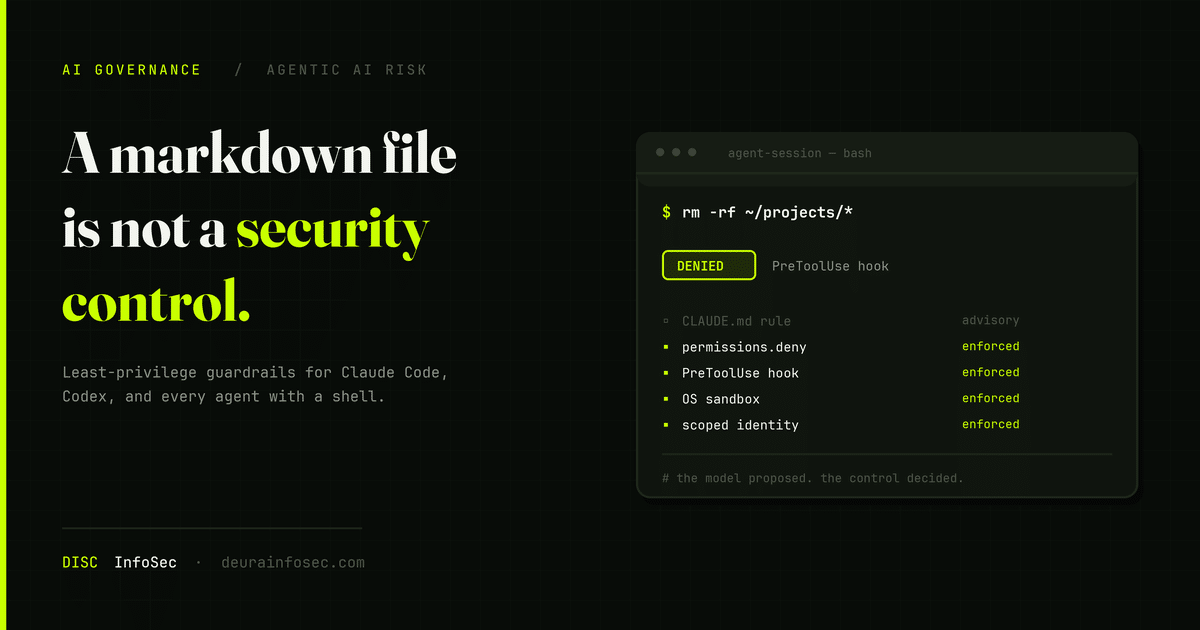
Policies alone don’t reduce AI risk. Real‑time monitoring, control, and enforcement do.

If your AI governance strategy can’t demonstrate continuous oversight, it won’t stand up to audit or real‑world threats.

DISC InfoSec helps organizations operationalize AI governance with integrated frameworks, runtime controls, and proven certification success.

Move from AI governance theory to enforcement.

Read the full post below: Is Your AI Governance Strategy Audit‑Ready — or Just Documented?

Schedule a consultation or drop a note below: info@deurainfosec.com

InfoSec services | InfoSec books | Follow our blog | DISC llc is listed on The vCISO Directory | ISO 27k Chat bot | Comprehensive vCISO Services | ISMS Services | AIMS Services | Security Risk Assessment Services | Mergers and Acquisition Security

Is your AI strategy truly audit-ready today?

AI governance is no longer optional. Frameworks like ISO/IEC 42001 AI Management System Standard and regulations such as the EU AI Act are rapidly reshaping compliance expectations for organizations using AI.

DISC InfoSec brings deep expertise across AI, cybersecurity, and regulatory compliance to help you build trust, reduce risk, and stay ahead of evolving mandates—with a proven track record of success.

Ready to lead with confidence? Let’s start the conversation.

At DISC InfoSec, we help organizations navigate this landscape by aligning AI risk management, governance, security, and compliance into a single, practical roadmap. Whether you are experimenting with AI or deploying it at scale, we help you choose and operationalize the right frameworks to reduce risk and build trust. Learn more at DISC InfoSec.

Tags: Claude Mythos, Project Glasswing


Apr 07 2026

Hackers at Machine Speed: The AI Cybersecurity Reality


A recent The New York Times report highlights how artificial intelligence is rapidly reshaping the cybersecurity landscape, particularly in the hands of hackers. Rather than introducing entirely new attack techniques, AI is acting as a force multiplier, enabling cybercriminals to execute existing methods faster, cheaper, and at a much larger scale.

One of the key themes is the democratization of cybercrime. AI tools are lowering the barrier to entry, allowing less-skilled attackers to perform sophisticated operations that previously required deep technical expertise. Tasks like writing malware, crafting phishing campaigns, and identifying vulnerabilities can now be automated, significantly expanding the pool of potential attackers.

The article also emphasizes the speed advantage AI provides. Cyberattacks that once took days or weeks can now be executed in minutes or hours. AI accelerates reconnaissance, automates exploit development, and enables rapid iteration, making it difficult for traditional security teams to keep up with the pace of modern threats.

Another important shift is the rise of AI-assisted social engineering. Hackers are using AI to generate highly convincing phishing messages, impersonations, and even real-time conversational attacks. This increases the success rate of attacks by making them more personalized, scalable, and harder to detect.

The report also points out that AI-driven attacks are not necessarily more sophisticated—they are simply more efficient and scalable. Attackers are reusing known techniques but executing them with greater precision and automation. This creates a scenario where organizations face a higher volume of attacks, each delivered with improved consistency and timing.

At the same time, defenders are not standing still. The article notes that AI can also be used defensively to analyze large volumes of data, detect anomalies, and respond to threats faster than humans alone. However, the advantage lies with organizations that can effectively apply AI with context and integrate it into their security operations.

Finally, the broader implication is that AI is accelerating an ongoing cybersecurity arms race. It is exposing weaknesses in traditional security models—particularly those reliant on manual processes, static controls, and delayed response mechanisms. Organizations that fail to adapt risk being overwhelmed by the speed and scale of AI-enabled threats.


Perspective:
The most important takeaway is that AI is not changing what attacks look like—it’s changing how fast and how often they happen. This reinforces a critical point: cybersecurity can no longer rely on detection and response alone. If attacks operate at machine speed, then security controls must also operate at machine speed.

This is where the conversation shifts directly into real-time enforcement, especially at the API layer. AI systems—and increasingly, enterprise systems overall—are API-driven. That means the only effective control point is inline, real-time decisioning.

In practical terms, the future of cybersecurity will be defined by organizations that can move from visibility to enforcement, from alerts to action, and from reactive defense to proactive control. AI didn’t break security—it simply exposed where it was already too slow.

Bottom line:
If your AI governance strategy cannot demonstrate continuous monitoring, control, and enforcement, it is unlikely to stand up to audit—or real-world threats.

That’s why AI governance enforcement is not just a feature—it’s the foundation for making AI governance actually work at scale.

Ready to Operationalize AI Governance?

If you’re serious about moving from **AI governance theory → real enforcement**,
DISC InfoSec can help you build the control layer your AI systems need.

Most organizations have AI governance documents — but auditors now want proof of enforcement.

Policies alone don’t reduce AI risk. Real‑time monitoring, control, and enforcement do.

If your AI governance strategy can’t demonstrate continuous oversight, it won’t stand up to audit or real‑world threats.

DISC InfoSec helps organizations operationalize AI governance with integrated frameworks, runtime controls, and proven certification success.

Move from AI governance theory to enforcement.

Read the full post below: Is Your AI Governance Strategy Audit‑Ready — or Just Documented?

Schedule a consultation or drop a note below: info@deurainfosec.com

InfoSec services | InfoSec books | Follow our blog | DISC llc is listed on The vCISO Directory | ISO 27k Chat bot | Comprehensive vCISO Services | ISMS Services | AIMS Services | Security Risk Assessment Services | Mergers and Acquisition Security

Is your AI strategy truly audit-ready today?

AI governance is no longer optional. Frameworks like ISO/IEC 42001 AI Management System Standard and regulations such as the EU AI Act are rapidly reshaping compliance expectations for organizations using AI.

DISC InfoSec brings deep expertise across AI, cybersecurity, and regulatory compliance to help you build trust, reduce risk, and stay ahead of evolving mandates—with a proven track record of success.

Ready to lead with confidence? Let’s start the conversation.

At DISC InfoSec, we help organizations navigate this landscape by aligning AI risk management, governance, security, and compliance into a single, practical roadmap. Whether you are experimenting with AI or deploying it at scale, we help you choose and operationalize the right frameworks to reduce risk and build trust. Learn more at DISC InfoSec.

Tags: AI force multiplier, AI hacking, cyber attack, cyber crime


Apr 07 2026

AI Security = API Security: The Case for Real-Time Enforcement


AI Governance That Actually Works: Why Real-Time Enforcement Is the Missing Layer

AI governance is everywhere right now—frameworks, policies, and documentation are rapidly evolving. But there’s a hard truth most organizations are starting to realize:

Governance without enforcement is just intent.

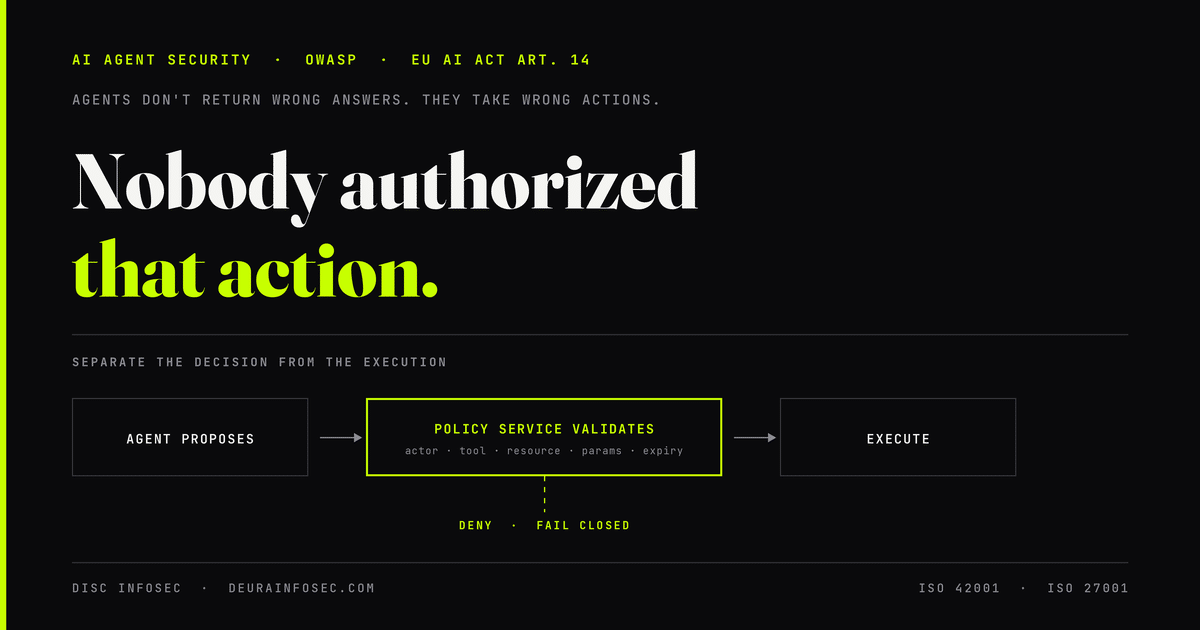
What separates mature AI security programs from the rest is the ability to enforce policies in real time, exactly where AI systems operate—at the API layer.


AI Security Is Fundamentally an API Security Problem

Modern AI systems—LLMs, agents, copilots—don’t operate in isolation. They interact through APIs:

  • Prompts are API inputs
  • Model inferences are API calls
  • Actions are executed via downstream APIs
  • Agents orchestrate workflows across multiple services

This means every AI risk—data leakage, prompt injection, unauthorized actions—manifests at runtime through APIs.

If you’re not enforcing controls at this layer, you’re not securing AI—you’re observing it.


Real-Time Enforcement at the Core

The most effective approach to AI governance is inline, real-time enforcement, and this is where modern platforms are stepping up.

A strong example is a three-layer enforcement engine that evaluates every interaction before it executes:

  • Deterministic Rules → Clear, policy-driven controls (e.g., block sensitive data exposure)
  • Semantic AI Analysis → Context-aware detection of risky or malicious intent
  • Knowledge-Grounded RAG → Decisions informed by organizational policies and domain context

This layered approach enables precise, intelligent enforcement—not just static rule matching.


From Policy to Action: Enforcement Decisions That Matter

Real governance requires more than alerts. It requires decisions at runtime.

Effective enforcement platforms deliver outcomes such as:

  • BLOCK → Stop high-risk actions immediately
  • WARN → Notify users while allowing controlled execution
  • MONITOR_ONLY → Observe without interrupting workflows
  • APPROVAL_REQUIRED → Introduce human-in-the-loop controls

These decisions happen in real time on every API call, ensuring that governance is not delayed or bypassed.


Full-Lifecycle Policy Enforcement

AI risk doesn’t exist in just one place—it spans the entire interaction lifecycle. That’s why enforcement must cover:

  • Prompts → Prevent injection, leakage, and unsafe inputs
  • Data → Apply field-level conditions and protect sensitive information
  • Actions → Control what agents and systems are allowed to execute

With session-aware tracking, enforcement can follow agents across workflows, maintaining context and ensuring policies are applied consistently from start to finish.


Controlling What Agents Can Do

As AI agents become more autonomous, the question is no longer just what they say—it’s what they do.

Policy-driven enforcement allows organizations to:

  • Define allowed vs. restricted actions
  • Control API-level execution permissions
  • Enforce guardrails on agent behavior in real time

This shifts AI governance from passive oversight to active control.


Built for the API Economy

By integrating directly with APIs and modern orchestration layers, enforcement platforms can:

  • Evaluate every request and response inline
  • Return real-time decisions (ALLOW, BLOCK, WARN, APPROVAL_REQUIRED)
  • Scale alongside high-throughput AI systems

This architecture aligns perfectly with how AI is actually deployed today—distributed, API-driven, and dynamic.


Perspective: Enforcement Is the Foundation of Scalable AI Governance

Most organizations are still focused on documenting policies and mapping controls. That’s necessary—but not sufficient.

The real shift happening now is this:

👉 AI governance is moving from documentation to enforcement.
👉 From static controls to runtime decisions.
👉 From visibility to action.

If AI operates at API speed, then governance must operate at the same speed.

Real-time enforcement is not just a feature—it’s the foundation for making AI governance work at scale.


Perspective: Why AI Governance Enforcement Is Critical

Most organizations are focusing on AI governance frameworks, but frameworks alone don’t reduce risk—enforcement does.

This is where many AI governance strategies fall apart.

AI systems are dynamic, API-driven, and often autonomous. Without real-time enforcement:

  • Policies remain static documents
  • Controls are inconsistently applied
  • Risks emerge during actual execution—not design

AI governance enforcement bridges that gap. It ensures that:

  • Prompts, responses, and agent actions are monitored in real time
  • Policy violations are detected and blocked instantly
  • Data exposure and misuse are prevented before impact

In short, enforcement turns governance from intent into control.

Bottom line:
If your AI governance strategy cannot demonstrate continuous monitoring, control, and enforcement, it is unlikely to stand up to audit—or real-world threats.

That’s why AI governance enforcement is not just a feature—it’s the foundation for making AI governance actually work at scale.

Ready to Operationalize AI Governance?

If you’re serious about moving from **AI governance theory → real enforcement**,
DISC InfoSec can help you build the control layer your AI systems need.

Most organizations have AI governance documents — but auditors now want proof of enforcement.

Policies alone don’t reduce AI risk. Real‑time monitoring, control, and enforcement do.

If your AI governance strategy can’t demonstrate continuous oversight, it won’t stand up to audit or real‑world threats.

DISC InfoSec helps organizations operationalize AI governance with integrated frameworks, runtime controls, and proven certification success.

Move from AI governance theory to enforcement.

Read the full post below: Is Your AI Governance Strategy Audit‑Ready — or Just Documented?

Schedule a free consultation or drop a comment below: info@deurainfosec.com

DISC InfoSec — Your partner for AI governance that actually works.

InfoSec services | InfoSec books | Follow our blog | DISC llc is listed on The vCISO Directory | ISO 27k Chat bot | Comprehensive vCISO Services | ISMS Services | AIMS Services | Security Risk Assessment Services | Mergers and Acquisition Security

Is your AI strategy truly audit-ready today?

AI governance is no longer optional. Frameworks like ISO/IEC 42001 AI Management System Standard and regulations such as the EU AI Act are rapidly reshaping compliance expectations for organizations using AI.

DISC InfoSec brings deep expertise across AI, cybersecurity, and regulatory compliance to help you build trust, reduce risk, and stay ahead of evolving mandates—with a proven track record of success.

Ready to lead with confidence? Let’s start the conversation.

At DISC InfoSec, we help organizations navigate this landscape by aligning AI risk management, governance, security, and compliance into a single, practical roadmap. Whether you are experimenting with AI or deploying it at scale, we help you choose and operationalize the right frameworks to reduce risk and build trust. Learn more at DISC InfoSec.

Tags: AI security, API Security


Apr 06 2026

Is Your AI Governance Strategy Audit-Ready—or Just Documented?

1. The Audit Question Organizations Must Answer
Is your AI governance strategy ready for audit? This is no longer a theoretical concern. As AI adoption accelerates, organizations are being evaluated not just on innovation, but on how well they govern, control, and document their AI systems.

2. AI Governance Is No Longer Optional
AI governance has shifted from a best practice to a business requirement. Organizations that fail to establish clear governance risk regulatory exposure, operational failures, and loss of customer trust. Governance is now a foundational pillar of responsible AI adoption.

3. Compliance Is Driving Business Outcomes
Frameworks like ISO 42001, NIST AI RMF, and the EU AI Act are no longer just compliance checkboxes—they are directly influencing contract decisions. Companies with strong governance are winning deals faster and reducing enterprise risk, while others are being left behind.

4. Proven Execution Matters
Deura Information Security Consulting (DISC InfoSec) positions itself as a trusted partner with a strong track record, including a proven certification success rate. Their team brings structured expertise, helping organizations navigate complex compliance requirements with confidence.

5. Integrated Framework Approach
Rather than treating frameworks in isolation, integrating multiple standards into a unified governance model simplifies the compliance journey. This approach reduces duplication, improves efficiency, and ensures broader coverage across AI risks.

6. Governance as a Competitive Advantage
Clear, well-implemented governance does more than protect—it differentiates. Organizations that can demonstrate control, transparency, and accountability in their AI systems gain a measurable edge in the market.

7. Taking the Next Step
The message is clear: organizations must act now. Engaging with experienced partners and building a robust governance strategy is essential to staying compliant, competitive, and secure in an AI-driven world.


Perspective: Why AI Governance Enforcement Is Critical

Most organizations are focusing on AI governance frameworks, but frameworks alone don’t reduce risk—enforcement does.

Having policies aligned to ISO 42001 or NIST AI RMF is important, but auditors and regulators are increasingly asking a deeper question:
👉 Can you prove those policies are actually enforced at runtime?

This is where many AI governance strategies fall apart.

AI systems are dynamic, API-driven, and often autonomous. Without real-time enforcement:

  • Policies remain static documents
  • Controls are inconsistently applied
  • Risks emerge during actual execution—not design

AI governance enforcement bridges that gap. It ensures that:

  • Prompts, responses, and agent actions are monitored in real time
  • Policy violations are detected and blocked instantly
  • Data exposure and misuse are prevented before impact

In short, enforcement turns governance from intent into control.

Bottom line:
If your AI governance strategy cannot demonstrate continuous monitoring, control, and enforcement, it is unlikely to stand up to audit—or real-world threats.

That’s why AI governance enforcement is not just a feature—it’s the foundation for making AI governance actually work at scale.

Ready to Operationalize AI Governance?

If you’re serious about moving from **AI governance theory → real enforcement**,
DISC InfoSec can help you build the control layer your AI systems need.

Most organizations have AI governance documents — but auditors now want proof of enforcement.

Policies alone don’t reduce AI risk. Real‑time monitoring, control, and enforcement do.

If your AI governance strategy can’t demonstrate continuous oversight, it won’t stand up to audit or real‑world threats.

DISC InfoSec helps organizations operationalize AI governance with integrated frameworks, runtime controls, and proven certification success.

Move from AI governance theory to enforcement.

🔗 Read the full post: Is Your AI Governance Strategy Audit‑Ready — or Just Documented? 📞 Schedule a consultation: info@deurainfosec.com

DISC InfoSec — Your partner for AI governance that actually works.

InfoSec services | InfoSec books | Follow our blog | DISC llc is listed on The vCISO Directory | ISO 27k Chat bot | Comprehensive vCISO Services | ISMS Services | AIMS Services | Security Risk Assessment Services | Mergers and Acquisition Security

Is your AI strategy truly audit-ready today?

AI governance is no longer optional. Frameworks like ISO/IEC 42001 AI Management System Standard and regulations such as the EU AI Act are rapidly reshaping compliance expectations for organizations using AI.

DISC InfoSec brings deep expertise across AI, cybersecurity, and regulatory compliance to help you build trust, reduce risk, and stay ahead of evolving mandates—with a proven track record of success.

Ready to lead with confidence? Let’s start the conversation.

At DISC InfoSec, we help organizations navigate this landscape by aligning AI risk management, governance, security, and compliance into a single, practical roadmap. Whether you are experimenting with AI or deploying it at scale, we help you choose and operationalize the right frameworks to reduce risk and build trust. Learn more at DISC InfoSec.

Tags: AI Governance Enforcement, EU AI Act, ISO 42001, NIST AI RMF


Apr 06 2026

AI-Native Risk: Why AI Security Is Still an API Security Problem

1. Defining Risk in AI-Native Systems
AI-native systems introduce a new class of risk driven by autonomy, scale, and complexity. Unlike traditional applications, these systems rely on dynamic decision-making, continuous learning, and interconnected services. As a result, risks are no longer confined to static vulnerabilities—they emerge from unpredictable behaviors, opaque logic, and rapidly evolving interactions across systems.

2. Why AI Security Is Still an API Security Problem
At its core, AI security remains an API security challenge. Modern AI systems—especially those powered by large language models (LLMs) and autonomous agents—operate through API-driven architectures. Every prompt, response, and action is mediated through APIs, making them the primary attack surface. The difference is that AI introduces non-deterministic behavior, increasing the difficulty of predicting and controlling how these APIs are used.

3. Expansion of the Attack Surface
The shift to AI-native design significantly expands the enterprise attack surface. AI workflows often involve chained APIs, third-party integrations, and cloud-based services operating at high speed. This creates complex execution paths that are harder to monitor and secure, exposing organizations to a broader range of potential entry points and attack vectors.

4. Emerging AI-Specific Threats
AI-native environments face unique threats that go beyond traditional API risks. Prompt injection can manipulate model behavior, model misuse can lead to unintended outputs, shadow AI introduces ungoverned tools, and supply-chain poisoning compromises upstream data or models. These threats exploit both the AI logic and the APIs that deliver it, creating layered security challenges.

5. Visibility and Control Gaps
A major risk factor is the lack of visibility and control across AI and API ecosystems. Security teams often struggle to track how data flows between models, agents, and services. Without clear insight into these interactions, it becomes difficult to enforce policies, detect anomalies, or prevent sensitive data exposure.

6. Applying API Security Best Practices
Organizations can reduce AI risk by extending proven API security practices into AI environments. This includes strong authentication, rate limiting, schema validation, and continuous monitoring. However, these controls must be adapted to account for AI-specific behaviors such as context handling, prompt variability, and dynamic execution paths.

7. Strengthening AI Discovery, Testing, and Protection
To secure AI-native systems effectively, organizations must improve discovery, testing, and runtime protection. This involves identifying all AI assets, continuously testing for adversarial inputs, and deploying real-time safeguards against misuse and anomalies. A layered approach—combining API security fundamentals with AI-aware controls—is essential to building resilient and trustworthy AI systems.

This post lands on the right core insight: AI security isn’t a brand-new discipline—it’s an evolution of API security under far more dynamic and unpredictable conditions. That framing is powerful because it grounds the conversation in something security teams already understand, while still acknowledging the real shift in risk introduced by AI-native architectures.

Where I strongly agree is the emphasis on API-chained workflows and non-deterministic behavior. In practice, this is exactly where most organizations underestimate risk. Traditional API security assumes predictable inputs and outputs, but LLM-driven systems break that assumption. The same API can behave differently based on subtle prompt variations, context memory, or agent decision paths. That unpredictability is the real multiplier of risk—not just the APIs themselves.

I also think the callout on identity and agent behavior is critical and often overlooked. In AI systems, identity is no longer just “user or service”—it becomes “agent acting on behalf of a user with partial autonomy.” That creates a blurred accountability model. Who is responsible when an agent chains five APIs and exposes sensitive data? This is where most current security models fall short.

On threats like prompt injection, shadow AI, and supply-chain poisoning, we’re highlighting the right categories, but the deeper issue is that these attacks bypass traditional controls entirely. They don’t exploit code—they exploit logic and trust boundaries. That’s why legacy AppSec tools (SAST, DAST, even WAFs) struggle—they’re not designed to understand intent or context.

The point about visibility gaps is probably the most urgent operational problem. Most teams simply don’t know:

  • Which AI models are in use
  • What data is being sent to them
  • What downstream actions agents are taking

Without that, governance becomes theoretical. You can’t secure what you can’t see—especially when execution paths are being created in real time.

Where I’d push the perspective further is this:
AI security is not just API security with “extra controls”—it requires runtime governance.
Static controls and pre-deployment testing are not enough. You need continuous AI Governance enforcement at execution time—monitoring prompts, responses, and agent actions as they happen.

Finally, your recommendation to extend API security practices is absolutely right—but success depends on how deeply organizations adapt them. Basic controls like authentication and rate limiting are table stakes. The real maturity comes from:

  • Context-aware inspection (prompt + response)
  • Behavioral baselining for agents
  • Policy enforcement tied to business risk (not just endpoints)

If you’re serious about moving from **AI governance theory → real enforcement**,
DISC InfoSec can help you build the control layer your AI systems need.

Schedule a free consultation or drop a comment below: info@deurainfosec.com

Tags: AI security, API Security


Apr 03 2026

AI Governance Enforcement: The Foundation for Scaling AI Governance Effectively

Category: AI,AI Governance,AI Governance Enforcementdisc7 @ 3:22 pm


AI Governance Enforcement

AI governance enforcement is the operational layer that turns policies into real-time controls across AI systems. Instead of relying on static documents or post-incident monitoring, enforcement evaluates every AI action—prompts, outputs, code, documents, and messages—against defined policies and either allows, blocks, or flags them instantly. This ensures that compliance, security, and ethical requirements are actively upheld at runtime, with continuous audit evidence generated automatically.


Three-Layer Governance Engine

A three-layer governance engine combines deterministic rules, semantic AI reasoning, and organization-specific knowledge to evaluate AI behavior. Deterministic rules handle structured, pattern-based checks (e.g., PII detection), semantic AI interprets context and intent, and the knowledge layer applies company-specific policies derived from internal documents. Together, these layers provide fast, context-aware, and comprehensive enforcement without relying on a single method of evaluation.


What You Can Govern

AI governance enforcement can be applied across the entire AI ecosystem, including LLM prompts and responses, AI agents, source code, documents, emails, and messaging platforms. Any interaction where AI generates, processes, or transmits data can be evaluated against policies, ensuring consistent compliance across all systems and workflows rather than isolated checkpoints.


Govern Your AI System

Governing an AI system involves registering and classifying it by risk, applying relevant policy frameworks, integrating it with operational tools, and continuously enforcing policies at runtime. Every action taken by the AI is evaluated in real time, with violations blocked or flagged and all decisions logged for auditability. This creates a closed-loop system of classification, enforcement, and evidence generation that keeps AI aligned with regulatory and organizational requirements.


Perspective: Why AI Governance Enforcement Is the Key

AI governance fails when it remains theoretical. Policies, frameworks, and ethics statements mean little unless they are enforced at execution time. The shift happening now—driven by regulations and real-world risk—is from “intent” to “proof.” Organizations are no longer judged by what policies they publish, but by what they can demonstrably enforce and audit.

Enforcement is the missing link because it creates accountability, consistency, and evidence:

  • Accountability: Every AI decision is evaluated against rules.
  • Consistency: Policies apply uniformly across all systems and channels.
  • Evidence: Audit trails are generated automatically, not reconstructed later.

In simple terms:
👉 Without enforcement, governance is documentation.
👉 With enforcement, governance becomes control.

That’s why AI governance enforcement is not just a feature—it’s the foundation for making AI governance actually work at scale.

## 🚀 Ready to Operationalize AI Governance?

If you’re serious about moving from **AI governance theory → real enforcement**,
DISC InfoSec can help you build the control layer your AI systems need.

📩 Book a free consultation: [info@deurainfosec.com]

InfoSec services | InfoSec books | Follow our blog | DISC llc is listed on The vCISO Directory | ISO 27k Chat bot | Comprehensive vCISO Services | ISMS Services | AIMS Services | Security Risk Assessment Services | Mergers and Acquisition Security

Is your AI strategy truly audit-ready today?

AI governance is no longer optional. Frameworks like ISO/IEC 42001 AI Management System Standard and regulations such as the EU AI Act are rapidly reshaping compliance expectations for organizations using AI.

DISC InfoSec brings deep expertise across AI, cybersecurity, and regulatory compliance to help you build trust, reduce risk, and stay ahead of evolving mandates—with a proven track record of success.

Ready to lead with confidence? Let’s start the conversation.

At DISC InfoSec, we help organizations navigate this landscape by aligning AI risk management, governance, security, and compliance into a single, practical roadmap. Whether you are experimenting with AI or deploying it at scale, we help you choose and operationalize the right frameworks to reduce risk and build trust. Learn more at DISC InfoSec.

Tags: AI Governance Enforcement