Source: The Mythos Zero-Day Flood Is Here. Only AI Can Fix It.
The article argues that cybersecurity has entered a new phase driven by advanced AI systems like Claude Mythos Preview. These systems are capable of autonomously discovering zero-day vulnerabilities across major operating systems and browsers—something that previously required elite, well-funded research teams. This marks a fundamental shift in how vulnerabilities are found and exploited.
A key driver of this shift is the explosion in vulnerability discovery combined with shrinking exploit timelines. What once took years to weaponize can now happen in less than a day. AI can even reverse-engineer patches to uncover the underlying flaw within hours, effectively accelerating both offense and exploitation at unprecedented speed.
The post highlights a dramatic leap in capability: Mythos can not only find vulnerabilities but also chain multiple bugs into working exploits without human involvement. In testing, it vastly outperformed earlier models, demonstrating that AI has crossed from assistive tooling into autonomous offensive capability.
This evolution reshapes the attacker landscape. Capabilities once limited to nation-state actors are becoming accessible to a much broader audience. Even less-skilled attackers can now automate reconnaissance, generate exploits, and execute attacks—ushering in what the article calls a “vibe-hacking” era where barriers to entry collapse.
At the same time, these capabilities are not likely to remain restricted. The article stresses a familiar pattern: what is cutting-edge and controlled today will likely become widely available—possibly even open-source—within 12 to 18 months. That means mass-scale autonomous exploit development could soon be democratized.
This creates a widening gap between defenders and attackers. Security teams are already overwhelmed by vulnerability volume, and AI dramatically increases both the number and complexity of threats. The traditional vulnerability management lifecycle—discover, patch, remediate—is no longer keeping pace with the speed of AI-driven discovery.
The article’s core conclusion is blunt: only AI can counter AI. Human-driven security operations cannot scale to match machine-speed attacks. The future of defense must rely on autonomous systems capable of identifying, prioritizing, and fixing vulnerabilities at the same speed they are discovered.
Perspective (What this really means)
The article is directionally right—but slightly oversimplified.
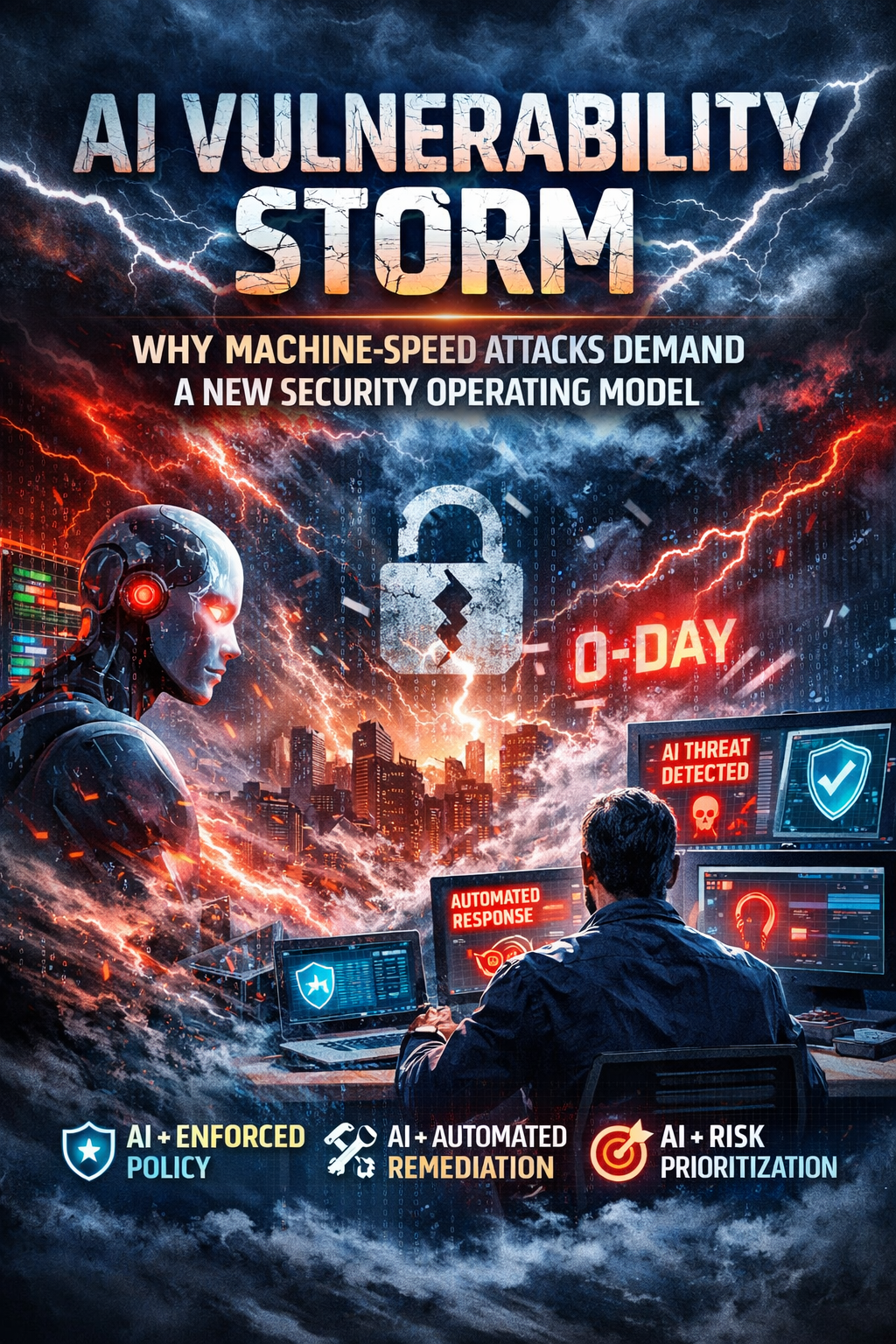
Yes, AI is compressing the timeline between discovery and exploitation, and it’s creating what you’ve been calling an “AI Vulnerability Storm.” But the idea that “only AI can fix it” is incomplete. The real issue isn’t just speed—it’s operational maturity.
Most organizations don’t fail because they lack detection—they fail because:
- They can’t prioritize what matters
- They can’t fix at scale
- They lack visibility into their actual attack surface
AI will help—but without governance, enforcement, and runtime controls, it just becomes another noisy tool.
The real winning strategy isn’t AI vs AI. It’s:
- AI + enforced policy
- AI + automated remediation workflows
- AI + business-aligned risk prioritization
In other words, this isn’t just a tooling shift—it’s a security operating model shift.
If companies respond by just “adding AI tools,” they’ll fall behind faster. If they redesign security around continuous, enforced, and measurable control systems, they’ll stay ahead.
$49 AI Vulnerability Scorecard
Identify Your AI Attack Surface in 15 Minutes
What It Is
The AI Vulnerability Scorecard is a rapid, expert-designed assessment that identifies where your organization is exposed to AI-driven attacks, agent risks, and API vulnerabilities—before attackers do.
Built for speed, this 20-question assessment maps your security posture against:
- AI attack surface exposure
- LLM / agent risks
- API and application vulnerabilities
- Third-party and supply chain weaknesses
Why This Matters (Right Now)
We are in the middle of an AI Vulnerability Storm:
- Vulnerabilities are discovered faster than you can patch
- Exploits are generated in hours, not weeks
- AI agents are expanding your attack surface silently
If you’re using AI tools, APIs, or automation—you already have exposure.
What You Get
AI Risk Score (0–100)
Clear snapshot of your current exposure
10-Page Executive Scorecard (PDF)
- Top vulnerabilities
- Risk heatmap
- Business impact summary
AI Attack Surface Breakdown
- APIs
- AI agents
- Shadow AI usage
- Third-party dependencies
Top 5 Immediate Fixes
What to prioritize in the next 30 days
Mapped to Industry Frameworks
Aligned to:
- ISO 27001
- NIST CSF
- ISO 42001 (AI Governance)
Who It’s For
- Startups using AI tools or APIs
- SaaS companies and product teams
- Mid-size businesses without a dedicated AI security strategy
- CISOs needing a quick risk snapshot for leadership
How It Works
- Answer 20 simple questions (10–15 mins)
- Get instant AI risk scoring
- Receive your detailed report within 24 hours
Sample Questions
- Do you use AI agents with access to internal systems?
- Are your APIs protected against automated abuse?
- Do you scan AI-generated code before deployment?
- Can you detect AI-driven attacks in real time?
Pricing
$49 (one-time)
No subscriptions. No complexity. Immediate value.
Identify Your AI Attack Surface in 15 Minutes
- Traditional vs. Agent Frameworks: Same Dimensions, Different Liabilities
- The Controls Are Still Being Written: Governing AI When the Technology Outruns the Audit
- If Your Frontier Model Vanished for 3 Weeks, Would Your Business Stop?
- The Evidence Lifecycle: Which Organizational Events to Log for Liability — and How Long to Keep Them
- 14 Months to Comply. 12 Months of Work. The High-Risk AI Playbook Nobody Has Started