Apr 20 2026

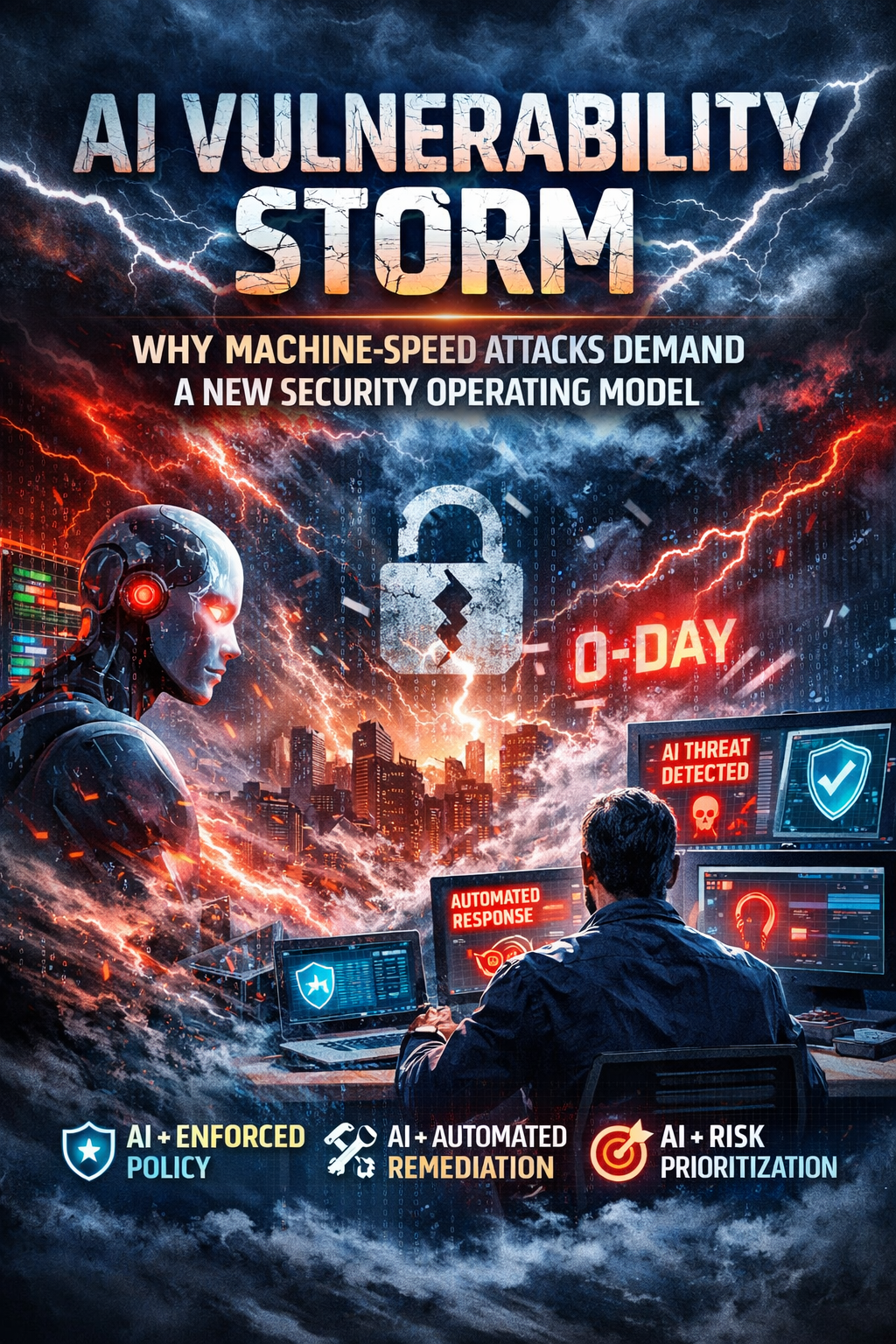
AI Vulnerability Storm: Why Machine-Speed Attacks Demand a New Security Operating Model

Source: The Mythos Zero-Day Flood Is Here. Only AI Can Fix It.


The article argues that cybersecurity has entered a new phase driven by advanced AI systems like Claude Mythos Preview. These systems are capable of autonomously discovering zero-day vulnerabilities across major operating systems and browsers—something that previously required elite, well-funded research teams. This marks a fundamental shift in how vulnerabilities are found and exploited.

A key driver of this shift is the explosion in vulnerability discovery combined with shrinking exploit timelines. What once took years to weaponize can now happen in less than a day. AI can even reverse-engineer patches to uncover the underlying flaw within hours, effectively accelerating both offense and exploitation at unprecedented speed.

The post highlights a dramatic leap in capability: Mythos can not only find vulnerabilities but also chain multiple bugs into working exploits without human involvement. In testing, it vastly outperformed earlier models, demonstrating that AI has crossed from assistive tooling into autonomous offensive capability.

This evolution reshapes the attacker landscape. Capabilities once limited to nation-state actors are becoming accessible to a much broader audience. Even less-skilled attackers can now automate reconnaissance, generate exploits, and execute attacks—ushering in what the article calls a “vibe-hacking” era where barriers to entry collapse.

At the same time, these capabilities are not likely to remain restricted. The article stresses a familiar pattern: what is cutting-edge and controlled today will likely become widely available—possibly even open-source—within 12 to 18 months. That means mass-scale autonomous exploit development could soon be democratized.

This creates a widening gap between defenders and attackers. Security teams are already overwhelmed by vulnerability volume, and AI dramatically increases both the number and complexity of threats. The traditional vulnerability management lifecycle—discover, patch, remediate—is no longer keeping pace with the speed of AI-driven discovery.

The article’s core conclusion is blunt: only AI can counter AI. Human-driven security operations cannot scale to match machine-speed attacks. The future of defense must rely on autonomous systems capable of identifying, prioritizing, and fixing vulnerabilities at the same speed they are discovered.


Perspective (What this really means)

The article is directionally right—but slightly oversimplified.

Yes, AI is compressing the timeline between discovery and exploitation, and it’s creating what you’ve been calling an “AI Vulnerability Storm.” But the idea that “only AI can fix it” is incomplete. The real issue isn’t just speed—it’s operational maturity.

Most organizations don’t fail because they lack detection—they fail because:

  • They can’t prioritize what matters
  • They can’t fix at scale
  • They lack visibility into their actual attack surface

AI will help—but without governance, enforcement, and runtime controls, it just becomes another noisy tool.

The real winning strategy isn’t AI vs AI. It’s:

  • AI + enforced policy
  • AI + automated remediation workflows
  • AI + business-aligned risk prioritization

In other words, this isn’t just a tooling shift—it’s a security operating model shift.

If companies respond by just “adding AI tools,” they’ll fall behind faster. If they redesign security around continuous, enforced, and measurable control systems, they’ll stay ahead.


 $49 AI Vulnerability Scorecard

Identify Your AI Attack Surface in 15 Minutes

 What It Is

The AI Vulnerability Scorecard is a rapid, expert-designed assessment that identifies where your organization is exposed to AI-driven attacks, agent risks, and API vulnerabilities—before attackers do.

Built for speed, this 20-question assessment maps your security posture against:

  • AI attack surface exposure
  • LLM / agent risks
  • API and application vulnerabilities
  • Third-party and supply chain weaknesses

 Why This Matters (Right Now)

We are in the middle of an AI Vulnerability Storm:

  • Vulnerabilities are discovered faster than you can patch
  • Exploits are generated in hours, not weeks
  • AI agents are expanding your attack surface silently

 If you’re using AI tools, APIs, or automation—you already have exposure.


 What You Get

 AI Risk Score (0–100)
Clear snapshot of your current exposure

 10-Page Executive Scorecard (PDF)

  • Top vulnerabilities
  • Risk heatmap
  • Business impact summary

 AI Attack Surface Breakdown

  • APIs
  • AI agents
  • Shadow AI usage
  • Third-party dependencies

 Top 5 Immediate Fixes
What to prioritize in the next 30 days

 Mapped to Industry Frameworks
Aligned to:

  • ISO 27001
  • NIST CSF
  • ISO 42001 (AI Governance)

 Who It’s For

  • Startups using AI tools or APIs
  • SaaS companies and product teams
  • Mid-size businesses without a dedicated AI security strategy
  • CISOs needing a quick risk snapshot for leadership

 How It Works

  1. Answer 20 simple questions (10–15 mins)
  2. Get instant AI risk scoring
  3. Receive your detailed report within 24 hours

 Sample Questions

  • Do you use AI agents with access to internal systems?
  • Are your APIs protected against automated abuse?
  • Do you scan AI-generated code before deployment?
  • Can you detect AI-driven attacks in real time?

 Pricing

 $49 (one-time)
No subscriptions. No complexity. Immediate value.

Identify Your AI Attack Surface in 15 Minutes

Tags: AI Vulnerability Storm, Claude Mythos


Apr 07 2026

Claude Mythos and the Future of Cybersecurity: Powerful—and Potentially Dangerous

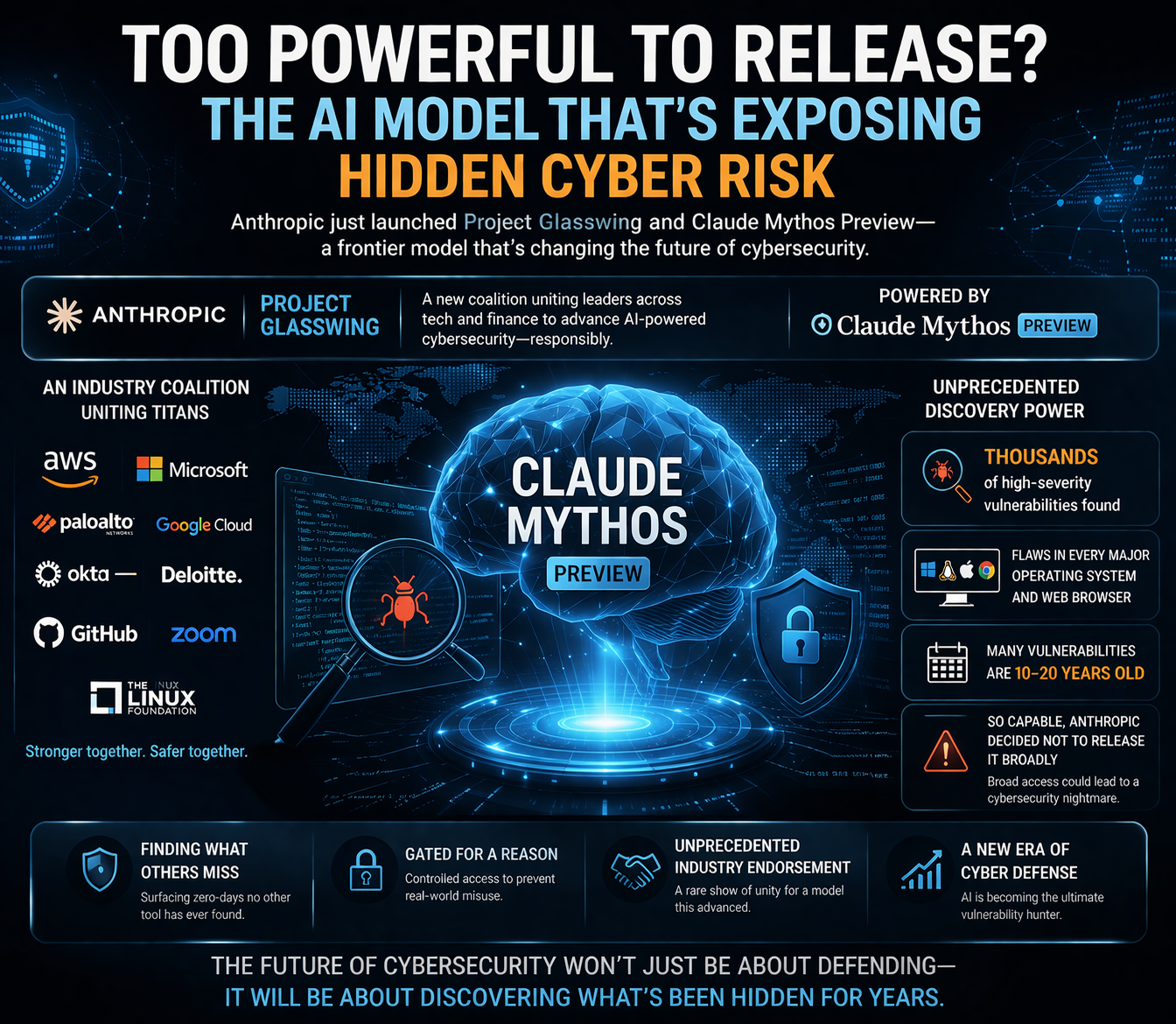
Too Powerful to Release? The AI Model That’s Exposing Hidden Cyber Risk


This development is one that deserves close attention. Anthropic has introduced Project Glasswing, a new industry coalition that brings together major players across technology and financial services. At the center of this initiative is a highly advanced frontier model known as Claude Mythos Preview, signaling a significant shift in how AI intersects with cybersecurity.

Project Glasswing is not just another AI release—it represents a coordinated effort between leading organizations to explore the implications of next-generation AI capabilities. By aligning multiple sectors, the initiative highlights that the impact of such models extends far beyond research labs into critical infrastructure and global enterprise environments.

What sets Claude Mythos apart is its demonstrated ability to identify high-severity vulnerabilities at scale. According to the announcement, the model has already uncovered thousands of serious security flaws, including weaknesses across major operating systems and widely used web browsers. This level of discovery suggests a step-change in automated vulnerability research.

Even more striking is the nature of the vulnerabilities being found. Many of them are not newly introduced issues but long-standing flaws—some dating back one to two decades. This indicates that existing tools and methods have been unable to fully surface or prioritize these risks, leaving hidden exposure in foundational technologies.

The implications for cybersecurity are profound. A model capable of uncovering such deeply embedded vulnerabilities challenges long-held assumptions about the maturity and completeness of current security practices. It suggests that the attack surface is not only larger than expected, but also less understood than previously believed.

Recognizing the potential risks, Anthropic has chosen not to release the model broadly. Instead, access is being tightly controlled through the Glasswing coalition. The company has explicitly stated that unrestricted availability could lead to a cybersecurity crisis, as malicious actors could leverage the same capabilities to discover and exploit vulnerabilities at unprecedented speed.

This decision marks a notable departure from the typical AI release cycle, where rapid deployment and widespread access are often prioritized. In this case, restraint reflects an acknowledgment that capability has outpaced control, and that governance must evolve alongside technical progress.

It is also significant that a relatively young company like Anthropic has secured broad industry backing for such a cautious approach. The participation and endorsement of established cybersecurity and financial institutions signal a shared recognition of both the opportunity and the risk presented by models like Mythos.

Another critical point is that Mythos is reportedly identifying zero-day vulnerabilities that other tools have missed entirely. If validated at scale, this positions AI not just as a support tool for security teams, but as a primary engine for vulnerability discovery, fundamentally changing how organizations approach risk identification and remediation.


Perspective:
This moment feels like an inflection point for cybersecurity. What we’re seeing is the emergence of AI systems that can outpace traditional security processes, not just incrementally but exponentially. The real issue is no longer whether vulnerabilities exist—it’s how quickly they can be discovered and exploited.

This reinforces a critical shift: cybersecurity must move from periodic testing and reactive patching to continuous, real-time control. If AI can find vulnerabilities at scale, attackers will eventually gain access to similar capabilities. The only viable response is to implement runtime enforcement and API-level controls that can mitigate risk even when unknown vulnerabilities exist.

In short, AI is forcing the industry to confront a new reality—you can’t patch fast enough, so you must control behavior in real time.

Bottom line:
If your AI governance strategy cannot demonstrate continuous monitoring, control, and enforcement, it is unlikely to stand up to audit—or real-world threats.

That’s why AI governance enforcement is not just a feature—it’s the foundation for making AI governance actually work at scale.

Ready to Operationalize AI Governance?

If you’re serious about moving from **AI governance theory → real enforcement**,
DISC InfoSec can help you build the control layer your AI systems need.

Most organizations have AI governance documents â€” but auditors now want proof of enforcement.

Policies alone don’t reduce AI risk. Real‑time monitoring, control, and enforcement do.

If your AI governance strategy can’t demonstrate continuous oversight, it won’t stand up to audit or real‑world threats.

DISC InfoSec helps organizations operationalize AI governance with integrated frameworks, runtime controls, and proven certification success.

Move from AI governance theory to enforcement.

Read the full post below: Is Your AI Governance Strategy Audit‑Ready — or Just Documented?

Schedule a consultation or drop a note below: info@deurainfosec.com

InfoSec services | InfoSec books | Follow our blog | DISC llc is listed on The vCISO Directory | ISO 27k Chat bot | Comprehensive vCISO Services | ISMS Services | AIMS Services | Security Risk Assessment Services | Mergers and Acquisition Security

Is your AI strategy truly audit-ready today?

AI governance is no longer optional. Frameworks like ISO/IEC 42001 AI Management System Standard and regulations such as the EU AI Act are rapidly reshaping compliance expectations for organizations using AI.

DISC InfoSec brings deep expertise across AI, cybersecurity, and regulatory compliance to help you build trust, reduce risk, and stay ahead of evolving mandates—with a proven track record of success.

Ready to lead with confidence? Let’s start the conversation.

At DISC InfoSec, we help organizations navigate this landscape by aligning AI risk management, governance, security, and compliance into a single, practical roadmap. Whether you are experimenting with AI or deploying it at scale, we help you choose and operationalize the right frameworks to reduce risk and build trust. Learn more at DISC InfoSec.

Tags: Claude Mythos, Project Glasswing