
Most AI Security Tools Won’t Pass an Audit. Here’s a 15-Minute Way to Find Out.
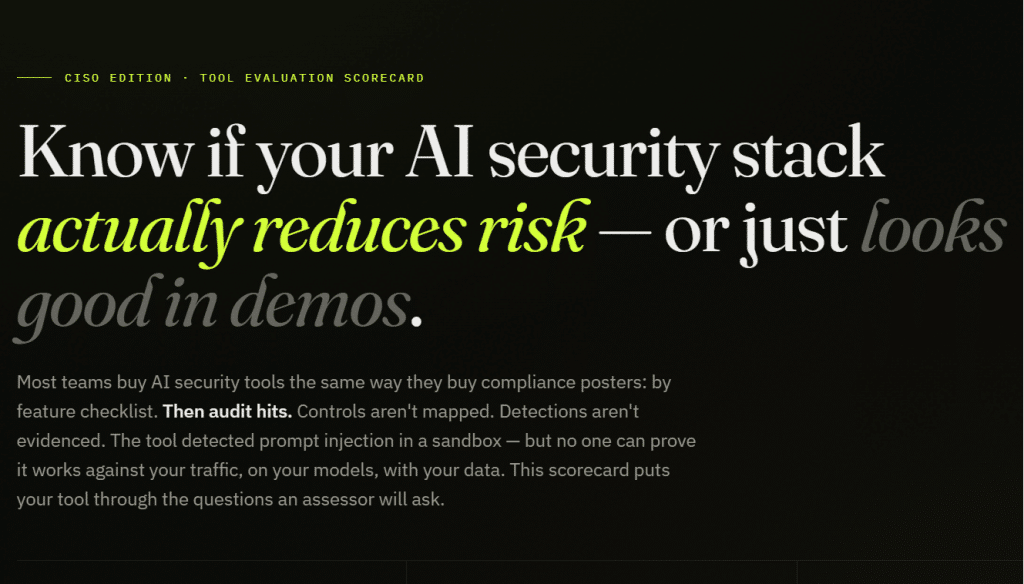
An effective CISO-grade scorecard that puts your AI security tool through the questions an assessor will actually ask — and maps every gap to NIST AI RMF and ISO 42001.
Walk into any AI security vendor demo and the choreography is the same. A prompt injection lights up red on a dashboard. A jailbreak attempt gets blocked in real time. A leaderboard shows their detection rates beating the competition. Heads nod. Procurement opens a folder. Six weeks later the tool is in production, the budget line item is closed, and everyone moves on. Then the auditor shows up and asks one question: “Show me where this control is mapped to your AI management system.” Silence. The dashboard is impressive. The control evidence does not exist. This is not a vendor problem. It’s a buying problem — and it’s everywhere right now.
The reason this happens is what I’ve been calling the capability-governance gap. Vendors are sprinting to ship features because that’s what gets them into POCs. Buyers are sprinting to check the “we have AI security” box because that’s what gets them into board decks. Nobody in either direction is doing the boring, unglamorous work of mapping detections to NIST AI RMF subcategories, or to the 47 controls in ISO 42001 Annex A — the actual things assessors will reference during a certification audit. The result is a market full of capable detection layers being sold (and bought) as if they were controls. They are not the same thing. A control produces evidence. A detection layer produces alerts. An auditor needs the first.
That gap is exactly why we built the AI Security Tool Evaluation Scorecard — CISO Edition. It’s a practical, self-contained tool with twenty questions across five domains: Threat Coverage, Detection Quality, Integration & Scope, Governance & Audit, and Vendor & Risk Reduction. Each question is weighted by audit impact rather than by how well it demos. Governance & Audit carries the heaviest weight in the scoring — twenty-five points out of a hundred — because that’s where every certification audit and every regulator inquiry actually lives. You answer Yes, Partial, No, or Don’t Know. The tool scores in real time. At the end you get a maturity band, a domain-by-domain risk exposure read, and a ranked list of gaps.
Three design choices make this different from the generic “AI security checklist” PDFs floating around. First, every single gap is tagged with the specific NIST AI RMF subcategories and ISO 42001 Annex A controls it maps to — so when you take it to your auditor, you’re speaking their language from the first sentence. Second, “Don’t Know” counts as a gap, not a neutral answer. Assessors don’t accept “we’d have to ask the vendor” as evidence; neither does this tool. Third, the questions were built from the inside of an active ISO 42001 implementation at a financial-services data room — meaning these are questions we’ve actually had to answer for assessors, not questions we imagined a CISO might one day care about.
Try the scorecard: [Link-To-Tool] Book a 30-minute walkthrough: info@deurainfosec.com
DISC InfoSec is an active ISO 42001 implementer and PECB Authorized Training Partner specializing in AI governance for B2B SaaS and financial services organizations.
AI Vulnerability Scorecard: Discover Your AI Attack Surface Before Attackers Do
Your Shadow AI Problem Has a Name-And Now It Has a Score

InfoSec services | InfoSec books | Follow our blog | DISC llc is listed on The vCISO Directory | ISO 27k Chat bot | Comprehensive vCISO Services | ISMS Services | AIMS Services | Security Risk Assessment Services | Mergers and Acquisition Security
- Prompt Engineering for Agents: Your System Prompt Is Now Production Code
- US Banks Are Blocking Third-Party AI Agents from Customer Accounts
- Traditional vs. Agent Frameworks: Same Dimensions, Different Liabilities
- The Controls Are Still Being Written: Governing AI When the Technology Outruns the Audit
- If Your Frontier Model Vanished for 3 Weeks, Would Your Business Stop?



April 30th, 2026 10:24 am
[…] Most AI Security Tools Won’t Pass an Audit. Here’s a 15-Minute Way to Find Out. […]
May 4th, 2026 10:06 am
[…] Most AI Security Tools Won’t Pass an Audit. Here’s a 15-Minute Way to Find Out. […]
May 18th, 2026 9:16 am
[…] Most AI Security Tools Won’t Pass an Audit. Here’s a 15-Minute Way to Find Out. […]
May 27th, 2026 10:32 am
[…] Most AI Security Tools Won’t Pass an Audit. Here’s a 15-Minute Way to Find Out. […]
June 4th, 2026 8:49 am
[…] Most AI Security Tools Won’t Pass an Audit. Here’s a 15-Minute Way to Find Out. […]
June 5th, 2026 2:03 pm
[…] Most AI Security Tools Won’t Pass an Audit. Here’s a 15-Minute Way to Find Out. […]
June 8th, 2026 9:28 am
[…] Most AI Security Tools Won’t Pass an Audit. Here’s a 15-Minute Way to Find Out. […]
June 15th, 2026 9:17 am
[…] Most AI Security Tools Won’t Pass an Audit. Here’s a 15-Minute Way to Find Out. […]
June 29th, 2026 9:10 am
[…] Most AI Security Tools Won’t Pass an Audit. Here’s a 15-Minute Way to Find Out. […]