InfoSec Compliance & AI Governance For over 20 years, DISC InfoSec has been a trusted voice for cybersecurity professionals—sharing practical insights, compliance strategies, and AI governance guidance to help you stay informed, connected, and secure in a rapidly evolving landscape.
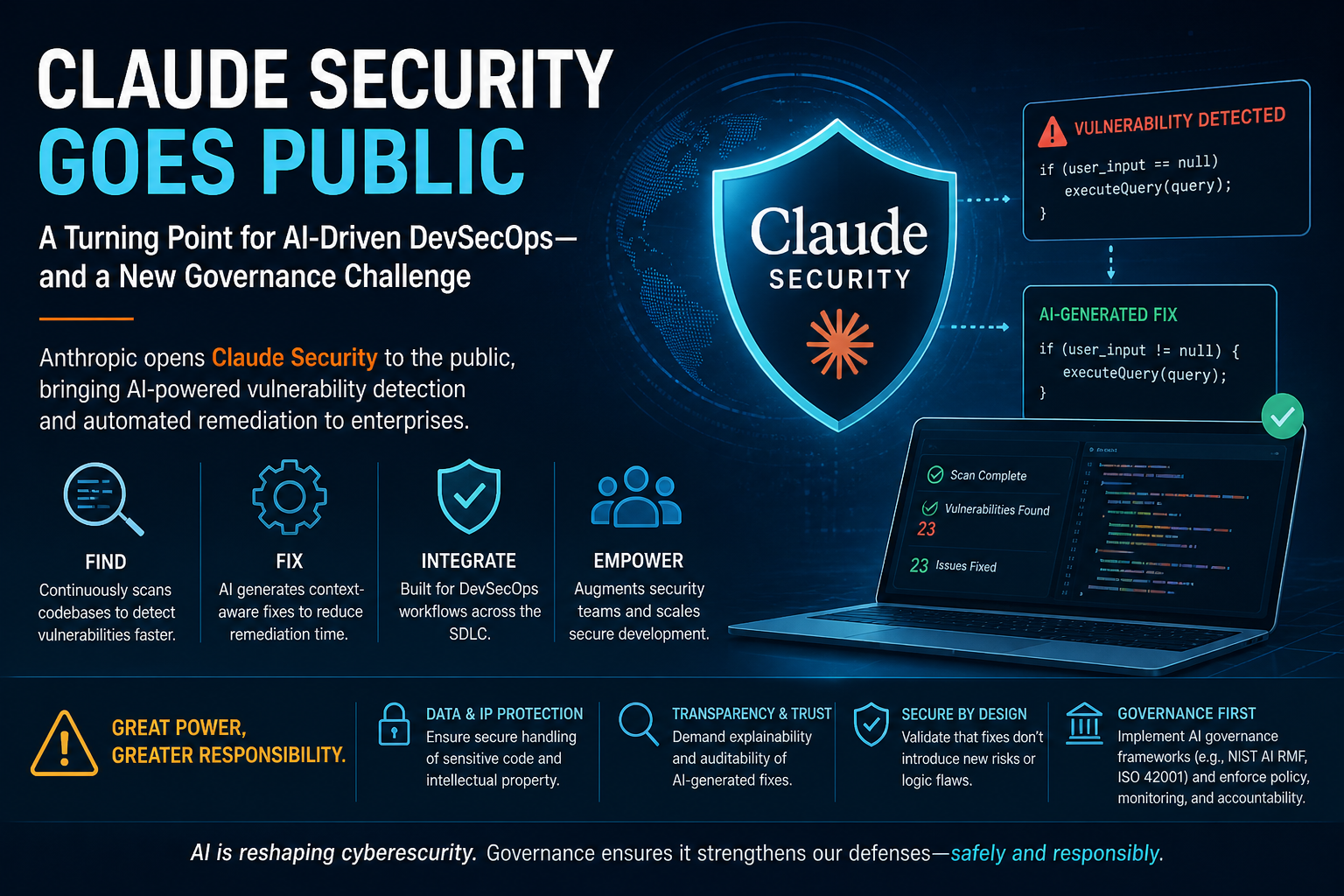
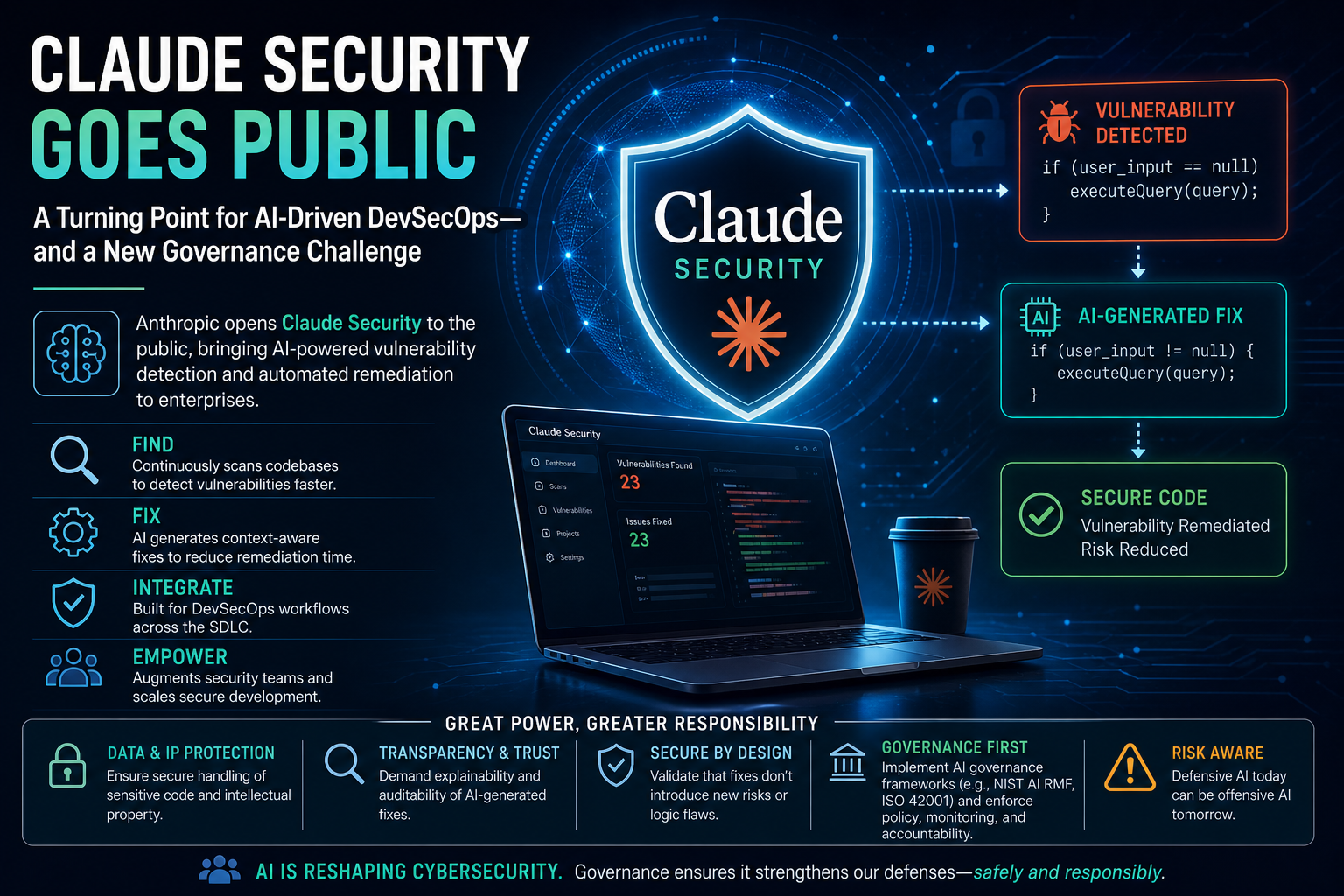
Anthropic has expanded access to its AI-driven security capability, Claude Security, moving it into a broader public beta for enterprise users. The solution is designed to help organizations identify vulnerabilities in their codebases and automatically generate remediation fixes, signaling a shift toward AI-assisted secure software development at scale.
At its core, Claude Security applies advanced AI models to perform continuous code analysis, enabling faster detection of weaknesses that would traditionally require manual secure code review or static analysis tools. The automation of patch generation introduces a new paradigm where remediation is embedded directly into the development lifecycle rather than treated as a downstream activity.
The release comes at a time when AI is increasingly being used by both defenders and attackers. Anthropic positions Claude Security as a defensive countermeasure to the growing risk of AI-powered exploitation, emphasizing that traditional security approaches may not scale effectively against AI-driven threats.
Importantly, the rollout is initially targeted at enterprise environments, suggesting a controlled adoption strategy. By limiting access to organizations with mature security programs, Anthropic appears to be mitigating risks associated with misuse while gathering operational feedback to refine the platform.
The broader context is critical: Anthropic has recently faced scrutiny over internal security lapses, including accidental exposure of large volumes of source code. These incidents highlight the inherent tension between building advanced AI systems and maintaining robust internal security hygiene.
Additionally, emerging AI models such as Anthropic’s advanced systems have demonstrated the capability to uncover large-scale vulnerabilities across major platforms, raising concerns about dual-use risks. The same technology that strengthens defense could also accelerate offensive cyber capabilities if misused.
Overall, Claude Security reflects a broader industry trend: embedding AI directly into cybersecurity operations. It represents a move toward autonomous or semi-autonomous security tooling that augments human analysts, reduces remediation time, and integrates security deeper into DevSecOps pipelines.
Professional Perspective (InfoSec & AI Governance)
From an InfoSec and AI Governance standpoint, this is both inevitable and risky.
First, this validates what many of us have been anticipating: AI-native AppSec is becoming the new baseline. Static analysis, SAST/DAST tools, and manual reviews will increasingly be supplemented—or replaced—by AI systems capable of contextual reasoning and automated remediation. This will compress vulnerability management cycles dramatically.
However, governance is lagging behind capability. Tools like Claude Security introduce several non-trivial risks:
Model trust & explainability: Can you audit why a fix was generated?
Secure SDLC integrity: Are AI-generated patches introducing hidden logic flaws?
Data exposure risk: What code or IP is being processed by external AI systems?
Supply chain implications: AI becomes part of your software assurance pipeline—expanding your attack surface.
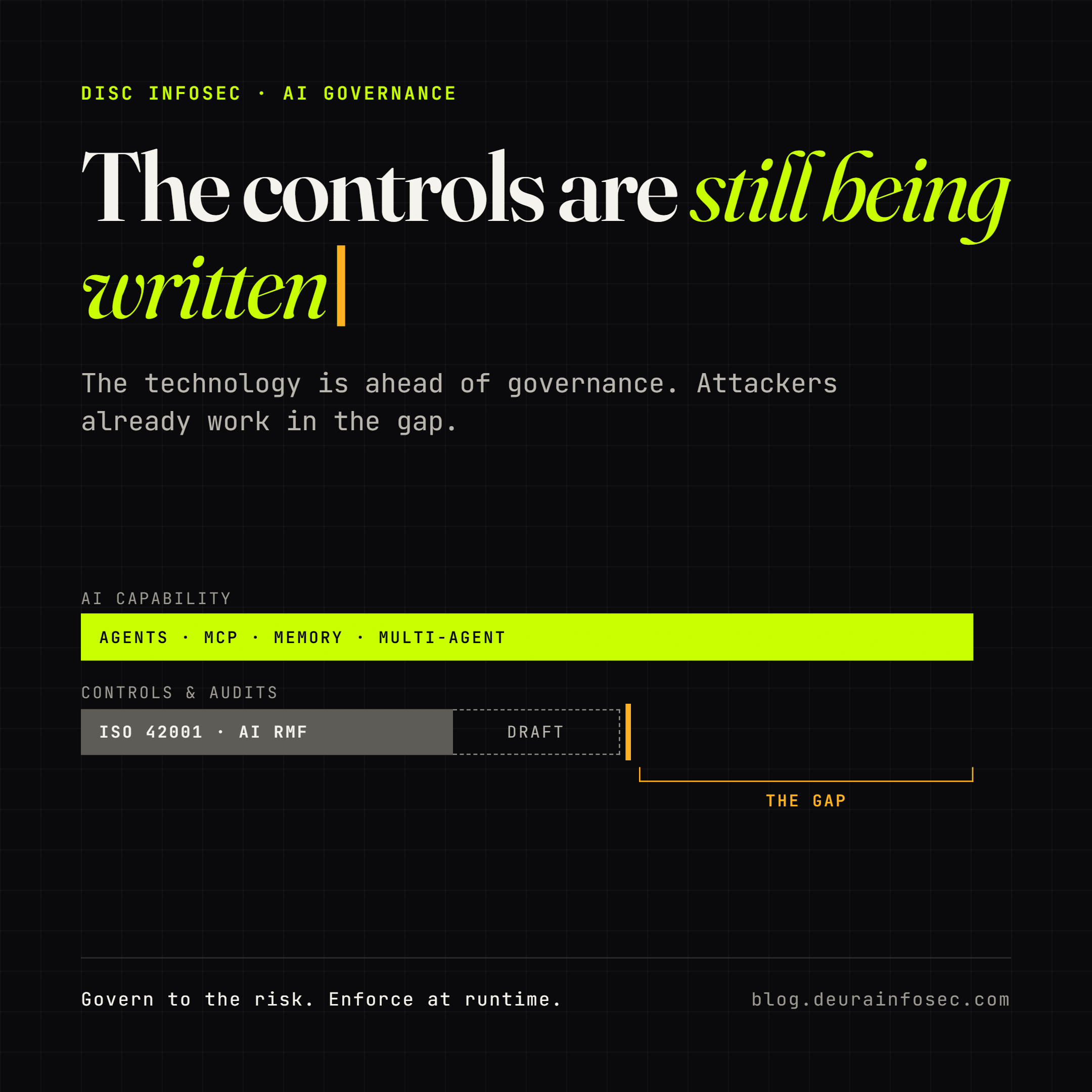
There’s also a strategic concern: defensive AI is racing against offensive AI. If models can autonomously find and fix vulnerabilities, they can also be repurposed to find and exploit them at scale. This reinforces the need for controlled access, monitoring, and policy enforcement (AI governance frameworks like ISO 42001, NIST AI RMF, etc.).
My bottom line: This is a major leap forward for DevSecOps efficiency, but without strong governance, it can quickly become a high-speed risk amplifier. Organizations adopting such tools should treat them as critical security infrastructure, not just developer productivity enhancers.
DISC InfoSec is an active ISO 42001 implementer and PECB Authorized Training Partner specializing in AI governance for B2B SaaS and financial services organizations.
AI Security Tool Evaluation: A Reality Check for CISOs
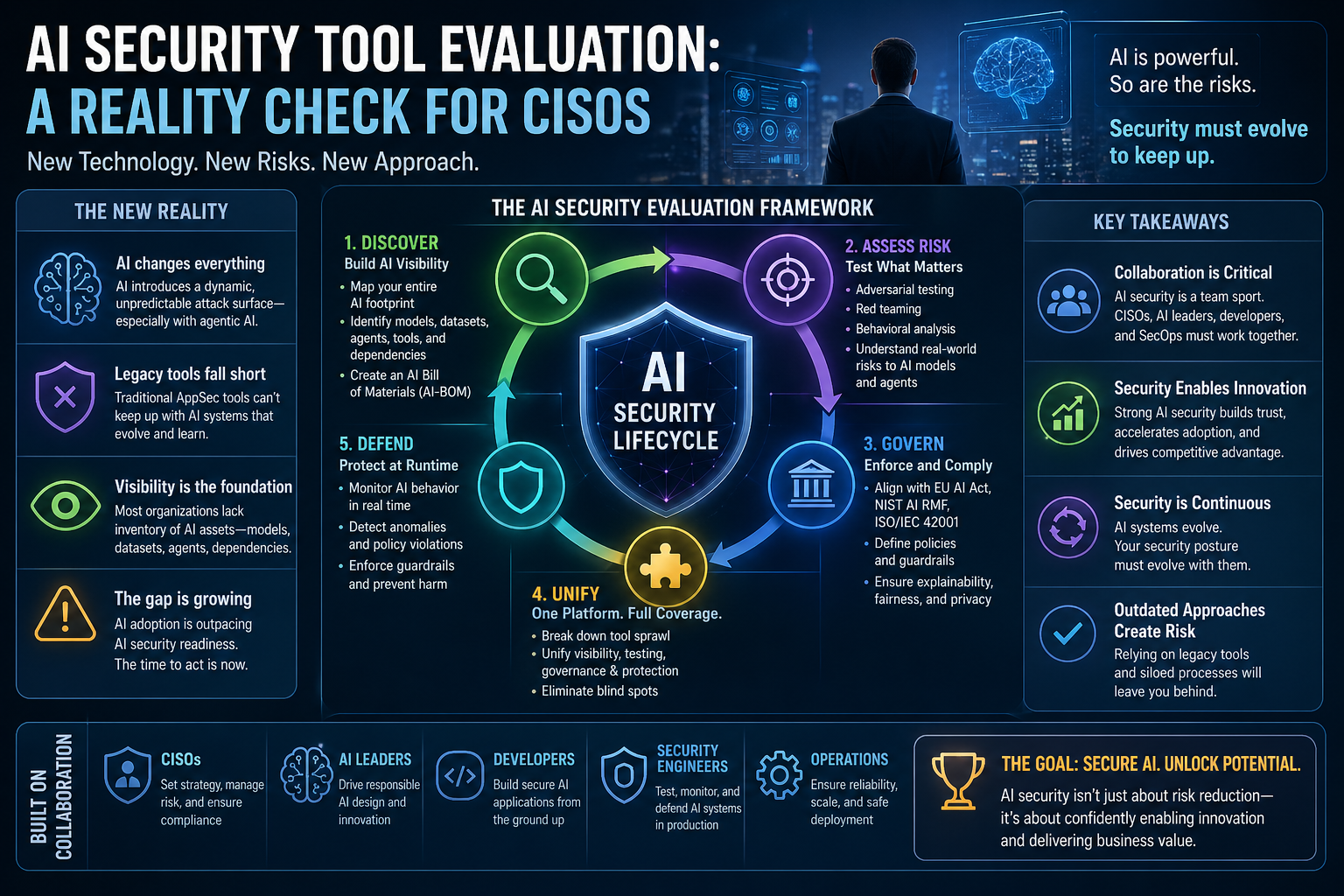
Artificial intelligence is fundamentally reshaping how applications are built, deployed, and attacked. Unlike traditional systems, AI introduces a dynamic and unpredictable attack surface—especially with the rise of agentic AI that can act autonomously. This shift demands a completely new approach to security evaluation.
Most organizations are still relying on legacy application security tools, which were designed for deterministic code. These tools struggle to keep up with AI systems that evolve, learn, and behave differently over time. As a result, CISOs are facing a widening gap between AI adoption and AI security readiness.
The core issue is visibility. Many organizations do not have a clear inventory of their AI assets—models, datasets, agents, and dependencies. Without this foundational understanding, it becomes nearly impossible to secure or govern AI effectively.
To address this, modern AI security evaluation must start with discovery. CISOs need tools that can map the entire AI footprint, including hidden dependencies and third-party integrations. This concept is often referred to as an AI Bill of Materials (AI-BOM), which provides a structured view of the AI supply chain.
Once visibility is established, the next step is risk assessment. AI systems require new testing approaches such as adversarial testing, red teaming, and behavioral analysis. Unlike traditional vulnerability scanning, these methods simulate real-world attacks against AI models and agents to uncover hidden risks.
Governance is another critical pillar. AI security tools must enable organizations to enforce policies aligned with emerging standards like the EU AI Act, NIST AI RMF, and ISO/IEC 42001. Security is no longer just about detection—it must include enforceable controls across the AI lifecycle.
A major shift highlighted in the framework is the need for unified platforms. Fragmented tools create blind spots and operational inefficiencies. Instead, organizations should prioritize integrated solutions that combine visibility, testing, governance, and runtime protection into a single system.
Runtime defense is becoming increasingly important where you may need AI Governance enforcement. AI agents can take actions in real time, interact with external systems, and trigger cascading effects. Security tools must monitor and control these behaviors dynamically, not just during development.
Another key insight is collaboration. AI security is no longer owned by a single team. CISOs, AI leaders, developers, and security engineers must work together to ensure safe adoption. This requires tools and processes that bridge gaps between governance, engineering, and operations.
Ultimately, the goal of AI security tool evaluation is not just to reduce risk but to enable innovation. Organizations that can securely adopt AI will move faster and gain competitive advantage, while those relying on outdated approaches will struggle to keep pace.
Perspective & Recommendations (from a GRC / vCISO lens)
Here’s the blunt truth: most AI security tool evaluations today are feature-driven, not risk-driven.
CISOs are still asking:
“Does this tool scan prompts?”
“Does it detect jailbreaks?”
But they should be asking:
“Can this tool enforce governance?”
“Can I prove compliance and control effectiveness?”
My perspective:
AI security is quickly becoming a governance problem disguised as a tooling problem.
If you don’t tie tools to:
Risk scenarios
Regulatory obligations
Business impact
…you’re just buying expensive dashboards.
What I recommend (practical + actionable)
1. Start with AI Risk Scenarios, not tools
Define:
Model misuse
Data leakage
Prompt injection
Autonomous agent abuse
Then evaluate tools against these risks.
2. Demand “control enforcement,” not just detection
Most tools find issues. Few can:
Block unsafe actions
Enforce policies
Provide audit evidence
That’s the gap regulators will focus on.
3. Align evaluation with frameworks early
Map tools to:
NIST AI RMF
ISO 42001
EU AI Act
If a tool can’t map to controls, it won’t survive audit.
4. Prioritize AI asset inventory (non-negotiable)
If you don’t know:
Where AI is used
What models exist
What data flows through them
You don’t have security—you have assumptions.
5. Test tools in real-world scenarios (not demos)
Run:
Red team exercises
Abuse cases
Failure simulations
Because AI breaks in production, not in slide decks.
6. Avoid tool sprawl early
Pick platforms that:
Integrate into SDLC
Provide governance + security
Support runtime controls
Otherwise, you’ll recreate the same AppSec mess.
Final Thought
AI security evaluation is evolving into AI governance maturity assessment.
The winners won’t be the companies with the most tools. They’ll be the ones who can prove control, enforce policy, and demonstrate trust.
DISC InfoSec is an active ISO 42001 implementer and PECB Authorized Training Partner specializing in AI governance for B2B SaaS and financial services organizations.
Most AI Security Tools Won’t Pass an Audit. Here’s a 15-Minute Way to Find Out.
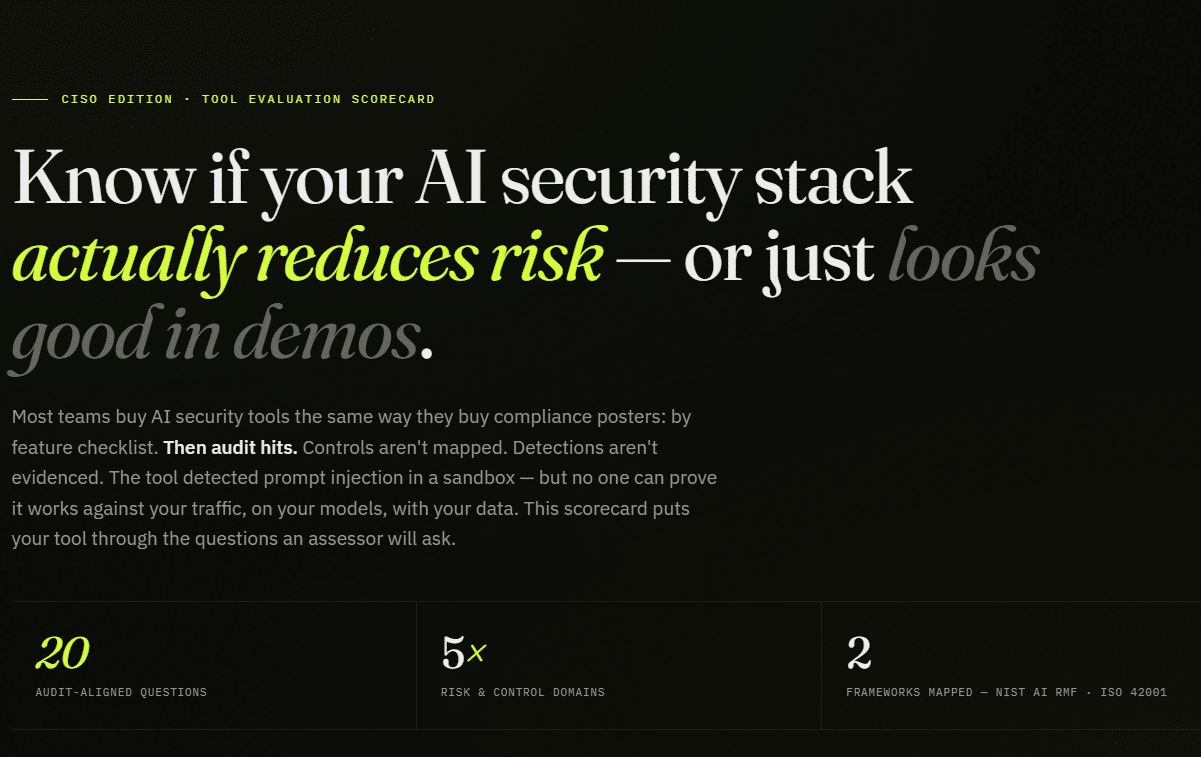
A free CISO-grade scorecard that puts your AI security tool through the questions an assessor will actually ask — and maps every gap to NIST AI RMF and ISO 42001.
Walk into any AI security vendor demo and the choreography is the same. A prompt injection lights up red on a dashboard. A jailbreak attempt gets blocked in real time. A leaderboard shows their detection rates beating the competition. Heads nod. Procurement opens a folder. Six weeks later the tool is in production, the budget line item is closed, and everyone moves on. Then the auditor shows up and asks one question: “Show me where this control is mapped to your AI management system.” Silence. The dashboard is impressive. The control evidence does not exist. This is not a vendor problem. It’s a buying problem — and it’s everywhere right now.
The reason this happens is what I’ve been calling the capability-governance gap. Vendors are sprinting to ship features because that’s what gets them into POCs. Buyers are sprinting to check the “we have AI security” box because that’s what gets them into board decks. Nobody in either direction is doing the boring, unglamorous work of mapping detections to NIST AI RMF subcategories, or to the 47 controls in ISO 42001 Annex A — the actual things assessors will reference during a certification audit. The result is a market full of capable detection layers being sold (and bought) as if they were controls. They are not the same thing. A control produces evidence. A detection layer produces alerts. An auditor needs the first.
That gap is exactly why we built the AI Security Tool Evaluation Scorecard — CISO Edition. It’s a free, self-contained tool with twenty questions across five domains: Threat Coverage, Detection Quality, Integration & Scope, Governance & Audit, and Vendor & Risk Reduction. Each question is weighted by audit impact rather than by how well it demos. Governance & Audit carries the heaviest weight in the scoring — twenty-five points out of a hundred — because that’s where every certification audit and every regulator inquiry actually lives. You answer Yes, Partial, No, or Don’t Know. The tool scores in real time. At the end you get a maturity band, a domain-by-domain risk exposure read, and a ranked list of gaps.
Three design choices make this different from the generic “AI security checklist” PDFs floating around. First, every single gap is tagged with the specific NIST AI RMF subcategories and ISO 42001 Annex A controls it maps to — so when you take it to your auditor, you’re speaking their language from the first sentence. Second, “Don’t Know” counts as a gap, not a neutral answer. Assessors don’t accept “we’d have to ask the vendor” as evidence; neither does this tool. Third, the questions were built from the inside of an active ISO 42001 implementation at a financial-services data room — meaning these are questions we’ve actually had to answer for assessors, not questions we imagined a CISO might one day care about.
Use it before purchase, before contract renewal, before audit prep, and before any board update where someone is going to ask “are we covered on AI risk?” If you’re a CISO weighing two competing tools, run both through the scorecard and compare the gap maps — not the vendor scorecards. If you’re a GRC lead building an audit binder, the output gives you a defensible, mapped baseline you can drop straight into your control narrative. If you’re an AI governance lead doing vendor due diligence, the gap list becomes your negotiation leverage: “here are the seven things we need from you in writing before we sign.” It is meant to be useful at the moments where the budget and the calendar are still flexible.
The mechanics are simple. Fifteen minutes from start to finish, including the setup. You enter the tool you’re evaluating, your use case, and your compliance scope. You answer twenty questions with a live score updating in the sidebar. At the end you provide five details — name, business email, company, role, and company size — and the platform generates an instant maturity score in PDF format, makes a detailed text report available for download with remediation guidance and your top five priority gaps, and emails the full report to DISC InfoSec so we can follow up with a 30-minute walkthrough if you want one. There is no upsell wall, no “premium tier” to unlock the gaps, and no demo theater. You get the verdict, the evidence, and the remediation path.
My perspective, after eighteen months inside ISO 42001 implementation work: the honest read on the AI security tools market right now is that most of these products are very good at detecting things and very bad at producing the kind of evidence that makes audits go smoothly. That’s not a moral failing on the vendors’ part — it’s where the market is in its lifecycle. The capability layer always ships before the governance layer; that’s been true of every security category in the last twenty years. But it does mean that if you bought an AI security tool in the last twelve months and you have an ISO 42001 certification on the calendar, or an EU AI Act deadline approaching, or a SOC 2 attestation that’s about to grow an AI scope — you are almost certainly carrying more residual risk than the vendor’s dashboard suggests. The scorecard won’t fix that. What it will do is give you a precise, mapped, defensible read on exactly where the gap is — so you can decide whether to address it through vendor pressure, compensating controls, or honest scope reduction. Whatever the score comes back as, the gap list is the more useful artifact. That’s the part you take to the audit.
DISC InfoSec is an active ISO 42001 implementer and PECB Authorized Training Partner specializing in AI governance for B2B SaaS and financial services organizations.
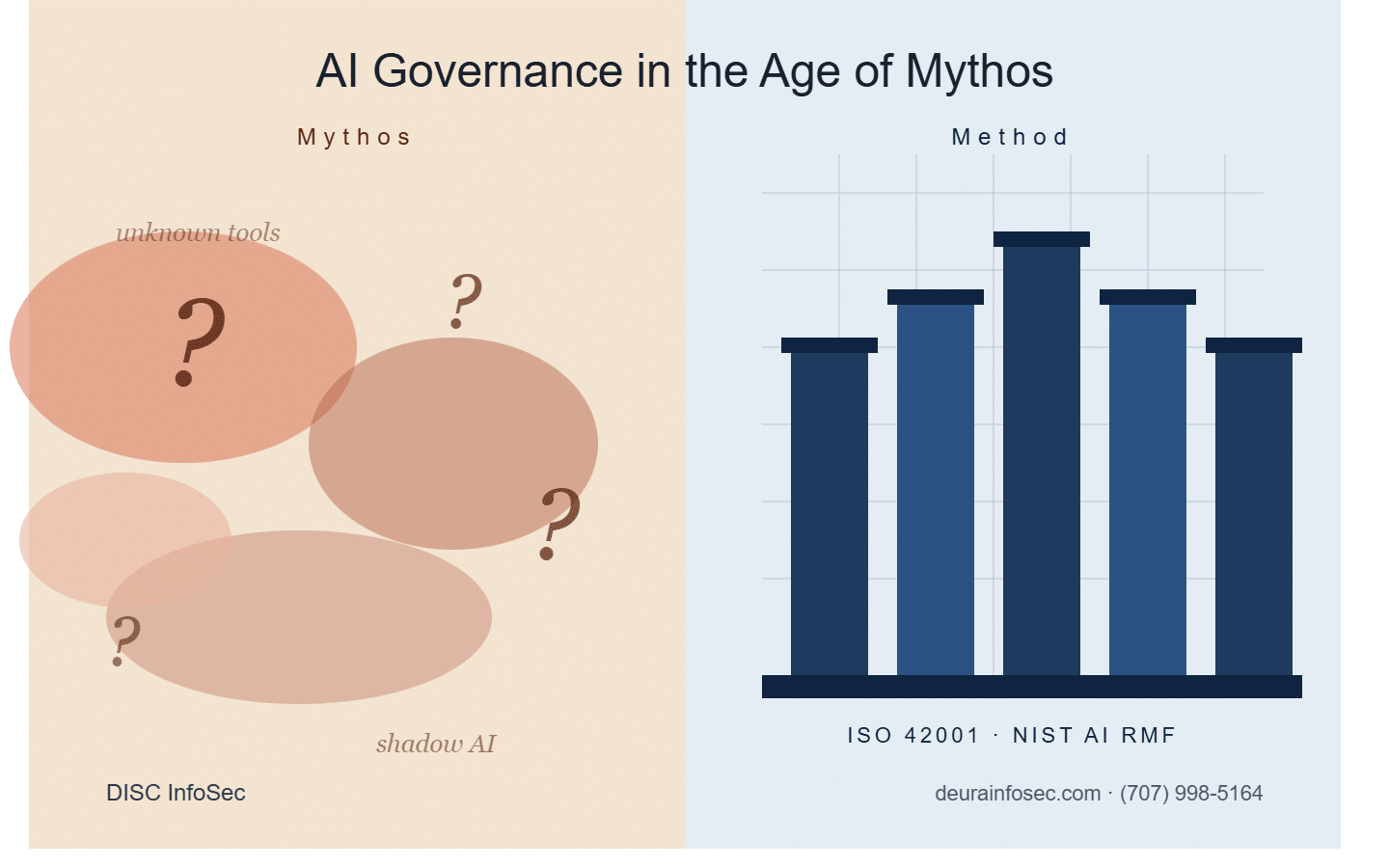
AI Governance in the Age of Mythos: Why Small Business Owners Can’t Afford to Wait
We are living in the age of mythos. Every week brings a new AI story: the tool that will replace your accountant, the chatbot that cost a company $10,000 in refunds, the startup that 10x’d its revenue with a single prompt. Small business owners are drowning in contradictory narratives — AI is a savior, AI is a threat, AI is a gimmick, AI is inevitable.
Here is the truth behind the noise: your employees are already using AI. Probably ChatGPT. Possibly Claude. Likely a half-dozen free tools they signed up for with a company email and a personal phone number. That is not a hypothetical — it is happening right now, in your business, without a policy, without a record, and without a safety net.
This is why AI Governance is no longer a Fortune 500 concern. It is a small business survival issue.
Five Benefits Small Business Owners Should Care About
1. Protect the customer trust you spent years building. One employee pasting client data into a public AI tool can undo a decade of reputation work. Governance puts guardrails in place before the incident, not after.
2. Stay ahead of regulation, not buried by it. The EU AI Act is live. Colorado, California, and New York have active AI laws on the books. The FTC is enforcing. Governance today means you are not scrambling when a client sends you an AI vendor questionnaire — or when a regulator does.
3. Eliminate shadow AI. Most small businesses have no idea which AI tools their people are actually using. An inventory, a policy, and a lightweight approval process turn chaos into visibility — and visibility is the foundation of every control that follows.
4. Win bigger deals. Enterprise buyers — banks, healthcare, government — are now asking small vendors for AI governance attestations. A documented AI Management System is no longer a nice-to-have. It is a procurement gate.
5. Lower your liability exposure. Cyber insurers are quietly adding AI exclusions. Courts are treating “the AI did it” as a non-defense. Written policies, training records, and risk assessments are what stand between your business and a claim denial.
“We’re Too Small for This” — The Most Expensive Myth
The most common objection I hear from small business owners sounds like this:
“AI governance is for big companies. We don’t have a CISO or a compliance team. This is overkill for us.”
Here is the rebuttal: small businesses are more exposed, not less. A Fortune 500 can absorb a $2M AI incident. You cannot. You do not need a CISO — you need a right-sized AI Management System that fits a 10, 50, or 200-person operation. That is exactly what ISO 42001 was designed for, and it is exactly what practitioners like DISC InfoSec deliver every day. One expert. No coordination overhead. No bloated committees. Governance that matches the size of your business and the seriousness of your risk.
If we can make it work in the hard-mode compliance environment of financial data rooms serving M&A transactions, we can make it work for you.
Start Your AI Governance Journey Today
You do not need to boil the ocean. You need a starting point.
Begin with a rapid AI attack surface assessment. Build an AI inventory. Draft an acceptable use policy. Train your team. Each step compounds — and each step moves you from mythos to method.
DISC InfoSec helps small and mid-sized businesses across the USA design, implement, and operate AI governance programs anchored in ISO 42001 and the NIST AI RMF. We have done it. We can do it for you.
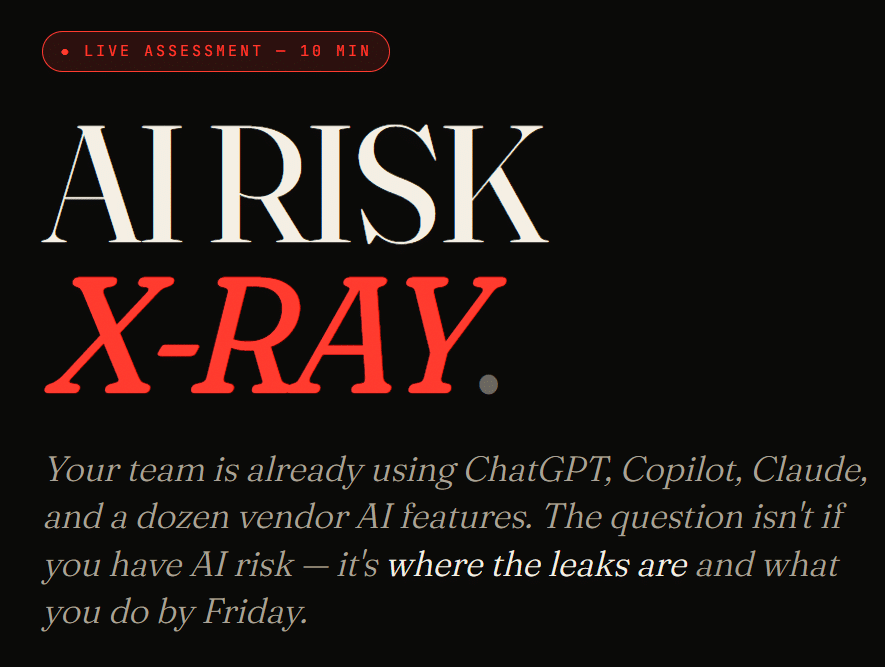
Your Shadow AI Problem Has a Name. And Now It Has a Score.
A 10-minute CMMC-aligned AI Risk X-Ray for SMBs who are done pretending they have this under control.
Nobody is flying this plane
Right now, somebody at your company is pasting a customer contract into ChatGPT to “summarize the key terms.” Somebody else just asked Copilot to draft a reply to a vendor — and the reply quoted a line from an internal doc they didn’t mean to share. A third employee installed a browser extension that promises “AI meeting notes” and quietly streams your entire Zoom call to a server you’ve never heard of.
You probably don’t know any of their names. You probably don’t have a policy that says they can’t. And if a client emailed you today asking “How are you using AI safely with our data?” — you’d stall, draft something vague, and hope they don’t press.
This is the AI risk posture of most SMBs in 2026. Not because they’re negligent. Because they’re busy, the tools are free, the guidance is overwhelming, and the frameworks everyone points at (NIST AI RMF, ISO 42001, the EU AI Act) were written for companies with a governance team and a legal budget you don’t have.
The result: shadow AI, quietly compounding. Every week you don’t address it, the blast radius of the eventual incident gets bigger.
We built the AI Risk X-Ray to fix that — specifically for SMBs who want an honest answer in 10 minutes, not a six-week consulting engagement.
What the AI Risk X-Ray actually does
It’s a free, self-service assessment. Ten questions. Each one scored on the CMMC 5-level maturity scale (Initial → Managed → Defined → Measured → Optimizing). No fluff, no framework jargon, no pretending you need to “align with ISO 42001 Annex A” before you can answer a client’s basic AI question.
You walk through ten risk domains that cover the immediate, day-to-day AI exposure every SMB has right now:
Shadow AI Inventory — Do you actually know which AI tools your employees are using? Not just the ones you approved. The ones they’re using.
Acceptable Use Policy — Is there a written AI policy staff have read, or did you send a Slack message in 2024 and call it done?
Data Leakage Controls — Are employees trained on what data must never be pasted into public AI tools? (Hint: customer PII, contracts, source code, credentials — the stuff that gets you sued.)
Vendor AI Risk — Your CRM, HR platform, and helpdesk have all quietly added AI features. Do you know which of them are processing your data for model training?
Client / Contract Readiness — Can you answer “how are you using AI safely?” with a documented response, or do you freeze?
AI Output Review — Is anyone checking the AI-generated emails, code, and contracts before they leave the building?
Access & Accounts — Are employees on enterprise AI plans with data retention turned off, or on personal free accounts that may be training on your prompts?
Regulatory Awareness — Colorado AI Act. EU AI Act. California AB 2013. “We’re too small” is no longer a defense.
Incident Response — If someone leaked sensitive data into an AI tool tomorrow, what happens in the next four hours?
Accountability — Is there a specific named person responsible for AI risk, or does it live in the gap between IT, legal, and “someone should probably own this”?
That’s it. Ten questions. Nothing esoteric. No 47-page NIST crosswalk.
What you get at the end
Three things land in your browser the moment you finish the assessment:
A maturity score out of 100. Animated ring, big number, tier label — Critical Exposure, High Risk, Moderate, Strong, or Optimized. No hand-waving. Your score is the arithmetic of your answers.
Your top 5 priority gaps. Not all ten. The five lowest-maturity domains, ranked by where you’d get hurt first. Each one ships with a concrete remediation you can execute inside a week — not a framework reference, an actual sentence telling you what to do Monday morning.
A detailed PDF report you can download, forward to your CEO, or attach to the board deck. It includes the executive summary, the top-5 fix list, a full breakdown of all ten domains, and a 30/60/90-day plan that walks you from “we have nothing” to “we can pass a client’s AI due-diligence questionnaire.”
Ten minutes. A number you can defend. A list of fixes you can actually do.
Get Instant Clarity on Your AI Risk — Free
Launch your Free AI Risk X-Ray Tool and uncover hidden vulnerabilities, compliance gaps, and governance blind spots in minutes. No fluff, just actionable insight.
👉 Click the link or image above to start your assessment now.
Who this is for (and who it isn’t)
This is for you if:
You’re at an SMB (roughly 50 to 1500 employees) using AI tools with informal or zero governance.
You’re in B2B SaaS, financial services, healthcare, legal, or professional services — any sector where client data sensitivity is high and AI questions are already arriving in RFPs.
Your CEO asked “are we safe with AI?” last quarter and you said “yeah, we’re fine” and have been vaguely uncomfortable about it ever since.
A client, prospect, or investor has asked you an AI-specific question and you didn’t have a clean answer.
This isn’t for you if:
You already run a formal AI governance program with an AI risk committee, quarterly audits, and ISO 42001 certification. (If that’s you — we should probably talk anyway, because you’re the exception, not the rule.)
You want a comprehensive enterprise AI risk assessment. This is a 10-minute snapshot, not a 6-week engagement. It surfaces the pain. It doesn’t replace deep work.
Where DISC InfoSec comes in
Here’s what happens after the score.
Most SMBs run the X-Ray, see a 38/100, and go through predictable stages: disbelief, defensiveness, then the uncomfortable realization that they’ve been playing Russian roulette with their client data. Then comes the harder question: who’s going to fix this?
Internal IT is already at capacity. Traditional Big-4 consultants show up with a $150K proposal and a six-month timeline. Framework vendors sell software that assumes you already have the governance program their software is supposed to manage. None of it fits the SMB reality.
This is exactly the gap DISC InfoSec was built to close. We specialize in SMBs — B2B SaaS, financial services, and regulated industries — who need practical AI governance implemented this month, not theorized about for the next fiscal year.
Here’s what that looks like in practice:
A 1-page AI Acceptable Use Policy your staff will actually read and your lawyers will sign off on — drafted in days, not weeks.
Shadow AI discovery using the tools and logs you already have, producing a living AI inventory with owners, data sensitivity, and approval status.
Vendor AI questionnaires pre-built for your top SaaS tools, ready to send, with contract language you can paste into renewal negotiations.
An AI Trust Brief you can put on your website or hand to a prospect — the document that turns “how are you using AI safely?” from a deal-killer into a deal-accelerator.
Migration from personal AI accounts to enterprise plans with zero-data-retention, SSO, and admin visibility — budgeted and sequenced so it doesn’t blow up your P&L.
ISO 42001 readiness for the subset of clients who need to formalize what they’ve built. We implemented ISO 42001 at ShareVault (a virtual data room platform serving M&A and financial services), which passed its Stage 2 audit with SenSiba. The playbook is real, battle-tested, and portable.
A fractional vCAIO / vCISO model — the “one expert, no coordination overhead” approach. You get a named person accountable for your AI risk who has done this at scale, without hiring a full-time executive or coordinating across three consulting firms.
The remediation isn’t theoretical. The 30/60/90-day plan in your X-Ray report is the exact sequence we’ve used with other SMBs. Most of our engagements close the first four of your five priority gaps inside 60 days.
Why this matters more for SMBs than for enterprises
Big companies have entire AI governance teams now. They have budget. They have legal review. They have the ability to absorb an AI-related incident without it being existential.
SMBs don’t have any of that. One leaked customer dataset can end a relationship that represents 30% of your revenue. One regulatory inquiry can consume the next two quarters of your senior team’s attention. One bad AI-generated output in a contract can trigger litigation you can’t afford to defend.
The asymmetry is brutal: smaller surface area, but every hit lands with more force. Which is exactly why the “we’re too small to need AI governance” reflex is the most dangerous belief in the SMB security world right now.
You don’t need to out-govern Google. You need to not be the easiest target in your vertical. A 70/100 on the AI Risk X-Ray puts you comfortably above most SMB peers and answers 80% of the client AI questions you’ll get this year. That’s achievable in under 90 days with the right help.
Take 10 minutes. See the number.
The AI Risk X-Ray is free. No email gate for marketing spam, no paywall, no “enter your credit card to see results.” You get the score, the top 5 gaps, the PDF, and the 30/60/90-day plan the moment you finish.
A copy of your report lands with us too — at info@deurainfosec.com — so if you want to talk through it, we already have the context. No introductory deck, no “let me get familiar with your situation” call. We already know your score, your gaps, and your sector. We’ll email you within one business day with the three things we’d fix first.
If you’d rather just take the assessment and keep the conversation for later, that’s fine too. The tool stands on its own.
[Take the AI Risk X-Ray →](link to the hosted tool on deurainfosec.com)
Perspective on this tool
I’ll be direct, because the whole point of this thing is directness.
Most AI risk assessments on the market right now are either (a) thinly-disguised lead-capture forms that score every answer as “you need to buy our platform,” or (b) 200-question enterprise instruments that take six hours and score you against a framework your SMB will never realistically adopt. Both are useless if you’re trying to make a decision this week.
The X-Ray is deliberately neither. Ten questions is the minimum you need to get a defensible maturity picture across the domains that actually matter for SMBs in 2026. Anything shorter is a marketing quiz. Anything longer is a consulting engagement pretending to be an assessment.
Is the score perfect? No. A real audit looks at evidence — policy documents, access logs, training records, vendor contracts. Self-assessment has an inherent generosity bias; people rate themselves a level higher than reality warrants. I’d expect most scores to be slightly inflated, which means if you score a 55, you’re probably actually a 45, and you should act accordingly.
But here’s what the X-Ray does that a perfect audit doesn’t: it gets answered. The perfect audit sits in someone’s queue for two months. The X-Ray gets finished in a coffee break, produces a number you can put on a slide, and gives you enough clarity to make a decision about what to do next. That’s the trade I’d make every time for an SMB who hasn’t even started.
If you score below 60, you have real work to do and you should stop scrolling LinkedIn AI think-pieces and actually fix something. If you score between 60 and 80, you’re in decent shape but there are specific gaps that will cost you deals when your next enterprise client sends an AI questionnaire. If you score above 80, you’re ahead of 90% of your peers — audit it, formalize it, and turn it into a sales asset.
Whatever your score, the next move isn’t to read another article about AI governance. It’s to close one gap this week. Then another next week. Then another. That’s how AI risk actually gets managed at an SMB — not by reading frameworks, but by doing one unglamorous thing at a time until the score moves.
We can help with that. Or you can do it yourself with the 30/60/90 plan in the PDF. Either way, stop guessing.
10 minutes. 10 questions. The honest answer.
DISC InfoSec is an AI governance and cybersecurity consulting firm serving B2B SaaS, financial services, and other regulated SMBs. We’re a PECB Authorized Training Partner for ISO 27001 and ISO 42001, and we served as internal auditor on ShareVault’s ISO 42001 certification. One expert. No coordination overhead. Email info@deurainfosec.com or visit deurainfosec.com.
The article argues that cybersecurity has entered a new phase driven by advanced AI systems like Claude Mythos Preview. These systems are capable of autonomously discovering zero-day vulnerabilities across major operating systems and browsers—something that previously required elite, well-funded research teams. This marks a fundamental shift in how vulnerabilities are found and exploited.
A key driver of this shift is the explosion in vulnerability discovery combined with shrinking exploit timelines. What once took years to weaponize can now happen in less than a day. AI can even reverse-engineer patches to uncover the underlying flaw within hours, effectively accelerating both offense and exploitation at unprecedented speed.
The post highlights a dramatic leap in capability: Mythos can not only find vulnerabilities but also chain multiple bugs into working exploits without human involvement. In testing, it vastly outperformed earlier models, demonstrating that AI has crossed from assistive tooling into autonomous offensive capability.
This evolution reshapes the attacker landscape. Capabilities once limited to nation-state actors are becoming accessible to a much broader audience. Even less-skilled attackers can now automate reconnaissance, generate exploits, and execute attacks—ushering in what the article calls a “vibe-hacking” era where barriers to entry collapse.
At the same time, these capabilities are not likely to remain restricted. The article stresses a familiar pattern: what is cutting-edge and controlled today will likely become widely available—possibly even open-source—within 12 to 18 months. That means mass-scale autonomous exploit development could soon be democratized.
This creates a widening gap between defenders and attackers. Security teams are already overwhelmed by vulnerability volume, and AI dramatically increases both the number and complexity of threats. The traditional vulnerability management lifecycle—discover, patch, remediate—is no longer keeping pace with the speed of AI-driven discovery.
The article’s core conclusion is blunt: only AI can counter AI. Human-driven security operations cannot scale to match machine-speed attacks. The future of defense must rely on autonomous systems capable of identifying, prioritizing, and fixing vulnerabilities at the same speed they are discovered.
Perspective (What this really means)
The article is directionally right—but slightly oversimplified.
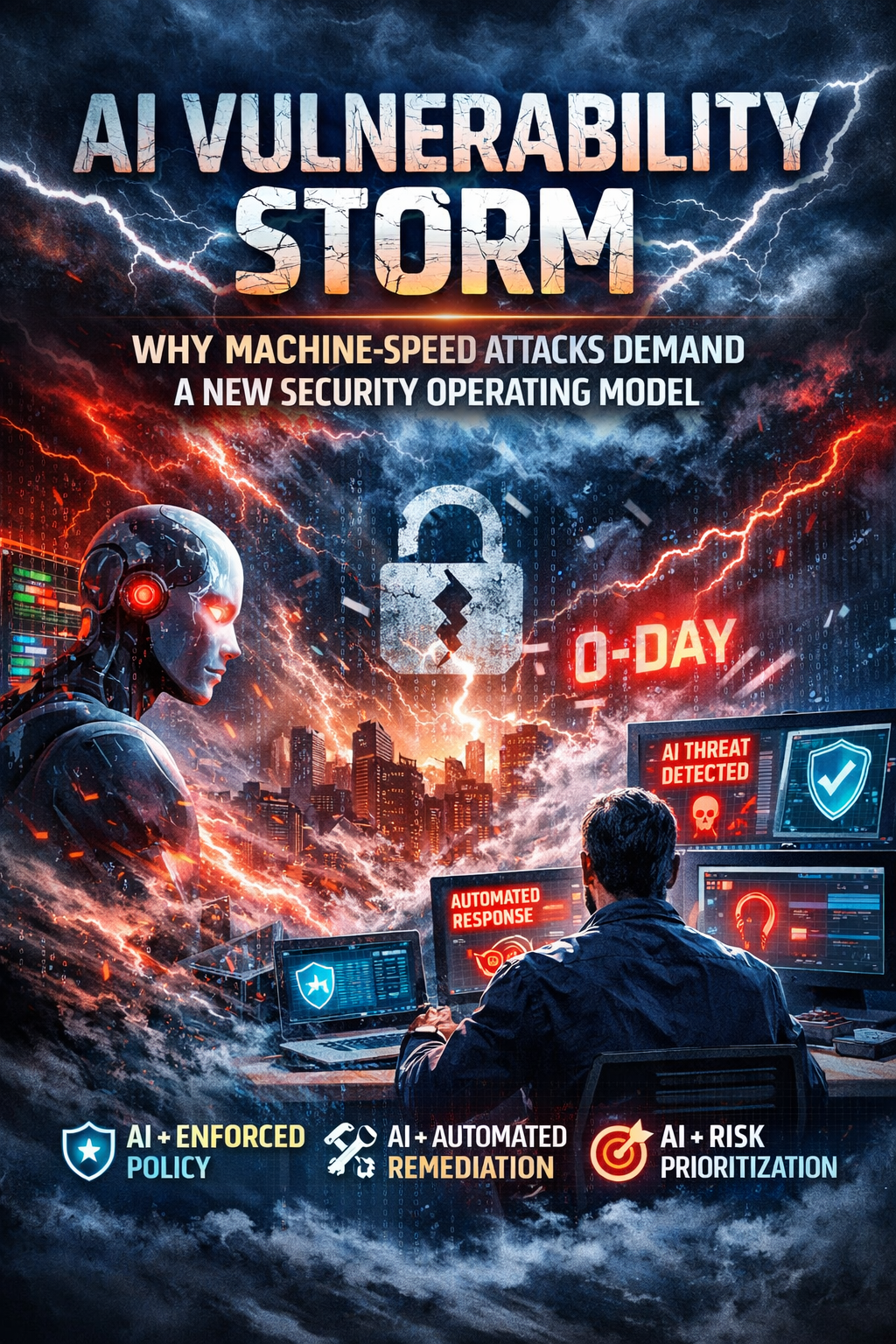
Yes, AI is compressing the timeline between discovery and exploitation, and it’s creating what you’ve been calling an “AI Vulnerability Storm.” But the idea that “only AI can fix it” is incomplete. The real issue isn’t just speed—it’s operational maturity.
Most organizations don’t fail because they lack detection—they fail because:
They can’t prioritize what matters
They can’t fix at scale
They lack visibility into their actual attack surface
AI will help—but without governance, enforcement, and runtime controls, it just becomes another noisy tool.
The real winning strategy isn’t AI vs AI. It’s:
AI + enforced policy
AI + automated remediation workflows
AI + business-aligned risk prioritization
In other words, this isn’t just a tooling shift—it’s a security operating model shift.
If companies respond by just “adding AI tools,” they’ll fall behind faster. If they redesign security around continuous, enforced, and measurable control systems, they’ll stay ahead.
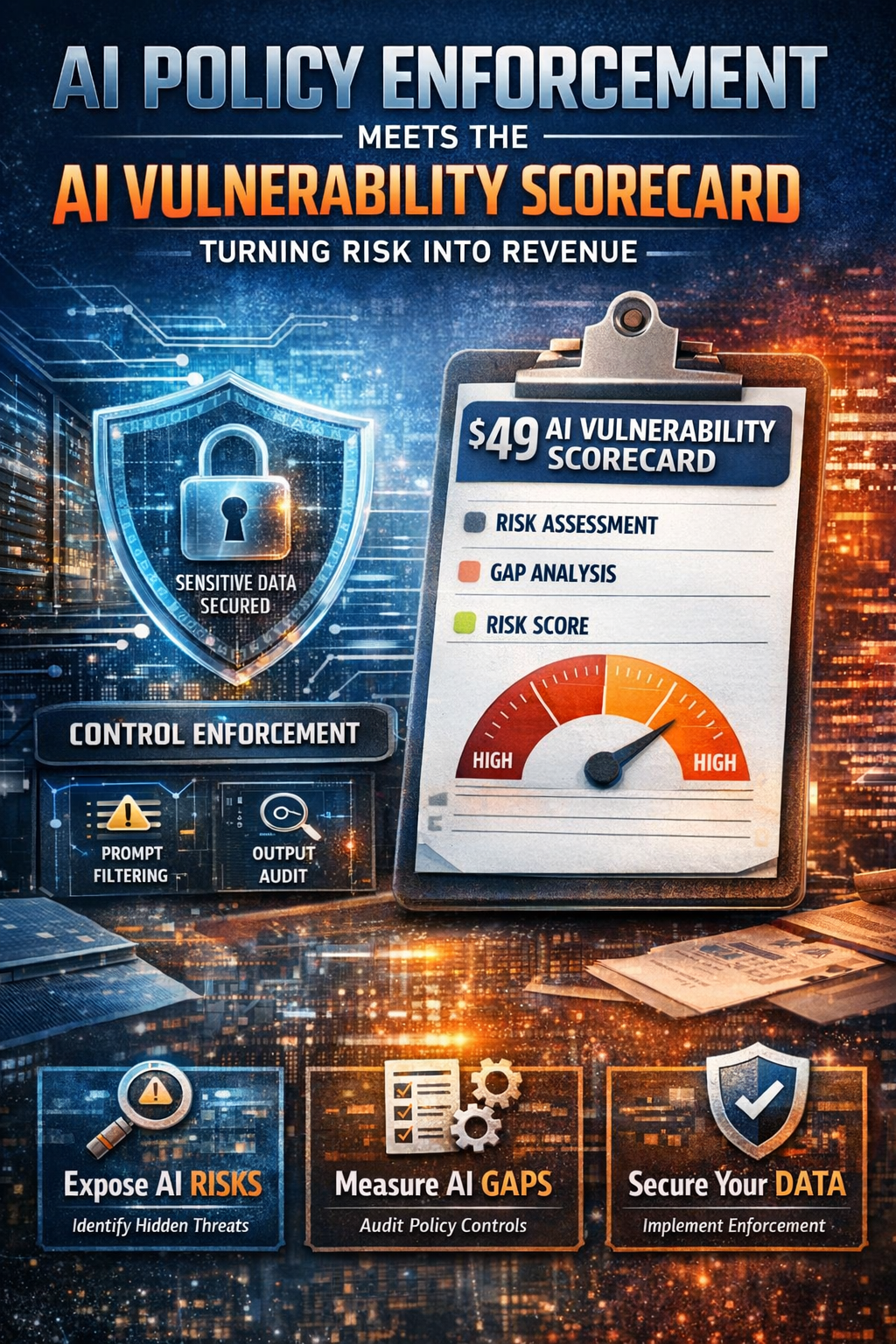
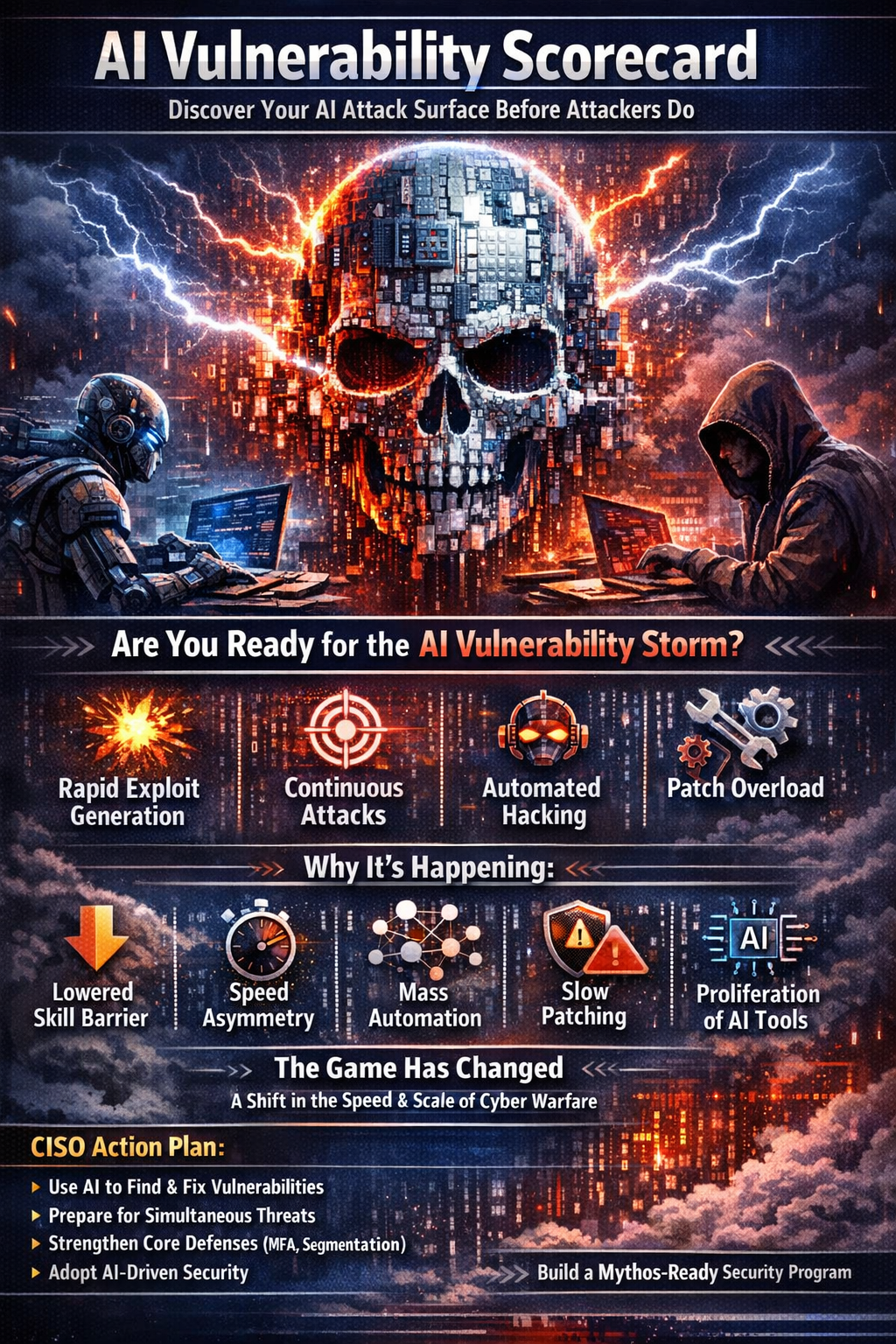
The AI Vulnerability Scorecard is a rapid, expert-designed assessment that identifies where your organization is exposed to AI-driven attacks, agent risks, and API vulnerabilities—before attackers do.
Built for speed, this 20-question assessment maps your security posture against:
AI attack surface exposure
LLM / agent risks
API and application vulnerabilities
Third-party and supply chain weaknesses
 Why This Matters (Right Now)
We are in the middle of an AI Vulnerability Storm:
Vulnerabilities are discovered faster than you can patch
Exploits are generated in hours, not weeks
AI agents are expanding your attack surface silently
 If you’re using AI tools, APIs, or automation—you already have exposure.
 What You Get
 AI Risk Score (0–100) Clear snapshot of your current exposure
 10-Page Executive Scorecard (PDF)
Top vulnerabilities
Risk heatmap
Business impact summary
 AI Attack Surface Breakdown
APIs
AI agents
Shadow AI usage
Third-party dependencies
 Top 5 Immediate Fixes What to prioritize in the next 30 days
 Mapped to Industry Frameworks Aligned to:
ISO 27001
NIST CSF
ISO 42001 (AI Governance)
 Who It’s For
Startups using AI tools or APIs
SaaS companies and product teams
Mid-size businesses without a dedicated AI security strategy
CISOs needing a quick risk snapshot for leadership
 How It Works
Answer 20 simple questions (10–15 mins)
Get instant AI risk scoring
Receive your detailed report within 24 hours
 Sample Questions
Do you use AI agents with access to internal systems?
Are your APIs protected against automated abuse?
Do you scan AI-generated code before deployment?
Can you detect AI-driven attacks in real time?
 Pricing
 $49 (one-time) No subscriptions. No complexity. Immediate value.
AI Policy Enforcement in Practice: From Theory to Control
What is AI Policy Enforcement?
AI policy enforcement is the operationalization of governance rules that control how AI systems are used, what data they can access, and how outputs are generated, stored, and shared. It moves beyond written policies into real-time, technical controls that actively monitor and restrict behavior.
In simple terms: AI policy defines what should happen. Enforcement ensures it actually happens.
Example: AI Policy Enforcement with Dropbox Integration
Consider a common enterprise scenario where employees use AI tools alongside cloud storage platforms like Dropbox.
Here’s how enforcement works in practice:
1. Data Access Control
AI systems are restricted from accessing sensitive folders (e.g., legal, financial, PII).
Policies define which datasets are “AI-readable” vs. “restricted.”
Integration enforces this automatically—no manual user decision required.
2. Content Monitoring & Classification
Files uploaded to Dropbox are scanned and tagged (confidential, internal, public).
AI tools can only process content based on classification level.
Example: AI summarization allowed for “internal” docs, blocked for “confidential.”
3. Prompt & Output Filtering
User prompts are inspected before being sent to AI models.
If a prompt includes sensitive data (customer info, IP), it is blocked or redacted.
AI-generated outputs are also scanned to prevent leakage or policy violations.
4. Activity Logging & Audit Trails
Every AI interaction tied to Dropbox data is logged.
Security teams can trace: who accessed what, what AI processed, and what was generated.
Enables compliance with regulations and internal audits.
5. Automated Policy Enforcement Actions
Block unauthorized AI usage on sensitive files.
Alert security teams on risky behavior.
Quarantine outputs that violate policy.
Why This Matters Now
The shift to AI-driven workflows introduces a new risk layer:
Employees unknowingly expose sensitive data to AI models
AI systems generate outputs that bypass traditional controls
Data flows faster than governance frameworks can keep up
Without enforcement, AI policies are just documentation.
Key Components of Effective AI Policy Enforcement
To make enforcement real and scalable:
Integration-first approach (Dropbox, Google Drive, APIs, SaaS apps)
Real-time controls instead of periodic audits
Data-centric security (classification + tagging)
AI-aware monitoring (prompts, responses, model behavior)
Automation at scale (alerts, blocking, remediation)
My Perspective: AI Policy Without Enforcement is a False Sense of Security
Most organizations today are writing AI policies faster than they can enforce them. That gap is dangerous.
Here’s the reality:
AI accelerates both productivity and risk
Traditional security controls (DLP, IAM) are not AI-aware
Users will adopt AI tools regardless of policy maturity
So the strategy must shift:
1. Treat AI as a New Attack Surface
Not just a tool—AI is a data processing layer that needs the same rigor as APIs and cloud infrastructure.
2. Move from Policy to Control Engineering
Policies should map directly to enforceable controls:
“No PII in AI prompts” → prompt inspection + redaction
“Restricted data stays internal” → storage-level enforcement
3. Integrate Where Data Lives
Enforcement must sit inside:
File systems (Dropbox, SharePoint)
APIs
Collaboration tools
Not as an external overlay.
4. Assume Continuous Drift
AI usage evolves daily. Controls must adapt dynamically—not annually.
Bottom Line
AI policy enforcement is no longer optional—it’s the difference between controlled adoption and unmanaged exposure.
Organizations that succeed will:
Embed enforcement into workflows
Automate governance decisions
Continuously monitor AI interactions
Those that don’t will face an AI vulnerability storm—where speed, scale, and automation work against them.
Perspective: Why AI Governance Enforcement Is the Key
AI governance fails when it remains theoretical. Policies, frameworks, and ethics statements mean little unless they are enforced at execution time. The shift happening now—driven by regulations and real-world risk—is from “intent” to “proof.” Organizations are no longer judged by what policies they publish, but by what they can demonstrably enforce and audit.
Enforcement is the missing link because it creates accountability, consistency, and evidence:
Accountability: Every AI decision is evaluated against rules.
Consistency: Policies apply uniformly across all systems and channels.
Evidence: Audit trails are generated automatically, not reconstructed later.
In simple terms: Without enforcement, governance is documentation. With enforcement, governance becomes control.
That’s why AI governance enforcement is not just a feature—it’s the foundation for making AI governance actually work at scale.
## Ready to Operationalize AI Governance?
If you’re serious about moving from **AI governance theory → real enforcement**, DISC InfoSec can help you build the control layer your AI systems need.
An AI Vulnerability Storm is a rapid, large-scale surge in vulnerability discovery, exploitation, and attack execution driven by advanced AI systems. These systems can autonomously find flaws, generate exploits, and launch attacks faster than organizations can respond.
Why it’s happening (root causes)
AI lowers the skill barrier → more attackers can find and exploit vulnerabilities
Speed asymmetry → discovery → exploit cycle has collapsed from weeks to hours
Automation at scale → thousands of vulnerabilities can be found simultaneously
Patch limitations → defenders still rely on slower, human-driven processes
Proliferation of AI tools → offensive capabilities are spreading quickly
Bottom line: This is not just more vulnerabilities—it’s a fundamental shift in the tempo and economics of cyber warfare.
I. Initial Thoughts
AI is dramatically increasing the volume, speed, and sophistication of cyberattacks. While defenders also benefit from AI, attackers gain a stronger advantage because they can automate discovery and exploitation at scale.
The first wave (e.g., Project Glasswing) signals a future where:
Vulnerabilities are discovered continuously
Exploits are generated instantly
Attacks are orchestrated autonomously
Organizations must:
Rebalance risk models for continuous attack pressure
Prepare for patch overload and faster remediation cycles
Strengthen foundational controls like segmentation and MFA
Use AI internally to keep pace
II. CISO Takeaways
CISOs must shift from reactive security to AI-augmented operations.
Key priorities:
Use AI to find and fix vulnerabilities before attackers do
Prepare for multiple simultaneous high-severity incidents
Update risk metrics to reflect machine-speed threats
Double down on basic controls (IAM, segmentation, patching)
Accelerate teams using AI agents and automation
Plan for burnout and capacity constraints
Build collective defense partnerships
Core message: You cannot scale humans to match AI—you must scale with AI.
III. Intro to Mythos
AI-driven vulnerability discovery has been evolving, but systems like Mythos represent a step-change in capability:
Autonomous exploit generation
Multi-step attack chaining
Minimal human input required
The key disruption:
Time-to-exploit has dropped to hours
Attack capability is becoming widely accessible
This creates a structural imbalance:
Attackers move faster than patching cycles
Risk models and processes are now outdated
Organizations that succeed will:
Adopt AI deeply
Rebuild processes for speed
Accept continuous disruption as the new normal
IV. The Mythos-Aligned Security Program
A modern security program must evolve into a continuous, AI-driven resilience system.
Core shifts:
From periodic defense → continuous operations
From prevention → containment and recovery
From manual work → automated workflows
Key realities:
Patch volumes will surge dramatically
Risk management becomes less predictable
Governance must accelerate technology adoption
Strategic focus:
Build minimum viable resilience
Measure:
Cost of exploitation
Detection speed
Blast radius containment
Human factor:
Security teams face:
Burnout
Skill anxiety
Increased workload
But also:
Opportunity to become AI-augmented operators
Critical insight: Every security role is evolving into an “AI-enabled builder role.”
V. Board-Level AI Risk Briefing
AI is now a board-level risk and opportunity.
Key message to leadership:
AI accelerates business—but also accelerates attackers
Time to major incidents is shrinking rapidly
Risk must shift from prevention → resilience and recovery
The AI Vulnerability Scorecard is a rapid, expert-designed assessment that identifies where your organization is exposed to AI-driven attacks, agent risks, and API vulnerabilities—before attackers do.
Built for speed, this 20-question assessment maps your security posture against:
AI attack surface exposure
LLM / agent risks
API and application vulnerabilities
Third-party and supply chain weaknesses
⚠️ Why This Matters (Right Now)
We are in the middle of an AI Vulnerability Storm:
Vulnerabilities are discovered faster than you can patch
Exploits are generated in hours, not weeks
AI agents are expanding your attack surface silently
👉 If you’re using AI tools, APIs, or automation—you already have exposure.
📊 What You Get
✔️ AI Risk Score (0–100) Clear snapshot of your current exposure
✔️ 10-Page Executive Scorecard (PDF)
Top vulnerabilities
Risk heatmap
Business impact summary
✔️ AI Attack Surface Breakdown
APIs
AI agents
Shadow AI usage
Third-party dependencies
✔️ Top 5 Immediate Fixes What to prioritize in the next 30 days
✔️ Mapped to Industry Frameworks Aligned to:
ISO 27001
NIST CSF
ISO 42001 (AI Governance)
🎯 Who It’s For
Startups using AI tools or APIs
SaaS companies and product teams
Mid-size businesses without a dedicated AI security strategy
CISOs needing a quick risk snapshot for leadership
⚡ How It Works
Answer 20 simple questions (10–15 mins)
Get instant AI risk scoring
Receive your detailed report within 24 hours
💡 Sample Questions
Do you use AI agents with access to internal systems?
Are your APIs protected against automated abuse?
Do you scan AI-generated code before deployment?
Can you detect AI-driven attacks in real time?
💵 Pricing
👉 $49 (one-time) No subscriptions. No complexity. Immediate value.
AI governance is no longer optional. Frameworks like ISO/IEC 42001 AI Management System Standard and regulations such as the EU AI Act are rapidly reshaping compliance expectations for organizations using AI.
DISC InfoSec brings deep expertise across AI, cybersecurity, and regulatory compliance to help you build trust, reduce risk, and stay ahead of evolving mandates—with a proven track record of success.
Ready to lead with confidence? Let’s start the conversation.
At DISC InfoSec, we help organizations navigate this landscape by aligning AI risk management, governance, security, and compliance into a single, practical roadmap. Whether you are experimenting with AI or deploying it at scale, we help you choose and operationalize the right frameworks to reduce risk and build trust. Learn more at DISC InfoSec.
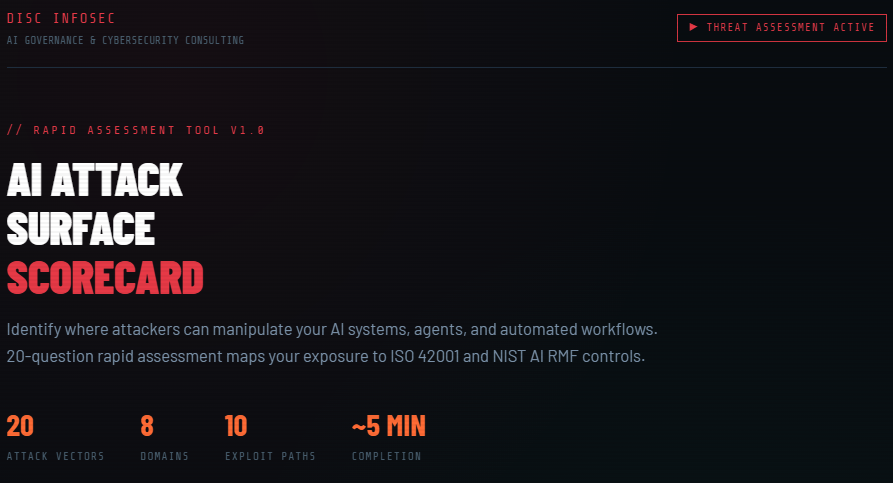
Uncover where your AI systems are truly vulnerable—before attackers do. The AI Attack Surface Scorecard is a powerful, rapid 20-question assessment that pinpoints how your AI models, agents, and automated workflows can be exploited across critical domains like prompt injection, model access, data leakage, and supply chain risk. Built with real-world threat scenarios, it delivers a dynamic 0–100 risk score, highlights your top exploitation paths, and maps every gap directly to ISO 42001 and NIST AI RMF controls. You’ll get prioritized, high-impact remediation steps, a board-ready executive summary, and a detailed downloadable report—everything you need to move from uncertainty to action fast. If you’re serious about securing AI, this is your starting point.
Identify where attackers can manipulate your AI systems, agents, and automated workflows. 20-question rapid assessment maps your exposure to ISO 42001 and NIST AI RMF controls.
Architected comprehensive AI security assessment tool with scoring, governance mapping, and automated reporting
The user wants a comprehensive scorecard for AI Attack Surface assessment. Let me review the frontend design.
Comprehensive AI Attack Surface scorecard report. it includes:
20 questionnaire items
Risk score (0-100)
Top 10 exploitation paths
Governance gaps mapped to ISO 42001 and NIST AI RMF
Priority fix recommendations
Board-ready summary report
Detailed downloadable text report
Email the report to info@deurainfosec.com if you’re interested in a free consultation.
Design is cybersecurity/dark industrial aesthetic – dark theme, red/orange accents, monospace elements, military-grade feel.
Building a comprehensive file with 20 questions spanning the full AI attack surface – prompt injection, model poisoning, API security, agent autonomy, RAG systems, output validation, supply chain risks, data leakage, jailbreak resistance, and more – along with dynamic scoring, a results dashboard with visualizations, PDF and text export capabilities.
Each question will have four risk-weighted options, with ISO 42001 and NIST AI RMF mappings for every item. We are going for a dark industrial cyberpunk aesthetic with threat-red indicators, monospace typography for technical elements, and clean data visualization to match the security-focused audience.
Here’s your AI Attack Surface Scorecard — fully operational. Here’s what’s packed in:
20 Questions across 8 Attack Domains: Prompt Security · Agent Autonomy · Model Access Control · Training Data Integrity · Output Validation · RAG & Vector DB Security · Supply Chain · AI Logging & Monitoring · Jailbreak & Adversarial · Data Exfiltration · AI Incident Response · AI Governance · Shadow AI · Model Inversion
Live-Generated Results Include:
Animated Risk Score ring (0–100) color-coded by severity
Domain-by-domain risk bars sorted by exposure
Top 10 exploitation paths dynamically re-ranked by your specific answers
Governance gaps individually mapped to ISO 42001 clause + NIST AI RMF control
Top 5 Priority Fix Recommendations with effort estimates and impact ratings
Board-ready Executive Summary ready to drop into a slide deck
Output Actions:
⬇ Download Full Report — detailed .txt file with all controls, remediation steps, gap mappings, and board summary
✉ Email Report — to info@deurainfosec.com full assessment details
↺ Retake — resets cleanly for a new client session
That’s the level where security leadership becomes strategic—and where vCISOs deliver the most value. Feel free to drop a note below if you have any questions.
Security is no longer about preventing breaches — it is about controlling autonomous decision systems operating at machine speed.
AI Governance + Security Compliance Stack (ISO 42001 + AI Act Readiness)
At DISC InfoSec, we help organizations navigate this landscape by aligning AI risk management, governance, security, and compliance into a single, practical roadmap. Whether you are experimenting with AI or deploying it at scale, we help you choose and operationalize the right frameworks to reduce risk and build trust. Learn more at DISC InfoSec | ISO 27001 | ISO 42001
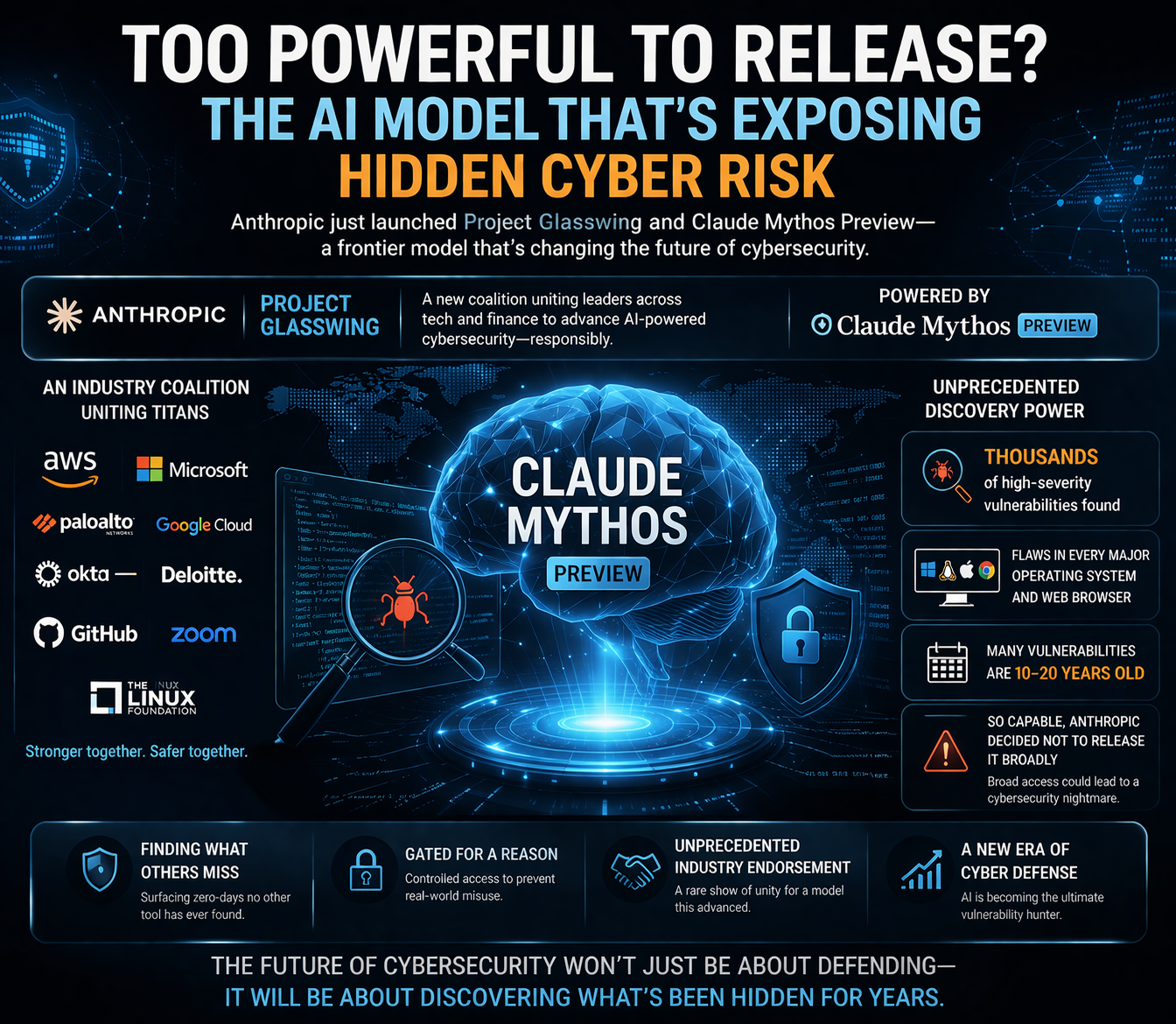
Too Powerful to Release? The AI Model That’s Exposing Hidden Cyber Risk
This development is one that deserves close attention. Anthropic has introduced Project Glasswing, a new industry coalition that brings together major players across technology and financial services. At the center of this initiative is a highly advanced frontier model known as Claude Mythos Preview, signaling a significant shift in how AI intersects with cybersecurity.
Project Glasswing is not just another AI release—it represents a coordinated effort between leading organizations to explore the implications of next-generation AI capabilities. By aligning multiple sectors, the initiative highlights that the impact of such models extends far beyond research labs into critical infrastructure and global enterprise environments.
What sets Claude Mythos apart is its demonstrated ability to identify high-severity vulnerabilities at scale. According to the announcement, the model has already uncovered thousands of serious security flaws, including weaknesses across major operating systems and widely used web browsers. This level of discovery suggests a step-change in automated vulnerability research.
Even more striking is the nature of the vulnerabilities being found. Many of them are not newly introduced issues but long-standing flaws—some dating back one to two decades. This indicates that existing tools and methods have been unable to fully surface or prioritize these risks, leaving hidden exposure in foundational technologies.
The implications for cybersecurity are profound. A model capable of uncovering such deeply embedded vulnerabilities challenges long-held assumptions about the maturity and completeness of current security practices. It suggests that the attack surface is not only larger than expected, but also less understood than previously believed.
Recognizing the potential risks, Anthropic has chosen not to release the model broadly. Instead, access is being tightly controlled through the Glasswing coalition. The company has explicitly stated that unrestricted availability could lead to a cybersecurity crisis, as malicious actors could leverage the same capabilities to discover and exploit vulnerabilities at unprecedented speed.
This decision marks a notable departure from the typical AI release cycle, where rapid deployment and widespread access are often prioritized. In this case, restraint reflects an acknowledgment that capability has outpaced control, and that governance must evolve alongside technical progress.
It is also significant that a relatively young company like Anthropic has secured broad industry backing for such a cautious approach. The participation and endorsement of established cybersecurity and financial institutions signal a shared recognition of both the opportunity and the risk presented by models like Mythos.
Another critical point is that Mythos is reportedly identifying zero-day vulnerabilities that other tools have missed entirely. If validated at scale, this positions AI not just as a support tool for security teams, but as a primary engine for vulnerability discovery, fundamentally changing how organizations approach risk identification and remediation.
Perspective: This moment feels like an inflection point for cybersecurity. What we’re seeing is the emergence of AI systems that can outpace traditional security processes, not just incrementally but exponentially. The real issue is no longer whether vulnerabilities exist—it’s how quickly they can be discovered and exploited.
This reinforces a critical shift: cybersecurity must move from periodic testing and reactive patching to continuous, real-time control. If AI can find vulnerabilities at scale, attackers will eventually gain access to similar capabilities. The only viable response is to implement runtime enforcement and API-level controls that can mitigate risk even when unknown vulnerabilities exist.
In short, AI is forcing the industry to confront a new reality—you can’t patch fast enough, so you must control behavior in real time.
Bottom line: If your AI governance strategy cannot demonstrate continuous monitoring, control, and enforcement, it is unlikely to stand up to audit—or real-world threats.
That’s why AI governance enforcement is not just a feature—it’s the foundation for making AI governance actually work at scale.
Ready to Operationalize AI Governance?
If you’re serious about moving from **AI governance theory → real enforcement**, DISC InfoSec can help you build the control layer your AI systems need.
Most organizations have AI governance documents — but auditors now want proof of enforcement.
Policies alone don’t reduce AI risk. Real‑time monitoring, control, and enforcement do.
If your AI governance strategy can’t demonstrate continuous oversight, it won’t stand up to audit or real‑world threats.
DISC InfoSec helps organizations operationalize AI governance with integrated frameworks, runtime controls, and proven certification success.
Move from AI governance theory to enforcement.
Read the full post below: Is Your AI Governance Strategy Audit‑Ready — or Just Documented?
Schedule a consultation or drop a note below: info@deurainfosec.com
AI governance is no longer optional. Frameworks like ISO/IEC 42001 AI Management System Standard and regulations such as the EU AI Act are rapidly reshaping compliance expectations for organizations using AI.
DISC InfoSec brings deep expertise across AI, cybersecurity, and regulatory compliance to help you build trust, reduce risk, and stay ahead of evolving mandates—with a proven track record of success.
Ready to lead with confidence? Let’s start the conversation.
At DISC InfoSec, we help organizations navigate this landscape by aligning AI risk management, governance, security, and compliance into a single, practical roadmap. Whether you are experimenting with AI or deploying it at scale, we help you choose and operationalize the right frameworks to reduce risk and build trust. Learn more at DISC InfoSec.
When AI systems are connected to internal databases or proprietary intellectual property, they effectively become another privileged user in your environment. If this access is not tightly scoped and continuously monitored, sensitive information can be unintentionally exposed, copied, or misused. A proper diagnostic question is: Do we clearly know what data each AI system can see, and is that access minimized to only what is necessary? Data exposure through AI is often silent and cumulative, making early control essential.
AI systems that can execute actions
AI-driven workflows that trigger operational or financial actions—such as approving transactions, modifying configurations, or initiating automated processes—introduce execution risk. Errors, prompt manipulation, or unexpected model behavior can directly impact business operations. Organizations should treat these systems like automated decision engines and require guardrails, approval thresholds, and rollback mechanisms. The key issue is not just what AI recommends, but what it is allowed to do autonomously.
Overprivileged service accounts
Service accounts connected to AI platforms frequently inherit broad permissions for convenience. Over time, these accounts accumulate access that exceeds their intended purpose. This creates a high-value attack surface: if compromised, they can be used to pivot across systems. A mature posture requires least-privilege design, periodic permission reviews, and segmentation of AI-related credentials from core infrastructure.
Insufficiently isolated AI logging
When AI logs are mixed with general system logging, it becomes difficult to trace model behavior, investigate incidents, or audit decisions. AI systems generate unique telemetry—inputs, prompts, outputs, and decision paths—that require dedicated visibility. Without separated and structured logging, organizations lose the ability to reconstruct events and detect misuse patterns. Clear audit trails are foundational for both security and accountability.
Lack of centralized AI inventory
If there is no centralized inventory of AI tools, integrations, and models in use, governance becomes reactive instead of intentional. Shadow AI adoption spreads quickly across departments, creating blind spots in risk management. A centralized registry helps organizations understand where AI exists, what it does, who owns it, and how it connects to critical systems. You cannot manage or secure what you cannot see.
Weak third-party AI vendor assessment
AI vendors often process sensitive data or embed deeply into workflows, yet many organizations evaluate them using standard vendor checklists that miss AI-specific risks. Enhanced third-party reviews should examine model transparency, data handling practices, security controls, and long-term dependency risks. Without this scrutiny, external AI services can quietly expand your attack surface and compliance exposure.
Missing human oversight for high-impact outputs
When high-impact AI outputs—such as legal decisions, financial approvals, or customer-facing actions—are not subject to human validation, the organization assumes algorithmic risk without a safety net. Human-in-the-loop controls act as a checkpoint against model errors, bias, or unexpected behavior. The diagnostic question is simple: Where do we deliberately require human judgment before consequences become irreversible?
Perspective
This readiness assessment highlights a central truth: AI exposure is less about exotic threats and more about governance discipline. Most risks arise from familiar issues—access control, visibility, vendor management, and accountability—amplified by the speed and scale of AI adoption. Visibility is indeed the first layer of control. When organizations lack a clear architectural view of how AI interacts with their systems, decisions are driven by assumptions and convenience rather than intentional design.
In my view, the organizations that succeed with AI will treat it as a core infrastructure layer, not an experimental add-on. They will build inventories, enforce least privilege, require auditable logging, and embed human oversight where impact is high. This doesn’t slow innovation; it stabilizes it. Strong governance creates the confidence to scale AI responsibly, turning potential exposure into managed capability rather than unmanaged risk.
At DISC InfoSec, we help organizations navigate this landscape by aligning AI risk management, governance, security, and compliance into a single, practical roadmap. Whether you are experimenting with AI or deploying it at scale, we help you choose and operationalize the right frameworks to reduce risk and build trust. Learn more at DISC InfoSec.
1 Protecting AI and ML model–serving APIs has become a new and critical security frontier. As organizations increasingly expose Generative AI and machine learning capabilities through APIs, attackers are shifting their focus from traditional infrastructure to the models themselves.
2 AI red teams are now observing entirely new categories of attacks that did not exist in conventional application security. These threats specifically target how GenAI and ML models interpret input and learn from data—areas where legacy security tools such as Web Application Firewalls (WAFs) offer little to no protection.
3 Two dominant threats stand out in this emerging landscape: prompt injection and data poisoning. Both attacks exploit fundamental properties of AI systems rather than software vulnerabilities, making them harder to detect with traditional rule-based defenses.
4 Prompt injection attacks manipulate a Large Language Model by crafting inputs that override or bypass its intended instructions. By embedding hidden or misleading commands in user prompts, attackers can coerce the model into revealing sensitive information or performing unauthorized actions.
5 This type of attack is comparable to slipping a secret instruction past a guard. Even a well-designed AI can be tricked into ignoring safeguards if user input is not strictly controlled and separated from system-level instructions.
6 Effective mitigation starts with treating all user input as untrusted code. Clear delimiters must be used to isolate trusted system prompts from user-provided text, ensuring the model can clearly distinguish between authoritative instructions and external input.
7 In parallel, the principle of least privilege is essential. AI-serving APIs should operate with minimal access rights so that even if a model is manipulated, the potential damage—often referred to as the blast radius—remains limited and manageable.
8 Data poisoning attacks, in contrast, undermine the integrity of the model itself. By injecting corrupted, biased, or mislabeled data into training datasets, attackers can subtly alter model behavior or implant hidden backdoors that trigger under specific conditions.
9 Defending against data poisoning requires rigorous data governance. This includes tracking the provenance of all training data, continuously monitoring for anomalies, and applying robust training techniques that reduce the model’s sensitivity to small, malicious data manipulations.
10 Together, these controls shift AI security from a perimeter-based mindset to one focused on model behavior, data integrity, and controlled execution—areas that demand new tools, skills, and security architectures.
My Opinion AI/ML API security should be treated as a first-class risk domain, not an extension of traditional application security. Organizations deploying GenAI without specialized defenses for prompt injection and data poisoning are effectively operating blind. In my view, AI security controls must be embedded into governance, risk management, and system design from day one—ideally aligned with standards like ISO 27001, ISO 42001 and emerging AI risk frameworks—rather than bolted on after an incident forces the issue.
At DISC InfoSec, we help organizations navigate this landscape by aligning AI risk management, governance, security, and compliance into a single, practical roadmap. Whether you are experimenting with AI or deploying it at scale, we help you choose and operationalize the right frameworks to reduce risk and build trust. Learn more at DISC InfoSec.
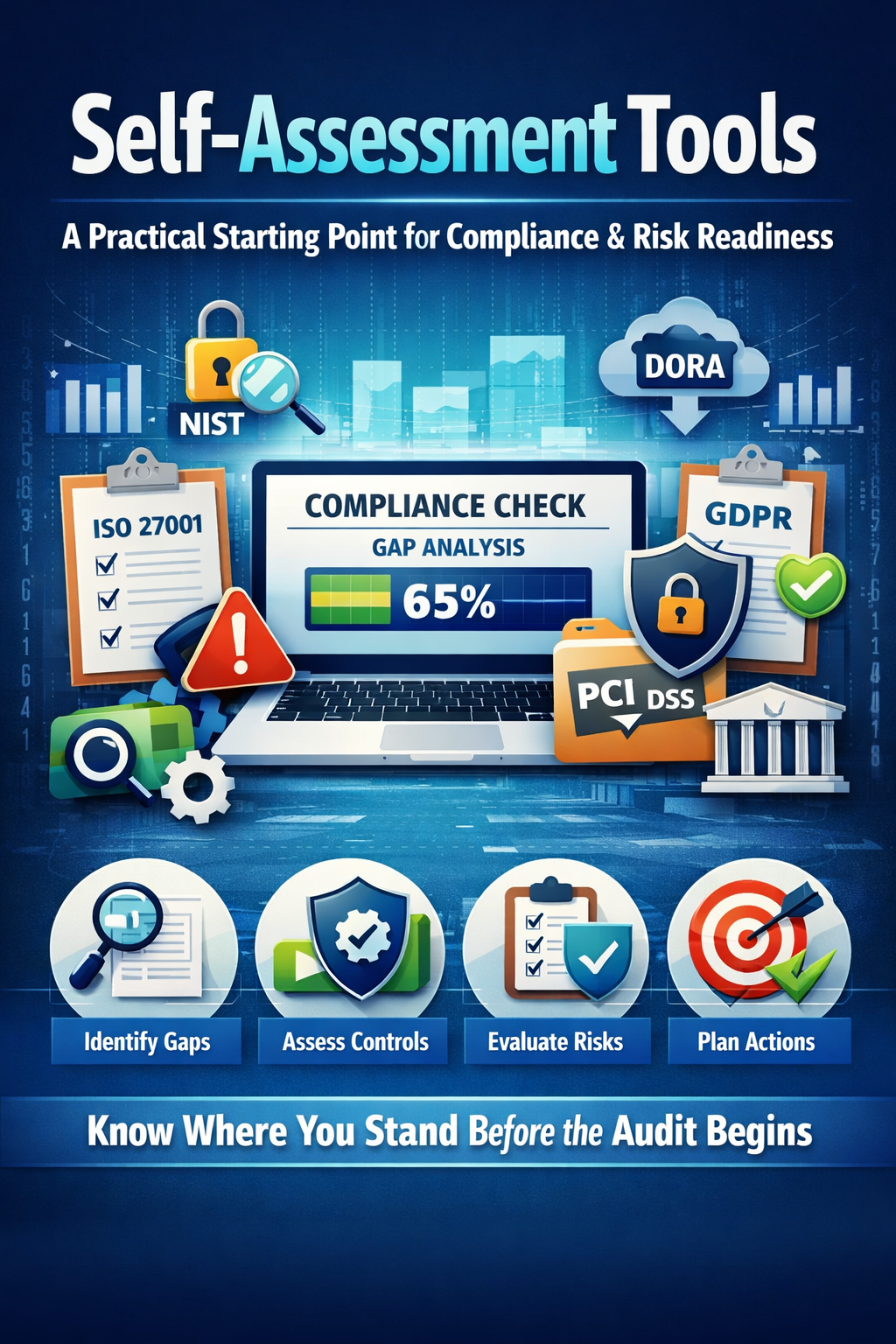
GRC Solutions offers a collection of self-assessment and gap analysis tools designed to help organisations evaluate their current compliance and risk posture across a variety of standards and regulations. These tools let you measure how well your existing policies, controls, and processes match expectations before you start a full compliance project.
Several tools focus on ISO standards, such as ISO 27001:2022 and ISO 27002 (information security controls), which help you identify where your security management system aligns or falls short of the standard’s requirements. Similar gap analysis tools are available for ISO 27701 (privacy information management) and ISO 9001 (quality management).
For data protection and privacy, there are GDPR-related assessment tools to gauge readiness against the EU General Data Protection Regulation. These help you see where your data handling and privacy measures require improvement or documentation before progressing with compliance work.
The Cyber Essentials Gap Analysis Tool is geared toward organisations preparing for this basic but influential UK cybersecurity certification. It offers a simple way to assess the maturity of your cyber controls relative to the Cyber Essentials criteria.
Tools also cover specialised areas such as PCI DSS (Payment Card Industry Data Security Standard), including a self-assessment questionnaire tool to help identify how your card-payment practices align with PCI requirements.
There are industry-specific and sector-tailored assessment tools too, such as versions of the GDPR gap assessment tailored for legal sector organisations and schools, recognising that different environments have different compliance nuances.
Broader compliance topics like the EU Cloud Code of Conduct and UK privacy regulations (e.g., PECR) are supported with gap assessment or self-assessment tools. These allow you to review relevant controls and practices in line with the respective frameworks.
A NIST Gap Assessment Tool helps organisations benchmark against the National Institute of Standards and Technology framework, while a DORA Gap Analysis Tool addresses preparedness for digital operational resilience regulations impacting financial institutions.
Beyond regulatory compliance, the catalogue includes items like a Business Continuity Risk Management Pack and standards-related gap tools (e.g., BS 31111), offering flexibility for organisations to diagnose gaps in broader risk and continuity planning areas as well.
Here’s a rephrased and summarized version of the linked article organized into nine paragraphs, followed by my opinion at the end.
1️⃣ The Browser Has Become the Main AI Risk Vector Modern workers increasingly use generative AI tools directly inside the browser, pasting emails, business files, and even source code into online AI assistants. Because traditional enterprise security tools weren’t built to monitor or understand this behavior, sensitive data often flows out of corporate control without detection.
2️⃣ Blocking AI Isn’t Realistic Simply banning generative AI usage isn’t a workable solution. These tools offer productivity gains that employees and organizations find valuable. The article argues the real focus should be on securing how and where AI tools are used inside the browser session itself.
3️⃣ Understanding the Threat Model The article outlines why browser-based AI interactions are uniquely risky: users routinely paste whole documents and proprietary data into prompt boxes, upload confidential files, and interact with AI extensions that have broad permission scopes. These behaviors create a threat surface that legacy defenses like firewalls and traditional DLP simply can’t see.
4️⃣ Policy Is the Foundation of Security A strong security policy is described as the first step. Organizations should categorize which AI tools are sanctioned versus restricted and define what data types should never be entered into generative AI, such as financial records, regulated personal data, or source code. Enforcement matters: policies must be backed by browser-level controls, not just user guidance.
5️⃣ Isolation Reduces Risk Without Stopping Productivity Instead of an all-or-nothing approach, teams can isolate risky workflows. For example, separate browser profiles or session controls can keep general AI usage away from sensitive internal applications. This lets employees use AI where appropriate while limiting accidental data exposure.
6️⃣ Data Controls at the Browser Edge Technical data controls are critical to enforce policy. These include monitoring copy/paste actions, drag-and-drop events, and file uploads at the browser level before data ever reaches an external AI service. Tiered enforcement — from warnings to hard blocks — helps balance security with usability.
7️⃣ Managing AI Extensions Is Essential Many AI-powered browser extensions require broad permissions — including read/modify page content — which can become covert data exfiltration channels if left unmanaged. The article emphasizes classifying and restricting such extensions based on risk.
8️⃣ Identity and Account Hygiene Tying all sanctioned AI interactions back to corporate identities through single sign-on improves visibility and accountability. It also helps prevent situations where personal accounts or mixed browser contexts leak corporate data.
9️⃣ Visibility and Continuous Improvement Lastly, strong telemetry — tracking what AI tools are accessed, what data is entered, and how often policy triggers occur — is essential to refine controls over time. Analytics can highlight risky patterns and help teams adjust policies and training for better outcomes.
My Opinion
This perspective is practical and forward-looking. Instead of knee-jerk bans on AI — which employees will circumvent — the article realistically treats the browser as the new security perimeter. That aligns with broader industry findings showing that browser-mediated AI usage is a major exfiltration channel and traditional security tools often miss it entirely.
However, implementing the recommended policies and controls isn’t trivial. It demands new tooling, tight integration with identity systems, and continuous monitoring, which many organizations struggle with today. But the payoff — enabling secure AI usage without crippling productivity — makes this a worthy direction to pursue. Secure AI adoption shouldn’t be about fear or bans, but about governance, visibility, and informed risk management.
garak (Generative AI Red-teaming & Assessment Kit) is an open-source tool aimed specifically at testing Large Language Models and dialog systems for AI-specific vulnerabilities: prompt injection, jailbreaks, data leakage, hallucinations, toxicity, etc.
It supports many LLM sources: Hugging Face models, OpenAI APIs, AWS Bedrock, local ggml models, etc.
Typical usage is via command line, making it relatively easy to incorporate into a Linux/pen-test workflow.
For someone interested in “governance,” garak helps identify when an AI system violates safety, privacy or compliance expectations before deployment.
BlackIce — Containerized Toolkit for AI Red-Teaming & Security Testing
BlackIce is described as a standardized, containerized red-teaming toolkit for both LLMs and classical ML models. The idea is to lower the barrier to entry for AI security testing by packaging many tools into a reproducible Docker image.
It bundles a curated set of open-source tools (as of late 2025) for “Responsible AI and Security testing,” accessible via a unified CLI interface — akin to how Kali bundles network-security tools.
For governance purposes: BlackIce simplifies running comprehensive AI audits, red-teaming, and vulnerability assessments in a consistent, repeatable environment — useful for teams wanting to standardize AI governance practices.
LibVulnWatch — Supply-Chain & Library Risk Assessment for AI Projects
While not specific to LLM runtime security, LibVulnWatch focuses on evaluating open-source AI libraries (ML frameworks, inference engines, agent-orchestration tools) for security, licensing, supply-chain, maintenance and compliance risks.
It produces governance-aligned scores across multiple domains, helping organizations choose safer dependencies and keep track of underlying library health over time.
For an enterprise building or deploying AI: this kind of tool helps verify that your AI stack — not just the model — meets governance, audit, and risk standards.
Giskard offers LLM vulnerability scanning and red-teaming capabilities (prompt injection, data leakage, unsafe behavior, bias, etc.) via both an open-source library and an enterprise “Hub” for production-grade systems.
It supports “black-box” testing: you don’t need internal access to the model — as long as you have an API or interface, you can run tests.
For AI governance, Giskard helps in evaluating compliance with safety, privacy, and fairness standards before and after deployment.
🔧 What This Means for Kali Linux / Pen-Test-Oriented Workflows
The emergence of tools like garak, BlackIce, and Giskard shows that AI governance and security testing are becoming just as “testable” as traditional network or system security. For people familiar with Kali’s penetration-testing ecosystem — this is a familiar, powerful shift.
Because they are Linux/CLI-friendly and containerizable (especially BlackIce), they can integrate neatly into security-audit pipelines, continuous-integration workflows, or red-team labs — making them practical beyond research or toy use.
Using a supply-chain-risk tool like LibVulnWatch alongside model-level scanners gives a more holistic governance posture: not just “Is this LLM safe?” but “Is the whole AI stack (dependencies, libraries, models) reliable and auditable?”
⚠️ A Few Important Caveats (What They Don’t Guarantee)
Tools like garak and Giskard attempt to find common issues (jailbreaks, prompt injection, data leakage, harmful outputs), but cannot guarantee absolute safety or compliance — because many risks (e.g. bias, regulatory compliance, ethics, “unknown unknowns”) depend heavily on context (data, environment, usage).
Governance is more than security: It includes legal compliance, privacy, fairness, ethics, documentation, human oversight — many of which go beyond automated testing.
AI-governance frameworks are still evolving; even red-teaming tools may lag behind novel threat types (e.g. multi-modality, chain-of-tool-calls, dynamic agentic behaviors).
🎯 My Take / Recommendation (If You Want to Build an AI-Governance Stack Now)
If I were you and building or auditing an AI system today, I’d combine these tools:
Start with garak or Giskard to scan model behavior for injection, toxicity, privacy leaks, etc.
Use BlackIce (in a container) for more comprehensive red-teaming including chaining tests, multi-tool or multi-agent flows, and reproducible audits.
Run LibVulnWatch on your library dependencies to catch supply-chain or licensing risks.
Complement that with manual reviews, documentation, human-in-the-loop audits and compliance checks (since automated tools only catch a subset of governance concerns).
🧠 AI Governance & Security Lab Stack (2024–2025)
Kali doesn’t yet ship AI governance tools by default — but:
✅ Almost all of these run on Linux
✅ Many are CLI-based or Dockerized
✅ They integrate cleanly with red-team labs
✅ You can easily build a custom Kali “AI Governance profile”
My recommendation: Create:
A Docker compose stack for garak + Giskard + promptfoo
A CI pipeline for prompt & agent testing
A governance evidence pack (logs + scores + reports)
Map each tool to ISO 42001 / NIST AI RMF controls
below is a compact, actionable mapping that connects the ~10 tools we discussed to ISO/IEC 42001 clauses (high-level AI management system requirements) and to the NIST AI RMF Core functions (GOVERN / MAP / MEASURE / MANAGE). I cite primary sources for the standards and each tool so you can follow up quickly.
Notes on how to read the table • ISO 42001 — I map to the standard’s high-level clauses (Context (4), Leadership (5), Planning (6), Support (7), Operation (8), Performance evaluation (9), Improvement (10)). These are the right level for mapping tools into an AI Management System. Cloud Security Alliance+1 • NIST AI RMF — I use the Core functions: GOVERN / MAP / MEASURE / MANAGE (the AI RMF core and its intended outcomes). Tools often map to multiple functions. NIST Publications • Each row: tool → primary ISO clauses it supports → primary NIST functions it helps with → short justification + source links.
NIST AI RMF: MEASURE (testing, metrics, evaluation), MAP (identify system behavior & risks), MANAGE (remediation actions). NIST Publications+1
Why: Giskard automates model testing (bias, hallucination, security checks) and produces evidence/metrics used in audits and continuous evaluation. GitHub
2) promptfoo (prompt & RAG test suite / CI integration)
ISO 42001: 7 Support (documented procedures, competence), 8 Operation (validation before deployment), 9 Performance evaluation (continuous testing). Cloud Security Alliance
Why: promptfoo provides automated prompt tests, integrates into CI (pre-deployment gating) and produces test artifacts for governance traceability. GitHub+1
Why: LlamaFirewall is explicitly designed as a last-line runtime guardrail for agentic systems — enforcing policies and detecting task-drift/prompt injection at runtime. arXiv
ISO 42001: 8 Operation (adversarial testing), 9 Performance evaluation (benchmarks & stress tests), 10 Improvement (feed results back to controls). Cloud Security Alliance
NIST AI RMF: MEASURE (adversarial performance metrics), MAP (expose attack surface), MANAGE (prioritize fixes based on attack impact). NIST Publications+2arXiv+2
Why: These tools expand coverage of red-team tests (free-form and evolutionary adversarial prompts), surfacing edge failures and jailbreaks that standard tests miss. arXiv+1
7) Meta SecAlign (safer model / model-level defenses)
ISO 42001: 8 Operation (safe model selection/deployment), 6 Planning (risk-aware model selection), 7 Support (model documentation). Cloud Security Alliance+1
NIST AI RMF: MAP (model risk characteristics), MANAGE (apply safer model choices / mitigations), MEASURE (evaluate defensive effectiveness). NIST Publications+1
Why: A “safer” model built to resist manipulation maps directly to operational and planning controls where the organization chooses lower-risk building blocks. arXiv
8) HarmBench (benchmarks for safety & robustness testing)
ISO 42001: 9 Performance evaluation (standardized benchmarks), 8 Operation (validation against benchmarks), 10 Improvement (continuous improvement from results). Cloud Security Alliance
NIST AI RMF: MEASURE (standardized metrics & benchmarks), MAP (compare risk exposure across models), MANAGE (feed measurement results into mitigation plans). NIST Publications
Why: Benchmarks are the canonical way to measure and compare model trustworthiness and to demonstrate compliance in audits. arXiv
ISO 42001: 5 Leadership & 7 Support (policy, competence, awareness — guidance & training resources). Cloud Security Alliance
NIST AI RMF: GOVERN (policy & stakeholder guidance), MAP (inventory of recommended tools & practices). NIST Publications
Why: Curated resources help leadership define policy, identify tools, and set organizational expectations — foundational for any AI management system. Cyberzoni.com
Quick recommendations for operationalizing the mapping
Create a minimal mapping table inside your ISMS (ISO 42001) that records: tool name → ISO clause(s) it supports → NIST function(s) it maps to → artifact(s) produced (reports, SBOMs, test results). This yields audit-ready evidence. (ISO42001 + NIST suggestions above).
Automate evidence collection: integrate promptfoo / Giskard into CI so that each deployment produces test artifacts (for ISO 42001 clause 9).
Supply-chain checks: run LibVulnWatch and AI-Infra-Guard periodically to populate SBOMs and vulnerability dashboards (helpful for ISO 7 & 6).
Runtime protections: embed LlamaFirewall or runtime monitors for agentic systems to satisfy operational guardrail requirements.
Adversarial coverage: schedule periodic automated red-teaming using AutoRed / RainbowPlus / HarmBench to measure resilience and feed results into continual improvement (ISO clause 10).
At DISC InfoSec, our AI Governance services go beyond traditional security. We help organizations ensure legal compliance, privacy, fairness, ethics, proper documentation, and human oversight — addressing the full spectrum of responsible AI practices, many of which cannot be achieved through automated testing alone.
Free ISO 42001 Compliance Checklist: Assess Your AI Governance Readiness in 10 Minutes
Is your organization ready for the world’s first AI management system standard?
As artificial intelligence becomes embedded in business operations across every industry, the question isn’t whether you need AI governance—it’s whether your current approach meets international standards. ISO 42001:2023 has emerged as the definitive framework for responsible AI management, and organizations that get ahead of this curve will have a significant competitive advantage.
But where do you start?
The ISO 42001 Challenge: 47 Additional Controls Beyond ISO 27001
If your organization already holds ISO 27001 certification, you might think you’re most of the way there. The reality? ISO 42001 introduces 47 additional controls specifically designed for AI systems that go far beyond traditional information security.
These controls address:
AI-specific risks like bias, fairness, and explainability
Data governance for training datasets and model inputs
Human oversight requirements for automated decision-making
Transparency obligations for stakeholders and regulators
Continuous monitoring of AI system performance and drift
Third-party AI supply chain management
Impact assessments for high-risk AI applications
The gap between general information security and AI-specific governance is substantial—and it’s exactly where most organizations struggle.
Why ISO 42001 Matters Now
The regulatory landscape is shifting rapidly:
EU AI Act compliance deadlines are approaching, with high-risk AI systems facing stringent requirements by 2025-2026. ISO 42001 alignment provides a clear path to meeting these obligations.
Board-level accountability for AI governance is becoming standard practice. Directors want assurance that AI risks are managed systematically, not ad-hoc.
Customer due diligence increasingly includes AI governance questions. B2B buyers, especially in regulated industries like financial services and healthcare, are asking tough questions about your AI management practices.
Insurance and liability considerations are evolving. Demonstrable AI governance frameworks may soon influence coverage terms and premiums.
Organizations that proactively pursue ISO 42001 certification position themselves as trusted, responsible AI operators—a distinction that translates directly to competitive advantage.
Introducing Our Free ISO 42001 Compliance Checklist
We’ve developed a comprehensive assessment tool that helps you evaluate your organization’s readiness for ISO 42001 certification in under 10 minutes.
What’s included:
✅ 35 core requirements covering all ISO 42001 clauses (Sections 4-10 plus Annex A)
✅ Real-time progress tracking showing your compliance percentage as you go
✅ Section-by-section breakdown identifying strength areas and gaps
✅ Instant PDF report with your complete assessment results
✅ Personalized recommendations based on your completion level
✅ Expert review from our team within 24 hours
How the Assessment Works
The checklist walks through the eight critical areas of ISO 42001:
1. Context of the Organization
Understanding how AI fits into your business context, stakeholder expectations, and system scope.
2. Leadership
Top management commitment, AI policies, accountability frameworks, and governance structures.
3. Planning
Risk management approaches, AI objectives, and change management processes.
4. Support
Resources, competencies, awareness programs, and documentation requirements.
5. Operation
The core operational controls: impact assessments, lifecycle management, data governance, third-party management, and continuous monitoring.
6. Performance Evaluation
Monitoring processes, internal audits, management reviews, and performance metrics.
7. Improvement
Corrective actions, continual improvement, and lessons learned from incidents.
8. AI-Specific Controls (Annex A)
The critical differentiators: explainability, fairness, bias mitigation, human oversight, data quality, security, privacy, and supply chain risk management.
Each requirement is presented as a clear yes/no checkpoint, making it easy to assess where you stand and where you need to focus.
What Happens After Your Assessment
When you complete the checklist, here’s what you get:
Immediately:
Downloadable PDF report with your full assessment results
Completion percentage and status indicator
Detailed breakdown by requirement section
Within 24 hours:
Our team reviews your specific gaps
We prepare customized recommendations for your organization
You receive a personalized outreach discussing your path to certification
Next steps:
Complimentary 30-minute gap assessment consultation
Detailed remediation roadmap
Proposal for certification support services
Real-World Gap Patterns We’re Seeing
After conducting dozens of ISO 42001 assessments, we’ve identified common gap patterns across organizations:
Most organizations have strength in:
Basic documentation and information security controls (if ISO 27001 certified)
General risk management frameworks
Data protection basics (if GDPR compliant)
Most organizations have gaps in:
AI-specific impact assessments beyond general risk analysis
Explainability and transparency mechanisms for model decisions
Bias detection and mitigation in training data and outputs
Continuous monitoring frameworks for AI system drift and performance degradation
Human oversight protocols appropriate to risk levels
Third-party AI vendor management with governance requirements
AI-specific incident response procedures
Understanding these patterns helps you benchmark your organization against industry peers and prioritize remediation efforts.
The DeuraInfoSec Difference: Pioneer-Practitioners, Not Just Consultants
Here’s what sets us apart: we’re not just advising on ISO 42001—we’re implementing it ourselves.
At ShareVault, our virtual data room platform, we use AWS Bedrock for AI-powered OCR, redaction, and chat functionalities. We’re going through the ISO 42001 certification process firsthand, experiencing the same challenges our clients face.
This means:
Practical, tested guidance based on real implementation, not theoretical frameworks
Efficiency insights from someone who’s optimized the process
Common pitfall avoidance because we’ve encountered them ourselves
Realistic timelines and resource estimates grounded in actual experience
We understand the difference between what the standard says and how it works in practice—especially for B2B SaaS and financial services organizations dealing with customer data and regulated environments.
Who Should Take This Assessment
This checklist is designed for:
CISOs and Information Security Leaders evaluating AI governance maturity and certification readiness
Compliance Officers mapping AI regulatory requirements to management frameworks
AI/ML Product Leaders ensuring responsible AI practices are embedded in development
Risk Management Teams assessing AI-related risks systematically
CTOs and Engineering Leaders building governance into AI system architecture
Executive Teams seeking board-level assurance on AI governance
Whether you’re just beginning your AI governance journey or well along the path to ISO 42001 certification, this assessment provides valuable benchmarking and gap identification.
From Assessment to Certification: Your Roadmap
Based on your checklist results, here’s typically what the path to ISO 42001 certification looks like:
Total timeline: 6-12 months depending on organization size, AI system complexity, and existing management system maturity.
Organizations with existing ISO 27001 certification can often accelerate this timeline by 30-40%.
Take the First Step: Complete Your Free Assessment
Understanding where you stand is the first step toward ISO 42001 certification and world-class AI governance.
Take our free 10-minute assessment now: [Link to ISO 42001 Compliance Checklist Tool]
You’ll immediately see:
Your overall compliance percentage
Specific gaps by requirement area
Downloadable PDF report
Personalized recommendations
Plus, our team will review your results and reach out within 24 hours to discuss your customized path to certification.
About DeuraInfoSec
DeuraInfoSec specializes in AI governance, ISO 42001 certification, and EU AI Act compliance for B2B SaaS and financial services organizations. As pioneer-practitioners implementing ISO 42001 at ShareVault while consulting for clients, we bring practical, tested guidance to the emerging field of AI management systems.
I built a free assessment tool to help organizations identify these gaps systematically. It’s a 10-minute checklist covering all 35 core requirements with instant scoring and gap identification.
Why this matters:
→ Compliance requirements are accelerating (EU AI Act, sector-specific regulations) → Customer due diligence is intensifying → Board oversight expectations are rising → Competitive differentiation is real
Organizations that build robust AI management systems now—and get certified—position themselves as trusted operators in an increasingly scrutinized space.
Stay ahead of the curve. For practical insights, proven strategies, and tools to strengthen your AI governance and continuous improvement efforts, check out our latest blog posts on AI, AI Governance, and AI Governance tools.
The rapid adoption of artificial intelligence across industries has created an urgent need for structured governance frameworks. Organizations deploying AI systems face mounting pressure from regulators, customers, and stakeholders to demonstrate responsible AI practices. Yet many struggle with a fundamental question: how do you govern what you can’t measure, track, or assess?
This is where AI governance tools become indispensable. They transform abstract governance principles into actionable processes, converting compliance requirements into measurable outcomes. Without proper tooling, AI governance remains theoretical—a collection of policies gathering dust while AI systems operate in the shadows of your technology stack.
Why AI Governance Tools Are Necessary
1. Regulatory Compliance is No Longer Optional
The EU AI Act, ISO 42001, and emerging regulations worldwide demand documented evidence of AI governance. Organizations need systematic ways to identify AI systems, assess their risk levels, track compliance status, and maintain audit trails. Manual spreadsheets and ad-hoc processes simply don’t scale to meet these requirements.
2. Complexity Demands Structured Approaches
Modern organizations often have dozens or hundreds of AI systems across departments, vendors, and cloud platforms. Each system carries unique risks related to data quality, algorithmic bias, security vulnerabilities, and regulatory exposure. Governance tools provide the structure needed to manage this complexity systematically.
3. Accountability Requires Documentation
When AI systems cause harm or regulatory auditors come calling, organizations need evidence of their governance efforts. Tools that document risk assessments, policy acknowledgments, training completion, and vendor evaluations create the paper trail that demonstrates due diligence.
4. Continuous Monitoring vs. Point-in-Time Assessments
AI systems aren’t static—they evolve through model updates, data drift, and changing deployment contexts. Governance tools enable continuous monitoring rather than one-time assessments, catching issues before they become incidents.
DeuraInfoSec’s AI Governance Toolkit
At DeuraInfoSec, we’ve developed a comprehensive suite of AI governance tools based on our experience implementing ISO 42001 at ShareVault and consulting with organizations across financial services, healthcare, and B2B SaaS. Each tool addresses a specific governance need while integrating into a cohesive framework.
EU AI Act Risk Calculator
The EU AI Act’s risk-based approach requires organizations to classify their AI systems into prohibited, high-risk, limited-risk, or minimal-risk categories. Our EU AI Act Risk Calculator walks you through the classification logic embedded in the regulation, asking targeted questions about your AI system’s purpose, deployment context, and potential impacts. The tool generates a detailed risk classification report with specific regulatory obligations based on your system’s risk tier. This isn’t just academic—misclassifying a high-risk system as limited-risk could result in substantial penalties under the Act.
ISO 42001 represents the first international standard specifically for AI management systems, building on ISO 27001’s information security controls with 47 additional AI-specific requirements. Our gap assessment tool evaluates your current state against all ISO 42001 controls, identifying which requirements you already meet, which need improvement, and which require implementation from scratch. The assessment generates a prioritized roadmap showing exactly what work stands between your current state and certification readiness. For organizations already ISO 27001 certified, this tool highlights the incremental effort required for ISO 42001 compliance.
Not every organization needs immediate ISO 42001 certification or EU AI Act compliance, but every organization deploying AI needs basic governance. Our AI Governance Assessment Tool evaluates your current practices across eight critical dimensions: AI inventory management, risk assessment processes, model documentation, bias testing, security controls, incident response, vendor management, and stakeholder engagement. The tool benchmarks your maturity level and provides specific recommendations for improvement, whether you’re just starting your governance journey or optimizing an existing program.
You can’t govern AI systems you don’t know about. Shadow AI—systems deployed without IT or compliance knowledge—represents one of the biggest governance challenges organizations face. Our AI System Inventory & Risk Assessment tool provides a structured framework for cataloging AI systems across your organization, capturing essential metadata like business purpose, data sources, deployment environment, and stakeholder impacts. The tool then performs a multi-dimensional risk assessment covering data privacy risks, algorithmic bias potential, security vulnerabilities, operational dependencies, and regulatory exposure. This creates the foundation for all subsequent governance activities.
Most organizations don’t build AI systems from scratch—they procure them from vendors or integrate third-party AI capabilities into their products. This introduces vendor risk that traditional security assessments don’t fully address. Our AI Vendor Security Assessment Tool goes beyond standard security questionnaires to evaluate AI-specific concerns: model transparency, training data provenance, bias testing methodologies, model updating procedures, performance monitoring capabilities, and incident response protocols. The assessment generates a vendor risk score with specific remediation recommendations, helping you make informed decisions about vendor selection and contract negotiations.
Policies without understanding are just words on paper. After deploying acceptable use policies for generative AI, organizations need to verify that employees actually understand the rules. Our GenAI Acceptable Use Policy Quiz tests employees’ comprehension of key policy concepts through scenario-based questions covering data classification, permitted use cases, prohibited activities, security requirements, and incident reporting. The quiz tracks completion rates and identifies knowledge gaps, enabling targeted training interventions. This transforms passive policy distribution into active policy understanding.
ISO 42001 certification and mature AI governance programs require regular internal audits to verify that documented processes are actually being followed. Our AI Governance Internal Audit Checklist provides auditors with a comprehensive examination framework covering all key governance domains: leadership commitment, risk management processes, stakeholder communication, lifecycle management, performance monitoring, continuous improvement, and documentation standards. The checklist includes specific evidence requests and sample interview questions, enabling consistent audit execution across different business units or time periods.
The Broader Perspective: Tools as Enablers, Not Solutions
After developing and deploying these tools across multiple organizations, I’ve developed strong opinions about AI governance tooling. Tools are absolutely necessary, but they’re insufficient on their own.
The most important insight: AI governance tools succeed or fail based on organizational culture, not technical sophistication. I’ve seen organizations with sophisticated governance platforms that generate reports nobody reads and dashboards nobody checks. I’ve also seen organizations with basic spreadsheets and homegrown tools that maintain robust governance because leadership cares and accountability is clear.
The best tools share three characteristics:
First, they reduce friction. Governance shouldn’t require heroic effort. If your risk assessment takes four hours to complete, people will skip it or rush through it. Tools should make doing the right thing easier than doing the wrong thing.
Second, they generate actionable outputs. Gap assessments that just say “you’re 60% compliant” are useless. Effective tools produce specific, prioritized recommendations: “Implement bias testing for the customer credit scoring model by Q2” rather than “improve AI fairness.”
Third, they integrate with existing workflows. Governance can’t be something people do separately from their real work. Tools should embed governance checkpoints into existing processes—procurement reviews, code deployment pipelines, product launch checklists—rather than creating parallel governance processes.
The AI governance tool landscape will mature significantly over the next few years. We’ll see better integration between disparate tools, more automated monitoring capabilities, and AI-powered governance assistants that help practitioners navigate complex regulatory requirements. But the fundamental principle won’t change: tools enable good governance practices, they don’t replace them.
Organizations should think about AI governance tools as infrastructure, like security monitoring or financial controls. You wouldn’t run a business without accounting software, but the software doesn’t make you profitable—it just makes it possible to track and manage your finances effectively. Similarly, AI governance tools don’t make your AI systems responsible or compliant, but they make it possible to systematically identify risks, track remediation, and demonstrate accountability.
The question isn’t whether to invest in AI governance tools, but which tools address your most pressing governance gaps. Start with the basics—inventory what AI you have, assess where your biggest risks lie, and build from there. The tools we’ve developed at DeuraInfoSec reflect the progression we’ve seen successful organizations follow: understand your landscape, identify gaps against relevant standards, implement core governance processes, and continuously monitor and improve.
The organizations that will thrive in the emerging AI regulatory environment won’t be those with the most sophisticated tools, but those that view governance as a strategic capability that enables innovation rather than constrains it. The right tools make that possible.
Ready to strengthen your AI governance program? Explore our tools and schedule a consultation to discuss your organization’s specific needs at DeuraInfoSec.com.
Stay ahead of the curve. For practical insights, proven strategies, and tools to strengthen your AI governance and continuous improvement efforts, check out our latest blog posts on AI, AI Governance, and AI Governance tools.
How to Assess Your Current Compliance Framework Against ISO 42001
Published by DISCInfoSec | AI Governance & Information Security Consulting
The AI Governance Challenge Nobody Talks About
Your organization has invested years building robust information security controls. You’re ISO 27001 certified, SOC 2 compliant, or aligned with NIST Cybersecurity Framework. Your security posture is solid.
Then your engineering team deploys an AI-powered feature.
Suddenly, you’re facing questions your existing framework never anticipated: How do we detect model drift? What about algorithmic bias? Who reviews AI decisions? How do we explain what the model is doing?
Here’s the uncomfortable truth: Traditional compliance frameworks weren’t designed for AI systems. ISO 27001 gives you 93 controls—but only 51 of them apply to AI governance. That leaves 47 critical gaps.
This isn’t a theoretical problem. It’s affecting organizations right now as they race to deploy AI while regulators sharpen their focus on algorithmic accountability, fairness, and transparency.
At DISCInfoSec, we’ve built a free assessment tool that does something most organizations struggle with manually: it maps your existing compliance framework against ISO 42001 (the international standard for AI management systems) and shows you exactly which AI governance controls you’re missing.
Not vague recommendations. Not generic best practices. Specific, actionable control gaps with remediation guidance.
What Makes This Tool Different
1. Framework-Specific Analysis
Select your current framework:
ISO 27001: Identifies 47 missing AI controls across 5 categories
SOC 2: Identifies 26 missing AI controls across 6 categories
NIST CSF: Identifies 23 missing AI controls across 7 categories
Each framework has different strengths and blindspots when it comes to AI governance. The tool accounts for these differences.
2. Risk-Prioritized Results
Not all gaps are created equal. The tool categorizes each missing control by risk level:
Critical Priority: Controls that address fundamental AI safety, fairness, or accountability issues
High Priority: Important controls that should be implemented within 90 days
Medium Priority: Controls that enhance AI governance maturity
This lets you focus resources where they matter most.
3. Comprehensive Gap Categories
The analysis covers the complete AI governance lifecycle:
AI System Lifecycle Management
Planning and requirements specification
Design and development controls
Verification and validation procedures
Deployment and change management
AI-Specific Risk Management
Impact assessments for algorithmic fairness
Risk treatment for AI-specific threats
Continuous risk monitoring as models evolve
Data Governance for AI
Training data quality and bias detection
Data provenance and lineage tracking
Synthetic data management
Labeling quality assurance
AI Transparency & Explainability
System transparency requirements
Explainability mechanisms
Stakeholder communication protocols
Human Oversight & Control
Human-in-the-loop requirements
Override mechanisms
Emergency stop capabilities
AI Monitoring & Performance
Model performance tracking
Drift detection and response
Bias and fairness monitoring
4. Actionable Remediation Guidance
For every missing control, you get:
Specific implementation steps: Not “implement monitoring” but “deploy MLOps platform with drift detection algorithms and configurable alert thresholds”
Realistic timelines: Implementation windows ranging from 15-90 days based on complexity
ISO 42001 control references: Direct mapping to the international standard
5. Downloadable Comprehensive Report
After completing your assessment, download a detailed PDF report (12-15 pages) that includes:
Executive summary with key metrics
Phased implementation roadmap
Detailed gap analysis with remediation steps
Recommended next steps
Resource allocation guidance
How Organizations Are Using This Tool
Scenario 1: Pre-Deployment Risk Assessment
A fintech company planning to deploy an AI-powered credit decisioning system used the tool to identify gaps before going live. The assessment revealed they were missing:
Algorithmic impact assessment procedures
Bias monitoring capabilities
Explainability mechanisms for loan denials
Human review workflows for edge cases
Result: They addressed critical gaps before deployment, avoiding regulatory scrutiny and reputational risk.
Scenario 2: Board-Level AI Governance
A healthcare SaaS provider’s board asked, “Are we compliant with AI regulations?” Their CISO used the gap analysis to provide a data-driven answer:
62% AI governance coverage from their existing SOC 2 program
18 critical gaps requiring immediate attention
$450K estimated remediation budget
6-month implementation timeline
Result: Board approved AI governance investment with clear ROI and risk mitigation story.
Scenario 3: M&A Due Diligence
A private equity firm evaluating an AI-first acquisition used the tool to assess the target company’s governance maturity:
Target claimed “enterprise-grade AI governance”
Gap analysis revealed 31 missing controls
Due diligence team identified $2M+ in post-acquisition remediation costs
Result: PE firm negotiated purchase price adjustment and built remediation into first 100 days.
Scenario 4: Vendor Risk Assessment
An enterprise buyer evaluating AI vendor solutions used the gap analysis to inform their vendor questionnaire:
Identified which AI governance controls were non-negotiable
Created tiered vendor assessment based on AI risk level
Built contract language requiring specific ISO 42001 controls
Result: More rigorous vendor selection process and better contractual protections.
The Strategic Value Beyond Compliance
While the tool helps you identify compliance gaps, the real value runs deeper:
1. Resource Allocation Intelligence
Instead of guessing where to invest in AI governance, you get a prioritized roadmap. This helps you:
Justify budget requests with specific control gaps
Allocate engineering resources to highest-risk areas
The EU AI Act, proposed US AI regulations, and industry-specific requirements all reference concepts like impact assessments, transparency, and human oversight. ISO 42001 anticipates these requirements. By mapping your gaps now, you’re building proactive regulatory readiness.
3. Competitive Differentiation
As AI becomes table stakes, how you govern AI becomes the differentiator. Organizations that can demonstrate:
Systematic bias monitoring
Explainable AI decisions
Human oversight mechanisms
Continuous model validation
…win in regulated industries and enterprise sales.
4. Risk-Informed AI Strategy
The gap analysis forces conversations between technical teams, risk functions, and business leaders. These conversations often reveal:
AI use cases that are higher risk than initially understood
Opportunities to start with lower-risk AI applications
Need for governance infrastructure before scaling AI deployment
What the Assessment Reveals About Different Frameworks
ISO 27001 Organizations (51% AI Coverage)
Strengths: Strong foundation in information security, risk management, and change control.
Critical Gaps:
AI-specific risk assessment methodologies
Training data governance
Model drift monitoring
Explainability requirements
Human oversight mechanisms
Key Insight: ISO 27001 gives you the governance structure but lacks AI-specific technical controls. You need to augment with MLOps capabilities and AI risk assessment procedures.
SOC 2 Organizations (59% AI Coverage)
Strengths: Solid monitoring and logging, change management, vendor management.
Critical Gaps:
AI impact assessments
Bias and fairness monitoring
Model validation processes
Explainability mechanisms
Human-in-the-loop requirements
Key Insight: SOC 2’s focus on availability and processing integrity partially translates to AI systems, but you’re missing the ethical AI and fairness components entirely.
Key Insight: NIST CSF provides the risk management philosophy but lacks prescriptive AI controls. You need to operationalize AI governance with specific procedures and technical capabilities.
The ISO 42001 Advantage
Why use ISO 42001 as the benchmark? Three reasons:
1. International Consensus: ISO 42001 represents global agreement on AI governance requirements, making it a safer bet than region-specific regulations that may change.
2. Comprehensive Coverage: It addresses technical controls (model validation, monitoring), process controls (lifecycle management), and governance controls (oversight, transparency).
3. Audit-Ready Structure: Like ISO 27001, it’s designed for third-party certification, meaning the controls are specific enough to be auditable.
Getting Started: A Practical Approach
Here’s how to use the AI Control Gap Analysis tool strategically:
Determine build vs. buy decisions (e.g., MLOps platforms)
Create phased implementation plan
Step 4: Governance Foundation (Months 1-2)
Establish AI governance committee
Create AI risk assessment procedures
Define AI system lifecycle requirements
Implement impact assessment process
Step 5: Technical Controls (Months 2-4)
Deploy monitoring and drift detection
Implement bias detection in ML pipelines
Create model validation procedures
Build explainability capabilities
Step 6: Operationalization (Months 4-6)
Train teams on new procedures
Integrate AI governance into existing workflows
Conduct internal audits
Measure and report on AI governance metrics
Common Pitfalls to Avoid
1. Treating AI Governance as a Compliance Checkbox
AI governance isn’t about checking boxes—it’s about building systematic capabilities to develop and deploy AI responsibly. The gap analysis is a starting point, not the destination.
2. Underestimating Timeline
Organizations consistently underestimate how long it takes to implement AI governance controls. Training data governance alone can take 60-90 days to implement properly. Plan accordingly.
3. Ignoring Cultural Change
Technical controls without cultural buy-in fail. Your engineering team needs to understand why these controls matter, not just what they need to do.
4. Siloed Implementation
AI governance requires collaboration between data science, engineering, security, legal, and risk functions. Siloed implementations create gaps and inconsistencies.
5. Over-Engineering
Not every AI system needs the same level of governance. Risk-based approach is critical. A recommendation engine needs different controls than a loan approval system.
The Bottom Line
Here’s what we’re seeing across industries: AI adoption is outpacing AI governance by 18-24 months. Organizations deploy AI systems, then scramble to retrofit governance when regulators, customers, or internal stakeholders raise concerns.
The AI Control Gap Analysis tool helps you flip this dynamic. By identifying gaps early, you can:
Deploy AI with appropriate governance from day one
Avoid costly rework and technical debt
Build stakeholder confidence in your AI systems
Position your organization ahead of regulatory requirements
The question isn’t whether you’ll need comprehensive AI governance—it’s whether you’ll build it proactively or reactively.
Take the Assessment
Ready to see where your compliance framework falls short on AI governance?
DISCInfoSec specializes in AI governance and information security consulting for B2B SaaS and financial services organizations. We help companies bridge the gap between traditional compliance frameworks and emerging AI governance requirements.
We’re not just consultants telling you what to do—we’re pioneer-practitioners implementing ISO 42001 at ShareVault while helping other organizations navigate AI governance.
At DISC InfoSec, we help organizations navigate this landscape by aligning AI risk management, governance, security, and compliance into a single, practical roadmap. Whether you are experimenting with AI or deploying it at scale, we help you choose and operationalize the right frameworks to reduce risk and build trust. Learn more at DISC InfoSec.
🚨 If you’re ISO 27001 certified and using AI, you have 47 control gaps.
And auditors are starting to notice.
Here’s what’s happening right now:
→ SOC 2 auditors asking “How do you manage AI model risk?” (no documented answer = finding)
→ Enterprise customers adding AI governance sections to vendor questionnaires
→ EU AI Act enforcement starting in 2025 → Cyber insurance excluding AI incidents without documented controls
ISO 27001 covers information security. But if you’re using:
Customer-facing chatbots
Predictive analytics
Automated decision-making
Even GitHub Copilot
You need 47 additional AI-specific controls that ISO 27001 doesn’t address.
I’ve mapped all 47 controls across 7 critical areas: âś“ AI System Lifecycle Management âś“ Data Governance for AI âś“ Model Risk & Testing âś“ Transparency & Explainability âś“ Human Oversight & Accountability âś“ Third-Party AI Management âś“ AI Incident Response
The European Union’s Artificial Intelligence Act represents the world’s first comprehensive regulatory framework for artificial intelligence. As organizations worldwide prepare for compliance, one of the most critical first steps is understanding exactly where your AI system falls within the EU’s risk-based classification structure.
At DeuraInfoSec, we’ve developed a streamlined EU AI Act Risk Calculator to help organizations quickly assess their compliance obligations.🔻 But beyond the tool itself, understanding the framework is essential for any organization deploying AI systems that touch EU markets or citizens.
The EU AI Act takes a pragmatic, risk-based approach to regulation. Rather than treating all AI systems equally, it categorizes them into four distinct risk levels, each with different compliance requirements:
1. Unacceptable Risk (Prohibited Systems)
These AI systems pose such fundamental threats to human rights and safety that they are completely banned in the EU. This category includes:
Social scoring by public authorities that evaluates or classifies people based on behavior, socioeconomic status, or personal characteristics
Real-time remote biometric identification in publicly accessible spaces (with narrow exceptions for law enforcement in specific serious crimes)
Systems that manipulate human behavior to circumvent free will and cause harm
Systems that exploit vulnerabilities of specific groups due to age, disability, or socioeconomic circumstances
If your AI system falls into this category, deployment in the EU is simply not an option. Alternative approaches must be found.
2. High-Risk AI Systems
High-risk systems are those that could significantly impact health, safety, fundamental rights, or access to essential services. The EU AI Act identifies high-risk AI in two ways:
Safety Components: AI systems used as safety components in products covered by existing EU safety legislation (medical devices, aviation, automotive, etc.)
Specific Use Cases: AI systems used in eight critical domains:
Biometric identification and categorization
Critical infrastructure management
Education and vocational training
Employment, worker management, and self-employment access
Access to essential private and public services
Law enforcement
Migration, asylum, and border control management
Administration of justice and democratic processes
High-risk AI systems face the most stringent compliance requirements, including conformity assessments, risk management systems, data governance, technical documentation, transparency measures, human oversight, and ongoing monitoring.
3. Limited Risk (Transparency Obligations)
Limited-risk AI systems must meet specific transparency requirements to ensure users know they’re interacting with AI:
Chatbots and conversational AI must clearly inform users they’re communicating with a machine
Emotion recognition systems require disclosure to users
Biometric categorization systems must inform individuals
Deepfakes and synthetic content must be labeled as AI-generated
While these requirements are less burdensome than high-risk obligations, they’re still legally binding and require thoughtful implementation.
4. Minimal Risk
The vast majority of AI systems fall into this category: spam filters, AI-enabled video games, inventory management systems, and recommendation engines. These systems face no specific obligations under the EU AI Act, though voluntary codes of conduct are encouraged, and other regulations like GDPR still apply.
Why Classification Matters Now
Many organizations are adopting a “wait and see” approach to EU AI Act compliance, assuming they have time before enforcement begins. This is a costly mistake for several reasons:
Timeline is Shorter Than You Think: While full enforcement doesn’t begin until 2026, high-risk AI systems will need to begin compliance work immediately to meet conformity assessment requirements. Building robust AI governance frameworks takes time.
Competitive Advantage: Early movers who achieve compliance will have significant advantages in EU markets. Organizations that can demonstrate EU AI Act compliance will win contracts, partnerships, and customer trust.
Foundation for Global Compliance: The EU AI Act is setting the standard that other jurisdictions are likely to follow. Building compliance infrastructure now prepares you for a global regulatory landscape.
Risk Mitigation: Even if your AI system isn’t currently deployed in the EU, supply chain exposure, data processing locations, or future market expansion could bring you into scope.
Using the Risk Calculator Effectively
Our EU AI Act Risk Calculator is designed to give you a rapid initial assessment, but it’s important to understand what it can and cannot do.
What It Does:
Provides a preliminary risk classification based on key regulatory criteria
Identifies your primary compliance obligations
Helps you understand the scope of work ahead
Serves as a conversation starter for more detailed compliance planning
What It Doesn’t Replace:
Detailed legal analysis of your specific use case
Comprehensive gap assessments against all requirements
Technical conformity assessments
Ongoing compliance monitoring
Think of the calculator as your starting point, not your destination. If your system classifies as high-risk or even limited-risk, the next step should be a comprehensive compliance assessment.
Common Classification Challenges
In our work helping organizations navigate EU AI Act compliance, we’ve encountered several common classification challenges:
Boundary Cases: Some systems straddle multiple categories. A chatbot used in customer service might seem like limited risk, but if it makes decisions about loan approvals or insurance claims, it becomes high-risk.
Component vs. System: An AI component embedded in a larger system may inherit the risk classification of that system. Understanding these relationships is critical.
Intended Purpose vs. Actual Use: The EU AI Act evaluates AI systems based on their intended purpose, but organizations must also consider reasonably foreseeable misuse.
Evolution Over Time: AI systems evolve. A minimal-risk system today might become high-risk tomorrow if its use case changes or new features are added.
The Path Forward
Whether your AI system is high-risk or minimal-risk, the EU AI Act represents a fundamental shift in how organizations must think about AI governance. The most successful organizations will be those who view compliance not as a checkbox exercise but as an opportunity to build more trustworthy, robust, and valuable AI systems.
At DeuraInfoSec, we specialize in helping organizations navigate this complexity. Our approach combines deep technical expertise with practical implementation experience. As both practitioners (implementing ISO 42001 for our own AI systems at ShareVault) and consultants (helping organizations across industries achieve compliance), we understand both the regulatory requirements and the operational realities of compliance.
Take Action Today
Start with our free EU AI Act Risk Calculator to understand your baseline risk classification. Then, regardless of your risk level, consider these next steps:
Conduct a comprehensive AI inventory across your organization
Perform detailed risk assessments for each AI system
Develop AI governance frameworks aligned with ISO 42001
Implement technical and organizational measures appropriate to your risk level
Establish ongoing monitoring and documentation processes
The EU AI Act isn’t just another compliance burden. It’s an opportunity to build AI systems that are more transparent, more reliable, and more aligned with fundamental human values. Organizations that embrace this challenge will be better positioned for success in an increasingly regulated AI landscape.
Ready to assess your AI system’s risk level? Try our free EU AI Act Risk Calculator now.
Need expert guidance on compliance? Contact DeuraInfoSec.com today for a comprehensive assessment.
DeuraInfoSec specializes in AI governance, ISO 42001 implementation, and EU AI Act compliance for B2B SaaS and financial services organizations. We’re not just consultants—we’re practitioners who have implemented these frameworks in production environments.