
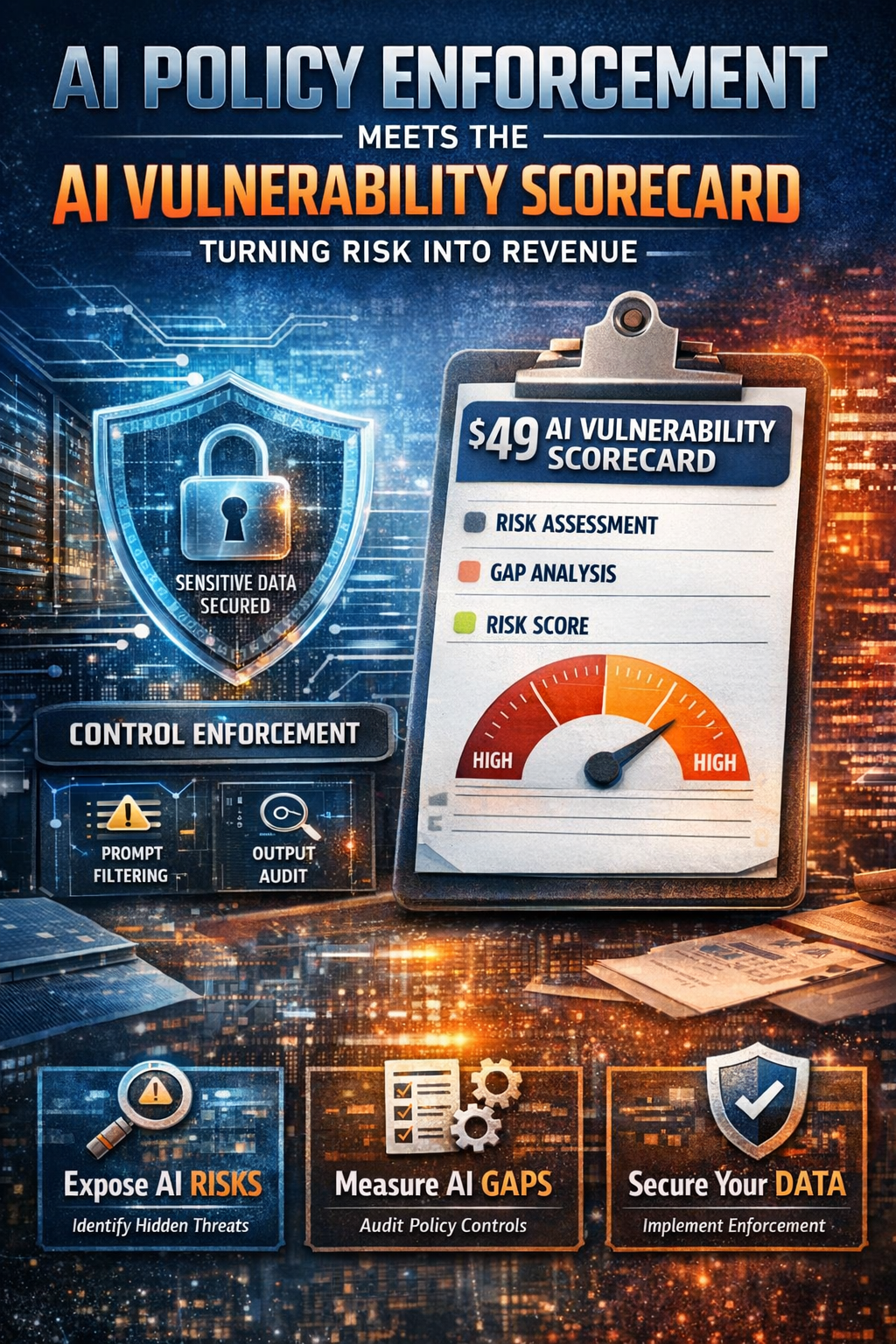
AI Policy Enforcement in Practice: From Theory to Control
What is AI Policy Enforcement?
AI policy enforcement is the operationalization of governance rules that control how AI systems are used, what data they can access, and how outputs are generated, stored, and shared. It moves beyond written policies into real-time, technical controls that actively monitor and restrict behavior.
In simple terms:
AI policy defines what should happen. Enforcement ensures it actually happens.
Example: AI Policy Enforcement with Dropbox Integration
Consider a common enterprise scenario where employees use AI tools alongside cloud storage platforms like Dropbox.
Here’s how enforcement works in practice:
1. Data Access Control
- AI systems are restricted from accessing sensitive folders (e.g., legal, financial, PII).
- Policies define which datasets are “AI-readable” vs. “restricted.”
- Integration enforces this automatically—no manual user decision required.
2. Content Monitoring & Classification
- Files uploaded to Dropbox are scanned and tagged (confidential, internal, public).
- AI tools can only process content based on classification level.
- Example: AI summarization allowed for “internal” docs, blocked for “confidential.”
3. Prompt & Output Filtering
- User prompts are inspected before being sent to AI models.
- If a prompt includes sensitive data (customer info, IP), it is blocked or redacted.
- AI-generated outputs are also scanned to prevent leakage or policy violations.
4. Activity Logging & Audit Trails
- Every AI interaction tied to Dropbox data is logged.
- Security teams can trace: who accessed what, what AI processed, and what was generated.
- Enables compliance with regulations and internal audits.
5. Automated Policy Enforcement Actions
- Block unauthorized AI usage on sensitive files.
- Alert security teams on risky behavior.
- Quarantine outputs that violate policy.
Why This Matters Now
The shift to AI-driven workflows introduces a new risk layer:
- Employees unknowingly expose sensitive data to AI models
- AI systems generate outputs that bypass traditional controls
- Data flows faster than governance frameworks can keep up
Without enforcement, AI policies are just documentation.
Key Components of Effective AI Policy Enforcement
To make enforcement real and scalable:
- Integration-first approach (Dropbox, Google Drive, APIs, SaaS apps)
- Real-time controls instead of periodic audits
- Data-centric security (classification + tagging)
- AI-aware monitoring (prompts, responses, model behavior)
- Automation at scale (alerts, blocking, remediation)
My Perspective: AI Policy Without Enforcement is a False Sense of Security
Most organizations today are writing AI policies faster than they can enforce them. That gap is dangerous.
Here’s the reality:
- AI accelerates both productivity and risk
- Traditional security controls (DLP, IAM) are not AI-aware
- Users will adopt AI tools regardless of policy maturity
So the strategy must shift:
1. Treat AI as a New Attack Surface
Not just a tool—AI is a data processing layer that needs the same rigor as APIs and cloud infrastructure.
2. Move from Policy to Control Engineering
Policies should map directly to enforceable controls:
- “No PII in AI prompts” → prompt inspection + redaction
- “Restricted data stays internal” → storage-level enforcement
3. Integrate Where Data Lives
Enforcement must sit inside:
- File systems (Dropbox, SharePoint)
- APIs
- Collaboration tools
Not as an external overlay.
4. Assume Continuous Drift
AI usage evolves daily. Controls must adapt dynamically—not annually.
Bottom Line
AI policy enforcement is no longer optional—it’s the difference between controlled adoption and unmanaged exposure.
Organizations that succeed will:
- Embed enforcement into workflows
- Automate governance decisions
- Continuously monitor AI interactions
Those that don’t will face an AI vulnerability storm—where speed, scale, and automation work against them.
AI Governance Enforcement: The Foundation for Scaling AI Governance Effectively
Perspective: Why AI Governance Enforcement Is the Key
AI governance fails when it remains theoretical. Policies, frameworks, and ethics statements mean little unless they are enforced at execution time. The shift happening now—driven by regulations and real-world risk—is from “intent” to “proof.” Organizations are no longer judged by what policies they publish, but by what they can demonstrably enforce and audit.
Enforcement is the missing link because it creates accountability, consistency, and evidence:
- Accountability: Every AI decision is evaluated against rules.
- Consistency: Policies apply uniformly across all systems and channels.
- Evidence: Audit trails are generated automatically, not reconstructed later.
In simple terms:
Without enforcement, governance is documentation.
With enforcement, governance becomes control.
That’s why AI governance enforcement is not just a feature—it’s the foundation for making AI governance actually work at scale.
## Ready to Operationalize AI Governance?
If you’re serious about moving from **AI governance theory → real enforcement**,
DISC InfoSec can help you build the control layer your AI systems need.
Book a free consultation: [info@deurainfosec.com]
AI Vulnerability Scorecard
This is where your DISC InfoSec AI Vulnerability Scorecard becomes powerful.
Instead of overwhelming organizations with complex frameworks, the scorecard:
Quickly Identifies AI Risk Exposure
- Where AI is accessing sensitive data (e.g., Dropbox, APIs)
- Gaps in policy enforcement
- Shadow AI usage across teams
Maps Policy to Reality
- Are controls actually enforced—or just documented?
- Are prompts and outputs being monitored?
- Is data classification driving AI access decisions?
Delivers a Clear Risk Score
- Simple, executive-friendly scoring
- Immediate visibility into AI security posture
- Prioritized risk areas
Provides Actionable Recommendations
- What to fix first
- Where to implement enforcement controls
- How to reduce exposure quickly

InfoSec services | InfoSec books | Follow our blog | DISC llc is listed on The vCISO Directory | ISO 27k Chat bot | Comprehensive vCISO Services | ISMS Services | AIMS Services | Security Risk Assessment Services | Mergers and Acquisition Security
- The Controls Are Still Being Written: Governing AI When the Technology Outruns the Audit
- If Your Frontier Model Vanished for 3 Weeks, Would Your Business Stop?
- The Evidence Lifecycle: Which Organizational Events to Log for Liability — and How Long to Keep Them
- 14 Months to Comply. 12 Months of Work. The High-Risk AI Playbook Nobody Has Started
- Your biggest AI risk isn’t hackers. It’s your own data walking out the door





April 30th, 2026 10:24 am
[…] are confident in controls that don’t actually exist, or exist only on paper meaning no AI Governance enforcement. This is the precise pattern that produces front-page incidents, the kind where post-mortems reveal […]
May 18th, 2026 9:16 am
[…] AI Policy Enforcement in Practice: From Theory to Control […]