May 11 2026

Your Shadow AI Inventory Is Wrong. Here’s a Free Way to Fix It.

Your Shadow AI Inventory Is Wrong. Here’s a Free Way to Fix It.

If I asked your CISO or DPO today, “What’s the complete list of AI tools touching company or customer data?” — what would they hand you?

In most B2B SaaS and financial services orgs I work with, the answer is a stale spreadsheet of the four or five tools that got procurement approval, plus a vague acknowledgement that “people are probably using ChatGPT.” That’s not an AI inventory. That’s wishful thinking with a header row.

And it’s about to become an audit finding.

Why this gap matters now

EU AI Act obligations for general-purpose AI and high-risk systems are arriving in waves through August 2026. ISO 42001 Clause 6.1 expects you to identify AI risks tied to the specific systems in use. HIPAA enforcement around PHI in genAI tools is already here. NIST AI RMF’s GOVERN function presumes you can name what you govern.

Every one of those frameworks has the same prerequisite: a current, defensible inventory of every AI system in scope — including the ones nobody told you about.

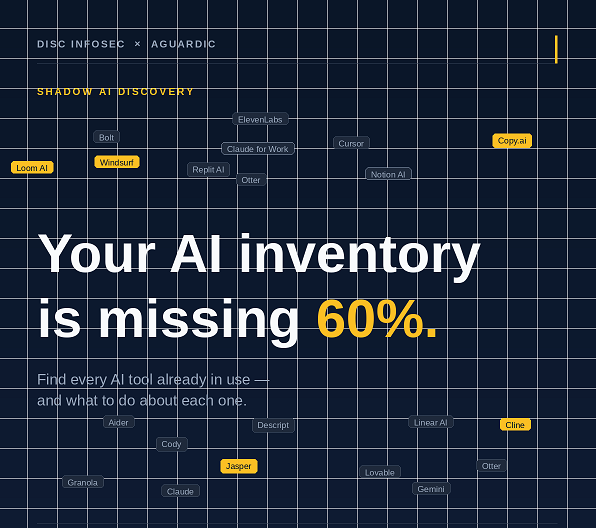
Standard discovery tooling misses most of it. DLP doesn’t catch a browser tab. CASB doesn’t see a personal Claude session on a managed device. OAuth audits in Workspace and Entra catch the embedded SaaS AI but skip the web tools entirely. The result: most “AI inventories” are 30–40% of reality, and the missing 60% is exactly where the unreviewed PHI, PII, and source code is flowing.

A practical way to close the gap (free)

I’ve been collaborating with the team at Aguardic on a Shadow AI Discovery tool that I think is genuinely useful for anyone running an AI governance program. It’s free, browser-based, and you don’t need to install anything.

Three inputs:

  1. What you already know. Free-text list of AI tools your team uses — browser, embedded SaaS, dev tools, voice transcribers. Anything you’ve spotted.
  2. Optional: a DNS or proxy log export. Cisco Umbrella, Cloudflare Zero Trust, NextDNS, Pi-hole — the tool has inline export instructions for each. Files are parsed in memory, not stored.
  3. Optional: an OAuth grants export. Google Workspace, Microsoft 365 / Entra ID, Okta, Auth0 — again with step-by-step export guides in the form.

It matches everything against a curated catalog of 100+ AI tools and produces an editable Word report with, per tool: BAA coverage status, framework exposure (HIPAA, EU AI Act, GDPR, ISO 42001, NIST AI RMF, SOC 2, Colorado AI Act, FERPA, PCI DSS), a risk rating tied to the frameworks you selected, and a specific policy recommendation.

Want a professional AI risk assessment you can actually share with leadership or clients?

Contact DISC InfoSec directly to help run the report and deliver it as a DISC InfoSec co-branded assessment — positioned as a polished executive-ready deliverable, not just another vendor-generated brochure.

A great way to start conversations around Shadow AI, AI governance, and enterprise AI risk visibility.

→ https://www.aguardic.com/

My take

Shadow AI isn’t really a tool problem. It’s a governance sequencing problem.

Most organizations I see are trying to write AI acceptable use policies, vendor risk frameworks, and ISO 42001 documentation before they actually know what AI is in use. The policy ends up referencing “approved AI tools” without naming any, the risk register has three line items when it should have thirty, and the internal auditor’s first question — “how did you scope this?” — has no defensible answer.

ISO 42001 Clause 4 (Context) and Annex A.4 (Resources for AI systems) both presume you have an inventory you trust. EU AI Act Article 9 (Risk Management) presumes the same. You cannot classify a high-risk AI system under Annex III if you don’t know the system exists.

Discovery is the first 80% of the work that makes every downstream control function. Skip it, and your governance program is governing a fiction.

If you’ve been putting this off because the manual version is painful — surveying employees, chasing IT for DNS logs, mapping each tool to controls one by one — this is a 10-minute version of that work that gives you something concrete to bring to your next steering committee.

Run it, share the report, and use it as the starting point for the AI risk register you should already have.


If you want help operationalizing what the report surfaces — turning the findings into an ISO 42001 Annex A control set, an EU AI Act classification decision, or a vendor risk workflow — that’s what we do at DISC InfoSec. Reach out.

The AI Governance Quick-Start: Defensible in 10 Days, Not 4 Quarters

DISC InfoSec is an active ISO 42001 implementer and PECB Authorized Training Partner specializing in AI governance for B2B SaaS and financial services organizations.

AI Attack Surface ScoreCard

AI Vulnerability Scorecard: Discover Your AI Attack Surface Before Attackers Do

Your Shadow AI Problem Has a Name-And Now It Has a Score

Most AI Security Tools Won’t Pass an Audit. Here’s a 15-Minute Way to Find Out.
AIMS and Data Governance – Managing data responsibly isn’t just good practice—it’s a legal and ethical imperative

Schedule a consultation or drop a note below: info@deurainfosec.com

InfoSec services | InfoSec books | Follow our blog | DISC llc is listed on The vCISO Directory | ISO 27k Chat bot | Comprehensive vCISO Services | ISMS Services | AIMS Services | Security Risk Assessment Services | Mergers and Acquisition Security

Tags: Shadow AI, Shadow AI Inventory


Apr 29 2026

The AI Governance Quick-Start: Defensible in 10 Days, Not 4 Quarters

The AI Governance Quick-Start: Defensible in 10 Days, Not 4 Quarters

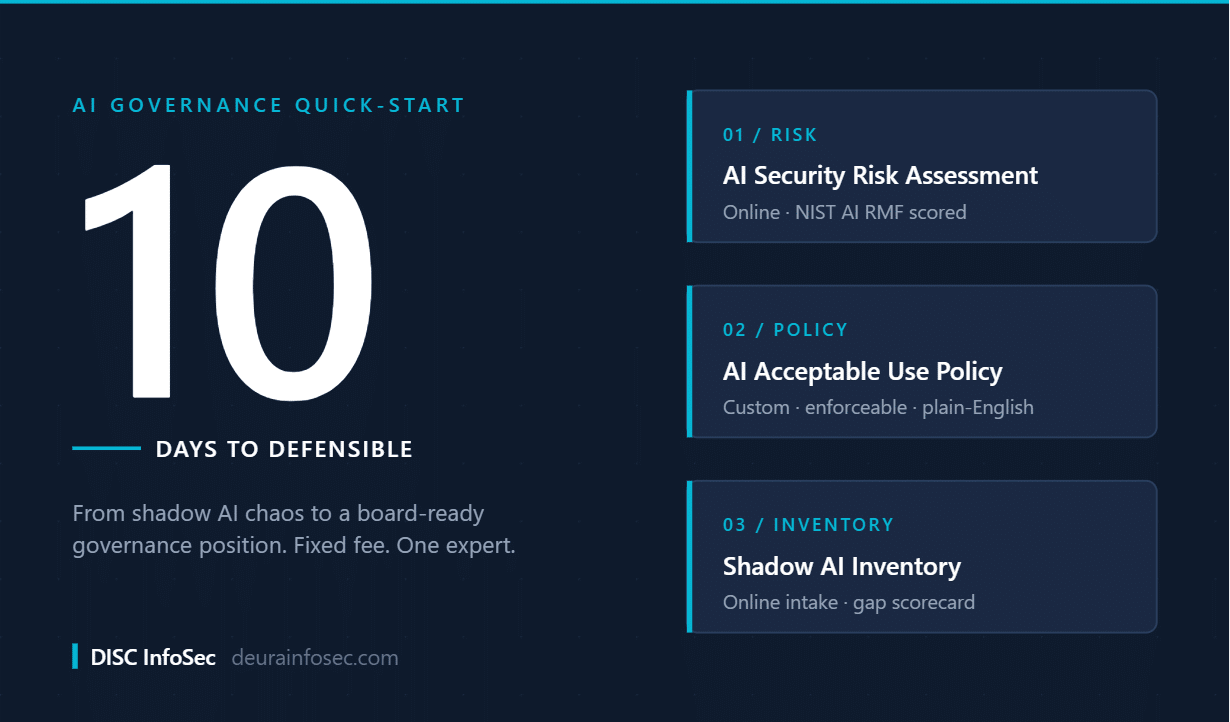
AI governance doesn’t fail because of frameworks—it fails because it never starts. The AI Governance Quick-Start changes that. In just 7–10 business days, you move from uncertainty to a defensible position aligned with NIST AI Risk Management Framework, EU AI Act, and ISO/IEC 42001—without months of consulting overhead. This fixed-fee engagement delivers exactly what stakeholders ask for: a clear AI Security Risk Assessment, a practical Acceptable Use Policy your employees will follow, and a Shadow AI Inventory that exposes real usage across your business. No fluff, no delays—just actionable insight and immediate governance. Whether you’re answering board questions, closing deals, or preparing for audits, this gives you proof that AI risk is managed. Stop waiting for “perfect.” Get compliant, visible, and in control—fast.

Most small businesses aren’t ignoring AI governance. They’re stuck.

Stuck between a CEO who signed up for three new AI tools last month, a security team buried in SOC 2 evidence collection, and a board that’s started asking pointed questions about “the AI thing.” The honest answer—“we’ll get to it after the audit”—is no longer holding up.

That’s the gap the AI Governance Quick-Start was built to close.

AI Governance Quick-Start: your AI Security Risk Assessment + an AI Acceptable Use Policy + a Shadow AI inventory, packaged as a fixed-fee

What you actually get

Three deliverables, one engagement, one consultant. No subcontractors, no coordination overhead, no 60-page proposal.

1. AI Security Risk Assessment. An online questionnaire your team completes in under an hour, scored against NIST AI RMF, EU AI Act and ISO/IEC 42001 controls. You get a clear-eyed read on where AI is being used, what data it’s touching, and which exposures matter—delivered as a written report, not a generic checklist your team will quietly ignore.

2. AI Acceptable Use Policy. A short, enforceable AUP your employees will actually read. Covers approved tools, prohibited inputs (customer data, source code, M&A materials), disclosure requirements, and the escalation path when someone wants to use something new. Written for humans, not for legal review committees.

3. Shadow AI Inventory. An online intake captures the AI tools in use across your company—including the ones nobody officially approved. ChatGPT plugins, Copilot in dev environments, the marketing team’s favorite content generator. The output is a scorecard that ranks each tool by data sensitivity, vendor risk, and policy alignment, so you can see your gaps at a glance and prioritize the fixes that actually matter.

7 to 10 business days. Fixed fee. Delivered under the vCAIO banner so you have a named AI governance owner the moment we kick off.

My perspective: why “quick-start” beats “comprehensive”

I’ve watched a lot of AI governance programs stall at the planning stage. Steering committees form. Frameworks get evaluated. RACI charts circulate. Six months later, no policy is enforced, no inventory exists, and the same shadow AI is still chewing through customer data in three departments.

The capability-governance gap—the place where most AI risk actually lives—doesn’t widen because companies pick the wrong framework. It widens because they wait for the perfect one. Meanwhile, the engineers ship, the marketers experiment, and the legal team writes panicked Slack threads.

A Quick-Start engagement won’t make you ISO 42001 certified. It won’t satisfy a Big Four auditor on day one. What it will do is give you a defensible position—the three artifacts a regulator, a customer, or an acquirer is going to ask for first—delivered in less time than most firms spend scheduling the kickoff meeting.

If you need full ISO 42001 next, do that. The Quick-Start makes Stage 1 dramatically faster because you’ve already done the foundational work most consultants charge $40K to “discover.” I know, because I’m currently running ISO 42001 implementation at ShareVault—a virtual data room serving M&A and financial services clients—where the discovery work alone would have run two months without these three artifacts in hand.

What this costs

Most small businesses want one thing from a governance proposal: a price they can put on a credit card without convening a procurement committee.

Because two of the three deliverables run on online intake (questionnaire and scorecard), we pass the savings through:

  • $499 — businesses under 50 employees
  • $950 — businesses 50–150 employees
  • $1500 — organizations up to 250 employees, or with multi-cloud / regulated-industry complexity

Fixed fee. No hourly billing. No “scope expansion” emails seven days in.

Then message it like:

“What most firms charge $10K+ to discover—we deliver in 10 days.”

That’s less than most companies spend on a single month of marketing software. The difference: this one shows up in your next vendor security questionnaire as evidence that you have your house in order—and on your board deck as a named owner with a signed AUP and a scored inventory behind them.

Next step

If this maps to where you are, contact us info@deurainfosec.com and we’ll confirm the spot. No discovery deck, no five-touch follow-up sequence. If it’s a fit, you’ll have a signed SOW the same week.

More on the practice: deurainfosec.com.

DISC InfoSec is an active ISO 42001 implementer and PECB Authorized Training Partner specializing in AI governance for B2B SaaS and financial services organizations.

AI Attack Surface ScoreCard

AI Vulnerability Scorecard: Discover Your AI Attack Surface Before Attackers Do

Your Shadow AI Problem Has a Name-And Now It Has a Score

Most AI Security Tools Won’t Pass an Audit. Here’s a 15-Minute Way to Find Out.

AIMS and Data Governance – Managing data responsibly isn’t just good practice—it’s a legal and ethical imperative

Schedule a consultation or drop a note below: info@deurainfosec.com

InfoSec services | InfoSec books | Follow our blog | DISC llc is listed on The vCISO Directory | ISO 27k Chat bot | Comprehensive vCISO Services | ISMS Services | AIMS Services | Security Risk Assessment Services | Mergers and Acquisition Security

Tags: AI Acceptable Use Policy, AI Security Risk Assessment, Shadow AI Inventory