Most AI Security Tools Won’t Pass an Audit. Here’s a 15-Minute Way to Find Out.
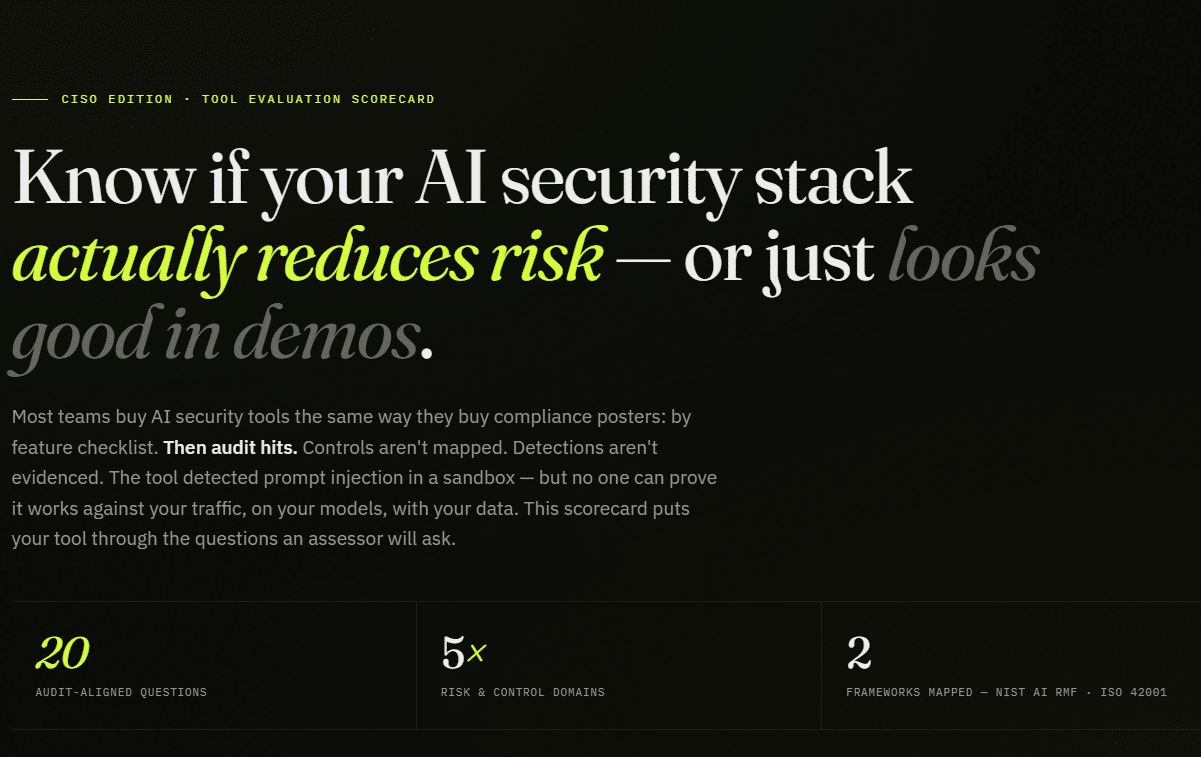
A free CISO-grade scorecard that puts your AI security tool through the questions an assessor will actually ask — and maps every gap to NIST AI RMF and ISO 42001.
Walk into any AI security vendor demo and the choreography is the same. A prompt injection lights up red on a dashboard. A jailbreak attempt gets blocked in real time. A leaderboard shows their detection rates beating the competition. Heads nod. Procurement opens a folder. Six weeks later the tool is in production, the budget line item is closed, and everyone moves on. Then the auditor shows up and asks one question: “Show me where this control is mapped to your AI management system.” Silence. The dashboard is impressive. The control evidence does not exist. This is not a vendor problem. It’s a buying problem — and it’s everywhere right now.
The reason this happens is what I’ve been calling the capability-governance gap. Vendors are sprinting to ship features because that’s what gets them into POCs. Buyers are sprinting to check the “we have AI security” box because that’s what gets them into board decks. Nobody in either direction is doing the boring, unglamorous work of mapping detections to NIST AI RMF subcategories, or to the 47 controls in ISO 42001 Annex A — the actual things assessors will reference during a certification audit. The result is a market full of capable detection layers being sold (and bought) as if they were controls. They are not the same thing. A control produces evidence. A detection layer produces alerts. An auditor needs the first.
That gap is exactly why we built the AI Security Tool Evaluation Scorecard — CISO Edition. It’s a free, self-contained tool with twenty questions across five domains: Threat Coverage, Detection Quality, Integration & Scope, Governance & Audit, and Vendor & Risk Reduction. Each question is weighted by audit impact rather than by how well it demos. Governance & Audit carries the heaviest weight in the scoring — twenty-five points out of a hundred — because that’s where every certification audit and every regulator inquiry actually lives. You answer Yes, Partial, No, or Don’t Know. The tool scores in real time. At the end you get a maturity band, a domain-by-domain risk exposure read, and a ranked list of gaps.
Three design choices make this different from the generic “AI security checklist” PDFs floating around. First, every single gap is tagged with the specific NIST AI RMF subcategories and ISO 42001 Annex A controls it maps to — so when you take it to your auditor, you’re speaking their language from the first sentence. Second, “Don’t Know” counts as a gap, not a neutral answer. Assessors don’t accept “we’d have to ask the vendor” as evidence; neither does this tool. Third, the questions were built from the inside of an active ISO 42001 implementation at a financial-services data room — meaning these are questions we’ve actually had to answer for assessors, not questions we imagined a CISO might one day care about.
Use it before purchase, before contract renewal, before audit prep, and before any board update where someone is going to ask “are we covered on AI risk?” If you’re a CISO weighing two competing tools, run both through the scorecard and compare the gap maps — not the vendor scorecards. If you’re a GRC lead building an audit binder, the output gives you a defensible, mapped baseline you can drop straight into your control narrative. If you’re an AI governance lead doing vendor due diligence, the gap list becomes your negotiation leverage: “here are the seven things we need from you in writing before we sign.” It is meant to be useful at the moments where the budget and the calendar are still flexible.
The mechanics are simple. Fifteen minutes from start to finish, including the setup. You enter the tool you’re evaluating, your use case, and your compliance scope. You answer twenty questions with a live score updating in the sidebar. At the end you provide five details — name, business email, company, role, and company size — and the platform generates an instant maturity score in PDF format, makes a detailed text report available for download with remediation guidance and your top five priority gaps, and emails the full report to DISC InfoSec so we can follow up with a 30-minute walkthrough if you want one. There is no upsell wall, no “premium tier” to unlock the gaps, and no demo theater. You get the verdict, the evidence, and the remediation path.
My perspective, after eighteen months inside ISO 42001 implementation work: the honest read on the AI security tools market right now is that most of these products are very good at detecting things and very bad at producing the kind of evidence that makes audits go smoothly. That’s not a moral failing on the vendors’ part — it’s where the market is in its lifecycle. The capability layer always ships before the governance layer; that’s been true of every security category in the last twenty years. But it does mean that if you bought an AI security tool in the last twelve months and you have an ISO 42001 certification on the calendar, or an EU AI Act deadline approaching, or a SOC 2 attestation that’s about to grow an AI scope — you are almost certainly carrying more residual risk than the vendor’s dashboard suggests. The scorecard won’t fix that. What it will do is give you a precise, mapped, defensible read on exactly where the gap is — so you can decide whether to address it through vendor pressure, compensating controls, or honest scope reduction. Whatever the score comes back as, the gap list is the more useful artifact. That’s the part you take to the audit.
Try the scorecard: [LINK_TO_TOOL] Book a 30-minute walkthrough: info@deurainfosec.com · (707) 998-5164
DISC InfoSec is an active ISO 42001 implementer and PECB Authorized Training Partner specializing in AI governance for B2B SaaS and financial services organizations.
AI Vulnerability Scorecard: Discover Your AI Attack Surface Before Attackers Do
Your Shadow AI Problem Has a Name-And Now It Has a Score
InfoSec services | InfoSec books | Follow our blog | DISC llc is listed on The vCISO Directory | ISO 27k Chat bot | Comprehensive vCISO Services | ISMS Services | AIMS Services | Security Risk Assessment Services | Mergers and Acquisition Security
- AI Log Retention: Why Every AI Log Doesn’t Deserve the Same Shelf Life
- The AI Agent Harness Is the New Security Boundary
- Stop asking what your agent can do
- You can’t put a human in the loop of a system that kills its agents every 3 minutes
- Human Oversight vs Human Control: Where the Human Sits in AI Execution