How to Answer AI Questions on Your Vendor Assessment (Without Stalling the Deal)
Eighteen months ago, “Do you use AI?” was a footnote on a vendor questionnaire. Today it is a deal-blocker. Procurement teams at banks, healthcare systems, and even mid-market SaaS buyers now routinely send 40 to 80 AI-specific questions before signing a contract. If your responses are slow, vague, or contradictory, the deal stalls or dies.
For SMBs evaluating an AI vendor — or being evaluated as one — this is no longer optional. It is the first real diligence step.
Why SMBs Have to Ask AI Questions Before Buying
A traditional SOC 2 report or generic security questionnaire does not surface AI-specific risk. Three frameworks now make AI vendor diligence a baseline expectation:
- NIST AI RMF 1.0 — The GOVERN function (specifically subcategories GV-6.1 and GV-6.2) requires organizations to establish policies, processes, and accountability for third-party AI risks, including data, models, and downstream impacts.
- ISO/IEC 42001:2023 — Annex A control A.10 mandates documented requirements for AI suppliers, with A.10.3 covering how responsibilities are allocated across the AI value chain.
- EU AI Act (Articles 25 and 26) — Imposes obligations on deployers of high-risk AI systems that flow contractually back to providers, regardless of where the buyer is located.
Skipping AI-specific questions means inheriting risk you did not price in: hallucination liability, training data provenance, undisclosed model retraining, prompt injection exposure, and sub-processors using your data to train their models without your knowledge.
Why Vendors Take So Long to Respond
A 60-question AI assessment typically lands in a sales rep’s inbox. From there it travels to security, legal, engineering, the ML team, and sometimes a data science lead — five owners minimum. Most SaaS vendors do not have a maintained answer library for AI questions because the standards are only 18 months old and the products keep shipping new features. The most common delays:
- No single owner of the AI governance program
- Engineering and ML teams being asked the same question for the third time this quarter
- Legal blocking on language about model training and data retention
- Genuine uncertainty about which sub-processors (OpenAI, Anthropic, Azure OpenAI) the product actually calls
Two to four weeks of silence is normal. That is exactly what kills momentum.
Build the Process Before the Questionnaire Arrives
The fix is a pre-built, version-controlled response library mapped to the frameworks buyers cite. The workflow that actually works:
- Designate one owner. Whether it is a fractional vCAIO, an internal GRC lead, or your CISO, one person owns the AI assessment response queue.
- Build a master answer bank. Pre-write responses to the 100 most common AI questions, mapped to NIST AI RMF subcategories, ISO 42001 Annex A controls, and EU AI Act articles. Store evidence — model cards, DPIAs, sub-processor lists, AI acceptable use policies — in one repository.
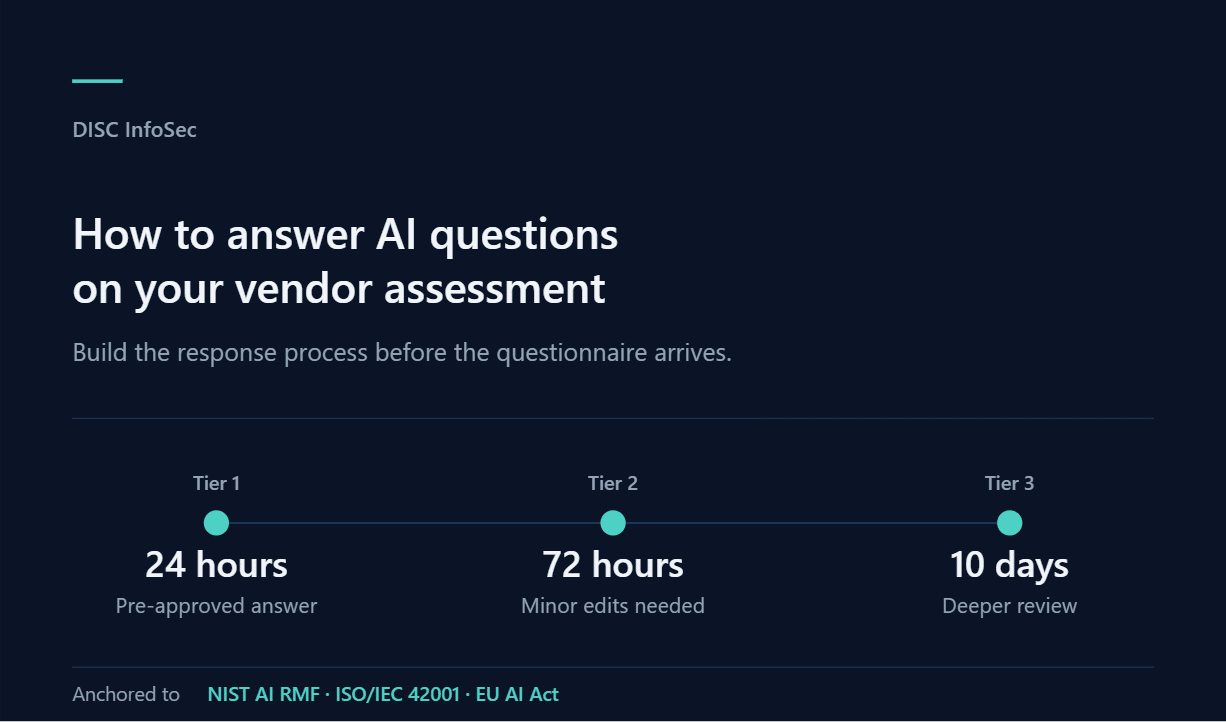
- Use a tiered review SLA. Tier 1 (boilerplate, already approved) goes out in 24 hours. Tier 2 (minor edits) goes out in 72 hours. Tier 3 (new capability, legal review) gets a holding response within 48 hours and a full answer within ten business days.
- Refresh quarterly. AI products change fast. A stale answer is worse than no answer because it becomes a contractual misrepresentation.
- Track every question that surprises you. When buyers ask something new, that is your roadmap for the next governance update.
Vendors who treat AI questionnaires as a recurring operational process — not a fire drill — close deals weeks faster than competitors who do not. In a market where buyers are now leading with AI diligence, that speed is the differentiator.
Hospital vendor assessments, bank vendor reviews, enterprise SOC 2 questionnaires—any assessment that includes AI-related questions.
DISC automatically isolates the AI governance portions, maps them to the relevant control frameworks (HIPAA, HTI-1, EU AI Act, NIST AI RMF, ISO 42001), and generates an editable Word draft.
Non-AI infrastructure questions are intentionally skipped, with clear annotations so you know exactly where to route them.
DISC can assist you in “AI questions on your vendor assessment” share your questionnaire and which relevant framwork you would like to map to. Of course first one is free. info@deurainfosec.com
DISC InfoSec helps you handle all AI-related questions in your vendor assessments—fast and audit-ready.
👉 Share your questionnaire
👉 Tell us which framework you need
We map your answers to:
- HIPAA
- HTI-1
- EU AI Act
- NIST AI Risk Management Framework
- ISO/IEC 42001
⚡ What you get:
✔ AI-specific answers extracted and completed
✔ Control mapping aligned to your chosen framework
✔ Clean, editable Word draft ready to submit
✔ Clear notes on non-AI questions so nothing gets missed
🎯 Why it matters
Vendor assessments are becoming AI audits in disguise.
If your responses aren’t aligned to recognized frameworks,
👉 you risk delays, rejections, or lost deals.
🎁 Start with zero risk
Your first assessment is FREE.
📩 Email: Info@deurainfosec.com
Let DISC InfoSec turn your AI questionnaire burden into a competitive advantage.
#AIGovernance #VendorRiskManagement #ThirdPartyRisk #AISecurity #Compliance #SOC2 #HIPAA #ISO42001 #NISTAIRMf #EUAIAct #GRC #DISCInfoSec
Building this process internally, or evaluating an AI vendor and need a defensible response framework? Book a working session at info@deurainfosec.com or visit deurainfosec.com.
DISC InfoSec is an active ISO 42001 implementer and PECB Authorized Training Partner specializing in AI governance for B2B SaaS and financial services organizations.
AI Vulnerability Scorecard: Discover Your AI Attack Surface Before Attackers Do
Your Shadow AI Problem Has a Name-And Now It Has a Score
InfoSec services | InfoSec books | Follow our blog | DISC llc is listed on The vCISO Directory | ISO 27k Chat bot | Comprehensive vCISO Services | ISMS Services | AIMS Services | Security Risk Assessment Services | Mergers and Acquisition Security