Apr 06 2026

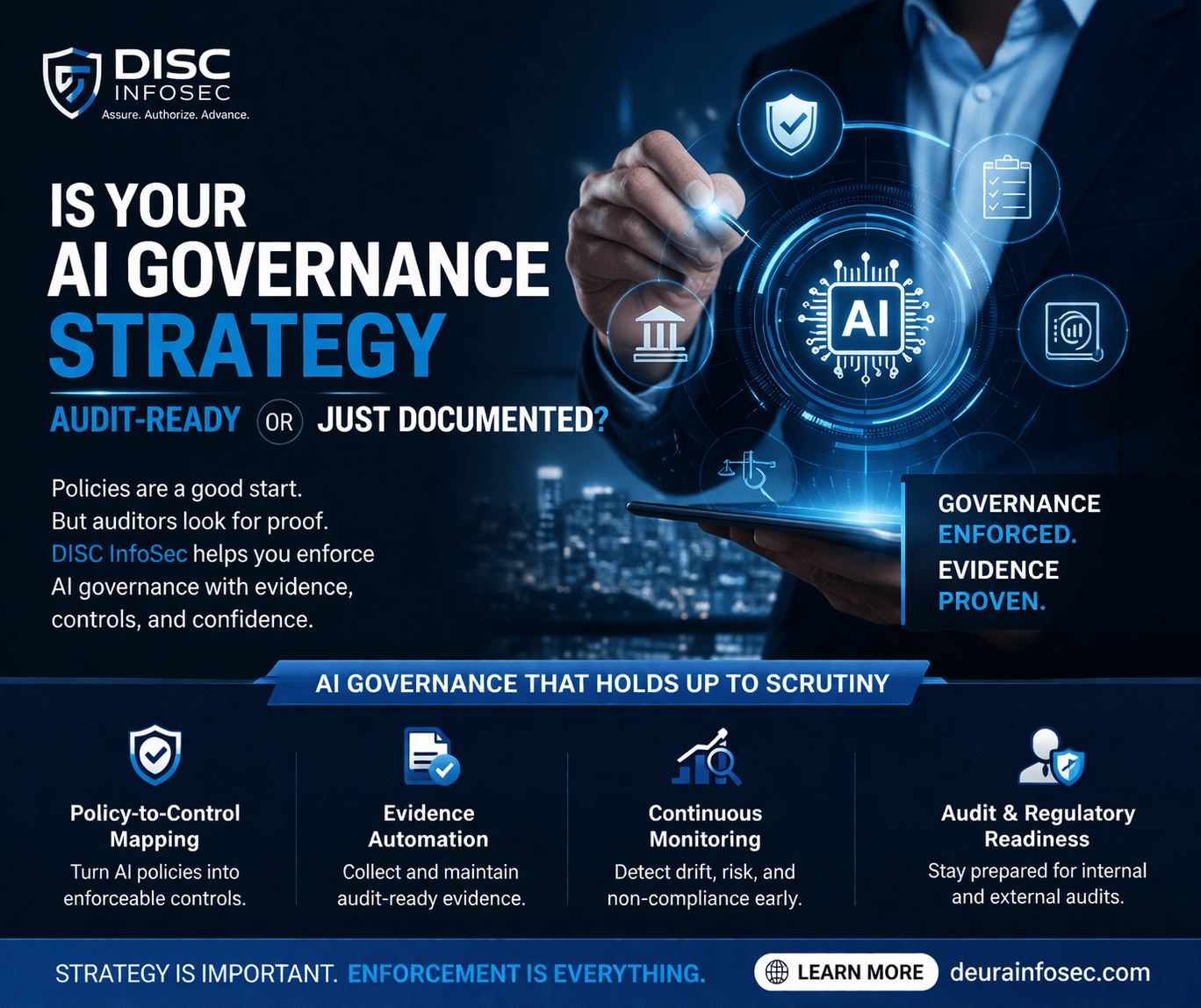
Is Your AI Governance Strategy Audit-Ready—or Just Documented?

1. The Audit Question Organizations Must Answer
Is your AI governance strategy ready for audit? This is no longer a theoretical concern. As AI adoption accelerates, organizations are being evaluated not just on innovation, but on how well they govern, control, and document their AI systems.

2. AI Governance Is No Longer Optional
AI governance has shifted from a best practice to a business requirement. Organizations that fail to establish clear governance risk regulatory exposure, operational failures, and loss of customer trust. Governance is now a foundational pillar of responsible AI adoption.

3. Compliance Is Driving Business Outcomes
Frameworks like ISO 42001, NIST AI RMF, and the EU AI Act are no longer just compliance checkboxes—they are directly influencing contract decisions. Companies with strong governance are winning deals faster and reducing enterprise risk, while others are being left behind.

4. Proven Execution Matters
Deura Information Security Consulting (DISC InfoSec) positions itself as a trusted partner with a strong track record, including a proven certification success rate. Their team brings structured expertise, helping organizations navigate complex compliance requirements with confidence.

5. Integrated Framework Approach
Rather than treating frameworks in isolation, integrating multiple standards into a unified governance model simplifies the compliance journey. This approach reduces duplication, improves efficiency, and ensures broader coverage across AI risks.

6. Governance as a Competitive Advantage
Clear, well-implemented governance does more than protect—it differentiates. Organizations that can demonstrate control, transparency, and accountability in their AI systems gain a measurable edge in the market.

7. Taking the Next Step
The message is clear: organizations must act now. Engaging with experienced partners and building a robust governance strategy is essential to staying compliant, competitive, and secure in an AI-driven world.


Perspective: Why AI Governance Enforcement Is Critical

Most organizations are focusing on AI governance frameworks, but frameworks alone don’t reduce risk—enforcement does.

Having policies aligned to ISO 42001 or NIST AI RMF is important, but auditors and regulators are increasingly asking a deeper question:
👉 Can you prove those policies are actually enforced at runtime?

This is where many AI governance strategies fall apart.

AI systems are dynamic, API-driven, and often autonomous. Without real-time enforcement:

  • Policies remain static documents
  • Controls are inconsistently applied
  • Risks emerge during actual execution—not design

AI governance enforcement bridges that gap. It ensures that:

  • Prompts, responses, and agent actions are monitored in real time
  • Policy violations are detected and blocked instantly
  • Data exposure and misuse are prevented before impact

In short, enforcement turns governance from intent into control.

Bottom line:
If your AI governance strategy cannot demonstrate continuous monitoring, control, and enforcement, it is unlikely to stand up to audit—or real-world threats.

That’s why AI governance enforcement is not just a feature—it’s the foundation for making AI governance actually work at scale.

Ready to Operationalize AI Governance?

If you’re serious about moving from **AI governance theory → real enforcement**,
DISC InfoSec can help you build the control layer your AI systems need.

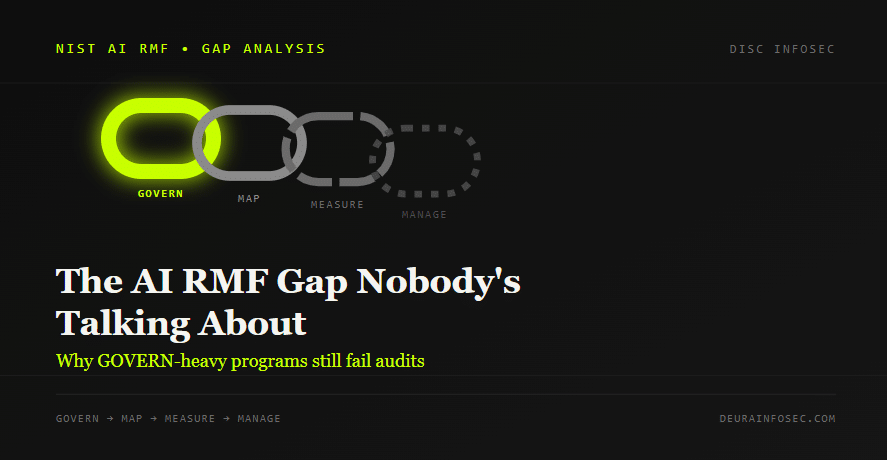
Most organizations have AI governance documents — but auditors now want proof of enforcement.

Policies alone don’t reduce AI risk. Real‑time monitoring, control, and enforcement do.

If your AI governance strategy can’t demonstrate continuous oversight, it won’t stand up to audit or real‑world threats.

DISC InfoSec helps organizations operationalize AI governance with integrated frameworks, runtime controls, and proven certification success.

Move from AI governance theory to enforcement.

🔗 Read the full post: Is Your AI Governance Strategy Audit‑Ready — or Just Documented? 📞 Schedule a consultation: info@deurainfosec.com

DISC InfoSec — Your partner for AI governance that actually works.

InfoSec services | InfoSec books | Follow our blog | DISC llc is listed on The vCISO Directory | ISO 27k Chat bot | Comprehensive vCISO Services | ISMS Services | AIMS Services | Security Risk Assessment Services | Mergers and Acquisition Security

Is your AI strategy truly audit-ready today?

AI governance is no longer optional. Frameworks like ISO/IEC 42001 AI Management System Standard and regulations such as the EU AI Act are rapidly reshaping compliance expectations for organizations using AI.

DISC InfoSec brings deep expertise across AI, cybersecurity, and regulatory compliance to help you build trust, reduce risk, and stay ahead of evolving mandates—with a proven track record of success.

Ready to lead with confidence? Let’s start the conversation.

At DISC InfoSec, we help organizations navigate this landscape by aligning AI risk management, governance, security, and compliance into a single, practical roadmap. Whether you are experimenting with AI or deploying it at scale, we help you choose and operationalize the right frameworks to reduce risk and build trust. Learn more at DISC InfoSec.

Tags: AI Governance Enforcement, EU AI Act, ISO 42001, NIST AI RMF


Mar 31 2026

Which AI Governance Framework Should You Adopt First? A Practical Guide for U.S., EU, and Global Organizations

Category: AI Governance,ISO 42001disc7 @ 9:28 am

ISO/IEC 42001, the EU AI Act, and the NIST AI Risk Management Framework (AI RMF) represent three distinct but complementary approaches to governing artificial intelligence. ISO 42001 is a formal management system standard designed to institutionalize AI governance within organizations. Its core concept is continuous improvement through structured controls, with a primary focus on embedding AI risk management into business processes. It applies broadly across industries and is certifiable, making it attractive for organizations seeking formal assurance. Its scope covers governance, lifecycle management, and accountability, using a risk-based, auditable approach. Globally, it is emerging as the backbone for standardized AI governance, especially for enterprises seeking international credibility.

The EU AI Act is fundamentally different, operating as a regulatory framework rather than a voluntary standard. Its core concept is risk classification of AI systems (e.g., unacceptable, high-risk), with a primary focus on protecting individuals’ rights and safety. It applies to any organization that develops, deploys, or offers AI systems within the European Union, regardless of where the company is based. Compliance is mandatory, not certifiable, and enforced through legal mechanisms. Its scope is extensive, covering use cases, data governance, transparency, and human oversight. The risk approach is prescriptive and tiered, and its global impact is significant, as it effectively sets a de facto regulatory benchmark for companies operating internationally.

The NIST AI RMF takes a more flexible, guidance-driven approach. Its core concept is trustworthy AI built on principles like fairness, accountability, and transparency. The primary focus is helping organizations identify, assess, and manage AI risks without imposing strict requirements. It is applicable to organizations of all sizes, particularly in the U.S., but is not certifiable or legally binding. Its scope spans the AI lifecycle, emphasizing governance, mapping, measurement, and management functions. The risk approach is adaptive and contextual rather than prescriptive. Globally, it serves as a practical playbook and is widely referenced as a baseline for AI risk discussions.

When compared, ISO 42001 provides structure and certifiability, the EU AI Act enforces legal accountability, and NIST AI RMF offers operational flexibility. ISO is ideal for organizations wanting to operationalize governance programs with measurable controls. The EU AI Act is unavoidable for companies interacting with EU markets, demanding strict adherence to compliance requirements. NIST AI RMF, meanwhile, is best suited for organizations seeking to mature their AI risk posture without the overhead of certification or regulatory burden.

Together, these frameworks form a layered model of AI governance: NIST AI RMF as the foundation for understanding and managing risk, ISO 42001 as the system for institutionalizing and auditing those practices, and the EU AI Act as the regulatory overlay enforcing accountability. Organizations that align across all three are better positioned to move from reactive compliance to proactive, continuous AI risk management—something that is quickly becoming a competitive differentiator in the global market.

If you’re deciding which framework to adopt first, the answer isn’t “one-size-fits-all”—it depends heavily on where you operate, your regulatory exposure, and how mature your AI usage is. But there is a practical sequencing that works in most real-world scenarios.


🇺🇸 U.S.-based organizations (like you in California)

Start with NIST AI Risk Management Framework.

Image

The reason is simple: it’s flexible, fast to adopt, and aligns well with how U.S. companies already think about risk (similar to NIST CSF). It gives you an immediate way to structure AI governance without slowing innovation.

From a vCISO or GRC standpoint, this is your “operational foundation”—you can quickly map risks, define controls, and start producing defensible outputs for clients or regulators.

👉 My take: If you skip this step and jump straight into compliance-heavy frameworks, you’ll create “paper governance” without real risk visibility.


🇪🇺 If you touch EU markets (customers, users, or data)

Prioritize the EU AI Act immediately—even before anything else if exposure is high.

Image

This is not optional. If your AI system falls into “high-risk,” you’re dealing with legal obligations, audits, and potential penalties.

👉 My take: This is the “hard boundary” framework. It defines what you must do, not what you should do.

Even U.S. companies often underestimate this—if your product scales, EU rules will reach you faster than expected.


🌍 When you want credibility, scale, or enterprise trust

Adopt ISO/IEC 42001 after you’ve operationalized risk (typically after NIST AI RMF).

Image
Image

ISO 42001 is where governance becomes institutionalized and auditable. It’s especially valuable if you:

  • Sell to enterprises
  • Need third-party assurance
  • Want to productize your AI governance (e.g., your DISC InfoSec offering)

👉 My take: This is your “trust multiplier.” It turns internal practices into something marketable and defensible.


🔑 Practical adoption sequence (what I recommend)

For most organizations (especially in the U.S.):

  1. Start with NIST AI RMF → build real risk visibility
  2. Overlay EU AI Act (if applicable) → ensure regulatory compliance
  3. Formalize with ISO 42001 → scale, certify, and monetize trust


💡 My blunt perspective

  • If you start with ISO 42001 → you risk over-engineering too early
  • If you ignore EU AI Act → you risk legal exposure
  • If you skip NIST AI RMF → you risk fake governance (compliance theater)

Comparing of ISO 27001 with ISO 42001

ISO/IEC 42001 builds directly on the structure of ISO/IEC 27001, so at first glance the two frameworks look similar in clauses, risk assessment approach, and use of Annex A controls. However, their intent and scope diverge significantly. ISO 27001 is inward-focused, centered on protecting an organization’s information assets and managing risks that could impact the business. In contrast, ISO/IEC 42001 is outward-looking and expands accountability beyond the organization to include impacts—both negative and positive—on society, individuals, and other stakeholders arising from AI use. It also shifts emphasis from purely information protection to governance of AI-driven products and services, making it closer to a quality management system in practice. Key differences include the introduction of AI system impact assessments (evaluating societal harms and benefits), distinct and more AI-specific Annex A controls, and additional guidance annexes. While many governance elements (e.g., audits, nonconformities) remain structurally similar, ISO 42001 requires deeper scrutiny of ethical, societal, and product-level risks, making it broader, more externally accountable, and more aligned with AI lifecycle management than ISO 27001.


      At DISC InfoSec:
      👉 “We move you from AI chaos → risk visibility → compliance → certification”

      AI Governance Playbook: How to Secure, Control, and Optimize Artificial Intelligence Initiatives


      InfoSec services | InfoSec books | Follow our blog | DISC llc is listed on The vCISO Directory | ISO 27k Chat bot | Comprehensive vCISO Services | ISMS Services | AIMS Services | Security Risk Assessment Services | Mergers and Acquisition Security

      At DISC InfoSec, we help organizations navigate this landscape by aligning AI risk management, governance, security, and compliance into a single, practical roadmap. Whether you are experimenting with AI or deploying it at scale, we help you choose and operationalize the right frameworks to reduce risk and build trust. Learn more at DISC InfoSec.

      Tags: AI Governance Playbook, EU AI Act, ISO 42001, NIST AI RMF


      Mar 10 2026

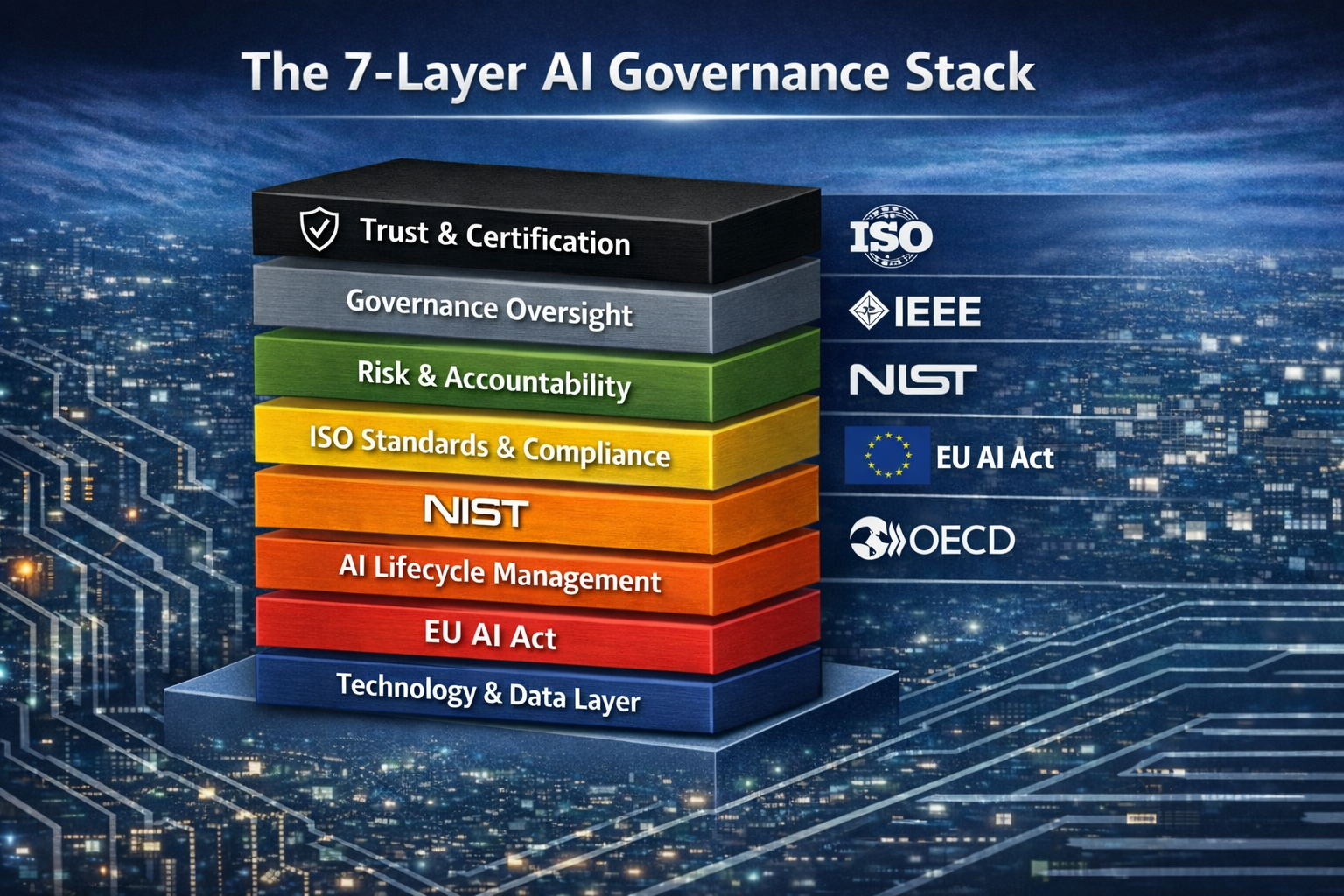
      AI Governance Is Becoming Infrastructure: The Layer Governance Stack Organizations Need

      Category: AI,AI Governance,Information Security,ISO 42001disc7 @ 2:17 pm

      Defining the AI Governance Stack (Layers + Countermeasures)

      1. Technology & Data Layer
      This is the foundational layer where AI systems are built and operate. It includes infrastructure, datasets, machine learning models, APIs, cloud environments, and development platforms that power AI applications. Risks at this level include data poisoning, model manipulation, unauthorized access, and insecure pipelines.
      Countermeasures: Secure data governance, strong access control, encryption, secure MLOps pipelines, dataset validation, and adversarial testing to protect model integrity.

      2. AI Lifecycle Management
      This layer governs the entire lifecycle of AI systems—from design and training to deployment, monitoring, and retirement. Without lifecycle oversight, models may drift, produce harmful outputs, or operate outside their intended purpose.
      Countermeasures: Implement lifecycle governance frameworks such as the National Institute of Standards and Technology AI Risk Management Framework and ISO model lifecycle practices. Continuous monitoring, model validation, and AI system documentation are essential.

      3. Regulation Layer
      Regulation defines the legal obligations governing AI development and use. Governments worldwide are establishing regulatory regimes to address safety, privacy, and accountability risks associated with AI technologies.
      Countermeasures: Regulatory compliance programs, legal monitoring, AI impact assessments, and alignment with frameworks like the EU AI Act and other national laws.

      4. Standards & Compliance Layer
      Standards translate regulatory expectations into operational requirements and technical practices that organizations can implement. They provide structured guidance for building trustworthy AI systems.
      Countermeasures: Adopt international standards such as ISO/IEC 42001 and governance engineering frameworks from Institute of Electrical and Electronics Engineers to ensure responsible design, transparency, and accountability.

      5. Risk & Accountability Layer
      This layer focuses on identifying, evaluating, and managing AI-related risks—including bias, privacy violations, security threats, and operational failures. It also defines who is responsible for decisions made by AI systems.
      Countermeasures: Enterprise risk management integration, algorithmic risk assessments, impact analysis, internal audit oversight, and adoption of principles such as the OECD AI Principles.

      6. Governance Oversight Layer
      Governance oversight ensures that leadership, ethics boards, and risk committees supervise AI strategy and operations. This layer connects technical implementation with corporate governance and accountability structures.
      Countermeasures: Establish AI governance committees, board-level oversight, policy frameworks, and internal controls aligned with organizational governance models.

      7. Trust & Certification Layer
      The top layer focuses on demonstrating trust externally through certification, assurance, and transparency. Organizations must show regulators, partners, and customers that their AI systems operate responsibly and safely.
      Countermeasures: Independent audits, third-party certification programs, transparency reporting, and responsible AI disclosures aligned with global assurance standards.


      AI Governance Is Becoming Infrastructure

      The real challenge of AI governance has never been simply writing another set of ethical principles. While ethics guidelines and policy statements are valuable, they do not solve the structural problem organizations face: how to manage dozens of overlapping regulations, standards, and governance expectations across the AI lifecycle.

      The fundamental issue is governance architecture. Organizations do not need more isolated principles or compliance checklists. What they need is a structured system capable of integrating multiple governance regimes into a single operational framework.

      In practical terms, such governance architectures must integrate multiple frameworks simultaneously. These may include regulatory systems like the EU AI Act, governance standards such as ISO/IEC 42001, technical risk frameworks from the National Institute of Standards and Technology, engineering ethics guidance from the Institute of Electrical and Electronics Engineers, and global governance principles like the OECD AI Principles.

      The complexity of the governance environment is significant. Today, organizations face more than one hundred AI governance frameworks, regulatory initiatives, standards, and guidelines worldwide. These systems frequently overlap, creating fragmentation that traditional compliance approaches struggle to manage.

      Historically, global discussions about AI governance focused primarily on ethics principles, isolated compliance frameworks, or individual national regulations. However, the rapid expansion of AI technologies has transformed the governance landscape into a dense ecosystem of interconnected governance regimes.

      This shift is reflected in emerging policy guidance, particularly the due diligence frameworks being promoted by international institutions. These approaches emphasize governance processes such as risk identification, mitigation, monitoring, and remediation across the entire lifecycle of AI systems rather than relying on standalone regulatory requirements.

      As a result, organizations are no longer dealing with a single governance framework. They are operating within a layered governance stack where regulations, standards, risk management frameworks, and operational controls must work together simultaneously.


      Perspective on the Future of AI Governance

      From my perspective, the next phase of AI governance will not be defined by new frameworks alone. The real transformation will occur when governance becomes infrastructure—a structured system capable of integrating regulations, standards, and operational controls at scale.

      In other words, AI governance is evolving from policy into governance engineering. Organizations that build governance architectures—rather than simply chasing compliance—will be far better positioned to manage AI risk, demonstrate trust, and adapt to the rapidly expanding global regulatory environment.

      For cybersecurity and governance leaders, this means treating AI governance the same way we treat cloud architecture or security architecture: as a foundational system that enables resilience, accountability, and trust in AI-driven organizations. 🔐🤖📊

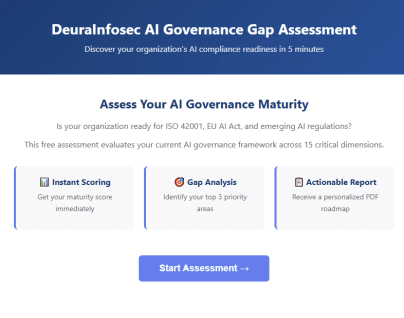
      Get Your Free AI Governance Readiness Assessment â€“ Is your organization ready for ISO 42001, EU AI Act, and emerging AI regulations?

      AI Governance Gap Assessment tool

      1. 15 questions
      2. Instant maturity score 
      3. Detailed PDF report 
      4. Top 3 priority gaps

      Click below to open an AI Governance Gap Assessment in your browser or click the image to start assessment.

      ai_governance_assessment-v1.5Download

      Built by AI governance experts. Used by compliance leaders.

      InfoSec services | InfoSec books | Follow our blog | DISC llc is listed on The vCISO Directory | ISO 27k Chat bot | Comprehensive vCISO Services | ISMS Services | AIMS Services | Security Risk Assessment Services | Mergers and Acquisition Security

      At DISC InfoSec, we help organizations navigate this landscape by aligning AI risk management, governance, security, and compliance into a single, practical roadmap. Whether you are experimenting with AI or deploying it at scale, we help you choose and operationalize the right frameworks to reduce risk and build trust. Learn more at DISC InfoSec.

      Tags: AI Life cycle management, EU AI Act, Governance oversight, ISO 42001, NIST AI RMF


      Jan 15 2026

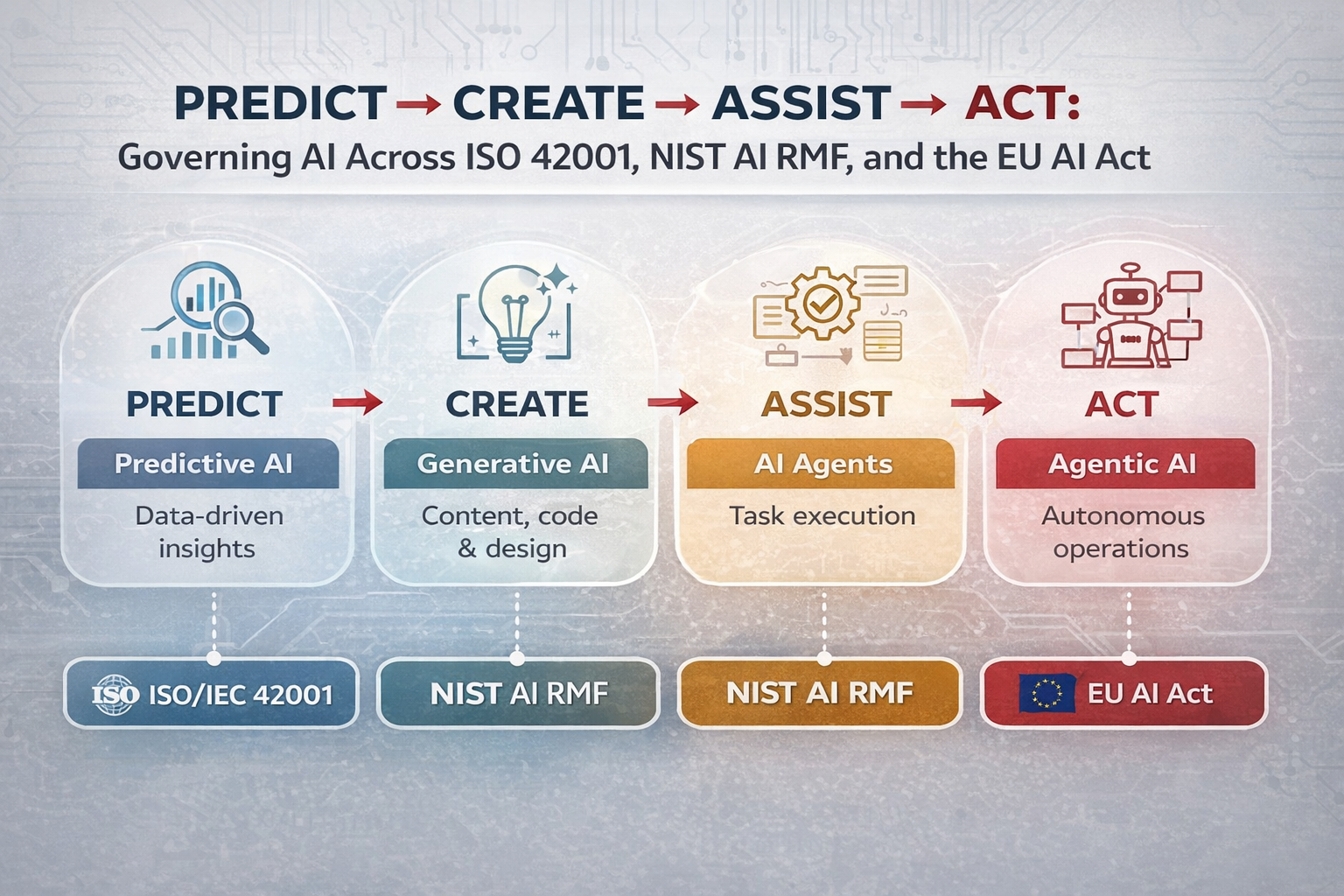
      From Prediction to Autonomy: Mapping AI Risk to ISO 42001, NIST AI RMF, and the EU AI Act

      Category: AI,AI Governance,AI Guardrails,ISO 42001disc7 @ 12:49 pm

      PCAA


      1️⃣ Predictive AI – Predict

      Predictive AI is the most mature and widely adopted form of AI. It analyzes historical data to identify patterns and forecast what is likely to happen next. Organizations use it to anticipate customer demand, detect fraud, identify anomalies, and support risk-based decisions. The goal isn’t automation for its own sake, but faster and more accurate decision-making, with humans still in control of final actions.


      2️⃣ Generative AI – Create

      Generative AI goes beyond prediction and focuses on creation. It generates text, code, images, designs, and insights based on prompts. Rather than replacing people, it amplifies human productivity, helping teams draft content, write software, analyze information, and communicate faster. Its core value lies in increasing output velocity while keeping humans responsible for judgment and accountability.


      3️⃣ AI Agents – Assist

      AI Agents add execution to intelligence. These systems are connected to enterprise tools, applications, and internal data sources. Instead of only suggesting actions, they can perform tasks—such as retrieving data, updating systems, responding to requests, or coordinating workflows. AI Agents expand human capacity by handling repetitive or multi-step tasks, delivering knowledge access and task leverage at scale.


      4️⃣ Agentic AI – Act

      Agentic AI represents the frontier of AI adoption. It orchestrates multiple agents to run workflows end-to-end with minimal human intervention. These systems can plan, delegate, verify, and complete complex processes across tools and teams. At this stage, AI evolves from a tool into a digital team member, enabling true process transformation, not just efficiency gains.


      Simple decision framework

      • Need faster decisions? → Predictive AI
      • Need more output? → Generative AI
      • Need task execution and assistance? → AI Agents
      • Need end-to-end transformation? → Agentic AI

      Below is a clean, standards-aligned mapping of the four AI types (Predict → Create → Assist → Act) to ISO/IEC 42001, NIST AI RMF, and the EU AI Act.
      This is written so you can directly reuse it in AI governance decks, risk registers, or client assessments.


      AI Types Mapped to ISO 42001, NIST AI RMF & EU AI Act


      1️⃣ Predictive AI (Predict)

      Forecasting, scoring, classification, anomaly detection

      ISO/IEC 42001 (AI Management System)

      • Clause 4–5: Organizational context, leadership accountability for AI outcomes
      • Clause 6: AI risk assessment (bias, drift, fairness)
      • Clause 8: Operational controls for model lifecycle management
      • Clause 9: Performance evaluation and monitoring

      👉 Focus: Data quality, bias management, model drift, transparency


      NIST AI RMF

      • Govern: Define risk tolerance for AI-assisted decisions
      • Map: Identify intended use and impact of predictions
      • Measure: Test bias, accuracy, robustness
      • Manage: Monitor and correct model drift

      👉 Predictive AI is primarily a Measure + Manage problem.


      EU AI Act

      • Often classified as High-Risk AI if used in:
        • Credit scoring
        • Hiring & HR decisions
        • Insurance, healthcare, or public services

      Key obligations:

      • Data governance and bias mitigation
      • Human oversight
      • Accuracy, robustness, and documentation

      2️⃣ Generative AI (Create)

      Text, code, image, design, content generation

      ISO/IEC 42001

      • Clause 5: AI policy and responsible AI principles
      • Clause 6: Risk treatment for misuse and data leakage
      • Clause 8: Controls for prompt handling and output management
      • Annex A: Transparency and explainability controls

      👉 Focus: Responsible use, content risk, data leakage


      NIST AI RMF

      • Govern: Acceptable use and ethical guidelines
      • Map: Identify misuse scenarios (prompt injection, hallucinations)
      • Measure: Output quality, harmful content, data exposure
      • Manage: Guardrails, monitoring, user training

      👉 Generative AI heavily stresses Govern + Map.


      EU AI Act

      • Typically classified as General-Purpose AI (GPAI) or GPAI with systemic risk

      Key obligations:

      • Transparency (AI-generated content disclosure)
      • Training data summaries
      • Risk mitigation for downstream use

      ⚠️ Stricter rules apply if used in regulated decision-making contexts.


      3️⃣ AI Agents (Assist)

      Task execution, tool usage, system updates

      ISO/IEC 42001

      • Clause 6: Expanded risk assessment for automated actions
      • Clause 8: Operational boundaries and authority controls
      • Clause 7: Competence and awareness (human oversight)

      👉 Focus: Authority limits, access control, traceability


      NIST AI RMF

      • Govern: Define scope of agent autonomy
      • Map: Identify systems, APIs, and data agents can access
      • Measure: Monitor behavior, execution accuracy
      • Manage: Kill switches, rollback, escalation paths

      👉 AI Agents sit squarely in Manage territory.


      EU AI Act

      • Risk classification depends on what the agent does, not the tech itself.

      If agents:

      • Modify records
      • Trigger transactions
      • Influence regulated decisions

      → Likely High-Risk AI

      Key obligations:

      • Human oversight
      • Logging and traceability
      • Risk controls on automation scope

      4️⃣ Agentic AI (Act)

      End-to-end workflows, autonomous decision chains

      ISO/IEC 42001

      • Clause 5: Top management accountability
      • Clause 6: Enterprise-level AI risk management
      • Clause 8: Strong operational guardrails
      • Clause 10: Continuous improvement and corrective action

      👉 Focus: Autonomy governance, accountability, systemic risk


      NIST AI RMF

      • Govern: Board-level AI risk ownership
      • Map: End-to-end workflow impact analysis
      • Measure: Continuous monitoring of outcomes
      • Manage: Fail-safe mechanisms and incident response

      👉 Agentic AI requires full-lifecycle RMF maturity.


      EU AI Act

      • Almost always High-Risk AI when deployed in production workflows.

      Strict requirements:

      • Human-in-command oversight
      • Full documentation and auditability
      • Robustness, cybersecurity, and post-market monitoring

      🚨 Highest regulatory exposure across all AI types.


      Executive Summary (Board-Ready)

      AI TypeGovernance IntensityRegulatory Exposure
      Predictive AIMediumMedium–High
      Generative AIMediumMedium
      AI AgentsHighHigh
      Agentic AIVery HighVery High

      Rule of thumb:

      As AI moves from insight to action, governance must move from IT control to enterprise risk management.


      📚 Training References – Learn Generative AI (Free)

      Microsoft offers one of the strongest beginner-to-builder GenAI learning paths:


      InfoSec services | InfoSec books | Follow our blog | DISC llc is listed on The vCISO Directory | ISO 27k Chat bot | Comprehensive vCISO Services | ISMS Services | AIMS Services | Security Risk Assessment Services | Mergers and Acquisition Security

      At DISC InfoSec, we help organizations navigate this landscape by aligning AI risk management, governance, security, and compliance into a single, practical roadmap. Whether you are experimenting with AI or deploying it at scale, we help you choose and operationalize the right frameworks to reduce risk and build trust. Learn more at DISC InfoSec.

      Tags: Agentic AI, AI Agents, EU AI Act, Generative AI, ISO 42001, NIST AI RMF, Predictive AI


      Jan 04 2026

      AI Governance That Actually Works: Beyond Policies and Promises

      Category: AI,AI Governance,AI Guardrails,ISO 42001,NIST CSFdisc7 @ 3:33 pm


      1. AI Has Become Core Infrastructure
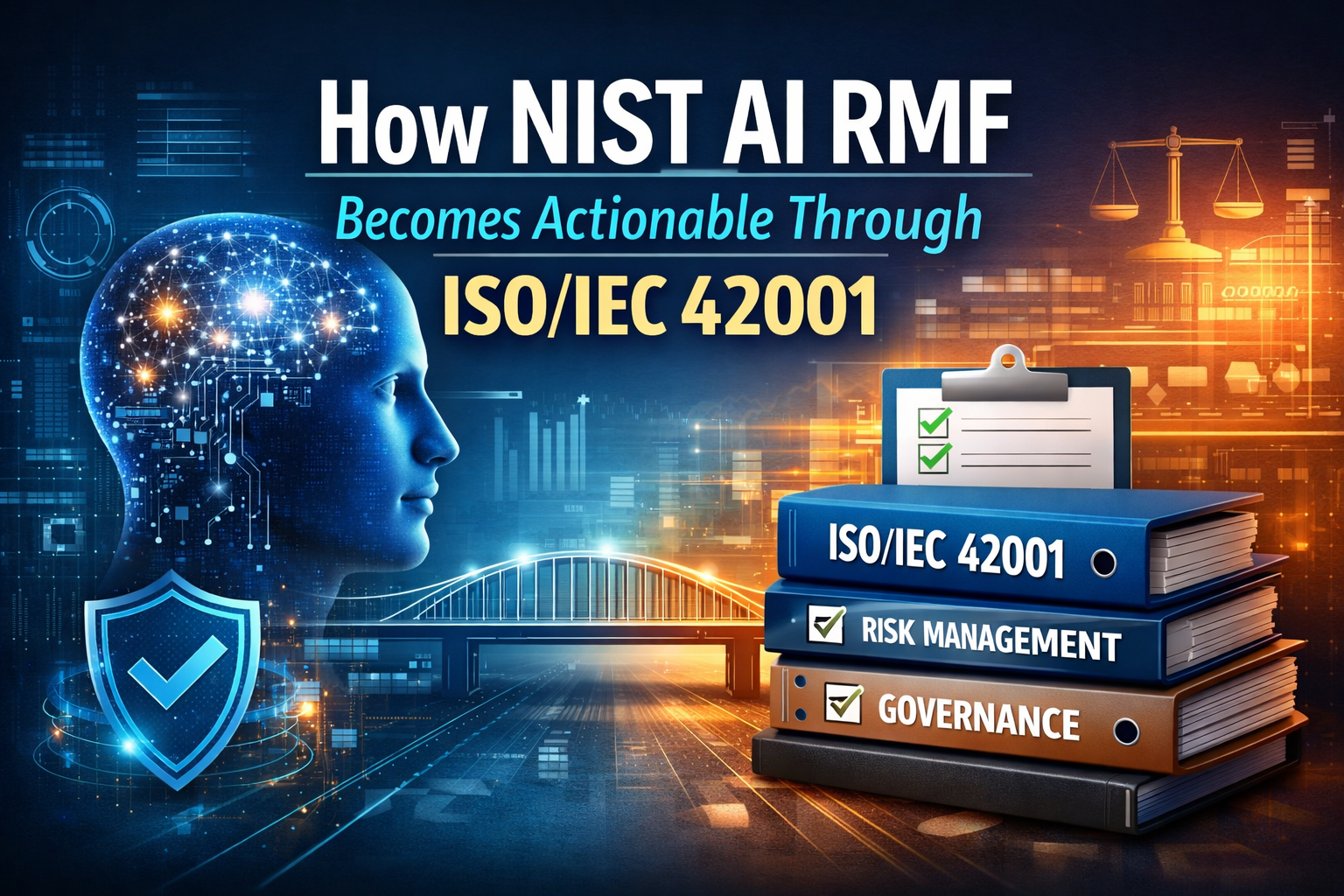
      AI is no longer experimental — it’s now deeply integrated into business decisions and societal functions. With this shift, governance can’t stay theoretical; it must be operational and enforceable. The article argues that combining the NIST AI Risk Management Framework (AI RMF) with ISO/IEC 42001 makes this operationalization practical and auditable.

      2. Principles Alone Don’t Govern
      The NIST AI RMF starts with the Govern function, stressing accountability, transparency, and trustworthy AI. But policies by themselves — statements of intent — don’t ensure responsible execution. ISO 42001 provides the management-system structure that anchors these governance principles into repeatable business processes.

      3. Mapping Risk in Context
      Understanding the context and purpose of an AI system is where risk truly begins. The NIST RMF’s Map function asks organizations to document who uses a system, how it might be misused, and potential impacts. ISO 42001 operationalizes this through explicit impact assessments and scope definitions that force organizations to answer difficult questions early.

      4. Measuring Trust Beyond Accuracy
      Traditional AI metrics like accuracy or speed fail to capture trustworthiness. The NIST RMF expands measurement to include fairness, explainability, privacy, and resilience. ISO 42001 ensures these broader measures aren’t aspirational — they require documented testing, verification, and ongoing evaluation.

      5. Managing the Full Lifecycle
      The Manage function addresses what many frameworks ignore: what happens after AI deployment. ISO 42001 formalizes post-deployment monitoring, incident reporting and recovery, decommissioning, change management, and continuous improvement — framing AI systems as ongoing risk assets rather than one-off projects.

      6. Third-Party & Supply Chain Risk
      Modern AI systems often rely on external data, models, or services. Both frameworks treat third-party and supplier risks explicitly — a critical improvement, since risks extend beyond what an organization builds in-house. This reflects growing industry recognition of supply chain and ecosystem risk in AI.

      7. Human Oversight as a System
      Rather than treating human review as a checkbox, the article emphasizes formalizing human roles and responsibilities. It calls for defined escalation and override processes, competency-based training, and interdisciplinary decision teams — making oversight deliberate, not incidental.

      8. Strategic Value of NIST-ISO Alignment
      The real value isn’t just technical alignment — it’s strategic: helping boards, executives, and regulators speak a common language about risk, accountability, and controls. This positions organizations to be both compliant with emerging regulations and competitive in markets where trust matters.

      9. Trust Over Speed
      The article closes with a cultural message: in the next phase of AI adoption, trust will outperform speed. Organizations that operationalize responsibility (through structured frameworks like NIST AI RMF and ISO 42001) will lead, while those that chase innovation without governance risk reputational harm.

      10. Practical Implications for Leaders
      For AI leaders, the takeaway is clear: you need both risk-management logic and a management system to ensure accountability, measurement, and continuous improvement. Cryptic policies aren’t enough; frameworks must translate into auditable, executive-reportable actions.


      Opinion

      This article provides a thoughtful and practical bridge between high-level risk principles and real-world governance. NIST’s AI RMF on its own captures what needs to be considered (governance, context, measurement, and management) — a critical starting point for responsible AI risk management. (NIST)

      But in many organizations today, abstract frameworks don’t translate into disciplined execution — that gap is exactly where ISO/IEC 42001 can add value by prescribing systematic processes, roles, and continuous improvement cycles. Together, the NIST AI RMF and ISO 42001 form a stronger operational baseline for responsible, auditable AI governance.

      In practice, however, the challenge will be in integration — aligning governance systems already in place (e.g., ISO 27001, internal risk programs) with these newer AI standards without creating redundancy or compliance fatigue. The real test of success will be whether organizations can bake these practices into everyday decision-making, not just compliance checklists.

      At DISC InfoSec, we help organizations navigate this landscape by aligning AI risk management, governance, security, and compliance into a single, practical roadmap. Whether you are experimenting with AI or deploying it at scale, we help you choose and operationalize the right frameworks to reduce risk and build trust. Learn more at DISC InfoSec.


      InfoSec services
       | InfoSec books | Follow our blog | DISC llc is listed on The vCISO Directory | ISO 27k Chat bot | Comprehensive vCISO Services | ISMS Services | AIMS Services | Security Risk Assessment Services | Mergers and Acquisition Security

      Tags: ISO 42001, NIST AI Risk Management Framework, NIST AI RMF


      Jul 21 2025

      What are the benefits of AI certification Like AICP by EXIN

      Category: AIdisc7 @ 9:48 am

      The Artificial Intelligence for Cybersecurity Professional (AICP) certification by EXIN focuses on equipping professionals with the skills to assess and implement AI technologies securely within cybersecurity frameworks. Here are the key benefits of obtaining this certification:

      🔒 1. Specialized Knowledge in AI and Cybersecurity

      • Combines foundational AI concepts with cybersecurity principles.
      • Prepares professionals to handle AI-related risks, secure machine learning systems, and defend against AI-powered threats.

      📈 2. Enhances Career Opportunities

      • Signals to employers that you’re prepared for emerging AI-security roles (e.g., AI Risk Officer, AI Security Consultant).
      • Helps you stand out in a growing field where AI intersects with InfoSec.

      🧠 3. Alignment with Emerging Standards

      • Reflects principles from frameworks like ISO 42001, NIST AI RMF, and AICM (AI Controls Matrix).
      • Prepares you to support compliance and governance in AI adoption.

      💼 4. Ideal for GRC and Security Professionals

      • Designed for cybersecurity consultants, compliance officers, risk managers, and vCISOs who are increasingly expected to assess AI use and risk.

      📚 5. Vendor-Neutral and Globally Recognized

      • EXIN is a respected certifying body known for practical, independent training programs.
      • AICP is not tied to any specific vendor tools or platforms, allowing broader applicability.

      🚀 6. Future-Proof Your Skills

      • AI is rapidly transforming cybersecurity — from threat detection to automation.
      • AICP helps professionals stay ahead of the curve and remain relevant as AI becomes integrated into every security program.

      Here’s a comparison of AICP by EXIN vs. other key AI security certifications — focused on practical use, target audience, and framework alignment:


      1. AICP (Artificial Intelligence for Cybersecurity Professional) – EXIN

      FeatureDetails
      FocusPractical integration of AI in cybersecurity, including threat detection, governance, and AI-driven risk.
      Based OnGeneral AI principles, cybersecurity practices, and touches on ISO, NIST, and AICM concepts.
      Best ForCybersecurity professionals, GRC consultants, vCISOs looking to expand into AI risk/security.
      StrengthsBalanced overview of AI in cyber, vendor-neutral, exam-based credential, accessible without deep AI technical background.
      WeaknessesLess technical depth in machine learning-specific attacks or AI development security.

      🧠 2. NIST AI RMF (Risk Management Framework) Training & Certifications

      FeatureDetails
      FocusManaging and mitigating risks associated with AI systems. Framework-based approach.
      Based OnNIST AI Risk Management Framework (released Jan 2023).
      Best ForU.S. government contractors, risk managers, policy/governance leads.
      StrengthsAuthoritative for U.S.-based public sector and compliance programs.
      WeaknessesNot a formal certification (yet) — most offerings are private training or awareness courses.

      🔐 3. CSA AICM (AI Controls Matrix) Training

      FeatureDetails
      FocusApplying 243 AI-specific security and compliance controls across 18 domains.
      Based OnCloud Security Alliance’s AICM (AI Controls Matrix).
      Best ForRisk managers, auditors, AI/ML security assessors.
      StrengthsHighly structured, control-mapped, strong for gap assessments and compliance audits.
      WeaknessesCurrently limited official training or certs; requires familiarity with ISO/NIST/CSA frameworks.

      📘 4. ISO/IEC 42001 Lead Implementer / Lead Auditor

      FeatureDetails
      FocusImplementing and auditing an AI Management System (AIMS) based on ISO/IEC 42001.
      Based OnThe first global standard for AI management systems (released Dec 2023).
      Best ForGRC professionals, ISO practitioners, consultants, internal/external auditors.
      StrengthsStrong compliance and certification credibility. Essential for orgs building an AI governance program.
      WeaknessesFormal and audit-heavy; steep learning curve for those without ISO/ISMS experience.

      🔍 Summary Comparison Table

      FeatureAICP (EXIN)NIST AI RMFCSA AICMISO 42001 LI/LA
      AudienceCyber & GRC prosRisk managersAuditors, CISOsISO implementers/auditors
      Practical✅✅✅✅✅✅✅✅✅✅✅✅✅✅
      Governance Depth✅✅✅✅✅✅✅✅✅✅✅✅✅✅
      Certification LevelMidAwareness-basedInformal trainingAdvanced (Lead Level)
      Industry RecognitionGrowingHigh (US Gov)Growing (CloudSec)High (ISO/IEC)
      Tool/Framework Neutral✅✅✅✅✅✅✅✅✅✅✅✅✅✅✅✅✅✅✅

      The New Role of the Chief Artificial Intelligence Risk Officer (CAIRO)

      InfoSec services | InfoSec books | Follow our blog | DISC llc is listed on The vCISO Directory | ISO 27k Chat bot | Comprehensive vCISO Services | ISMS Services | Security Risk Assessment Services

      Tags: AI Certs, AICP, CSA AICM, ISO 42001 LI/LA, NIST AI RMF