The Quiet Truth in the Gen AI Hype: Governance Is the Product
I just finished Generative AI and LLMs For Dummies — a solid primer aimed at executives and non-technical leaders trying to understand what they’ve already bought into. Most of it is what you’d expect: foundation models, transformers, prompt engineering, RAG, vector embeddings.
But buried in the middle of the book is the argument nobody in the LinkedIn AI commentariat wants to spend much time on:
A gen AI system is only as trustworthy as the governance around the data it touches.
That’s the whole post if you want to stop here. For the rest of you — let me unpack what that actually means in practice, because the gap between “we deployed a chatbot” and “we deployed a chatbot a regulator would accept” is wider than most teams realize.
The four governance failure points in a production LLM
When data flows through an LLM-powered application, governance has to follow it across at least four hand-offs:
- Training and fine-tuning data — what got fed into the model, and whether you have lineage, classification, and consent for it.
- The retrieval layer — what RAG and vector search are pulling back, and whether row-level controls survive the journey from your warehouse into the embedding store.
- The prompt-and-completion stream — what users typed in (often sensitive) and what came back (often combining sensitive sources in ways the user wouldn’t have been authorized to query directly).
- The orchestration layer — agents calling APIs, chaining prompts, hitting external systems. Each is a fresh data-egress point.
Framing — bring your processing to the data rather than take your data to the processing engine — is the right instinct. The further your data travels from your control plane, the more your governance program becomes a polite suggestion.
The blob-storage problem most teams haven’t thought about
One detail in the book deserves more attention than it gets.
Cloud object stores (S3, Azure Blob, GCS) make it trivial to dump PDFs, audio, video, and chat transcripts into your gen AI pipeline. They do not give you row-level or document-level access controls at the blob level. If your “unstructured data lake” is a bucket with permissive IAM and a service account the AI team uses for retrieval, you’ve quietly created a new exfiltration surface that your DLP tooling probably doesn’t see.
Most of the ISO 42001 gaps I see in client environments live exactly here — at the seam between “we have controls for structured data” and “the AI team is reading from a bucket nobody mapped.”
What good actually looks like
In our ISO 42001 implementation work at ShareVault — a virtual data room serving M&A and financial services clients — the governance challenge wasn’t writing the AI acceptable-use policy. That’s the easy part. The hard part was:
- Mapping every data flow that touches an AI system, including the unstructured ones.
- Establishing classification labels that travel with the data into embeddings, prompts, and completions.
- Logging completions in a way that supports audit without creating a new sensitive-data repository.
- Defining model-change management that satisfies ISO 42001 Clause 6.2 and the security controls inherited from ISO 27001.
Financial data rooms are the “hard mode” of compliance — if it works there, it works anywhere. The lesson from running this through a live Stage 2 audit: the model is almost never your biggest risk. The plumbing around the model is.
Three things I’d push every security and AI team to do this quarter
- Run an AI data-flow inventory. Not your applications inventory — the actual flow of data into prompts, embeddings, fine-tuning sets, and completions. You will find things you didn’t know existed.
- Decide who owns “model + data” risk. Most organizations split this between the AI team and security. That gap is where incidents happen. ISO 42001 forces you to name an owner; do it whether you’re certifying or not.
- Treat prompts and completions as production data. They need retention, classification, monitoring, and access policy. Most teams treat them like log files. They’re not.
Where I think this goes — a practitioner’s perspective on the future
The next 24 months in enterprise gen AI will be defined less by model capability and more by which organizations can prove their AI systems are governed. The capability ceiling keeps rising — Claude, GPT, Gemini, Llama, Mistral all get sharper every quarter. But the deployment ceiling is set by trust, and trust is set by governance.
Three things I expect:
- Procurement will start asking for ISO 42001. It’s already happening in financial services and healthcare. Within 18 months, expect it in standard B2B SaaS RFPs the way SOC 2 is today.
- The shadow-AI problem will get worse before it gets better. Employees are already using gen AI tools nobody inventoried. Governance frameworks that only address policy — and not discovery and enforcement — will fail in production.
- The competitive advantage moves to organizations that govern unstructured data well. Roughly 80% of enterprise data is unstructured, and almost no one governs it the way they govern their warehouse. That gap is the next decade of work for everyone in this space.
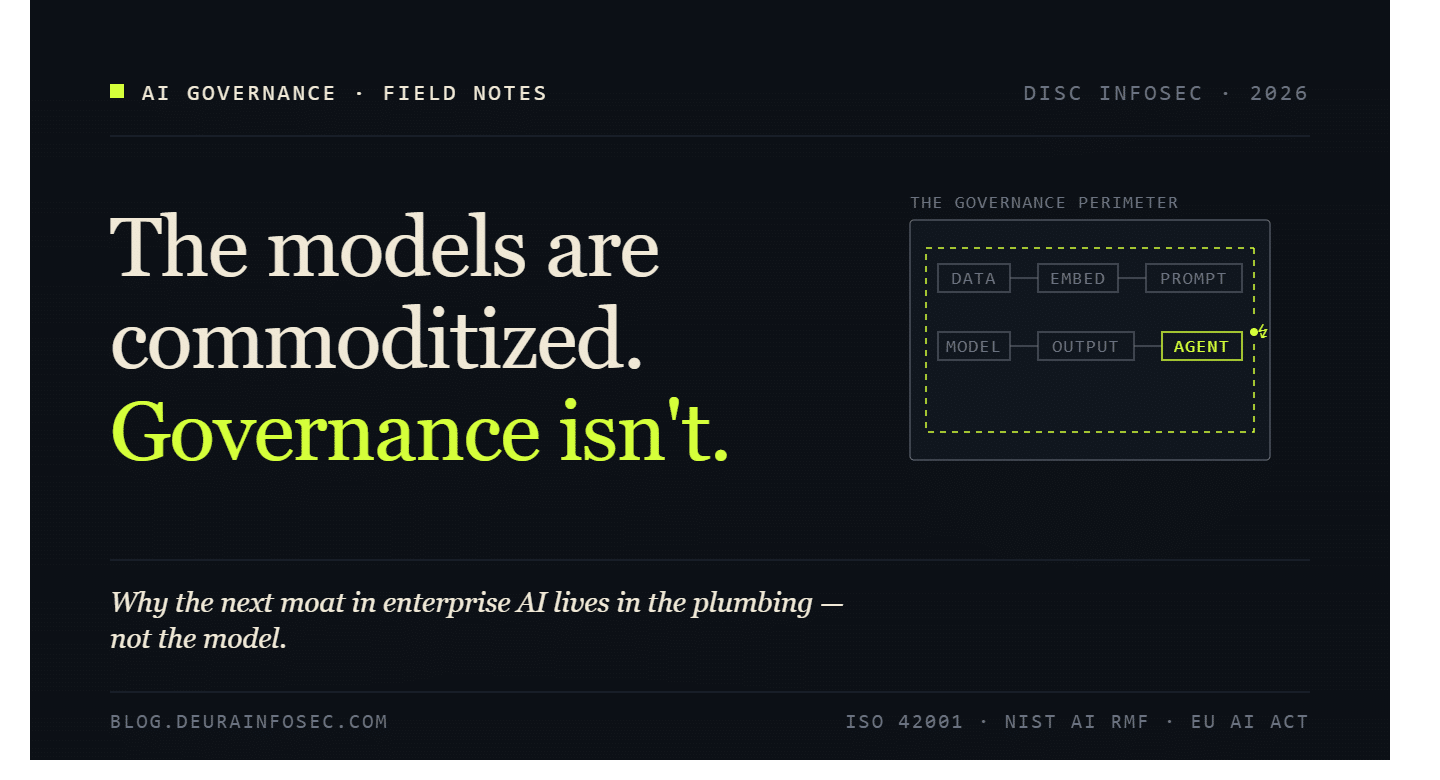
The models are getting commoditized. Governance isn’t. Build there.
If you’re working through ISO 42001, NIST AI RMF, or the EU AI Act in a serious way and want a practitioner’s view of what actually holds up under audit — that’s most of what we do at DISC InfoSec.
The AI Governance Quick-Start: Defensible in 10 Days, Not 4 Quarters
DISC InfoSec is an active ISO 42001 implementer and PECB Authorized Training Partner specializing in AI governance for B2B SaaS and financial services organizations.
AI Vulnerability Scorecard: Discover Your AI Attack Surface Before Attackers Do
Your Shadow AI Problem Has a Name-And Now It Has a Score
Most AI Security Tools Won’t Pass an Audit. Here’s a 15-Minute Way to Find Out.

InfoSec services | InfoSec books | Follow our blog | DISC llc is listed on The vCISO Directory | ISO 27k Chat bot | Comprehensive vCISO Services | ISMS Services | AIMS Services | Security Risk Assessment Services | Mergers and Acquisition Security
- 14 Months to Comply. 12 Months of Work. The High-Risk AI Playbook Nobody Has Started
- Your biggest AI risk isn’t hackers. It’s your own data walking out the door
- The cheapest security control you’ll ever implement is the component you decided not to build
- AI Handoffs: How Uncertainty Propagates—and How to Fix It
- The Security Risks Hiding in AI Agent Memory