InfoSec Compliance & AI Governance For over 20 years, DISC InfoSec has been a trusted voice for cybersecurity professionals—sharing practical insights, compliance strategies, and AI governance guidance to help you stay informed, connected, and secure in a rapidly evolving landscape.
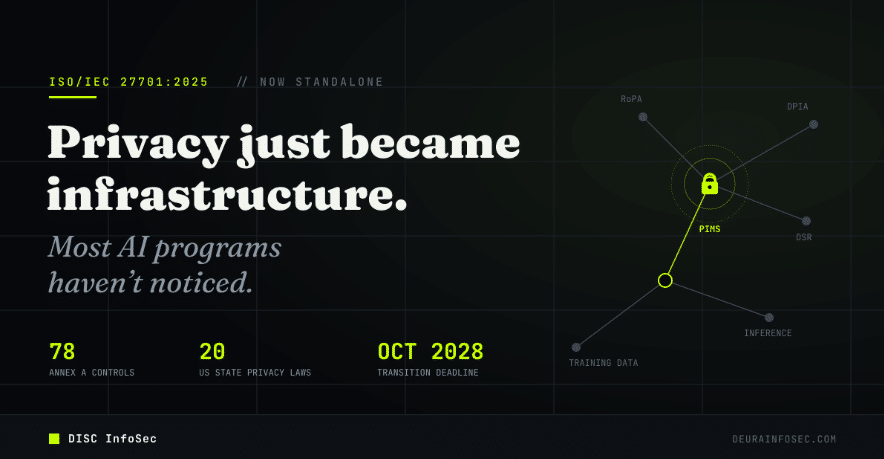
Privacy Just Became Infrastructure. Most AI Programs Haven’t Noticed.
By DISC InfoSec
For twenty years, privacy compliance meant disclosure: post a policy, collect consent, answer the occasional access request. That era is over. In 2026, privacy is infrastructure — regulators are testing whether your controls actually work, not whether your privacy notice reads well.
I spend my days implementing management systems for companies where the data can’t leak — financial data rooms, M&A platforms, AI-enabled SaaS. Here’s what the privacy threat landscape actually looks like right now, and what I’d do about it.
In practical terms, it means:
Privacy is built into systems by design. Organizations must embed privacy controls into applications, AI systems, cloud platforms, and data architectures from the beginning rather than adding them later.
Privacy enables business operations. Just as networking, identity management, and cybersecurity are core infrastructure, privacy has become an essential capability that supports AI, data sharing, digital services, and regulatory compliance.
Privacy is a technical and operational discipline. Engineers, architects, security teams, and AI governance professionals are now responsible for implementing privacy-enhancing technologies, data minimization, consent management, encryption, and access controls—not just legal or compliance teams.
For organizations deploying AI, the phrase is especially relevant because regulations and frameworks increasingly require privacy to be integrated into AI governance. This includes conducting privacy impact assessments, limiting unnecessary data collection, protecting personal information, and ensuring transparency and accountability throughout the AI lifecycle.
In short, “Privacy Just Became Infrastructure” means privacy is now a foundational capability that organizations must engineer, manage, and continuously maintain—just like cybersecurity, identity, and cloud infrastructure.
The pressure on industry, in general
The patchwork is now a wall. Twenty US states have comprehensive privacy laws in force. Indiana, Kentucky, and Rhode Island went enforceable this year. California’s updated CCPA regulations now mandate independent cybersecurity audits with certifications filed to the CPPA, and formal risk assessments before any “significant risk” processing begins. Rhode Island carries no cure period — day-one enforcement exposure. If your compliance program was built for one or two state laws, it’s already behind. Compliance is no longer optional or fragmented. The growing number of regulations now creates a comprehensive set of expectations that every organization must address.
Enforcement moved from awareness to action. California imposed its largest CCPA fine to date in 2025, targeting exactly the unglamorous stuff: broken opt-out mechanisms, missing processor contract clauses, notices that don’t match actual processing. California, Colorado, and Connecticut ran a joint sweep on Global Privacy Control compliance. Regulators are no longer reading your policy — they’re testing your website.
The data you forgot about is the data that kills you. The average US breach now costs over $10M. In almost every incident I’ve reviewed, the most damaging records were the ones nobody knew the company still held. No current data inventory means no defensible position — full stop.
Cross-border transfers are a moving target. DOJ’s bulk data transfer rule, Vietnam’s new PDPL, evolving adequacy politics — transfer assessments are now a living exercise, not a one-time SCC signing ceremony.
The pressure in the AI space, specifically
AI didn’t create new privacy principles. It broke every assumption the old controls were built on.
Training data is now a regulated disclosure. California’s AB 2013 requires generative AI developers to publicly summarize the categories and sources of their training data. If you fine-tuned a model on customer data and can’t document what went in, you have a transparency problem with an enforcement hook.
Inference is processing. Every prompt containing customer PII, every RAG pipeline pulling from a CRM, every AI agent reading a mailbox — that’s personal data processing, with all the lawful-basis, minimization, and retention obligations that implies. Most AI inventories I review don’t capture inference-time data flows at all.
Automated decisions are the new high-risk zone. Colorado’s AI Act, Texas TRAIGA, and California’s ADMT regulations converge on the same target: AI making consequential decisions about employment, credit, housing, healthcare. The EU AI Act’s high-risk obligations land in August. If your AI touches a consequential decision and you can’t produce a risk assessment, you’re the test case.
Models remember. Memorization and output leakage mean personal data put into a model can come back out — to a different user, in a different context. “We deleted the source record” doesn’t answer “is it still in the weights?”
Shadow AI is shadow processing. Employees pasting customer data into consumer AI tools is the 2026 version of the rogue file share — except the data leaves your control permanently and may train someone else’s model.
Where ISO 27701:2025 changes the math
Here’s the development most compliance teams haven’t caught up with: ISO 27701 was rebuilt as a standalone standard in October 2025. You no longer need ISO 27001 first — you can implement and certify a Privacy Information Management System (PIMS) on its own, with 78 Annex A controls split across PII controller obligations (A.1), processor obligations (A.2), and shared security controls (A.3). The 2025 edition explicitly added control coverage for cloud, IoT, and AI processing — the standard caught up to the threat landscape.
It also shares the same harmonized structure as ISO 27001:2022 and ISO 42001:2023. That matters practically: if you’re building AI governance and privacy management at the same time — and in 2026, you are — the clause structures interlock. One risk methodology, one internal audit program, one management review. I’ve run that integration play; the overhead savings are real.
One honest caveat, because practitioner credibility requires it: ISO 27701 is not a GDPR safe harbor. Certification doesn’t shield you from enforcement and carries no legal presumption of compliance. What it does provide is the thing regulators actually ask for — demonstrable accountability: a current RoPA, tested data subject rights procedures, documented DPIAs, processor contracts with the right clauses, and evidence behind every control. When the CPPA or a DPA comes asking, “we have a certified, audited PIMS” is a very different conversation than “here’s our privacy policy.”
(Already certified under the 2019 edition? You have until October 2028 to transition. Start scoping now — the control structure changed materially.)
My perspective: the threat is unmanaged processing, not AI
The core privacy threat in 2026 isn’t any single technology. It’s processing that nobody owns, nobody inventoried, and nobody assessed — and AI multiplies the amount of it exponentially. Every remediation path runs through the same discipline:
1. Inventory first. Build a unified data + AI inventory: what personal data you hold, which AI systems touch it, at training and at inference. You cannot protect what you cannot see.
2. Assess before you deploy. DPIAs for every AI system processing personal data, mandatory for anything touching consequential decisions. The EU AI Act, Colorado, and California all converge here — one good assessment process serves all three.
3. Fix the processor chain. Audit your DPAs and sub-processor terms against actual data flows, including AI vendors. Contract gaps are the most-fined, least-fixed problem in privacy.
4. Operationalize rights. Data subject requests must work end-to-end — including data that went into AI systems. Test them like you’d test a DR plan.
5. Put it in a management system. Point-in-time compliance decays. A PIMS under ISO 27701:2025 forces the loop — risk assessment, treatment, internal audit, management review, corrective action — that keeps the program alive between audits.
Privacy by design used to be a slogan. In 2026 it’s the enforcement standard. The organizations that treat privacy as infrastructure will spend less, move faster, and sleep better than the ones still treating it as paperwork.
DISC (CISSP, CISM, ISO 27001 & ISO 42001 Lead Implementer) Consultant at DISC InfoSec, helping B2B SaaS and financial services firms build integrated security, privacy, and AI governance programs — including taking a financial data room platform through ISO 42001 certification. Financial data rooms are the hard mode of compliance; privacy programs built for hard mode work everywhere.
Building or transitioning a PIMS? Start the conversation: info@deurainfosec.com | deurainfosec.com
Not because it’s the flashiest. Not because a regulator is threatening a fine. But because it is the only framework that forces you to build a real information security management system — one your entire compliance stack can grow on top of.
Here’s why.
What ISO 27001 Actually Is (And Isn’t)
ISO/IEC 27001:2022 is the international standard for Information Security Management Systems (ISMS). It’s published by the International Organization for Standardization and the International Electrotechnical Commission, and it applies to any organization, any size, any sector.
What it is not is a checklist. It is a management system standard — meaning it requires your organization to define its context, assess risk, implement controls, measure performance, and continuously improve. That PDCA (Plan-Do-Check-Act) discipline is exactly what makes it so durable and so transferable.
The 2022 version restructured the Annex A control library from 114 controls across 14 domains down to 93 controls across 4 themes — Organizational, People, Physical, and Technological — and added 11 new controls for cloud security, threat intelligence, data masking, secure coding, and more. Every organization with a 2013 certification was required to transition by October 2025.
If you’re still operating on a 2013-era ISMS, you’re already out of conformance.
The Mandatory Clause Framework: Where the Real Value Lives
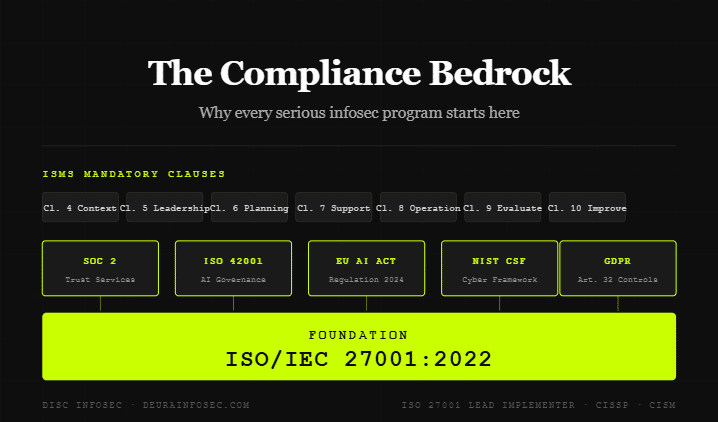
ISO 27001’s Clauses 4 through 10 apply to every organization without exception. This is where the management system lives — not in the Annex A controls, but in the operational discipline the clauses require:
Clause 4 — Know your context. Who are your stakeholders? What are their expectations? What’s in scope?
Clause 5 — Leadership owns security. A signed policy isn’t a checkbox. It’s a commitment from the top.
Clause 6 — Plan your risk treatment. A formal risk register, a risk treatment plan, and a Statement of Applicability (SoA) are mandatory outputs.
Clause 8 — Operate your controls. Evidence that risk treatment is actually executing, not just documented.
Clause 9 — Measure and audit. KPIs, internal audits, management review — the cadence that prevents ISMS drift.
Clause 10 — Improve. Nonconformities get documented. Corrective actions get tracked. The system learns.
This is not bureaucracy for its own sake. This is the operational skeleton that every mature compliance program eventually needs to build — ISO 27001 just requires you to build it on day one.
Why ISO 27001 Is the Foundation Other Frameworks Stand On
Here’s the practitioner reality: most compliance frameworks are control libraries with a certification stamp. ISO 27001 is different — it’s a management system that happens to include a control library.
That distinction matters enormously when you’re trying to layer frameworks.
SOC 2
The AICPA’s Trust Services Criteria map heavily to ISO 27001 Annex A. If you have implemented access control (A.5.15–5.18), incident response (A.5.24–5.28), supplier security (A.5.19–5.22), and availability controls (A.5.29–5.30), you have already addressed the majority of CC6, CC7, A1, and C1 criteria. ISO 27001 gives SOC 2 auditors a documented ISMS they can rely on — which typically compresses audit timelines and reduces evidence burden.
ISO 42001 (AI Management Systems)
ISO/IEC 42001:2023 — the AI governance standard — was explicitly designed to be compatible with ISO 27001. The two standards share the same Annex SL high-level structure, meaning risk assessment methodology, documentation requirements, internal audit cadence, and management review processes are directly reusable. Organizations that have ISO 27001 in place have an immediate head start on 42001 implementation. For AI-powered SaaS companies facing EU AI Act pressure, this integration is not optional — it’s strategic.
EU AI Act
The EU AI Act’s requirements for high-risk AI systems — risk management systems, data governance, technical documentation, human oversight, robustness — all assume a baseline of information security hygiene. ISO 27001 provides that baseline, particularly through its new 2022 controls: A.8.9 (configuration management), A.8.28 (secure coding), A.5.23 (cloud services security), and A.8.12 (data leakage prevention). Regulators and notified bodies will look for this foundation.
NIST CSF 2.0
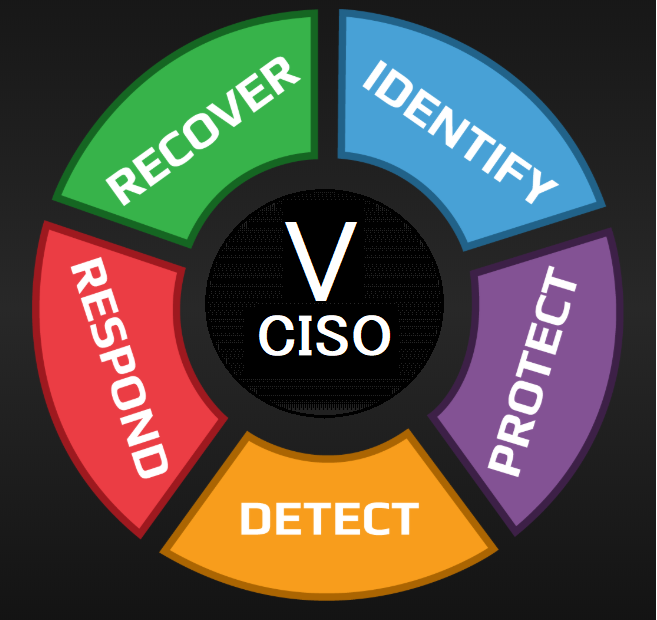
The NIST Cybersecurity Framework’s six functions — Govern, Identify, Protect, Detect, Respond, Recover — map cleanly to ISO 27001. The Govern function aligns to Clauses 4, 5, and 6. Protect maps to Annex A’s organizational and technological controls. Detect and Respond align to incident management controls A.5.24–5.28. If you’re pursuing FedRAMP or CMMC, your ISO 27001 ISMS is the documentation backbone the NIST SP 800-53 assessor will want to see.
GDPR and Privacy Regulations
ISO 27001 doesn’t cover privacy by itself — that’s ISO 27701 territory. But the ISMS structure, supplier security controls (A.5.19–5.22), and information classification controls (A.5.12–5.13) provide the security safeguards that GDPR Article 32 requires. A GDPR compliance program built on an ISO 27001 ISMS is structurally sounder than one built from scratch.
The Business Case: Why Enterprises and Governments Demand It
ISO 27001 certification signals something that no internal policy document can: an independent third party has verified your security management system meets a globally recognized standard.
For vendor selection in enterprise and financial services, that matters. For cross-border contracts in the EU, UK, APAC, and Middle East, it’s often a baseline requirement. For regulated industries — healthcare, fintech, government supply chains — it can be the difference between getting on the shortlist or getting cut from procurement.
This is why I tell clients: ISO 27001 is not just a compliance achievement. It’s a revenue enabler.
What “Foundation” Actually Means in Practice
When I use the word foundation, I mean something specific: the mandatory documentation that ISO 27001 requires you to produce becomes the evidentiary infrastructure for every other program you layer on top.
Your ISO 27001 ISMS produces:
A scoped asset inventory (feeds SOC 2, FedRAMP, CMMC)
A formal risk register (feeds ISO 42001, NIST AI RMF, EU AI Act)
A Statement of Applicability (feeds gap analysis for any other framework)
An internal audit programme (feeds SOC 2 Type 2, FedRAMP ConMon)
A supplier security process (feeds GDPR Article 28, SOC 2 CC9)
Management review minutes (feeds governance evidence for any board-level framework)
You build it once. Every other framework benefits.
The Practitioner’s Bottom Line
We’ve implemented ISO 27001 for organizations ranging from boutique SaaS companies to financial services platforms handling sensitive deal data. The pattern is consistent: the organizations that invest in a real ISMS — not a documentation exercise, but an operational management system — spend dramatically less time and money on every subsequent compliance program.
If your organization is serious about security — not just compliant on paper, but operationally disciplined — this is where you begin.
DISC InfoSec specializes in ISO 27001 and ISO 42001 implementation, vCISO and vCAIO services, and AI governance for B2B SaaS and financial services organizations. We are a PECB Authorized Training Partner and have led ISO 42001 Stage 2 certification engagements for production AI systems.
Ready to build a compliance program that actually holds up? Let’s talk. info@deurainfosec.com
How to Build a Master Questionnaire as Your Single Source of Truth for ISO 27001, ISO 42001, NIST 800-53, and GDPR
I want to tell you about a problem that is quietly draining compliance teams at SaaS companies right now — and a structural fix that changed how we think about audits entirely.
Here is the situation most security and compliance leaders find themselves in. You hold ISO 27001 certification. Your enterprise customers require NIST 800-53 Rev 5 verification. GDPR applies because you handle European personal data. And now, with AI baked into your product, ISO 42001 is on the table too. Four frameworks. Four sets of controls. Four different auditors asking different versions of the same fundamental questions.
The instinctive response is to build four compliance programs — one for each standard. Four spreadsheets, four evidence libraries, four cycles of internal prep, four rounds of answering the same question about your access control policy worded slightly differently each time.
We did this at client. It was expensive, repetitive, and structurally fragile. Every time a policy changed, we had to update it in four places. Evidence collected for one audit sat invisible to the others. The left hand genuinely did not know what the right hand was doing.
Then we asked a different question: What if there was only one audit?
The Insight That Changes Everything
Across ISO 27001:2022, ISO 42001:2023, NIST SP 800-53 Rev 5, and GDPR, the vast majority of what auditors actually want to know falls into the same 18 operational domains: governance, risk management, access control, data protection, cryptography, incident response, business continuity, supplier management, secure development, and so on.
The standards differ in language, structure, and emphasis. But the underlying security and privacy reality they are probing — your policies, your controls, your evidence — is the same reality. An ISO 27001 auditor asking about your access control policy (A.5.15) and a NIST assessor asking about AC-1 are fundamentally asking the same organization the same question. Your Access Control Policy v1.3 answers both of them.
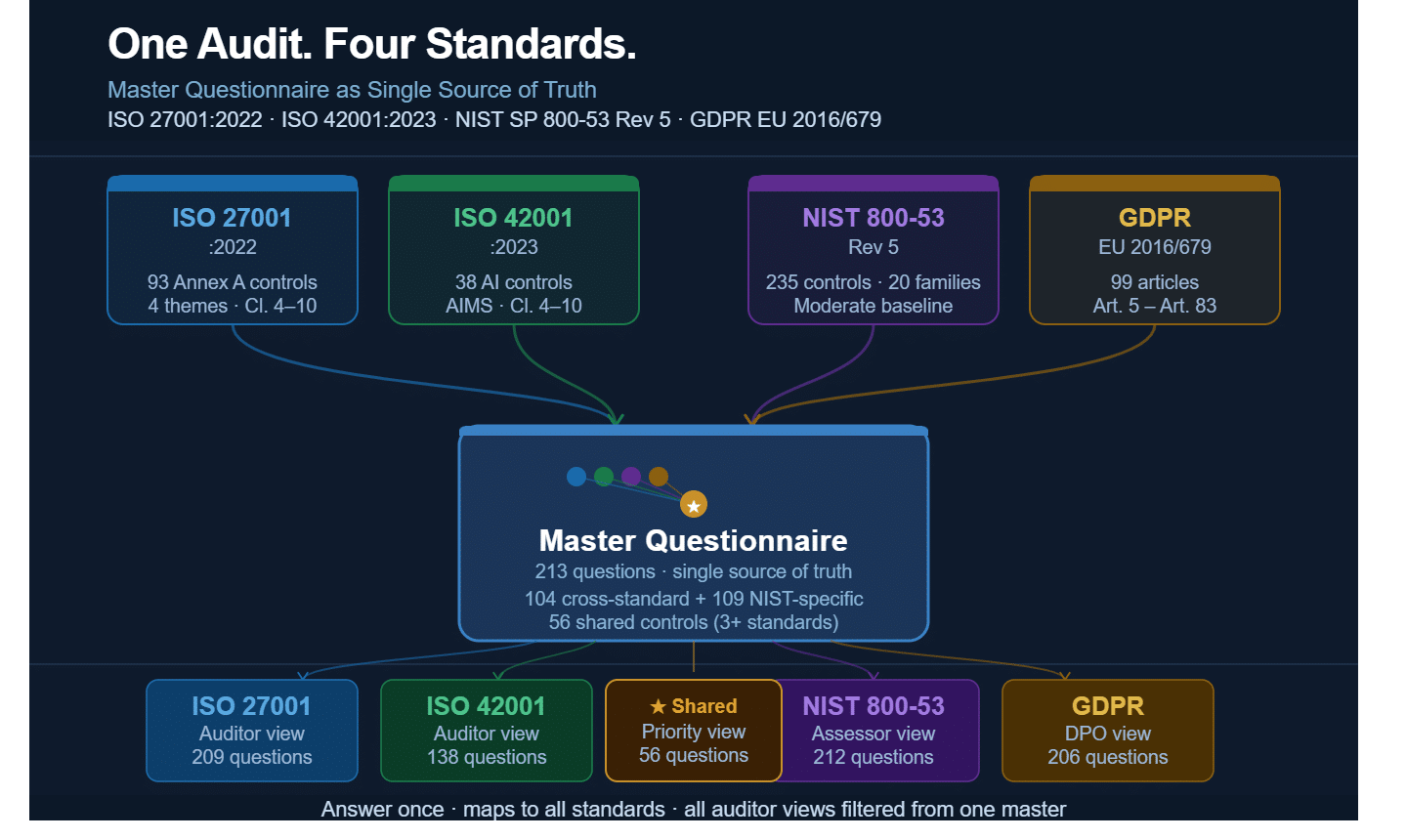
This is the foundation of the Master Questionnaire approach: write the question once, map the answer to every standard it satisfies simultaneously.
Why Most Multi-Standard Programs Fail Structurally
Before describing what to build, it is worth being precise about why the typical approach breaks down. The problem is not effort or intention — compliance teams work hard. The problem is architecture.
Most organizations build what I call parallel catalogs: one spreadsheet or GRC module per standard, each with its own question set, its own evidence columns, its own status tracking. When the ISO 27001 auditor asks about incident response and the GDPR auditor asks about breach notification, they get two separate answers pointing to the same IR Procedure — but there is no structural connection between them. If you update the procedure, you have to remember to update both rows in both sheets. You usually do not. Inconsistencies accumulate. Auditors notice.
The second failure is ID scheme collision. This sounds technical but it matters enormously in practice. If your internal questionnaire uses “IR-01” for your Incident Response domain questions and NIST SP 800-53 uses “IR-1” for the same family, you end up with ID conflicts that make cross-referencing impossible. You cannot write a formula or filter that reliably maps one to the other. We ran into exactly this problem in our own workbook, discovering 173 NIST Moderate baseline controls that existed only in a standalone NIST catalog with no connection whatsoever to the master question set.
The third failure is scope mismatch. NIST SP 800-53 Rev 5 Moderate baseline has approximately 235 distinct controls across 20 families when enhancements are included. ISO 27001:2022 has 93 Annex A controls. ISO 42001:2023 has 38 AI-specific controls. GDPR has 99 Articles. Organizations routinely under-scope their questionnaires, sampling 26 or 30 NIST controls and calling it “covered.” A real Moderate baseline assessment covers every control — AC-1 through SR-12, including every enhancement number that the baseline requires.
The Architecture of a Single Source of Truth
Here is how to build it correctly.
Start with 18 operational domains, not four standards.
The domains should reflect how your organization actually operates: Governance & Policies, Scope & Context, Risk Management, Access Control & Identity, Data Protection & Privacy, Cryptography & Key Management, Network & Infrastructure Security, Secure Development, Incident Response, Business Continuity, Supplier & Third-Party Management, Physical & Environmental Security, Human Resources Security, Audit Logging & Monitoring, Configuration & Change Management, AI Governance, Compliance & Internal Audit, and Cross-Border Data Transfers.
Every question you write lives in one of these domains. The domain structure is standard-agnostic — it reflects your operational reality, not any single framework’s chapter structure.
Write questions that satisfy multiple standards simultaneously.
Take access control as an example. Rather than writing four separate questions — one citing ISO 27001 A.5.16, one citing NIST AC-2, one citing GDPR Art. 32, one citing ISO 42001 A.6.2.2 — you write one question: “Describe the complete joiner-mover-leaver process. How are accounts created, modified, and deactivated? What is the maximum time to deprovision a terminated user?”
This single question satisfies ISO 27001:2022 A.5.16 and A.5.18, NIST SP 800-53 Rev 5 AC-2, AC-2(1), AC-2(3), and AC-2(5), and GDPR Art. 32. One answer. Four standards. That is not a shortcut — that is what a mature account management process actually looks like when described completely.
Use a collision-free ID scheme from the start.
This is a technical detail that pays significant dividends. Cross-standard questions should use domain-based prefixes that do not clash with any standard’s own naming: G- for Governance, A- for Access Control, INC- for Incident Response (not IR-, which collides with the NIST IR family), BCP- for Business Continuity, CFG- for Configuration Management (not CM-, which collides with NIST CM), CRY- for Cryptography, and so on.
NIST-specific questions — those covering Moderate baseline controls not addressed by any cross-standard question — should use a clearly distinct scheme: NIST-{family}-{sequence}, for example NIST-AC-07 for AC-7, NIST-PE-04 for PE-13. This makes the source of every question unambiguous and allows you to filter programmatically by standard without collision.
The Master tab is the only place answers live.
Every auditor view — ISO 27001 tab, ISO 42001 tab, NIST tab, GDPR tab — is a filtered subset of the Master, not an independent document. When the answer to a question changes, you update it once in the Master. The filter propagates to all auditor views automatically. If you find yourself maintaining two versions of an answer, your architecture has a flaw.
Add a Question Source column.
This single column distinguishes between cross-standard questions (one question, many standards) and NIST-specific questions (one control, one question). It tells any auditor looking at the sheet exactly what they are looking at and why the question exists. It also tells your team where to invest effort — cross-standard questions with a “★ Shared” marker satisfy three or more frameworks simultaneously and should be answered first.
What the Numbers Look Like in Practice
When we implemented this at client, the numbers clarified the approach nicely.
We ended up with 213 total questions in the Master: 104 cross-standard questions covering all 18 operational domains, and 109 NIST-specific questions covering NIST Moderate baseline controls that needed dedicated coverage. The NIST auditor view contains 212 questions — covering 235 distinct NIST controls — all filtered directly from the Master. The ISO 27001 view contains 209 questions. The GDPR view contains 206. The ISO 42001 view contains 138, reflecting that ISO 42001’s scope is intentionally narrower.
Of the 213 total questions, 56 are marked as shared controls — meaning a single answer to that question satisfies three or more standards simultaneously. These 56 questions are the highest-leverage evidence collection effort in your entire audit programme. Answer them well and you have satisfied the core control requirements of all four frameworks for the most critical domains: risk management, access control, encryption, incident response, supplier management, data protection, logging, and business continuity.
Before this restructure, we had a v3 workbook with 104 questions in the Master and 187 in a standalone NIST tab with zero structural connection between them. The root cause was that the NIST tab had been built as a separate catalog with NIST family-based IDs that clashed with our domain IDs, making cross-referencing impossible. This is a common mistake and worth naming explicitly: a NIST tab that cannot be proven to be a filtered view of the Master is not a single source of truth — it is a second source of truth, which is the same as no single source of truth at all.
The Columns That Make It Work
A Master Questionnaire has a specific anatomy. Every row needs:
Q-ID — unique, collision-free identifier following your scheme.
Domain — the operational domain, not the standard’s chapter.
Audit Question — written to satisfy all applicable standards simultaneously, framed around your actual controls and evidence.
Audit Type — Document Review, Technical Review, Interview, Sample, or combinations. This tells both your team and the auditor what kind of evidence the question expects.
ISO 27001:2022 reference — official Annex A control IDs (A.5.1 through A.8.34) and Clause references (Cl.4 through Cl.10). Not approximated — exact.
ISO 42001:2023 reference — official Annex A control IDs (A.2.2 through A.10.4) and Clause references. ISO 42001 Annex A objectives (A.x.1 entries) are not controls — the controls begin at A.x.2. This distinction matters when an ISO 42001 auditor checks your SoA.
NIST SP 800-53 Rev 5 reference — official control IDs with enhancement numbers. AC-2(1) is a different control from AC-2. A Moderate baseline assessment distinguishes between them. If your questionnaire collapses AC-2 and all its enhancements into a single cell without specifying which enhancements apply, your NIST assessor will push back.
GDPR reference — specific Article numbers at sub-article precision. Art. 5(1)(c) is different from Art. 5(1)(e). Art. 28(3) specifies the mandatory clauses in a DPA. Approximated references like “Art. 32 generally” are insufficient for a DPO-level review.
Answer column — blank, awaiting your response. This is the most important column in the workbook. It is where your security reality meets the standards’ requirements.
Status — a dropdown: Implemented, Partial, Not Implemented, N/A, Not Tested. The Partial status is particularly important — it tells auditors and management exactly where gaps exist without overstating or understating compliance.
Evidence / Document Reference — the policy name, version, section, screenshot, log excerpt, or configuration that proves the answer. This column is pre-filled with hints when you build the questionnaire (e.g., “Access Control Policy v1.3; 90-day review evidence; LastPass configuration”) and updated with actual references during audit preparation.
Question Owner — the individual responsible for providing the answer and evidence. Compliance does not happen in a CISO’s office alone. Owners span IT, HR, Legal, DevOps, the AI Officer, and the DPO.
Auditor Notes — reserved for the auditor. Your team does not pre-fill this column. It is the auditor’s workspace during the actual audit session.
Shared Control flag — a star marker for questions satisfying three or more standards. Your audit preparation team should complete all starred questions first. They represent the core of your compliance posture across every framework.
The Audit Session Experience
Here is what this looks like in practice when you sit down with an auditor.
Your ISO 27001 auditor receives the ISO 27001 filtered view tab. They see 209 questions, each with official Annex A or Clause references, your pre-populated answer, a status, and an evidence reference. They work through the Auditor Notes column adding their observations. They do not need to navigate the NIST questions or the AI governance section unless a control overlaps.
Your NIST assessor receives the NIST view tab: 212 questions covering 235 controls across all 20 families from AC through SR. Both cross-standard questions (where your Access Control Policy satisfies AC-1, AC-2, AC-3 simultaneously) and NIST-specific questions (AC-7 lockout thresholds, AC-11 device lock, SC-15 collaborative device controls) are visible, with the Question Source column clearly labeling each type.
Your DPO or privacy auditor receives the GDPR view: 206 questions covering Articles 5 through 83, with cross-references to the ISO 27001 and ISO 42001 controls that satisfy the same requirement. The RoPA question, the DPIA question, the data subject rights process question, the breach notification procedure — all answered once in the Master, surfaced here for the privacy auditor’s review.
What none of these auditors receive is a contradictory answer. Because there is only one answer. There is only one Master.
The AI Governance Layer
ISO 42001:2023 deserves specific attention because it is the newest of the four standards and the one most organizations are building from scratch rather than extending from existing programs.
The standard requires several things that have no direct analog in ISO 27001 or NIST. AI System Impact Assessments (AISIAs) are mandatory for every AI system in scope — a structured analysis of potential impacts on individuals, groups, and society, resulting in a Low, Medium, or High impact classification. This feeds directly into how much human oversight, transparency, and testing is required for each system. Your AI governance questions need to cover this lifecycle: system registration, AISIA, responsible design principles (A.6.1.3), verification and validation testing (A.6.2.4), controlled deployment (A.6.2.5), monitoring (A.8.5), and AI-specific incident management (A.8.4).
The AI data governance controls — A.7.2 through A.7.6 covering data quality, provenance, and preparation — have meaningful overlap with GDPR’s data minimisation (Art. 5(1)(c)), purpose limitation (Art. 5(1)(b)), and privacy by design (Art. 25) requirements. A single well-written question about AI data governance can cover all of these simultaneously, but only if you know both standards well enough to write it that way.
The EU AI Act adds a classification layer that sits above ISO 42001 rather than within it: your AI systems need to be assessed against the Act’s risk tiers (prohibited, high-risk Annex III, limited risk, minimal risk) with resulting compliance obligations. This is an AIX-domain question in the Master with no NIST equivalent — which is fine, because not every question needs to satisfy all four standards. The single source of truth principle does not mean every question covers every standard; it means every answer lives in one place.
Five Principles to Build By
If I were starting this process from scratch at a new organization, I would anchor on five principles from day one.
Official control IDs only. Approximated references create ambiguity that auditors exploit. If your ISO 27001 reference says “A.5 generally” instead of “A.5.15; A.5.16; A.5.18,” a thorough auditor will ask which specific controls you are claiming coverage for and you will have to reconstruct the mapping under pressure. Use the exact IDs from the published standards. ISO 27001:2022 Annex A runs from A.5.1 to A.8.34. NIST 800-53 Rev 5 AC-2(1) is a separate control from AC-2. These distinctions are in the standards for a reason.
Full coverage, not sampling. A Moderate NIST baseline assessment covers approximately 235 controls. An ISO 27001 audit covers all 93 Annex A controls. Sampling — picking representative controls from each family — may satisfy a checkbox exercise but it will not satisfy a thorough assessor and it will not actually tell you where your gaps are. The discipline of building complete coverage is also the discipline of discovering what you do not have implemented yet.
One answer, not four. If you catch yourself writing the same answer in two different tabs, your architecture is broken. Fix the architecture, not the duplicate. The structural constraint — all auditor views are filtered subsets of the Master — should make duplication physically impossible.
Gaps are information, not failure. The Partial and Not Implemented status options are not admissions of guilt — they are the output of an honest audit programme. A questionnaire where everything is marked Implemented before an auditor has looked at it is not a compliance programme; it is a liability. Real compliance posture requires knowing where you stand, including the uncomfortable parts.
The questionnaire is a living document, not a pre-audit scramble. The most valuable thing a Master Questionnaire does is shift compliance from a periodic event to a continuous state. When your IR procedure changes, you update the INC-01 answer. When you onboard a new AI service provider, you update the AIX-09 answer and the SUP-03 answer. The questionnaire should be reviewed quarterly, updated continuously, and owned by named individuals — not assembled in the three weeks before an auditor arrives.
A Note on AI-Assisted Compliance
One of the most significant changes in compliance practice over the last two years is the ability to use AI tools to populate questionnaire answers from an organization’s existing knowledge base — policies, procedures, security documentation, vendor assessments, architecture documents.
This does not replace human judgment. The Answer column in a Master Questionnaire still requires a human to verify accuracy, attach actual evidence references, and set a status they are willing to defend in an audit. But it dramatically compresses the time between “questionnaire template built” and “questionnaire ready for auditor review.”
At ShareVault, where our knowledge base includes our Security Policy, Access Control Policy, AI Management Policy, Incident Response Procedure, Risk Assessment Procedure, Privacy Policy, and Security & Availability documentation, an AI tool can populate an initial draft of most answers from these sources and flag which questions have insufficient documentation to answer — which is itself valuable information.
The key discipline is the same as for all AI-assisted work: the human remains accountable for the output. The AI drafts; the owner reviews, corrects, and signs off. The auditor evaluates the answer, not the method used to produce it.
Where to Start
If you are managing compliance across multiple standards and you recognize the structural problems described here, the path forward is straightforward even if the work is substantial.
Start with a gap analysis of what you currently have. Count your actual questions per standard. Map each one to the official control ID it is claiming to satisfy. Find the NIST families you have not covered at all (typically MA, MP, PE, PL, and SR are the most common gaps). Identify whether your auditor view tabs are provably filtered subsets of a master, or independent catalogs that happen to cover some of the same ground.
Then rebuild the Master with the architecture described above. It takes time to write 213 questions with precise official references. But you write them once. After that, every audit, every evidence collection cycle, and every questionnaire from a customer or prospect draws from the same source.
That is the value of a single source of truth. Not that compliance becomes easy — but that every effort you invest in it compounds instead of fragmenting.
The client team holds ISO 27001:2022 certification (SHA-27K-PRI) and ISO 42001:2023 certification (SHA-AIMS-20260129), maintains NIST SP 800-53 Rev 5 Moderate baseline verification, and operates under GDPR as both a data controller and processor for European customers. The Master Audit Questionnaire described in this article was built through iterative refinement of our own internal compliance programme.
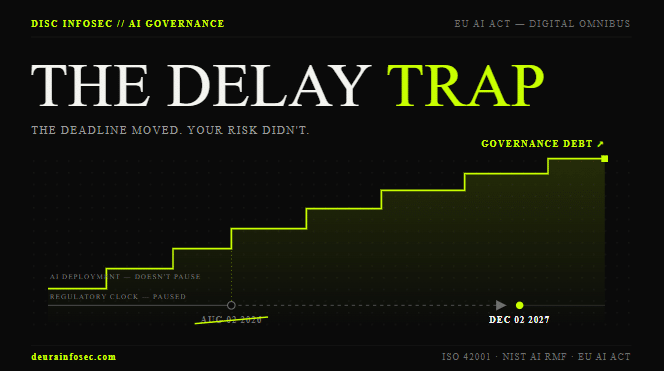
The Delay Trap: Why the EU AI Act Postponement Is the Most Dangerous Gift Your Compliance Program Ever Received
Brussels just handed enterprises sixteen extra months. Most of them are about to spend it accumulating governance debt.
On May 7, 2026, EU legislators reached a provisional agreement on the Digital Omnibus on AI — the first substantive amendment to the AI Act since its adoption. The headline: obligations for standalone high-risk AI systems under Annex III, originally biting on August 2, 2026, are deferred to December 2, 2027. High-risk AI embedded in regulated products under Annex I slips further, to August 2, 2028.
Across boardrooms, you could hear the exhale. Budget lines earmarked for AI Act readiness are already being quietly reallocated. Steering committees that met biweekly are moving to quarterly. “We have until the end of 2027” is becoming the most repeated sentence in European compliance.
It’s also the most dangerous one.
The deadline moved. Nothing else did.
Here’s what the delay did not change: your AI footprint. The recruitment screening model your HR team piloted last quarter. The credit decisioning logic your fintech partner embedded in your onboarding flow. The agentic workflows your engineering org is wiring into production right now, this week, without waiting for Brussels to finish its paperwork.
The AI Act’s timeline was political. Your risk accumulation is operational. Those two clocks were never synchronized, and the Omnibus just desynchronized them further. Every month between now and December 2027, your organization will deploy more AI, embed it deeper into consequential decisions, and entangle it with more vendors — while the regulatory pressure that was forcing executive attention quietly deflates.
I’ve spent two decades watching organizations respond to compliance deadlines, from SOX to GDPR to ISO certification cycles. The pattern is depressingly consistent: a moved deadline doesn’t extend the runway. It deletes the urgency, the program decays, and eighteen months later the organization restarts from a worse position than where it paused — because the environment kept getting more complex while the program stood still.
That’s governance debt with a compounding interest rate. And the AI version compounds faster than anything we’ve seen, because AI adoption doesn’t pause when your governance program does.
Three reasons “we’ll restart in 2027” is a fiction
First, the delay isn’t even law yet. The May 7 agreement is provisional. Formal adoption and publication in the Official Journal are still pending. The April trilogue round collapsed before this one succeeded, which tells you how fragile the politics are. Until the amendment is in the Official Journal, August 2, 2026 remains the legally operative date — and several obligations, including transparency requirements and enforcement structures, were never part of the deferral conversation at all. Organizations planning against a deadline that hasn’t been enacted are practicing compliance by press release.
Second, the EU was never your only regulator. Colorado’s AI Act, the expanding patchwork of US state AI legislation, sector regulators sharpening their AI expectations, and — most immediately — your customers’ procurement teams. Enterprise buyers are not waiting for December 2027 to ask how you govern AI. They’re asking now, in security questionnaires, in vendor risk assessments, in contract language. I watched this dynamic play out firsthand taking a client through ISO 42001 certification: the commercial pressure to demonstrate AI governance arrived well ahead of any regulatory enforcement date. The market is enforcing faster than the regulators.
Third, the legislators themselves told you why they delayed. The deferral exists because harmonised standards, notified bodies, and compliance tooling weren’t ready — not because the obligations got lighter. The requirements in Articles 9 through 17 are coming intact: risk management systems, data governance, technical documentation, logging, human oversight, accuracy and robustness. Sixteen months is not generous for building those capabilities from a standing start. It’s barely adequate for organizations that keep moving. For organizations that pause and restart in mid-2027? It’s a guaranteed fire drill, executed against finalized standards, with every consultancy and notified body in Europe simultaneously overbooked.
What the sixteen months are actually for
The organizations that will look smart in December 2027 are treating this window as exactly what the legislators intended: time to build properly instead of compliance theater under deadline pressure.
That means doing the unglamorous foundational work now. Inventory your AI systems — including the shadow AI your business units deployed without telling anyone, and the AI capabilities your vendors switched on inside products you already license. Classify against Annex III honestly, not optimistically. Stand up the risk management and data governance machinery that Article 9 and Article 10 will demand, because those capabilities take quarters to mature, not weeks.
And anchor it in a management system, not a project plan. This is where ISO 42001 earns its relevance. A certifiable AI management system gives you a regulation-agnostic backbone: the same governance infrastructure satisfies EU AI Act obligations, Colorado’s requirements, NIST AI RMF alignment, and the procurement questionnaires landing in your inbox this quarter. Projects end when deadlines move. Management systems persist because they’re wired into how the organization operates. That structural difference is precisely what separates the companies that will coast through December 2027 from the ones that will panic through it.
The Digital Omnibus came with an explicit expectation attached: implementation efforts should already be underway. That wasn’t diplomatic filler. It was the legislators telling you how they’ll view organizations that show up in late 2027 with nothing built.
The question for your next leadership meeting
Don’t ask “when is the deadline now?” Ask: “What did we deploy this quarter that we couldn’t explain to a regulator, a customer, or a courtroom?”
If the honest answer is “we’re not sure,” the EU just gave you sixteen months to find out. Spend them like the gift they are — or discover in 2027 that the delay trap was never about the deadline at all.
DISC InfoSec helps organizations build AI governance programs that survive deadline changes — ISO 42001 implementation, EU AI Act readiness, and NIST AI RMF alignment from a practitioner who has taken a client through certification, not just talked about it. Start with our free EU AI Act gap assessment at deurainfosec.com.
DISC InfoSec is an active ISO 42001 implementer and PECB Authorized Training Partner specializing in AI governance for B2B SaaS and financial services organizations.
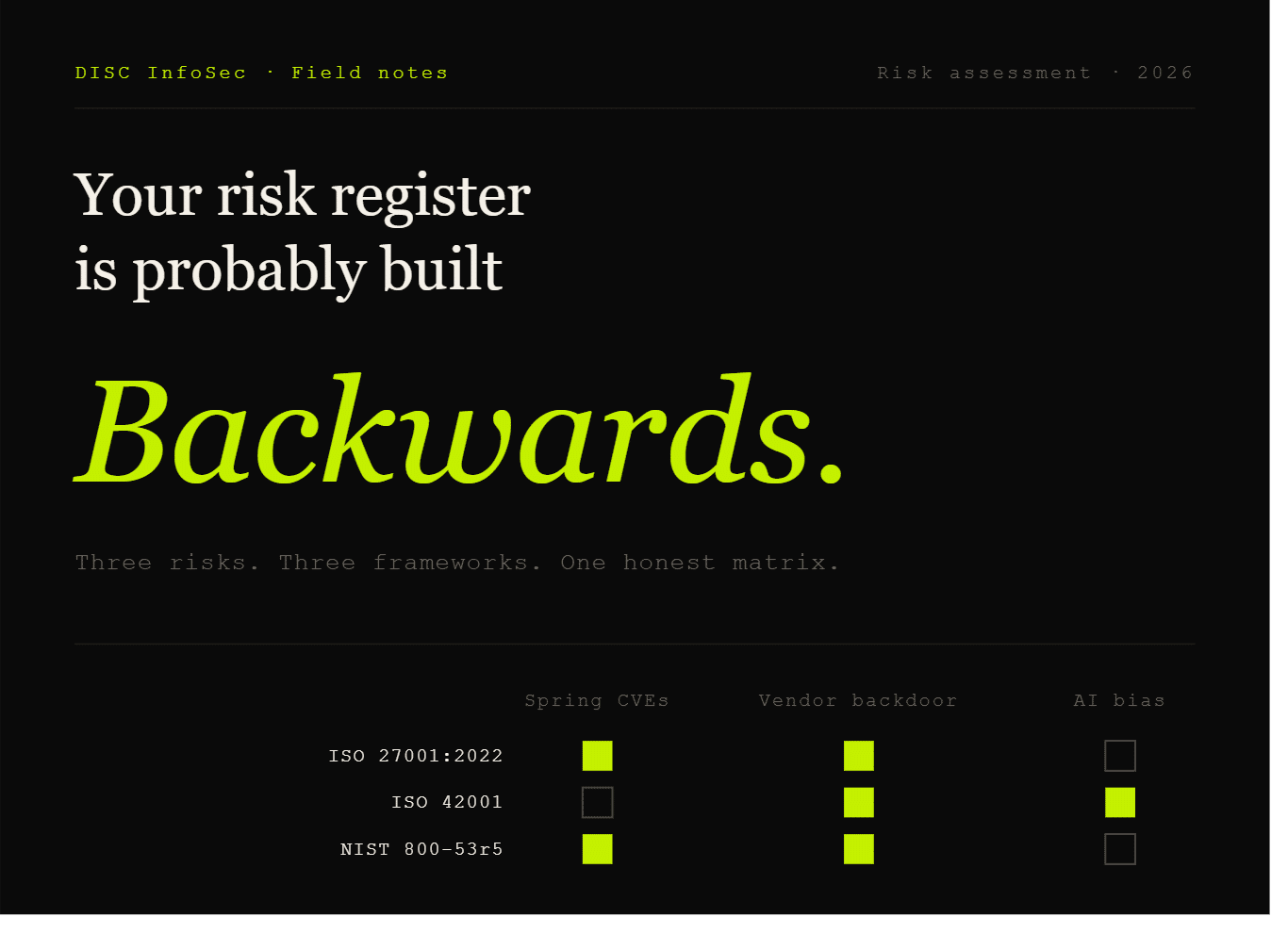
Four risks, three frameworks, and what mapping ISO 27001, ISO 42001, and NIST 800-53r5 actually looks like in practice.
Most risk registers are built backwards. Someone exports a control list from a framework, generates a row for each control, and reverse-engineers a “risk” to justify it. The result looks comprehensive and tells you almost nothing useful. Auditors recognize it on sight.
A working risk register starts from the other direction — from the business issue. What could materially hurt the company? What’s the mechanism? What controls actually move the needle? Then the framework mapping comes in, and only as a way to evidence that the controls you already need are also the ones the standards expect.
This post walks through four risks. Four come from a live register at a SaaS platform serving M&A and financial services clients — ISO 42001 & ISO 27001 certified. The fourth is the risk almost every SMB is currently running without measuring, and the one I expect to dominate AI-era incident reports for the next two years.
Risk 1 — Outdated Spring Framework and Spring Security
The business issue. The core application is running on Spring Framework 5.3.39 and Spring Security 5.8.16. Both are end-of-OSS-support. Both are missing fixes for high and critical CVEs that have been public for over a year. The framework underlies every authenticated request the platform serves, so the blast radius of any successful exploit is the entire customer base.
Contributing risk factors. Framework upgrades are the kind of work that gets deferred because nothing visibly breaks when you skip a quarter — until something does. Contributing factors typically include: engineering capacity prioritized toward customer-visible features, breaking-change risk in major Spring upgrades, dependency entanglement with libraries that pin to older Spring versions, and the absence of a configuration-as-code baseline that would make environment-by-environment upgrades safer to attempt.
How it relates across domains.
InfoSec: Direct exposure. Spring4Shell-class vulnerabilities and Spring Security authentication-bypass CVEs are not theoretical — they have working exploits, EDR signatures, and threat-actor playbooks.
Privacy: Indirect but real. An authentication bypass against a platform processing M&A diligence rooms means unauthorized access to highly sensitive personal and corporate data. GDPR Article 32 (security of processing) becomes the relevant hook.
Compliance: Indefensible at audit. “We are running a framework with known unpatched critical CVEs” is not a position you want to be in during a customer security questionnaire or an ISO 27001 surveillance audit.
AI governance: Tangential. But worth noting: if AI features depend on the same framework, the AI system’s confidentiality and integrity properties inherit the framework’s weaknesses. ISO 42001 expects you to know that.
Compensating controls already in place. CrowdStrike EDR, WAF, network segmentation, MFA, session controls. These reduce — but do not eliminate — exposure. They buy time. They are not a substitute for the upgrade.
Risk 2 — Hidden or Backdoor Functionality in Major Vendor Software
The business issue. Major vendor software in the stack (Apache Tomcat as one example, but the category is broader) could contain undocumented functionality — whether maliciously inserted, accidentally shipped, or buried in a dependency three layers deep. Recent industry events have made this category move from “theoretical supply-chain hand-wringing” to “the thing your insurance carrier asks about by name.”
Contributing risk factors. Vendor opacity. Lack of reproducible builds. Incomplete or absent SBOMs for transitive dependencies. The economic reality that even diligent vendor management cannot inspect code you do not have. The increasing sophistication of nation-state actors targeting widely deployed open-source components as a force multiplier.
How it relates across domains.
InfoSec: Detection is the only realistic primary control. You will not prevent this at the source — you will catch it through behavioral monitoring, anomaly detection, and network segmentation that limits what a compromised component can reach.
Privacy: If the compromised component handles personal data, you are looking at notification obligations under GDPR Article 33/34 and U.S. state breach laws. Processor relationships (Article 28) make this messier — you may be on the hook for a sub-processor’s exposure.
Compliance: Supply-chain assurance is one of the fastest-growing audit focus areas across ISO 27001:2022 (A.5.19–A.5.22), SOC 2, and regulator guidance. “We trusted the vendor” is not an acceptable answer anymore.
AI governance: If AI components or models come from third-party vendors — and most do, somewhere in the pipeline — supply-chain integrity extends to model weights, training datasets, and inference infrastructure. ISO 42001 A.10 (third-party and customer relationships) is the natural home for this.
Compensating controls already in place. Vendor management program, SBOM where available, CrowdStrike EDR for behavioral detection, network segmentation, Sumo Logic for anomaly detection, monitoring of third-party security research feeds.
Risk 3 — AI Feature Produces Misleading or Biased Output in Customer Use
The business issue. AI features in production — for example, financial, healthcare, or M&A document summarization and redaction recommendations — could produce outputs that are misleading, biased, or wrong in ways customers cannot easily detect. In a high-stakes diligence context, a confidently incorrect summary or a missed redaction is not a minor UX (User Experience) issue. It is a trust event, potentially a liability event, and depending on jurisdiction a regulatory event.
Contributing risk factors. Model limitations (every model has them; vendors do not always disclose them in operational terms). Training data quality and representativeness. Insufficient human-in-the-loop review for high-stakes outputs. Lack of structured output validation. The general gap between how AI systems are marketed and how they behave under tail-case inputs.
How it relates across domains.
InfoSec: Indirect. The risk is not confidentiality or integrity of the system — it is integrity of the output. This is the category where pure infosec frameworks run out of language and AI-specific governance has to take over.
Privacy: Direct under GDPR. Article 22 (automated decision-making), Articles 13–14 (transparency obligations), Article 5 (accuracy and fairness principles), and Article 35 (DPIA threshold) all engage when AI output materially affects an individual or a transaction.
Compliance: ISO 42001 is the primary frame. The 27001 hooks are thin and forcing them dilutes the analysis — bias and misleading output is genuinely a 42001-domain risk and should be scored there.
AI governance: This is the canonical ISO 42001 risk. Clause 8.3 (AI system impact assessment), Annex A.6.2.4 (system validation), A.7.4 (data quality), A.9.2 (operation), A.6.2.6 (system monitoring) — the entire 42001 spine engages here.
Compensating controls already in place. ISO 42001 AI management system controls, AI feature review and approval process, human-in-the-loop for high-stakes outputs, customer disclosure of AI use, model performance monitoring, output validation in QA, AI impact assessment process where threshold is met.
Risk 4 — Uncontrolled Data Exposure Through Shadow AI and Connected AI Tools
This is the most prolific AI security risk facing SMBs today, and it is almost universally underweighted on the registers I see. Most SMBs are running it actively, right now, without measuring it.
The business issue. Employees use consumer AI tools — ChatGPT free tier, Gemini, personal Claude accounts, AI meeting note-takers, AI browser extensions, AI plug-ins inside Slack and Notion and Chrome — to do real work. They paste customer data, source code, draft contracts, financial records, internal communications, and partner data into systems the company has no contractual relationship with, no DPA from, no visibility into, and often no acceptable use policy covering.
The connected AI tools half of this risk is the more dangerous one. A sanctioned AI meeting notetaker plugged into the corporate calendar. An AI sales assistant connected to the CRM. An AI coding agent with repository access. An AI feature that a SaaS vendor turned on in their latest release without prompting a fresh security review. Each of these has authenticated access to substantial corporate data. Each was typically procured department-by-department without going through vendor risk review, security review, or a DPIA. The aggregate data exposure is much larger than any individual decision-maker realized when they clicked “enable.”
Contributing risk factors. No AI acceptable use policy, or one that exists but is not enforced. No technical controls — no CASB, no DLP that recognizes AI endpoints, no browser-level AI gating. Consumer AI free tiers without enterprise-grade data protections (training opt-out, retention controls, audit logs). Procurement workflows that do not catch “this SaaS tool also has AI features now,” which by 2026 describes nearly every SaaS tool in the stack. BYOD environments where the company has no visibility into what is running. The general pace at which vendors are shipping AI features faster than security teams can review them.
How it relates across domains.
InfoSec: This is data exfiltration through user behavior rather than through exploit. The “attacker” is well-intentioned employees getting work done. That makes it the hardest category for traditional security tooling — there is no malware signature, no anomalous network destination if the AI tool runs in a sanctioned browser, no exfil pattern that EDR catches. Detection has to come from policy, awareness, DLP that understands AI endpoints, and vendor management.
Privacy: This is the heaviest privacy exposure on the register. Sending PII or customer data to an AI tool the company has no DPA with is a probable subprocessor violation under GDPR Article 28 and a likely CCPA issue. Purpose limitation (Article 5(1)(b)) and accuracy (Article 5(1)(d)) both engage. If the AI tool retains data for training, you have lost control of customer information you contractually promised to protect — and you may not be able to get it back.
Compliance: B2B SaaS customer contracts increasingly carry explicit subprocessor lists, data residency clauses, and prohibitions on sending customer data to AI training. Shadow AI usage breaks every one of those simultaneously. SOC 2 CC9.2 (vendor management) and ISO 27001 A.5.19–A.5.22 are the audit hooks. For regulated customers (financial services, healthcare), this can be a contract termination event.
AI governance: ISO 42001 covers this even when the AI is being used informally rather than deployed as a product. A.9.3 (responsible use) and A.5.2–A.5.5 (AI policy framework) apply to ad-hoc internal usage. This is exactly the gap that catches SMBs without an AI management system in place.
A note on the SMB profile specifically. Enterprises have legal, procurement, and security teams that can absorb some of this risk through process. SMBs typically do not. The 30-person SaaS company where everyone has admin on their own laptop and procures their own SaaS tools is the canonical Shadow AI environment. Most don’t know what data is being sent where, and most have no realistic path to find out without first putting policy and tooling in place. The good news: this is the risk where the early-stage investments — an AI AUP, vendor inventory, awareness training, browser-level controls — produce disproportionate residual-risk reduction.
Compensating controls in a mature program. AI acceptable use policy, AI vendor inventory, AI-aware DLP, browser-level controls or CASB enforcement on AI endpoints, awareness training that names specific tools and specific behaviors, procurement gates that flag AI features in new and renewing contracts, periodic spot-checks of connected AI integrations across the SaaS estate.
The Control Matrix
The table below maps each risk to the controls that actually do the work — not every control that could conceivably touch the risk, just the ones that move residual exposure. The NIST column is split: 800-53r5 for the technical and operational risks where it has strong native coverage, NIST AI RMF for the AI-specific risks where 800-53 underperforms.
A.10.2 (allocation of responsibilities), A.10.3 (suppliers) — plus B.8 processor controls where Organization’s acts as processor
800-53r5: SR-3 (supply chain controls and processes), SR-6 (supplier assessments and reviews), SR-11 (component authenticity), RA-5 (vulnerability scanning), SI-2 (flaw remediation), SI-4 (system monitoring), AU-6 (audit record review, analysis, and reporting)
AI feature produces misleading or biased output
A.5.34 (privacy and PII protection) — and intentionally light here; this is a 42001 risk
A.6.2.4 (system validation), A.6.2.5 (system requirements), A.6.2.6 (system monitoring), A.6.2.8 (system documentation), A.7.2 (data for AI systems), A.7.4 (data quality), A.7.5 (data provenance), A.8.2 (responsible AI), A.8.3 (AI system impact assessment), A.9.2 (responsible use), A.5.2–A.5.5 (AI policy and governance)
NIST AI RMF: GOVERN-3.2 (AI risk roles and responsibilities), MAP-2.3 (system capabilities and limitations characterized), MEASURE-2.11 (fairness and bias evaluation), MANAGE-4.1 (post-deployment monitoring) — paired with 800-53r5 SA-11, RA-3, PM-31 as proxy controls
Shadow AI / connected AI tool data exposure
A.5.10 (acceptable use of information), A.5.14 (information transfer), A.5.19–A.5.22 (supplier relationships, applied to AI vendors), A.6.3 (information security awareness, education, and training), A.8.3 (information access restriction), A.8.12 (data leakage prevention — legitimate use here), A.8.16 (monitoring activities), A.5.34 (privacy and PII protection)
A.5.2–A.5.5 (AI policy framework), A.6.1.2 (AI objectives — including unsanctioned use boundaries), A.9.2 (responsible use), A.9.3 (use of AI systems), A.10.4 (customers — for downstream data flow impact)
800-53r5: AC-20 (use of external information systems), AC-21 (information sharing), AT-2 (literacy training and awareness), PL-4 (rules of behavior), SC-7 (boundary protection), SI-4 (system monitoring), CA-9 (internal system connections). NIST AI RMF: GOVERN-3.2 (roles and responsibilities), MAP-4.1 (third-party AI considerations), MANAGE-3.1 (AI risks and benefits documented)
A few things worth noticing about this matrix.
First, the AI bias row is intentionally light on ISO 27001. Forcing A.8.12 (DLP) or similar onto an AI bias risk is the kind of stretch that auditors notice and that practitioners do to make registers look symmetrical. Different risks live in different frameworks for a reason.
Second, A.8.12 (DLP) finally finds a legitimate home in the Shadow AI row. That control was the wrong fit for AI output bias, but it is exactly right for AI input leakage. Same control number, completely different risk story — which is part of why control-first registers fail.
Third, the Shadow AI row pulls from all three frameworks at near-equal weight. It is simultaneously a supplier risk, an awareness risk, a boundary-protection risk, an AI-governance risk, and a privacy risk. That cross-cutting profile is part of why it is hard for any single team to own — and part of why it sits unaddressed on so many registers.
Fourth, the supply-chain row pulls A.5.23 (cloud services) and SR-11 (component authenticity) explicitly. These have moved from “nice to have” to “expected” in the last twelve months as the audit community has caught up to the reality of modern dependency graphs.
A Practitioner’s Perspective on Mapping Business Risks to Frameworks
Six things I’ve learned doing this work at the implementation end rather than the consulting-deck end.
Start from the risk, not the control. Every register I have inherited that started from a control list is unusable. The ones that started from “what could materially hurt the business” are the ones that survive contact with an auditor and with reality. Frameworks are evidence, not source material. Shadow AI is the cleanest illustration of this principle in the current threat landscape — start from controls and you map it to DLP and call it done. Start from the business issue and you discover it is a policy gap, a vendor management gap, a training gap, a technical controls gap, and a privacy gap simultaneously. The controls are the answer. They are not the question.
Resist the urge to map everything to everything. A clean register has some empty cells. An AI bias risk genuinely does not have strong ISO 27001 coverage, and pretending otherwise dilutes both the risk analysis and the framework. If a column is light, write that down. Auditors prefer honesty over symmetry.
Use the right framework for the risk. NIST 800-53r5 is excellent for infrastructure and operational controls and underperforms on AI-specific risks. NIST AI RMF is purpose-built for the AI risks and has no opinion about your patching cadence. ISO 27001:2022 and ISO 42001 are designed to interlock — let them. The temptation to force one framework to cover everything is the single most common mistake I see in mid-market registers.
Compensating controls are real, but they are not the destination. Every one of the risks above has compensating controls in place. CrowdStrike, WAFs, segmentation, monitoring, human review, awareness training. These reduce velocity and impact. They do not eliminate the underlying issue. A register that scores residual risk as “low” because compensating controls exist — without a plan to remediate the root cause — is telling you a story about itself, not about the risk.
Score the risk the SMB is actually running, not the one the framework imagines. Shadow AI is the canonical example. Most SMB registers either omit it entirely or score it at moderate residual on the strength of an AUP nobody enforces. The honest score reflects what would happen if a customer audited the actual data flows tomorrow. That is usually a different number — and the gap between the two numbers is the value the security function is failing to deliver.
The capability-governance gap is the real risk category. Every one of these four risks is a version of the same problem: technical capability has outrun the governance and operational practices needed to keep it safe. The Spring stack is more complex than the upgrade process can keep up with. The supply chain is deeper than the vendor management program can see. The AI feature is more capable than the output validation can verify. The AI tools employees use are more numerous and more powerful than any inventory the company maintains. The frameworks are useful because they force you to close that gap — not because the controls themselves are magic.
A risk register is a forcing function. It makes you write down what you know, what you do not know, and what you are doing about it. The frameworks are the language you write it in. The business issues are what you are writing about. Get that order right and the register starts doing real work. Get it wrong and you have a document that satisfies no one — not the auditor, not the board, not the engineers who are supposed to fix the problem.
Written from the implementation seat. If you are working through similar risks on your own register — especially Shadow AI, which most SMBs are running unmeasured — DISC InfoSec does this work for B2B SaaS and financial services organizations. vCISO, vCAIO, ISO 42001 and ISO 27001 implementation, AI governance. Reach out: hd@deurainfosec.com.
DISC InfoSec is an active ISO 42001 implementer and PECB Authorized Training Partner specializing in AI governance for B2B SaaS and financial services organizations.
METATRON: The First Practical Glimpse of Local-AI Penetration Testing — And Why AI Governance Teams Should Care
An InfoSec, compliance, and AI governance perspective from DISC InfoSec
In our recent post “Why Run LLMs Locally? The Future of Private Enterprise AI”, we made the case that the next phase of enterprise AI maturity will be measured by control, not capability. Cloud LLMs gave us speed. Local LLMs give us sovereignty, auditability, and defensibility — the three things every InfoSec and compliance program is now being asked to prove.
We closed that post by flagging an emerging tool worth watching: METATRON.
This is the deeper look.
What Is METATRON?
METATRON is an open-source, CLI-based penetration testing assistant that runs entirely on the operator’s local machine — no cloud, no API keys, no third-party subscriptions, no data leaving the host.
You feed it a target IP or domain. It autonomously orchestrates a stack of standard reconnaissance tools (nmap, nikto, whois, dig, whatweb, curl), pipes the raw output into a locally hosted, fine-tuned LLM, and the model performs the analysis — identifying services, flagging probable vulnerabilities, cross-referencing CVEs, and recommending fixes. Everything is persisted to a five-table MariaDB schema with full audit history and exportable PDF/HTML reports.
A few specifics worth pinning down:
Language / runtime: Python 3, CLI
AI model:metatron-qwen, a fine-tuned variant of huihui_ai/qwen3.5-abliterated:9b
LLM runner: Ollama, running on-device
Model parameters: 16,384-token context window, temperature 0.7, top-k 10, top-p 0.9 — tuned for technical precision, not creative output
OS target: Parrot OS / Debian-based Linux
Hardware floor: ~8.4 GB RAM for the 9B model (a 4B variant is available for lighter rigs)
The two architectural choices that matter most for an AI governance practitioner:
An agentic loop. The model can autonomously request additional tool executions mid-analysis if it needs more data before rendering a verdict. This is genuine iterative reasoning, not a single-pass scan.
A zero-exfiltration guarantee. Because inference runs locally through Ollama, target data — internal IP ranges, banner information, discovered vulnerabilities, exploit attempts — never leaves the tester’s machine.
That second point is the headline. We’ll come back to it.
How METATRON Strengthens AI Governance Controls
If you’re implementing an AIMS under ISO/IEC 42001, mapping to NIST AI RMF, or preparing for the EU AI Act, here’s where METATRON’s architecture maps onto real control requirements rather than slideware.
1. Data sovereignty becomes a default, not a policy fiction
Most AI tools force a difficult conversation with your DPO or compliance lead: “What happens to the data we feed the model?” With cloud-AI pentest assistants, your answer typically involves vendor TOS, retention windows, and cross-border data transfer clauses you may or may not have negotiated.
With METATRON, the answer is structurally simple: nothing leaves the host. That single architectural property satisfies:
ISO 27001:2022 A.5.14 (Information transfer) — no external transfer occurs
ISO 42001 Annex A controls on data handling and third-party AI services — the AI provider is you
GDPR Article 28 / SCCs — there is no processor to assess; cross-border transfer is moot
Internal data residency commitments to enterprise customers — the assertion becomes verifiable, not aspirational
This is the same architectural principle we lean on when advising regulated clients. Financial data rooms are the “hard mode” of compliance — if it works there, it works anywhere — and the same logic applies to security tooling.
2. Auditability is built in, not bolted on
The five-table MariaDB schema (history, vulnerabilities, fixes, exploits_attempted, summary) keyed by session number isn’t just engineering tidiness. It’s an audit trail.
For AI governance, this matters because regulators and auditors are increasingly asking the same questions of AI-assisted security work that they ask of AI-assisted business work:
Who ran the AI?
Against what target?
What did the model output?
What action was taken on that output?
Can you reproduce the analysis?
METATRON answers all five by design. That maps cleanly to ISO 42001 Clause 8 (Operation) and Clause 9 (Performance evaluation), and to the NIST AI RMF MEASURE function — specifically the obligation to log, retain, and review AI system outputs.
Exportable PDF/HTML reports give you something to attach to a finding, a client deliverable, or an audit working paper.
3. Third-party AI risk drops to near-zero for this workflow
The fastest-growing category of Shadow AI in security teams is not ChatGPT — it’s pentesters and SOC analysts pasting sensitive data into cloud LLMs to accelerate analysis. We’ve seen it in vendor assessments. We’ve seen it in internal audit walkthroughs. It is everywhere.
METATRON removes the temptation. The local model is good enough to be useful, the workflow is purpose-built, and there’s no cloud endpoint to send anything to. For a CISO trying to enforce an Acceptable Use of AI Tools policy under ISO 42001 Annex A.3, that’s a structural win, not a training problem.
4. It pressure-tests AI-deployed environments using AI-native tooling
This is the meta-point. If your organization is shipping AI features, your attack surface now includes prompts, embeddings, vector stores, model endpoints, and orchestration plumbing — none of which traditional pentest workflows fully cover.
METATRON’s agentic loop is, in effect, a small example of the architecture you’re trying to defend. Operating it gives security teams direct, hands-on exposure to:
Local model serving (Ollama)
Context-window management
Agentic tool dispatch and prompt routing
LLM output validation against structured tooling
That’s not a curriculum. That’s practice. And practice is what builds AI security maturity faster than any framework alone.
Why You Should Have It on Your Bench Today
A few honest reasons, not marketing reasons.
1. The AI pentesting tooling landscape is consolidating fast. METATRON, Apex, pentest-ai-agents, CVE MCP Server — within a single quarter we’ve seen multiple credible entrants. Getting hands on the open-source ones now is how you stay literate before clients and auditors start asking which you use.
2. Auditors are starting to ask AI-specific testing questions. “Have you tested your AI system’s attack surface?” is a question on more audit checklists every quarter. Saying “yes, with a tool that runs entirely on-prem and produces a defensible audit trail” is materially stronger than “yes, we used a cloud service.”
3. The Shadow AI problem inside security teams is real. If your pentesters and analysts are already using cloud LLMs to speed up analysis, you have a data-exfiltration risk you may not be tracking. A local alternative gives you something to migrate them to.
4. The cost is your time, not your budget. MIT-licensed, free, no subscription. The only meaningful cost is the GPU/RAM to run the model. If you’re already running local LLM experiments — and you should be — the marginal cost is roughly zero.
5. It’s a teaching environment. For internal training on local AI, prompt engineering for technical workflows, and agentic orchestration, METATRON is one of the more concrete sandboxes available right now.
How to Install METATRON
Below is the consolidated install path, distilled from the project’s README. Run it on Parrot OS or another Debian-based distribution. Plan for around 8.4 GB of free RAM for the 9B model (use the 4B variant on lighter hardware).
⚠️ Legal note up front: This is offensive security tooling. Only run it against systems you own or have explicit written authorization to test. Unauthorized scanning is illegal.
Step 1 — Clone the repository
git clone https://github.com/sooryathejas/METATRON.git
cd METATRON
CREATE DATABASE metatron;
CREATE USER 'metatron'@'localhost' IDENTIFIED BY '123';
GRANT ALL PRIVILEGES ON metatron.* TO 'metatron'@'localhost';
FLUSH PRIVILEGES;
EXIT;
🔐 Hardening note: The default credentials in the README (metatron / 123) are fine for a lab. Do not ship them. Rotate immediately, store the new password in a vault, and restrict the MariaDB bind address to localhost.
Then create the five tables exactly as defined in the project’s README (history, vulnerabilities, fixes, exploits_attempted, summary). The schema is short and worth pasting verbatim from the source — see the GitHub repo for the canonical DDL.
Step 8 — Run it
You need two terminals.
Terminal 1 — load the model:
ollama run metatron-qwen
Wait for the >>> prompt. Leave it running.
Terminal 2 — launch METATRON:
cd ~/METATRON
source venv/bin/activate
python metatron.py
From the main menu, pick [1] New Scan, enter a target you’re authorized to test, and choose the recon tools to run. METATRON handles the rest — orchestration, LLM analysis, CVE lookups, persistence, and report generation.
My Perspective
A few practitioner-grade observations to close.
This is an early tool, not a managed product. With 44 stars on GitHub and four commits at the time of writing, METATRON is a research-grade project from a single author. That’s a feature, not a bug — it’s the right time to evaluate it, understand the architecture, and decide whether to fork, contribute, or wait. But don’t put it on a production engagement until you’ve vetted the codebase yourself.
The local LLM is the real innovation here, not the recon stack.nmap and nikto orchestration has existed for two decades. What’s new is the deterministic privacy posture of the analysis layer. That’s the part worth studying, because the same architectural pattern — local model + structured tool dispatch + persistent audit trail — is what AI governance teams are going to want for every sensitive AI workflow, not just pentesting.
Treat the AI output as a first opinion, not a verdict. The model is fine-tuned for technical analysis, but it’s still a 9B-parameter model running on a laptop. Cross-reference CVE findings, validate exploit suggestions, and remember that the temperature 0.7 setting means the output isn’t deterministic. For ISO 42001 conformance, this is exactly the kind of human-in-the-loop control you’d document under A.6.2.6 (Human oversight) and A.9.3 (Use of AI systems).
The hard problems METATRON doesn’t solve are also worth naming. It doesn’t address prompt injection of the LLM itself, doesn’t sandbox the recon tools, doesn’t enforce scope boundaries against unauthorized targets, and doesn’t include a safety layer to prevent operator misuse. Each of those is something a mature program should layer around the tool, not assume the tool provides.
Where this fits in a real practice. For DISC InfoSec’s clients — and frankly for any organization implementing ISO 42001 — METATRON is most valuable as a demonstration platform: a hands-on way to show executives, auditors, and engineering teams what “AI inside the security perimeter” actually looks like. It is much easier to govern something you have touched than something you have only read about.
The organizations that learn to operate local AI tooling now — under their own roof, on their own hardware, against their own audit trail — are the ones that will pass the AI governance audits of 2027 without breaking a sweat.
METATRON is one place to start.
Need help building an AI governance program that holds up to a real Stage 2 audit? DISC InfoSec is an active ISO/IEC 42001 implementer and PECB Authorized Training Partner. email: info@deurainfosec.com.
DISC InfoSec is an active ISO 42001 implementer and PECB Authorized Training Partner specializing in AI governance for B2B SaaS and financial services organizations.
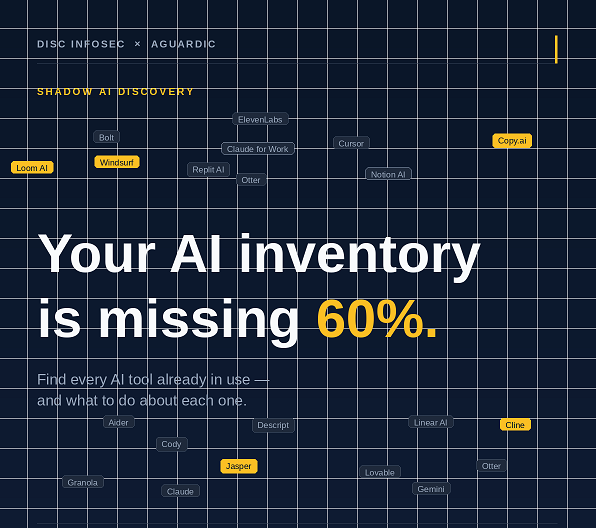
Your Shadow AI Inventory Is Wrong. Here’s a Free Way to Fix It.
If I asked your CISO or DPO today, “What’s the complete list of AI tools touching company or customer data?” — what would they hand you?
In most B2B SaaS and financial services orgs I work with, the answer is a stale spreadsheet of the four or five tools that got procurement approval, plus a vague acknowledgement that “people are probably using ChatGPT.” That’s not an AI inventory. That’s wishful thinking with a header row.
And it’s about to become an audit finding.
Why this gap matters now
EU AI Act obligations for general-purpose AI and high-risk systems are arriving in waves through August 2026. ISO 42001 Clause 6.1 expects you to identify AI risks tied to the specific systems in use. HIPAA enforcement around PHI in genAI tools is already here. NIST AI RMF’s GOVERN function presumes you can name what you govern.
Every one of those frameworks has the same prerequisite: a current, defensible inventory of every AI system in scope — including the ones nobody told you about.
Standard discovery tooling misses most of it. DLP doesn’t catch a browser tab. CASB doesn’t see a personal Claude session on a managed device. OAuth audits in Workspace and Entra catch the embedded SaaS AI but skip the web tools entirely. The result: most “AI inventories” are 30–40% of reality, and the missing 60% is exactly where the unreviewed PHI, PII, and source code is flowing.
A practical way to close the gap (free)
I’ve been collaborating with the team at Aguardic on a Shadow AI Discovery tool that I think is genuinely useful for anyone running an AI governance program. It’s free, browser-based, and you don’t need to install anything.
Three inputs:
What you already know. Free-text list of AI tools your team uses — browser, embedded SaaS, dev tools, voice transcribers. Anything you’ve spotted.
Optional: a DNS or proxy log export. Cisco Umbrella, Cloudflare Zero Trust, NextDNS, Pi-hole — the tool has inline export instructions for each. Files are parsed in memory, not stored.
Optional: an OAuth grants export. Google Workspace, Microsoft 365 / Entra ID, Okta, Auth0 — again with step-by-step export guides in the form.
It matches everything against a curated catalog of 100+ AI tools and produces an editable Word report with, per tool: BAA coverage status, framework exposure (HIPAA, EU AI Act, GDPR, ISO 42001, NIST AI RMF, SOC 2, Colorado AI Act, FERPA, PCI DSS), a risk rating tied to the frameworks you selected, and a specific policy recommendation.
Want a professional AI risk assessment you can actually share with leadership or clients?
Contact DISC InfoSec directly to help run the report and deliver it as a DISC InfoSec co-branded assessment — positioned as a polished executive-ready deliverable, not just another vendor-generated brochure.
A great way to start conversations around Shadow AI, AI governance, and enterprise AI risk visibility.
→ https://www.aguardic.com/
My take
Shadow AI isn’t really a tool problem. It’s a governance sequencing problem.
Most organizations I see are trying to write AI acceptable use policies, vendor risk frameworks, and ISO 42001 documentation before they actually know what AI is in use. The policy ends up referencing “approved AI tools” without naming any, the risk register has three line items when it should have thirty, and the internal auditor’s first question — “how did you scope this?” — has no defensible answer.
ISO 42001 Clause 4 (Context) and Annex A.4 (Resources for AI systems) both presume you have an inventory you trust. EU AI Act Article 9 (Risk Management) presumes the same. You cannot classify a high-risk AI system under Annex III if you don’t know the system exists.
Discovery is the first 80% of the work that makes every downstream control function. Skip it, and your governance program is governing a fiction.
If you’ve been putting this off because the manual version is painful — surveying employees, chasing IT for DNS logs, mapping each tool to controls one by one — this is a 10-minute version of that work that gives you something concrete to bring to your next steering committee.
Run it, share the report, and use it as the starting point for the AI risk register you should already have.
If you want help operationalizing what the report surfaces — turning the findings into an ISO 42001 Annex A control set, an EU AI Act classification decision, or a vendor risk workflow — that’s what we do at DISC InfoSec. Reach out.
DISC InfoSec is an active ISO 42001 implementer and PECB Authorized Training Partner specializing in AI governance for B2B SaaS and financial services organizations.
Who Actually Owns AI Governance? An InfoSec & AI Governance Reading of the IAPP Conversation
The IAPP’s Ashley Casovan, in a recent AdExchanger interview, surfaces what is quickly becoming the most uncomfortable question inside enterprise compliance functions: when an AI tool is deployed, who actually owns the governance of it? Privacy teams have spent years building muscle around data minimization, consent, dark patterns, and children’s data — and now AI is layering on a parallel set of obligations. Crucially, there is no clean line yet between privacy governance and AI governance, which makes the seemingly basic question of accountability surprisingly difficult to answer inside most organizations.
The IAPP’s own research underscores how unsettled this is. Forty-eight percent of organizations report insufficient budget and resources to invest in governance professionals, and sixty-seven percent say primary responsibility for AI governance currently sits inside the privacy function. Casovan is candid that survey-based research conducted with privacy professionals carries some bias, but even accounting for that, the signal is unmistakable: privacy teams are being pulled into AI governance work whether or not they were resourced for it, and the role itself is still being defined organization by organization.
Structurally, there is no consistent operating model. In some organizations, AI governance is simply bolted onto what privacy professionals are already doing. In others, it has evolved into a distinct, near-full-time function — with someone else taking over the residual privacy work. And it is not just privacy teams getting pulled in. Cybersecurity professionals, data governance teams, and increasingly internal audit and assurance functions are being drawn into AI work, with the specific mix dictated by organizational complexity, sector, and size.
The actual scope of AI governance work is broad, spanning policy, compliance, technical evaluation, and ethics. On the policy side, it means translating high-level principles into concrete rules of use and standing up governance structures — committees, oversight boards, decision rights — so the right people are at the table when AI use cases come forward. On the compliance side, it means implementing and operationalizing frameworks like the NIST AI RMF. On the technical side, it means evaluating systems for bias and assessing the cybersecurity risks introduced through AI components. And layered above all of this is the assurance and ethics work — thinking through downstream impacts and, in regulated sectors, building independent audits and evaluations.
That scope has clear upskilling implications. A regulatory understanding remains foundational, but the modern AI governance role expects practitioners to move beyond a pure compliance lens and engage with technical evaluation methodologies. Casovan specifically flags assurance teams — including accountants and internal auditors — as a population now being asked to review AI systems, raising real questions about what training and tooling those professionals actually have to do that work credibly.
On the regulatory front, Casovan points to California as the bellwether for automated decision-making. The state’s combination of a large, diverse population and its concentration of major tech platforms is producing some of the most substantive and mature AI policy debates in the United States, and what gets resolved in California on automated decision-making is likely to influence other states. On consent, she draws a useful parallel: while advertising-driven AI ecosystems collect significant data passively under questionable consent conditions, more mature domains — pharmaceutical research, medical research — already have well-established guardrails around purpose limitation, downstream use, and data minimization that ad tech and other AI-heavy sectors can learn from.
So what does “good” actually look like today? Casovan lays out a clear sequence: first, know where AI is actually being used in your organization — this is harder than it sounds because AI features are increasingly being injected into existing systems through routine vendor updates (an “agentic AI chatbot” appearing overnight is now a real scenario). Second, define what good means for your organization through policies, standards, and internal principles. Third, stand up a governance mechanism with real decision rights and accountability. Fourth, evaluate potential harms and impacts on real people — not just risk-category checkboxes. Finally, understand jurisdiction-specific compliance obligations, including disclosure and recourse mechanisms. The opportunity, she argues, is for AI governance professionals to move beyond a check-the-box posture and surface the implementation realities the rest of the organization isn’t yet seeing.
Professional Perspective (InfoSec & AI Governance)
The most important takeaway from Casovan’s interview is one she states almost in passing: AI governance is currently being shaped not by org design, but by org default. Privacy teams are being pulled in because they’re the closest existing function — not because they’re the right one. And while privacy professionals bring real value (data subject rights, regulatory fluency, harm-impact thinking), AI governance done well requires capabilities that extend well beyond the privacy lens: model risk evaluation, AI-specific cybersecurity (data poisoning, prompt injection, model exfiltration), supply-chain assurance for AI vendors, and ML-specific testing methodologies. When 67% of organizations are defaulting AI governance to privacy and 48% lack the budget to staff it properly, what you have is a structural under-resourcing problem disguised as an organizational ambiguity problem.
This is where I would push the conversation further than the interview does. The future-state of AI governance is not “expanded privacy,” and it is not “rebadged GRC.” It is an integrated discipline that sits at the intersection of three frameworks that most organizations are still treating as separate: ISO/IEC 42001 for the AI Management System (the operating layer — policies, roles, controls, lifecycle management), NIST AI RMF for the risk methodology (Govern, Map, Measure, Manage), and the EU AI Act for the regulatory floor (risk classification, conformity assessment, transparency obligations). Privacy frameworks like GDPR and CCPA inform the data-handling layer, but they do not, on their own, govern the model itself, the system around the model, or the decisions the model produces. Organizations that try to retrofit AI governance into a privacy program will find the program straining within twelve months.
For practitioners and executives reading this, my recommendation is concrete: stop debating who owns AI governance in the abstract and start operationalizing it. Build an AI inventory mapped to ISO 42001 Annex A controls. Stand up a cross-functional AI governance committee with explicit decision rights, with privacy, security, legal, data governance, and a business sponsor at the table. Define AI-specific vendor assurance that goes beyond a SOC 2 letter. Establish board-level reporting that treats AI adoption velocity as a measurable risk indicator. And invest in upskilling, particularly for assurance and audit functions who are about to be handed AI review responsibilities they were never trained for. The organizations that get this right won’t necessarily have the most sophisticated AI — they’ll have the operational discipline to defend, in front of a regulator or an enterprise customer, exactly why their AI behaves the way it does. That defensibility is the actual deliverable of AI governance, and it’s the work we do at DISC InfoSec every day.
DISC InfoSec is an active ISO 42001 implementer (ShareVault / Pandesa Corporation) and PECB Authorized Training Partner specializing in integrated AI governance — ISO 42001, ISO 27001, NIST AI RMF, and EU AI Act — for B2B SaaS and financial services organizations. If “who owns AI governance?” is an open question in your organization, that is the conversation we have. Reach out at info@deurainfosec.com.
DISC InfoSec is an active ISO 42001 implementer and PECB Authorized Training Partner specializing in AI governance for B2B SaaS and financial services organizations.
AI Governance in the Age of Mythos: Why Small Business Owners Can’t Afford to Wait
We are living in the age of mythos. Every week brings a new AI story: the tool that will replace your accountant, the chatbot that cost a company $10,000 in refunds, the startup that 10x’d its revenue with a single prompt. Small business owners are drowning in contradictory narratives — AI is a savior, AI is a threat, AI is a gimmick, AI is inevitable.
Here is the truth behind the noise: your employees are already using AI. Probably ChatGPT. Possibly Claude. Likely a half-dozen free tools they signed up for with a company email and a personal phone number. That is not a hypothetical — it is happening right now, in your business, without a policy, without a record, and without a safety net.
This is why AI Governance is no longer a Fortune 500 concern. It is a small business survival issue.
Five Benefits Small Business Owners Should Care About
1. Protect the customer trust you spent years building. One employee pasting client data into a public AI tool can undo a decade of reputation work. Governance puts guardrails in place before the incident, not after.
2. Stay ahead of regulation, not buried by it. The EU AI Act is live. Colorado, California, and New York have active AI laws on the books. The FTC is enforcing. Governance today means you are not scrambling when a client sends you an AI vendor questionnaire — or when a regulator does.
3. Eliminate shadow AI. Most small businesses have no idea which AI tools their people are actually using. An inventory, a policy, and a lightweight approval process turn chaos into visibility — and visibility is the foundation of every control that follows.
4. Win bigger deals. Enterprise buyers — banks, healthcare, government — are now asking small vendors for AI governance attestations. A documented AI Management System is no longer a nice-to-have. It is a procurement gate.
5. Lower your liability exposure. Cyber insurers are quietly adding AI exclusions. Courts are treating “the AI did it” as a non-defense. Written policies, training records, and risk assessments are what stand between your business and a claim denial.
“We’re Too Small for This” — The Most Expensive Myth
The most common objection I hear from small business owners sounds like this:
“AI governance is for big companies. We don’t have a CISO or a compliance team. This is overkill for us.”
Here is the rebuttal: small businesses are more exposed, not less. A Fortune 500 can absorb a $2M AI incident. You cannot. You do not need a CISO — you need a right-sized AI Management System that fits a 10, 50, or 200-person operation. That is exactly what ISO 42001 was designed for, and it is exactly what practitioners like DISC InfoSec deliver every day. One expert. No coordination overhead. No bloated committees. Governance that matches the size of your business and the seriousness of your risk.
If we can make it work in the hard-mode compliance environment of financial data rooms serving M&A transactions, we can make it work for you.
Start Your AI Governance Journey Today
You do not need to boil the ocean. You need a starting point.
Begin with a rapid AI attack surface assessment. Build an AI inventory. Draft an acceptable use policy. Train your team. Each step compounds — and each step moves you from mythos to method.
DISC InfoSec helps small and mid-sized businesses across the USA design, implement, and operate AI governance programs anchored in ISO 42001 and the NIST AI RMF. We have done it. We can do it for you.
Why ISO 27701 Is No Longer Optional: A Privacy Wake-Up Call for U.S. Small Business Owners
By DISC InfoSec | Privacy & AI Governance Practitioners
We are living in the age of AI, where every customer interaction generates data, every SaaS tool ingests it, and every chatbot, CRM, and marketing automation platform processes it in ways most business owners never see. For small businesses across the United States, this isn’t a distant concern — it’s the operating environment. And in this environment, privacy is no longer a back-office checkbox. It is a signal — to your customers, your partners, and your regulators — about whether you can be trusted with what matters most.
That is why ISO/IEC 27701, the international standard for a Privacy Information Management System (PIMS), has moved from “nice to have” to business-critical for small and mid-sized firms.
Why now?
State privacy laws are multiplying. California, Colorado, Texas, Virginia, and a growing list of others have enacted enforceable consumer privacy rights. AI tools are scraping, summarizing, and acting on personal data at speeds no manual policy can keep up with. Meanwhile, enterprise buyers are quietly raising the bar: vendor security questionnaires now routinely ask whether you have a privacy management system in place. If your answer is “we have a privacy notice on our website,” you are losing deals you may never even know you were considered for.
ISO 27701 fixes that.
Five reasons small businesses should pursue ISO 27701 today
1. Customer trust becomes a measurable asset. Certification proves — through independent audit — that you handle personal data with discipline. In a market where breach and AI-misuse headlines hit weekly, that proof is a real differentiator.
2. Regulatory readiness across jurisdictions. ISO 27701 maps cleanly to GDPR, CCPA/CPRA, and emerging U.S. state privacy laws. One framework, multiple compliance obligations satisfied.
3. Lower breach exposure and cyber insurance costs. Insurers increasingly reward demonstrable privacy governance with better premiums and coverage terms. A documented PIMS is exactly what underwriters want to see.
4. Enterprise sales enablement. Mid-market and enterprise buyers — especially in finance, healthcare, and SaaS — are filtering vendors on privacy posture. ISO 27701 gets you past procurement instead of stuck in it.
5. Operational clarity. Most small businesses don’t have a privacy problem. They have a privacy visibility problem. ISO 27701 turns scattered practices into a managed system with clear roles, controls, and measurable outcomes.
“We’re too small for ISO certification.”
This is the objection I hear most. It’s also the one that costs business owners the most.
The reality: ISO 27701 is designed to scale. It builds on top of ISO 27001 and is implemented proportionally to your size, your risk, and your data footprint. A focused small-business implementation is achievable in months, not years, and the cost is a fraction of a single breach response, a single regulatory fine, or a single lost enterprise deal. Small doesn’t mean exempt — regulators and attackers alike know that small businesses often hold valuable data behind the lightest defenses. ISO 27701 is how you change that equation.
Start your ISO 27701 journey today
At DISC InfoSec, we help small and mid-sized businesses turn privacy from a liability into a market advantage. As ISO-certified practitioners with 16+ years of hands-on experience — including active deployments in financial-grade environments where the data stakes are highest — we know how to scope, implement, and certify a PIMS that fits your business, not someone else’s.
Don’t wait for a breach, a lost deal, or a regulator’s letter to force the conversation.
Published by DISC InfoSec · AI Governance & Cybersecurity
The 2026 AI Compliance Checklist: 60 Controls Across 10 Domains
If you run security, compliance, or AI at a B2B SaaS or financial services company, you have probably noticed something uncomfortable in the last six months: every framework you used to live by has grown an AI annex, every enterprise customer has added an AI section to their vendor questionnaire, and every regulator has decided 2026 is the year they stop asking nicely.
The EU AI Act’s high-risk obligations begin enforcement in August 2026. ISO/IEC 42001 has gone from “interesting standard” to “procurement requirement” inside eighteen months. The NIST AI RMF is quietly becoming the lingua franca of U.S. enterprise buyers. Article 22 of the GDPR is being dusted off and pointed at automated decisions that nobody bothered to call “AI” two years ago.
And most AI compliance programs we walk into are still a binder of policies and a hopeful Notion page.
We built the 2026 AI Compliance Checklist because the gap between having a policy and having a program an auditor will defend is where every consulting engagement we run actually lives. Sixty controls. Ten domains. Mapped to the four frameworks that matter — ISO/IEC 42001, the EU AI Act, NIST AI RMF, and ISO/IEC 27001 — with cross-references to GDPR, HIPAA, and SOC 2 where they apply.
The pattern is consistent enough that we can name it. Companies start with enthusiasm: leadership signs an AI policy, someone is named “AI lead,” a vendor questionnaire gets updated. Six months later the same company cannot answer four questions:
Which of our AI systems are high-risk under the EU AI Act, and who decided?
What is our Statement of Applicability for ISO 42001, and is it defensible?
If a customer asks for our AI sub-processor list tomorrow, can we produce it?
If a regulator asks for our serious-incident reporting procedure, is it written down?
These are not exotic questions. They are the first four questions in any audit. The reason programs stall on them is not that the standards are unclear — the standards are perfectly clear. The reason they stall is that nobody owns the implementation work, and nobody on the team has done it before.
That’s the gap the checklist is built around.
The 10 domains
Each domain reflects something we have implemented in production for a real client. Not theory. Not what we read in a study guide.
1. AI Governance Foundation
The boring stuff that determines whether anything else matters. A board-approved AI policy. A named, accountable AI owner — CAIO, vCAIO, or equivalent — with the authority to halt deployments. A cross-functional AI council with a written charter. A live AI system inventory that includes the shadow IT your engineers haven’t told you about. An Acceptable Use Policy with annual acknowledgment. And as of February 2025, an AI literacy program under EU AI Act Article 4 if you operate in the EU market.
If these six controls are not in place, the rest of your program is decorative.
2. EU AI Act Risk Classification
The single most consequential decision in your entire program is how you classify each AI system. Get it wrong and the rest of your effort is misallocated — over-investing in low-risk systems, under-investing in the ones that will get you fined. The checklist walks you through prohibited use cases (Article 5), high-risk Annex III mappings, GPAI obligations under Article 53 if you deploy or fine-tune foundation models, and the post-market monitoring plan that everyone forgets until they need it.
3. ISO/IEC 42001 AIMS
The certifiable AI Management System scaffolding. Scope statement. Context analysis. Measurable objectives. Statement of Applicability covering all 38 Annex A controls. Internal audit cycle. Management review. Six controls — and the difference between a program that passes a Stage 2 audit and one that doesn’t.
We know this domain particularly well because we are currently deploying it at ShareVault, a virtual data room platform serving M&A and financial services clients. ShareVault achieved ISO 42001 certification with DISC InfoSec serving as internal auditor and SenSiba conducting the Stage 2 audit. The same playbook is in the checklist.
4. NIST AI RMF Alignment
The four functions — GOVERN, MAP, MEASURE, MANAGE — give you a vocabulary U.S. enterprise buyers already understand. Most of the GOVERN function maps cleanly onto your ISO 42001 work, so you can reuse artifacts. The GenAI Profile (NIST AI 600-1) lists twelve risks specific to generative AI; if you deploy LLM-based systems and you have not reviewed it, you are flying blind.
5. Data Governance for AI
Most AI failures are data failures wearing a model’s clothes. Training, validation, and test data lineage. Bias and representativeness assessment. Pre-training data quality controls. PII and PHI handling per GDPR or HIPAA. Retention and right-to-deletion procedures that actually cover model artifacts — because embeddings and fine-tuned weights derived from personal data are personal data, and a deletion request that doesn’t reach them is incomplete.
6. Third-Party & Vendor AI Risk
Most of your AI risk lives in someone else’s data center. A standard SIG questionnaire does not cover training-on-customer-data, model lineage, or sub-processor changes. Your DPAs probably need new clauses. Your sub-processor list almost certainly needs to include AI providers — and to track when they change. Model cards or system cards should be on file for each vendor model in use; if a vendor refuses to share one, that is itself a risk signal.
7. Transparency & Documentation
If you cannot explain a system to a regulator in writing, you do not actually understand it. System cards. User-facing AI disclosure where Article 50 of the EU AI Act requires it (chatbots must self-identify; synthetic media must be labeled). Watermarking or provenance signals for synthetic content. Decision logs for high-risk automated decisions. A public-facing trust center page — because procurement teams will look for it before they ask you for it.
8. Human Oversight
“Human-in-the-loop” loses meaning when the human is rubber-stamping at scale. The checklist forces you to define oversight roles, document and rehearse override procedures, build unambiguous escalation paths, and train reviewers — including on automation bias, which is the number one failure mode of HITL systems. Where decisions are wholly automated, GDPR Article 22 rights to explanation and contest must be honored with documented procedures.
9. Security & Adversarial Testing
Your existing AppSec program does not cover prompt injection, model extraction, or training data poisoning. STRIDE does not cover evasion or membership inference attacks. You need a threat-modeling framework built for AI — MITRE ATLAS is the current best-of-breed — and you need red-teaming with current attack libraries, not last year’s. Output filtering and PII-leak detection at inference time are now essential, especially for any RAG pipeline pulling from internal data.
10. Incident Response & Monitoring
Drift is silent. Failure is loud. The checklist closes with the AI-specific incident response plan most companies don’t have, production drift monitoring with thresholds reviewed quarterly, the Article 73 serious-incident reporting criteria (15-day clock for high-risk systems), model change management with documented approvals, and a post-incident review process that actually feeds back into your AI risk register.
If your incidents don’t change anything, you are not learning. You are just absorbing.
Why DISC InfoSec
We are not a generalist firm with an AI practice grafted on. AI governance and cybersecurity are the practice. The principal consultant — backed by 16+ years across NASA, Dell, Lam Research, and O’Reilly Media, with CISSP, CISM, ISO 27001 Lead Implementer, and ISO 42001 certifications — is the person you actually work with. No partner-and-pyramid model. No junior consultants billing hours to learn ISO 42001 on your engagement.
This matters more than it sounds. AI governance is one of those domains where coordination overhead inside a consulting firm consumes most of the value the firm could deliver. Our vCAIO model is the structural answer: one expert, embedded, accountable.
And we are doing the work, not just teaching it. The ShareVault ISO 42001 deployment is live. The Annex A controls are operational. The Stage 2 audit is closed. Every control in the 2026 checklist is in the checklist because we have implemented it ourselves or watched someone else fail to implement it.
What to do this week
If you have not started: open the checklist, share it with your AI council (or convene one), and run through Section 1. Most companies discover their gap inside the first six controls.
If you are mid-program and stuck: Sections 2 and 3 are usually where we find the load-bearing problems. EU AI Act classification disagreements and ISO 42001 scope drift kill more programs than any other two issues combined.
If you want a second set of eyes — a senior practitioner who has done this end-to-end — that is exactly what the vCAIO engagement is built for.
API Security — what it is and why it matters API security is the practice of protecting application programming interfaces (APIs) from unauthorized access, abuse, and data exposure. APIs are the connective tissue between systems—apps, services, partners, and now AI models. Because they expose business logic and sensitive data directly, a single weak API can bypass traditional perimeter defenses. With over 80% of internet traffic now API-driven, attackers increasingly target APIs to exploit authentication flaws, misconfigurations, and excessive data exposure. In short, if your APIs are exposed, your core systems are exposed.
Why API security is critical (even more with AI in the mix) If you’re already using AI tools, API security becomes non-negotiable. Most AI systems—LLMs, agents, automation workflows—rely heavily on APIs for data retrieval, decision-making, and action execution. That means every AI capability you deploy expands your API attack surface. A vulnerable API can allow attackers to manipulate inputs to AI models, extract sensitive data, or trigger unintended actions. AI doesn’t reduce risk—it amplifies it if the underlying APIs aren’t secured and tested.
Why API security matters for AI Governance AI governance is about accountability, control, and trust in how AI systems operate. APIs are the execution layer of AI governance—they enforce (or fail to enforce) policy. If APIs lack proper authentication, authorization, rate limiting, or logging, then governance controls are effectively bypassed. You cannot claim governance if you cannot control who accesses your AI systems, what data they use, and what actions they perform. API security is therefore foundational to enforcing AI policies, auditability, and responsible use.
Why API security matters for security, compliance, and privacy From a security standpoint, APIs are a primary entry point for attacks like broken authentication, privilege escalation, and data exfiltration. From a compliance perspective (ISO 27001, SOC 2, HIPAA, GDPR, etc.), APIs must enforce access controls, protect sensitive data, and maintain audit trails. From a privacy standpoint, APIs often expose personally identifiable information (PII), making them high-risk vectors for breaches. A single vulnerable API can violate multiple regulatory requirements at once.
Context: why your API definition file matters A 403 “unauthorized” response when attempting to access the API definition via URL simply means access is restricted—which is good—but it also highlights a gap: without the OpenAPI/Swagger (JSON/YAML) definition, a proper security assessment cannot be performed. Modern API security testing—especially AI-assisted scanning—depends on structured API definitions to understand endpoints, parameters, authentication flows, and data models. Without it, testing is incomplete and blind to deeper vulnerabilities.
Why API vulnerability assessment is imperative API vulnerabilities are not theoretical—they are routinely used for privilege escalation, allowing attackers to move from basic access to administrative control. Given the scale of API traffic and their direct exposure to business logic, continuous API assessment is essential. This is even more critical when APIs are used by AI systems, where a flaw can propagate automated decisions at scale.
My perspective API security is no longer a technical subdomain—it’s the control plane of modern digital and AI ecosystems. If your APIs are not fully inventoried, documented, and continuously tested, your security posture is incomplete—regardless of how strong your traditional controls are. In the AI era, API security is governance. It’s where policy meets execution. And without visibility (API definitions) and validation (security testing), you’re operating on trust rather than control—which is exactly where attackers thrive.
AI governance is no longer optional. Frameworks like ISO/IEC 42001 AI Management System Standard and regulations such as the EU AI Act are rapidly reshaping compliance expectations for organizations using AI.
DISC InfoSec brings deep expertise across AI, cybersecurity, and regulatory compliance to help you build trust, reduce risk, and stay ahead of evolving mandates—with a proven track record of success.
Ready to lead with confidence? Let’s start the conversation.
At DISC InfoSec, we help organizations navigate this landscape by aligning AI risk management, governance, security, and compliance into a single, practical roadmap. Whether you are experimenting with AI or deploying it at scale, we help you choose and operationalize the right frameworks to reduce risk and build trust. Learn more at DISC InfoSec.
Many organizations claim they’re taking a cautious, wait-and-see approach to AI adoption. On paper, that sounds prudent. In reality, innovation pressure doesn’t pause just because leadership does. Developers, product teams, and analysts are already experimenting with autonomous AI agents to accelerate coding, automate workflows, and improve productivity.
The problem isn’t experimentation — it’s invisibility. When half of a development team starts relying on a shared agentic AI server with no authentication controls or without even basic 2FA, you don’t just have a tooling decision. You have an ungoverned risk surface expanding in real time.
Agentic systems are fundamentally different from traditional SaaS tools. They don’t just process inputs; they act. They write code, query data, trigger workflows, and integrate with internal systems. If access controls are weak or nonexistent, the blast radius isn’t limited to a single misconfiguration — it extends to source code, sensitive data, and production environments.
This creates a dangerous paradox. Leadership believes AI adoption is controlled because there’s no formal rollout. Meanwhile, the organization is organically integrating AI into core processes without security review, risk assessment, logging, or accountability. That’s classic Shadow IT — just more powerful, autonomous, and harder to detect.
Even more concerning is the authentication gap. A shared AI endpoint without identity binding, role-based access control, audit trails, or MFA is effectively a privileged insider with no supervision. If compromised, you may not even know what the agent accessed, modified, or exposed. For regulated industries, that’s not just operational risk — it’s compliance exposure.
The productivity gains are real. But so is the unmanaged risk. Ignoring it doesn’t slow adoption; it only removes visibility. And in cybersecurity, loss expectancy grows fastest in the dark.
Why AI Governance Is Imperative
AI governance becomes imperative precisely because agentic systems blur the line between user and system action. When AI can autonomously execute tasks, access data, and influence business decisions, traditional IT governance models fall short. You need defined accountability, access controls, monitoring standards, risk classification, and acceptable use boundaries tailored specifically for AI.
Without governance, organizations face three compounding risks:
Data leakage through uncontrolled prompts and integrations
Unauthorized actions executed by poorly secured agents
Regulatory exposure due to lack of auditability and control
In my perspective, the “wait-and-see” approach is not neutral — it’s a governance vacuum. AI will not wait. Developers will not wait. Competitive pressure will not wait. The only viable strategy is controlled enablement: allow innovation, but with guardrails.
AI governance isn’t about slowing teams down. It’s about preserving trust, reducing loss expectancy, and ensuring operational resilience in an era where software doesn’t just assist humans — it acts on their behalf.
The organizations that win won’t be the ones that blocked AI. They’ll be the ones that governed it early, intelligently, and decisively.
At DISC InfoSec, we help organizations navigate this landscape by aligning AI risk management, governance, security, and compliance into a single, practical roadmap. Whether you are experimenting with AI or deploying it at scale, we help you choose and operationalize the right frameworks to reduce risk and build trust. Learn more at DISC InfoSec.
Summary of the key points from the Joint Statement on AI-Generated Imagery and the Protection of Privacy published on 23 February 2026 by the Global Privacy Assembly’s International Enforcement Cooperation Working Group (IEWG) — coordinated by data protection authorities including the UK’s Information Commissioner’s Office (ICO):
📌 What the Statement is: Data protection regulators from 61 jurisdictions around the world issued a coordinated statement raising serious concerns about AI systems that generate realistic images and videos of identifiable individuals without their consent. This includes content that can be intimate, defamatory, or otherwise harmful.
📌 Core Concerns: The authorities emphasize that while AI can bring benefits, current developments — especially image and video generation integrated into widely accessible platforms — have enabled misuse that poses significant risks to privacy, dignity, safety, and especially the welfare of children and other vulnerable groups.
📌 Expectations and Principles for Organisations: Signatories outlined a set of fundamental principles that must guide the development and use of AI content generation systems:
Implement robust safeguards to prevent misuse of personal information and avoid creation of harmful, non-consensual content.
Ensure meaningful transparency about system capabilities, safeguards, appropriate use, and risks.
Provide mechanisms for individuals to request removal of harmful content and respond swiftly.
Address specific risks to children and vulnerable people with enhanced protections and clear communication.
📌 Why It Matters: By coordinating a global position, regulators are signaling that companies developing or deploying generative AI imagery tools must proactively meet privacy and data protection laws — and that creating identifiable harmful content without consent can already constitute criminal offences in many jurisdictions.
How the Feb 23, 2026 Joint Statement by data protection regulators on AI-generated imagery — including the one from the UK Information Commissioner’s Office — will affect the future of AI governance globally:
🔎 What the Statement Says (Summary)
The joint statement — coordinated by the Global Privacy Assembly’s International Enforcement Cooperation Working Group (IEWG) and signed by 61 data protection and privacy authorities worldwide — focuses on serious concerns about AI systems that can generate realistic images/videos of real people without their knowledge or consent.
Key principles for organisations developing or deploying AI content-generation systems include:
Implement robust safeguards to prevent misuse of personal data and harmful image creation.
Ensure transparency about system capabilities, risks, and guardrails.
Provide effective removal mechanisms for harmful content involving identifiable individuals.
Address specific risks to children and vulnerable groups with enhanced protections.
The statement also emphasizes legal compliance with existing privacy and data protection laws and notes that generating non-consensual intimate imagery can be a criminal offence in many places.
🧭 How This Will Shape AI Governance
1. 📈 Raising the Bar on Responsible AI Development
This statement signals a shift from voluntary guidelines to expectations that privacy and human-rights protections must be embedded early in development lifecycles.
Privacy-by-design will no longer be just a GDPR buzzword – regulators expect demonstrable safeguards from the outset.
Systems must be transparent about their risks and limitations.
Organisations failing to do so are more likely to attract enforcement attention, especially where harms affect children or vulnerable groups. (EDPB)
This creates a global baseline of expectations even where laws differ — a powerful signal to tech companies and AI developers.
2. 🛡️ Stronger Enforcement and Coordination Between Regulators
Because 61 authorities co-signed the statement and pledged to share information on enforcement approaches, we should expect:
More coordinated investigations and inquiries, particularly against major platforms that host or enable AI image generation.
Cross-border enforcement actions, especially where harmful content is widely distributed.
Regulators referencing each other’s decisions when assessing compliance with privacy and data protection law. (EDPB)
This cooperation could make compliance more uniform globally, reducing “regulatory arbitrage” where companies try to escape strict rules by operating in lax jurisdictions.
3. ⚖️ Clarifying Legal Risks for Harmful AI Outputs
Two implications for AI governance and compliance:
Non-consensual image creation may be treated as criminal or civil harm in many places — not just a policy issue. Regulators explicitly said it can already be a crime in many jurisdictions.
Organisations may face tougher liability and accountability obligations when identifiable individuals are involved — particularly where children are depicted.
This adds legal pressure on AI developers and platforms to ensure their systems don’t facilitate defamation, harassment, or exploitation.
4. 🤝 Encouraging Proactive Engagement Between Industry and Regulators
The statement encourages organisations to engage proactively with regulators, not reactively:
Early risk assessments
Regular compliance outreach
Open dialogue on mitigations
This marks a shift from regulators policing after harm to requiring proactive risk governance — a trend increasingly reflected in broader AI regulation such as the EU AI Act. (mlex.com)
5. 🌐 Contributing to Emerging Global Norms
Even without a single binding law or treaty, this statement helps build international norms for AI governance:
Shared principles help align diverse legal frameworks (e.g., GDPR, local privacy laws, soon the EU AI Act).
Sets the stage for future binding rules or standards in areas like content provenance, watermarking, and transparency.
Helps civil society and industry advocate for consistent global risk standards for AI content generation.
📌 Bottom Line
This joint statement is more than a warning — it’s a governance pivot point. It signals that:
✅ Privacy and data protection are now core governance criteria for generative AI — not nice-to-have. ✅ Regulators globally are ready to coordinate enforcement. ✅ Companies that build or deploy AI systems will increasingly be held accountable for the real-world harms their outputs can cause.
In short, the statement helps shift AI governance from frameworks and principles toward operational compliance and enforceable expectations.
At DISC InfoSec, we help organizations navigate this landscape by aligning AI risk management, governance, security, and compliance into a single, practical roadmap. Whether you are experimenting with AI or deploying it at scale, we help you choose and operationalize the right frameworks to reduce risk and build trust. Learn more at DISC InfoSec.
Security Risk Assessments: Choosing the Right Test at the Right Time
Cybersecurity isn’t about running every assessment available—it’s about selecting the right assessment based on your organization’s risk, maturity, and business context. Each security assessment answers a different question across people, process, and technology. When used correctly, they improve resilience, reduce waste, and deliver measurable ROI.
Below is a practical breakdown of the 10 key types of security assessments, their purpose, and when to use them.
Enterprise Risk Assessment
An enterprise risk assessment provides an organization-wide view of critical assets, threats, and potential business impact. Purpose: To help executives and boards understand cyber risk in business terms. When to use: When establishing a security baseline, prioritizing investments, or aligning security strategy with business objectives.
Gap Assessment
A gap assessment compares current controls against frameworks like ISO 27001, SOC 2, PCI DSS, HIPAA, or GDPR. Purpose: To identify compliance and control gaps. When to use: When preparing for audits, certifications, customer due diligence, or regulatory reviews.
Vulnerability Assessment
This assessment uses automated scanning and validation to identify known technical weaknesses. Purpose: To uncover exploitable vulnerabilities and hygiene issues. When to use: On a recurring basis (monthly or quarterly) to guide patching and configuration management.
Network Penetration Test
A human-led attack simulation focused on networks and hosts. Purpose: To test how real attackers could compromise systems and move laterally. When to use: For new environments, after major infrastructure changes, or annually for deep testing.
Application Security Test
This assessment targets applications and APIs for authentication, input validation, business logic, and data handling flaws. Purpose: To reduce application-layer risk and prevent data breaches. When to use: Before major releases or for applications handling sensitive data or payments.
Red Team Exercise
A stealthy, goal-driven adversary simulation spanning people, process, and technology. Purpose: To test detection, response, and organizational readiness—not just prevention. When to use: When baseline security hygiene is strong and you want to validate end-to-end defenses.
Cloud Security Assessment
A review of cloud configurations, IAM, logging, network design, and security posture. Purpose: To reduce misconfigurations and cloud-native risks. When to use: If you’re cloud-first, multi-cloud, or scaling rapidly.
Architecture Review
A forward-looking assessment focused on threat modeling and secure design. Purpose: To prevent risk before systems are built. When to use: When designing, replatforming, or integrating major applications or APIs.
Phishing Assessment
Controlled phishing and social engineering simulations targeting users. Purpose: To measure human risk and security awareness effectiveness. When to use: When improving security culture or validating training programs with real data.
Incident Response Readiness
Scenario-based exercises that test incident response plans and coordination. Purpose: To ensure teams can respond effectively under pressure. When to use: Annually, after major changes, or following a real incident.
Key Takeaway
Security risk assessments are not interchangeable—and they are not checkboxes. Organizations that align assessments to risk maturity, business growth, and regulatory pressure consistently outperform those that test blindly.
Maturity-driven security beats checkbox security
Smart assessment selection improves resilience and ROI
The right test, at the right time, makes security defensible and scalable
A well-designed assessment strategy turns security from a cost center into a risk management advantage.
💡 The real question: Which assessment has delivered the most value in your organization—and why?
At DISC InfoSec, we help organizations navigate this landscape by aligning AI risk management, governance, security, and compliance into a single, practical roadmap. Whether you are experimenting with AI or deploying it at scale, we help you choose and operationalize the right frameworks to reduce risk and build trust. Learn more at DISC InfoSec.
ISO Standards: The Backbone of Information & Cyber Security
Information and cyber security are not built on a single framework. They rely on an interconnected ecosystem of ISO standards that collectively address governance, risk, privacy, resilience, and operational security. The post highlights 19 critical ISO standards that, together, form a mature and defensible security posture.
Below is a practical summary of each standard, with real-world use cases.
This is the foundational standard for establishing, implementing, maintaining, and continually improving an ISMS. Use case: Organizations use ISO 27001 to build a structured, auditable security program aligned with business objectives and regulatory expectations.
Provides detailed security control guidance supporting ISO 27001. Use case: Security teams use 27002 to select, design, and operationalize security controls such as access management, logging, and incident response.
Focuses on identifying, analyzing, and treating information security risks. Use case: Used to formalize risk assessments, threat modeling, and risk treatment plans aligned with business impact.
Extends ISO 27002 with cloud-specific security guidance. Use case: Cloud service providers and customers use this to clarify shared responsibility models and secure cloud workloads.
Addresses privacy controls for personally identifiable information in cloud environments. Use case: Organizations handling customer data in public clouds use this to demonstrate privacy protection and regulatory compliance.
Extends ISO 27001 to cover privacy governance. Use case: Used to operationalize GDPR, CCPA, and global privacy requirements through structured privacy controls and accountability.
Tailored security guidance for energy and utility environments. Use case: Utilities use this to secure operational technology (OT) and critical infrastructure systems.
Covers network architecture, design, and secure communications. Use case: Applied when designing secure enterprise networks, segmentation strategies, and secure data flows.
Provides guidance for embedding security into application lifecycles. Use case: Development teams use this to implement secure SDLC practices and reduce application-layer vulnerabilities.
Defines a structured approach to detecting, responding to, and learning from incidents. Use case: Used to build incident response playbooks, escalation paths, and post-incident reviews.
Addresses incident-related risks involving third parties. Guidelines to plan and prepare for incident response. Use case: Helps organizations manage breaches involving vendors, MSPs, or supply-chain partners.
Guidelines for handling digital evidence properly. Forensic sciences – Analysis Use case: Used during forensic investigations to ensure evidence admissibility and integrity.
Defines methods for securely redacting sensitive data from documents. Use case: Legal, compliance, and security teams use this to prevent data leakage during disclosures or sharing.
14. ISO 22301:2019 – Business Continuity Management System (BCMS)
Ensures organizational resilience during disruptions. Use case: Used to design business continuity plans, crisis management procedures, and recovery objectives.
Focuses on IT and technology recovery capabilities. Use case: Supports disaster recovery planning, data center failover strategies, and system restoration.
16. ISO 31000:2018 – Risk Management Principles & Guidelines
Provides enterprise-wide risk management guidance beyond security. Use case: Used by executives and boards to integrate cyber risk into overall enterprise risk management (ERM).
Defines principles for effective governance of IT. Use case: Helps boards and leadership ensure IT investments support business strategy and risk appetite.
Reinforces sector-specific resilience for critical infrastructure. Use case: Applied where availability and safety are mission-critical, such as power and utilities.
Combines governance and security management. Use case: Ensures accountability from the boardroom to operations for cyber risk decisions.
Perspective
ISO standards are not checklists or compliance trophies—they are architectural components of security maturity. When applied together, they create a defensible, auditable, and scalable security posture that aligns technology, people, and processes.
Tools change. Threats evolve. Standards endure.
Security maturity starts with standards—not tools.
At DISC InfoSec, we help organizations navigate this landscape by aligning AI risk management, governance, security, and compliance into a single, practical roadmap. Whether you are experimenting with AI or deploying it at scale, we help you choose and operationalize the right frameworks to reduce risk and build trust. Learn more at DISC InfoSec.
The NIST Cybersecurity Framework provides a flexible, risk-based approach to managing cybersecurity using five core functions: Identify, Protect, Detect, Respond, and Recover. It is widely adopted by both government and private organizations to understand current security posture, prioritize risks, and improve resilience over time. NIST CSF is particularly strong as a communication tool between technical teams and business leadership because it focuses on outcomes rather than prescriptive controls.
ISO/IEC 27001
ISO/IEC 27001 is an international standard for establishing, implementing, and maintaining an Information Security Management System (ISMS). It emphasizes governance, risk assessment, policies, audits, and continuous improvement. Unlike NIST, ISO 27001 is certifiable, making it valuable for organizations that need formal assurance, regulatory credibility, or customer trust across global markets.
CIS Critical Security Controls
The CIS Controls are a prioritized set of practical, technical security best practices designed to reduce the most common cyber risks. They focus on actionable safeguards such as system hardening, access control, monitoring, and incident detection. CIS is highly effective for organizations that want fast, measurable security improvements without the overhead of full governance frameworks.
PCI DSS
PCI DSS is a mandatory compliance standard for organizations that store, process, or transmit payment card data. It focuses on securing cardholder data through access control, monitoring, encryption, and vulnerability management. PCI DSS is narrowly scoped but very detailed, making it essential for payment security but insufficient as a standalone enterprise security framework.
COBIT
COBIT is an IT governance and management framework that aligns IT processes with business objectives, risk management, and compliance requirements. It is less about technical security controls and more about decision-making, accountability, performance measurement, and process maturity. COBIT is commonly used by large enterprises, auditors, and boards to ensure IT delivers business value while managing risk.
GDPR
GDPR is a data protection regulation focused on privacy rights, lawful data processing, and accountability for personal data handling within the EU (and beyond). It requires organizations to implement strong data protection controls, transparency mechanisms, and breach response processes. GDPR is regulatory in nature, with significant penalties for non-compliance, and places individuals’ rights at the center of security and governance efforts.
Opinion: When and How to Apply These Frameworks
In practice, no single framework is sufficient on its own. The most effective security programs intentionally combine frameworks based on business context, risk exposure, and regulatory pressure.
Use NIST CSF when you need a strategic, flexible starting point to assess risk, communicate with leadership, or build a roadmap without jumping straight into certification.
Adopt ISO/IEC 27001 when you need formal governance, customer assurance, or regulatory credibility, especially for SaaS, global operations, or enterprise clients.
Implement CIS Controls when your priority is rapid risk reduction, technical hardening, and improving day-to-day security operations.
Apply PCI DSS only when payment data is involved—treat it as a mandatory baseline, not a full security program.
Use COBIT when security must be tightly integrated with enterprise governance, audit expectations, and board oversight.
Comply with GDPR whenever personal data of EU residents is processed, and use it to strengthen privacy-by-design practices globally.
How Do You Know Which Framework Is Relevant?
You know a framework is relevant when it clearly answers one or more of these questions for your organization:
What regulatory or contractual obligations do we have?
What risks matter most to our business model?
Who needs assurance—customers, regulators, auditors, or the board?
Do we need outcomes, controls, certification, or governance?
The right framework is the one that reduces real risk, supports business goals, and can actually be operationalized by your organization—not the one that simply looks good on paper. Mature security programs evolve by layering frameworks, not replacing them.
At DISC InfoSec, we help organizations navigate this landscape by aligning AI risk management, governance, security, and compliance into a single, practical roadmap. Whether you are experimenting with AI or deploying it at scale, we help you choose and operationalize the right frameworks to reduce risk and build trust. Learn more at DISC InfoSec.
GRC Solutions offers a collection of self-assessment and gap analysis tools designed to help organisations evaluate their current compliance and risk posture across a variety of standards and regulations. These tools let you measure how well your existing policies, controls, and processes match expectations before you start a full compliance project.
Several tools focus on ISO standards, such as ISO 27001:2022 and ISO 27002 (information security controls), which help you identify where your security management system aligns or falls short of the standard’s requirements. Similar gap analysis tools are available for ISO 27701 (privacy information management) and ISO 9001 (quality management).
For data protection and privacy, there are GDPR-related assessment tools to gauge readiness against the EU General Data Protection Regulation. These help you see where your data handling and privacy measures require improvement or documentation before progressing with compliance work.
The Cyber Essentials Gap Analysis Tool is geared toward organisations preparing for this basic but influential UK cybersecurity certification. It offers a simple way to assess the maturity of your cyber controls relative to the Cyber Essentials criteria.
Tools also cover specialised areas such as PCI DSS (Payment Card Industry Data Security Standard), including a self-assessment questionnaire tool to help identify how your card-payment practices align with PCI requirements.
There are industry-specific and sector-tailored assessment tools too, such as versions of the GDPR gap assessment tailored for legal sector organisations and schools, recognising that different environments have different compliance nuances.
Broader compliance topics like the EU Cloud Code of Conduct and UK privacy regulations (e.g., PECR) are supported with gap assessment or self-assessment tools. These allow you to review relevant controls and practices in line with the respective frameworks.
A NIST Gap Assessment Tool helps organisations benchmark against the National Institute of Standards and Technology framework, while a DORA Gap Analysis Tool addresses preparedness for digital operational resilience regulations impacting financial institutions.
Beyond regulatory compliance, the catalogue includes items like a Business Continuity Risk Management Pack and standards-related gap tools (e.g., BS 31111), offering flexibility for organisations to diagnose gaps in broader risk and continuity planning areas as well.
Organizations face multiple types of risks that can affect strategy, operations, compliance, and reputation. Strategic risks arise when business objectives or long-term goals are threatened—such as when weak security planning damages customer confidence. Operational risks stem from human errors, flawed processes, or technology failures, like a misconfigured firewall or inadequate incident response.
Cyber and information security risks affect the confidentiality, integrity, and availability of data. Examples include ransomware attacks, data breaches, and insider threats. Compliance or regulatory risks occur when companies fail to meet legal or industry requirements such as ISO 27001, ISO 42001, GDPR, PCI-DSS, or IEC standards.
Financial risk is tied to monetary losses through fraud, fines, or system downtime. Reputational risks damage stakeholder trust and the public perception of the organization, often triggered by events like public breach disclosures. Lastly, third-party/vendor risks originate from suppliers and partners, such as when a vendor’s weak cybersecurity exposes the organization.
Risk assessment is the structured process used to protect the business from these threats, ensuring vulnerabilities are addressed before causing harm. The assessment lifecycle involves five key phases: 1️⃣ Identifying risks through understanding assets and their vulnerabilities 2️⃣ Analyzing likelihood and impact 3️⃣ Evaluating and prioritizing based on risk severity 4️⃣ Treating risks through mitigation, transfer, acceptance, or avoidance 5️⃣ Monitoring and continually improving controls over time
Opinion: Why Knowing Risk Types Helps Businesses
Understanding the distinct categories of risks allows companies to take a proactive approach instead of reacting after damage occurs. It provides clarity on where threats originate, which helps leaders allocate resources more efficiently, strengthen compliance, protect revenue, and build trust with customers and stakeholders. Ultimately, knowing the types of risks empowers smarter decision-making and leads to long-term business resilience.
EU AI Act: Why Every Organization Using AI Must Pay Attention
The EU AI Act is the world’s first major regulation designed to govern how artificial intelligence is developed, deployed, and managed across industries. Approved in June 2024, it establishes harmonized rules for AI use across all EU member states — just as GDPR did for privacy.
Any organization that builds, integrates, or sells AI systems within the European Union must comply — even if they are headquartered outside the EU. That means U.S. and global companies using AI in European markets are officially in scope.
The Act introduces a risk-based regulatory model. AI is categorized across four risk tiers — from unacceptable, which are completely banned, to high-risk, which carry strict controls, limited-risk with transparency requirements, and minimal-risk, which remain largely unregulated.
High-risk AI includes systems governing access to healthcare, finance, employment, critical infrastructure, law enforcement, and essential public services. Providers of these systems must implement rigorous risk management, governance, monitoring, and documentation processes across the entire lifecycle.
Certain AI uses are explicitly prohibited — such as social scoring, biometric emotion recognition in workplaces or schools, manipulative AI techniques, and untargeted scraping of facial images for surveillance.
Compliance obligations are rolling out in phases beginning February 2025, with core high-risk system requirements taking effect in August 2026 and final provisions extending through 2027. Organizations have limited time to assess their current systems and prepare for adherence.
This legislation is expected to shape global AI governance frameworks — much like GDPR influenced worldwide privacy laws. Companies that act early gain an advantage: reduced legal exposure, customer trust, and stronger market positioning.
How DISC InfoSec Helps You Stay Ahead
DISC InfoSec brings 20+ years of security and compliance excellence with a proven multi-framework approach. Whether preparing for EU AI Act, ISO 42001, GDPR, SOC 2, or enterprise governance — we help organizations implement responsible AI controls without slowing innovation.
If your business touches the EU and uses AI — now is the time to get compliant.