
The Delay Trap: Why the EU AI Act Postponement Is the Most Dangerous Gift Your Compliance Program Ever Received
Brussels just handed enterprises sixteen extra months. Most of them are about to spend it accumulating governance debt.
On May 7, 2026, EU legislators reached a provisional agreement on the Digital Omnibus on AI — the first substantive amendment to the AI Act since its adoption. The headline: obligations for standalone high-risk AI systems under Annex III, originally biting on August 2, 2026, are deferred to December 2, 2027. High-risk AI embedded in regulated products under Annex I slips further, to August 2, 2028.
Across boardrooms, you could hear the exhale. Budget lines earmarked for AI Act readiness are already being quietly reallocated. Steering committees that met biweekly are moving to quarterly. “We have until the end of 2027” is becoming the most repeated sentence in European compliance.
It’s also the most dangerous one.
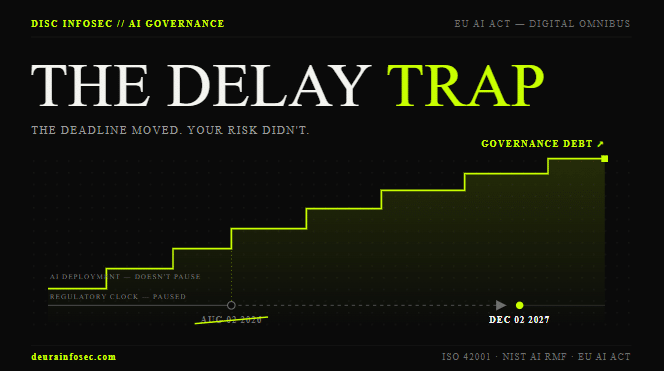
The deadline moved. Nothing else did.
Here’s what the delay did not change: your AI footprint. The recruitment screening model your HR team piloted last quarter. The credit decisioning logic your fintech partner embedded in your onboarding flow. The agentic workflows your engineering org is wiring into production right now, this week, without waiting for Brussels to finish its paperwork.
The AI Act’s timeline was political. Your risk accumulation is operational. Those two clocks were never synchronized, and the Omnibus just desynchronized them further. Every month between now and December 2027, your organization will deploy more AI, embed it deeper into consequential decisions, and entangle it with more vendors — while the regulatory pressure that was forcing executive attention quietly deflates.
I’ve spent two decades watching organizations respond to compliance deadlines, from SOX to GDPR to ISO certification cycles. The pattern is depressingly consistent: a moved deadline doesn’t extend the runway. It deletes the urgency, the program decays, and eighteen months later the organization restarts from a worse position than where it paused — because the environment kept getting more complex while the program stood still.
That’s governance debt with a compounding interest rate. And the AI version compounds faster than anything we’ve seen, because AI adoption doesn’t pause when your governance program does.
Three reasons “we’ll restart in 2027” is a fiction
First, the delay isn’t even law yet. The May 7 agreement is provisional. Formal adoption and publication in the Official Journal are still pending. The April trilogue round collapsed before this one succeeded, which tells you how fragile the politics are. Until the amendment is in the Official Journal, August 2, 2026 remains the legally operative date — and several obligations, including transparency requirements and enforcement structures, were never part of the deferral conversation at all. Organizations planning against a deadline that hasn’t been enacted are practicing compliance by press release.
Second, the EU was never your only regulator. Colorado’s AI Act, the expanding patchwork of US state AI legislation, sector regulators sharpening their AI expectations, and — most immediately — your customers’ procurement teams. Enterprise buyers are not waiting for December 2027 to ask how you govern AI. They’re asking now, in security questionnaires, in vendor risk assessments, in contract language. I watched this dynamic play out firsthand taking a client through ISO 42001 certification: the commercial pressure to demonstrate AI governance arrived well ahead of any regulatory enforcement date. The market is enforcing faster than the regulators.
Third, the legislators themselves told you why they delayed. The deferral exists because harmonised standards, notified bodies, and compliance tooling weren’t ready — not because the obligations got lighter. The requirements in Articles 9 through 17 are coming intact: risk management systems, data governance, technical documentation, logging, human oversight, accuracy and robustness. Sixteen months is not generous for building those capabilities from a standing start. It’s barely adequate for organizations that keep moving. For organizations that pause and restart in mid-2027? It’s a guaranteed fire drill, executed against finalized standards, with every consultancy and notified body in Europe simultaneously overbooked.
What the sixteen months are actually for
The organizations that will look smart in December 2027 are treating this window as exactly what the legislators intended: time to build properly instead of compliance theater under deadline pressure.
That means doing the unglamorous foundational work now. Inventory your AI systems — including the shadow AI your business units deployed without telling anyone, and the AI capabilities your vendors switched on inside products you already license. Classify against Annex III honestly, not optimistically. Stand up the risk management and data governance machinery that Article 9 and Article 10 will demand, because those capabilities take quarters to mature, not weeks.
And anchor it in a management system, not a project plan. This is where ISO 42001 earns its relevance. A certifiable AI management system gives you a regulation-agnostic backbone: the same governance infrastructure satisfies EU AI Act obligations, Colorado’s requirements, NIST AI RMF alignment, and the procurement questionnaires landing in your inbox this quarter. Projects end when deadlines move. Management systems persist because they’re wired into how the organization operates. That structural difference is precisely what separates the companies that will coast through December 2027 from the ones that will panic through it.
The Digital Omnibus came with an explicit expectation attached: implementation efforts should already be underway. That wasn’t diplomatic filler. It was the legislators telling you how they’ll view organizations that show up in late 2027 with nothing built.
The question for your next leadership meeting
Don’t ask “when is the deadline now?” Ask: “What did we deploy this quarter that we couldn’t explain to a regulator, a customer, or a courtroom?”
If the honest answer is “we’re not sure,” the EU just gave you sixteen months to find out. Spend them like the gift they are — or discover in 2027 that the delay trap was never about the deadline at all.
DISC InfoSec helps organizations build AI governance programs that survive deadline changes — ISO 42001 implementation, EU AI Act readiness, and NIST AI RMF alignment from a practitioner who has taken a client through certification, not just talked about it. Start with our free EU AI Act gap assessment at deurainfosec.com.
The AI Governance Quick-Start: Defensible in 10 Days, Not 4 Quarters
DISC InfoSec is an active ISO 42001 implementer and PECB Authorized Training Partner specializing in AI governance for B2B SaaS and financial services organizations.
AI Vulnerability Scorecard: Discover Your AI Attack Surface Before Attackers Do
Your Shadow AI Problem Has a Name-And Now It Has a Score
Most AI Security Tools Won’t Pass an Audit. Here’s a 15-Minute Way to Find Out.

InfoSec services | InfoSec books | Follow our blog | DISC llc is listed on The vCISO Directory | ISO 27k Chat bot | Comprehensive vCISO Services | ISMS Services | AIMS Services | Security Risk Assessment Services | Mergers and Acquisition Security
- 14 Months to Comply. 12 Months of Work. The High-Risk AI Playbook Nobody Has Started
- Your biggest AI risk isn’t hackers. It’s your own data walking out the door
- The cheapest security control you’ll ever implement is the component you decided not to build
- AI Handoffs: How Uncertainty Propagates—and How to Fix It
- The Security Risks Hiding in AI Agent Memory





