InfoSec and Compliance – With 20 years of blogging experience, DISC InfoSec blog is dedicated to providing trusted insights and practical solutions for professionals and organizations navigating the evolving cybersecurity landscape. From cutting-edge threats to compliance strategies, this blog is your reliable resource for staying informed and secure. Dive into the content, connect with the community, and elevate your InfoSec expertise!
In this post, I’ll collect links on Apple’s iPhone backdoor for scanning CSAM images. Previous links are here and here.
Apple says that hash collisions in its CSAM detection system were expected, and not a concern. I’m not convinced that this secondary system was originally part of the design, since it wasn’t discussed in the original specification.
Good op-ed from a group of Princeton researchers who developed a similar system:
Our system could be easily repurposed for surveillance and censorship. The design wasn’t restricted to a specific category of content; a service could simply swap in any content-matching database, and the person using that service would be none the wiser.
Practical Mobile Forensics: Forensically investigate and analyze iOS, Android, and Windows 10 devices
The consequences of such an action could prove dire for your business, though, so before you let another day of stress go by, read on to learn some warning signs and tips on how to deal with burnout. The goal is to get your team working at maximum capacity without overworking them.
Signs of burnout
Burnout is the word used to describe acute exhaustion when your work becomes overwhelming and too stressful. It can lead to poor performance, absenteeism, or resignations. It is a real problem in many industries, but it’s hugely prevalent in information security because of the long hours and high pressure.
Fortunately, burnout comes with early warning signs that you can spot and address. These include:
Anger at colleagues
A constant feeling of exhaustion that could manifest in team members getting lost in daydreams or even nodding off at their desk
Expressions of hopelessness or being overwhelmed by their responsibilities or current task
The team member isolating themselves from others, i.e., avoiding time out with colleagues or social events
Unhappiness in the role
An inability to stop and take breaks
An increase in working hours (coming in early, staying late, skipping lunch, or frequently emailing during out-of-office hours)
If any of your staff shows some of these symptoms, it’s time to act!
Researchers have disclosed a nasty new way for bad people to mess up the internet for the rest of us. They’ve found a fantastically powerful reflective-amplification attack technique that could easily be used for distributed denial of service (DDoS).
You’ll be pleased to know the researchers haven’t wasted their time dreaming up a fancy name or a logo. On the other hand, they’re far from hopeful that the problems can be fixed.
Nation-states would have to fix their firewalls, which ain’t gonna happen. In today’s SB Blogwatch, this is why we can’t have nice things.
Weaponizing this attack is relatively simple” Academics said they discovered a way to abuse the TCP protocol, firewalls, and other network middleboxes to launch giant distributed denial of service (DDoS) attacks. … The research is the first of its kind to describe a method to carry out DDoS reflective amplification attacks via the TCP protocol, previously thought to be unusable for such operations. … Reflective amplification … happens when an attacker sends network packets to a third-party server on the internet, the server processes and creates a much larger response packet, which it then sends to a victim instead of the attacker. … The amplification factor for these TCP-based attacks is also far larger than UDP protocols, making TCP protocol abuse one of the most dangerous forms of … DDoS. … The flaw they found was in the design of middleboxes, which are equipment installed inside large organizations that inspect network traffic. … If the attacker tried to access a forbidden website, then the middlebox would respond with a “block page,” which would typically be much larger than the initial packet—hence an amplification effect. … Weaponizing this attack is relatively simple.
Distributed Denial of Service (DDoS) Attacks: Classification, Attacks, Challenges and Countermeasures
Think of APIs as the new network; interconnected in complex ways and with API interactions happening both within and outside of the organization.
“Public-facing APIs—for example, consumer banking—are usually a key area of focus when it comes to zero-trust,” said Dunne. “This is due to the obvious risk exposure when APIs are documented and made available on the public internet.”
However, the larger risk is found in private and internal APIs, because there is a common assumption that since they aren’t documented or found on a public network, they aren’t exposed.
But as threat actors become more sophisticated in their search for and discovery of private APIs, there is increased risk of the bad guys gaining access to massive amounts of sensitive data. Private APIs need the same layers of protection as public-facing APIs.
“APIs are, by definition, atomic in nature—meaning they can be invoked independently,” explained Setu Kulkarni, vice president, strategy at NTT Application Security in an email interview. “That creates a real challenge for securing these APIs.”
Given that, Kulkarni added, a critical consideration for implementing zero-trust in APIs is to ensure that there is appropriate access control built into the API implementation. Every API function call requires not just authentication but also authorization. Also, adding zero-trust around session validation helps to prevent unintended data leakage.
FireEye Mandiant researchers have discovered a critical vulnerability in the Kalay cloud platform that exposes millions of IoT devices to attacks.
Researchers at FireEye’s Mandiant have discovered a critical vulnerability, tracked as CVE-2021-28372, in a core component of the Kalay cloud platform which is used by millions of IoT devices from many vendors.
The flaw could be easily exploited by a remote attacker to take over an IoT device, the only info needed for the attack is the Kalay unique identifier (UID) of the targeted user. The identifier could be obtained via social engineering.
“The vulnerabilities described in this post affect a core component of the Kalay platform. Mandiant was not able to create a comprehensive list of affected devices; however, ThroughTek’s website reports more than 83 million active devices on the Kalay platform at the time of writing this post.” states the report published by Mandiant.“An attacker would require comprehensive knowledge of the Kalay protocol and the ability to generate and send messages. The attacker would also need to obtain Kalay UIDs through social engineering or other vulnerabilities in APIs or services that return Kalay UIDs. From there, an attacker would be able to remotely compromise affected devices that correspond to the obtained UIDs.”
An attacker that has obtained the UID of a targeted device could send a specially crafted request to the Kalay network to register another device with the same UID on the network. Then the Kalay servers will overwrite the existing device. Once the victim will connect the device, his connection will be directed to the attacker that could obtain the credentials used by the victim to access the device.
Most of the devices using the platform are video surveillance products such as IP cameras and baby monitors, an attacker could exploit this flaw to eavesdrop audio and video data.
The attacker could also use RPC (remote procedure call) functionality to completely take over the device.
Practical IoT Hacking: The Definitive Guide to Attacking the Internet of Things
While Security Orchestration Automation and Response (SOAR) solutions help automate and structure these activities, the activities themselves require telemetry data that provide the breadcrumbs to help scope, identify and potentially remedy the situation. This takes increasing significance in the cloud for a few reasons:
The public cloud shared security model may lead to gaps in the telemetry (e.g., lack of telemetry from the underlying infrastructure that could help correlate breadcrumbs at the infrastructure level to the application level).
Lack of consistency in telemetry information as applications increasingly segment into microservices, containers and Platform-as-a-Service, and as various modules come from different sources such as internal development, open source, commercial modules, and outsourced development.
Misconfigurations and misunderstandings as control shifts between DevOps, CloudOps and SecOps.
All the above coupled with a significant expansion of attack surface area with the decomposition of monolith applications into microservices.
When incidents occur, the ability to quickly size up the scope, impact and root cause of the incident is directly proportional to the availability of quality data, and its ability to be easily queried, analyzed, and dissected. As companies migrate to the cloud, logs have become the de-facto standard of gathering telemetry.
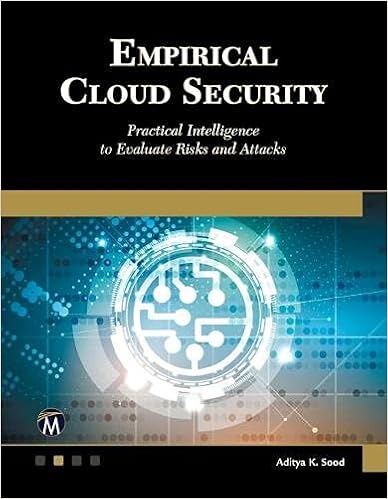
This book is designed for security and risk assessment professionals, DevOps engineers, penetration testers, cloud security engineers, and cloud software developers who are interested in learning practical approaches to cloud security. It covers practical strategies for assessing the security and privacy of your cloud infrastructure and applications and shows how to make your cloud infrastructure secure to combat threats, attacks, and prevent data breaches. The chapters are designed with a granular framework, starting with the security concepts, followed by hand-on assessment techniques based on real-world studies, and concluding with recommendations including best practices.
FEATURES:
Includes practical strategies for assessing the security and privacy of your cloud infrastructure and applications
Covers topics such as cloud architecture and security fundamentals, database and storage security, data privacy, security and risk assessments, controls related to continuous monitoring, and more
Presents several case studies revealing how threat actors abuse and exploit cloud environments to spread malware
Recent research indicates that 51 percent of SOC teams feel emotionally overwhelmed by the impossible volume of security alerts they must deal with, with the stress impacting their home lives.
Increasing the maturity of a SOC allows analysts to stop fighting fires and focus on higher value work. With careful planning and the right combination of automation and standardized processes, a mature, effective, and world-class SOC can be established.
The danger of alert overload
The cybersecurity landscape has become increasingly hostile, and teams must deal with an ever-increasing barrage of security alerts. Teams have reported spending nearly a third of their time simply dealing with false positives, and we have long since passed the tipping point where these numbers can be dealt with on a manual basis.
This is exacerbated by the fact that the on-going skills gap means recruiting and retaining a full team of analysts has become an increasingly costly proposition. Few firms can afford large teams, and even an army of analysts will not be able to comfortably tackle hundreds of alerts a day in addition to their other duties.
In addition to the sheer number of alerts they must deal with, SOC teams are hampered by inefficient processes. Many analysts end up using an ad-hoc suite of security solutions cobbled together from different providers and great deal of time can be wasted every day as analysts swap back and forth between different solutions. There is no easy way to compare data from different tools to identify trends and more complex threats. Uniting solutions under a single management system can help to win back lost time and establish a single view of threat data.
The Industry Standard, Vendor-Neutral Guide to Managing SOCs and Delivering SOC Services
This completely new, vendor-neutral guide brings together all the knowledge you need to build, maintain, and operate a modern Security Operations Center (SOC) and deliver security services as efficiently and cost-effectively as possible.
Leading security architect Joseph Muniz helps you assess current capabilities, align your SOC to your business, and plan a new SOC or evolve an existing one. He covers people, process, and technology; explores each key service handled by mature SOCs; and offers expert guidance for managing risk, vulnerabilities, and compliance. Throughout, hands-on examples show how advanced red and blue teams execute and defend against real-world exploits using tools like Kali Linux and Ansible. Muniz concludes by previewing the future of SOCs, including Secure Access Service Edge (SASE) cloud technologies and increasingly sophisticated automation.
This guide will be indispensable for everyone responsible for delivering security services―managers and cybersecurity professionals alike.
* Address core business and operational requirements, including sponsorship, management, policies, procedures, workspaces, staffing, and technology * Identify, recruit, interview, onboard, and grow an outstanding SOC team * Thoughtfully decide what to outsource and what to insource * Collect, centralize, and use both internal data and external threat intelligence * Quickly and efficiently hunt threats, respond to incidents, and investigate artifacts * Reduce future risk by improving incident recovery and vulnerability management * Apply orchestration and automation effectively, without just throwing money at them * Position yourself today for emerging SOC technologies
Fortinet addresses a command injection vulnerability that can allow attackers to take complete control of servers running vulnerable FortiWeb WAF installs.
An authenticated attacker could execute arbitrary commands as the root user on the underlying system via the SAML server configuration page. Experts pointed out that the flaw could be chained with an authentication bypass flaw that could allow an attacker
The vulnerability impacts Fortinet FortiWeb versions 6.3.11 and earlier, an authenticated attacker could exploit the issue to take complete control of servers running vulnerable versions of the FortiWeb WAF.
An authenticated attacker could execute arbitrary commands as the root user on the underlying system via the SAML server configuration page. Experts pointed out that the flaw could be chained with an authentication bypass flaw (i.e. CVE-2020-29015) to allow an unauthenticated attacker to trigger the vulnerability.
The vulnerability was reported by the researcher William Vu from Rapid7.
“An attacker, who is first authenticated to the management interface of the FortiWeb device, can smuggle commands using backticks in the “Name” field of the SAML Server configuration page. These commands are then executed as the root user of the underlying operating system.” reads the post published by Rapid7.“An attacker can leverage this vulnerability to take complete control of the affected device, with the highest possible privileges. “
The flaw could allow an attacker to deploy a persistent shell, install crypto mining software, or other malware families. If the management interface is exposed to the internet, an attacker could trigger the issue to reach into the affected network beyond the DMZ. Rapid7 researchers discovered less than three hundred devices exposing their management interfaces online. Let’s remind that management interfaces for devices like FortiWeb should not be exposed online!
Copyright scams aren’t new – we’ve written about them many times in recent years.
These scammers often target your Facebook or Instagram account, fraudulently claiming that someone has registered a complaint about content that you’ve posted, such as a photo, and telling you that you need to resolve the issue in order to avoid getting locked out of your account.
The problem with copyright infringement notices is that if they’re genuine, they can’t just be ignored, because social media sites are obliged to try to resolve meaningful copyright complaints when they’re received.
To discourage bogus complaints and reduce harrassment – and if you are a content producer or influencer yourself, with an active blog, video or social media account, you will probably have had many well-meaning but ill-informed complaints in your time – sites such as Facebook, Instagram, Twitter and the like don’t put the complainant directly in touch with you.
The process usually goes something like this:
The complainant makes their claim to the service provider concerned. The service provider expects them to give full contact details, in order to discourage anonymous harasssment.
If the claim seems to hold water, the service alerts you, without giving your details to the complainant, and invites you to defend or to accept the complaint. (Obviously bogus claims, such as complaints about an images or video content in an article that is all text, shouldn’t go any further.)
If the claim is incorrect, you can repudiate it, for example by stating that you took a photo yourself or by showing a licence you acquired for a music clip.
If you don’t wish to contest the claim, you are usually expected to remove the allegedly infringing material promptly, and report that you have done so.
In either case, assuming that the service provider considers the case resolved, it’s then closed without the complainant getting to contact you directly, and without you needing to deal directly with the complainant in return.
Scam Me If You Can: Simple Strategies to Outsmart Today’s Rip-off Artists
ISO 45001 is the international standard that contains best practices for OH&S (occupational health and safety). Its goal is to reduce injuries and diseases in the workplace, including the promotion and protection of physical and mental health.
COVID-19 helped put some of those problems into relief, but it’s something organisations must continue to be vigilant about as the pandemic subsides.
In this blog, we look at the mandatory documentation and records you must complete to comply with ISO 45001 – as well as non-mandatory documents that can support your compliance activities.
Mandatory documentation
Clause 4.3 Scope of the OH&S management system
Clause 5.2 OH&S policy
Clause 5.3 Responsibilities and authorities within OH&SMS
Clause 6.1.1 OH&S process for addressing risks and opportunities
Clause
6.1.2.2
Methodology and criteria for assessment of OH&S risks
Clause 6.2.2 OH&S objectives and plans for achieving them
Clause 8.2 Emergency preparedness and response process
Mandatory records
Clause 6.1.1 OH&S risks and opportunities and actions for addressing them
Clause 6.1.3 Legal and other requirements
Clause 7.2 Evidence of competence
Clause 7.4.1 Evidence of communications
Clause 8.2 Plans for responding to potential emergency situations
Clause 9.1.1 Results on monitoring, measurements, analysis and performance evaluation
Clause 9.1.1 Maintenance, calibration or verification of monitoring equipment
Clause 9.1.2 Compliance evaluation results
Clause 9.2.2 Internal audit program
Clause 9.2.2 Internal audit report
Clause 9.3 Results of management review
Clause 10.2 Nature of incidents or nonconformities and any subsequent action taken
Clause 10.2 Results of any action and corrective action, including their effectiveness
Clause 10.3 Evidence of the results of continual improvement
Non-mandatory documents
In addition to mandatory documentation, there are many other parts of ISO 45001 that organisations may find relevant. This includes:
Clause 4.1 Procedure for determining context of the organization and interested parties
Clause 5.4 Procedure for consultation and participation of workers
Clause 6.1.2.1 Procedure for hazard identification and assessment
Clause 6.1.3 Procedure for identification of legal requirements
Clause 7.4.1 Procedure for communication
Clause 7.5 Procedure for document and record control
Clause 8.1 Procedure for operational planning and control
Clause 8.1.3 Procedure for change management
Clause 9.1.1 Procedure for monitoring, measuring and analysis
Clause 9.1.2 Procedure for compliance evaluation
Clause 9.2 Procedure for internal audit
Clause 9.3 Procedure for management review
Clause 10.1 Procedure for incident investigation
Clause 10.1 Procedure for management of nonconformities and corrective actions
This book, written by consultant and trainer Naeem Sadiq, explains how organisations can use ISO 45001’s requirements to create a safer work environment.
You’ll find out the purpose and requirements of each clause in ISO 45001, learn how to build an OH&S management system in a step-by-step approach and receive real-world examples of health and safety issues along with the ideal way to handle that situation.
At their core, boards approve the strategic direction of an organization as well as how the organization allocates resources and mitigates risk. Security leaders have to present metrics that align with business objectives to make an impact at the board level. Here’s why many security metrics often fall short of this goal:
Metrics such as the number of daily phishing alerts don’t provide context—that is, they don’t inform CISOs if the numbers are good news or bad news. If metrics don’t point to next steps such as changing processes, better configuration of products or identifying opportunities for automation, the path to action is unclear.
Metrics often illustrate how tools are being used, not the results they yield and what those actually mean. Metrics based on tools are considered the low-hanging fruit of the security world—they’re easily available, but they don’t help solve problems.
Often, organizations don’t address people, processes and technology—three key pillars necessary to construct a big-picture view of how a company’s security model is performing.
While these are metrics to avoid, there’s are different metrics that matter to leadership and are understandable to many more stakeholders—not just the security team. These metrics focus on the effectiveness of resources being deployed (i.e. the security program tools and people) as well as ensuring you have the proper visibility to mitigate risk.
Google has open-sourced the Allstar tool that can be used to secure GitHub projects and prevent security misconfigurations.
Google has open-sourced the Allstar tool that can be used to secure GitHub projects by enforcing a set of security policies to prevent misconfiguration.
“Allstar is a GitHub App installed on organizations or repositories to set and enforce security policies. Its goal is to be able to continuously monitor and detect any GitHub setting or repository file contents that may be risky or do not follow security best practices.” reads the project description. “If Allstar finds a repository to be out of compliance, it will take an action such as create an issue or restore security settings.”
Open Source Intelligence Techniques: Resources for Searching and Analyzing Online Information
Nowadays just as one cannot take enough safety measures when leaving their house of work to avoid running into problems and tribulations along the way, the exact same measures are to be taken into consideration when strolling around the wonderful world of the internet. It can be argued that the internet stands right up there as being one of the most important tools that recent technology has offered mankind to make lives easier. You can look for information, shop, wager on sporting events like pro football games through sites that focus on NFL predictions for games amongst other services and many other activities.
The internet has become the perfect tool for anyone and everyone to find absolutely everything they may want, need or anything in between, it’s become a staple of commodity and leisure, but it can also be a very dangerous tool if not handled properly. This tech tool has especially garnered fame and recognition amongst sports fans who flock to it in order to find all items related to their favorite teams, athletes and sports, but rest assured, one wrong move and dire consequences could be on the way
Today though, let’s focus on one of sports fans’ favorite online activities, online sports betting and how to prevent hacking incidents from happening.
For these and other reasons, organizations are increasingly opting for cyber insurance coverage and paying higher premiums year after year. According to the U.S. Government Accountability Office, the number of companies opting for cybersecurity coverage grew from 26% in 2016 to 47% in 2020, and most saw breach insurance premiums increase by up to 30%.
Given the clear financial stakes, it is time security leaders understand the risks before adding cyber insurance to their strategy for ransomware prevention and recovery.
Successful breaches breed more attacks
Ransomware typically enters a company via a phishing attack or a compromise of a vulnerable system deployed on a network’s perimeter. From there, the infection proliferates via exploits or open shares, encrypting important data as it jumps from machine to machine, after which cyber criminals withhold the encryption key and threaten to publish sensitive data unless a ransom is paid.
The attackers, many of whom are part of sophisticated and organized groups, often provide a step-by-step guide for the targeted company to transfer ransoms in cryptocurrency, sometimes in the hundreds of thousands or millions of dollars. Sadly, when faced with costly downtime and/or the downstream effects of having sensitive data made public, many companies end up complying with the attackers’ demands. Paying the ransom, in turn, incentivizes more attacks, perpetuating the cycle of crime.
It’s important to note that cybersecurity insurance is also incentivizing attacks rather than serving as protection for the rarest of breaches. While U.S. law enforcement has typically urged companies not to pay the ransom, it has yet to decide to ban such payments altogether (though the US Department of the Treasury’s Office of Foreign Assets Control regulations prohibit U.S. companies from paying up if they suspect the attackers of being under its cyber-related sanctions program).
Security firms Trend Micro is warning its customers of attacks exploiting zero-day vulnerabilities in its Apex One and Apex One as a Service products.
On July 28, Trend Micro released security patches for multiple incorrect permission assignment privilege escalation, incorrect permission preservation authentication bypass, arbitrary file upload, and local privilege escalation vulnerabilities in Apex One and Apex One as a Service products. The security firm also reported that attackers are already exploits at least two of the flaws (CVE-2021-32464, CVE-2021-32465, CVE-2021-36741, CVE-2021-36742) in attacks in the wild.
The vulnerabilities affect the Trend Micro Apex One (On Premise) and Apex One as a Service (SaaS) on Windows.
“Trend Micro has observed an active attempt of exploitation against two of these vulnerabilities (chained) in-the-wild (ITW) in a very limited number of instances, and we have been in contact with these customers already. All customers are strongly encouraged to update to the latest versions as soon as possible.” reads the advisory.
The company did not share info about the attacks in the wild that exploited the above vulnerabilities.
In April, the security firm revealed that attackers were actively exploiting a vulnerability, tracked as
CVE-2020-24557
, in its antivirus solutions to gain admin rights on Windows systems.
The main components of the security tool are the Cobalt Strike client — also known as a Beacon — and the Cobalt Strike team server, which sends commands to infected computers and receives the data they exfiltrate. An attacker starts by spinning up a machine running Team Server that has been configured to use specific “malleability” customizations, such as how often the client is to report to the server or specific data to periodically send.
Although it’s usually said aloud as “Mount Gox”, as if it were a topographic feature, it actually started life as MTGOX, short for Magic: The Gathering Online Exchange, where MTG fans could trade cards via the internet.
The web domain was eventually repurposed for what was, back in 2014, the world’s biggest Bitcoin cryptocurrency exchange.
Mt. Gox was headquartered in Japan, holding what was then a mind-blowing $500,000,000 in other people’s bitcoins (BTC).
And then a strange thing happened: the money, or at least the bitcoins, vanished, just like that.
We’ve never really found out what happened.
Early suggestions blamed a cryptographic flaw known as transaction malleability, but sceptics argued that this sort of treachery, even if if were possible on such an epic scale, would be visible in the Bitcoin transaction record, also known as the blockchain.
Simply put, transaction malleability means that two different transactions can be rigged to have the same supposedly unique identifier. Crooked transactors could, in theory, fraudulently concoct duplicate-yet-different transaction pairs, and use these transactions to trick a naive exchange into thinking that something had gone wrong. Them the crooks could dishonestly repudiate one of the transactions in each pair and demand a refund.
Some experts say that Bitcoin and cryptocurrencies are just a scam; others say they’re “the most important invention since the internet.” It’s hard to tell who’s right.
Authored by Silicon Valley leaders from Google, Microsoft, and Facebook, Bubble or Revolution cuts through the hype to offer a balanced, comprehensive, and accessible analysis of blockchains and cryptocurrencies.
The first step toward a zero-trust environment consists of establishing a zero-trust network architecture that covers all aspects of users interacting with corporate internal and cloud-based IT resources, wherever the users or the resources might be located.
This requires an evaluation of the context of user access, combined with the creation of risk profiles. Based on these risk profiles and continuous context analysis, the security team can implement and enforce centralized security policies – independently from any old-fashioned network firewall perimeter.
Establishing context entails checking numerous aspects such as the IP address and geographic location, device status (corporate-owned, privately owned), OS status (jailbroken/rooted or secure), patch status, and so on, as well as verifying digital certificates for identity and access management.
The constant evaluation of all this data is then matched with predefined granular policies. For example, businesses might determine that employees can only access sensitive resources if the device is fully secured, and the user is identified via multi-factor authentication. Otherwise, a pop-up notification will inform the employee how to proceed, while the device might be put into quarantine until its desired state is achieved.
Evan Grant, a researcher at network security scanning company Tenable, recently decided to have a go at hacking a home router.
The idea, it seems, was more to learn about the general techniques, tools and procedures available to router hackers than to conduct a security assessment of any particular product.
Understandably, therefore, Grant picked a router model using two non-technical criteria: was it popular, and was it available in Canada (Grant’s home country)?
After opening up the router casing to get access to the circuit board, Grant made good progress, by quickly:
Finding likely pins on the circuit board where a debugging device could be connected.
Identifying the correct wiring for the debugging circuity to permit a serial connection.
Getting a root shell via a serial line and accessing the files on the device.
Grant’s first stop was to download a binary file (executable program) called httpd, which is the name under which you typically find a home or small business router’s web server, used for managing the device from a browser.
The name httpd stands for HTTP daemon, where HTTP means that the program handles web traffic, and daemon is the Unix/Linux name for what Windows users know as a service: software that runs in the background whether anyone is logged in or not. (The word daemon is properly pronounced “die-moan” or “day-moan”, but many sysadmins just call them “demons”, and you may need to follow suit to avoid causing confusion.)
Home and small business routers under attack – how to see if you are at risk
This is pretty shocking coming from Apple, which is generally really good about privacy. It opens the door for all sorts of other surveillance, since now that the system is build it can be used for all sorts of other messages. And it breaks end-to-end encryption, despite Apple’s denials:
Does this break end-to-end encryption in Messages?
No. This doesn’t change the privacy assurances of Messages, and Apple never gains access to communications as a result of this feature. Any user of Messages, including those with with communication safety enabled, retains control over what is sent and to whom. If the feature is enabled for the child account, the device will evaluate images in Messages and present an intervention if the image is determined to be sexually explicit. For accounts of children age 12 and under, parents can set up parental notifications which will be sent if the child confirms and sends or views an image that has been determined to be sexually explicit. None of the communications, image evaluation, interventions, or notifications are available to Apple.
Detecting Backdoor Using Stepping Stone Detection Approach







![OWASP WEB APPLICATION SECURITY THREATS – MARKET INTEREST TREND : FULL REPORT PACKAGE by [CURIOSITY PUBLISHERS]](https://m.media-amazon.com/images/I/41MW20-YgdL.jpg)