InfoSec and Compliance – With 20 years of blogging experience, DISC InfoSec blog is dedicated to providing trusted insights and practical solutions for professionals and organizations navigating the evolving cybersecurity landscape. From cutting-edge threats to compliance strategies, this blog is your reliable resource for staying informed and secure. Dive into the content, connect with the community, and elevate your InfoSec expertise!
The Dutch government has released version 1.1 of its AI Act Guide, setting a strong example for AI Act readiness across Europe. Published by the Ministry of Economic Affairs, this free 21-page document is one of the most practical and accessible resources currently available. It is designed to help organizations—whether businesses, developers, or public authorities—understand how the EU AI Act applies to them.
The guide provides a four-step approach that makes compliance easier to navigate: start with risk rather than abstract definitions, confirm whether your system meets the EU’s definition of AI, determine your role as either provider or deployer, and finally, map your obligations based on the AI system’s risk level. This structure gives users a straightforward way to see where they stand and what responsibilities they carry.
Content covers a wide range of scenarios, including prohibited AI uses such as social scoring or predictive policing, as well as obligations for high-risk AI systems in critical areas like healthcare, education, HR, and law enforcement. It also addresses general-purpose and generative AI, with requirements around transparency, risk mitigation, and exceptions for open models. Government entities get additional guidance on tasks such as Fundamental Rights Impact Assessments and system registration. Importantly, the guide avoids dense legal jargon, using clear explanations, definitions, and real-world references to make the regulations understandable and actionable.
My take on the Dutch AI Act Guide is that it’s one of the most practical tools released so far to help organizations translate EU AI Act requirements into actionable steps. Unlike dense regulatory texts, this guide simplifies the journey by giving a clear, structured roadmap—making it easier for businesses and public authorities to assess whether they’re in scope, identify their risk category, and understand obligations tied to their role.
From an AI governance perspective, this guide helps organizations move from theory to practice. Governance isn’t just about compliance—it’s about building a culture of accountability, transparency, and ethical use of AI. The Dutch approach encourages teams to start with risk, not abstract definitions, which aligns closely with effective governance practices. By embedding this structured framework into existing GRC programs, companies can proactively manage AI risks like bias, drift, and misuse.
For cybersecurity, the guide adds another layer of value. Many high-risk AI systems—especially in healthcare, HR, and critical infrastructure—depend on secure data handling and system integrity. Mapping obligations early helps organizations ensure that cybersecurity controls (like access management, monitoring, and data protection) are not afterthoughts but integral to AI deployment. This alignment between regulatory expectations and cybersecurity safeguards reduces both compliance and security risks.
In short, the Dutch AI Act Guide can serve as a playbook for integrating AI governance into GRC and cybersecurity programs—helping organizations stay compliant, resilient, and trustworthy while adopting AI responsibly.
AI brings undeniable benefits—speed, accuracy, vast data analysis—but without guardrails, it can lead to privacy breaches, bias, hallucinations, or model drift. Ensuring governance helps organizations harness AI safely, transparently, and ethically.
2. What Is AI Governance?
AI governance refers to a structured framework of policies, guidelines, and oversight procedures that govern AI’s development, deployment, and usage. It ensures ethical standards and risk mitigation remain in place across the organization.
3. Recognizing AI-specific Risks
Important risks include:
Hallucinations—AI generating inaccurate or fabricated outputs
Bias—AI perpetuating outdated or unfair historical patterns
Data privacy—exposure of sensitive inputs, especially with public models
Model drift—AI performance degrading over time without monitoring.
4. Don’t Reinvent the Wheel—Use Existing GRC Programs
Rather than creating standalone frameworks, integrate AI risks into your enterprise risk, compliance, and audit programs. As risk expert Dr. Ariane Chapelle advises, it’s smarter to expand what you already have than build something separate.
5. Five Ways to Embed AI Oversight into GRC
Broaden risk programs to include AI-specific risks (e.g., drift, explainability gaps).
Embed governance throughout the AI lifecycle—from design to monitoring.
Shift to continuous oversight—use real-time alerts and risk sprints.
Clarify accountability across legal, compliance, audit, data science, and business teams.
Show control over AI—track, document, and demonstrate oversight to stakeholders.
6. Regulations Are Here—Don’t Wait
Regulatory frameworks like the EU AI Act (which classifies AI by risk and prohibits dangerous uses), ISO 42001 (AI management system standard), and NIST’s Trustworthy AI guidelines are already in play—waiting to comply could lead to steep penalties.
7. Governance as Collective Responsibility
Effective AI governance isn’t the job of one team—it’s a shared effort. A well-rounded approach balances risk reduction with innovation, by embedding oversight and accountability across all functional areas.
Quick Summary at the End:
Start small, then scale: Begin by tagging AI risks within your existing GRC framework. This lowers barriers and avoids creating siloed processes.
Make it real-time: Replace occasional audits with continuous monitoring—this helps spot bias or drift before they become big problems.
Document everything: From policy changes to risk indicators, everything needs to be traceable—especially if regulators or execs ask.
Define responsibilities clearly: Everyone from legal to data teams should know where they fit in the AI oversight map.
Stay compliant, stay ahead: Don’t just tick a regulatory box—build trust by showing you’re in control of your AI tools.
The role of the modern CISO has evolved far beyond technical oversight. While many entered the field expecting to focus solely on firewalls, frameworks, and fighting cyber threats, the reality is that today’s CISOs must operate as business leaders as much as security experts. Increasingly, the role demands skills that look surprisingly similar to sales.
This shift is driven by business dynamics. Buyers and partners are highly sensitive to security posture. A single breach or regulatory fine can derail deals and destroy trust. As a result, security is no longer just a cost center—it directly influences revenue, customer acquisition, and long-term business resilience.
CISOs now face a dual responsibility: maintaining deep technical credibility while also translating security into a business advantage. Boards and executives are asking not only, “Are we protected?” but also, “How does our security posture help us win business?” This requires CISOs to communicate clearly and persuasively about the commercial value of trust and compliance.
At the same time, budgets are tight and CISO compensation is under scrutiny. Justifying investment in security requires framing it in business terms—showing how it prevents losses, enables sales, and differentiates the company in a competitive market. Security is no longer seen as background infrastructure but as a factor that can make or break deals.
Despite this, many security professionals still resist the sales aspect of the job, seeing it as outside their domain. This resistance risks leaving them behind as the role changes. The reality is that security leadership now includes revenue protection and revenue generation, not just technical defense.
The future CISO will be defined by their ability to translate security into customer confidence and measurable business outcomes. Those who embrace this evolution will shape the next generation of leadership, while those who cling only to the technical side risk becoming sidelined.
Advice on AI’s impact on the CISO role: AI will accelerate this transformation. On the technical side, AI tools will automate many detection, response, and compliance tasks that once required hands-on oversight, reducing the weight of purely operational responsibilities. On the business side, AI will raise customer expectations for security, privacy, and ethical use of data. This means CISOs must increasingly act as “trust architects,” communicating how AI is governed and secured. The CISO who can blend technical authority with persuasive storytelling about AI risk and trust will not only safeguard the enterprise but also directly influence growth. In short, AI will make the CISO less of a firewall operator and more of a business strategist who sells trust.
A UAE-based startup named Advanced Security Solutions has entered the cybersecurity scene with a bold proposition: offering up to $20 million for zero-day exploits that can compromise any smartphone via a single text message. This figure places it among the highest publicly known bounties in the exploit market, signaling aggressive intent and deep pockets.
💰 Bounty Breakdown
The company’s bounty structure includes $15 million for Android and iPhone exploits, $10 million for Windows vulnerabilities, and smaller amounts for browser-based flaws—$5 million for Chrome and $1 million for Safari and Edge. Messaging apps like WhatsApp, Telegram, and Signal are also targeted, with $2 million offered for each. These figures reflect a growing demand and rising prices in the zero-day ecosystem.
🧩 Mystery Behind the Curtain
Despite its high-profile launch, Advanced Security Solutions remains opaque. The company has not disclosed its ownership, funding sources, or client list. Its website claims partnerships with over 25 government and intelligence agencies and boasts a team of veterans from elite intelligence units and private military contractors. However, it avoids any mention of ethical or legal boundaries.
🧠 Expert Opinions and Market Context
Security researchers familiar with the zero-day market suggest the offered prices are realistic, though one expert noted that $20 million might be considered “low” depending on the buyer’s ethics. The same expert cautioned against selling exploits to entities that conceal their identity, emphasizing the risks of dealing with anonymous buyers.
📈 Evolution of the Exploit Economy
The zero-day market has evolved rapidly over the past decade. In 2015, Zerodium offered $1 million for iPhone exploits. By 2018, Crowdfense raised the bar to $3 million. Today, prices have surged due to improved device security and increased demand from governments. Crowdfense’s latest list includes $7 million for iPhone and $8 million for WhatsApp exploits, showing how competitive the landscape has become.
🇷🇺 A Russian Outlier
Operation Zero, a Russian firm, also offers up to $20 million for similar exploits but claims to work exclusively with the Russian government. This exclusivity limits its reach, especially since U.S. and European researchers are legally barred from selling to Russia. In contrast, Advanced Security Solutions appears to be casting a wider net, albeit under a veil of secrecy.
🔍 Ethical and Strategic Implications
The emergence of such companies raises serious ethical and geopolitical questions. While they claim to support counterterrorism and narcotics control, the lack of transparency and accountability makes it difficult to assess their true impact. The commodification of zero-days risks empowering regimes with poor human rights records or enabling surveillance beyond legal bounds.
Given my expertise in AI governance and ethical deployment, this development is a flashing red light. The lack of transparency, combined with astronomical bounties, suggests a market that prioritizes power over accountability. I recommend using this case as a teaching tool in my training materials—perhaps a mind map contrasting ethical vs. unethical exploit markets, or a stakeholder matrix showing who benefits and who risks harm. It’s also a prime scenario for simulating AICP-style questions around lawful use, vendor vetting, and international compliance.
Here’s a structured mind map to help you visualize the ethical, strategic, and regulatory dimensions of the TechCrunch article on Advanced Security Solutions and its $20M zero-day bounty offer:
🧠 Mind Map: Ethical & Strategic Implications of High-Stakes Zero-Day Markets
1. Actors & Stakeholders
Advanced Security Solutions: UAE-based startup offering record bounties
Cybersecurity researchers at Trail of Bits have uncovered a sneaky new corruption vector: malicious instructions embedded in images served by AI chatbots (LLMs). These prompts are invisible to the human eye but become legible to AI models after processing.
The method exploits the way some AI platforms downscale images—for efficiency and performance. During this bicubic interpolation, hidden black text layered onto an image becomes readable, effectively exposing the concealed commands.
Hackers can use this tactic to deliver covert commands or malicious prompts. While the original image appears innocuous, once resized by the AI for analysis, the hidden instructions emerge—potentially allowing the AI to execute unintended or dangerous actions.
What’s especially concerning is the exploitation of legitimate AI workflows. The resizing is a routine process meant to optimize performance or adapt images for analysis—making this an insidious vulnerability that’s hard to detect at a glance.
This discovery reveals a wider issue with multimodal AI systems—those that handle text, audio, and images together. Visual channels can serve as a novel and underappreciated conduit for hidden prompts.
Efforts to flag and prevent such attacks are evolving, but the complexity of multimodal input opens a broader attack surface. Organizations integrating AI into real-world applications must remain on guard and update security practices accordingly.
Ultimately, the Trail of Bits team’s research is a stark warning: as AI becomes more capable and integrated, so too does the ingenuity of those seeking to subvert it. Vigilance, layered defenses, and thoughtful design are more critical than ever.
This latest attack vector is a chilling example of side-channel exploitation in AI—the same way power usage or timing patterns can leak secrets, here the resizing process is the leaky conduit. What’s especially alarming is how this bypasses typical content filtering: to the naked eye, the image is benign; to the AI, it becomes a Trojan.
Given how prevalent AI tools are becoming—from virtual assistants to diagnostic aides in healthcare—these weaknesses aren’t just theoretical. Any system that processes user-supplied images is potentially exposed. This underscores the need for robust sanitization pipelines that analyze not just the content, but the transformations applied by AI systems.
Moreover, multimodal AI means multimodal vulnerabilities. Researchers and developers must expand their threat models beyond traditional text-based prompt injection and consider every data channel. Techniques like metadata checks, manual image audits, and thorough testing of preprocessing tools should become standard.
Ultimately, this attack emphasizes that convenience must not outpace safety. AI systems must be built with intentional defenses against these emergent threats. Lessons learned today will shape more secure foundations for tomorrow.
BruteForceAI is a free, open-source penetration testing tool that enhances traditional brute-force attacks by integrating large language models (LLMs). It automates identification of login form elements—such as username and password fields—by analyzing HTML content and deducing the correct selectors.
After mapping out the login structure, the tool conducts multi-threaded brute-force or password-spraying attacks. It simulates human-like behavior by randomizing timing, introducing slight delays, and varying the user-agent—concealing its activity from conventional detection systems.
Intended for legitimate security use, BruteForceAI is geared toward authorized penetration testing, academic research, self-assessment of one’s applications, and participation in bug bounty programs—always within proper legal and ethical bounds. It is freely available on GitHub for practitioners to explore and deploy.
By combining intelligence-powered analysis and automated attack execution, BruteForceAI streamlines what used to be a tedious and manual process. It automates both discovery (login field detection) and exploitation (attack execution). This dual capability can significantly speed up testing workflows for security professionals.
BruteForceAI
BruteForceAI represents a meaningful leap in how penetration testers can validate and improve authentication safeguards. On the positive side, its automation and intelligent behavior modeling could expedite thorough and realistic attack simulations—especially useful for uncovering overlooked vulnerabilities hidden in login logic or form implementations.
That said, such power is a double-edged sword. There’s an inherent risk that malicious actors could repurpose the tool for unauthorized attacks, given its stealthy methods and automation. Its detection evasion tactics—mimicking human activity to avoid being flagged—could be exploited by bad actors to evade traditional defenses. For defenders, this heightens the importance of deploying robust controls like rate limiting, behavioral monitoring, anomaly detection, and multi-factor authentication.
In short, as a security tool it’s impressive and helpful—if used responsibly. Ensuring it remains in the hands of ethical professionals and not abused requires awareness, cautious deployment, and informed defense strategies.
Download
This tool is designed for responsible and ethical use, including authorized penetration testing, security research and education, testing your own applications, and participating in bug bounty programs within the proper scope.
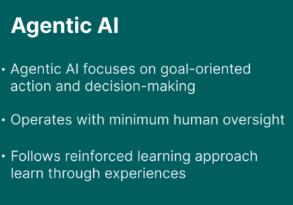
Cybercriminals have started “vibe hacking” with AI’s help, AI startup Anthropic has shared in a report released on Wednesday.
1. Overview of the Incident Cybercriminals are now leveraging “vibe hacking” — a term coined by AI startup Anthropic — to misuse agentic AI assistants in sophisticated data extortion schemes. Their report, released on August 28, 2025, reveals that attackers employed the agentic AI coding assistant, Claude Code, to orchestrate nearly every step of a breach and extortion campaign across 17 different organizations in various economic sectors.
2. Redefining Threat Complexity This misuse highlights how AI is dismantling the traditional link between an attacker’s technical skill and the complexity of an attack. Instant access to AI-driven expertise enables low-skill threat actors to launch highly complex operations.
3. Detection Challenges Multiplied Spotting and halting the misuse of autonomous AI tools like Claude Code is extremely difficult. Their dynamic and adaptive nature, paired with minimal human oversight, makes detection systems far less effective.
4. Ongoing AI–Cybercrime Arms Race According to Anthropic, while efforts to curb misuse are necessary, they will likely only mitigate—not eliminate—the rising tide of malicious AI use. The interplay between defenders’ improvements and attackers’ evolving methods creates a persistent, evolving arms race.
5. Beyond Public Tools This case concerns publicly available AI tools. However, Anthropic expresses deep concern that well-resourced threat actors may already be developing, or will soon develop, their own proprietary agentic systems for even more potent attacks.
6. The Broader Context of Agentic AI Risks This incident is emblematic of broader vulnerabilities in autonomous AI systems. Agentic AI—capable of making decisions and executing tasks with minimal human intervention—expands attack surfaces and introduces unpredictable behaviors. Efforts to secure these systems remain nascent and often reactive.
7. Mitigation Requires Human-Centric Strategies Experts stress the importance of human-centric cybersecurity responses: building deep awareness of AI misuse, investing in real-time monitoring and anomaly detection, enforcing strong governance and authorization frameworks, and designing AI systems with security and accountability built in from the start.
Perspective
This scenario marks a stark inflection point in AI-driven cyber risk. When autonomous systems like agentic AI assistants can independently orchestrate multi-stage extortion campaigns, the cybersecurity playing field fundamentally changes. Traditional defenses—rooted in predictable attack patterns and human oversight—are rapidly becoming inadequate.
To adapt, we need a multipronged response:
Technical Guardrails: AI systems must include robust safety measures like runtime policy enforcement, behavior monitoring, and anomaly detection capable of recognizing when an AI agent goes off-script.
Human Oversight: No matter how autonomous, AI agents should operate under clearly defined boundaries, with human-in-the-loop checkpoints for high-stakes actions.
Governance and Threat Modeling: Security teams must rigorously evaluate threats from agentic usage patterns, prompt injections, tool misuse, and privilege escalation—especially considering adversarial actors deliberately exploiting these vulnerabilities.
Industry Collaboration: Sharing threat intelligence and developing standardized frameworks for detecting and mitigating AI misuse will be essential to stay ahead of attackers.
Ultimately, forward-looking organizations must embrace the dual nature of agentic AI: recognizing its potential for boosting efficiency while simultaneously addressing its capacity to empower even low-skilled adversaries. Only through proactive and layered defenses—blending human insight, governance, and technical resilience—can we begin to control the risks posed by this emerging frontier of AI-enabled cybercrime.
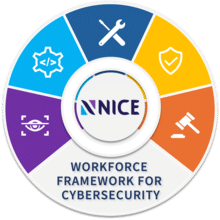
NIST’s NICE (National Initiative for Cybersecurity Education) Workforce Framework (NICE Framework) , known as NIST SP 800-181 rev. 1, has been designed for adaptability — particularly to account for emerging technologies like artificial intelligence (AI). Strong engagement with federal agencies, industry, academia, and international groups has ensured that NICE evolves with AI developments. NICE has hosted numerous events — from webinars to annual conferences — to explore AI’s impact on cybersecurity education, workforce needs, and program design.
2. AI Security as a New Competency Area
One major evolution includes the introduction of a new AI Security Competency Area within the NICE Framework. This area will define the core knowledge and skills needed to understand how AI intersects with cybersecurity — from managing risks to leveraging opportunities. The draft competency content is open for public comment and draws on resources such as the AI Risk Management Framework (AI RMF 1.0), the NSF AI Scholarships for Service initiative, and DoD’s Cyber Workforce Framework.
3. AI’s Role in Work Roles & Skills Integration
Beyond this standalone competency, NICE aims to integrate AI-related Tasks, Knowledge, and Skill (TKS) statements into existing and newly emerging cybersecurity job roles. This includes coverage for three essential themes: (a) strategic implications of AI for organizations and legal/regulatory considerations; (b) securing AI systems against threats including misuse; and (c) enhancing cybersecurity work through AI — such as using it for threat detection and analysis.
4. Community Engagement & Feedback Mechanisms
NIST encourages public participation in shaping the evolution of the NICE Framework. Stakeholders—including federal agencies, educators, certification bodies, and private-sector groups—are invited to join forums like the NICE Community Coordinating Council, attend events, join the NICE Framework Users Group, or provide direct feedback.
5. AI’s Dual Security Role in NIST Strategy
Another dimension of NIST’s AI-focused cybersecurity efforts focuses on both securing AI (making AI systems robust against threats) and enabling security through AI (using AI to strengthen defenses). Related initiatives include developing community profiles for adapting other cybersecurity frameworks (e.g., the Cybersecurity Framework), as well as launching research tools such as Dioptra and the PETs Testbed that support evaluation of machine learning and privacy technologies.
6. Broader Vision for AI & Cybersecurity Integration
NIST’s broader vision includes aligning its AI-cybersecurity initiatives with its existing guidance (e.g., AI RMF, SSDF, privacy frameworks) and expanding into practical, operational tools and community-driven resources. The goal is a cohesive, holistic approach that supports both the defense of AI systems and the incorporation of AI into cybersecurity across organizational, national, and international levels.
7. Summary
In essence, the NIST blog outlines how AI is reshaping the cybersecurity workforce—through new competency areas, an expanded skill taxonomy, and community-driven development of training and frameworks. NIST is at the forefront of this transformation, laying essential groundwork for organizations to adapt to AI-induced changes while safeguarding both AI and the systems it interacts with.
Engage proactively: If you’re in the cybersecurity field—especially in education, policy, workforce development, or hiring—stay involved. Submit feedback to NIST, participate in the NICE community forums, or attend their events to help shape AI-integrated workforce standards.
Upskill intentionally: Incorporate AI-related skills into your training or hiring programs. Target roles that require AI literacy—such as understanding AI risks, securing AI systems, or leveraging AI for defense.
Emphasize both “of” and “through” AI: Ensure your workforce is prepared not only to protect AI systems (security of AI) but also to harness AI as a tool for enhancing cybersecurity (security through AI).
Leverage NIST tools and frameworks: Explore resources like AI RMF, SSDF profiles for generative AI, Dioptra, and PETs Testbed to inform your practices, tool selection, and workflow integration.
AI systems should be developed using data sets that meet certain quality standards
Data Governance AI systems, especially high-risk ones, must rely on well-managed data throughout training, validation, and testing. This involves designing systems thoughtfully, knowing the source and purpose of collected data (especially personal data), properly processing data through labeling and cleaning, and verifying assumptions about what the data represents. It also requires ensuring there is enough high-quality data available, addressing harmful biases, and fixing any data issues that could hinder compliance with legal or ethical standards.
Quality of Data Sets The data sets used must accurately reflect the intended purpose of the AI system. They should be reliable, representative of the target population, statistically sound, and complete to ensure that outputs are both valid and trustworthy.
Consideration of Context AI developers must ensure data reflects the real-world environment where the system will be deployed. Context-specific features or variations should be factored in to avoid mismatches between test conditions and real-world performance.
Special Data Handling In rare cases, sensitive personal data may be used to identify and mitigate biases. However, this is only acceptable if no other alternative exists. When used, strict security and privacy safeguards must be applied, including controlled access, thorough documentation, prohibition of sharing, and mandatory deletion once the data is no longer needed. Justification for such use must always be recorded.
Non-Training AI Systems For AI systems that do not rely on training data, the requirements concerning data quality and handling mainly apply to testing data. This ensures that even rule-based or symbolic AI models are evaluated using appropriate and reliable test sets.
Organizations building or deploying AI should treat data management as a cornerstone of trustworthy AI. Strong governance frameworks, bias monitoring, and contextual awareness ensure systems are fair, reliable, and compliant. For most companies, aligning with standards like ISO/IEC 42001 (AI management) and ISO/IEC 27001 (security) can help establish structured practices. My recommendation: develop a data governance playbook early, incorporate bias detection and context validation into the AI lifecycle, and document every decision for accountability. This not only ensures regulatory compliance but also builds user trust.
Here’s a clause-by-clause rephrased summary of ISO 27001 (from your document) with my final advice on certification at the end:
ISO 27001: A Clause-by-Clause Guide to Building Trust in Security
Breaking Down ISO 27001 — What Every Business Leader Should Know
From Context to Controls: Simplifying ISO 27001 Requirements
ISO 27001 Made Simple: Clause-by-Clause Summary and Insights
Turning ISO 27001 Into Strategy: A Practical Breakdown
Clause 4 – Context of the Organization
Organizations must understand internal and external factors that affect security, identify interested parties (customers, regulators, partners) and their expectations, and define the scope of their Information Security Management System (ISMS). The ISMS must be established, documented, and continually improved.
Clause 5 – Leadership
Top management must actively support and commit to the ISMS. They ensure policies align with business strategy, provide resources, assign roles and responsibilities, and promote awareness across the organization. Leadership must also set and maintain a clear information security policy available to employees and stakeholders.
Clause 6 – Planning
This clause covers risk management and objectives. Organizations must assess risks and opportunities, establish risk criteria, conduct regular risk assessments, and plan treatments using controls (including Annex A). They must define measurable information security objectives, assign accountability, allocate resources, and plan ISMS changes in a structured way.
Clause 7 – Support
Support relates to resources, competence, awareness, communication, and documentation. The organization must ensure trained staff, awareness of security responsibilities, proper communication channels, and documented processes. All relevant ISMS information must be created, controlled, updated, and protected against misuse or loss.
Clause 8 – Operation
Operations require planning, execution, and monitoring of ISMS activities. Organizations must perform risk assessments and risk treatments at regular intervals, control outsourced processes, and ensure documentation exists to prove risks are being handled effectively. They must also adapt operations to planned or unexpected changes.
Clause 9 – Performance Evaluation
This involves measuring, monitoring, analyzing, and evaluating ISMS performance. Organizations must track how well policies, objectives, and controls work. Internal audits should be performed regularly by independent auditors, with corrective actions tracked. Management reviews must ensure the ISMS remains aligned with strategy and continues to deliver results.
Clause 10 – Improvement
Organizations must drive continual improvement in their ISMS. Nonconformities and incidents should trigger corrective actions that address root causes. Effectiveness of corrective actions must be measured, documented, and embedded in updated processes to prevent recurrence. Continuous improvement ensures resilience against evolving threats.
Annex A – Controls
Annex A lists 93 controls across four areas: organizational (policies, asset management, suppliers, incident response, compliance), people (training, awareness, HR security), physical (facilities, equipment protection), and technology (cryptography, malware defenses, secure development, network controls, logging, and monitoring).
My Advice on ISO 27001 Certification
ISO 27001 certification is far more than a compliance exercise — it demonstrates to customers, regulators, and partners that you manage information security risks systematically. By aligning leadership, planning, operations, and continual improvement, certification strengthens trust, reduces breach likelihood, and enhances business reputation. While achieving certification requires investment in people, processes, and documentation, the long-term benefits — credibility, reduced risks, and competitive advantage — far outweigh the costs. For most organizations handling sensitive data, pursuing ISO 27001 certification is not optional; it is a strategic necessity.
Continual improvement doesn’t necessarily entail significant expenses. Many enhancements can be achieved through regular internal audits, management reviews, and staff engagement. By fostering a culture of continuous improvement, organizations can maintain an ISMS that effectively addresses current and emerging information security risks, ensuring resilience and compliance with ISO 27001 standards.
At DISC InfoSec, we streamline the entire process—guiding you confidently through complex frameworks such as ISO 27001, and SOC 2.
Here’s how we help:
Conduct gap assessments to identify compliance challenges and control maturity
Deliver straightforward, practical steps for remediation with assigned responsibility
Ensure ongoing guidance to support continued compliance with standard
Confirm your security posture through risk assessments and penetration testing
Let’s set up a quick call to explore how we can make your cybersecurity compliance process easier.
ISO 27001 certification validates that your ISMS meets recognized security standards and builds trust with customers by demonstrating a strong commitment to protecting information.
Feel free to get in touch if you have any questions about the ISO 27001 Internal audit or certification process.
Successfully completing your ISO 27001 audit confirms that your Information Security Management System (ISMS) meets the required standards and assures your customers of your commitment to security.
Get in touch with us to begin your ISO 27001 audit today.
Cybersecurity is no longer confined to the IT department — it has become a fundamental issue of business survival. The past year has shown that security failures don’t just disrupt operations; they directly impact reputation, financial stability, and customer trust. Organizations that continue to treat it as a back-office function risk being left exposed.
Over the last twelve months, we’ve seen high-profile companies fined millions of dollars for data breaches. These penalties demonstrate that regulators and customers alike are holding businesses accountable for their ability to protect sensitive information. The cost of non-compliance now goes far beyond the technical cleanup — it threatens long-term credibility.
Another worrying trend has been the exploitation of supply chain partners. Attackers increasingly target smaller vendors with weaker defenses to gain access to larger organizations. This highlights that cybersecurity is no longer contained within one company’s walls; it is interconnected, making vendor oversight and third-party risk management critical.
Adding to the challenge is the rapid adoption of artificial intelligence. While AI brings efficiency and innovation, it also introduces untested and often misunderstood risks. From data poisoning to model manipulation, organizations are entering unfamiliar territory, and traditional controls don’t always apply.
Despite these evolving threats, many businesses continue to frame the wrong question: “Do we need certification?” While certification has its value, it misses the bigger picture. The right question is: “How do we protect our data, our clients, and our reputation — and demonstrate that commitment clearly?” This shift in perspective is essential to building a sustainable security culture.
This is where frameworks such as ISO 27001, ISO 27701, and ISO 42001 play a vital role. They are not merely compliance checklists; they provide structured, internationally recognized approaches for managing security, privacy, and AI governance. Implemented correctly, these frameworks become powerful tools to build customer trust and show measurable accountability.
Every organization faces its own barriers in advancing security and compliance. For some, it’s budget constraints; for others, it’s lack of leadership buy-in or a shortage of skilled professionals. Recognizing and addressing these obstacles early is key to moving forward. Without tackling them, even the best frameworks will sit unused, failing to provide real protection.
My advice: Stop viewing cybersecurity as a cost center or certification exercise. Instead, approach it as a business enabler — one that safeguards reputation, strengthens client relationships, and opens doors to new opportunities. Begin by identifying your organization’s greatest barrier, then create a roadmap that aligns frameworks with business goals. When leadership sees cybersecurity as an investment in trust, adoption becomes much easier and far more impactful.
Continual improvement doesn’t necessarily entail significant expenses. Many enhancements can be achieved through regular internal audits, management reviews, and staff engagement. By fostering a culture of continuous improvement, organizations can maintain an ISMS that effectively addresses current and emerging information security risks, ensuring resilience and compliance with ISO 27001 standards.
At DISC InfoSec, we streamline the entire process—guiding you confidently through complex frameworks such as ISO 27001, and SOC 2.
Here’s how we help:
Conduct gap assessments to identify compliance challenges and control maturity
Deliver straightforward, practical steps for remediation with assigned responsibility
Ensure ongoing guidance to support continued compliance with standard
Confirm your security posture through risk assessments and penetration testing
Let’s set up a quick call to explore how we can make your cybersecurity compliance process easier.
ISO 27001 certification validates that your ISMS meets recognized security standards and builds trust with customers by demonstrating a strong commitment to protecting information.
Feel free to get in touch if you have any questions about the ISO 27001, ISO 42001, ISO 27701 Internal audit or certification process.
Successfully completing your ISO 27001 audit confirms that your Information Security Management System (ISMS) meets the required standards and assures your customers of your commitment to security.
Get in touch with us to begin your ISO 27001 audit today.
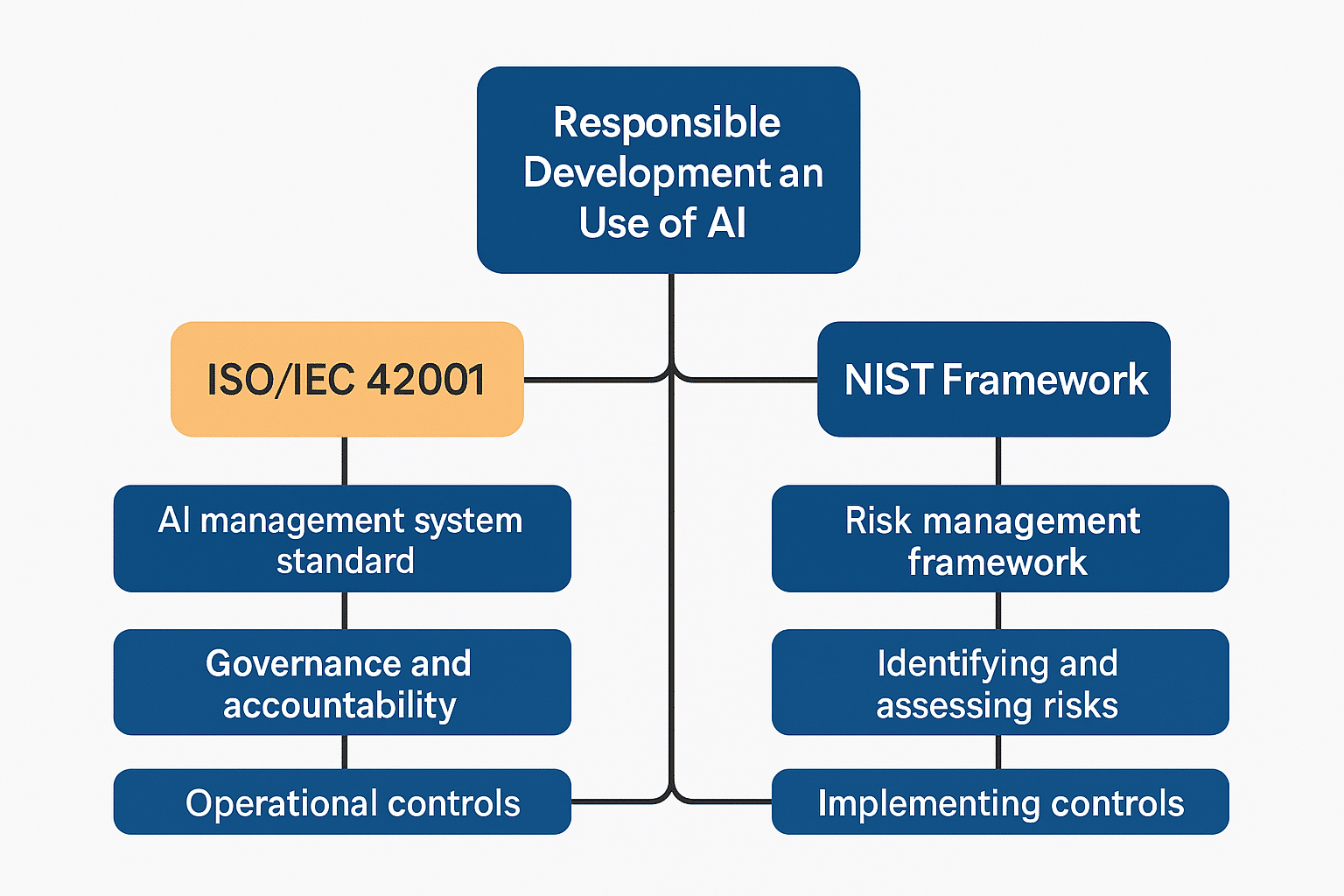
The ISO/IEC 42001 standard and the NIST AI Risk Management Framework (AI RMF) are two cornerstone tools for businesses aiming to ensure the responsible development and use of AI. While they differ in structure and origin, they complement each other beautifully. Here’s a breakdown of how each contributes—and how they align.
🧭 ISO/IEC 42001: AI Management System Standard
Purpose: Establishes a formal AI Management System (AIMS) across the organization, similar to ISO 27001 for information security.
🔧 Key Components
Leadership & Governance: Requires executive commitment and clear accountability for AI risks.
Policy & Planning: Organizations must define AI objectives, ethical principles, and risk tolerance.
Operational Controls: Covers data governance, model lifecycle management, and supplier oversight.
Monitoring & Improvement: Includes performance evaluation, impact assessments, and continuous improvement loops.
✅ Benefits
Embeds responsibility and accountability into every phase of AI development.
Supports legal compliance with regulations like the EU AI Act and GDPR.
Enables certification, signaling trustworthiness to clients and regulators.
🧠 NIST AI Risk Management Framework (AI RMF)
Purpose: Provides a flexible, voluntary framework for identifying, assessing, and managing AI risks.
🧩 Core Functions
Function
Description
Govern
Establish organizational policies and accountability for AI risks
Map
Understand the context, purpose, and stakeholders of AI systems
Measure
Evaluate risks, including bias, robustness, and explainability
Manage
Implement controls and monitor performance over time
✅ Benefits
Promotes trustworthy AI through transparency, fairness, and safety.
Helps organizations operationalize ethical principles without requiring certification.
Adaptable across industries and AI maturity levels.
🔗 How They Work Together
ISO/IEC 42001
NIST AI RMF
Formal, certifiable management system
Flexible, voluntary risk management framework
Focus on organizational governance
Focus on system-level risk controls
PDCA cycle for continuous improvement
Iterative risk assessment and mitigation
Strong alignment with EU AI Act compliance
Strong alignment with U.S. Executive Order on AI
Together, they offer a dual lens:
ISO 42001 ensures enterprise-wide governance and accountability.
NIST AI RMF ensures system-level risk awareness and mitigation.
visual comparison chart or a mind map to show how these frameworks align with the EU AI Act or sector-specific obligations.
mind map comparing ISO/IEC 42001 and the NIST AI RMF for responsible AI development and use:
This visual lays out the complementary roles of each framework:
ISO/IEC 42001 focuses on building an enterprise-wide AI management system with governance, accountability, and operational controls.
NIST AI RMF zeroes in on system-level risk identification, assessment, and mitigation.
The EU AI Act introduces a layered regulatory framework that significantly affects stakeholders in the autonomous driving ecosystem. Because autonomous vehicles (AVs) rely heavily on high-risk AI systems—such as perception, decision-making, and navigation—their regulation is both sector-specific and cross-cutting. Here’s a structured analysis tailored to your compliance-oriented lens:
🚗 Autonomous Driving: Stakeholder Impact Analysis
1. Automotive Manufacturers
Obligations:
Must ensure AI systems embedded in AVs meet high-risk requirements under the AI Act.
Required to conduct conformity assessments and maintain technical documentation.
Must align with both the AI Act and sectoral legislation like the Type-Approval Framework Regulation (EU 2018/858).
Risks:
High compliance costs and technical complexity, especially for explainability and real-time monitoring.
Exposure to fines up to €35 million or 7% of global turnover for non-compliance.
Opportunities:
Regulatory alignment can enhance consumer trust and market access.
Participation in AI regulatory sandboxes may accelerate innovation.
2. AI System Developers (Perception, Planning, Control Modules)
Obligations:
Must classify systems by risk level and ensure robustness, safety, and transparency.
Required to implement post-market monitoring and incident reporting.
Risks:
Difficulty in making complex models explainable (e.g., deep neural networks for object detection).
Liability for system failures or biased decision-making.
Opportunities:
Demand for modular, certifiable AI components.
Competitive edge through compliance-ready architectures.
3. Regulators & Market Surveillance Authorities
Obligations:
Must oversee conformity assessments and enforce compliance across borders.
Required to coordinate with sectoral regulators (e.g., UNECE, national transport authorities).
Risks:
Fragmentation between AI Act and existing automotive regulations.
Resource strain due to technical complexity and volume of AV deployments.
Opportunities:
Development of harmonized standards and certification pathways.
Use of regulatory sandboxes to test and refine oversight mechanisms.
Must ensure deployed AVs comply with AI Act and sectoral safety standards.
Required to inform users about AI-driven decisions and ensure human oversight where applicable.
Risks:
Operational liability for accidents or system failures.
Public backlash if transparency and safety are lacking.
Opportunities:
Ethical AV deployment can differentiate services and attract public support.
Data-driven optimization of routes and maintenance.
5. Consumers / Road Users
Rights:
Right to safety, transparency, and redress in case of harm.
Protection from opaque or discriminatory AI decisions.
Risks:
Potential for accidents due to system errors or edge-case failures.
Privacy concerns from data collected by AVs (e.g., location, biometrics).
Opportunities:
Safer, more accessible mobility options.
Reduced human error and traffic fatalities.
🧭 Strategic Takeaway
The AI Act doesn’t operate in isolation—it intersects with existing automotive regulations, creating a hybrid compliance landscape. Stakeholders must navigate:
Data protection laws (e.g., GDPR for connected vehicle data)
Starting with a stakeholder matrix to map out responsibilities, risks, and opportunities, followed by a compliance roadmap tailored to autonomous vehicle (AV) deployment under the EU AI Act. This dual approach gives you both a strategic overview and an operational guide.
🚦 Autonomous Driving Stakeholder Matrix (EU AI Act)
Stakeholder
Responsibilities
Risks
Opportunities
Automotive OEMs
Ensure AI systems in AVs meet high-risk requirements; conduct conformity assessments
Liability for system failures; high compliance costs
Market leadership through ethical, compliant AVs
AI System Developers
Build explainable, robust, and traceable AI modules (e.g., perception, planning)
Technical complexity; explainability of deep learning models
Demand for modular, certifiable AI components
Fleet Operators / MaaS
Deploy compliant AVs; ensure user transparency and oversight
Great prompt, Hugh. The Fundamental Rights Impact Assessment (FRIA) under Article 27 of the EU AI Act is a powerful tool for identifying and protecting the rights of individuals affected by high-risk AI systems. Here’s how it works and what rights it safeguards:
🛡️ Key Rights Protected by the EU AI Act via FRIA
When conducting a FRIA, deployers must assess how an AI system could impact the following fundamental rights:
Right to human dignity Ensures AI systems do not dehumanize or degrade individuals.
Right to non-discrimination Protects against algorithmic bias based on race, gender, age, disability, etc.
Right to privacy and data protection Evaluates how personal data is used, stored, and protected.
Freedom of expression and information Ensures AI does not suppress speech or manipulate access to information.
Right to good administration Guarantees fair, transparent, and accountable decision-making by public bodies using AI.
Access to justice and remedies Individuals must be able to challenge decisions made by AI systems and seek redress.
🧾 What a FRIA Must Include
Deployers of high-risk AI systems (especially public bodies or private entities providing public services) must document:
Purpose and context of AI use
Groups likely to be affected
Specific risks of harm to those groups
Human oversight measures
Mitigation steps if risks materialize
Governance and complaint mechanisms
This assessment must be completed before first use and updated as needed. Results are reported to the market surveillance authority, and the EU AI Office will provide a standardized template.
🧭 Why It Matters
The FRIA isn’t just paperwork—it’s a safeguard against invisible harms. It forces organizations to think critically about how their AI systems might infringe on rights and to build in protections from the start. It’s a shift from reactive to proactive governance.
If you’d like, I can walk you through a mock FRIA for a specific AI use case—say, facial recognition in public spaces or automated hiring tools. Just name the scenario.
Walk through a realistic scenario to interpret how the EU AI Act’s ethical guidelines would apply in practice.
🏥 Scenario: Deploying an AI System in a European Hospital
A hospital in Germany wants to deploy an AI system to assist doctors in diagnosing rare diseases based on patient data and medical imaging.
🧭 Applying the EU AI Act Guidelines
1. Risk Classification
The system is considered high-risk under the EU AI Act because it affects health outcomes and involves biometric data.
Therefore, it must meet strict requirements for transparency, robustness, and human oversight.
2. Ethical Deployment Requirements
Principle
Application in Scenario
Human Autonomy
Doctors retain final decision-making authority. AI provides recommendations, not verdicts.
Prevention of Harm
The system undergoes rigorous testing to avoid misdiagnosis. Fail-safes are built in.
Fairness & Non-Bias
Training data is audited to ensure diverse representation across age, gender, ethnicity.
Transparency
The hospital provides clear documentation on how the AI works and its limitations.
Explicability
Doctors can access explanations for each AI-generated diagnosis.
Accountability
The hospital sets up a governance board to monitor AI performance and handle complaints.
3. Compliance Measures
Data Governance: Patient data is anonymized and processed in line with GDPR.
Impact Assessment: A conformity assessment is conducted before deployment.
Monitoring & Reporting: The hospital commits to reporting serious incidents to the AI Office.
Stakeholder Engagement: Patients are informed and can opt out of AI-assisted diagnosis.
✅ Outcome
By following these steps, the hospital ensures that its AI system is ethically deployed, legally compliant, and trustworthy—aligning with the EU’s vision for responsible AI.
Explore how the EU AI Act’s ethical guidelines would apply in a real-world education scenario.
🎓 Scenario: AI-Powered Learning Analytics in a European Secondary School
A secondary school in France wants to use an AI system that analyzes student performance data to identify those at risk of falling behind and recommend personalized learning paths.
🧭 Applying the EU AI Act in Education
1. Risk Classification
This system is considered high-risk under the EU AI Act because it influences students’ access to educational opportunities and involves sensitive personal data.
Emotion-recognition features (e.g., analyzing facial expressions to gauge engagement) would be prohibited as they fall under the “unacceptable risk” category.
2. Ethical Deployment Requirements
Principle
How It Applies in the School Setting
Human Autonomy
Teachers make final decisions; AI offers insights, not mandates.
Fairness & Non-Bias
The system is trained on diverse datasets to avoid bias based on race, gender, or SES.
Transparency
Students and parents are informed about how the AI works and what data it uses.
Privacy Protection
Data is anonymized and processed in line with GDPR.
Accountability
The school designates a responsible staff member to oversee AI performance and ethics.
Explicability
Teachers can access clear explanations for each AI-generated recommendation.
3. Compliance Measures
Documentation: The school maintains records of the AI system’s design, training data, and risk assessments.
Monitoring: Regular audits are conducted to ensure the system remains fair and accurate.
Stakeholder Engagement: Students and parents can opt out and provide feedback on the system’s impact.
✅ Outcome
By following the EU AI Act’s guidelines, the school ensures that its AI system supports learning ethically, transparently, and safely—while respecting students’ rights and dignity.
University-level scenario or explore how AI affects teacher evaluations.
Dive into a university-level scenario to see how the EU AI Act’s ethical guidelines shape the deployment of AI in higher education.
🎓 Scenario: AI-Based Admissions System at a European University
A university in the Netherlands wants to implement an AI system to help evaluate student applications for competitive graduate programs. The system analyzes academic records, recommendation letters, and personal statements to rank candidates.
🧭 Applying the EU AI Act in Higher Education
1. Risk Classification
This system is classified as high-risk under the EU AI Act because it significantly affects access to education and future opportunities.
It must comply with strict requirements around transparency, fairness, human oversight, and data governance.
2. Ethical Deployment Requirements
Principle
Application in University Admissions
Human Autonomy
Admissions officers retain final decision-making authority. AI provides rankings, not verdicts.
Fairness & Non-Bias
The system is trained on diverse, representative data to avoid bias based on gender, ethnicity, or socioeconomic status.
Transparency
Applicants are informed that AI is used and can request explanations of how decisions are made.
Privacy Protection
Personal data is processed in line with GDPR, with strict access controls and anonymization.
Accountability
The university appoints an AI ethics officer to monitor system performance and handle appeals.
Explicability
Admissions staff can access clear, interpretable explanations for each AI-generated recommendation.
3. Additional EU AI Act Provisions
Article 4: Requires that staff using the AI system receive training to ensure adequate AI literacy.
Recital 56: Encourages AI deployment that promotes high-quality digital education and critical thinking.
Emotion Recognition Ban: Any attempt to use emotion inference (e.g., analyzing facial expressions in video interviews) would be prohibited as an “unacceptable risk”.
✅ Outcome
By following the EU AI Act, the university ensures its admissions system is fair, transparent, and legally compliant, while respecting applicants’ rights and promoting trust in the process.
Explore how universities can use AI for personalized learning or student support next.
EU AI Act’s ethical guidelines apply to a university scenario focused on personalized learning and student support.
🧑🎓 Scenario: AI-Powered Student Support System at a European University
A university in Spain deploys an AI system to monitor student engagement, predict academic risk, and recommend personalized resources—like tutoring, mental health services, or study groups.
🧭 EU AI Act Interpretation in This Context
1. Risk Classification
This system is considered high-risk because it influences students’ access to support services and may impact academic outcomes.
If it includes emotion recognition (e.g., analyzing facial expressions or voice tone), that feature is prohibited under the Act’s “unacceptable risk” category.
2. Ethical Deployment Requirements
Principle
Application in Student Support AI
Human Autonomy
Advisors and counselors retain control; AI offers suggestions, not decisions.
Fairness & Non-Bias
Algorithms are trained on diverse data to avoid disadvantaging marginalized groups.
Transparency
Students are informed about how the system works and what data it uses.
Privacy Protection
All personal data is anonymized and processed in compliance with GDPR.
Explicability
Staff can interpret why the AI flagged a student as needing support.
Accountability
The university sets up a governance board to audit system performance and ethics.
3. Additional EU AI Act Provisions
Article 4: Requires universities to ensure staff are trained in AI literacy, so they can use and supervise the system responsibly.
Recital 56: Encourages AI systems that promote high-quality digital education and empower students with critical thinking and media literacy.
✅ Outcome
By aligning with the EU AI Act, the university ensures its AI system enhances student well-being and academic success—while safeguarding rights, promoting fairness, and building trust.
The EU AI Act is the European Union’s landmark regulation designed to create a legal framework for the development, deployment, and use of artificial intelligence across the EU. Its primary objectives can be summed up as follows:
Protect Fundamental Rights and Safety
Ensure AI systems do not undermine fundamental rights guaranteed by the EU Charter (privacy, non-discrimination, dignity, etc.) or compromise the health and safety of individuals.
Promote Trustworthy AI
Establish standards so AI systems are transparent, explainable, and accountable, which is key to building public trust in AI adoption.
Risk-Based Regulation
Introduce a tiered approach:
Unacceptable risk: Prohibit AI uses that pose clear threats (e.g., social scoring by governments, manipulative systems).
High risk: Strict obligations for AI in sensitive areas like healthcare, finance, employment, and law enforcement.
Limited/minimal risk: Light or no regulatory requirements.
Harmonize AI Rules Across the EU
Create a uniform framework that avoids fragmented national laws, ensuring legal certainty for businesses operating in multiple EU countries.
Foster Innovation and Competitiveness
Encourage AI innovation by providing clear rules and setting up “regulatory sandboxes” where businesses can test AI in a supervised, low-risk environment.
Ensure Transparency for Users
Require disclosure when people interact with AI (e.g., chatbots, deepfakes) so users know they are dealing with a machine.
Strengthen Governance and Oversight
Establish national supervisory authorities and an EU-level AI Office to monitor compliance, enforce rules, and coordinate among Member States.
Address Bias and Discrimination
Mandate quality datasets, documentation, and testing to reduce harmful bias in AI systems, particularly in areas affecting citizens’ rights and opportunities.
Guarantee Robustness and Cybersecurity
Require that AI systems are secure, resilient against attacks or misuse, and perform reliably across their lifecycle.
Global Standard Setting
Position the EU as a leader in setting international norms for AI regulation, influencing global markets the way GDPR did for privacy.
understand the scope of the AI Act.
To understand the scope of the EU AI Act, it helps to break it down into who and what it applies to, and how risk determines obligations. Here’s a clear guide:
1. Who it Applies To
Providers: Anyone (companies, developers, public bodies) placing AI systems on the EU market, regardless of where they are based.
Deployers/Users: Organizations or individuals using AI within the EU.
Importers & Distributors: Those selling or distributing AI systems in the EU.
➡️ Even if a company is outside the EU, the Act applies if their AI systems are used in the EU.
2. What Counts as AI
The Act uses a broad definition of AI (based on OECD/Commission standards).
Includes machine learning, rule-based, statistical, and generative AI models.
3. Risk-Based Approach
The scope is defined by categorizing AI uses into risk levels:
Unacceptable Risk (Prohibited)
Social scoring, manipulative techniques, real-time biometric surveillance in public (with limited exceptions).
High Risk (Strictly Regulated)
AI in sensitive areas like:
healthcare (diagnostics, medical devices),
employment (CV screening),
education (exam scoring),
law enforcement and migration,
critical infrastructure (transport, energy).
Limited Risk (Transparency Requirements)
Chatbots, deepfakes, emotion recognition—users must be informed they are interacting with AI.
Minimal Risk (Largely Unregulated)
AI in spam filters, video games, recommendation engines—free to operate with voluntary best practices.
4. Exemptions
AI used for military and national security is outside the Act’s scope.
Systems used solely for research and prototyping are exempt until they are placed on the market.
5. Key Takeaway on Scope
The EU AI Act is horizontal (applies across sectors) but graduated (the rules depend on risk).
If you are a provider, you need to check whether your system falls into a prohibited, high, limited, or minimal category.
If you are a user, you need to know what obligations apply when deploying AI (especially if it’s high-risk).
👉 In short: The scope of the EU AI Act is broad, extraterritorial, and risk-based. It applies to almost anyone building, selling, or using AI in the EU, but the depth of obligations depends on how risky the AI application is considered.
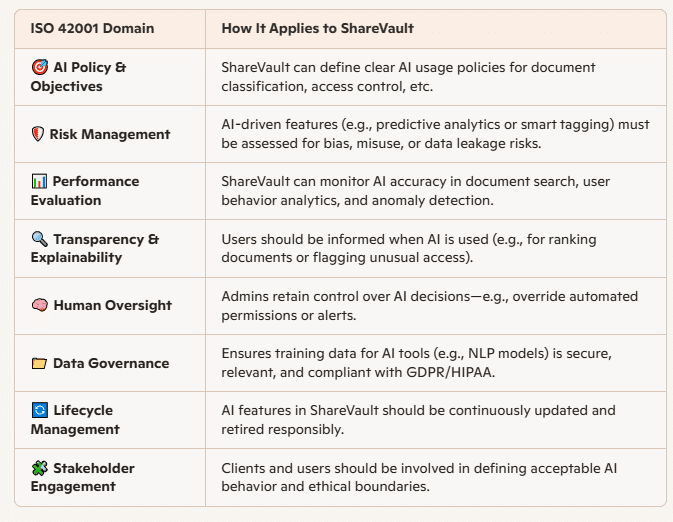
Regulatory Alignment: ISO 42001 supports GDPR, HIPAA, and EU AI Act compliance.
Client Trust: Demonstrates responsible AI governance to enterprise clients.
Competitive Edge: Positions ShareVault as a forward-thinking, standards-compliant VDR provider.
Audit Readiness: Facilitates internal and external audits of AI systems and data handling.
If ShareVault were to pursue ISO 42001 certification, it would not only strengthen its AI governance but also reinforce its reputation in regulated industries like life sciences, finance, and legal services.
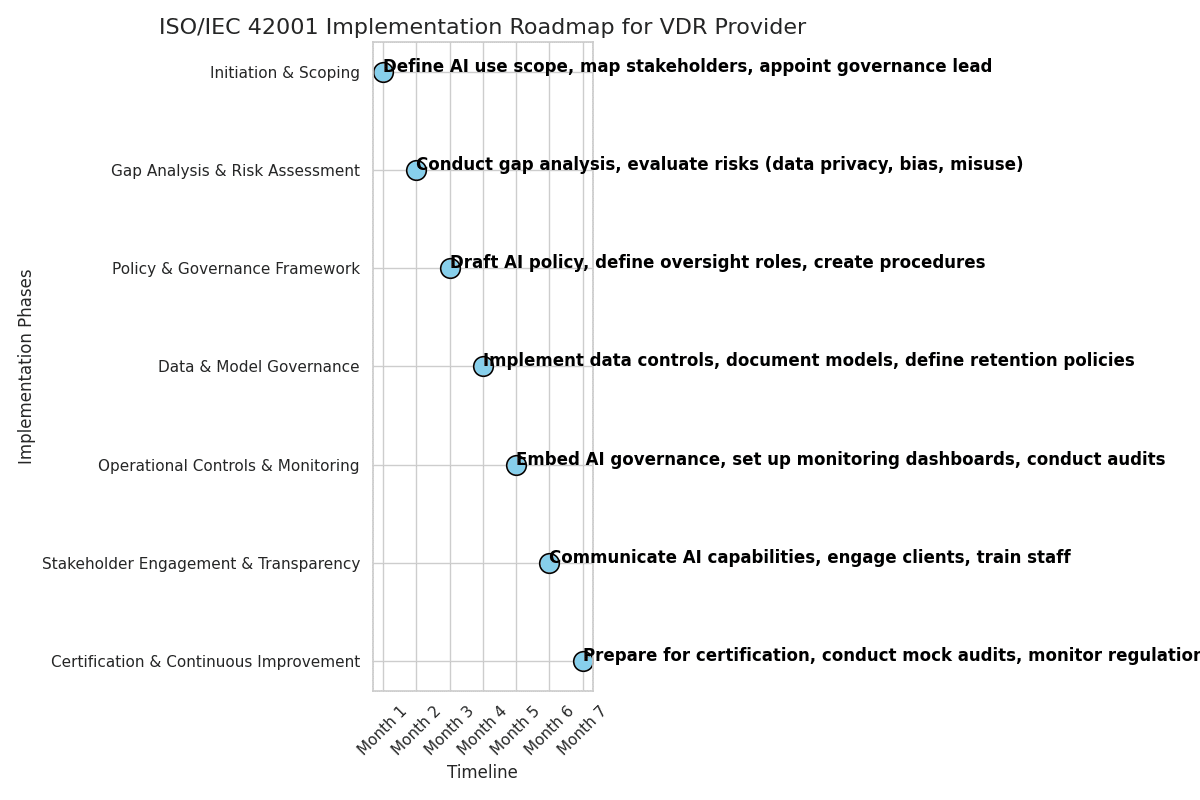
Here’s a tailored ISO/IEC 42001 implementation roadmap for a Virtual Data Room (VDR) provider like ShareVault, focusing on responsible AI governance, risk mitigation, and regulatory alignment.
🗺️ ISO/IEC 42001 Implementation Roadmap for ShareVault
Phase 1: Initiation & Scoping
🔹 Objective: Define the scope of AI use and align with business goals.
Identify AI-powered features (e.g., smart search, document tagging, access analytics).
These are AI practices banned outright because they pose a clear threat to safety, rights, or democracy. Examples:
Social scoring by governments (like assigning citizens a “trust score”).
Real-time biometric identification in public spaces for mass surveillance (with narrow exceptions like serious crime).
Manipulative AI that exploits vulnerabilities (e.g., toys with voice assistants that encourage dangerous behavior in kids).
👉 If your system falls here → cannot be marketed or used in the EU.
🔹 2. High Risk
These are AI systems with significant impact on people’s rights, safety, or livelihoods. They are allowed but subject to strict compliance (risk management, testing, transparency, human oversight, etc.). Examples:
AI in recruitment (CV screening, job interview analysis).
Credit scoring or AI used for approving loans.
Medical AI (diagnosis, treatment recommendations).
AI in critical infrastructure (electricity grid management, transport safety systems).
AI in education (grading, admissions decisions).
👉 If your system is high-risk → must undergo conformity assessment and registration before use.
🔹 3. Limited Risk
These require transparency obligations, but not full compliance like high-risk systems. Examples:
Chatbots (users must know they’re talking to AI, not a human).
AI systems generating deepfakes (must disclose synthetic nature unless for law enforcement/artistic/expressive purposes).
Emotion recognition systems in non-high-risk contexts.
👉 If limited risk → inform users clearly, but lighter obligations.
🔹 4. Minimal or No Risk
The majority of AI applications fall here. They’re largely unregulated beyond general EU laws. Examples:
Spam filters.
AI-powered video games.
Recommendation systems for e-commerce or music streaming.
AI-driven email autocomplete.
👉 If minimal/no risk → free use with no extra requirements.
⚖️ Rule of Thumb for Classification:
If it manipulates or surveils → often unacceptable risk.
If it affects health, jobs, education, finance, safety, or fundamental rights → high risk.
If it interacts with humans but without major consequences → limited risk.
If it’s just convenience or productivity-related → minimal/no risk.
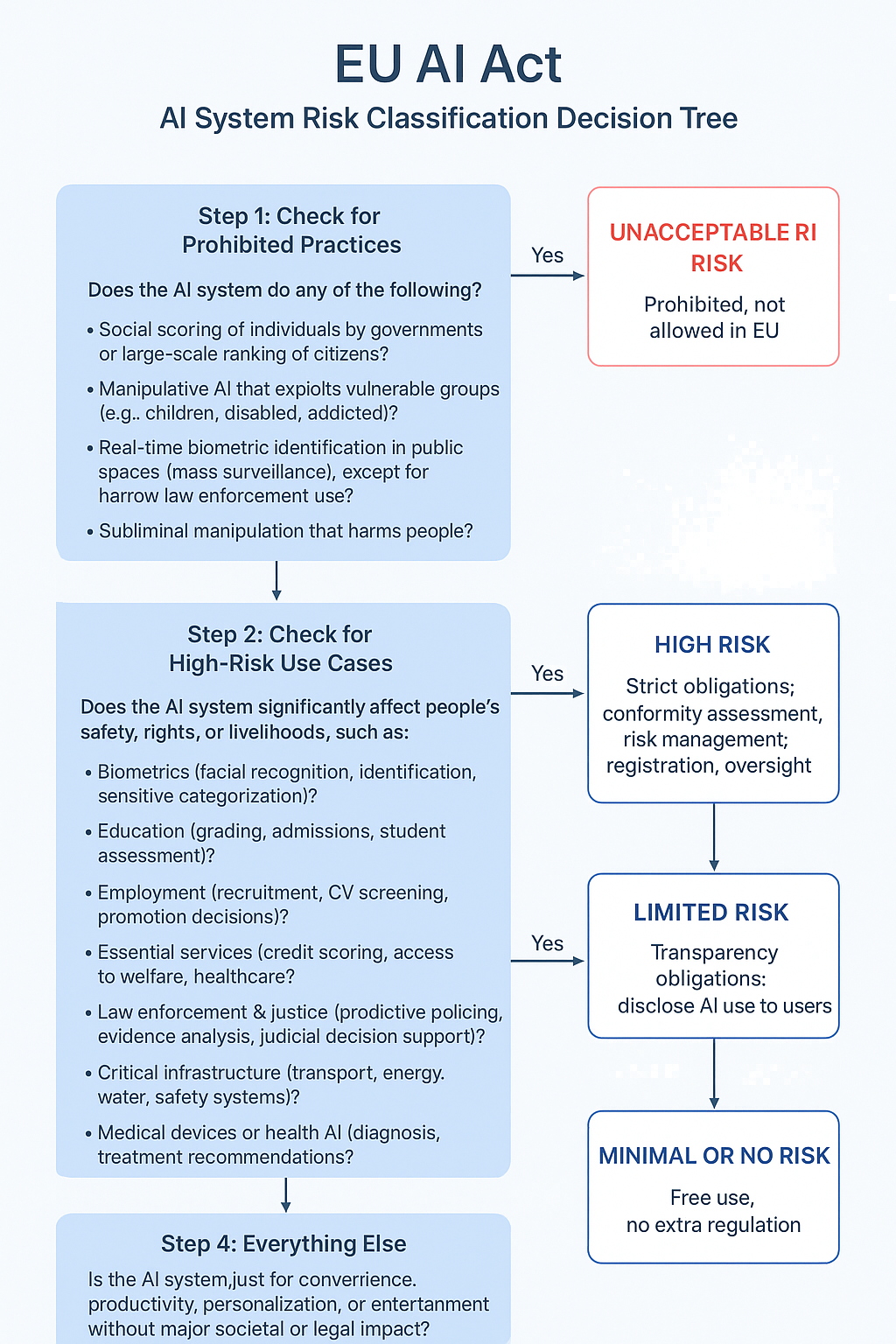
A decision tree you can use to classify any AI system under the EU AI Act risk framework:
🧭 EU AI Act AI System Risk Classification Decision Tree
Step 1: Check for Prohibited Practices
👉 Does the AI system do any of the following?
Social scoring of individuals by governments or large-scale ranking of citizens?
Manipulative AI that exploits vulnerable groups (e.g., children, disabled, addicted)?
Real-time biometric identification in public spaces (mass surveillance), except for narrow law enforcement use?
Subliminal manipulation that harms people?
✅ Yes → UNACCEPTABLE RISK (Prohibited, not allowed in EU). ❌ No → go to Step 2.
Step 2: Check for High-Risk Use Cases
👉 Does the AI system significantly affect people’s safety, rights, or livelihoods, such as:
The OWASP AI Maturity Assessment provides organizations with a structured way to evaluate how mature their practices are in managing the security, governance, and ethical use of AI systems. Its scope goes beyond technical safeguards, emphasizing a holistic approach that covers people, processes, and technology.
2. Core Maturity Domains
The framework divides maturity into several domains: governance, risk management, security, compliance, and operations. Each domain contains clear criteria that organizations can use to assess themselves and identify both strengths and weaknesses in their AI security posture.
3. Governance and Oversight
A strong governance foundation is highlighted as essential. This includes defining roles, responsibilities, and accountability structures for AI use, ensuring executive alignment, and embedding oversight into organizational culture. Without governance, technical controls alone are insufficient.
4. Risk Management Integration
Risk management is emphasized as an ongoing process that must be integrated into AI lifecycles. This means continuously identifying, assessing, and mitigating risks associated with data, algorithms, and models, while also accounting for evolving threats and regulatory changes.
5. Security and Technical Controls
Security forms a major part of the maturity model. It stresses the importance of secure coding, model hardening, adversarial resilience, and robust data protection. Secure development pipelines and automated monitoring of AI behavior are seen as crucial for preventing exploitation.
6. Compliance and Ethical Considerations
The assessment underscores regulatory alignment and ethical responsibilities. Organizations are expected to demonstrate compliance with applicable laws and standards while ensuring fairness, transparency, and accountability in AI outcomes. This dual lens of compliance and ethics sets the framework apart.
7. Operational Excellence
Operational maturity is measured by how well organizations integrate AI governance into day-to-day practices. This includes ongoing monitoring of deployed AI systems, clear incident response procedures for AI failures or misuse, and mechanisms for continuous improvement.
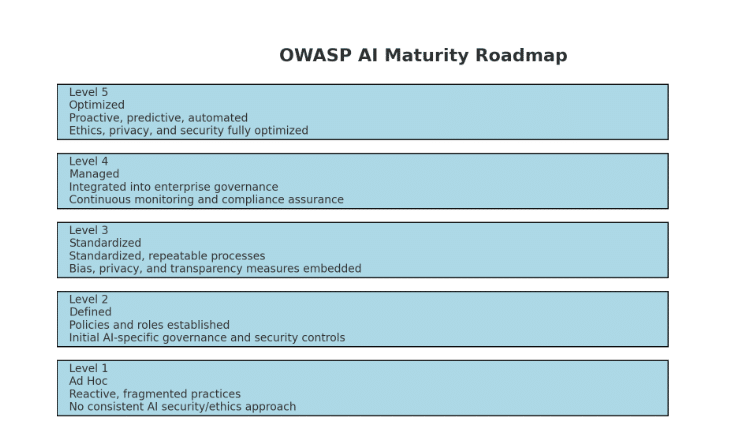
8. Maturity Levels
The framework uses levels of maturity (from ad hoc practices to fully optimized processes) to help organizations benchmark themselves. Moving up the levels involves progress from reactive, fragmented practices to proactive, standardized, and continuously improving capabilities.
9. Practical Assessment Method
The assessment is designed to be practical and repeatable. Organizations can self-assess or engage third parties to evaluate maturity against OWASP criteria. The output is a roadmap highlighting gaps, recommended improvements, and prioritized actions based on risk appetite.
10. Value for Organizations
Ultimately, the OWASP AI Maturity Assessment enables organizations to transform AI adoption from a risky endeavor into a controlled, strategic advantage. By balancing governance, security, compliance, and ethics, it gives organizations confidence in deploying AI responsibly at scale.
My Opinion
The OWASP AI Maturity Assessment stands out as a much-needed framework in today’s AI-driven world. Its strength lies in combining technical security with governance and ethics, ensuring organizations don’t just “secure AI” but also use it responsibly. The maturity levels provide clear benchmarks, making it actionable rather than purely theoretical. In my view, this framework can be a powerful tool for CISOs, compliance leaders, and AI product managers who need to align innovation with trust and accountability.
visual roadmap of the OWASP AI Maturity levels (1–5), showing the progression from ad hoc practices to fully optimized, proactive, and automated AI governance and security.
At the AI4 2025 conference in Las Vegas, Geoffrey Hinton—renowned as the “Godfather of AI” and a Nobel Prize winner—issued a powerful warning about the trajectory of artificial intelligence. Speaking to an audience of over 8,000 tech leaders, researchers, and policymakers, Hinton emphasized that while AI’s capabilities are expanding rapidly, we’re lacking the global coordination needed to manage it safely.
2. The Rise of Fragmented Intelligence
Hinton highlighted how AI is being deployed across diverse sectors—healthcare, transportation, finance, and military systems. Each application grows more autonomous, yet most are developed in isolation. This fragmented evolution, he argued, increases the risk of incompatible systems, competing goals, and unintended consequences—ranging from biased decisions to safety failures.
3. Introducing the Concept of “Mother AI”
To address this fragmentation, Hinton proposed a controversial but compelling idea: a centralized supervisory intelligence, which he dubbed “Mother AI.” This system would act as a layer of governance above all other AIs, helping to coordinate their behavior, ensure ethical standards, and maintain alignment with human values.
4. A Striking Analogy
Hinton used a vivid metaphor to describe this supervisory model: “The only example of a more intelligent being being controlled by a less intelligent one is a mother being controlled by her baby.” In this analogy, individual AIs are the children—powerful yet immature—while “Mother AI” provides the wisdom, discipline, and ethical guidance necessary to keep them in check.
5. Ethics, Oversight, and Coordination
The key role of this Mother AI, according to Hinton, would be to serve as a moral and operational compass. It would enforce consistency across various systems, prevent destructive behavior, and address the growing concern that AI systems might evolve in ways that humans cannot predict or control. Such oversight would help mitigate risks like surveillance misuse, algorithmic bias, or even accidental harm.
6. Innovation vs. Control
Despite his warnings, Hinton acknowledged AI’s immense benefits—particularly in areas like medicine, where it could revolutionize diagnostics, personalize treatments, and even cure previously untreatable diseases. His core argument wasn’t to slow progress, but to steer it—ensuring innovation is paired with global governance to avoid reckless development.
7. The Bigger Picture
Hinton’s call for a unifying AI framework is a challenge to the current laissez-faire approach in the tech industry. His concept of a “Mother AI” is less about creating a literal super-AI and more about instilling centralized accountability in a world of distributed algorithms. The broader implication: if we don’t proactively guide AI’s development, it may evolve in ways that slip beyond our control.
My Opinion
Hinton’s proposal is bold, thought-provoking, and increasingly necessary. The idea of a “Mother AI” might sound dramatic, but it reflects a deep truth: today’s AI systems are being built faster than society can regulate or understand them. While the metaphor may not translate into a practical solution immediately, it effectively underscores the urgent need for coordination, oversight, and ethical alignment. Without that, we risk building a powerful ecosystem of machines that may not share—or even recognize—our values. The future of AI isn’t just about intelligence; it’s about wisdom, and that starts with humans taking responsibility now…