Feb 01 2010

Google attack highlights ‘zero-day’ black market

Category: Information Security — DISC @ 2:40 pm

Beck at Yahoo! Hack Day
Image by Laughing Squid via Flickr

By Jordan Robertson, AP

The recent hacking attack that prompted Google’s threat to leave China is underscoring the heightened dangers of previously undisclosed computer security flaws — and renewing debate over buying and selling information about them in the black market.

Because no fix was available, the linchpin in the attack was one of the worst kinds of security holes. Criminals treasure these types of “zero day” security vulnerabilities because they are the closest to a sure thing and virtually guarantee the success of a shrewdly crafted attack.

The attackers waltzed into victims’ computers, like burglars with a key to the back door, by exploiting such a zero-day vulnerability in Microsoft Corp.’s Internet Explorer browser. Microsoft rushed out a fix after learning of the attack.

How did the perpetrators learn about the flaw? Likely, they merely had to tap a thriving underground market, where a hole “wide enough to drive a truck through” can command hundreds of thousands of dollars, said Ken Silva, chief technology officer of VeriSign Inc. Such flaws can take months of full-time hacking to find.

“Zero days are the safest for attackers to use, but they’re also the hardest to find,” Silva said. “If it’s not a zero day, it’s not valuable at all.”

The Internet Explorer flaw used in the attack on Google Inc. required tricking people into visiting a malicious Web site that installed harmful software on victims’ computers.

The attack, along with a discovery that computer hackers had tricked human-rights activists into exposing their Google e-mail accounts to outsiders, infuriated Google and provoked a larger fight over China’s censorship of the Internet content. Google has threatened to shut down its censored, Chinese-language search engine and possibly close its offices in China.

Pedram Amini, manager of the Zero Day Initiative at the security firm TippingPoint, estimated that the IE flaw could have fetched as much as $40,000. He said even more valuable zero-day flaws are ones that can infect computers without any action on the users’ part.

Zero days refer to security vulnerabilities caused by programming errors that haven’t been “patched,” or fixed, by the products’ developers. Often those companies don’t know the weaknesses exist and have had zero days to work on closing the holes.

In this case, Microsoft actually knew about the flaw since September but hadn’t planned to fix it until February, as companies sometimes prioritize fixing other problems and wait on the ones they haven’t seen it used in attacks.

Microsoft often fixes multiple vulnerabilities at once because testing patches individually is time-consuming and costly, said Chris Wysopal, co-founder of security company Veracode Inc.

But criminals know how the patch cycle works, and Wysopal said the Google attackers may have realized their zero-day flaw was getting old — and thus struck in December just before they thought Microsoft was going to fix it.

“They likely thought the bug would be fixed in January or February,” he said. “They were right.”

Microsoft certainly could have fixed the bug earlier and prevented it from being used on Google, but security experts caution that an adversary that is well-funded or determined could have easily found another bug to use.

“Zero days aren’t difficult to find,” said Steve Santorelli, a former Microsoft security research who now works with Team Cymru, a nonprofit research group. “You don’t have to have a Ph.D. in computer science to find a zero-day exploit. It really is a factor of the amount of energy and effort you’re willing to put in.”

In fact, such exploits are widely available for the right price. VeriSign’s iDefense Labs and 3Com Corp.’s TippingPoint division run programs that buy zero-day vulnerabilities from researchers in the so-called “white market.” They alert the affected companies without publicly disclosing the flaw and use the information to get a jump on rivals on building protections into their security products.

There’s also another, highly secretive market for zero days: U.S. and other government agencies, which vie with criminals to offer the most money for the best vulnerabilities to improve their military and intelligence capabilities and shore up their defenses.

TippingPoint’s Amini said he has heard of governments offering as high as $1 million for a single vulnerability — a price tag that private industry currently doesn’t match.

Little is publicly known about such efforts, and the U.S. government typically makes deals through contractors, Amini said. Several U.S. government agencies contacted by The Associated Press did not respond to requests for comment.

One researcher who has been open about his experience is Charlie Miller, a former National Security Agency analyst who now works in the private sector with Independent Security Evaluators. Miller netted $50,000 from an unspecified U.S. government contractor for a bug he found in a version of the Linux operating system.

Whether to pay — and seek payment — is hotly debated among researchers.

“I basically had to make a choice between doing something that would protect everybody and remodeling my kitchen — as terrible as that is, I made that choice, and it’s hard,” Miller said. “It’s a lot of money for someone to turn down.”

Companies whose products are vulnerable generally won’t pay outside researchers for bugs they’ve found. Microsoft said offering payment “does not foster a community-based approach to protecting customers from cybercrime.” The company declined further comment on its practices and the timing of the fix for the flaw used in the Google attack.

On Thursday, Google announced that it will start paying at least $500 to researchers who find certain types of bugs in its Chrome browser, calling the program an “experimental new incentive.” That mirrors a reward that Mozilla has been offering for critical bugs found in its Firefox browser.

Computer vulnerabilities are so dangerous that one day private companies such as Microsoft might be pressured into buying from the black market to prove they’re doing all they can to keep customers secure — especially the most critical ones such as the military and power companies.

“I think it’s only a matter of time,” said Jeremiah Grossman, founder of WhiteHat Security Inc. “Something really bad has to happen first, and it hasn’t yet. When a virus runs through a children’s hospital and causes loss of life, it’s going to matter a lot.”

Tags: china, Chris Wysopal, Google, Internet Explorer, Microsoft, VeriSign, vulnerability, Zero day attack


Jan 22 2010

If Your Password Is 123456, Just Make It HackMe

Category: Information Security — DISC @ 2:20 pm

by Ashlee Vance, NYTimes

Back at the dawn of the Web, the most popular account password was “12345.”

Today, it’s one digit longer but hardly safer: “123456.”

Despite all the reports of Internet security breaches over the years, including the recent attacks on Google’s e-mail service, many people have reacted to the break-ins with a shrug.

According to a new analysis, one out of five Web users still decides to leave the digital equivalent of a key under the doormat: they choose a simple, easily guessed password like “abc123,” “iloveyou” or even “password” to protect their data.

“I guess it’s just a genetic flaw in humans,” said Amichai Shulman, the chief technology officer at Imperva, which makes software for blocking hackers. “We’ve been following the same patterns since the 1990s.”

Mr. Shulman and his company examined a list of 32 million passwords that an unknown hacker stole last month from RockYou, a company that makes software for users of social networking sites like Facebook and MySpace. The list was briefly posted on the Web, and hackers and security researchers downloaded it. (RockYou, which had already been widely criticized for lax privacy practices, has advised its customers to change their passwords, as the hacker gained information about their e-mail accounts as well.)

The trove provided an unusually detailed window into computer users’ password habits. Typically, only government agencies like the F.B.I. or the National Security Agency have had access to such a large password list.

“This was the mother lode,” said Matt Weir, a doctoral candidate in the e-crimes and investigation technology lab at Florida State University, where researchers are also examining the data.

Imperva found that nearly 1 percent of the 32 million people it studied had used “123456” as a password. The second-most-popular password was “12345.” Others in the top 20 included “qwerty,” “abc123” and “princess.”

More disturbing, said Mr. Shulman, was that about 20 percent of people on the RockYou list picked from the same, relatively small pool of 5,000 passwords.

That suggests that hackers could easily break into many accounts just by trying the most common passwords. Because of the prevalence of fast computers and speedy networks, hackers can fire off thousands of password guesses per minute.

“We tend to think of password guessing as a very time-consuming attack in which I take each account and try a large number of name-and-password combinations,” Mr. Shulman said. “The reality is that you can be very effective by choosing a small number of common passwords.”

Some Web sites try to thwart the attackers by freezing an account for a certain period of time if too many incorrect passwords are typed. But experts say that the hackers simply learn to trick the system, by making guesses at an acceptable rate, for instance.

To improve security, some Web sites are forcing users to mix letters, numbers and even symbols in their passwords. Others, like Twitter, prevent people from picking common passwords.

Still, researchers say, social networking and entertainment Web sites often try to make life simpler for their users and are reluctant to put too many controls in place.

Even commercial sites like eBay must weigh the consequences of freezing accounts, since a hacker could, say, try to win an auction by freezing the accounts of other bidders.

Overusing simple passwords is not a new phenomenon. A similar survey examined computer passwords used in the mid-1990s and found that the most popular ones at that time were “12345,” “abc123” and “password.”

Why do so many people continue to choose easy-to-guess passwords, despite so many warnings about the risks?

Security experts suggest that we are simply overwhelmed by the sheer number of things we have to remember in this digital age.

“Nowadays, we have to keep probably 10 times as many passwords in our head as we did 10 years ago,” said Jeff Moss, who founded a popular hacking conference and is now on the Homeland Security Advisory Council. “Voice mail passwords, A.T.M. PINs and Internet passwords — it’s so hard to keep track of.”

In the idealized world championed by security specialists, people would have different passwords for every Web site they visit and store them in their head or, if absolutely necessary, on a piece of paper.

But bowing to the reality of our overcrowded brains, the experts suggest that everyone choose at least two different passwords — a complex one for Web sites were security is vital, such as banks and e-mail, and a simpler one for places where the stakes are lower, such as social networking and entertainment sites.

Mr. Moss relies on passwords at least 12 characters long, figuring that those make him a more difficult target than the millions of people who choose five- and six-character passwords.

“It’s like the joke where the hikers run into a bear in the forest, and the hiker that survives is the one who outruns his buddy,” Mr. Moss said. “You just want to run that bit faster.”

Tags: facebook, Federal Bureau of Investigation, Florida State University, Google, MySpace, RockYou, Security, Social network service


Jan 19 2010

Protection Suite Small Business Edition

Category: Information Security,Malware — DISC @ 3:39 pm

An Easy-to-Use, All-in-One Suite

Symantec™ Protection Suite Small Business Edition is an easy-to-use, all-in-one suite that protects critical business assets by securing them against today’s complex malware and spam threats, and rapidly recovering computer systems. By upgrading, you will receive multiple layers of protection through award-winning technologies from the market-leading endpoint security, messaging security, and backup and recovery provider. The new Symantec Protection Suite Small Business Edition includes:

  • Symantec Endpoint Protection Small Business Edition 12.0
  • Symantec Mail Security for Microsoft® Exchange with Premium AntiSpam
  • Symantec Norton™ AntiVirus for Macintosh
  • Backup Exec™ System Recovery Desktop Edition 8.5


  • This all-inclusive suite creates a secure environment and unmatched defense against email-borne threats and security risks. It also enables reliable recovery of data in seconds or complete systems in minutes, ensuring high availability and avoiding business-interruption threats. Small businesses can now save both time and money with this ready-to-go, comprehensive suite that is trouble-free and straightforward to install, deploy and manage. Symantec protection suite protect critical business data and meet compliance requirements. Comes with 12 months free support.

    Checkout detail features and key benefits for Symantec Protection Suite SBE

    Tags: business edition, complex malware, critical business asset, email-borne threats, multiple layer, protection suite SBE, security risks, Symantec, symantec mail security, system recovery


    Jan 19 2010

    Long Awaited ISO/IEC 20000

    Category: Information Security — DISC @ 12:31 am

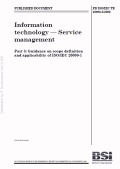
    The long awaited international standard on scoping a Service Management System, ISO/IEC TR 20000-3, is now available.

    It’s a must have –

    Buy the hard copy here:

    or the download here:

    It may seem a little backwards buying part 3 of the ISO 20000 series ahead of parts 1 and 2 but this makes perfect sense, let me explain…
    This part of ISO/IEC 20000 will help you if you are considering using ISO/IEC 20000-1 for implementing a service management system (SMS). It will also be of aid if you need specific advice on whether ISO/IEC 20000-1 is applicable to your organisation.
    It shows you how to define the scope of your SMS based on practical examples, for assessment, irrespective of whether you have previous experience with other management system standards.

    Key Features and Benefits:
    ď‚§ Will assist those looking to define a scope statement for implementing an SMS that is fully aligned with ISO/IEC 20000-1. Saving time and money over hiring expensive IT service management consultants to help you with you SMS paperwork.
    ď‚§ Explanations, guidance, and recommendations shed light on implementing an ISO/IEC 20000-1 SMS. Providing information which is complementary to that in ISO/IEC 20000-2.
    ď‚§ The information in this standard is generic, thus it is applicable no matter the size, type or location of the organisation.

    Get your copy today >>

    Buy the hard copy here:

    or the download here:

    Tags: ISO 20000, ISO/IEC 20000, Service Management System


    Jan 06 2010

    Automated polls not hack-proof

    Category: Information Security — DISC @ 3:39 pm

    6 machines
    Image by Valerie Reneé via Flickr

    By Andreo Calonzo

    The system that will be used in the May 2010 automated elections is not hack-proof, but adequate safeguards are in place to protect the results from hackers, the Commission on Elections (Comelec) assured Wednesday.

    “I am not saying that the system cannot be hacked. No system is 100-percent hack-proof. I am just saying that we have made sure that the system will not be hacked,” Comelec spokesperson James Jimenez said.

    Jimenez gave the assurance after three government Web sites were hacked in less than two weeks, the latest of which was that of the National Disaster Coordinating Council (NDCC).

    Last week, the Web sites of the Department of Health (DOH) and the Department of Social Welfare and Development (DSWD) were also victimized by hackers.

    Jimenez said the system to be used in the coming automated elections would operate on a “virtual private network,” making it difficult for hackers to bypass the system’s security mechanisms.

    “It’s like trying to rob a house, but you don’t even know where its exact location is,” he said in Filipino.

    Jimenez also explained that the “real time” transmission of the results would make hacking more difficult.

    “Our machines transmit for only two minutes. That’s too fast. In order to actually decode the data, it will take you something like three years. If you only have two minutes to do it, you do not have enough time,” he said.

    But Jimenez conceded that hacking could happen at the municipal level. “The possibility of hacking is greatest at the municipal level, because it is the one most visible to the public.”

    He said to prevent this, the poll body would use two other independent servers, one to a central server and another to a server assigned to media groups, accredited citizens’ arm and political parties.

    “If you hack the municipal server, and if you hack the municipal server results, you are not hacking the reports of the other servers,” he said.

    “If one report is hacked, this doesn’t mean that you have hacked everything. In fact, if one report is hacked, the tampering becomes more evident because there are other reports to contradict it,” he added.

    An American company, Systest Laboratories in Colorado, is currently verifying the security and accuracy of the source code to be used in the automated counting machines, according to Comelec commissioner Gregorio Larrazabal. – KBK/RSJ, GMANews.TV

    Tags: automated pollling machine, Colorado, Department of Health, Department of Social Welfare and Development, DSWD, hacker, Hacking, National Disaster Coordinating Council, Polling place, Seattle, United States, Voting


    Dec 28 2009

    Hackers’ attacks rise in volume, sophistication

    Category: Information Security — DISC @ 6:41 pm

    digital-hijack


    Year in review for online security attacks – 2009 is going to be known as a year of change in tactics of exploitation, rather than creating more new tools in hacker’s community. They are utilizing social media as a tool to exploit and using built-in trust in social media to their advantage. That’s why stealing social media accounts are considered as a treasure trove in hacker’s community to spread malwares (rogue anti-virus) which helps them to steal personal and private information. This perhaps was another reason why social media community was busy in 2009 changing their security and privacy policy on a frequent basis. Do you think, as social media grow, so does the threat to personal and private information?.


    At the same time 2009 comes to an end with a bang with an appointment of Howard Schmidt by Obama’s administration as a cybersecurity coordinator. A great choice indeed but why it took them a whole year to make this important decision. This indecision will cost them, no matter how you look at it. Now hopefully the current administration is going to keep the politics aside and take his recommendations seriously to make up for the lost time.

    Alejandro MartĂ­nez-Cabrera, SF Chronicle

    Security experts describe the typical hacker of 2009 as more sophisticated, prolific and craftier than ever. If anything, criminals will be remembered by the sheer number of attacks they unleashed upon the Web.

    While the year didn’t see many technological leaps in the techniques hackers employ, they continued to expand their reach to every corner of the Internet by leveraging social media, infiltrating trusted Web sites, and crafting more convincing and tailored scams.

    Although there were a handful of firsts – like the first iPhone worm – most attacks in 2009 were near-identical to tactics used in prior years, changing only in the victims they targeted and their level of sophistication.

    One of the most preoccupying trends was personalized attacks designed to steal small and medium business owners’ online banking credentials. The scheme was particularly damaging because banks take less responsibility for the monetary losses of businesses than of individual consumers in identity theft cases.

    In October, the FBI estimated small and medium businesses have lost at least $40 million to cyber-crime since 2004.

    Attacks continued to plague larger organizations. The Wall Street Journal reported on Tuesday that the FBI was investigating the online theft of tens of millions of dollars from Citigroup, which has denied the incident.

    Alan Paller, director of research at the SANS Institute, said criminals shifted the focus of their tactics from developing attack techniques to improving the social engineering of their scams.

    “It’s not the tools but the skills. That’s a new idea,” he said.

    One example is rogue antivirus schemes, which often trick computer users with a fake infection. Criminals then obtain their victims’ credit card information as they pay for a false product, all the while installing the very malicious software they were seeking to repel.

    Even though these scams have been around for several years, they have become more a popular tactic among criminals because they pressure potential victims into making on-the-spot decisions.

    “People have been told to look out for viruses and want to do the right thing. There’s security awareness now, but the criminals are taking advantage of their limited knowledge,” said Mike Dausin, a researcher with network security firm TippingPoint’s DVLabs.

    Chester Wisniewski, senior adviser for software security firm Sophos, said social networks also continued to be an important target for attackers. Despite Facebook and Twitter’s efforts to beef up their security, it has become a common tactic for scammers to hijack Facebook accounts and post malicious links on the walls of the victim’s friends or distribute harmful content through tweets.

    “We haven’t had this before – a place where all kinds of people go and dump their information, which makes it very valuable for criminals,” Wisniewski said. “It’s kind of a gold mine for identity thieves to get on people’s Facebook account.”

    Using PDFs
    Another common ploy was malicious software that piggybacked on common third-party applications like Adobe PDFs and Flash animations.

    Although Adobe scrambled this year to improve its software update procedures and roll out patches more frequently, criminals have increasingly exploited the coding flaws in Adobe products in particular because of their ubiquity and the abundance of vulnerable old code, said Roel Schouwenberg, senior virus analyst at Kaspersky Lab.

    By using ad networks or taking advantage of exploitable Web programming errors to insert malicious content, criminals cemented their presence in legitimate Web sites and made 2009, according to anti-malware firm Dasient, the year of the “drive-by download,” in which users only have to visit a compromised Web site to become infected.

    An October report from the San Jose company estimated that 640,000 legitimate Web sites became infected in the third quarter of 2009, compared with 120,000 infected sites during the same period of 2008.

    Damaging reputations
    The trend was not only a security threat for consumers, but also stood to damage the reputation and traffic of the victimized Web sites. In September, a fake antivirus pop-up made its way into the New York Times’ Web site by infiltrating the company’s ad network.

    Researchers also noted a high volume of attacks disguised as content related to popular news items – anything from Michael Jackson to the swine flu – to coax Web users into downloading malicious content. This closing year also saw a handful of notorious politically motivated online attacks, and the issue of national cybersecurity continued to gain prominence.

    On Dec. 18, Twitter’s home page was defaced by hackers calling themselves the “Iranian Cyber Army,” although authorities said there was no evidence they were in fact connected to Iran. An August attack on a Georgian blogger also indirectly affected the popular microblogging site and brought it down for several hours.

    In July, several U.S. and South Korean government Web sites went offline after being hit by a denial-of-service attack that South Korea has attributed to a North Korean ministry. U.S. defense officials revealed in April that hackers have stolen thousands of files on one of the military’s most advanced fighter aircrafts.

    “Now it’s in the agenda of every government to pay attention to the cyberworld,” Schouwenberg said.

    Security coordinator
    On Tuesday, the White House announced the appointment of Howard A. Schmidt as the Obama administration’s new cybersecurity coordinator. Schmidt occupied a similar post under the Bush administration.

    Even though crime continued to evolve into a more organized and compartmentalized operation this year, experts believe a new White House administration conscientious of threats and partnerships between law enforcement agencies and security firms offer encouraging signs for next year.

    An example is the Conficker Work Group, an international industry coalition that joined to mitigate the spread of the Conficker worm. The group also collaborates with law enforcement agencies by providing them with forensic information.

    “It’s the first time I’ve seen such partnership between countries. Typically it’s the Wild West and nobody is in charge of anything. Now it’s clear there’s a lot more international collaboration,” Dausin said.

    Tags: antivirus, cybersecurity coordinator, Denial-of-service attack, facebook, hacker, howard schmidt, Identity Theft, iPhone, Law enforcement agency, Malware, Michael Jackson, South Korea, Twitter


    Dec 10 2009

    What is a risk assessment framework

    Category: Information Security,Risk Assessment — DISC @ 5:46 pm

    Computer security is an ongoing threat?!?
    Image by Adam Melancon via Flickr

    The Security Risk Assessment Handbook: A Complete Guide for Performing Security Risk Assessments

    Definition – A risk assessment framework (RAF) is a strategy for prioritizing and sharing information about the security risks to an information technology (IT) infrastructure.

    A good RAF organizes and presents information in a way that both technical and non-technical personnel can understand. It has three important components: a shared vocabulary, consistent assessment methods and a reporting system.

    The common view an RAF provides helps an organization see which of its systems are at low risk for abuse or attack and which are at high risk. The data an RAF provides is useful for addressing potential threats pro-actively, planning budgets and creating a culture in which the value of data is understood and appreciated.

    There are several risk assessment frameworks that are accepted as industry standards including:

    Risk Management Guide for Information Technology Systems (NIST guide) from the National Institute of Standards.

    Operationally Critical Threat, Asset, and Vulnerability Evaluation (OCTAVE) from the Computer Emergency Readiness Team.

    Control Objectives for Information and related Technology (COBIT) from the Information Systems Audit and Control Association.

    To create a risk management framework, an organization can use or modify the NIST guide, OCTAVE or COBIT or create a framework inhouse that fits the organization’s business requirements. However the framework is built, it should:

    1. Inventory and categorize all IT assets.
    Assets include hardware, software, data, processes and interfaces to external systems.

    2. Identify threats.
    Natural disasters or power outages should be considered in addition to threats such as malicious access to systems or malware attacks.

    3. Identify corresponding vulnerabilities.
    Data about vulnerabilities can be obtained from security testing and system scans. Anecdotal information about known software and/or vendor issues should also be considered.

    4. Prioritize potential risks.
    Prioritization has three sub-phases: evaluating existing security controls, determining the likelihood and impact of a breach based on those controls, and assigning risk levels.

    5. Document risks and determine action.
    This is an on-going process, with a pre-determined schedule for issuing reports. The report should document the risk level for all IT assests, define what level of risk an organization is willing to tolerate and accept and identify procedures at each risk level for implementing and maintaining security controls.

    Tags: Business, COBIT, Computer security, Data, Fire and Security, Information Technology, iso 27001, iso 27002, National Institute of Standards and Technology, NIST, OCTAVE, Risk management, Security, security controls, Technology


    Oct 16 2009

    Web Services and Security

    Category: Cloud computing,Information Security — DISC @ 4:01 pm

    Cloud Security and Privacy

    Because of financial incentive, malicious software threats are real and attackers are using the web to gain access to corporate data. Targeted malicious software’s are utilized to steal intellectual property and other confidential data, which is sold in the black market for financial gain. With use of social media in corporate arena, organizations need to have web services use policy, to ensure employees use the internet for business and comply with company web use policies. To have an effective web use policy makes business sense and to implement this policy efficiently is not only due diligence but also assist in compliance. After implementing, the key to the success of web use policy is to monitor the effectiveness of the policy on regular basis.

    webservices

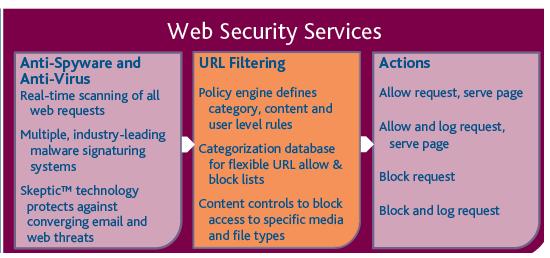
    Hosted web security services operate at the internet level, intercepting viruses, spyware and other threats before they get anywhere near your network. These days if malicious software has infected your gateway node the attacker is home free and it is basically game over. How to fight this malice is to use hosted web security services, which is transparent to users and stop the malwares before they get to the corporate network.

    Things to look at web security hosted services are protection, control, security, recovery and multilayer protection.

    Protect your corporation from anti-virus, anti-spam, and anti-spyware
    Content Control of images, URL filtering and enterprise instant messages, all web request are checked against the policy
    Secure email with encryption
    Archive email for recovery
    Multilayer protection against known and unknown threats including mobile user protection

    Web Security Anti-Virus, Anti-Spyware – stops web-borne spyware and viruses before they infiltrate your network, protecting your business from information theft and costly diminished network performance.

    Web Filtering – enables you to block access to unwanted websites by URL, allowing you to control Internet use and enforce acceptable Internet usage policies


    Download a free guide for the following hosted solutions

    Hosted email solution
    Hosted email archiving
    Hosted web monitoring
    Hosted online backup

    Tags: archive email, boundary encryption, content control, email archiving, email solution, image control, Malicious Software, Malware, multilayer protection, online backup, Spyware, url filtering, web filtering, web monitoring, wen security


    Oct 08 2009

    Security Controls and Principles

    Category: Information Security — DISC @ 3:08 pm

    checklist

    Principles of Information Security

    For security controls to be effective apply the pillars of information security

    –Principle of least privilege
    –Separation of duties
    –Economy of mechanism
    –Complete mediation
    –Open design

    Least Privilege
    • “Need to Know”
    • Default deny – essentially , don’t permit any more to occur than is required to meet business or functional objectives
    • Anything extra introduces risk

    Separation of Duties
    • The idea is that we don’t want to give any one individual so much power that they cloud take dangerous actions without any checks and balances in place.
    • You trust them with their job responsibilities but they should be accountable for their actions which is only possible when you measure or monitor their performance.

    Economy of Mechanism
    • Complexity is an enemy of security, it’s much more difficult to create a simple mechanism and keep it that way.
    • The more complexity added to a system, the more chance for error or flaw

    Complete Mediation
    • The control cannot be bypassed (organization firewall, by creating a backdoor)
    • This principle says no unofficial backdoor (no disabling the anti-virus software)

    Open Design
    • The security of a system must not be based on the obscurity of the mechanism
    • Proprietary software are not tested properly and sometime include an undisclosed back door (ballot counting software)


    [TABLE=9]

    Tags: Complete mediation, Economy of mechanism, open design, Principle of least privilege, security controls, security principles, Separation of duties


    Sep 21 2009

    Due Diligence, and Security Assessments

    Category: Information Security,Security Risk Assessment — DISC @ 9:21 pm

    Microsoft Baseline Security Analyzer
    Image via Wikipedia

    Fighting Computer Crime: A New Framework for Protecting Information

    Risk assessment demands due diligence, which makes business sense and derives organization mission. Due care care is also about applying the specific control that counts. In information security, due diligence means a complete and comprehensive effort is made to avoid a security breach which could cause detrimental effects and identify various threats that may be exploited for a possible security breach.

    Donn Parker defines due care as a “use of resonable safeguards based on the practices of similiar organizations”

    Fred Cohen defines “due diligence is met by virtue of compliance review.”

    Organizations must: (i) periodically assess the security controls in organizational information systems to determine if the controls are effective in their application; (ii) develop and implement plans of action designed to correct deficiencies and reduce or eliminate vulnerabilities in organizational information systems; (iii) authorize the operation of organizational information systems and any associated information system connections; and (iv) monitor information system security controls on an ongoing basis to ensure the continued effectiveness of the controls.
    (FIPS 200, Section 3, Minimum Security Requirements)


    Reblog this post [with Zemanta]

    Tags: donn parker, due care, due diligence, Fred Cohen, security controls


    Sep 10 2009

    Way beyond the edge and de-perimeterization

    Category: Cloud computing,Information Security — DISC @ 2:59 pm

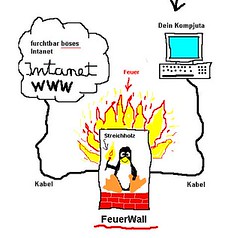
    Wie eine Firewall arbeitet / how a firewall works
    Image by pittigliani2005 via Flickr

    De-perimeterization term has been around almost for a decade and finally industry is taking it seriously because of virtualization and cloud computing popularity. Is it time for businesses to emabrace de-perimeterization?

    De-perimeterization is a double edge sword for industry which creates scalable options for operation and huge challenges for safeguarding the assets beyond the edge. One of the major advantages for de-perimeterization is that user can access corporate information over the internet; in this situation user can access corporate data from any where, it’s hard to draw the line where the edge begins and where it ends. All you basically need a functional laptop with internet connection. On the other hand, de- perimeterization poses a great challenge due to possibility of viruses, spywares and worms spreading in your internal protected infrastructure.

    In de-perimeterized environment, security attributes shall follow the data, wherever the data may go or reside.

    In security architecture where firewall was considered a very effective perimeter defense has been weakens by virtualization and cloud computing. In early days of firewall defense, organization only needed to open few necessary protocols and ports to do business. Internet accessible systems were located on the DMZ and the communication was initiated from the corporate to internet. Now there are whole slew of protocols and ports which needs to be open to communicate with application in the cloud. As corporate application move out of the organization network into the cloud, the effectiveness of firewall diminished.

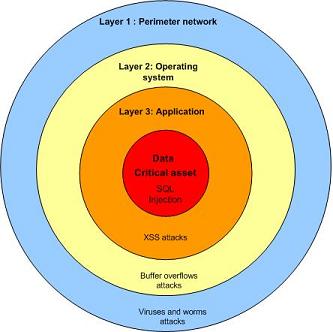
    Defense in depth is required for additional protection of data because as new threats emerge, the firewall cannot be used as an only layer of security. The key to the security of de-perimeterization is to push security at each layer of infrastructure including application and data. Data is protected at every layer to ensure the confidentiality, integrity and availability (CIA). Various techniques can be utilized for safeguarding data including data level authentication. The idea of data level authentication is that data is encrypted with specific privileges, when the data move, those privileges are moved with the data.

    layered-defense

    Endpoint security is relevant in today’s business environment especially for laptop and mobile devices. Agents on laptops and mobile devices utilized pull/push techniques to enforce relevant security policies. Different policies are applied depending on the location of the laptop. Where security policy will ensure which resources are available and what data need to be encrypted depending on the location of the device.

    When corporate application and important data reside in the cloud, SLA should be written to protect the availability of the application and confidentiality of the data. Organizations should do their own business continuity planning so they are not totally dependent on the cloud service provider. For example backup your important data or utilize remote backup services where all data stored is encrypted.


    Cloud Security and Privacy: An Enterprise Perspective on Risks and Compliance


    Download a free guide for following cloud computing applications

    Hosted email solution
    Hosted email archiving
    Hosted web monitoring
    Hosted online backup


    Reblog this post [with Zemanta]

    Tags: business continuity, Cloud computing, cloud computing article, cloud computing concerns, cloud computing email, cloud computing hosting, cloud computing information, cloud computing security, cloud computing services, cloud security, cloud services, de-perimeterizations, DMZ, iso assessment


    Jul 28 2009

    PCI DSS Law and State of Nevada

    Category: Information Security,pci dss — DISC @ 12:09 am

    Information Security Wordle: PCI DSS v1.2 (try #2)
    Image by purpleslog via Flickr

    45 States followed California when they introduced “SB1386”, the Security Breach Information Act, which has specific and restrictive privacy breach reporting requirements.

    Similarly to the SB1386 Law, California, Massachusetts & Texas are already looking at making PCI DSS Law and history tells us that when California moves, everyone else follows!

    From the 1st January 2010, ALL businesses that collect or transmit payment card information, will be legally obliged, by Navada Law, to comply with PCI DSS.

    Not only does this effect Navada-based organisations, it affects EVERY organisation that collect or transmit payment card information about any person who lives in Nevada.

    Where One leads – others WILL follow!


    Reblog this post [with Zemanta]

    Tags: california, Credit card, Nevada, Payment card, pci dss, privacy, Security, Texas


    Jul 16 2009

    Common Information Security lapses

    Category: Information Security — DISC @ 4:36 pm

    Information Security Wordle: RFC2196 - Site Se...
    Image by purpleslog via Flickr
    User Security
  • Opening email attachments with integrated email clients

  • Not updating client software

  • Downloading untrusted software

  • Not creating or testing backups

  • Using wireless router connected inside the LAN
  • Strategic Security

  • Not providing training to security personnel

  • Only addressing physical security, neglecting data security

  • Not validating security fixes

  • Relying on firewall for all security needs

  • Not evaluating impact on reputation and data of security breach

  • Not implementing long term security decisions, relying on hot fixes to put out fires

  • Not addressing issues, neglecting security as policy
  • Operational Security

  • Not hardening internet connected host

  • Connecting test systems to the internet

  • Not updating systems on a regular and emergency basis

  • Using unencrypted protocols for management, reporting

  • Choosing bad default user passwords, changing passwords in insecure manner, or notifying users in insecure manners

  • Not testing or maintaining backups, not understanding the intricacies of backup software and procedures

  • Tags: Backup, Information Security, poor security, Security, security mistakes


    Jun 30 2009

    Security controls and ISO 27002

    Category: Information Security,ISO 27k — DISC @ 1:56 pm

    seeyourdataUsually security breach occurs due to lack of basic security controls or lack of effective control which is not relevant over the time. Security controls also disintegrate over the time due to lack of maintenance and monitoring.
    According to Privacy Rights Clearinghouse survey, the top three breaches resulted from laptop theft, software or human error, and hackers. Most of these breaches could have been prevented by procedural, management and technical security controls. Most of the security breaches happen during the state of non-compliance. The most famous TJX security breach happens in 2007, at the time of the breach TJX complied with only 3 out of 12 PCI-DSS requirements.

    Small organizations sometimes don’t have enough resources to comply with all the requirements of regulations and standards like HIPAA and PCI. But that is not an excuse of not understanding the relevant regulations and standards requirements to your business and having a clear security strategy which explains how to achieve the compliance down the road. Also your security strategy will be an evidence of your due diligence to secure your critical assets. On the other hand big organizations have enough resources to implement security controls, but for whatever reason they often do not have clear strategy how to establish security controls.

    Information security is not a onetime static process but an ongoing assessment of risks in your business, where you need to understand the your critical assets, classification of those assets based on CIA, sensitive data and its access, policies, standards, procedures , training, security reviews and continuous monitoring.

    One of the most popular baseline for security controls is the international standard ISO 27002 – Code of Practice for Information Security management. ISO 27002 have 11 security clauses and 133 security controls are high level which provides a reasonable guidance for implementing an Information Security Management System (ISMS). Due to ISO 27002 broad scope, it’s relevant to every industry and size of business.

    Organization should have a baseline of security controls before barging onto complying with PCI or HIPAA regulation. ISO assessment will help you to understand what controls are in place and assist you with security strategy and later will become a measuring stick for your ISMS.

    Ongoing compliance is achieved by monitoring the relevant controls. Ongoing compliance will depend on the quality of your information security management system (ISMS). ISMS would include thorough monitoring, logging and reviewing controls to maintain and improve system security over time. You can develop an automated monitoring process to achieve consistent results and sustain compliance by continuously monitoring your system. ISMS (based on ISO 27001) certainly can be a great value to manage ongoing monitoring, maintenance and improvement cycle.

    [TABLE=2]


    Reblog this post [with Zemanta]

    Tags: Computer security, Health Insurance Portability and Accountability Act, Information Security, Information Security Management System, ISO/IEC 27001, pci dss, Privacy Rights Clearinghouse


    Jun 17 2009

    Credit card authorization process weakness

    Category: Information Security,pci dss — DISC @ 3:09 pm

    A diagram showing the front side of a typical ...
    Image via Wikipedia

    Credit Repair Kit For Dummies (For Dummies (Business & Personal Finance))

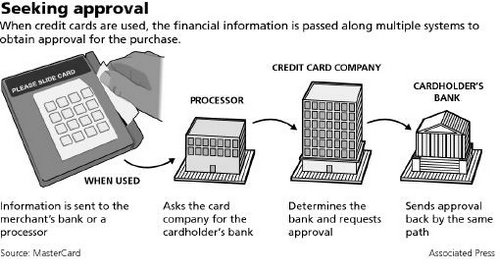
    Credit card authorization sequence:

    1) Creditholder swipes card at merchant. A request is sent to merchants bank
    2) Merchants bank “asks” processor to determine the cardholder bank
    3) Processing network finds cardholders bank and request approval for purchase
    4) Cardholders bank approves purchase and generates a approval code
    5) Processor sends an approval code merchants bank
    6) Merchants bank sends approval code to merchant
    7) Purchase is complete and cardholder receives a receipt

    “Every time you swipe your credit card and wait for the transaction to be approved, sensitive data including your name and account number are ferried from store to bank through computer networks, each step a potential opening for hackers.”

    Weak security enables credit card hacks

    Credit Card Fraud Made Easy
    httpv://www.youtube.com/watch?v=m5UE5fXRyKs


    Reblog this post [with Zemanta]

    Tags: Credit card, credit card privacy, credit card secure, credit card security, credit card theft, secured card, visa card


    May 06 2009

    Rise of cybercrime and management responsibility

    Category: Information Security,Information Warfare — DISC @ 5:08 pm

    ITIL Security Management
    Image via Wikipedia
    According to SF Chronicle article by Deborah Gage (May 8, 2009, c2) consumer reports magazine’s annual “State of the Net” survey finds that cybercrimes has held steady since 2004, with one out of five consumers becoming victims in last two years at a cost to economy of $8 billion. Consumer report can be found on at www.consumerreports.org

    Uncertain economic time brings new threats and scams and most of the security experts agree that there’s a possibility of increase in cybercrime for this year. Survey also found that around 1.7 million people were victims of identity theft and 1.2 million had replaced their computers because of infected software.

    First why all the signs are showing uptick in cybercrimes and second what are we going to do about it.

    Management should start considering security as total cost of ownership instead of wasting time on what is ROI of information security. If there is a security breach, somebody in the management should be held accountable not an IT or security personnel. Management will keep demonstrating lax attitude toward data protection and security in general unless there are serious consequences like spending time in jail for lack of security controls (basic due diligence) and not taking appropriate actions for the risks that posed a significant threat to the organization.

    PCI, HIPAA and SOX compliance are a good start in a right direction for management to take information security into consideration, but these compliance initiatives don’t address the security of a whole organization. They address security risks of a business unit in an organization. If management is really serious about security then ISO 27002 code of practice is one of the option which should be considered to address the security of the whole organization and ultimately organization should achieve ISO 27001 certification which will build a comprehensive information security management system to manage ongoing risks.

    [TABLE=2]

    Reblog this post [with Zemanta]

    Tags: Information Security, International Organization for Standardization, isms, iso 27001, iso 27002, Operating system, Policy, Security


    Apr 22 2009

    RSA and cybersecurity

    Category: Information Security — DISC @ 6:52 pm

    SAN FRANCISCO - FEBRUARY 6:  Art Coviello, Exe...
    Image by Getty Images via Daylife
    This week I was in attendance with thousands of people from all over the globe at RSA conference in Moscone Center San Francisco. The conference offers variety of training tracks and this year included two new tracks physical security & governance and risk & compliance. Since Novell CNE was one of my first professional certification, I was glad to see Novell making some headway’s in information security arena, especially Deloitte was promoting Novell identity management solution in the conference.

    The cloud computing is the buzz word for this year conference. As far as virtual environment boundaries are concerned , it’s hard to say where it start and where it ends which complicate the matters and complexity of the cloud will introduce new threats and risks. With that in mind cyber security appears to be worse than last year. Attendance might be bit low this year due to budget cut but the conference floor was packed with vendors and enthusiastic audiences.

    Most of the security expert understand that companies are cutting budgets and might be decreasing their investment in security. Having a proactive security strategy and spending the security dollars wisely is the key to success of a business in this downturn economy. One thing to understand about information security, there is no ROI (return on investment) in security. ROI is a total cost of ownership.

    Another concern in the conference is that the threats and fraud goes up during downturn economy. Companies should have comprehensive policies to tackle insider threats regarding disgruntled employees who might be at verge of getting laid off to prevent them from stealing intellectual property.

    There is an outstanding line of keynote speakers like Melissa Hathaway, federal acting senior director of cyberspace. She advised the current (Obama) administration. She will be discussing issues like how much federal government should be involved in protecting critical assets like power grids. The conference like RSA helps security professionals to sharpen their skills and work in collaborative manners to successfully defend their organizations from attackers.

    RSA Conference 2009 Highlights
    httpv://www.youtube.com/watch?v=BAxAagvmu6w

    Reblog this post [with Zemanta]

    Tags: Cloud computing, Consultants, Information Security, Melissa Hathaway, Moscone Center, Obama, RSA Conference, San Francisco, Security


    Mar 17 2009

    Congressional data mining and security

    Category: Information Security — DISC @ 12:42 am

    Data mining
    Image by moonhouse via Flickr
    “By slipping a simple, three-sentence provision into the gargantuan spending bill passed by the House of Representatives last week, a congressman from Silicon Valley is trying to nudge Congress into the 21st Century. Rep. Mike Honda (D-Calif.) placed a measure in the bill directing Congress and its affiliated organs — including the Library of Congress and the Government Printing Office — to make its data available to the public in raw form. This will enable members of the public and watchdog groups to craft websites and databases showcasing government data that are more user-friendly than the government’s own.”

    Would be great if this passes BUT, Government would have to have security provisions so hackers could not manipulate databases in this case raw data. Without proper controls, databases can be easily modified and stolen, so before making the raw data available to public, Congress might need a comprehensive legislation to protect the confidentiality, integrity and availability of the data.

    Security principles and controls which should be considered in database legislation?
    • Principles of least privilege
    • Separation of duties
    • Defense in depth at every level
    • Strong auditing and monitoring controls
    • Security risk assessment to assess risks based on ISO 27002 and NIST 800-53
    • Comprehensive risk management program to manage risks

    Congressional Data Mining: Coming Soon? (Mother Jones)


    httpv://www.youtube.com/watch?v=wqpMyQMi0to

    Reblog this post [with Zemanta]

    Tags: Business, Data mining, database, defense in depth, iso 27002, Mike Honda, National Institute of Standards and Technology, Risk Assessment, Risk management, Security, separation of duities, Silicon Valley


    Feb 18 2009

    Economic turmoil and BCP

    Category: BCP,Information Security — DISC @ 6:42 pm

    information
    Due to economic insecurity all the warning signs are pointing that this year is going to top the record for information security and privacy incidents. Organizations may not be in a position to take business limiting risk and bypass security fundamental like Business Continuity Planning (BCP). During this economic uncertainty organizations have to pay more attention to liability, regulatory penalties and negative PR which might cause an irrecoverable damage to business in today’s market.


    “BCP is the creation and validation of a practiced logistical plan for how organization will recover and restore partially or completely interrupted critical functions within a predetermine time after a disaster or extended disruption”

    The first step in business continuity process is to consider the potential impact of each disaster or disruption. Next step is to determine the likelihood of the disruption or how likely this disruption will occur within a year and how many times. Both impact and likelihood will determine the risk to the organization critical asset in a sense if impact of the disruption is high the risk is high or if likelihood of the incident is high the risk is high. High risk disruption will attract more attention during planning process.

    Risk Analysis:
    • Understand the function of probabilities and risk reduction
    • Identify potential risks to the organization
    • Identify outside expertise required
    • Identify vulnerabilities / threats / exposures
    • Identify risk reduction / mitigation alternatives
    • Identify credible information sources
    • Interface with management to determine acceptable risk levels
    • Document and present findings

    BCP Plan:
    • Understand clear objectives, available alternatives, their advantages, disadvantages, and cost ranges, including mitigation as a recovery strategy
    • Identify viable recovery strategies with business functional areas
    • Consolidate strategies
    • Identify off-site storage requirements and alternative facilities
    • Develop business unit consensus
    • Present strategies to management to obtain commitment

    Assessing the Effectiveness of a BCP Plan for an Individual Business Unit:
    Business unit contingency planning was never more important than now. The success of BCP planning depends upon the feasibility and appropriateness of the plan. However, only comprehensive TESTING of the contingency plans could validate that and everyone hates testing. It is important that the Contingency Plan clearly identify those responsible for declaring a disaster and executing the plan. BS 25999-2:2007 is the specification for implementing, establishing, and improving a business continuity management system (BCMS) within an organization.

    The requirements in the standard are generic and are intended to be applicable to all organizations, regardless of type, size and nature of business. The extent of application of these requirements depends on the organization’s operating environment and complexity. BS 25999-2 can be used by internal and external parties, including certification bodies, to assess an organization’s ability to meet its own business continuity needs, as well as any customer, legal or regulatory needs.

    Purchase BS25999-2:2007 online today and prove business resilience to customers and partners.

    [TABLE=16]

    BSI – What is Business Continuity Management?
    httpv://www.youtube.com/watch?v=DkQsmSg1PFU&NR=1

    Reblog this post [with Zemanta]

    Tags: Business, Business continuity planning, Business Services, Contingency plan, Emergency Management, Fire and Security, Information Security, Risk management


    « Previous Page — Next Page »