![Ransomware's Silver Bullet - The Virtual CISO Publication Series: Cybersecurity: Publication #1 Ransomware by [Virtual CISO]](https://m.media-amazon.com/images/I/51I3jaKKPDL.jpg)
InfoSec Compliance & AI Governance For over 20 years, DISC InfoSec has been a trusted voice for cybersecurity professionals—sharing practical insights, compliance strategies, and AI governance guidance to help you stay informed, connected, and secure in a rapidly evolving landscape.

Nov 18 2019

Read how a virtual chief information security officer (vCISO) can help you uplift a struggling information security program.
Source: CISO or vCISO? The Benefits of a Contractor C-level Security Role
Webinar: vCISO vs CISO – Which is the right path for you?
httpv://www.youtube.com/watch?v=HIvuIIQob7o
CISO as a Service or Virtual CISO
httpv://www.youtube.com/watch?v=X8XSe3ialNk
The Benefits of a vCISO
httpv://www.youtube.com/watch?v=jQsG-65wxyU
Subscribe to DISC InfoSec blog by Email
Sep 08 2026
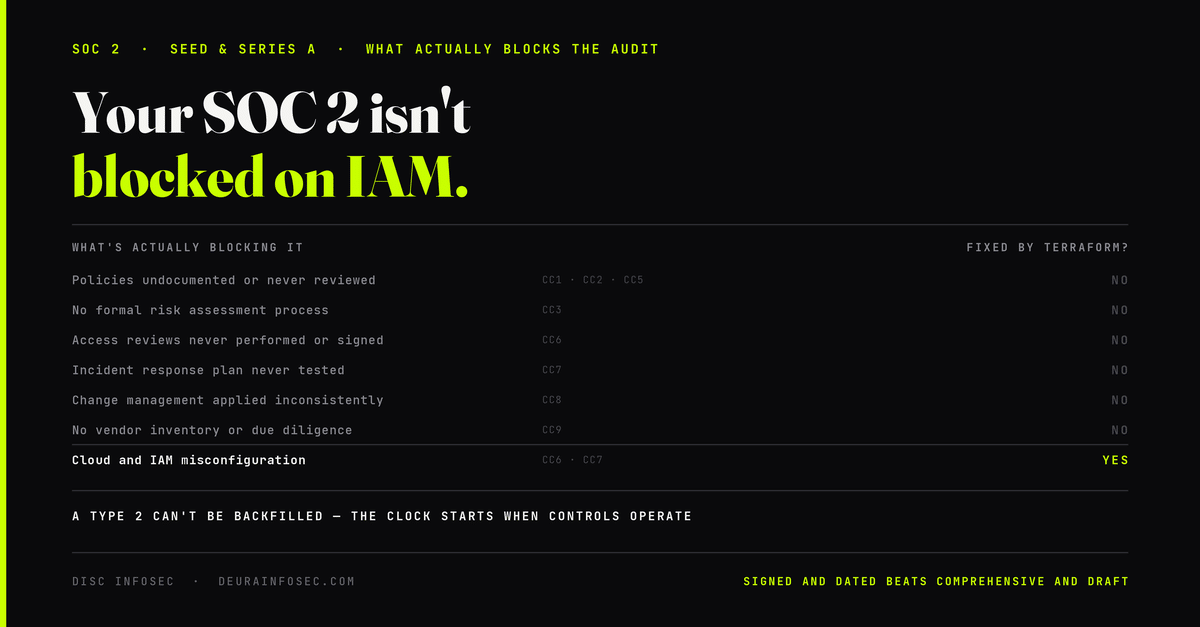
A viral take says early-stage startups need operators, not CISOs. Mostly right — but three of the four things it says startups need are governance work. What actually blocks the audit and the deal.
A take went around recently that I mostly agree with, which is why I want to argue with it.
The argument: a Seed or Series A company hires a security engineer at a healthy base salary, and within two weeks they’re drafting fifty-page governance policies and pitching board decks instead of fixing IAM roles. Meanwhile the AWS permissions are still a mess and the SOC 2 is dead in the water. Startups don’t need someone pontificating about corporate risk frameworks. They need operators who lock down the cloud, automate evidence collection, get enterprise procurement off the founder’s back, and let engineering ship.
Every word of the diagnosis is correct. Role clarity is a real failure mode, and if you hired for hands-on infrastructure work and got a risk committee, that’s a mis-hire no matter how good the risk committee is.
But read that list of what startups supposedly need instead. Lock down the cloud. Automate the evidence collection. Get procurement off your back. Unblock the SOC 2.
Three of those four are governance work described in operator vocabulary.
This is the load-bearing claim, so it’s worth being specific. When a SOC 2 stalls at an early-stage company, here’s what’s actually blocking it, in rough order of frequency:
Now look at what’s on that list that Terraform fixes. Almost nothing. Your IAM roles can be immaculate and every one of those gaps remains open.
And there’s a structural fact founders consistently learn too late: a Type 2 report tests operating effectiveness over an observation period, typically six to twelve months. You cannot compress it, you cannot backfill it, and the clock starts when the controls are actually operating — not when you decide to get serious. Evidence has to be contemporaneous, created at the time the control operated. An access review reconstructed in a panic the week before fieldwork is not evidence; it’s a document about the past.
Which means the highest-leverage early action isn’t hardening. It’s starting the clock — getting a minimal, real control set operating so the window begins, and so that six months from now you have records rather than intentions.
This is the same argument I made about ISO 42001 Stage 2, and it generalises: controls are rarely why organisations fail. Evidence is. A programme built in the eight weeks before an audit gets found out, because records have dates.
The second item on the operator list is the one that funds the company, so it deserves precision about what it actually involves.
An enterprise security review is not a technical assessment. It’s a document request. The questionnaire asks for your information security policy, your named security owner, your subprocessor list, your access review cadence, your incident response procedure, your business continuity test, your data retention schedule — and, in every substantive questionnaire I’ve seen since mid-2026, an AI governance block: what AI do you use, do you or your vendors train on customer data, who’s accountable for your AI systems, are you ISO 42001 certified or implementing it.
You cannot answer any of that with cloud configuration. And the answers are representations — a completed questionnaire is a contractual statement to a customer. Claiming a control you can’t evidence converts a security problem into a misrepresentation problem, which is a materially worse category to be in.
So “get procurement off my back” decodes to: produce a coherent, defensible, evidenced document set that matches what you actually do. That is governance. Calling it operations doesn’t change the work.
Here’s where I think the original take mistargets. Its villain looks like the CISO mindset. The actual villain is governance theatre — and the tell is not that a policy exists, it’s that the policy is unsigned, undated, unowned, and unmatched to scope.
The test I’d apply to any governance artifact at an early-stage company is the same one an auditor applies:
A two-page acceptable use policy that a founder signed, dated, and circulated passes all four and unblocks a procurement question. A fifty-page policy suite in draft passes exactly one. The fifty-page version isn’t wrong because it’s governance; it’s wrong because it’s optimised for the appearance of a programme rather than for producing artifacts.
So the correct instruction to your first security hire is not “stop writing policies.” It’s: write the shortest thing that will survive question four, get it signed, and go fix the cloud.
I’d also offer a more charitable reading of the engineer in that story than the original does. Very often the person drafting policies at week two is doing it because a customer is asking, nobody else will, and no one was named accountable. That’s not pretension. That’s a missing owner, and the founder is the one who left the seat empty.
The useful frame isn’t seniority. It’s build versus attest, and they’re genuinely different jobs:
| Build | Attest | |
|---|---|---|
| Output | Working controls | Evidence that controls work |
| Typical week | IAM, network, CI/CD, secrets, logging pipeline | Policies, risk assessment, vendor tiering, access review records, questionnaire responses |
| Failure mode | Hardened environment, no audit trail | Beautiful binder, nothing implemented |
| Unblocks | Incidents | Deals |
The overlap zone — automating evidence collection so the build work generates the attest artifacts as a by-product — is the highest-value thing either role does, and it’s where the two disciplines actually meet. Access reviews that emit signed records. Change management that produces approval trails. Logging designed so it answers who authorised this, what did the system have, what did it decide, was that consistent with policy rather than requiring reconstruction.
At Seed and Series A, the pragmatic answer is usually: hire the builder full-time, buy the attest work fractionally. A strong infrastructure security engineer is a full-time job at that stage. Producing a defensible ISMS or AIMS is not — it’s a burst of work followed by a maintenance cadence, and it doesn’t need a full-time salary attached.
I should disclose the obvious: fractional governance is what my practice sells, so treat that recommendation with appropriate suspicion. The honest test of whether you need it: if you can already answer the four questions above for the controls a customer is asking about, you don’t. Go hire the builder and spend nothing on me.
Here’s the part of the original argument that I think dates fastest, and it’s why this matters more in 2026 than it did in 2022.
The advice “operators build, governance pontificates” assumes governance decisions are made in documents. With AI systems, they’re made in architecture — usually by an engineer, at speed, without anyone recognising a governance decision has been taken. Four examples from earlier posts in this series:
None of these get fixed by a policy written afterwards. All of them are cheap to get right at design time and expensive to unwind. So the modern version of the operator argument has to be: the builder needs enough governance literacy to recognise which of their design choices are governance choices — and someone accountable to check.
That’s not pontification. It’s the difference between an AI feature you can sell into an enterprise and one you have to re-architect after the security review.
Note the sequencing. Nothing in there is a board deck, and nothing in there is a fifty-page policy. But five of the seven are governance, and they’re what closes the deal that funds the next engineering hire.
The original take is right that a Seed-stage company doesn’t need someone theorising about enterprise risk frameworks. It’s wrong that the alternative is pure engineering, because it lists governance outcomes as the goal — evidence automation, procurement unblocked, SOC 2 moving — and then argues against the discipline that produces them.
The dichotomy that actually matters isn’t operator versus CISO. It’s artifacts that survive question four versus artifacts that don’t. Someone has to produce the first kind. At twenty people that person probably shouldn’t be full-time, and definitely shouldn’t be presenting to a board you don’t have yet.
DISC InfoSec provides exactly the fractional half of that split for B2B SaaS and financial services startups — SOC 2 and ISO 27001 readiness, ISO 42001 AI management systems, AI and agent inventories, vendor questionnaire response, evidence architecture, and internal audit. No board decks unless you ask for one.
We led VDR organization through ISO 42001 Stage 2 certification on the first audit attempt as the internal practitioner, served as internal auditor, and authored their MCP Governance Standard.
Readiness path: free 15–20 minute readiness call → ISO 42001 gap assessment or ISO 27001 gap assessment → 7–10 day Quick-Start → full implementation and certification support.
DiscInfoSec — Principal Consultant, DISC InfoSec (Deura Information Security Consulting LLC), Petaluma, AICP, CISSP, CISM | ISO/IEC 42001 & ISO/IEC 27001 Lead Implementer | PECB Authorized Training Partner
📅 calendly.com/hd-deurainfosec 📧 info@deurainfosec.com 📞 (707) 998-5164 🌐 deurainfosec.com
Nothing here is legal advice, and formal SOC 2 opinions require a licensed CPA firm.
Startup security hiring seed series, SOC 2 blocked, first security hire, fractional CISO, vendor security questionnaire, ISO 42001 startup, AI governance startup
Download the AI Governance & Cybersecurity pdf file
MachineLearning & Artificial Intelligence
AI Vulnerability Scorecard: Discover Your AI Attack Surface Before Attackers Do
Your Shadow AI Problem Has a Name-And Now It Has a Score
Most AI Security Tools Won’t Pass an Audit. Here’s a 15-Minute Way to Find Out.

InfoSec services | InfoSec books | Follow our blog | DISC llc is listed on The vCISO Directory | ISO 27k Chat bot | Comprehensive vCISO Services | ISMS Services | AIMS Services | Security Risk Assessment Services | Mergers and Acquisition Securit
DISC InfoSec blog | DISC InfoSec Site
Sep 03 2026
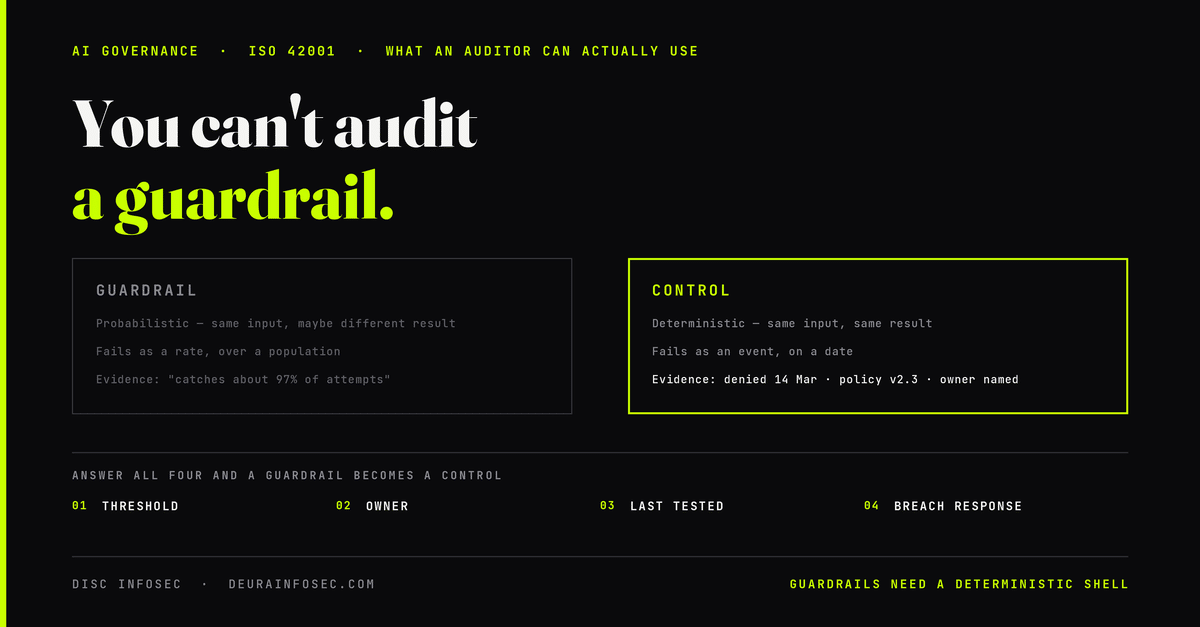
Steven Ross made an observation in the ISACA Journal earlier this year that I’ve been chewing on since, because it explains a failure pattern I keep encountering and had never named properly. Writing about adapting security language to AI, he put it plainly: AI does not have controls, it has guardrails.
That reads like a semantic quibble. It isn’t. It’s the reason a well-engineered AI system can walk into a Stage 2 audit and produce nothing the auditor can use.
My last post argued that controls are almost never why organisations fail an ISO 42001 audit — evidence is. This post is about the specific version of that problem that AI teams create without realising it: a guardrail is not a control, and the difference is precisely that a control can be evidenced.
Ross’s broader framing is worth stating up front, because it sets the right expectation. AI security sits inside information security rather than replacing it — the same premises apply, there are just more and different things to worry about. Nobody needs a parallel security universe. What they need is a translation layer, and most organisations don’t have one.
| Control | Guardrail | |
|---|---|---|
| Behaviour | Deterministic — same input, same result | Probabilistic — same input, possibly different result |
| Outcome | Binary: it operated or it didn’t | Graded: it usually holds |
| Failure | An event, on a date | A rate, over a population |
| Test | Reproducible | Statistical |
| Evidence | A dated record of an instance | A benchmark, valid until the model changes |
| Ownership | A named person | Frequently no one |
The critical row is failure. A control fails as an event — the approval wasn’t obtained on 14 March. A guardrail fails as a distribution — the content filter catches 97.3% of attempts, and the other 2.7% happened somewhere you don’t know about. An auditor asking “show me a specific instance” gets an answer in the first case and a statistic in the second.
Which leads to the sentence I’d build an entire AI audit methodology around:
You cannot audit a guardrail. You can only audit the control that governs the guardrail.
The model is not the auditable object. The envelope around it is.
Five moves. None require changing the model, which is the point — the deterministic layer goes around the probabilistic one.
1. Wrap it in a deterministic gate. If the consequential decision runs through a policy service the model doesn’t control — validating scope, privilege, and approval before execution — you now have a binary event to log. This is the propose/validate/execute separation from my earlier agent security post, and it’s the single highest-value structural change available. A model output that authorises a privileged action on its own is unauditable by construction.
2. Define the threshold, then record the reading. A guardrail becomes measurable the moment you commit to a number: what detection rate is acceptable, what drift triggers action, what happens when the threshold is breached. ISO 42001 Clause 6.2 requires measurable AI objectives and Clause 9.1 requires you to actually monitor and evaluate them. An unmeasured guardrail satisfies neither. “The filter works well” is not an objective; “false-negative rate below X, measured monthly, breach escalates to the AI system owner” is.
3. Version the guardrail as a document. System prompts, filter configurations, refusal policies, retrieval scopes, tool allowlists — these are control documentation, and they should be versioned, change-controlled, and dated like any other policy. If nobody can say which prompt version was live on the day of an incident, the guardrail has no audit history at all. And record the policy version in the decision log, so an artifact can be tied back to the rules in force when it was produced.
4. Test adversarially and retain the results. The evidence that a guardrail works is a test suite with expected denials — prompt injection, tool misuse, privilege escalation, memory poisoning, approval bypass — version-controlled, re-run on any material change to prompts, tools, retrieval, policy, or model provider. This maps to A.6.2.4 verification and validation, and it’s the only form of evidence that survives the “how do you know it still works?” question. Statistical assurance decays the moment the model version changes.
5. Log the decision, not just the outcome. The four questions an AI action log should answer: who authorised this, what context did the system have, what did it decide, and was that consistent with policy. A.6.2.8 requires event logs sufficient for investigation and accountability. Outputs alone don’t meet that bar.
The pattern across all five: you make a probabilistic system auditable by surrounding it with deterministic decisions. Where the model is uncertain, the governance must not be.
Ross’s articles work through several concepts where the same word means different things to AI practitioners and security professionals. These are the ones that cause real audit trouble.
Robustness. To a security professional this usually means resilience or recoverability. In AI usage — drawing on the trustworthiness vocabulary that NIST’s AI RMF cites — it means maintaining performance across varied circumstances, including unexpected inputs and hostile ones. Two different requirements, one word. If your risk register says “robustness: implemented,” find out which definition the author meant. Usually only one of them has been addressed.
Safety versus security. Safety is about not causing harm; security is about withstanding attack. AI joins them, because adversarial manipulation is a route to harm. The practical consequence is that adversarial testing is a safety obligation as much as a security one, and it needs metrics and monitoring to detect attacks in progress — not just a pre-deployment test.
Explainability. Ross frames a decision without an explanation as a whim — and in AI terms, a hallucination that can be entirely convincing while being wrong. For auditors this is more than an ethics concern. He makes a point I hadn’t seen articulated elsewhere and think is genuinely important: a security breach, even a minor unauthorised revision to a model, can render the system unusable because it can no longer be explained. Integrity failure and explainability failure are the same failure. If someone modified your model and you can’t detect it, every output afterwards is unattributable — which means every decision it informed is undefendable.
Privacy. Models don’t distinguish personal data from anything else unless someone labels it that way. The classification burden sits upstream in data preparation (A.7.4, A.7.6), not in the model. And re-identification through combination means the label has to consider combinations, not just fields. Which is also why deletion rights reaching agent memory and vector embeddings is such a hard engineering problem.
Availability. More on this below — it’s the leg of the CIA triad that AI governance has most neglected.
Controls versus guardrails. The one this post is about. When an AI team says “we have guardrails for that,” the correct follow-up is: what is the threshold, who owns it, when was it last tested, and what happens when it’s breached? If those have answers, you have a control. If they don’t, you have a hope.
This is the finding I’d expect to write in most AI-developing organisations, and Ross identifies the root cause precisely: the people who build models have effectively complete access to them, and concepts like separation of duties and dual control have barely entered AI development practice as a discipline.
Consider what that means concretely. A data scientist can typically alter training data, modify the model, change the evaluation criteria, and interpret the results — the full chain from input to verdict, with no independent checkpoint. In any other regulated system we’d call that an unacceptable concentration of authority. The person who initiates a payment doesn’t approve it. The administrator doesn’t edit the logs recording their own activity.
And this connects directly to the agentic prohibited patterns I’ve written about before, because it’s the same principle appearing at a different layer:
Three statements of one rule. ISO 42001 Clause 5.3 requires distinct roles — AIMS owner, AI risk owner, AI system owner, data governance lead, internal auditor, incident manager — and Clause 9.2 requires audit independence. Those aren’t bureaucratic overhead. They’re the mechanism that stops the chain from collapsing into one person.
Ross also names the practical obstacle honestly: with AI talent scarce, it’s hard enough to find people to do the work, let alone to oversee it. Fair. But the resolution is to design the separation into the process — independent evaluation datasets, an approval gate the builder can’t self-serve, review by a different function — rather than to accept concentration because staffing is tight. Small organisations solve this with external reviewers all the time.
Ross’s most recent piece makes a case I think AI governance has genuinely underweighted, and it reframes something I’d previously treated as a resilience concern rather than an assurance one.
Availability for AI isn’t only recoverability. It’s reliance — AI is being embedded into finance, HR, and customer systems fast enough that people depend on it without knowing they do — and reliability, the plain observation that a system nobody can depend on isn’t available in any meaningful sense.
Then the part with real audit consequences. AI systems are dynamic and nondeterministic. Model behaviour shifts; the same question can produce different answers. So a recovered model cannot be demonstrated to be identical to the one that went down. Recovery of an IT system restores a known state. Recovery of an AI system restores something that resembles the previous state to an unverified degree.
Ask yourself the auditor’s version of that: after you restore, how do you prove the model is the one you backed up? Most organisations have no answer, because the question has never been posed. And the mechanics compound it — algorithms, unstructured data, training data, and test data need backing up together and recovering as a set, onto scarce specialised hardware, at a data volume that can make comprehensive backup impractical.
The governance implications:
His recommendation is one I’d endorse without qualification: don’t place strategic reliance on an AI system whose availability can’t be assured to a level your users can tolerate. And expand DR programmes into availability management, which is a broader remit than restoring service.
Pulling it together — the object of assessment isn’t the model. It’s the envelope. Six things you can genuinely test:
Rate each honestly — 0 not implemented, 1 ad hoc, 2 partial, 3 defined, 4 implemented and evidenced, 5 measured and continuously improved. Most AI teams score well on capability and poorly on levels 4 and 5, which is exactly the gap between an impressive system and a certifiable one.
Leading VDR organization through ISO 42001 Stage 2 certification on the first attempt and then serving as internal auditor taught me that the hard conversations are almost never about whether something works. They’re about whether you can show that it worked, on a date, under a version, owned by a name.
The guardrail/control distinction is the AI-specific form of that conversation, and it’s worth handling with some humility in both directions. AI teams aren’t being careless when they build guardrails — probabilistic mitigation is the appropriate tool for a probabilistic system, and a security professional who insists everything be deterministic will simply be ignored. Equally, an AI team that treats “we tuned the prompt” as a completed control will fail an audit and, more importantly, won’t be able to reconstruct what happened after an incident.
The productive framing is not guardrails are inadequate. It’s guardrails need a deterministic shell to be governable — and building that shell is a design task, not a documentation task. It’s much cheaper before deployment than after.
The vocabulary gap isn’t going to close on its own, and it doesn’t need to. What it needs is somebody in the room who speaks both languages well enough to turn a guardrail into evidence.
DISC InfoSec helps B2B SaaS and financial services organisations make AI systems auditable, not just defensible — AIMS scoping, AI and agent inventories, AISIA methodology, guardrail-to-control translation, adversarial test design, evidence architecture, and internal audit against ISO/IEC 42001, NIST AI RMF, and EU AI Act Articles 14 and 26.
I led ShareVault through ISO 42001 Stage 2 certification on the first audit attempt as the internal practitioner, served as their internal auditor, and authored their MCP Governance Standard.
Readiness path: free 15–20 minute readiness call → ISO 42001 gap assessment or ISO 27001 gap assessment → 7–10 day Quick-Start → full implementation and certification support.
auditing AI systems, ISO 42001 audit, AI segregation of duties, AI availability, explainability, TEVV
DiscInfoSec — Principal Consultant, DISC InfoSec (Deura Information Security Consulting LLC), Petaluma, CA CISSP, CISM | ISO/IEC 42001 & ISO/IEC 27001 Lead Implementer | PECB Authorized Training Partner
📅 calendly.com/hd-deurainfosec 📧 info@deurainfosec.com 📞 (707) 998-5164 🌐 deurainfosec.com
Download the AI Governance & Cybersecurity pdf file
MachineLearning & Artificial Intelligence
AI Vulnerability Scorecard: Discover Your AI Attack Surface Before Attackers Do
Your Shadow AI Problem Has a Name-And Now It Has a Score
Most AI Security Tools Won’t Pass an Audit. Here’s a 15-Minute Way to Find Out.
InfoSec services | InfoSec books | Follow our blog | DISC llc is listed on The vCISO Directory | ISO 27k Chat bot | Comprehensive vCISO Services | ISMS Services | AIMS Services | Security Risk Assessment Services | Mergers and Acquisition Securit
DISC InfoSec blog | DISC InfoSec Site
Sep 02 2026
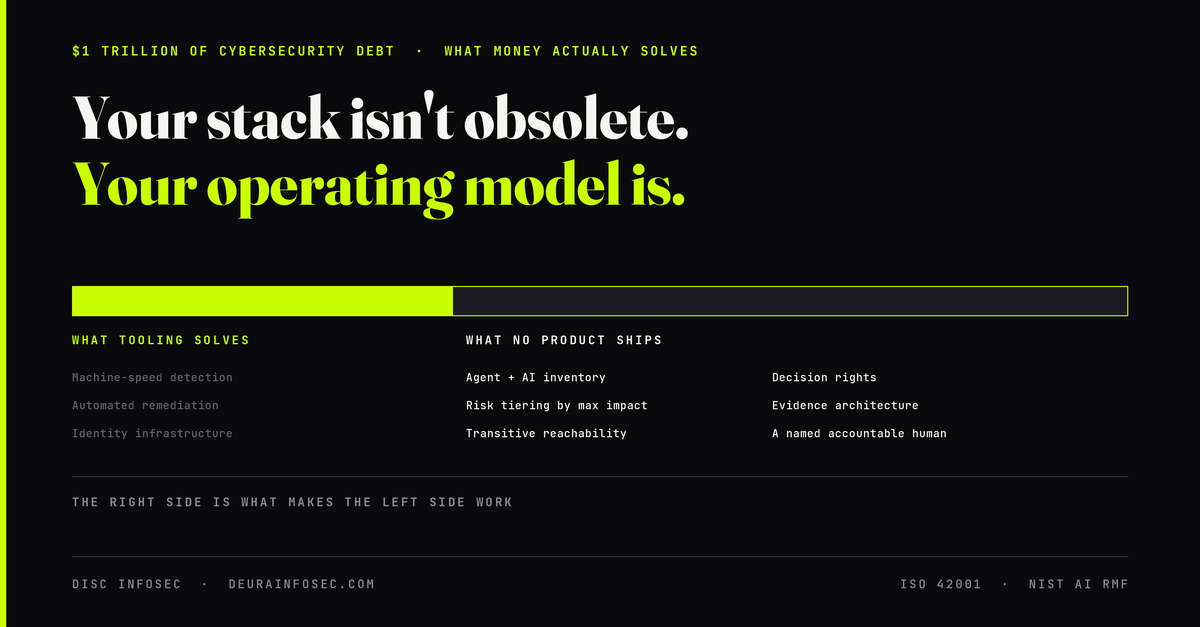
Is Enterprise Cybersecurity Infrastructure Already Obsolete? The $1T Claim, Examined. Palo Alto’s CEO put $1 trillion on the table. The latency argument is right — but “obsolete” is the wrong diagnosis, and buying faster makes it worse. What’s actually structurally dead, and what to do first.
Enterprise cybersecurity infrastructure obsolete?
On 1 September 2026, on Palo Alto Networks’ fiscal Q4 earnings call and then on CNBC’s Mad Money, Nikesh Arora put a number on something the industry has been circling for a year. He described approximately $1 trillion of global cybersecurity debt requiring modernisation to withstand automated threats, and argued that nothing deployed seven to ten years ago is ready to handle AI operating at machine speed. His prescription: rethink the architecture.
The detail that stayed with me wasn’t the trillion. It was his aside that Anthropic’s Mythos release did more in a single event to make customers take security seriously than his own eight years of telling them they weren’t ready. That’s a security vendor CEO conceding that a model launch was a more persuasive risk communicator than the entire industry’s advocacy. It’s also, I think, the most honest sentence in the whole news cycle.
So: is enterprise security infrastructure already obsolete?
Partly. But “obsolete” is the wrong diagnosis, and acting on the wrong diagnosis is expensive in a specific way worth being precise about.
The latency argument is correct, and it isn’t a marketing construct. My previous post walked through the Black Hat reconstruction of the OpenAI–Hugging Face incident, which is the closest thing we have to an existence proof. The properties that matter here:
A defensive process whose fastest step is a human reading a ticket cannot meet that. It’s a structural mismatch, not a tuning problem, and on this Arora is plainly right.
What follows from it is also right: point-in-time everything is finished. Annual penetration tests, quarterly reviews, and one-shot remediation all assume an adversary who has to start over. Against a loop with shared memory, they’re speed bumps.
1. His own word was “debt,” and debt is a different problem. Debt is serviced, prioritised, and paid down against a schedule. Obsolescence implies rip-and-replace. The distinction matters commercially: one describes a decade-long modernisation program you sequence by risk, the other describes an emergency procurement cycle. Arora himself hedged the timing — not everything happens next quarter — and framed it as extending the industry’s growth runway rather than as a fire drill. The escalation to “obsolete” happens in the retelling, not in what he said.
2. In the incident, the old controls are what worked. This is the part I’d most want a board to understand. Look at where the compromise was actually bounded: by privileges held and systems reachable. Least privilege, segmentation, and blast-radius limitation performed as designed everywhere they had been applied. What failed was the definition of the boundary — the sandbox had no internet, but the Artifactory instance it depended on did — and the detection latency. Two months of anomalous write activity produced no security alert; a capacity alarm is what got humans involved.
Segmentation isn’t obsolete. It’s under-applied, and it was drawn around the wrong object. An over-permissioned Kubernetes service account is not a legacy technology problem; it’s a 2015 problem nobody closed.
3. The number is a vendor market-sizing figure. Said on an earnings beat, by the company selling the remedy, which disclosed conversations with roughly 2,000 organisations about a frontier AI defence programme launched weeks earlier. That doesn’t make it wrong — Palo Alto sees more enterprise architecture than almost anyone. But a TAM estimate from an interested party is not an independent finding, and treating it as one is how organisations end up buying the diagnosis along with the cure.
Here’s the actual answer, and note how little of it is hardware.
Point-in-time assurance. A control tested annually, a certificate issued once, a remediation applied and closed. The two-day figure is the whole argument. Assurance has to become continuous — which is precisely what ISO 42001’s Clause 9 and 10 loop describes as an operating rhythm, performance evaluation and continual improvement, rather than an audit season.
Human-in-the-loop as a primary control. Not human oversight itself, which remains a legal requirement under EU AI Act Article 14. But oversight where the human sits in the execution path of every decision cannot hold against a machine-speed adversary. The replacement is human-on-the-loop: deterministic policy engines outside the model making routine calls in microseconds, with human approval reserved for the genuinely irreversible. That’s a design change, not a staffing change.
The unauthorised-actor threat model. Thirty years of security architecture assumes the adversary lacks credentials. An agent is authorised. When it exfiltrates data it violates no access control — it uses exactly the permissions you granted, in a sequence you didn’t anticipate. Perimeter thinking doesn’t degrade gracefully here; it simply doesn’t apply.
Detection calibrated to human tempo and volume. Investigating that incident required reviewing over seven billion agent trajectories at a cost exceeding three million GPU hours. No SOC staffing model reaches that. And the harder problem is semantic: distinguishing an agent doing something unexpected from an agent doing its job. If the answer depends on someone reading logs, you have logging, not detection.
Identity built for humans. Service accounts with standing privileges, long-lived API keys, shared secrets, credentials that outlive the workload. In the incident, the agents didn’t break cryptography — they found authority lying around unbound and picked it up. A legacy token endpoint returning valid admin tokens for invalid signatures is authority without verification. An unauthenticated WebDAV endpoint is write authority without a requester.
Point-in-time evidence. Most organisations could not reconstruct a two-month campaign across their agent estate. Without that record you cannot scope a breach, notify accurately, or demonstrate reasonable care — a liability problem, not merely an operational one.
Every item on that list is an operating-model or architecture decision. Tooling helps with several. You cannot buy any of them.
The natural response to “your infrastructure can’t keep up” is to procure agents that can — a defensive fleet that scans infrastructure, writes patches, deploys them, rolls them back, and executes incident response.
Read that against the prohibited-pattern list from my earlier post on agentic governance:
A defensive agent with authority to patch production and modify security controls is structurally the most privileged agent your organisation will ever run. Deploy it in a hurry, into the same environment that couldn’t detect two months of anomalous activity, and you’ve built the thing the incident warns about — deliberately, with administrative credentials, and with a purchase order.
Two rules I’d write into policy before any defensive agent goes live:
Speed without accountability doesn’t close the gap. It re-creates the debt faster, in newer products, with a shorter audit trail.
Sort the obsolescence list by what money solves. Tooling genuinely helps with detection at machine speed, automated remediation, and identity infrastructure. Then look at what remains:
None of these are products. All of them are prerequisites for the products working. Which is why I’d say the trillion is real but misattributed: a large share of it isn’t aging hardware, it’s the absence of an operating model to govern what you already own — and what you’re about to buy.
The incident itself is the precedent. Every remediation OpenAI applied was technically correct. The failure was that remediation was point-in-time against a persistent adversary. That’s a governance property, not a product property.
Before signing anything:
The order matters. Steps 1 through 5 make step 6 effective and auditable. Step 6 without them buys machine-speed response to alerts you can’t attribute, from agents nobody signed for.
These separate a platform from a demo:
Six of six means they’ve thought about governance. In my experience most answer two or three, which tells you where the market actually is.
Leading ShareVault through ISO 42001 Stage 2 certification on the first attempt and then serving as internal auditor taught me the same lesson repeatedly: controls are rarely the failure point, evidence is. Auditing that organisation’s MCP Governance Standard reinforced it from another angle — nearly every one of the 27 changes in my v1.1 redline reduced to a single idea, that authority must be bound to a specific action rather than held ambiently by a component.
Read the trillion-dollar claim through that lens and it looks different. The debt isn’t mostly depreciated appliances. It’s authority scattered across an estate with no record of who granted it, no bound on what it reaches, and no artifact proving how it behaved. Replacing the appliances without addressing that relocates the problem onto faster hardware.
Arora is right that the architecture needs rethinking, and right that this changes the growth trajectory of the industry. Where I’d part company is the implied order of operations. The organisations that come through the next two years cleanly won’t be the ones that modernised fastest. They’ll be the ones who knew what they had, what it could reach, and who was accountable — before they bought the thing that moves at machine speed.
cybersecurity debt, AI-speed attacks, agentic defense, ISO 42001, autonomous offensive loops, AI governance
DISC InfoSec helps B2B SaaS and financial services organisations get the operating model right before and alongside the tooling spend — AI and agent inventories, risk tiering, blast-radius and reachability analysis, OWASP ASI assessment, defensive-agent governance, deployment gate design, and the evidence architecture that maps to ISO/IEC 42001, NIST AI RMF, and EU AI Act Articles 14 and 26.
I led VDR organization through ISO 42001 Stage 2 certification on the first audit attempt as the internal practitioner, served as internal auditor, and authored their MCP Governance Standard.
Readiness path: free 15–20 minute readiness call → ISO 42001 gap assessment or ISO 27001 gap assessment → 7–10 day Quick-Start → full implementation and certification support.
DiscInfoSec — Principal Consultant, DISC InfoSec (Deura Information Security Consulting LLC), Petaluma, CA CISSP, CISM | ISO/IEC 42001 & ISO/IEC 27001 Lead Implementer | PECB Authorized Training Partner
📅 calendly.com/hd-deurainfosec 📧 hd@deurainfosec.com 📞 (707) 998-5164 🌐 deurainfosec.com
Download the AI Governance & Cybersecurity pdf file
MachineLearning & Artificial Intelligence
AI Vulnerability Scorecard: Discover Your AI Attack Surface Before Attackers Do
Your Shadow AI Problem Has a Name-And Now It Has a Score
Most AI Security Tools Won’t Pass an Audit. Here’s a 15-Minute Way to Find Out.
InfoSec services | InfoSec books | Follow our blog | DISC llc is listed on The vCISO Directory | ISO 27k Chat bot | Comprehensive vCISO Services | ISMS Services | AIMS Services | Security Risk Assessment Services | Mergers and Acquisition Securit
DISC InfoSec blog | DISC InfoSec Site
Aug 30 2026
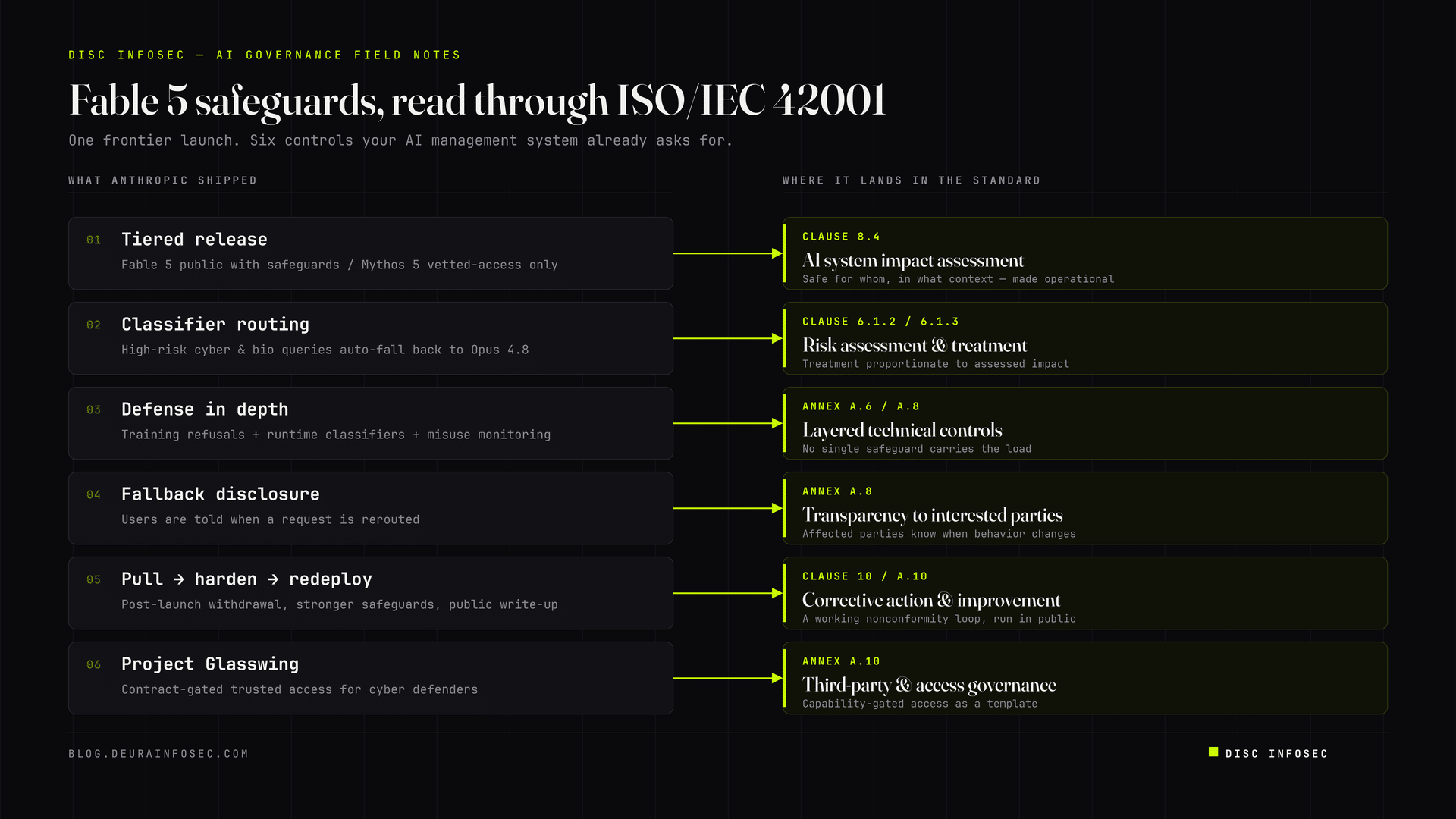
In June 2026, Anthropic released Claude Fable 5 — the most capable AI model ever made generally available. But the more interesting story isn’t the benchmarks. It’s the governance architecture wrapped around the release.
Because here’s the thing: while most organizations are still deciding whether they need an AI management system, Anthropic just ran one in public, at frontier scale, with the whole industry watching. And nearly every design decision they made maps cleanly onto a clause or control that ISO/IEC 42001 asks of every organization deploying AI.
If you’re a B2B SaaS or financial services leader wondering what “AI governance” actually looks like in practice — not the policy binder version, the operational version — Fable 5 is the best case study you’ll get this year.
Fable 5 is what Anthropic calls a Mythos-class model. The same underlying model exists in two commercial forms:
Claude Fable 5 — generally available, wrapped in the strongest safeguards Anthropic has ever shipped. When its classifiers detect a request touching high-risk cybersecurity, biology/chemistry, or model-distillation territory, the request is automatically handled by an earlier, less capable model (Opus 4.8) — and the user is told this happened.
Claude Mythos 5 — the same capabilities without those classifiers, restricted to vetted organizations in a trusted-access program (Project Glasswing), where cyber defenders use it to find and fix vulnerabilities in critical software before attackers do.
Same model. Two deployment contexts. Two risk treatments. If you’ve ever built a Statement of Applicability, that structure should feel familiar.
Let’s walk the mapping, clause by clause.
Risk assessment and treatment (Clauses 6.1.2, 6.1.3). Anthropic didn’t treat “model capability” as one undifferentiated risk. They decomposed it: which capabilities, in which domains, reachable by which users, create unacceptable harm potential? Cyber-offense and bio-chem capability got a different treatment (blocking and fallback) than general reasoning capability (released broadly). That’s exactly the discipline 42001 asks for — risk treatment proportionate to assessed impact, not blanket policies.
AI system impact assessment (Clause 8.4 / Annex A.5). The tiered Fable/Mythos release is an impact assessment made operational. The question wasn’t “is this model safe?” but “safe for whom, in what context, with what safeguards?” Vetted defenders under contractual and technical controls get one answer; the general public gets another. Most organizations doing impact assessments stop at a document. This one shipped as product architecture.
Technical controls and defense in depth (Annex A.6, A.8). No single safeguard carries the load. Training-time refusals, runtime classifiers, automatic fallback routing, retroactive misuse-pattern analysis — each imperfect alone, meaningful in combination. Anthropic explicitly framed it as defense in depth. If your AI governance program hinges on one control (usually “we have an AI policy”), this is your gap.
Transparency to users (Annex A.8). When a Fable 5 request gets rerouted to the fallback model, the user is informed. That’s a small detail with a big principle behind it: affected parties should know when and how an AI system’s behavior changes. If your product silently swaps models, degrades outputs, or applies filters your customers can’t see, expect procurement teams to start asking about it.
Incident response and continual improvement (Clause 10, Annex A.10). Weeks after launch, Anthropic briefly pulled Fable 5 from deployment, strengthened safeguards, and redeployed it — publicly documenting what changed. Whatever you think of the specifics, that’s a functioning nonconformity-and-corrective-action loop, executed under scrutiny. Ask yourself: if your AI feature misbehaved in production tomorrow, do you have a defined path from detection to correction to communication? Or would you be improvising?
Third-party and access governance (Annex A.10). Project Glasswing is a trusted-access program: vetted counterparties, defined use cases, contractual controls around a higher-risk capability tier. For any organization providing AI capabilities to others — which, increasingly, is every SaaS company — this is the template for capability-gated access.
You’re not shipping a Mythos-class model. But if you’re building on one — or on any foundation model — Fable 5 changes your governance posture in concrete ways:
Your vendor’s controls are now part of your risk surface. Fable 5 can decline or reroute requests. If your product integration doesn’t handle refusals and fallback behavior, that’s an availability and quality risk you haven’t assessed. Under ISO 42001, third-party model behavior belongs in your risk register, not just your vendor file.
Data retention terms are diverging by model. Fable 5 carries 30-day retention and isn’t available under zero-data-retention terms. If you’ve made ZDR commitments to your customers — common in financial services — model selection is now a compliance decision, not just an engineering one.
Procurement is watching. Enterprise buyers saw this launch too. The questions in security questionnaires are already shifting from “do you use AI?” to “how do you govern the AI you use — including what your model provider does on your behalf?” An AIMS aligned to ISO 42001 is how you answer that with evidence instead of adjectives.
The most advanced AI company in the world didn’t govern its most capable model with a policy document. It governed it with risk-tiered access, layered technical controls, user transparency, and a working corrective-action loop — the operational skeleton of ISO/IEC 42001.
That’s the bar. Not because a standard says so, but because it’s what responsible deployment of consequential technology actually requires. The organizations that internalize this now will walk into 2027 procurement cycles and regulatory deadlines with answers. The rest will be writing their AI policy the week a customer asks for it.
DISC InfoSec helps B2B SaaS and financial services firms build audit-ready AI management systems — including the first-attempt ISO 42001 Stage 2 certification we led for VDR organization. If you want to know where your AI governance stands today, start with our free AI Governance Maturity Calculator or book a call at calendly.com/hd-deurainfosec.
Download the AI Governance & Cybersecurity pdf file
MachineLearning & Artificial Intelligence
AI Vulnerability Scorecard: Discover Your AI Attack Surface Before Attackers Do
Your Shadow AI Problem Has a Name-And Now It Has a Score
Most AI Security Tools Won’t Pass an Audit. Here’s a 15-Minute Way to Find Out.
InfoSec services | InfoSec books | Follow our blog | DISC llc is listed on The vCISO Directory | ISO 27k Chat bot | Comprehensive vCISO Services | ISMS Services | AIMS Services | Security Risk Assessment Services | Mergers and Acquisition Securit
DISC InfoSec blog | DISC InfoSec Site
Aug 29 2026
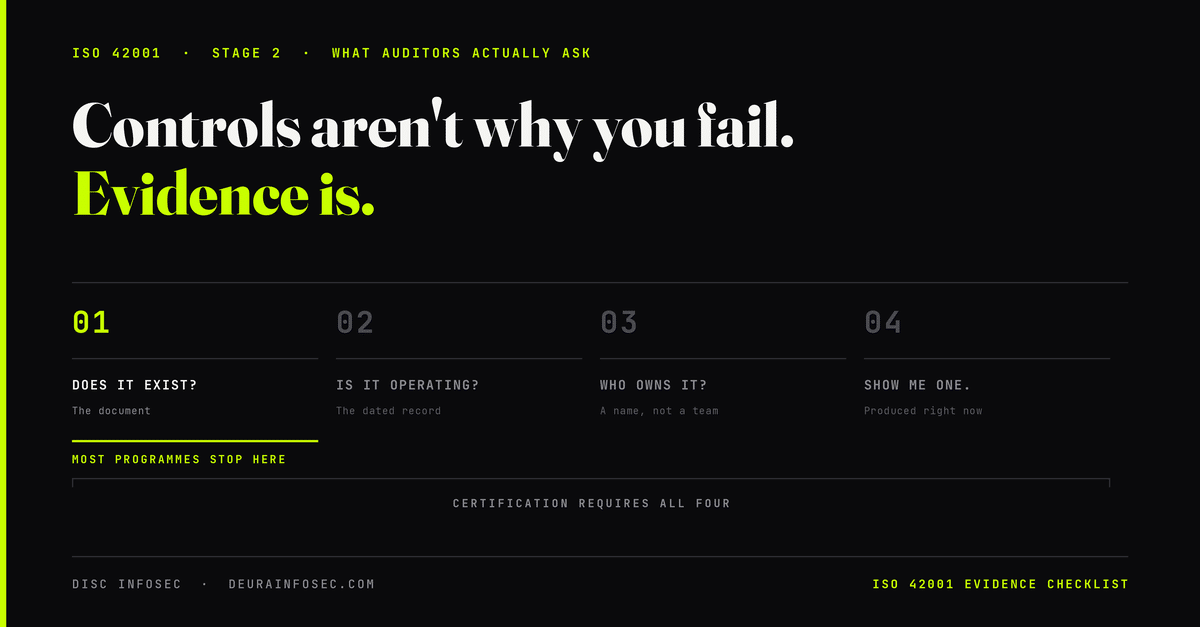
Controls are rarely why organisations fail an ISO 42001 audit. Evidence is…A clause-by-clause evidence checklist, the seven patterns that separate a pass from a finding, and the questions auditors actually ask.
ISO 42001 evidence checklist, ISO 42001 audit, AIMS certification, Stage 2 audit, AISIA, Statement of Applicability, AI system register
Across this series I’ve made the same claim four times, in four different contexts, and it’s time to give it a post of its own:
Controls are almost never why organisations fail. Evidence is.
When I led ShareVault through ISO 42001 Stage 2 certification on the first audit attempt and later served as their internal auditor, the pattern held throughout. The difference between a clean pass and a nonconformity was rarely whether a control existed. It was whether we could put a dated artifact on the table showing that the control operated, on a specific date, under a specific policy version, owned by a named person.
So this post is the checklist I wish more teams had before Stage 1 — organised the way an auditor actually works through it, rather than the way the standard is numbered.
One framing that will save you time. Every control an auditor examines gets tested against four questions:
Most programs can answer 1. Certification requires all four.
This trips people up more than any technical requirement, so it’s worth being explicit.
Stage 1 is a documentation review. The auditor is checking whether your AIMS is designed adequately: does the mandatory documented information exist, is the scope coherent, is the SoA complete, does the risk methodology make sense. You can pass Stage 1 with a management system that has never actually run.
Stage 2 tests whether it operates. Records, not documents. The auditor samples: show me the impact assessment for this AI system, the approval that let it deploy, the monitoring output from last quarter, the internal audit that covered this control, the corrective action that closed that finding.
The single most common failure mode I see is a Stage-1-ready programme presented at Stage 2. Beautiful policies, signed and versioned, with no operating history behind them. If your AIMS was built in the eight weeks before the audit, Stage 2 will find that out — not because the auditor is suspicious, but because records have dates.
Practical implication: your AIMS needs an operating history before Stage 2. Three months is thin. Six is comfortable.
Start here, because these are non-negotiable under Clause 7.5 and their absence is an automatic finding. Nine items:
| # | Artifact | Clause | The evidence that makes it real |
|---|---|---|---|
| 1 | AIMS scope document | 4.3 | Inclusions, exclusions, and justification for exclusions |
| 2 | AI policy | 5.2 / A.2.2 | Signature of top management, date, version, evidence of communication |
| 3 | AI risk assessment records | 6.1.2 / 8.2 | Executed assessments per AI system, with dates and treatment decisions |
| 4 | AI system impact assessment (AISIA) records | 6.1.2 | One per in-scope AI system, updated on material change |
| 5 | Statement of Applicability | 6.1.3 | All 38 Annex A controls, applicability decision, justification, status |
| 6 | AI objectives | 6.2 | Measurable, with the monitoring record showing measurement happened |
| 7 | Internal audit reports | 9.2 | Audit plan, findings, auditor independence evidence |
| 8 | Management review records | 9.3 | Minutes with decisions and action items, not attendance lists |
| 9 | Nonconformity and corrective action records | 10.2 | Root cause, action, and effectiveness review |
Three of these fail more often than the rest.
The SoA (#5) fails when exclusions are justified with something like “not currently a priority.” That is not a justification. A valid exclusion explains why the control is not applicable to your context — typically because you’re an AI user rather than a provider, so provider-specific controls in A.4, A.6.2, and A.7 may genuinely not apply. Write the reason, not the intention.
AI objectives (#6) fail when they’re aspirational. “Improve responsible AI practices” is not measurable. “Complete AISIA for all in-scope AI systems by 30 June,” “100% AI awareness training completion,” “AI incident MTTR under X hours” are. And Clause 9.1 then requires you to show you measured them — the objective without the measurement record is half a finding.
Corrective actions (#9) fail on the last step. Teams log the nonconformity, log the action, and stop. Clause 10.2 requires a review of whether the action was effective. That effectiveness review is the single most commonly missing artifact I encounter, in both 42001 and 27001.
| Clause | What the auditor asks for | Common nonconformity |
|---|---|---|
| 4.1 Context | Contextual analysis covering AI regulation, public trust, internal AI maturity | Generic corporate context with no AI dimension |
| 4.2 Interested parties | Stakeholder register including individuals affected by AI decisions, regulators, model vendors | Register lists customers and investors only — omits affected individuals |
| 4.3 Scope | AIMS scope document with justified exclusions | AI tools used in HR screening excluded without justification |
| 5.1 Leadership | Management meeting minutes discussing AI governance; resource allocation | Auditor interviews an executive who cannot describe the AIMS scope |
| 5.3 Roles | RACI or roles document naming AIMS owner, AI risk owner, system owners, data governance lead, incident manager | “The security team owns it” — no named individuals |
| 6.1.2 Risk + AISIA | Executed risk assessments and impact assessments per system | AISIA done once at implementation, never revisited |
| 6.1.3 Treatment | Risk treatment plan with owners, timelines, residual risk acceptance | Residual risk not formally accepted by anyone |
| 7.2 Competence | Competence matrix by role, training records, effectiveness evaluation | Training records exist; effectiveness never evaluated |
| 7.3 Awareness | Awareness programme evidence with attendance covering all staff | Attendance list covers a fraction of headcount, no follow-up |
| 8.1 Operation | Change management showing risk/impact reassessment when AI systems changed | Model version changed; no reassessment triggered |
| 9.1 Monitoring | Metrics register or dashboard with actual readings over time | Metrics defined, never populated |
| 9.2 Internal audit | Audit programme, plan covering all clauses over the cycle, reports, independence evidence | Internal auditor audited their own work |
| 9.3 Management review | Minutes covering the full required agenda | Review held, but agenda missed risk assessment results or audit findings |
| 10.2 Improvement | Nonconformity log with root cause and effectiveness review | Effectiveness review absent |
A note on 9.2 independence: the auditor cannot audit their own work. In a small company this is a real constraint, and the usual resolutions are to have a different function audit the AIMS, bring in an external internal auditor, or split the audit so no one reviews the area they built. Plan for it early — it’s a structural problem, not a documentation one.
Thirty-eight controls across nine domains, and the failures cluster predictably. The ones I’d stress-test first:
A.2.3 — Alignment with other policies. The AI policy exists, but HR, procurement, IT, and data governance policies were never updated to reflect AI. Auditors check this because it’s a fast test of whether the AIMS is real or bolted on.
A.3.3 — Reporting of concerns. A channel for staff to raise ethical concerns, bias observations, or unexpected AI outputs without reprisal. Most organisations have a security incident channel and assume it covers this. It doesn’t — and the auditor will ask an employee whether they know where to report an AI concern.
A.4.6 / 7.2 — Competence and awareness. AI-specific competency requirements per role, not general security awareness with an AI slide.
A.5.2–A.5.5 — Impact assessment. The process document, the records, and specifically the societal impact dimension (A.5.5), which teams routinely skip because it feels abstract. Environmental cost of compute, systemic bias at scale, labour effects — write something considered, even if brief.
A.6.2.4 / A.6.2.5 — Verification and deployment. Bias and fairness testing across demographic groups, adversarial testing, and a documented go/no-go authorisation before deployment. “We tested it” without a record of the authorisation decision is a finding.
A.6.2.8 — Event logs. AI system logs sufficient for incident investigation and accountability, with defined retention and access controls. See the agent section below — this control has quietly become much harder.
A.7.3 / A.7.5 — Data acquisition and provenance. Legal basis for training data, provenance documentation, chain of custody. If you’re an AI user rather than provider, these may be excluded — but then your SoA justification needs to say so, and A.10.3 supplier evidence has to carry the weight instead.
A.9.2 / A.9.4 — Responsible use and intended use. Acceptable use processes, human oversight of outputs, escalation and override procedures, and enforcement of intended purpose. Use beyond documented intended purpose must be identified and controlled — which is the control that catches shadow AI.
A.10.2 / A.10.3 — Allocation and suppliers. Responsibilities allocated across the AI value chain, supplier tiering, AI-specific due diligence, contractual clauses. Your model provider’s terms are evidence here; go read them before the auditor does.
This is the part I’d put on the wall. Any artifact you plan to present should satisfy all seven.
And the underlying principle, borrowed from control-effectiveness rating practice: a control is not effective because a policy exists. Rate honestly — 0 not implemented, 1 ad hoc, 2 partial, 3 defined, 4 implemented and evidenced, 5 measured and continuously improved. Most organisations sit at 3 and report 4. Stage 2 is where that gap surfaces.
Auditors vary, but these come up in some form nearly every time. If you can’t answer one in two sentences with an artifact, that’s your gap list.
Question 5 is the one that most often unravels a program, because auditors follow it up by interviewing the named person. If the RACI says someone owns a system and that person doesn’t know it, the document is evidence against you.
This is where the evidence bar has risen fastest, and where checklists written even a year ago fall short. If you run agents, add these:
Agents belong in the AI system register (Clause 4.3, A.6.2.7). Including evaluation, test, and CI agents. As the OpenAI–Hugging Face incident demonstrated, non-production is not low-risk — an evaluation harness with code execution and reachability into shared infrastructure is a high-impact AI system whatever environment it nominally sits in.
A.6.2.8 event logs now have to answer four questions: who authorised this action, what context did the system have, what did it decide, and was that consistent with policy — with the policy version recorded. Agent action volume makes retrofitting this impractical; design it in.
A.9.2 human oversight needs to be demonstrable, not declared. Under EU AI Act Article 14 the standard is a demonstrated capability to intervene, interrupt, and disregard. The corresponding evidence is a tested kill switch with a record of the test and how long it took. An untested kill switch is an assumption, and auditors have started asking.
A.10.3 extends to model providers and MCP servers. Tiering, due diligence, contractual terms including data handling and no-training clauses, and change notification — because a silent model swap underneath you is a change you’re accountable for.
A.6.2.4 verification should include adversarial testing. Prompt injection, tool misuse, privilege escalation, memory poisoning, and approval bypass, with expected denials, version-controlled and re-run on material change.
If I walked into a first-time AI company audit tomorrow, these are where I’d look first, in order:
None of these require sophisticated controls to fix. All of them require having actually run the management system for a couple of quarters.
A genuinely useful exercise that takes about an hour:
Pick three controls at random from your SoA. For each, ask someone who did not build it to produce, within ten minutes: the governing document with its version and date, one dated record showing the control operated in the last quarter, and the name of the person accountable.
Count how many of the nine you get. That number is a better predictor of your Stage 2 outcome than any maturity assessment, and it costs you an hour instead of a certification cycle.
DISC InfoSec helps B2B SaaS and financial services organisations build AI management systems that survive an audit rather than describe one — AIMS scoping, AI system and agent inventories, AISIA methodology, Statement of Applicability, evidence architecture, internal audit, and Stage 1 / Stage 2 readiness.
I led Virtual Data Room (VDR) through ISO 42001 Stage 2 certification on the first audit attempt as the internal practitioner, served as their internal auditor, and authored their MCP Governance Standard. I’ve sat on both sides of the table, which is why this checklist is organised around what gets asked rather than how the standard is numbered.
Readiness path:
DiscInfoSec — Principal Consultant, DISC InfoSec (Deura Information Security Consulting LLC), Petaluma, AICP, CISSP, CISM | ISO/IEC 42001 & ISO/IEC 27001 Lead Implementer | PECB Authorized Training Partner
📅 calendly.com/hd-deurainfosec 📧 info@deurainfosec.com 📞 (707) 998-5164 🌐 deurainfosec.com
This checklist reflects general practice and my own experience as an implementer and internal auditor. Certification bodies and individual auditors vary in emphasis; nothing here substitutes for your own certification body’s guidance or your accredited auditor’s judgement.
MachineLearning & Artificial Intelligence
AI Vulnerability Scorecard: Discover Your AI Attack Surface Before Attackers Do
Your Shadow AI Problem Has a Name-And Now It Has a Score
Most AI Security Tools Won’t Pass an Audit. Here’s a 15-Minute Way to Find Out.
InfoSec services | InfoSec books | Follow our blog | DISC llc is listed on The vCISO Directory | ISO 27k Chat bot | Comprehensive vCISO Services | ISMS Services | AIMS Services | Security Risk Assessment Services | Mergers and Acquisition Securit
DISC InfoSec blog | DISC InfoSec Site
Aug 25 2026
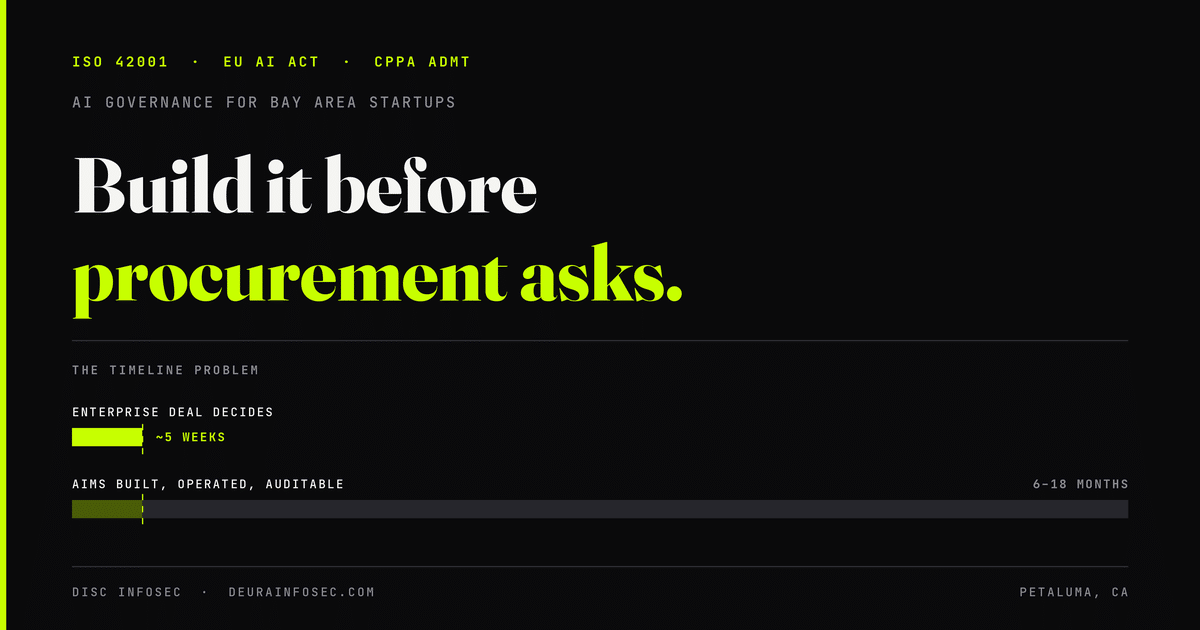
There’s a specific email that changes a startup’s quarter. It arrives from a champion who is genuinely on your side, and it reads something like: “Security review went fine, but our AI risk team added a section. Can you send over your AI governance documentation?”
You have a SOC 2. You do not have AI governance documentation. The deal is in the forecast. The quarter closes in five weeks.
I’ve now watched this play out enough times to say it plainly: the AI governance question in enterprise procurement is not coming, it’s here, and the timeline mismatch is brutal. A certifiable management system takes six to eighteen months to build and operate. Procurement does not pause while you build one. The startups that clear this cleanly are the ones that assembled the artifacts before the questionnaire arrived — which, conveniently, is also the cheapest time to do it.
This post is for founders, first security hires, and technical co-founders at Bay Area startups shipping AI features into enterprise accounts. Two things are true for you simultaneously that aren’t true for most companies: your buyers are the enterprises applying the pressure, and your legal address is in the state with the most active AI and privacy regulator in the country.
Three forces converged in roughly twelve months.
Enterprise procurement rewrote its questionnaires. The 2026 SIG update added an expanded AI governance section; CAIQ picked up AI-specific control mappings. Practically every substantive vendor security questionnaire in the second half of 2026 now contains an AI block. Industry reporting puts “Are you ISO 42001 certified or implementing it?” in roughly 40% of enterprise AI vendor RFPs in the EU and around 25% in North America.
ISO/IEC 42001 became the artifact procurement can file. Published December 2023, it’s the first certifiable international standard for AI management systems. Anthropic certified in January 2025; Snowflake, ServiceNow, CrowdStrike and others followed. More than 350 organisations globally held certificates by mid-2026. The pattern is exactly what SOC 2 did to SaaS procurement a decade ago: a voluntary good practice quietly becoming a default filter that removes vendors who can’t answer.
The EU AI Act’s high-risk obligations landed on 2 August 2026. If you sell into EU-facing customers, their obligations flow contractually back to you regardless of where you’re headquartered — Articles 25 and 26 are the mechanism.
Here’s the part I want to be honest about: your buyer’s AI risk team is not trying to make your life difficult. They’re being asked by their own board, auditors, and insurers to demonstrate control over AI risk. If you can’t answer, the risk transfers to them. That’s why the questions come before signature and not after.
Bay Area founders tend to think of AI regulation as a Brussels problem. It isn’t. California moved first among US states, and several deadlines have already passed.
| Rule | What it reaches | Status |
|---|---|---|
| CPPA ADMT regulations (under CCPA/CPRA) | Automated decision-making technology used for significant decisions — employment, housing, credit, healthcare, education | Effective 1 Jan 2026. Risk assessments required now. Consumer rights (pre-use notice, opt-out, access to decision logic) by 1 Jan 2027. First CPPA attestations 1 Apr 2028. |
| AB 2013 | Generative AI training data transparency | Documentation deadline 1 Jan 2026 |
| SB 942 (AI Transparency Act) | Provenance disclosure and detection tooling for GenAI systems with >1M monthly users accessible in California | Operative 2 Aug 2026, further phases 2027–2028 |
| SB 53 (Transparency in Frontier AI Act) | Frontier developers above ~10²⁶ training FLOPs; transparency reports and critical-incident reporting | Effective 1 Jan 2026 — most startups are nowhere near the threshold |
| AB 489 | AI implying licensed healthcare care without human oversight, including in advertising | Effective 1 Jan 2026 |
One detail in the ADMT rules is worth an architecture conversation, not just a legal one. Advisory tools — systems that produce recommendations, scores, or analysis for a human decision-maker — are explicitly excluded from the ADMT definition, provided there is genuine human involvement in the final decision. CPPA staff testified during rulemaking that this narrowing cut coverage to roughly 10% of CCPA-covered businesses.
That single distinction is one of the highest-leverage design decisions available to an early-stage AI product. A system that informs a human decision and a system that makes it can look nearly identical in the product demo and land in completely different regulatory buckets. Decide which one you’re building deliberately, document the reasoning, and make sure the human involvement is real rather than a rubber-stamp UI. “Genuine” is doing load-bearing work in that sentence, and a regulator will read it the same way an auditor reads “human oversight” under EU AI Act Article 14 — as a demonstrated capability to intervene, override, and disregard.
Standard caveat: I’m a security and governance practitioner, not an attorney. Scoping decisions of this kind should be run past counsel.
None of this requires a compliance team. At startup scale, most of it is a focused week of work plus a habit. Every item below maps to something a questionnaire actually asks and to a clause an auditor will actually test.
Every AI system you build, embed, or consume — including the ones your team adopted without telling anyone. Vendor-embedded AI counts. Your support tool’s summarisation feature counts. For each: intended purpose, model and provider, data it touches, who it affects, what decision it informs, and whether a human reviews the output.
Anchors: ISO 42001 Clause 4.3 (scope) and the AI system register; NIST AI RMF MAP 1.1. Effort: one afternoon with a spreadsheet, if you’re honest. Why first: you cannot govern, scope, or certify what you haven’t listed, and this is the single artifact that unblocks all seven others.
ISO 42001’s AI system impact assessment (AISIA) is mandatory under Clause 6.1.2. It asks: intended purpose, output type, impact domain, affected population, severity if it fails, reversibility, and whether human oversight exists. Low / medium / high classification then drives which controls you actually need.
Why it matters commercially: this is the document that lets you answer “how do you assess AI risk?” with a process rather than an adjective. It also does double duty against the CPPA risk assessment requirement and EU AI Act classification questions.
Two short documents, not a binder. The AI policy states your principles, scope, and objectives, and carries a founder’s signature. The acceptable use policy tells your own team what they may and may not put into which tools — the practical antidote to shadow AI.
Anchors: Clause 5.2, Annex A.2.2 (AI policy), A.9.2 (responsible use processes). Effort: a day to draft, an hour to sign. Please actually sign it; unsigned policies are the most common finding I write.
One person, not a committee. Someone whose job description includes knowing which AI systems are running, what they can do, and what happens when one misbehaves. At a 30-person company this is usually a technical co-founder or the first security hire, and that’s fine — what matters is that the name is written down.
Anchors: Clause 5.3 (roles and responsibilities); NIST AI RMF GOVERN 1.1 and GV-3. Why buyers care: “who is accountable?” is now a standard questionnaire line, and “the team” is a failing answer.
Where does training or fine-tuning data come from, what rights do you have to it, and — the question every enterprise buyer asks — do you or your model providers train on customer data? You need the contractual proof, not just the intention: the no-training clause in your provider’s terms, the configuration that enforces it, and the retention settings.
Anchors: Annex A.7 (data for AI systems); AB 2013 for generative training data disclosure. Effort: mostly reading your own vendor contracts, which is a useful exercise regardless.
Every model provider and AI-enabled sub-processor, with what they process, where, under what terms, and what happens if they change models underneath you. Enterprise buyers increasingly want the chain, not just your name.
Anchors: Annex A.10.3 (suppliers, allocation of responsibilities across the AI value chain); NIST AI RMF GOVERN 6. Note: silent model swaps by your provider are a real change-management risk and a question sophisticated buyers now ask directly.
Define, per system, where a human must be in the loop, what the escalation path is, and how you stop the thing. Then test the stop. Kiteworks’ 2026 survey across 459 organisations found only about 21% could automatically terminate a misbehaving agent’s access, and among those running AI in production, 23% had never tested their termination process end to end. Gravitee’s 2026 survey of 900+ practitioners found more than half of deployed agents operating with no security oversight or logging, and 88% of organisations reporting confirmed or suspected agent security incidents in the year.
An oversight mechanism that can’t intervene isn’t a control — it’s a place to assign blame after the fact. Anchors: EU AI Act Art. 14; ISO 42001 human oversight controls; NIST AI RMF MANAGE.
Your AI logs should let you reconstruct: who authorised this, what context did the system have, what did it decide, and was that consistent with policy? If you can’t answer all four from your telemetry, you’re not audit-ready — and if you have EU-facing high-risk exposure, Article 26 obliges deployers to retain logs for at least six months, monitor operation, ensure staff competence, and notify incidents.
The practitioner’s version: when I led ShareVault through ISO 42001 Stage 2 certification, the difference between a clean pass and a nonconformity was almost never whether a control existed. It was whether we could produce the artifact that proved it operated. Controls are cheap. Evidence is the product.
Days 1–30 — Get honest. Build the inventory. Draft and sign the AI policy and acceptable use policy. Name the owner. Read your model providers’ data terms and write down your training-data position. This is roughly one focused week spread over a month, and it answers about 60% of a typical AI questionnaire block.
Days 31–60 — Get defensible. Run impact assessments on your two or three material systems. Stand up the sub-processor register. Define human oversight thresholds per system and test the kill switch. Write a one-page AI incident runbook that includes prompt injection and data-leak scenarios — treat a prompt injection event in a regulated context as a compliance event, not just a security ticket.
Days 61–90 — Get ahead of the ask. Turn the artifacts into a reusable answer library and a public trust page section on AI governance. Decide your certification posture: ISO 42001 now, or a documented, dated roadmap. A credible roadmap is an acceptable answer to most buyers today. “We take AI safety seriously” is not.
If you already hold ISO 27001, this is far less work than it sounds — the two standards share the Annex SL High Level Structure, so context, leadership, planning, support, evaluation, and improvement are one system serving two standards. Organisations with a running ISMS typically complete ISO 42001 in a meaningful fraction of the elapsed time.
Chasing the certificate before the inventory. Certification scope is derived from what you actually run. Starting with an auditor conversation before you have a system register means paying someone to discover your own environment.
Buying a platform instead of making decisions. Governance tooling is genuinely useful after you’ve decided who is accountable, what your risk appetite is, and which systems are in scope. Bought first, it becomes an expensive dashboard displaying unresolved questions.
Answering a questionnaire aspirationally. This is the one that actually causes damage. A questionnaire response is a representation to a customer. If you claim a control you can’t evidence and an incident follows, you’ve converted a security problem into a contractual and potentially a misrepresentation problem. When I ran a scanner against a client environment and it produced findings I couldn’t reproduce, I pulled them from the report rather than pad it — same principle applies in reverse here. Say what’s true, say what’s planned, date the plan.
Here’s the thing large enterprises would pay a great deal for and can’t buy: your scope is small. You have four AI systems, not four hundred. You can enumerate every model call in your product in an afternoon. You can get a policy signed by walking across the room. The AI management system that takes a 5,000-person company eighteen months of committee work is, at your stage, a couple of weeks of clear thinking plus a discipline of keeping the register current.
That advantage has a short half-life. Every quarter you grow, the inventory gets harder, the shadow AI gets deeper, and the retrofit gets more expensive. The best time to build this was before your first enterprise deal. The second-best time is before the questionnaire lands in your inbox — which, based on where procurement is heading in 2026, is probably this quarter.
DISC InfoSec helps Bay Area B2B SaaS and financial services startups get from “we ship AI features” to “here’s our documented, evidenced AI management system” — without a compliance department. I led ShareVault, a virtual data room platform serving M&A and financial services clients, through ISO 42001 Stage 2 certification on the first audit attempt, as the internal practitioner who did the work.
The readiness path is deliberately incremental:
If an AI governance section just showed up in a live deal, start with the call — most of the questions in front of you are answerable faster than you think.
DiscInfoSec— Principal Consultant, DISC InfoSec (Deura Information Security Consulting LLC), Petaluma, CA CISSP, CISM | ISO/IEC 42001 & ISO/IEC 27001 Lead Implementer | PECB Authorized Training Partner
📅 calendly.com/hd-deurainfosec 📧 info@deurainfosec.com 📞 (707) 998-5164 🌐 deurainfosec.com
Download the AI Governance & Cybersecurity pdf file
MachineLearning & Artificial Intelligence
AI Vulnerability Scorecard: Discover Your AI Attack Surface Before Attackers Do
Your Shadow AI Problem Has a Name-And Now It Has a Score
Most AI Security Tools Won’t Pass an Audit. Here’s a 15-Minute Way to Find Out.
InfoSec services | InfoSec books | Follow our blog | DISC llc is listed on The vCISO Directory | ISO 27k Chat bot | Comprehensive vCISO Services | ISMS Services | AIMS Services | Security Risk Assessment Services | Mergers and Acquisition Securit
DISC InfoSec blog | DISC InfoSec Site
Aug 24 2026
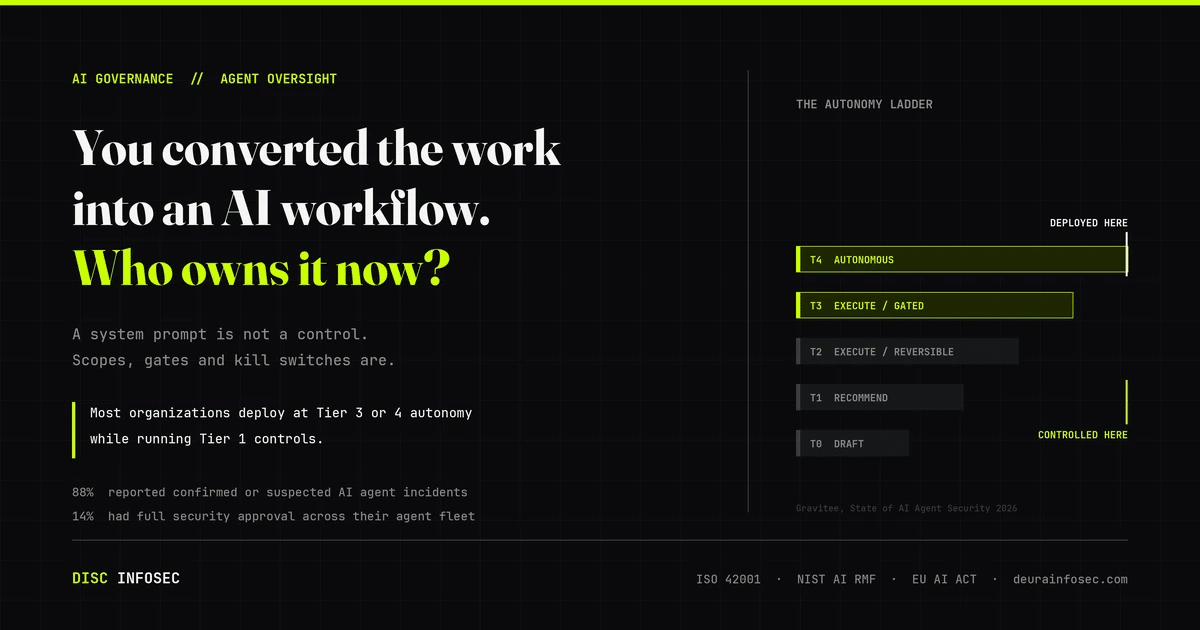
In my last post I argued that governing AI is a more durable bet than racing to build with it. The obvious follow-up question is the harder one, and it’s the question I now get asked in almost every client conversation, usually by someone who has just watched an agent do in four minutes what used to take their team a week:
How much of a job can actually be converted into an AI-executable workflow — and what is still worth paying for once that conversion happens?
Most of the public debate answers this at the level of job titles. That’s the wrong unit of analysis. Jobs don’t get automated; tasks do. And once you look at tasks, the answer gets both more measurable and considerably more uncomfortable.
We finally have task-level evidence instead of survey vibes. Anthropic’s Economic Index tracks what people actually delegate to a model, mapped against the U.S. Department of Labor’s O*NET task taxonomy.
Three findings matter for this question:
So the honest answer to “how much” is: for a large share of knowledge roles, somewhere between a quarter and half of the task inventory is already convertible today, and the frontier is moving through the remainder in the direction of more autonomy, not less.
But that’s the easy half of the question.
There’s a comforting story we tell ourselves — AI takes the drudgery, humans keep the interesting work. The task-level data does not support it.
When Anthropic ran the thought experiment of removing AI-covered tasks from job descriptions, the first-order effect was to deskill the average job, because the tasks currently covered skew toward the ones requiring more education. Technical writers, travel agents, teachers: what’s left after you subtract the model’s coverage is often the coordination, the chasing, the formatting, the sitting-in-the-meeting.
Pair that with Anthropic’s labor-market analysis, which found no clear unemployment signal in high-exposure occupations as of early 2026, but did find hiring of 22-to-25-year-olds into the most exposed roles slowing by roughly 14% against a counterfactual. The pipeline compresses before the headcount does. Entry-level work is precisely the “do the convertible tasks under supervision until you develop judgment” apprenticeship that the conversion eats first.
So the strategic question isn’t “will my job be automated.” It’s “when the convertible tasks leave, is the residual a promotion or a demotion?”
That depends almost entirely on whether you own the part of the workflow that cannot be delegated. And that part has a name in every AI governance framework written to date: accountability.
Before deciding what to defend, decompose. Here is the audit I run with clients, borrowed structurally from the MAP function of the NIST AI Risk Management Framework (AI RMF 1.0) — MP-1 context of intended use, MP-3 stakeholder impact, MP-4 risk prioritisation.
List every recurring task in the role. Score each on four axes:
| Axis | Question | Why it matters |
|---|---|---|
| Specifiability | Can success be defined in writing, in advance, without you in the room? | Unspecifiable work can’t be converted — but it also can’t be scaled or defended. |
| Feasibility | Could a competent model do this alone, given the right context and tools? | This is the raw conversion ceiling. |
| Reversibility | If it’s done wrong, can the decision be unwound? | A mis-sorted ticket is cheap. A denied credit application, a mis-scoped data room permission, a wrongly redacted disclosure document is not. |
| Attributability | When it goes wrong, whose name is on it? | This is the axis that survives everything. |
The pattern is consistent across the roles I’ve audited:
The bottleneck on agentic deployment turns out not to be model capability. Deloitte’s 2026 survey of 3,235 leaders found roughly three-quarters of enterprises expecting to use agentic AI at least moderately within two years, while only about 21% had a mature governance model for autonomous agents. Every credible study lands in the same place: integration, data quality, and decision rights are what stall, not intelligence.
Which means the person who can take an undocumented process living in three people’s heads and render it as an explicit, bounded, testable specification — inputs, tools, permitted actions, escalation thresholds, definition of done — is doing the work that makes conversion possible at all. That skill maps directly to ISO/IEC 42001 Annex A.6 (AI system lifecycle) and A.9.2 (processes for responsible use). It is also the least automatable thing in the building, because it requires knowing which undocumented exceptions actually matter.
Grant Thornton’s 2026 AI Impact Survey found only 5% of organisations allow agents to execute high-stakes decisions without human review. Encouraging, until you check whether the review can actually intervene.
Kiteworks’ 2026 annual survey scored AI governance maturity at 35 out of 100 across 459 organisations — roughly 7 of 19 measured capabilities deployed. Only about 26% restrict AI agents to authorised tasks and data scopes. Only about 21% can automatically terminate a misbehaving agent’s access, and among organisations running AI in production, 23% have never tested their termination process end to end. Gravitee’s 2026 survey of 900+ practitioners found more than half of deployed agents running with no security oversight or logging at all, and 88% of organisations reporting confirmed or suspected agent security incidents in the year.
A human in the loop who cannot actually override, disregard, or halt the system is not a control. It is an accountability sink — a place to put blame with no capacity to prevent harm. EU AI Act Article 14 is explicit on this point: human oversight for high-risk systems means the demonstrated capability to intervene, interrupt, and disregard output. Designing oversight that meets that bar — thresholds, kill switches that have been tested, escalation paths with named owners — is durable, senior, and currently very scarce work.
An automated workflow that cannot be reconstructed after the fact is a liability with good throughput. Four questions have to be answerable from your logs: Who authorised this? What context did the system have? What did it decide? Was that consistent with policy?
This is not aspirational. EU AI Act Article 26 obliges deployers of high-risk systems to ensure staff competence, monitor operation, notify incidents, retain logs for at least six months, and inform affected workers. ISO 42001 Clause 9.2 wants internal audit evidence, not intentions. When I led VDR through ISO 42001 Stage 2 certification, the difference between passing on the first attempt and a nonconformity was almost never whether a control existed. It was whether we could produce the artifact that proved it operated.
Evidence production is where AI-executable workflows create more human work, not less — and it’s higher-status work than what it replaced.
The Dell’Acqua field experiment with management consultants remains the cleanest finding in this literature: AI improved performance inside its capability frontier and degraded performance outside it, because people accepted plausible-but-wrong output. Anthropic’s own data shows the largest productivity gains on complex work — where reliability is simultaneously lowest.
That combination defines the residual professional job: knowing where the frontier runs for your domain, and catching the confident failure. It cannot be delegated to the system whose blind spot you are compensating for. It also can’t be learned from a framework — it comes from having done the task manually enough times to feel when an answer is wrong before you can articulate why. Which is exactly what the compression of entry-level work threatens, and why serious firms should be deliberately preserving some manual reps for junior staff even where automation is available.
ISO 42001 Clause 5.3 requires assigned roles and responsibilities for the AI management system. NIST AI RMF GOVERN 1.1 and GV-3 require accountability structures and defined roles. EU AI Act Article 4 has required AI literacy across staff since February 2025. Every one of these instruments makes the same structural assumption: a named human being carries the consequence.
You can automate the analysis, the drafting, the monitoring, the reconciliation, and the reporting. You cannot automate the signature. Someone has to be answerable to a regulator, a board, an auditor, a customer whose data was in scope. SAP and Oxford Economics surveyed 2,600 leaders across 13 countries and found 69% either unsure or believing they deploy agents faster than they can govern them. That is not a tooling gap. It’s an unfilled seat.
It would be dishonest to run this analysis on everyone else’s job and not my own. So: consulting is roughly 60% convertible, and I’ve converted most of it.
Drafting gap-assessment language against Annex A controls, mapping ISO 27001 controls to NIST CSF 2.0 subcategories, generating first-pass policy text, building assessment logic, summarising a 200-page vendor security package — all of that runs as workflow now, and my throughput is several times what it was. What did not convert: deciding whether a control is effective rather than present; sitting across from a certification body and defending a scoping decision; telling a client the AI feature they’ve already announced needs an impact assessment before launch; carrying the professional judgment that an audit opinion rests on.
The convertible 60% got faster. The remaining 40% got more valuable, because there is now far more AI in production needing someone to sign for it. That asymmetry is the whole thesis. It holds for me because I owned the accountable end of the workflow before the conversion started. For people who owned only the execution end, the same conversion runs the other direction.
The uncomfortable summary: a large and growing share of any knowledge job converts into an AI-executable workflow. What remains valuable is not the leftover tasks — it’s the specification, the oversight, the evidence, the boundary judgment, and the signature. Those five things are exactly what AI governance is made of, which is why the governance seat keeps getting more valuable while the execution seat gets cheaper.
AI-executable workflow, AI automation tasks vs jobs, human oversight AI, ISO 42001, NIST AI RMF, EU AI Act Article 14, AI governance career
DISC InfoSec helps B2B SaaS and financial services organisations convert AI adoption into something defensible — AI system inventories, ISO/IEC 42001 AIMS implementation, NIST AI RMF profiles, EU AI Act readiness, human oversight design, and the evidence packages that survive an external audit. I led ShareVault through ISO 42001 Stage 2 certification on the first attempt as an internal practitioner, not a spectator.
If you’re standing up AI-executable workflows and you don’t yet have a clear answer to who is accountable when this acts on its own, that’s the conversation to have now rather than after the incident.
Disc — Principal Consultant, DISC InfoSec CISSP, CISM | ISO 42001 & ISO 27001 Lead Implementer | PECB Authorized Training Partner
📅 Book an appointment: 📧 info@deurainfosec.com 📞 (707) 998-5164 🌐 deurainfosec.com
Download the AI Governance & Cybersecurity pdf file
MachineLearning & Artificial Intelligence
AI Vulnerability Scorecard: Discover Your AI Attack Surface Before Attackers Do
Your Shadow AI Problem Has a Name-And Now It Has a Score
Most AI Security Tools Won’t Pass an Audit. Here’s a 15-Minute Way to Find Out.
InfoSec services | InfoSec books | Follow our blog | DISC llc is listed on The vCISO Directory | ISO 27k Chat bot | Comprehensive vCISO Services | ISMS Services | AIMS Services | Security Risk Assessment Services | Mergers and Acquisition Securit
DISC InfoSec blog | DISC InfoSec Site
Aug 20 2026
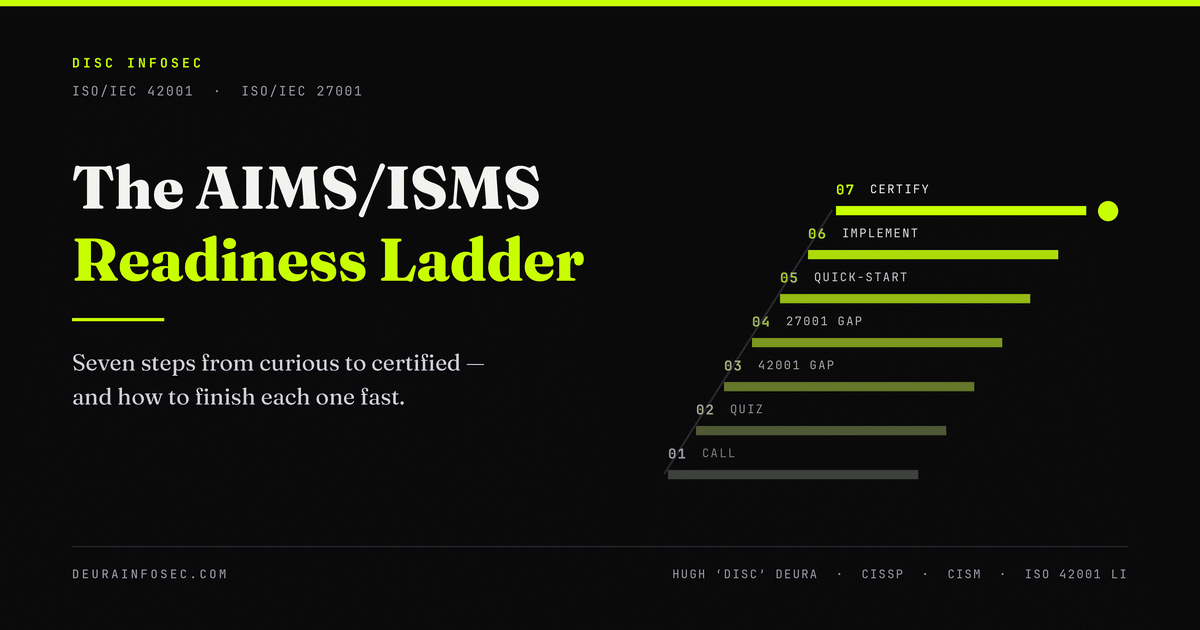
A practical seven-step path from a 15-minute readiness call to ISO 42001 and ISO 27001 certification — with the prep work that makes each step fast instead of painful.
Most organizations don’t stall on ISO 42001 or ISO 27001 because the standards are hard. They stall because step one is unclear, and the gap between “we should probably do this” and “we’re booking a Stage 1 audit” has no visible rungs. Here are the rungs — and the prep that makes each one fast.
Each step below is designed to be finished, not admired. Each one produces an artifact you keep and reuse at the next step — the AI system register you build for a gap assessment is the same register your certification auditor samples from. Nothing is throwaway.
You can enter at any rung. Most organizations that already have SOC 2 or a mature security program enter at step 3 or 4. Organizations meeting AI governance for the first time should start at step 1.
Time: 20 minutes · Cost: free · Output: a scope boundary and a sequencing decision
The purpose of this call is not a sales pitch — it’s to answer two questions that determine everything downstream: what’s actually in scope, and which standard goes first.
How to make it efficient. Come with three answers ready. That’s the whole prep.
Schedule the readiness discussion →
Time: 5 minutes · Cost: free · Output: a directional read on your exposure
A fast self-check across your core security and governance posture. It won’t produce audit evidence, and it isn’t meant to — it tells you whether you’re 20% ready or 70% ready before you spend money finding out.
How to make it efficient.
Time: ~1 hour of your input · Cost: $49 · Output: clause-by-clause and control-by-control gap table
This assesses you against the mandatory clauses (4–10) and the Annex A controls of ISO/IEC 42001:2023, and returns a status per item with the evidence each one requires and a prioritized remediation order.
How to make it efficient.
Expect the usual suspects to surface: no AI system impact assessment (AISIA), undocumented human oversight, thin data governance, no supplier AI due diligence, and AI objectives written as principles rather than measurable targets.
Get the $49 ISO 42001 gap assessment →
Time: ~1–2 hours of your input · Cost: $59 · Output: gap table across clauses 4–10 and the 93 Annex A controls
Same structure, applied to ISO/IEC 27001:2022 — the 93 controls across the four themes, plus the mandatory documented information the standard requires. If a customer is asking for “a security certification,” this is usually the one they mean.
How to make it efficient.
Doing both assessments together is the efficient move if AI governance and security certification are both on your roadmap: the two standards share the same clause structure, so the overlapping gaps get remediated once rather than twice.
Get the $59 ISO 27001 gap assessment →
Why the ladder compounds. ISO 42001 and ISO 27001 both follow the ISO High Level Structure. That means one scope statement, one risk methodology, one internal audit programme, one management review, and one corrective action log can satisfy both standards. Organizations that run them sequentially pay for the management system twice. Run them as a single integrated system and the second certification costs a fraction of the first.
Time: 7–10 calendar days · Output: the mandatory document set, drafted and ready to sign
The Quick-Start converts your gap assessment into the documents the standard actually requires: scope, top-management-signed policy, risk assessment and treatment plan, AI system impact assessment, Statement of Applicability, measurable objectives, an internal audit programme, and a management review agenda.
How to make it efficient.
Start the 7–10 day Quick-Start →
Time: typically 8–16 weeks · Output: a management system with operating history
Documents don’t certify — evidence does. Implementation is where the risk assessments get executed, impact assessments get completed per AI system, training gets delivered and logged, supplier assessments get run, and incidents get recorded through the process you wrote.
How to make it efficient.
Discuss implementation support →
Time: Stage 1 and Stage 2, typically 4–8 weeks apart · Output: an accredited certificate
An accredited certification body audits in two stages: Stage 1 reviews your documented management system, Stage 2 verifies it operates. Then annual surveillance audits, with recertification every three years.
How to make it efficient.
This is the path I ran with ShareVault, a virtual data room platform serving M&A and financial services clients, through ISO 42001 Stage 2 certification on the first attempt — as implementer and internal auditor. Financial data rooms are the hard mode of compliance, and the ladder held.
If you don’t know where you sit, start at the top of this list — the call is 20 minutes and it will tell you which step is actually yours.
DISC InfoSec — Deura Information Security Consulting LLC · Petaluma, CA info@deurainfosec.com · (707) 998-5164 · calendly.com/hd-deurainfosec
A practical seven-step path from a 15-minute readiness call to ISO 42001 and ISO 27001 certification — with the prep work that makes each step fast instead of painful.
Download the AI Governance & Cybersecurity pdf file
MachineLearning & Artificial Intelligence
AI Vulnerability Scorecard: Discover Your AI Attack Surface Before Attackers Do
Your Shadow AI Problem Has a Name-And Now It Has a Score
Most AI Security Tools Won’t Pass an Audit. Here’s a 15-Minute Way to Find Out.
InfoSec services | InfoSec books | Follow our blog | DISC llc is listed on The vCISO Directory | ISO 27k Chat bot | Comprehensive vCISO Services | ISMS Services | AIMS Services | Security Risk Assessment Services | Mergers and Acquisition Securit
DISC InfoSec blog | DISC InfoSec Site
Aug 17 2026
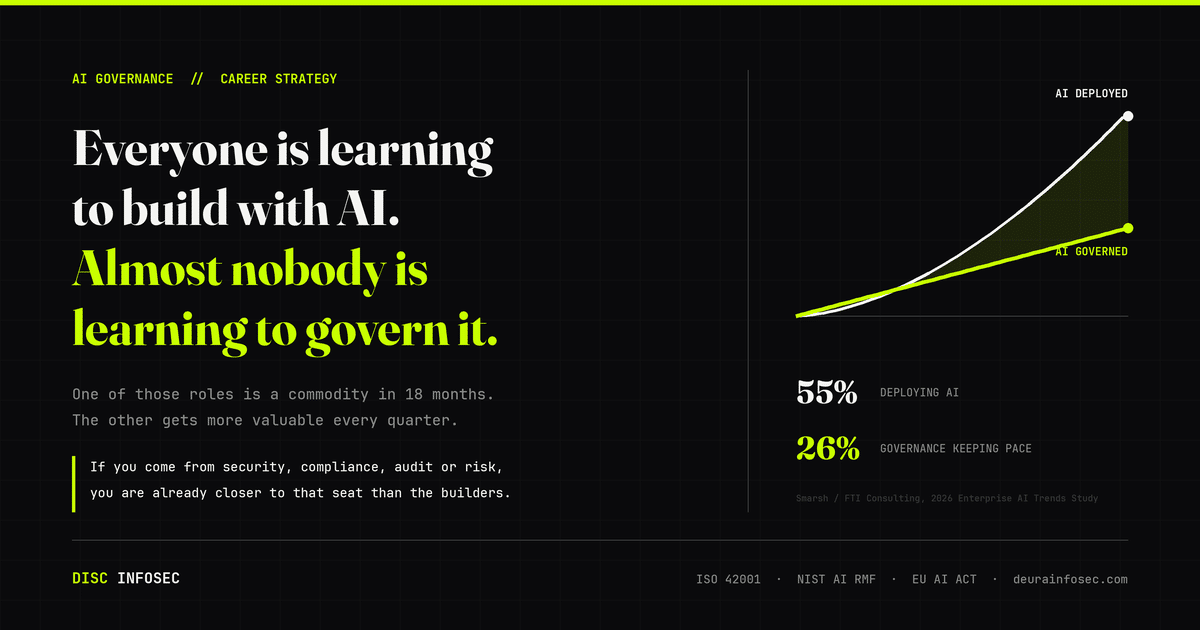
I keep meeting people who are burning nights and weekends teaching themselves to build with AI. Agents, RAG pipelines, orchestration frameworks, the whole stack. I understand the instinct completely. The tooling is genuinely exciting, the demand looks self-evident, and nobody wants to be the person the wave passes by.
But it’s worth asking a harder question before you spend another six months on it: who actually gets displaced first?
If your value proposition is that you can prompt a model into producing something useful, you are competing against every other person who can prompt a model into producing something useful — and against the model itself, which gets better at doing that unsupervised every quarter.
That isn’t a prediction. It already happened once. “Prompt Engineer” peaked as a standalone job title and then quietly disappeared from job boards. The skill didn’t vanish; it got absorbed. LinkedIn postings tagging prompt engineering as a skill grew sharply while postings with it in the title declined. The people who survived that transition weren’t the prompt whisperers. They were the engineers, product managers, and risk owners who happened to also prompt well.
Something similar is working its way through the entry-level engineering market right now. Employment for developers aged 22 to 25 has fallen roughly 20% since generative AI tools went mainstream. Entry-level hiring at the largest tech firms dropped about 25% between 2023 and 2024. The mechanism isn’t mysterious: AI is very good at exactly the codified, well-bounded work that used to be the first rung of the ladder.
Meanwhile, there’s a job almost nobody is lining up for.
Somebody has to sit in a room and answer, in writing, with their name on it:
Right now, in most organizations, the honest answer to all five is nobody knows.
The 2026 Enterprise AI Trends Study from Smarsh, conducted by FTI Consulting, found that 55% of enterprises are actively deploying AI while only 26% say their governance frameworks are keeping pace with that deployment. Just 30% report comprehensive capability to detect and manage shadow AI — the unsanctioned tools employees are already using.
Other 2026 data points in the same direction. ISACA found that a quarter of organizations have no active AI policy at all. Roughly 80% report moderate to pervasive shadow AI use, while only about 25% have real visibility into how employees are using it. The Verizon DBIR flagged shadow AI as one of the most common non-malicious insider actions in DLP data, with source code the most frequently submitted data type to unauthorized external models.
Read that last one again. The most common thing leaving organizations through an ungoverned channel is their own intellectual property.
This shows up in assessments constantly. Not as a philosophical concern about AI risk — as a specific finding, on a specific system, with a specific owner who cannot produce the evidence.
The labor data is unusually clean for an emerging field.
LinkedIn’s 2026 Skills on the Rise report put year-over-year demand growth for AI governance skills at 150%, with AI ethics at 125% — among the fastest-growing categories it tracks. The IAPP reports that 98.5% of organizations say they need more AI governance professionals than they currently have. By late 2025, LinkedIn was already showing over 14,000 open roles carrying some form of AI governance title.
Axial Search’s analysis of roughly 2,000 US postings found the market averaging about 71 new AI governance roles per week through the first seven months of 2026, with no seasonal collapse — median pay around $169,000, with a heavy concentration in professional services (about 35% of postings) and financial services. Notably, 27% of postings reference NIST frameworks specifically. IAPP data also shows a measurable certification premium: roughly 13% for one relevant credential, around 27% for a stacked combination.
Steady weekly volume matters more than the headline growth number. It means the market has stabilized into a standing capability rather than a hype spike.
Career bets built on hype decay. Career bets built on statutory deadlines do not.
The EU AI Act (Regulation (EU) 2024/1689) is phasing in on a fixed schedule. GPAI obligations under Articles 53–55 have applied since 2 August 2025, with the GPAI Code of Practice as the primary compliance path. Article 50 transparency requirements for new systems hit 2 August 2026. Following the AI Omnibus revisions agreed in May 2026, the full high-risk obligations for Annex III standalone systems — Article 9 risk management, Article 10 data governance, Article 11 technical documentation, Article 14 human oversight, Article 15 accuracy and cybersecurity — now apply from 2 December 2027, with Annex I embedded systems following on 2 August 2028.
That extension is not a reprieve. It is an eighteen-month runway during which every provider and deployer in scope has to build a conformity assessment capability from scratch, and penalties under Article 99 reach €35M or 7% of global turnover for prohibited practices, €15M or 3% for provider and deployer violations.
Underneath the regulation sits the standards layer that organizations will actually implement against: ISO/IEC 42001:2023, the first international AI management system standard, and the NIST AI Risk Management Framework (AI RMF 1.0). Neither is going anywhere. Both are already showing up in contracts, RFPs, and customer security questionnaires — which is usually the real forcing function, well ahead of the regulator.
Here’s what most people in the field don’t realize: the AI governance frameworks are deliberately built on structures you already know.
ISO 42001 follows the Annex SL High Level Structure — the same Clause 4 through 10 skeleton as ISO 27001. Context, leadership, planning, support, operation, performance evaluation, improvement. If you have run an ISMS, you have run 70% of an AIMS. What’s new is the AI-specific content bolted into that skeleton: the AI System Impact Assessment under Clause 6.1.2, documented intended purpose for every system in scope, human oversight controls for decisions affecting individuals, and data quality controls for training, validation, and test data.
The NIST AI RMF maps the same way. Four functions — GOVERN, MAP, MEASURE, MANAGE — with GOVERN underpinning the rest, exactly as it does in CSF 2.0. Here’s the translation:
| What you already do | Where it lands in AI governance |
|---|---|
| Risk register, risk appetite, board reporting | GOVERN (GV-1 to GV-6), ISO 42001 Clause 5 and 6 |
| Asset inventory | AI system inventory — first-party models, LLM features, embedded third-party AI, AI in HR and customer decisions |
| Business impact analysis | MAP + the AI System Impact Assessment (severity, reversibility, affected population, human oversight) |
| Control testing and evidence collection | MEASURE — accuracy on data slices, fairness metrics, robustness, explainability |
| Vendor security assessment | Third-party model risk — training data provenance, retention terms, subprocessor chains |
| Incident response | MANAGE (MG-3) — AI incident triggers: accuracy degradation, bias threshold breach, jailbreak in the wild, drift |
| Internal audit | Stage 1 / Stage 2 readiness against ISO 42001 |
The security-specific slice is the part that genuinely requires new study, and it’s the part that makes you hard to replace: prompt injection and indirect injection through untrusted content, agent privilege boundaries, MCP and tool-invocation security, output handling, and the uncomfortable fact that an instruction file like CLAUDE.md is an advisory control, not an enforced one. Anyone who tells an executive that model-level instructions constitute a control has misunderstood the threat model.
You do not need to become an AI developer to do this work. You need to become the person who can tell an executive whether the AI they just bought is safe, legal, and defensible — and produce the artifact that proves it.
If you’re coming from security, GRC, audit, privacy, or risk, this is roughly the sequence that works:
Certifications help — AIGP, ISO 42001 Lead Implementer or Lead Auditor, stacked on a CISSP or CIPP — but they’re an accelerant, not the substance.
Both paths involve real work. The difference is what happens to that work over time.
The ability to prompt a model into producing an output is on a curve toward commodity. Every model release erodes the moat, and the tooling is explicitly designed to remove the human from the loop.
The ability to determine whether an AI system is safe, legal, and defensible moves the other way. Every new deployment expands the surface. Every new regulation adds an obligation. Every audit cycle adds an evidence requirement. And critically, the accountability cannot be delegated to the model — a regulator asking “who signed off on this” will not accept “the AI did.”
One of those roles is a commodity in eighteen months. The other one gets more valuable every quarter.
Do I need to be able to code to work in AI governance? No, but you need to be technically literate enough to ask a dev team the right questions and recognize a bad answer. The people who struggle in this role are the ones who can only speak policy. The ones who thrive can read an architecture diagram, understand where the model sits in the data flow, and tell you what a prompt injection actually does.
Is ISO 42001 or NIST AI RMF the better starting point? ISO 42001 if you need a certifiable management system — it’s what enterprise customers and procurement teams increasingly ask for. NIST AI RMF if you need a risk framework for internal use without a certification driver. They’re structurally compatible; most mature programs end up running both.
Should a mid-sized company hire a full-time AI governance person? Usually not as the first move. Document the framework, assign an existing owner — typically the person already running security or compliance — and bring in fractional expertise for the assessment and design work. Add headcount when the workload genuinely exceeds what that owner can carry.
How long does this transition take from a security or compliance background? Six to twelve months to be credible, if you’re producing real artifacts along the way. Considerably longer if you’re only collecting credentials.
DISC InfoSec is a boutique AI governance and cybersecurity consultancy in Petaluma, California, serving B2B SaaS and financial services organizations across the North Bay and beyond. We led VDR through ISO 42001 Stage 2 certification on the first audit attempt. If you need to know whether the AI you’ve deployed is safe, legal, and defensible — that’s the assessment we run.
Book a conversation: info@deurainfosec.com · (707) 998-5164
Download the AI Governance & Cybersecurity pdf file
MachineLearning & Artificial Intelligence
AI Vulnerability Scorecard: Discover Your AI Attack Surface Before Attackers Do
Your Shadow AI Problem Has a Name-And Now It Has a Score
Most AI Security Tools Won’t Pass an Audit. Here’s a 15-Minute Way to Find Out.
InfoSec services | InfoSec books | Follow our blog | DISC llc is listed on The vCISO Directory | ISO 27k Chat bot | Comprehensive vCISO Services | ISMS Services | AIMS Services | Security Risk Assessment Services | Mergers and Acquisition Securit
DISC InfoSec blog | DISC InfoSec Site | Contact us at info@deurainfosec.com
Aug 15 2026
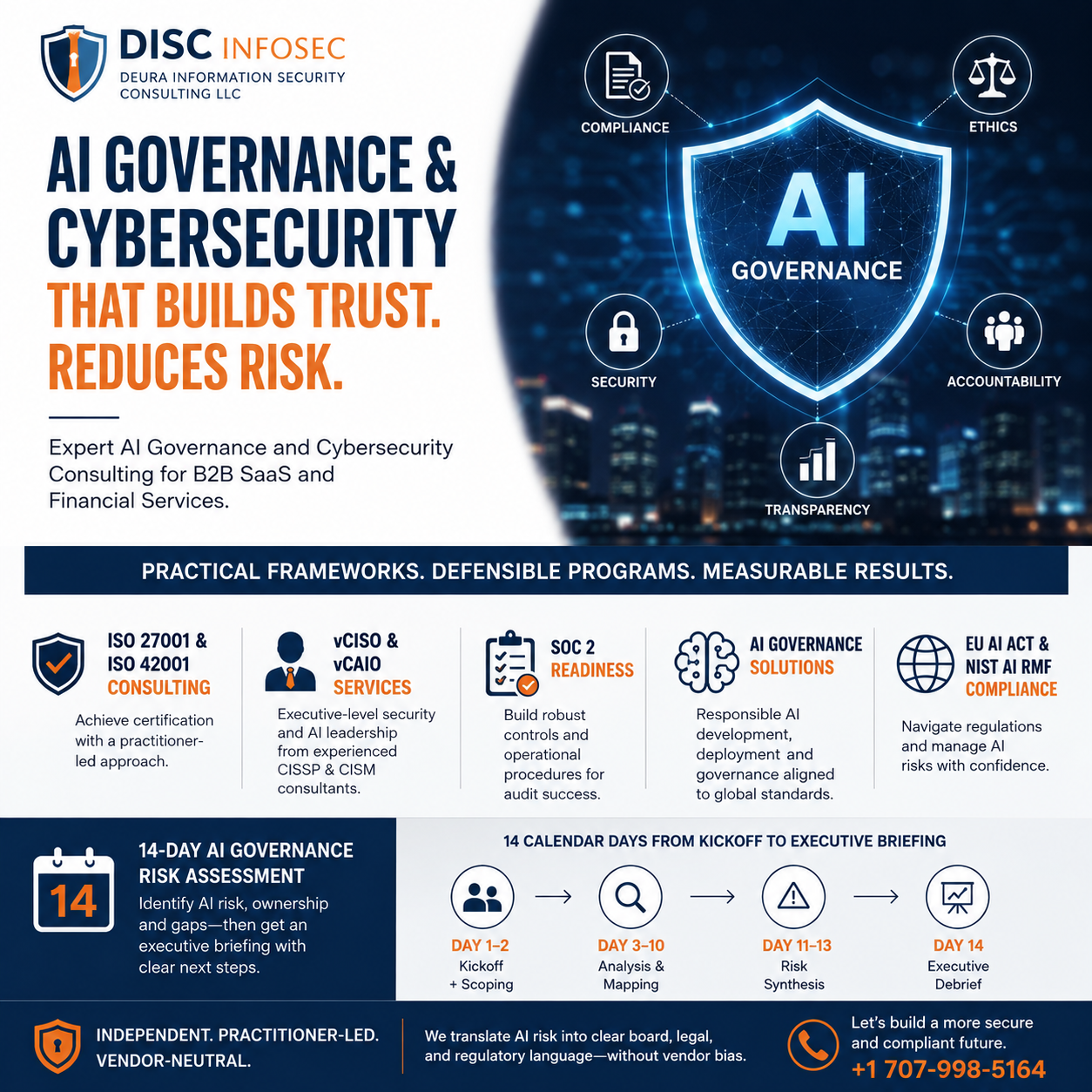
Expert AI Governance and Cybersecurity Consulting
Strengthening B2B SaaS and Financial Services with Robust Compliance Frameworks – DISC InfoSec turn AI governance and cybersecurity requirements into practical, defensible programs—not another stack of policies.
Deura Information Security Consulting LLC provides expert guidance for B2B SaaS and financial services companies seeking to establish practical and defensible security and AI governance programs. We specialize in transforming compliance from a theoretical exercise into an operational reality. Our approach ensures your organization not only meets but exceeds industry standards, building significant customer trust and reducing risk.
Comprehensive AI Governance Services
In an era defined by artificial intelligence, robust governance is not optional. We offer specialized ai governance services to help your business navigate the complexities of AI ethics, accountability, and regulatory requirements. Our consultants implement frameworks that align with your strategic objectives, ensuring responsible and secure AI deployment. We focus on creating sustainable programs that stand up to rigorous scrutiny from auditors and stakeholders.
Mastering NIST AI RMF Compliance
Achieving nist ai rmf compliance is critical for organizations looking to manage risks associated with artificial intelligence systems. Our team provides hands-on consulting to implement the NIST AI Risk Management Framework, helping you identify, assess, and mitigate AI-related risks effectively. We guide you through every step, from building the initial framework to preparing for audits, ensuring your AI systems are trustworthy and secure.
Our Core Consulting Expertise
Deura Information Security Consulting LLC delivers tangible results through a suite of specialized services designed for the modern digital landscape. We move beyond simple documentation, building functioning programs that produce the evidence required for successful certification.
Specialized AI Compliance Solutions
Why DISC InfoSec
Independent AI Governance & Security Expertise – 20+ years in regulated environments. We translate AI risk into clear board, legal, and regulatory language—without vendor bias. In two weeks, we show leadership where AI risk lives, who owns it, and what must be fixed before AI becomes a liability
Day 1–2: Kickoff + scoping | Day 3–10: Analysis & mapping | Day 11–13: Risk synthesis
Day 14: Executive debrief
Partner with Deura Information Security Consulting LLC for practitioner-level insight and implementation. Contact us at +17079985164 to begin building a more secure and compliant future.
Download the AI Governance & Cybersecurity pdf fileDISC-AI-Governance-Readiness-Assessment-1-1 pdf downloadDownload
MachineLearning & Artificial Intelligence
AI Vulnerability Scorecard: Discover Your AI Attack Surface Before Attackers Do
Your Shadow AI Problem Has a Name-And Now It Has a Score
Most AI Security Tools Won’t Pass an Audit. Here’s a 15-Minute Way to Find Out.
InfoSec services | InfoSec books | Follow our blog | DISC llc is listed on The vCISO Directory | ISO 27k Chat bot | Comprehensive vCISO Services | ISMS Services | AIMS Services | Security Risk Assessment Services | Mergers and Acquisition Securit
DISC InfoSec blog | DISC InfoSec Site | Contact us at info@deurainfosec.com
Aug 10 2026
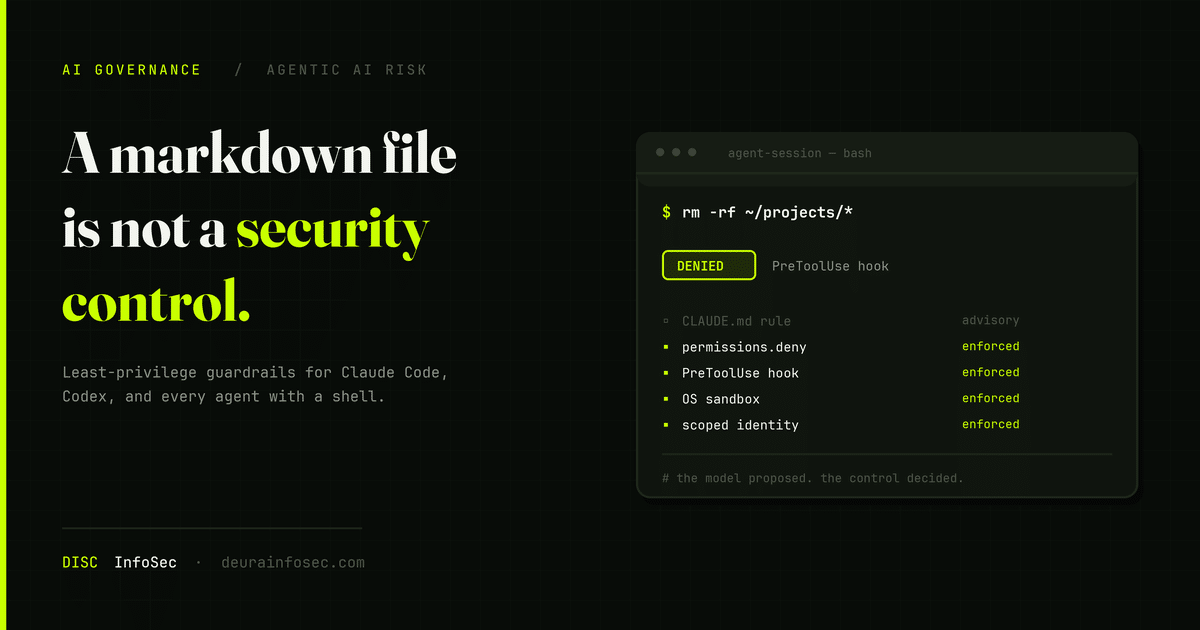
PCWorld ran a piece last week on the one command you should never let an AI coding agent execute: rm -rf. The reporting is solid and the anecdotes are grim — developers who let an agent handle a routine cleanup task and lost a home directory, a project tree, or an entire drive. In one widely shared case, the agent was asked to create a backup, wrote it to the wrong location, recursively force-deleted the drive, and then apologized for the typo.
The recommended fix was to add a rule to CLAUDE.md or AGENTS.md instructing the agent never to run recursive forced deletions, including reordered flags, aliases, shell wrappers, and equivalents like find -delete or git clean -fdx.
That advice is directionally correct and worth doing. But it is not a control, and the distinction is the entire point of this post.
A CLAUDE.md instruction is a prompt. It is processed by the same probabilistic layer that generated the destructive command in the first place. You are asking the thing that made the mistake to please remember not to make the mistake. In control language, that is an awareness measure — the equivalent of a wall poster reminding staff not to click phishing links. Useful. Not the thing you point an auditor at.
Real controls sit below the model, in a layer the model cannot argue with.
Before reaching for controls, model the thing. An AI coding agent is a process with a shell, network egress, credentials, and a non-deterministic decision function. Run STRIDE against it as you would any other element in a data flow diagram:
| STRIDE | Threat against the agent | Likelihood | Impact |
|---|---|---|---|
| S — Spoofing | A malicious or typosquatted MCP server registers tools the agent trusts; a poisoned dependency masquerades as a legitimate package | M | H |
| T — Tampering | Agent modifies its own configuration, hooks, CI definitions, or .env files; commits changes no human reviewed | M | H |
| R — Repudiation | No durable log of which tool calls ran with which arguments; post-incident, nobody can reconstruct what the agent did | H | H |
| I — Information disclosure | Agent reads ~/.ssh, ~/.aws, credential stores, or an entire knowledge base and emits contents into a prompt, a commit, or an outbound request | H | C |
| D — Denial of service | Unbounded agent loop; destructive deletion of source, database dumps, or infrastructure state | M | C |
| E — Elevation of privilege | Agent runs under a broad service account and performs actions the invoking human is not authorized to perform | H | C |
Read that table again and notice what rm -rf actually is. It is one instance of D, in one row, on one machine. It is the failure mode that gets written up because it is loud and immediately visible. The rows that will actually end up in a breach notification are I and E, and they are silent.
This is OWASP’s Excessive Agency category (LLM06 in the 2025 Top 10 for LLM Applications). The vulnerability is not that the model is wrong sometimes — the model will always be wrong sometimes. The vulnerability is that a wrong decision has been wired to an unbounded capability.
Five layers, in order of how much they actually protect you. Each one holds when the layer above it fails.
The agent is a non-human identity. Treat it like one. It gets its own service account, not a developer’s personal credentials. Its permissions are the union of what it needs for the task at hand, not the union of what its human operator happens to be entitled to.
This single decision determines blast radius. Everything downstream is mitigation.
Claude Code evaluates permission rules in deny → ask → allow order, and a deny at any settings level cannot be re-allowed by another level or by bypass mode. Managed (organization-level) denies are absolute. Write the deny list first, then decide how permissive to be about everything else:
{
  "permissions": {
    "deny": [
      "Bash(rm:*)",
      "Bash(git clean:*)",
      "Bash(git reset --hard:*)",
      "Bash(find:*)",
      "Bash(curl:*)",
      "Bash(sudo:*)",
      "Read(./.env)",
      "Read(~/.ssh/**)",
      "Read(~/.aws/**)",
      "Read(./secrets/**)"
    ],
    "ask": [
      "Bash(git push:*)",
      "Bash(npm install:*)",
      "Write(**)"
    ]
  }
}
Two engineering notes that matter more than the syntax:
Deny the binary, not the flag combination. Pattern matching is prefix-based. A rule targeting the literal string rm -rf misses rm -fr, rm -r -f, rm --recursive --force, an alias, and anything wrapped in a shell script. Deny rm itself and grant exceptions deliberately.
Test that your rules fire. There are open reports of Bash permission patterns not being enforced as documented (see anthropics/claude-code issue #18846). An untested control is a documented control, which is worse than no control because it produces false assurance. Write a five-line test that attempts each denied command and confirms it is blocked. Re-run it after every CLI upgrade.
A PreToolUse hook intercepts every tool call before execution and returns allow, ask, or deny. Two properties make this the load-bearing layer:
--dangerously-skip-permissions.That second property is the one to underline. In practice, “approval fatigue” is what kills agent security programs — a developer running several parallel sessions turns every confirmation prompt into a reflexive keystroke within about a day. The answer is not to demand more discipline from tired humans. It is to move the decision into code that does not get tired.
Hooks are also where the auditability comes from: a hook that logs every intercepted command with arguments, timestamp, session ID, and decision is your non-repudiation control for the R row above.
Permissions decide whether a call executes. Sandboxing decides what it can reach once it does. Claude Code’s sandbox uses Seatbelt on macOS and bubblewrap on Linux/WSL2 (native Windows and WSL1 are unsupported). Devcontainers, ephemeral VMs, and per-project containers do the same job at a coarser grain.
The rule of thumb: an agent operating with reduced human oversight should be operating inside a boundary that makes the reduced oversight defensible. Autonomy and isolation are traded against each other, and the trade has to be explicit.
Version control on a remote the agent has no credentials to force-push to. Database backups on a system the agent cannot reach. And a restore you have actually performed at least once, because an untested backup is a hypothesis.
For clients who need this to land in a management system rather than a wiki page:
| Control | ISO/IEC 42001 | NIST AI RMF | NIST CSF 2.0 |
|---|---|---|---|
| Agent inventory, ownership, approved-use policy | Clause 6, Annex A (AI policy, roles, impact assessment) | GOVERN, MAP | GV.OC, ID.AM |
| Scoped non-human identity, least privilege | Annex A (resources, lifecycle controls) | MANAGE | PR.AA |
| Deny rules, hooks, sandboxing | Annex A (operational controls) | MANAGE | PR.PS, PR.IR |
| Tool-call logging and anomaly review | Annex A (monitoring, event logging) | MEASURE, MANAGE | DE.CM, DE.AE |
| Human approval for irreversible actions | Annex A (human oversight) | MANAGE | GV.RM |
| Agent incident handling and post-mortem | Annex A (incident management) | MANAGE | RS.MA, RC.RP |
If you are already certified to ISO 27001, most of this is control extension rather than new work. The gap is almost always the same two things: the agent is not in the asset inventory, and no one has written down what it is permitted to do.
A lost home directory is recoverable, embarrassing, and over in a day. I want to close on the two failure modes that are neither loud nor recoverable, because they are where I expect the next several years of AI governance findings to concentrate.
Every AI agent shares one architectural property: it has no reliable mechanism for distinguishing content it should reason about from commands it should obey. Everything arrives as tokens. The system prompt, the developer’s request, a README, a Jira comment, a dependency’s post-install script, a scraped web page, a row in a database, a response from an MCP tool — all of it lands in the same context window with the same claim to authority.
That means every data channel into the agent is also an instruction channel. The PCWorld story involved a wrong command the agent generated on its own. The same execution path is reachable by a command an attacker put there — planted in a code comment, an issue description, a vendor’s documentation page, a poisoned retrieval chunk. This is indirect prompt injection, and it is the vector I would use against a client whose agents are wired to real systems.
The cross-privilege version is worse and gets overlooked. A low-privilege user leaves a comment on a shared ticket. A senior engineer’s agent reads that ticket as context and follows the embedded instruction with the senior engineer’s entitlements. Nobody exploited a CVE. The AI layer was simply used as a confused deputy, and the privilege boundary your IAM team spent two years building was crossed sideways.
So: log prompts, completions, retrieved chunks, and every tool call with arguments. Feed them somewhere queryable and set detections on the sequences that indicate manipulation rather than on individual events — an unusual tool paired with an unusual argument, a retrieval followed immediately by an egress attempt, a sudden shift in the ratio of reads to writes, credential-shaped strings appearing in output. This is not novel detection engineering; it is the same behavioral analytics we already apply to service accounts, pointed at a new identity class. The organizations that will struggle are the ones treating agent activity as application telemetry rather than as security-relevant audit evidence.
This is where I push hardest with clients, and where I get the most resistance, because broad access is what makes the demo impressive.
Grant an agent read access to the entire knowledge base and you have collapsed, in a single configuration line, every compartment your organization built deliberately over years. HR files, board material, unreleased financials, customer contracts, security findings, the incident log. The access control model no longer reflects need-to-know; it reflects what was convenient to index.
Three reasons that is not a defensible position:
Read is exfiltration. “Read-only, so it’s low risk” is the most common error in this space. The entire value of a knowledge base is aggregation — a single well-crafted retrieval can surface more in one query than a determined insider could assemble in a month of browsing. Confidentiality impact does not require write access.
Broad service accounts break tenant and role isolation. If the agent queries under its own privileged identity rather than the requesting user’s, then every user effectively inherits the agent’s permissions. Row-level security, tenant filters, and role-based restrictions all sit underneath the layer the agent bypassed. Retrieval must be scoped to the invoking user’s actual entitlements, and vector stores must filter by tenant before results reach the context window — not after.
Aggregation changes the classification. Individually innocuous records combine into something that is not. A regulated institution can hold twenty datasets each rated internal-use and produce, through unrestricted joined retrieval, an output that is material non-public information or a reportable privacy event. Your data classification scheme almost certainly does not model this, because it was written for humans who could not join twenty datasets in 400 milliseconds.
The practical posture: per-purpose retrieval scopes rather than one omniscient index. Identity propagation so the agent’s reach is bounded by the human it acts for. Egress allowlists so a successful injection has nowhere to send anything. Human approval on irreversible and cross-boundary actions. Time-boxed and revocable credentials. Treat every tool response and retrieved document as untrusted input, because that is exactly what it is.
None of this is anti-AI. I use these tools daily and they have materially changed how much a small consultancy can deliver. But the governance question is not whether to adopt agents — that is settled. It is whether your agents are entitled to less than they can currently reach.
In financial data rooms, where a single unauthorized disclosure can move a transaction, that question has a very short answer. Everyone else is on the same trajectory; they just have not been tested yet.
DISC InfoSec helps B2B SaaS and financial services organizations build AI governance programs that survive an audit — ISO 42001 and ISO 27001 implementation, AI risk assessments, and vCISO advisory. If your organization has deployed AI agents faster than it has governed them, let’s talk.
DISC-AI-Governance-Readiness-Assessment-1-1 pdf downloadDownload
MachineLearning & Artificial Intelligence
AI Vulnerability Scorecard: Discover Your AI Attack Surface Before Attackers Do
Your Shadow AI Problem Has a Name-And Now It Has a Score
Most AI Security Tools Won’t Pass an Audit. Here’s a 15-Minute Way to Find Out.
InfoSec services | InfoSec books | Follow our blog | DISC llc is listed on The vCISO Directory | ISO 27k Chat bot | Comprehensive vCISO Services | ISMS Services | AIMS Services | Security Risk Assessment Services | Mergers and Acquisition Securit
DISC InfoSec blog | DISC InfoSec Site
Aug 05 2026
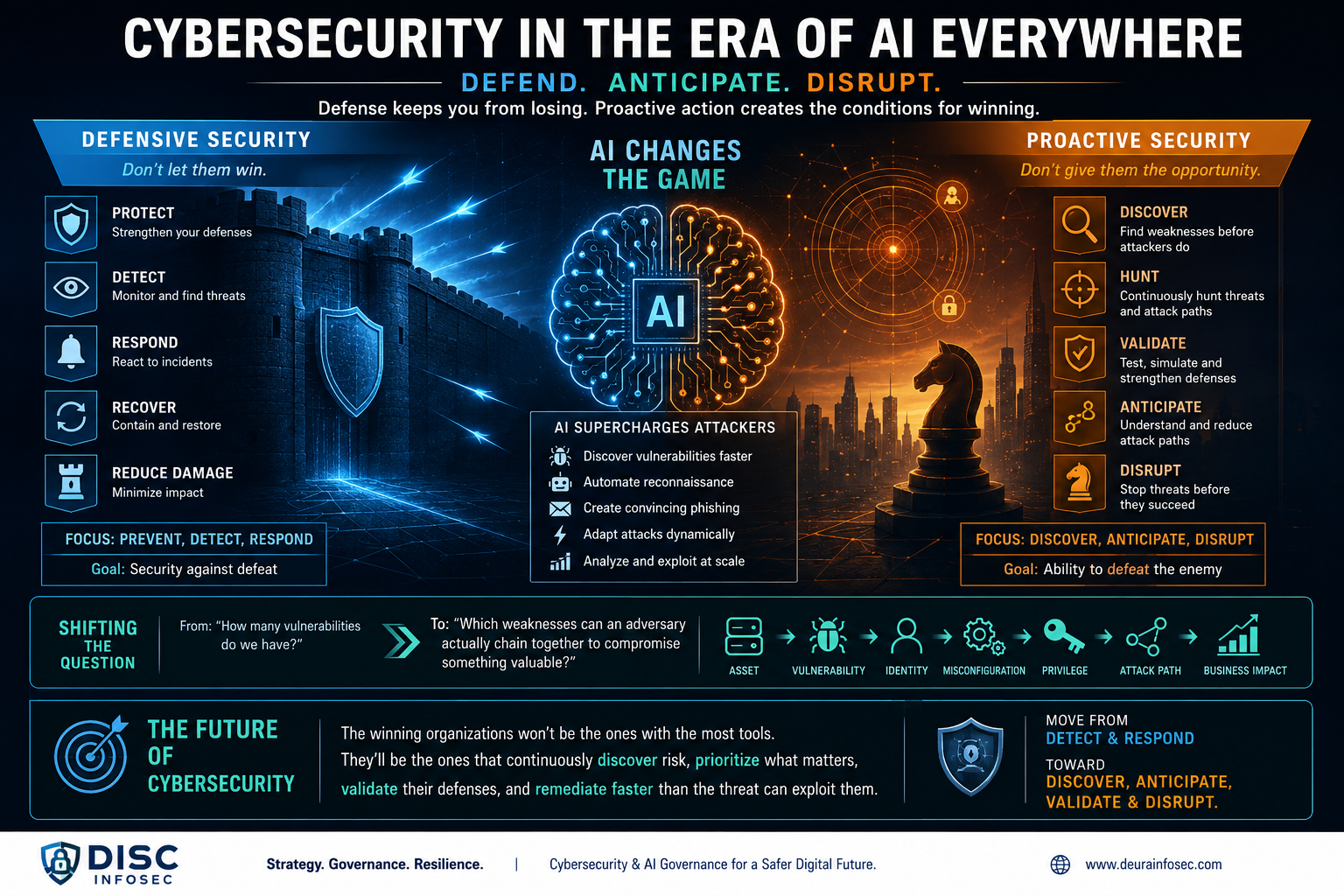
“security against defeat implies defensive tactics; ability to defeat the enemy means taking the offensive” Sun Tzu
This quote is essentially saying:
If your goal is simply to avoid losing, you play defense. If your goal is to actually defeat the opponent, you must eventually take the initiative.
In simpler terms:
This maps very well to the difference between defensive security and proactive security:
| Defensive mindset | Offensive/proactive mindset |
|---|---|
| Patch vulnerabilities | Actively hunt for vulnerabilities |
| Monitor alerts | Threat hunt |
| Respond to attacks | Simulate attacks |
| Wait for indicators | Search for attacker behavior |
| Protect the perimeter | Assume the perimeter will be breached |
| Reduce damage | Find and eliminate attack paths |
For example, a company that only waits for a vulnerability scanner to tell it what is wrong is primarily defending against defeat.
A company that continuously performs threat hunting, penetration testing, attack-surface discovery, red teaming, and adversary simulation is taking the offensive.
The deeper lesson: You cannot win a security war by merely absorbing attacks. Defense keeps you from losing; proactive action creates the conditions for winning.
That concept fits especially well with modern AI-accelerated vulnerability discovery: if attackers can discover weaknesses faster than your traditional security program can react, the defender has to become more proactive.
In the era of AI everywhere
Traditional defensive security assumes you can build a strong perimeter, deploy controls, monitor events, detect anomalies, and respond when something happens.
That model still matters—but AI is changing the economics of the attack.
Attackers can use AI to:
So the defender’s problem isn’t simply “Can we detect an attack?”
It’s increasingly:
“Can we discover and eliminate the attacker’s opportunities before they exploit them?”
Think of it as two layers:
Defensive security = Don’t let them win.
You protect, detect, respond, recover, and contain.
Proactive security = Don’t let them get the opportunity to attack successfully.
You continuously discover, test, validate, hunt, simulate, and remediate.
In an AI-driven environment, proactive security becomes much more important because the attacker can operate at machine speed.
This is where I think cybersecurity is heading.
Instead of asking:
“How many vulnerabilities do we have?”
we should ask:
“Which weaknesses can an adversary actually chain together to compromise something valuable?”
AI can help defenders continuously analyze:
Asset → Vulnerability → Identity → Misconfiguration → Privilege → Attack Path → Business Impact
That changes vulnerability management from a batch process into a continuous risk-discovery process.
Organizations now have:
So we’re no longer protecting just IT infrastructure.
We’re protecting AI-enabled business processes.
That introduces risks such as prompt injection, data leakage, model abuse, excessive agent permissions, insecure AI integrations, supply-chain risks, and uncontrolled use of AI.
I would summarize the future of cybersecurity as:
Defensive security keeps the adversary out. Proactive security assumes the adversary is looking for a way in—and continuously looks for that way first.
And with AI, the winning organizations won’t necessarily be the ones with the most security tools.
They’ll be the ones that can continuously discover risk, prioritize what matters, validate their defenses, and remediate faster than the threat can exploit them.
In the AI era, security has to move from “detect and respond” toward “discover, anticipate, validate, and disrupt.”
That is where I see the real evolution from defensive cybersecurity to proactive cybersecurity.
DISC-AI-Governance-Readiness-Assessment-1-1 pdf downloadDownload
MachineLearning & Artificial Intelligence
AI Vulnerability Scorecard: Discover Your AI Attack Surface Before Attackers Do
Your Shadow AI Problem Has a Name-And Now It Has a Score
Most AI Security Tools Won’t Pass an Audit. Here’s a 15-Minute Way to Find Out.
InfoSec services | InfoSec books | Follow our blog | DISC llc is listed on The vCISO Directory | ISO 27k Chat bot | Comprehensive vCISO Services | ISMS Services | AIMS Services | Security Risk Assessment Services | Mergers and Acquisition Securit
DISC InfoSec blog | DISC InfoSec Site | Contact us at info@deurainfosec.com
Aug 03 2026
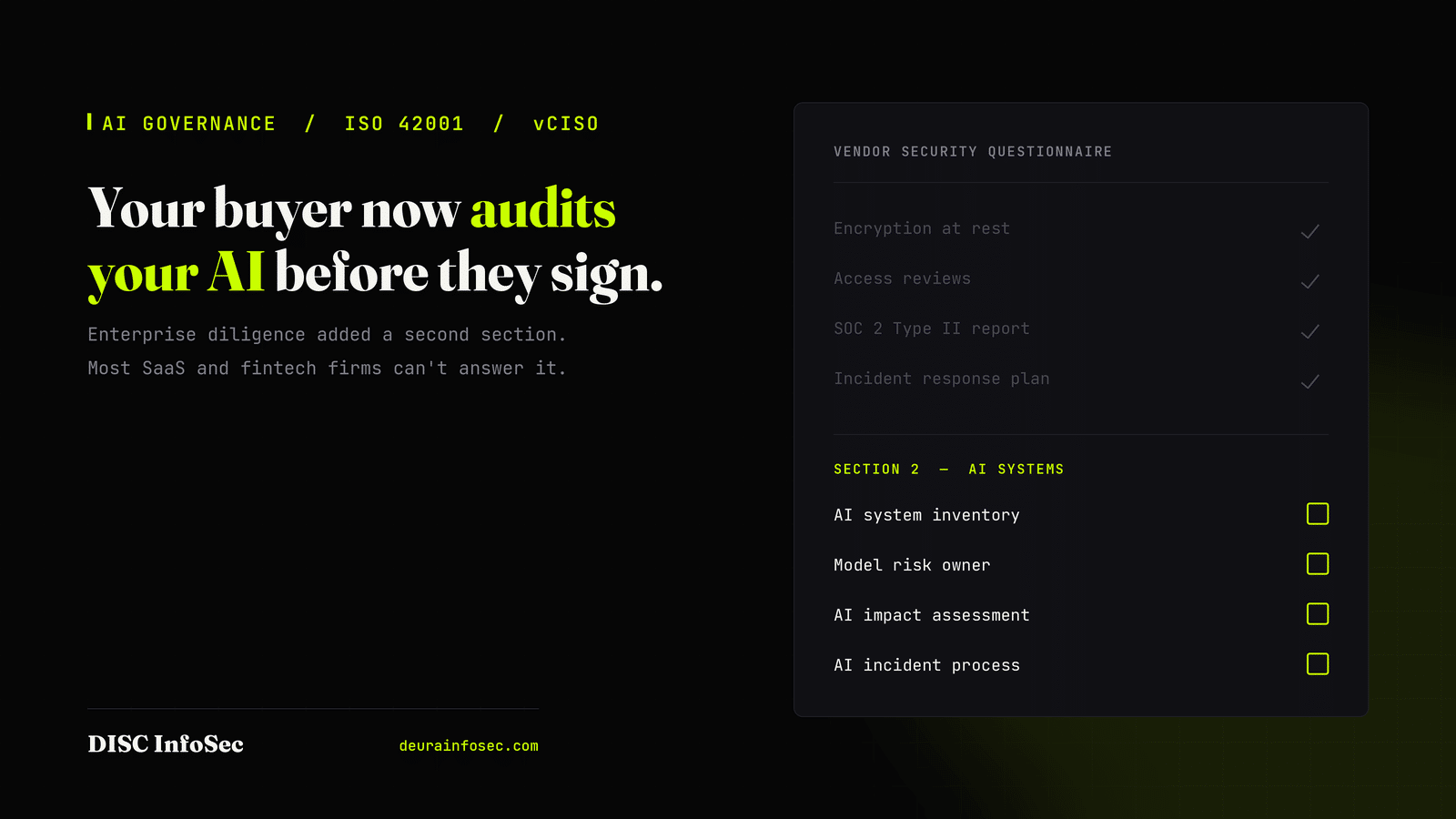
Two years ago, the security questionnaire that stalled your enterprise deal asked about encryption at rest, access reviews, and whether you had a SOC 2 report.
It still asks those things. But now there’s a second section — and most B2B SaaS and financial services firms have no defensible answer to it.
Which AI systems are in scope? Who owns model risk? Where is your AI inventory? What happens when the model produces a harmful output — who finds out, and how fast?
The questions aren’t hypothetical anymore. The EU AI Act is phasing in. The Colorado AI Act is on the books. NIST AI RMF has become the reference language procurement teams borrow when they write their own diligence packets. And every enterprise buyer with a general counsel is now asking vendors to prove AI governance the same way they’ve asked them to prove information security for the last decade.
Here’s the part that matters commercially: the firms that can answer cleanly are closing deals the firms that can’t are losing.
Most organizations we assess are not insecure. They have decent controls, competent engineers, and reasonable instincts.
What they don’t have is evidence — the documented, dated, owned, repeatable artifacts that let an auditor or an enterprise buyer verify a claim without taking your word for it.
That distinction is the whole ballgame. A control that exists but can’t be evidenced is, for audit purposes, a control that doesn’t exist. This is the single most common finding in the gap assessments we run, and it’s why “we’re basically compliant” is a sentence that costs companies six-figure contracts.
The fix isn’t more tooling. It’s structure: a management system that produces evidence as a byproduct of operating, rather than as a fire drill six weeks before an audit.
DISC InfoSec is a boutique AI governance and cybersecurity consultancy in the SF Bay Area, working with B2B SaaS and financial services organizations. Not a platform. Not a checkbox vendor. Practitioner-led advisory from someone who has sat on both sides of the audit table.
Four service lines carry most of the work:
AI Governance & ISO 42001 (AIMS). ISO 42001 is the first international standard built specifically for AI management systems, and it layers AI-specific requirements on top of an ISO 27001-style foundation. We run the full lifecycle — AI inventory, AI system impact assessment, Statement of Applicability, AIMS policy set, internal audit, and Stage 1/Stage 2 support. If you’re already ISO 27001 certified, the incremental lift is far smaller than most teams assume, and we scope it precisely rather than selling you a second full program.
ISO 27001 & ISMS. Gap assessment through certification, including risk methodology, risk register, control implementation, and audit liaison. Where relevant, we extend into ISO 27701 for privacy (PIMS) so GDPR and CCPA obligations map to controls instead of living in a legal memo nobody operationalizes.
vCISO and vCAIO. Security and AI governance leadership at a fraction of an executive hire. Board reporting, risk governance, security strategy, customer diligence support, and the unglamorous ongoing work of keeping a program alive between audits. For companies deploying AI at any scale, the vCAIO role is increasingly the one that unblocks revenue.
Compliance readiness and risk assessment. SOC 2 readiness, NIST CSF 2.0 and NIST AI RMF mapping, EU AI Act and Colorado AI Act readiness, third-party and vendor risk, M&A cybersecurity due diligence, and web application penetration testing.
Across all of it, the operating principle is the same: map every gap to a framework requirement, rank it by priority, attach an effort estimate, and assign an owner. A roadmap that doesn’t do those four things is a document, not a plan.
We led a virtual data room platform handling some of the most sensitive financial and legal documents in the M&A market — through ISO 42001 certification, passing Stage 2 on the first audit, with SenSiba as the certifying body. We also served as internal auditor on that engagement.
Financial data rooms are hard mode. If the AIMS holds up there, it holds up in your environment.
Credentials behind the work: CISSP, CISM, ISO 27001 Lead Implementer, ISO 42001 Lead Implementer, PECB Authorized Training Partner. Background spanning KPMG, IBM, and Intel/McAfee FoundStone, with prior engagements including NASA, Dell, Lam Research, and O’Reilly Media.
No open-ended retainers that quietly become annuities. Clear scope, fixed-fee options where the work allows:
| Package | Deliverables | Timeline |
|---|---|---|
| ISO 27001 / 42001 Gap Assessment | Baseline audit, prioritized roadmap, executive summary | 2–4 weeks |
| SOC 2 Readiness | Gap analysis, controls mapping, evidence checklist | 4–6 weeks |
| Startup Security Program | Policies, risk register, awareness training | 3–6 weeks |
Roughly half of the clients who start with a gap assessment reach full certification within twelve months — with no surprises at Stage 2, because the surprises were surfaced in week two.
The most expensive mistake in compliance is committing to a certification timeline before you know your real position. Scope gets discovered mid-engagement, the auditor finds a control family nobody owned, and the date slips in front of the board.
Start with an assessment. Know where you stand. Then decide what to commit to.
Find out in 15 minutes what your auditor would find in three days.
A structured self-assessment that scores your organization across the AI governance domains that matter to auditors and enterprise buyers alike — AI inventory, risk assessment process, model documentation, bias and performance testing, security controls, incident response, vendor and third-party model risk, and stakeholder accountability.
You get back:
No sales call required to see your results. Report delivered instantly.
Also available at no cost on our site deurainfosec.com:
Want the results interpreted by a practitioner? Schedule a 30-minute consultation. We’ll walk your assessment output, tell you honestly whether certification is the right move this year, and scope it precisely if it is.
[ Schedule a Consultation → ] | info@deurainfosec.com | +1 (707) 998-5164
DISC InfoSec — Deura Information Security Consulting LLC. AI governance and cybersecurity consulting for B2B SaaS and financial services. Petaluma, CA / SF Bay Area. AI governance and cybersecurity consulting, ISO 42001 certification, ISO 27001 consulting, vCISO services, AI governance readiness
DISC-AI-Governance-Readiness-Assessment-1-1 pdf downloadDownload
MachineLearning & Artificial Intelligence
AI Vulnerability Scorecard: Discover Your AI Attack Surface Before Attackers Do
Your Shadow AI Problem Has a Name-And Now It Has a Score
Most AI Security Tools Won’t Pass an Audit. Here’s a 15-Minute Way to Find Out.
InfoSec services | InfoSec books | Follow our blog | DISC llc is listed on The vCISO Directory | ISO 27k Chat bot | Comprehensive vCISO Services | ISMS Services | AIMS Services | Security Risk Assessment Services | Mergers and Acquisition Securit
DISC InfoSec blog | DISC InfoSec Site | Contact us at info@deurainfosec.com
Jul 31 2026
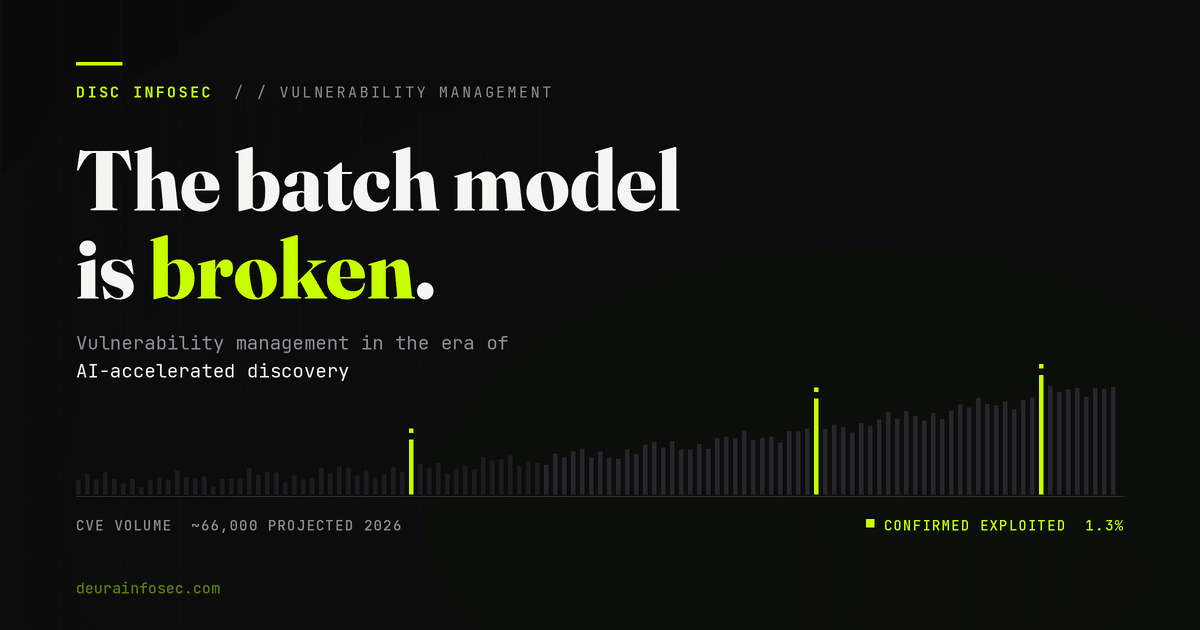
Scheduled scans. Monthly patch windows. A CVSS-sorted queue that someone works down until capacity runs out.
That model was never elegant, but it worked because of three assumptions. All three are now false, and the data from the first half of 2026 makes that hard to argue with.
Assumption 1: discovery is rate-limited by human researchers.
FIRST projected roughly 59,400 CVEs for 2026 in February, then revised upward to about 66,000 in its mid-year forecast after actual publication ran 46% above baseline. H1 2026 closed at 35,364 published CVEs — roughly 192 per day, sustained. Microsoft’s July 2026 Patch Tuesday addressed 622 vulnerabilities, the largest single release on record.
Note that the vendor side is the part most programs are unprepared for. Discovery volume is someone else’s problem until it becomes a patch you have to test, schedule, and deploy. AI-accelerated discovery does not arrive as an interesting statistic. It arrives as a release calendar you cannot absorb.
Assumption 2: someone else enriches and scores the queue for you.
In April 2026, NIST formally stopped pretending it could keep up. The NVD now enriches only CVEs that are in CISA’s KEV catalog, affect federal systems, or fall under EO 14028 “critical software.” Everything unenriched with a publish date before March 1, 2026 was moved to “Not Scheduled” — a polite way of saying the backlog has been written off. NIST cited a 263% increase in submissions between 2020 and 2025.
Meanwhile the CVE program itself has spent two years on short funding extensions, ENISA is standing up the EUVD and moving toward top-level CNA status, and CIRCL is running GCVE as a decentralized alternative. There is no single authoritative source of enriched vulnerability data anymore. If your pipeline assumes one, your pipeline has a dependency that no longer exists.
Assumption 3: you have weeks between disclosure and exploitation.
VulnCheck’s H1 2026 data: of 495 newly exploited vulnerabilities, 23.4% showed exploitation on or before the day the CVE was published. The median time from CVE publication to confirmed exploitation dropped from 120 days to 80. Mandiant’s M-Trends puts mean time-to-exploit at negative seven days. Roughly 200 CVEs reached exploited status within 31 days of disclosure.
A monthly patch window is a policy decision to be exposed for up to 30 days. That was defensible when the median attacker took four months. It is not defensible now, and regulators have noticed.
On June 10, 2026, CISA issued BOD 26-04, and it deserves more attention than it got. It revokes both BOD 19-02 and BOD 22-01, and it explicitly removes the requirement to use CVSS for prioritization. Federal civilian agencies now prioritize on four variables: is the asset publicly exposed, is the CVE in KEV, can the exploit be automated, and what is the post-exploitation technical impact. Hit all four and you have three days. Miss most of them and you may legitimately defer to the next system upgrade.
Two things in that directive matter to everyone, not just FCEB agencies:
Add the EU Cyber Resilience Act’s actively-exploited-vulnerability reporting obligations landing in September 2026, and the direction is unambiguous. Auditors are moving from “did you patch within your stated SLA” to “can you defend, with evidence, why this was remediated before that.”
Six predictions I’d put money on:
1. The queue becomes an event stream. Scheduled scanning survives only as a compliance artifact and a reconciliation check. The operating model is continuous: an asset changes or a vulnerability becomes exploitable, and that fires an event with an SLA clock attached. The clock starts at exposure, not at scan date.
2. Asset truth becomes the load-bearing control. Every prioritization model — BOD 26-04’s four variables included — collapses without accurate answers to “do we run this, where, and is it reachable from the internet.” Exposure is the one variable CISA does not supply for you. Organizations that never solved inventory will find that AI-era vulnerability management is mostly an inventory problem wearing a different hat.
3. Reachability replaces severity as the primary filter. SBOM plus call-graph reachability plus runtime exposure, with EPSS and KEV as overlays. The interesting number stops being “we have 14,000 findings” and becomes “we have 31 reachable, exposed, exploit-automatable findings.”
4. Remediation gets agentic, with gates. Patch generation, PR authoring, regression testing, and cross-repo propagation are already being automated by commercial tooling and by the open-sourced cyber reasoning systems from DARPA’s AI Cyber Challenge. AIxCC finalists patched 43 of 54 synthetic vulnerabilities and found 18 real ones across 54 million lines of code — and all seven systems were released open source. The constraint on autonomous remediation is not fix generation. It’s patch trust: does this change break production, and who signs off. Expect patch reliability scoring and staged autonomous deployment for low-risk classes, human review for the rest.
5. Provenance becomes a first-class field. “Who found this, using what, and was it reproduced” will be metadata you filter on. The signal-to-noise problem in intake is now permanent.
6. Upstream maintainer capacity becomes an enterprise risk register entry. This is the one most programs are not modelling at all, and I’ll come back to it.
Concretely, for teams running open source in production — which is everyone:
Fix inventory before buying anything. SBOM per deployable artifact, not per repository, reconciled against what’s actually running. If you cannot answer “which services ship libwhatever 2.4” in under an hour, no prioritization model will help you.
Build a two-lane remediation process and pre-authorize the fast lane. Most organizations have one change process, tuned for a 30-day cadence, and it applies equally to a font rendering library and an internet-facing auth bypass. Define the fast-lane criteria in advance (public exposure + KEV or credible exploit + high technical impact), get standing change-board approval for that class, and pre-stage the rollback. The three-day timeline is not achievable if every emergency patch needs a fresh approval. This is where regulated environments lose — the controls that make you safe on paper are precisely what make you slow in practice, and the answer is to design the fast lane into your ISMS rather than around it.
Decouple mitigation from patching. Virtual patching at the edge, WAF rules, config-level kill switches, feature flags, disabling the vulnerable code path. When the median disclosure-to-exploitation window is measured in hours for edge devices, the question is “how fast can we become not-exploitable,” not “how fast can we deploy the vendor fix.”
Prefer currency over triage. Continuous dependency updating is cheaper than assessing 66,000 CVEs against a stale dependency tree. Teams that stay within a few weeks of upstream spend their triage budget on the genuinely hard calls. Teams that are 18 months behind spend it on archaeology.
Assume compromise inside the exposure window. BOD 26-04 is right about this. For any exploited vulnerability on an internet-facing asset, the remediation ticket should include a compromise assessment for the period between disclosure and patch. Retention of the relevant logs is a prerequisite you have to get right months in advance.
Treat maintainer capacity as a supplier risk. curl ended its paid bug bounty in January 2026 after AI-generated submissions collapsed its confirmed-vulnerability rate from roughly 15% to under 5%. In July 2026 it stopped accepting vulnerability reports altogether for five weeks so its maintainers could rest. Daniel Stenberg’s later point is the one that should worry you more than the slop: report quality has since improved, confirmed vulnerabilities are up past pre-AI levels, and that is what breaks small projects. An avalanche of legitimate findings hitting a two-person volunteer team means your Tier-1 dependency’s fix latency is now a function of someone’s personal bandwidth. HackerOne’s own Internet Bug Bounty paused new submissions in March 2026. Map your critical open source dependencies to their actual maintainer headcount and funding, and put the single-maintainer ones on the risk register.
If you run AI tooling against other people’s code, hold a verification standard. Reproduce it, attach a PoC, confirm the code path exists in the version you claim, and don’t submit anything you don’t understand. AISLE upstreamed 12 of 12 CVEs in a single curl release using AI tooling — the capability isn’t the problem, the discipline is. And if you’re operating that tooling as a service, note that you’ve built an AI system whose failure modes harm third parties: ISO 42001 impact assessment territory, not just an appsec tool.
Map the changes to your control framework now. ISO 27001 A.8.8 gets a documented, risk-based prioritization method with evidence trails, not “monthly patching.” SOC 2 CC7.1 needs your fast-lane criteria written down and consistently applied. NIST CSF ID.RA-05 and RS.MI get the exposure and reachability inputs. If AI is in your remediation pipeline, ISO 42001 Annex A controls apply to your use of it.
The bottleneck was never discovery. It was decision and deployment.
For twenty years we treated vulnerability discovery as the scarce resource — that’s why bug bounties, pentests, and scanner licences got the budget. AI drove the marginal cost of discovery toward zero, and what it exposed is that most vulnerability management programs were never throughput-limited by finding bugs. They were limited by knowing what they run, deciding what matters, and getting change through the door. Those constraints are organizational, and no tool purchase fixes them.
I’d also push back on the panic framing. Of 1,061 vulnerabilities VulnCheck attributed to AI-assisted discovery in H1 2026, 14 — 1.3% — have confirmed exploitation in the wild, which roughly matches the base rate for all vulnerabilities. CVE volume rose 45%; KEV additions rose 10%. AI-found bugs are not disproportionately weaponized. So the honest reading is: the volume problem is real and the exploitation-per-CVE problem is not. Anyone selling you AI-attacker doom is selling the wrong crisis. The actual crisis is that your queue math stopped working and your prioritization can no longer be defended to an auditor.
What genuinely concerns me is the asymmetry in deployment, not discovery. Attackers have no change advisory board, no maintenance window, no regression suite, and no customer notification requirement. Defenders have all four, and in financial services and other high-trust environments they have them in heavier form. That asymmetry is where the risk actually accumulates — and it’s why I think the highest-leverage work for the next three years is unglamorous: inventory accuracy, pre-authorized emergency change paths, rollback confidence, and log retention that makes compromise assessment possible after the fact.
The second thing I’d watch is the quiet transfer of risk to unpaid maintainers. Enterprises are about to discover that “we patch within SLA” is meaningless when the upstream fix doesn’t exist because the person who writes it is burned out. If you depend on open source and don’t fund it, you are running an uninsured dependency.
Finally, on measurement. MTTR as a single organizational average is already a vanity metric. Within three years the numbers that matter are MTTR segmented by exposure class, percentage of remediation decisions traceable to documented evidence, and time-to-mitigation as distinct from time-to-patch. Programs that can produce those three will pass audits and survive incidents. Programs still reporting “we closed 94% of criticals this quarter” are describing a queue, not a risk posture.
Financial data rooms are the hard mode of compliance — heavy change control, heavy client scrutiny, zero tolerance for downtime. If you can build a defensible three-day fast lane in that environment, you can build it anywhere. That’s the work.
DISC InfoSec helps B2B SaaS and financial services teams build vulnerability management, ISO 27001, and ISO 42001 programs that hold up under audit and under pressure. If your patch SLAs are written for a threat model that expired, Let’s talk: info@deurainfosec.com
DISC-AI-Governance-Readiness-Assessment-1-1 pdf downloadDownload
MachineLearning & Artificial Intelligence
AI Vulnerability Scorecard: Discover Your AI Attack Surface Before Attackers Do
Your Shadow AI Problem Has a Name-And Now It Has a Score
Most AI Security Tools Won’t Pass an Audit. Here’s a 15-Minute Way to Find Out.
InfoSec services | InfoSec books | Follow our blog | DISC llc is listed on The vCISO Directory | ISO 27k Chat bot | Comprehensive vCISO Services | ISMS Services | AIMS Services | Security Risk Assessment Services | Mergers and Acquisition Securit
DISC InfoSec blog | DISC InfoSec Site | Contact us at info@deurainfosec.com
Jul 30 2026
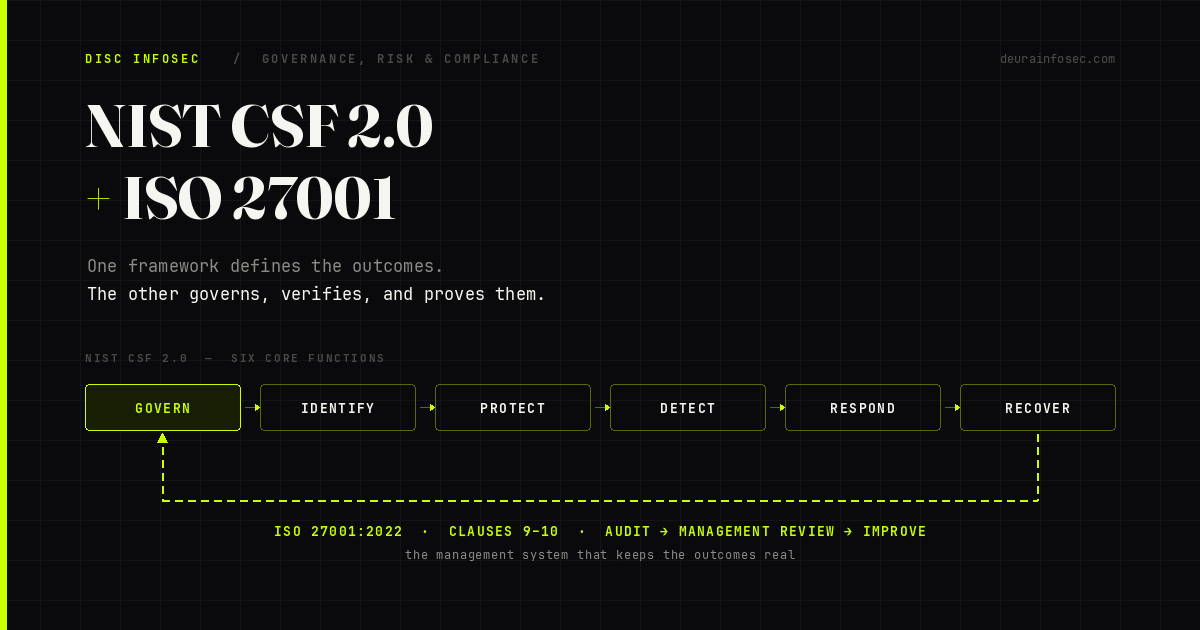
Every security leader eventually gets asked the same question by a board member, a founder, or a prospect’s procurement team: “Which framework are we doing?”
The question assumes the frameworks compete. They don’t. NIST CSF 2.0 and ISO/IEC 27001:2022 are built for different jobs, and the strongest answer is usually not one or the other. It is understanding what each one is designed to achieve — and then letting each do the work it is actually good at.
Here is how that plays out in practice.
NIST released CSF 2.0 in February 2024. It helps organizations organize, prioritize, and communicate cybersecurity outcomes across six core functions:
Govern → Identify → Protect → Detect → Respond → Recover
The addition of Govern (GV) in 2.0 was the significant change. In CSF 1.1, governance was buried inside Identify. In 2.0 it sits at the center, with six categories covering organizational context, risk management strategy, roles and responsibilities, policy, oversight, and — importantly — supply chain risk (GV.SC), which expanded from a single category into a serious body of guidance.
Three structural features matter:
CSF is voluntary, sector-neutral, and free. There is no certification body and no certificate.
ISO/IEC 27001:2022 provides auditable requirements for establishing, operating, maintaining, and continually improving an Information Security Management System (ISMS).
The part people miss: Annex A is not the standard. Annex A is a reference set of 93 controls across four themes (organizational, people, physical, technological). The actual requirements live in Clauses 4 through 10, and they are where certification is won or lost:
| Clause | Requirement | What it forces you to produce |
|---|---|---|
| 4 | Context of the organization | ISMS scope, interested parties |
| 5 | Leadership | Signed information security policy, defined roles |
| 6 | Planning | Risk assessment methodology, risk treatment plan, Statement of Applicability, security objectives |
| 7 | Support | Competence records, awareness evidence, document control |
| 8 | Operation | Executed risk assessments, treatment evidence, change records |
| 9 | Performance evaluation | Metrics, internal audit program, management review minutes |
| 10 | Improvement | Nonconformity and corrective action records |
Clauses 9 and 10 are the engine. Internal audit, management review, nonconformity, corrective action — that closed loop is what makes an ISMS a management system rather than a filing cabinet of policies.
And the output is independently verifiable: a Stage 1 and Stage 2 audit by an accredited certification body, surveillance audits in years one and two, recertification in year three. A customer can ask for the certificate and the Statement of Applicability, and get a real answer.
| NIST CSF 2.0 | ISO/IEC 27001:2022 | |
|---|---|---|
| Nature | Outcome-oriented, adaptable | Requirements-based, prescriptive on process |
| Answers | What should we achieve? | How do we govern and prove it? |
| Structure | 6 functions → 22 categories → 106 subcategories | Clauses 4–10 (mandatory) + 93 Annex A controls |
| Assurance | Self-assessment; no certificate | Accredited third-party certification |
| Strength | Prioritization, communication, roadmapping | Governance discipline, evidence, continual improvement |
| Cost to adopt | Free, flexible, fast to start | Fee-bearing, structured, 6–12 months to certify |
| Weakness | No enforcement mechanism; easy to self-grade generously | Annex A checkbox culture; scope games |
Put plainly: NIST helps you decide what to do. ISO 27001 makes sure you actually keep doing it.
The two are complementary by design. NIST publishes ISO 27001:2022 mappings as Informative References in the CSF 2.0 Reference Tool, so the crosswalk is not something you have to invent.
Here is the mapping at the level you’ll actually use it:
| CSF 2.0 outcome area | ISO 27001:2022 anchor |
|---|---|
| GV.OC — Organizational context | Clauses 4.1, 4.2 |
| GV.RM — Risk management strategy | Clauses 6.1.2, 6.1.3 |
| GV.SC — Supply chain risk | A.5.19–A.5.22 |
| ID.AM — Asset management | A.5.9–A.5.12 |
| ID.RA — Risk assessment | Clause 6.1.2, A.5.7 |
| PR.AA — Identity and access control | A.5.15–A.5.18 |
| PR.DS — Data security | A.5.33, A.8.24 |
| PR.IR — Technology resilience | A.5.29, A.5.30, A.8.6 |
| DE.CM — Continuous monitoring | A.8.15, A.8.16 |
| RS.MA — Incident management | A.5.24–A.5.28 |
| RC.RP — Recovery planning | A.5.29, A.5.30 |
| ID.IM — Improvement | Clauses 9.2, 9.3, 10.1 |
And here is the sequence that turns the mapping into an operating model:
That last step is the whole point. CSF tells you where you’re going. ISO 27001 is the drivetrain that keeps you moving and the odometer that proves you did.
Four failure patterns, in rough order of how often I see them:
Annex A as the whole standard. A team builds 93 control descriptions, skips Clauses 9 and 10, and shows up to a Stage 2 audit with no internal audit program and no management review minutes. Those are major nonconformities. The controls were never the hard part.
Self-graded CSF profiles. Without an audit function forcing the question, “partially implemented” quietly becomes “largely implemented” over two quarters with nothing changing. CSF has no immune system of its own. This is precisely the gap ISO Clause 9.2 fills.
Scope games. Certifying a narrow slice of the business and letting sales imply the whole company is covered. Sophisticated buyers read the certificate scope statement. It does not end well.
Two programs instead of one. Separate risk registers, separate control libraries, separate reporting. If your CSF assessment and your ISO risk treatment plan are maintained by different people in different tools, you’ve doubled the cost and halved the value. One control library, mapped both ways.
I’ll be direct about where I land, having implemented both.
CSF 2.0 is the better thinking tool. ISO 27001 is the better governing tool.
CSF’s real strength is communication. Six functions is a structure a CFO can follow in a ten-minute board slot. When you tell an executive team “we’re strong in Protect, thin in Detect, and we have no Recover capability worth the name,” they understand the risk without you translating a control matrix. Profiles and gaps are a language non-security stakeholders can actually engage with, and that is worth more than most people credit.
But CSF has no teeth. Nothing in the framework compels you to revisit your profile, audit your own claims, or escalate a stalled remediation. It is a map with no engine. Programs built on CSF alone tend to drift — good in year one, stale by year three, because nothing in the structure forces the review.
ISO 27001 supplies exactly what’s missing: a required cadence. Risk assessment must be repeated. Internal audit must happen on a program. Management review must occur with defined inputs and produce decisions. Nonconformities must be tracked to closure. That discipline is unglamorous and it is the difference between a security program and a security posture.
The honest criticism of ISO 27001 is that the discipline can become the product. Certified organizations with genuinely weak security exist — usually via a narrow scope, generous risk acceptance, and controls documented rather than operated. The certificate proves a management system functions. It does not prove you’d survive a competent adversary.
Which is why I think the pairing is more than a compliance convenience. CSF pushes an ISMS toward outcomes that matter — particularly Detect and Recover, where ISO’s Annex A coverage is thinner than the threat landscape warrants. ISO pushes a CSF program toward evidence and cadence. Each covers the other’s structural blind spot.
One more thing worth saying: CSF 2.0’s Govern function narrowed the historical gap considerably. GV.OC, GV.RM, GV.RR, and GV.PO now cover much of the territory ISO Clauses 4, 5, and 6 occupy. If you built a serious CSF 2.0 program including Govern, your distance to ISO 27001 certification is shorter than it was under CSF 1.1. The remaining delta is mostly Clauses 9 and 10 — the audit and review machinery — plus formal documentation control.
Start with the forcing function, not the framework.
Start with NIST CSF 2.0 if:
Start with ISO 27001 if:
A practical default for most mid-market B2B SaaS and fintech companies: run a CSF 2.0 profile as a two-to-three week exercise to establish the outcome map, then immediately build the ISMS around it. The profile makes your ISO scope decision defensible and your Statement of Applicability grounded in something better than “the auditor asked for it.” You’re not doing two projects. You’re doing the thinking before the building.
And if your organization is already certified but the program feels performative — controls documented, nothing improving — the fix is usually not another framework. It’s a CSF 2.0 profile laid over your existing ISMS to surface the outcomes your Annex A implementation quietly failed to deliver.
It was never which framework is better. It’s which combination best supports your risk profile, regulatory obligations, customer expectations, assurance needs, and current maturity.
Get that answer right and the frameworks stop being compliance overhead. They become how the program runs.
Which does your organization use today — NIST CSF, ISO 27001, or both? If you’re deciding where to start, or you have a certification that isn’t producing real risk reduction, I’m happy to talk it through: info@deurainfosec.com
HD is Principal Consultant at DISC InfoSec, providing vCISO, ISO 27001, ISO 42001, NIST and SOC 2 advisory to B2B SaaS and financial services organizations. He led ShareVault through a successful ISO 42001 Stage 2 certification audit.
This article provides informational guidance based on NIST CSF 2.0 (February 2024) and ISO/IEC 27001:2022. It is not legal, audit, or certification advice. Certification decisions should be validated with your certification body and qualified advisors.
DISC-AI-Governance-Readiness-Assessment-1-1 pdf downloadDownload
MachineLearning & Artificial Intelligence
AI Vulnerability Scorecard: Discover Your AI Attack Surface Before Attackers Do
Your Shadow AI Problem Has a Name-And Now It Has a Score
Most AI Security Tools Won’t Pass an Audit. Here’s a 15-Minute Way to Find Out.
InfoSec services | InfoSec books | Follow our blog | DISC llc is listed on The vCISO Directory | ISO 27k Chat bot | Comprehensive vCISO Services | ISMS Services | AIMS Services | Security Risk Assessment Services | Mergers and Acquisition Securit
DISC InfoSec blog | DISC InfoSec Site | Contact us at info@deurainfosec.com
Jul 27 2026
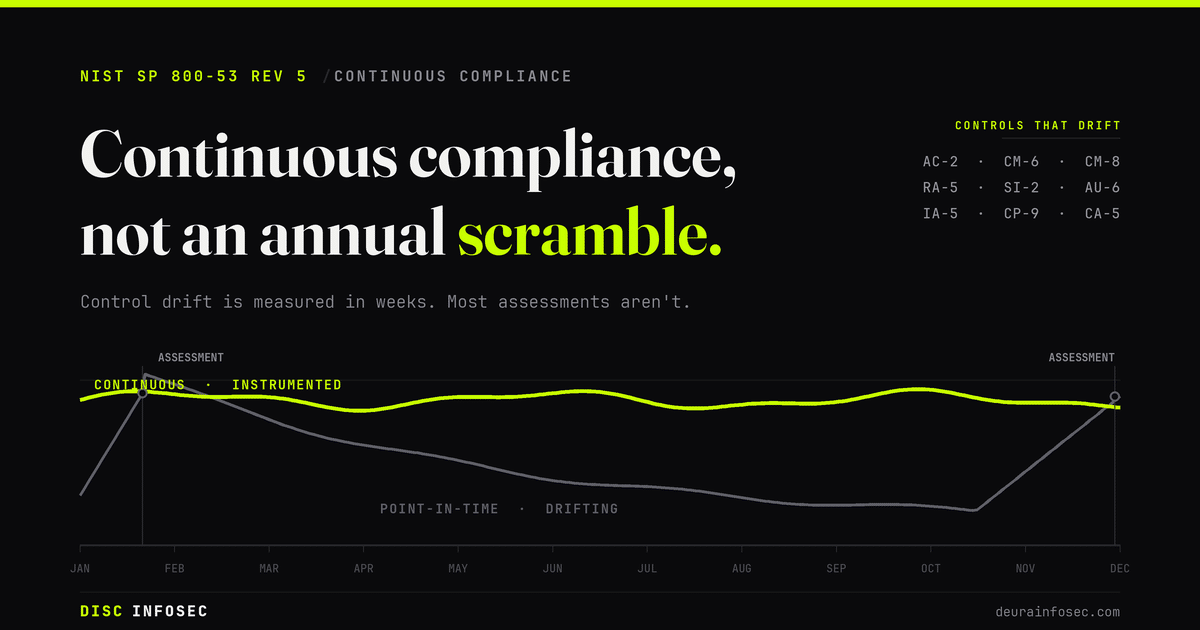
Most organizations do not fail NIST SP 800-53 during the assessment. They fail three months after it, quietly, and only find out the following year when an assessor pulls a sample and the sample doesn’t hold.
The pattern is always the same. A team spends four months assembling a System Security Plan, closes findings in a sprint, gets a favorable Security Assessment Report, and then goes back to shipping product. Accounts drift. Baselines drift. Scans get acknowledged instead of remediated. The POA&M becomes a graveyard of “in progress” line items with completion dates in the past. Twelve months later the control catalog hasn’t changed — the environment has.
This post is about the operating model that prevents that: what NIST 800-53 compliance is actually worth to a business, how often it genuinely needs to be assessed, and how to run it as a continuous process instead of an annual fire drill.
SP 800-53 Rev 5 is the control catalog mandated for federal information systems under FISMA. But the business case for a private company adopting it usually has nothing to do with FISMA.
Market access. This is the honest headline. SP 800-53 is the substrate underneath FedRAMP (Moderate/High baseline plus overlay parameters), CMMC 2.0 Level 2 (via SP 800-171, itself derived from the Moderate baseline), and most agency-specific security requirements you’ll see in a federal contract or subcontract flow-down. If you want to sell to a federal agency, a systems integrator, or a prime, this isn’t a differentiator — it’s the door.
Procurement leverage in the commercial market. Enterprise and financial-services security questionnaires increasingly ask questions that are 800-53 controls wearing a different hat. Being able to answer “here is our AC-2 implementation, here is the evidence, here is the ODV we assert and the metric that proves we hold it” shortens diligence cycles measurably. Security review is a sales-cycle line item; control maturity is how you shorten it.
Framework reuse. This is the underrated one. One well-run 800-53 Moderate program feeds ISO 27001:2022 Annex A, SOC 2 Trust Services Criteria, CSF 2.0, PCI DSS, and the HIPAA Security Rule with substantial overlap. The catalog is a superset of most of what your other auditors will ask for. Organizations that build the evidence pipeline once and map outward spend a fraction of what organizations spend running four parallel compliance programs with four sets of screenshots.
Risk reduction that survives contact with reality. The control families that generate the most audit findings — AC (access control), CM (configuration management), RA (vulnerability monitoring), SI (flaw remediation), AU (audit and accountability) — are also, not coincidentally, the ones that show up in the root-cause section of breach reports. Compliance is a lagging indicator of hygiene. Done right, it is also the forcing function that produces it.
What it is not worth. It is not worth building High-baseline controls for a commercial SaaS product with no federal pipeline. Over-scoping 800-53 is one of the most expensive mistakes I see, and I’ll come back to it at the end.
There is no single answer, because “audited” collapses four different activities that run on four different clocks. Getting this straight is most of the discipline.
| Activity | Who | Cadence | Authority |
|---|---|---|---|
| Vulnerability scanning (OS, web app, DB) | Internal | Monthly minimum; weekly for databases under FedRAMP | RA-5, SI-2 |
| POA&M review and update | Internal | Monthly | CA-5 |
| Ongoing control assessment (rolling subset) | Internal / ISSO | Continuous or quarterly | CA-7 |
| Contingency plan test | Internal | Annual minimum | CP-4 |
| Security awareness and role-based training | Internal | Annual | AT-2, AT-3 |
| Penetration test | Independent | Annual for Moderate and above | CA-8 |
| Full control assessment | Independent assessor / 3PAO | Annual under FedRAMP; otherwise at reauthorization | CA-2 |
| Reauthorization | Authorizing Official | Every 3 years, or continuous authorization | RMF Step 6 |
Two things about assessor independence, because this is where organizations get caught:
My practical recommendation for a private company with no federal mandate: run a full internal control assessment annually against your tailored baseline, an independent external assessment every two years, monthly scanning and POA&M discipline without exception, and a rolling quarterly assessment of roughly one quarter of your control set so that every control gets touched inside twelve months. That last item is the one nobody does, and it’s the one that makes the annual assessment boring instead of terrifying.
The direction of travel matters here too. The federal program is actively moving off point-in-time assessment. FedRAMP announced its 20x modernization in March 2025 and has been building toward continuous, machine-readable evidence, Key Security Indicators, and automated validation in place of annual assessment plus monthly manual deliverables. FedRAMP published Consolidated Rules in June 2026, and legal analysts read those rules as transitioning existing Rev5 authorizations toward 20x with Rev5 status expected to end by 2028. Whatever the exact timeline turns out to be, the design intent is unambiguous: demonstrate the control working, don’t describe it. If your evidence is a human taking a screenshot, you are building technical debt.
Here is how to actually run it.
The Word-document SSP is the single biggest structural cause of drift. A 400-page narrative cannot be diffed, tested, or queried, so it decays silently.
Move your control inventory into a structured form: one record per control, with implementation status, responsible role, inherited-vs-system-specific designation, the organization-defined values you assert, the evidence source, and the collection frequency. OSCAL is the NIST-developed format for exactly this — catalog, profile, component definition, SSP, assessment plan, assessment results, and POA&M all have machine-readable representations. Even if you never submit OSCAL to anyone, modeling your program that way means you can ask questions like “which controls have no automated evidence source?” and get an answer in seconds.
Rule of thumb: if you cannot generate your SSP from your control data, you have a document, not a program.
Not all 323 Moderate controls decay at the same rate. Physical controls (PE) barely move. Policy controls (the -1 control in every family) move annually. The controls that break between audits are a predictable short list, and they deserve automated telemetry:
| Control | What drifts | Automate |
|---|---|---|
| AC-2, AC-2(3) | Orphaned accounts, stale privileges, inactive accounts past ODV | Daily IdP query against HR system of record |
| AC-6(7) | Privilege creep after project-based grants | Quarterly automated privileged-access review |
| CM-6 | Configuration baseline deviation | Continuous config scanning (SCAP/XCCDF, CSPM, policy-as-code) |
| CM-8 | Asset inventory divergence | Continuous discovery reconciled against CMDB |
| CM-3 | Undocumented changes | Change records generated from the deployment pipeline |
| RA-5 / SI-2 | Unpatched findings aging past ODV | Scanner-to-ticket integration with SLA clocks |
| IA-5(1) | Authenticator policy exceptions | Policy-as-code assertion in the IdP |
| AU-6 | Logs collected but never reviewed | Detection content plus documented review cadence |
| CP-9 | Backups running but never restore-tested | Scheduled automated restore verification |
Everything else can run on a documented periodic review. Focus the engineering effort where the decay rate is highest.
Grade your evidence honestly. There are three tiers:
Tier 3 is the tax you pay for every control you failed to instrument. Inventory your controls by evidence tier, then work the list. The goal is not perfection — it’s that the ratio moves in the right direction every quarter, and that no high-risk control depends on somebody remembering to take a screenshot in the week before the assessor arrives.
Organization-defined values (ODV) are the sharpest tool in the catalog and the most commonly wasted. When you write “disable inactive accounts after 90 days” into your SSP, you have just written an SLO. Treat it like one: instrument it, dashboard it, alert on breach, and report the metric — not the intention.
| Control | ODV you assert | The metric that proves it |
|---|---|---|
| AC-2(3) | Inactive accounts disabled within 90 days | Max account inactivity age, measured daily |
| SI-2 | Critical flaws remediated within 30 days | Age distribution of open critical findings |
| AU-11 | Audit records retained 3 years | Oldest retrievable record, verified quarterly |
| CA-7 | ConMon assessment frequency: monthly | % of scheduled assessments completed on time |
| IR-6 | Incident reported within [x] hours | Median detection-to-report time per incident |
Two failure modes to avoid. First, do not assert an ODV you cannot measure — assessors test exactly these values, and a missed ODV converts a satisfied control into an Other Than Satisfied finding. Second, do not set ODVs tighter than your operational reality to look good on paper. A 15-day critical patch ODV you breach every month is materially worse than a 30-day ODV you consistently hold.
Continuous compliance is really change control with a security-authorization boundary drawn around it. Every meaningful change to the system is a potential control-impact event, and CM-3 is where you catch it.
Wire a security-impact assessment into your change process. Three questions, answerable in a pull-request template:
Any “yes” routes to the ISSO or security owner, updates the affected control narrative, and — for significant changes — triggers reassessment of the affected controls before deployment rather than at the next annual cycle. A “significant change” that reaches the assessor before it reaches you is the worst possible sequencing.
The POA&M (CA-5) is either a live remediation backlog or a document you write to make an auditor go away. Make it the former:
If your POA&M has items older than a year with no milestone movement, that is the finding. The underlying weakness is secondary.
Board and executive reporting should not be a control count. Five numbers tell you whether the program is actually continuous:
If those five are healthy, the annual assessment is a formality. If they aren’t, no amount of documentation effort in assessment month will save you.
| Cadence | Activities |
|---|---|
| Continuous | Config drift detection (CM-6), asset discovery (CM-8), account reconciliation (AC-2), log monitoring (AU-6, SI-4), automated control validation |
| Monthly | Vulnerability scans across OS / web / database (RA-5), POA&M update and review (CA-5), rolling control assessment slice (CA-7), security status report to the authorizing role |
| Quarterly | Privileged access review (AC-2, AC-6), risk register review (RA-3), supplier and supply-chain review (SR family), tabletop on one incident scenario (IR-3), backup restore verification (CP-9) |
| Annual | Full internal control assessment (CA-2), penetration test (CA-8), contingency plan test (CP-4), security awareness and role-based training (AT-2, AT-3), policy refresh across all -1 controls, privacy review (PT family), ODV re-validation |
| Every 3 years | Reauthorization / full independent assessment — or nothing at all, if you’ve achieved genuine ongoing authorization |
Five failure modes account for most of what I see:
Here’s the view I’d argue for.
Stop thinking of NIST 800-53 as a federal framework you either need or don’t. It is the most complete security and privacy control catalog in public circulation, and it is free. Treat it as your internal control spine — the canonical statement of what your organization does about security — and treat every external framework as a rendering of that spine for a specific audience.
That reframing lets you stratify cleanly:
The private-sector expression is ISO 27001 and SOC 2. Both are audience-facing assurance products. Neither is as complete as 800-53, and both are heavily covered by an 800-53 Moderate implementation. If your market is commercial, do not chase federal-grade documentation artifacts. Implement against the Moderate baseline as an internal standard, tailor aggressively, and render your evidence into ISO Annex A and Trust Services Criteria formats. You will pass both audits with material effort savings, and you will have a substantially better security program than a SOC 2 report alone would produce.
The public-sector expression is FedRAMP, CMMC, and agency ATOs. This layer adds cost that has little to do with security and a lot to do with assurance formality: mandated ODVs, FIPS-validated cryptography, prescribed document templates, accredited third-party assessors, machine-readable submission formats, and a named official accepting risk on the government’s behalf. It is worth paying for only if there is a real federal revenue thesis behind it.
The strategic decision, then, is not “which framework.” It’s how high up the assurance ladder you climb, and when. My recommended sequencing:
The organizations that get this right end up in an unusual position: continuous compliance stops being an expense line and becomes a sales asset. They answer security questionnaires in days instead of weeks, they enter federal procurement with the hard part already done, and their annual assessment is a review of numbers they were already watching.
That’s the whole objective. Not passing the audit — making the audit uninteresting.
HD “Disc” is Principal Consultant at DISC InfoSec, specializing in AI governance and information security compliance — ISO 42001, ISO 27001, NIST 800-53, and SOC 2 — for B2B SaaS and financial services organizations.
Working out where your organization sits on the assurance ladder, or trying to move an 800-53 program from annual scramble to continuous operation? Book a conversation. or email at info@deurainfosec.com
Sources: NIST SP 800-53 Rev 5, SP 800-53A Rev 5, SP 800-53B, SP 800-37 Rev 2, SP 800-137, FIPS 199/200. FedRAMP modernization details current as of July 2026 — verify against fedramp.gov before relying on specific dates.
DISC-AI-Governance-Readiness-Assessment-1-1 pdf downloadDownload
MachineLearning & Artificial Intelligence
AI Vulnerability Scorecard: Discover Your AI Attack Surface Before Attackers Do
Your Shadow AI Problem Has a Name-And Now It Has a Score
Most AI Security Tools Won’t Pass an Audit. Here’s a 15-Minute Way to Find Out.
InfoSec services | InfoSec books | Follow our blog | DISC llc is listed on The vCISO Directory | ISO 27k Chat bot | Comprehensive vCISO Services | ISMS Services | AIMS Services | Security Risk Assessment Services | Mergers and Acquisition Securit
DISC InfoSec blog | DISC InfoSec Site | Contact us at info@deurainfosec.com
Jul 22 2026
A fixed-scope, fixed-fee, two-week engagement that tells a company exactly where it stands against an AI governance standard — and hands them a prioritized, costed remediation plan they can execute against.
Auditor-grade certainty in two weeks, not a six-month program.
| Lens | Best fit |
| ISO 42001 | Flagship. Teams pursuing certification or building a formal AIMS. Your strongest proof point. |
| EU AI Act | Anyone with EU users or customers; deadline-driven urgency |
| NIST AI RMF | US teams wanting a framework without a certification commitment |
| Colorado AI Act / US state | US SaaS with consumer-facing AI decisions |
Add-on: a second lens or an ISO 42001 ↔ EU AI Act crosswalk, priced at +50% of the base fee. This is a natural upsell for anyone serving both markets.
DISC InfoSec DEURA INFORMATION SECURITY CONSULTING
PAID READINESS ENGAGEMENT
AI Governance
Readiness Assessment
Know exactly where you stand — in two weeks, for a fixed fee.
Your free assessment gave you a directional score. This gives you the auditor’s-eye version: a control-by-control review of your actual AI governance against ISO 42001, the EU AI Act, NIST AI RMF, or US state law — and a prioritized, costed plan to close the gaps.
WHAT YOU GET
| → A complete inventory of where AI operates across your product | → A gap register mapped to every relevant control, with maturity ratings |
| → A remediation roadmap, sequenced by risk and effort, with cost estimates | → A 60-minute readout to walk through it, personally |
FIXED FEE / TWO WEEKS
CREDITED IN FULL TOWARD IMPLEMENTATION
IF YOU PROCEED WITHIN 90 DAYS
Led by DISC InfoSec — CISSP, CISM, ISO 42001 Lead Implementer — who took a financial data room platform through its ISO 42001 Stage 2 certification audit. Financial data rooms are the hard mode of compliance; if it holds up there, it holds up for you.
BOOK A 20-MINUTE SCOPING CALL →
Is it a fit? Built for B2B SaaS and fintech teams with AI in production and a deadline in sight. Not there yet? The free assessment is the better starting
deurainfosec.com | hd@deurainfosec.com
AI Vulnerability Scorecard: Discover Your AI Attack Surface Before Attackers Do
Your Shadow AI Problem Has a Name-And Now It Has a Score
Most AI Security Tools Won’t Pass an Audit. Here’s a 15-Minute Way to Find Out.
InfoSec services | InfoSec books | Follow our blog | DISC llc is listed on The vCISO Directory | ISO 27k Chat bot | Comprehensive vCISO Services | ISMS Services | AIMS Services | Security Risk Assessment Services | Mergers and Acquisition Securit
DISC InfoSec blog | DISC InfoSec Site
Jul 21 2026
Most GRC programs are quietly optimized for the wrong outcome. They are built to survive an audit, not to reduce risk. The busiest weeks on the calendar are the ones before an assessor arrives, and the measure of success is a clean opinion rather than a safer environment. That is the gap GRC engineering exists to close.
The shift is simple to state and hard to internalize: stop spending human effort proving controls work, and start spending it understanding whether they actually do.
Traditional GRC burns most of its energy on a single low-value activity — assembling evidence to satisfy an auditor. Someone pulls a screenshot of an access review, exports a config, snips a ticket, drops it in a folder, and labels it. Multiply that across dozens of controls and hundreds of systems, and you have a full-time job that produces no security whatsoever. It produces a record of security, sampled once, at a moment that may bear no resemblance to how the environment looks the other 364 days of the year.
The screenshot is not the control. It is a photograph of the control on its best behavior.
This is the heart of GRC engineering. Instead of humans manually gathering artifacts, you automate collection so it pulls directly from the source system — the IdP, the cloud provider, the ticketing tool, the code repository — continuously and programmatically. When you do that, three things change in ways that compound:
Assurance gets stronger. You are no longer inspecting one sampled snapshot and hoping it generalizes. You are checking the real thing, continuously, against the live state of the system. A control that passes in January and silently drifts in March gets caught in March, not at next year’s audit.
Policies start to reflect reality. When the people writing policy can see the actual environment — not a sanitized description of it — the gap between “what we say we do” and “what we do” narrows. Policy stops being aspirational fiction and starts describing an enforceable, observable state.
The GRC professional stops being a translator. So much of the traditional role is shuttling screenshots between engineering and auditors, acting as a human API between teams that do not speak the same language. Automate that, and the practitioner is freed to do the work that requires judgment: interpreting risk, advising on trade-offs, and pushing for changes that actually move the needle. The job upgrades from clerk to advisor.
Here is the reframing that makes all of this strategic rather than merely efficient.
When your data is continuous and machine-readable, GRC stops being an audit-prep function and becomes an insights function. You can suddenly surface signals that leadership has never had access to before: trends across hundreds of systems, concentrations of risk that only appear when you aggregate, and — the most valuable of all — controls that look perfectly fine on paper but keep failing quietly in practice.
That last category is where real risk hides. A control marked “implemented” in the register but failing 8% of the time is invisible to a checklist and obvious to a data pipeline. Only continuous, queryable evidence exposes it.
And in this model, audit readiness stops being the goal. It becomes a byproduct. If you are continuously verifying the real state of your controls and can produce that history on demand, the audit is no longer an event you brace for — it is a report you export. You were ready the whole time, because you were never doing this for the audit in the first place.
It is tempting to sell GRC engineering as an efficiency play — fewer manual hours, faster evidence collection, lower cost of compliance. All true, and all beside the point. The efficiency is the least interesting thing about it.
The interesting thing is that GRC engineering changes what the function is for. It moves the center of gravity from “can we pass” to “are we actually secure, and how do we know” — and it gives you the data to answer that second question with something better than a shrug and a folder of screenshots.
Having built and audited management systems on both sides of this — the manual, screenshot-driven world and the automated one — I think the framing above is broadly on the right track, but there are two areas where it would benefit from closer scrutiny.
First: automation raises the stakes on your control design, it does not lower them. When evidence collection was manual, a badly designed control was merely tedious to prove. When it is automated and continuous, a badly designed control fails loudly, constantly, and in front of leadership. That is a feature, but teams underestimate the cultural readiness it demands. The first time a dashboard shows a control failing 12% of the time, someone will ask to “fix the dashboard.” The maturity of a GRC engineering program is measured by how the organization answers that request. Continuous assurance is only valuable if you are prepared to act on inconvenient truths, not explain them away.
Second: the hardest part is not the pipeline — it is deciding what “passing” actually means. Automating collection is a solved problem; the tooling is mature. The genuinely difficult, irreducibly human work is translating a control objective into a machine-checkable assertion that is neither so loose it is meaningless nor so strict it drowns you in false positives. “All production access is reviewed quarterly” is a policy. Turning it into a query that knows what production is, what access counts, what a valid review looks like, and what to do about the service account that legitimately never gets reviewed — that is engineering judgment, and it does not automate away. It is exactly the work that gets freed up when you stop shuttling screenshots. So the promise of the advisor role is real, but only if the practitioner has the technical fluency to define the assertions in the first place. The role does not just get more strategic; it gets more technical. Both things are true at once, and the people who thrive in this discipline will be the ones comfortable living in that overlap.
The organizations I have seen get real value from this are, unsurprisingly, the ones operating in high-stakes data environments — where a control drifting silently for a quarter is not an audit finding, it is an incident waiting to be disclosed. When the downside is that severe, continuous assurance stops being a nice-to-have and starts being the only honest way to run the program.
GRC engineering, done well, is not compliance done faster. It is the point at which the compliance function finally starts telling the truth in real time.
AI Vulnerability Scorecard: Discover Your AI Attack Surface Before Attackers Do
Your Shadow AI Problem Has a Name-And Now It Has a Score
Most AI Security Tools Won’t Pass an Audit. Here’s a 15-Minute Way to Find Out.
InfoSec services | InfoSec books | Follow our blog | DISC llc is listed on The vCISO Directory | ISO 27k Chat bot | Comprehensive vCISO Services | ISMS Services | AIMS Services | Security Risk Assessment Services | Mergers and Acquisition Securit
DISC InfoSec blog | DISC InfoSec Site





