The Batch Model Is Broken: Vulnerability Management in the Era of AI-Accelerated Discovery
Scheduled scans. Monthly patch windows. A CVSS-sorted queue that someone works down until capacity runs out.
That model was never elegant, but it worked because of three assumptions. All three are now false, and the data from the first half of 2026 makes that hard to argue with.
The three assumptions that just died
Assumption 1: discovery is rate-limited by human researchers.
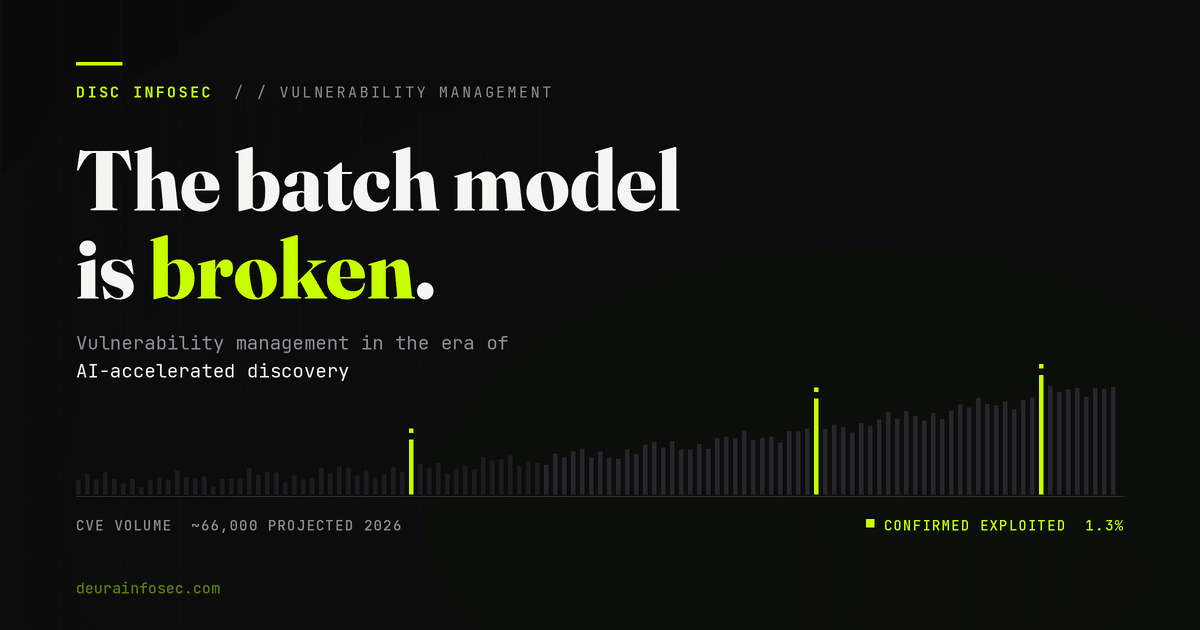
FIRST projected roughly 59,400 CVEs for 2026 in February, then revised upward to about 66,000 in its mid-year forecast after actual publication ran 46% above baseline. H1 2026 closed at 35,364 published CVEs — roughly 192 per day, sustained. Microsoft’s July 2026 Patch Tuesday addressed 622 vulnerabilities, the largest single release on record.
Note that the vendor side is the part most programs are unprepared for. Discovery volume is someone else’s problem until it becomes a patch you have to test, schedule, and deploy. AI-accelerated discovery does not arrive as an interesting statistic. It arrives as a release calendar you cannot absorb.
Assumption 2: someone else enriches and scores the queue for you.
In April 2026, NIST formally stopped pretending it could keep up. The NVD now enriches only CVEs that are in CISA’s KEV catalog, affect federal systems, or fall under EO 14028 “critical software.” Everything unenriched with a publish date before March 1, 2026 was moved to “Not Scheduled” — a polite way of saying the backlog has been written off. NIST cited a 263% increase in submissions between 2020 and 2025.
Meanwhile the CVE program itself has spent two years on short funding extensions, ENISA is standing up the EUVD and moving toward top-level CNA status, and CIRCL is running GCVE as a decentralized alternative. There is no single authoritative source of enriched vulnerability data anymore. If your pipeline assumes one, your pipeline has a dependency that no longer exists.
Assumption 3: you have weeks between disclosure and exploitation.
VulnCheck’s H1 2026 data: of 495 newly exploited vulnerabilities, 23.4% showed exploitation on or before the day the CVE was published. The median time from CVE publication to confirmed exploitation dropped from 120 days to 80. Mandiant’s M-Trends puts mean time-to-exploit at negative seven days. Roughly 200 CVEs reached exploited status within 31 days of disclosure.
A monthly patch window is a policy decision to be exposed for up to 30 days. That was defensible when the median attacker took four months. It is not defensible now, and regulators have noticed.
The regulatory clock already moved
On June 10, 2026, CISA issued BOD 26-04, and it deserves more attention than it got. It revokes both BOD 19-02 and BOD 22-01, and it explicitly removes the requirement to use CVSS for prioritization. Federal civilian agencies now prioritize on four variables: is the asset publicly exposed, is the CVE in KEV, can the exploit be automated, and what is the post-exploitation technical impact. Hit all four and you have three days. Miss most of them and you may legitimately defer to the next system upgrade.
Two things in that directive matter to everyone, not just FCEB agencies:
- CVSS has been formally demoted by the agency that spent years telling people to use it. Severity is now an input, not a sort key.
- The directive requires forensic triage before patching, on the reasoning that applying a patch does not evict an attacker who already used the bug. That is a real change in posture — the remediation unit of work is no longer “deploy patch,” it’s “deploy patch and answer whether we were already hit.”
Add the EU Cyber Resilience Act’s actively-exploited-vulnerability reporting obligations landing in September 2026, and the direction is unambiguous. Auditors are moving from “did you patch within your stated SLA” to “can you defend, with evidence, why this was remediated before that.”
What this looks like in three years
Six predictions I’d put money on:
1. The queue becomes an event stream. Scheduled scanning survives only as a compliance artifact and a reconciliation check. The operating model is continuous: an asset changes or a vulnerability becomes exploitable, and that fires an event with an SLA clock attached. The clock starts at exposure, not at scan date.
2. Asset truth becomes the load-bearing control. Every prioritization model — BOD 26-04’s four variables included — collapses without accurate answers to “do we run this, where, and is it reachable from the internet.” Exposure is the one variable CISA does not supply for you. Organizations that never solved inventory will find that AI-era vulnerability management is mostly an inventory problem wearing a different hat.
3. Reachability replaces severity as the primary filter. SBOM plus call-graph reachability plus runtime exposure, with EPSS and KEV as overlays. The interesting number stops being “we have 14,000 findings” and becomes “we have 31 reachable, exposed, exploit-automatable findings.”
4. Remediation gets agentic, with gates. Patch generation, PR authoring, regression testing, and cross-repo propagation are already being automated by commercial tooling and by the open-sourced cyber reasoning systems from DARPA’s AI Cyber Challenge. AIxCC finalists patched 43 of 54 synthetic vulnerabilities and found 18 real ones across 54 million lines of code — and all seven systems were released open source. The constraint on autonomous remediation is not fix generation. It’s patch trust: does this change break production, and who signs off. Expect patch reliability scoring and staged autonomous deployment for low-risk classes, human review for the rest.
5. Provenance becomes a first-class field. “Who found this, using what, and was it reproduced” will be metadata you filter on. The signal-to-noise problem in intake is now permanent.
6. Upstream maintainer capacity becomes an enterprise risk register entry. This is the one most programs are not modelling at all, and I’ll come back to it.
Defending against AI-accelerated open source discovery
Concretely, for teams running open source in production — which is everyone:
Fix inventory before buying anything. SBOM per deployable artifact, not per repository, reconciled against what’s actually running. If you cannot answer “which services ship libwhatever 2.4” in under an hour, no prioritization model will help you.
Build a two-lane remediation process and pre-authorize the fast lane. Most organizations have one change process, tuned for a 30-day cadence, and it applies equally to a font rendering library and an internet-facing auth bypass. Define the fast-lane criteria in advance (public exposure + KEV or credible exploit + high technical impact), get standing change-board approval for that class, and pre-stage the rollback. The three-day timeline is not achievable if every emergency patch needs a fresh approval. This is where regulated environments lose — the controls that make you safe on paper are precisely what make you slow in practice, and the answer is to design the fast lane into your ISMS rather than around it.
Decouple mitigation from patching. Virtual patching at the edge, WAF rules, config-level kill switches, feature flags, disabling the vulnerable code path. When the median disclosure-to-exploitation window is measured in hours for edge devices, the question is “how fast can we become not-exploitable,” not “how fast can we deploy the vendor fix.”
Prefer currency over triage. Continuous dependency updating is cheaper than assessing 66,000 CVEs against a stale dependency tree. Teams that stay within a few weeks of upstream spend their triage budget on the genuinely hard calls. Teams that are 18 months behind spend it on archaeology.
Assume compromise inside the exposure window. BOD 26-04 is right about this. For any exploited vulnerability on an internet-facing asset, the remediation ticket should include a compromise assessment for the period between disclosure and patch. Retention of the relevant logs is a prerequisite you have to get right months in advance.
Treat maintainer capacity as a supplier risk. curl ended its paid bug bounty in January 2026 after AI-generated submissions collapsed its confirmed-vulnerability rate from roughly 15% to under 5%. In July 2026 it stopped accepting vulnerability reports altogether for five weeks so its maintainers could rest. Daniel Stenberg’s later point is the one that should worry you more than the slop: report quality has since improved, confirmed vulnerabilities are up past pre-AI levels, and that is what breaks small projects. An avalanche of legitimate findings hitting a two-person volunteer team means your Tier-1 dependency’s fix latency is now a function of someone’s personal bandwidth. HackerOne’s own Internet Bug Bounty paused new submissions in March 2026. Map your critical open source dependencies to their actual maintainer headcount and funding, and put the single-maintainer ones on the risk register.
If you run AI tooling against other people’s code, hold a verification standard. Reproduce it, attach a PoC, confirm the code path exists in the version you claim, and don’t submit anything you don’t understand. AISLE upstreamed 12 of 12 CVEs in a single curl release using AI tooling — the capability isn’t the problem, the discipline is. And if you’re operating that tooling as a service, note that you’ve built an AI system whose failure modes harm third parties: ISO 42001 impact assessment territory, not just an appsec tool.
Map the changes to your control framework now. ISO 27001 A.8.8 gets a documented, risk-based prioritization method with evidence trails, not “monthly patching.” SOC 2 CC7.1 needs your fast-lane criteria written down and consistently applied. NIST CSF ID.RA-05 and RS.MI get the exposure and reachability inputs. If AI is in your remediation pipeline, ISO 42001 Annex A controls apply to your use of it.
My perspective
The bottleneck was never discovery. It was decision and deployment.
For twenty years we treated vulnerability discovery as the scarce resource — that’s why bug bounties, pentests, and scanner licences got the budget. AI drove the marginal cost of discovery toward zero, and what it exposed is that most vulnerability management programs were never throughput-limited by finding bugs. They were limited by knowing what they run, deciding what matters, and getting change through the door. Those constraints are organizational, and no tool purchase fixes them.
I’d also push back on the panic framing. Of 1,061 vulnerabilities VulnCheck attributed to AI-assisted discovery in H1 2026, 14 — 1.3% — have confirmed exploitation in the wild, which roughly matches the base rate for all vulnerabilities. CVE volume rose 45%; KEV additions rose 10%. AI-found bugs are not disproportionately weaponized. So the honest reading is: the volume problem is real and the exploitation-per-CVE problem is not. Anyone selling you AI-attacker doom is selling the wrong crisis. The actual crisis is that your queue math stopped working and your prioritization can no longer be defended to an auditor.
What genuinely concerns me is the asymmetry in deployment, not discovery. Attackers have no change advisory board, no maintenance window, no regression suite, and no customer notification requirement. Defenders have all four, and in financial services and other high-trust environments they have them in heavier form. That asymmetry is where the risk actually accumulates — and it’s why I think the highest-leverage work for the next three years is unglamorous: inventory accuracy, pre-authorized emergency change paths, rollback confidence, and log retention that makes compromise assessment possible after the fact.
The second thing I’d watch is the quiet transfer of risk to unpaid maintainers. Enterprises are about to discover that “we patch within SLA” is meaningless when the upstream fix doesn’t exist because the person who writes it is burned out. If you depend on open source and don’t fund it, you are running an uninsured dependency.
Finally, on measurement. MTTR as a single organizational average is already a vanity metric. Within three years the numbers that matter are MTTR segmented by exposure class, percentage of remediation decisions traceable to documented evidence, and time-to-mitigation as distinct from time-to-patch. Programs that can produce those three will pass audits and survive incidents. Programs still reporting “we closed 94% of criticals this quarter” are describing a queue, not a risk posture.
Financial data rooms are the hard mode of compliance — heavy change control, heavy client scrutiny, zero tolerance for downtime. If you can build a defensible three-day fast lane in that environment, you can build it anywhere. That’s the work.
DISC InfoSec helps B2B SaaS and financial services teams build vulnerability management, ISO 27001, and ISO 42001 programs that hold up under audit and under pressure. If your patch SLAs are written for a threat model that expired, Let’s talk: info@deurainfosec.com
Sources
- FIRST 2026 Vulnerability Forecast and Mid-Year Update
- NIST: Updates to NVD Operations to Address Record CVE Growth
- CISA BOD 26-04: Prioritizing Security Updates Based on Risk
- VulnCheck State of Exploitation 1H-2026
- DARPA AI Cyber Challenge final results
- Help Net Security: AI is drowning software maintainers in junk security reports
- Qualys: Manual patching can’t outrun AI
- OSSF Vulnerability Disclosures WG: AI-slop best practices
DISC-AI-Governance-Readiness-Assessment-1-1 pdf downloadDownload
MachineLearning & Artificial Intelligence
AI Vulnerability Scorecard: Discover Your AI Attack Surface Before Attackers Do
Your Shadow AI Problem Has a Name-And Now It Has a Score
Most AI Security Tools Won’t Pass an Audit. Here’s a 15-Minute Way to Find Out.

InfoSec services | InfoSec books | Follow our blog | DISC llc is listed on The vCISO Directory | ISO 27k Chat bot | Comprehensive vCISO Services | ISMS Services | AIMS Services | Security Risk Assessment Services | Mergers and Acquisition Securit
- US Banks Are Blocking Third-Party AI Agents from Customer Accounts
- Traditional vs. Agent Frameworks: Same Dimensions, Different Liabilities
- The Controls Are Still Being Written: Governing AI When the Technology Outruns the Audit
- If Your Frontier Model Vanished for 3 Weeks, Would Your Business Stop?
- The Evidence Lifecycle: Which Organizational Events to Log for Liability — and How Long to Keep Them
DISC InfoSec blog | DISC InfoSec Site | Contact us at info@deurainfosec.com