The Ship We All Share: Why AI Is a Civilizational Challenge, Not an AI War
Nov 11, 2026 · @disc
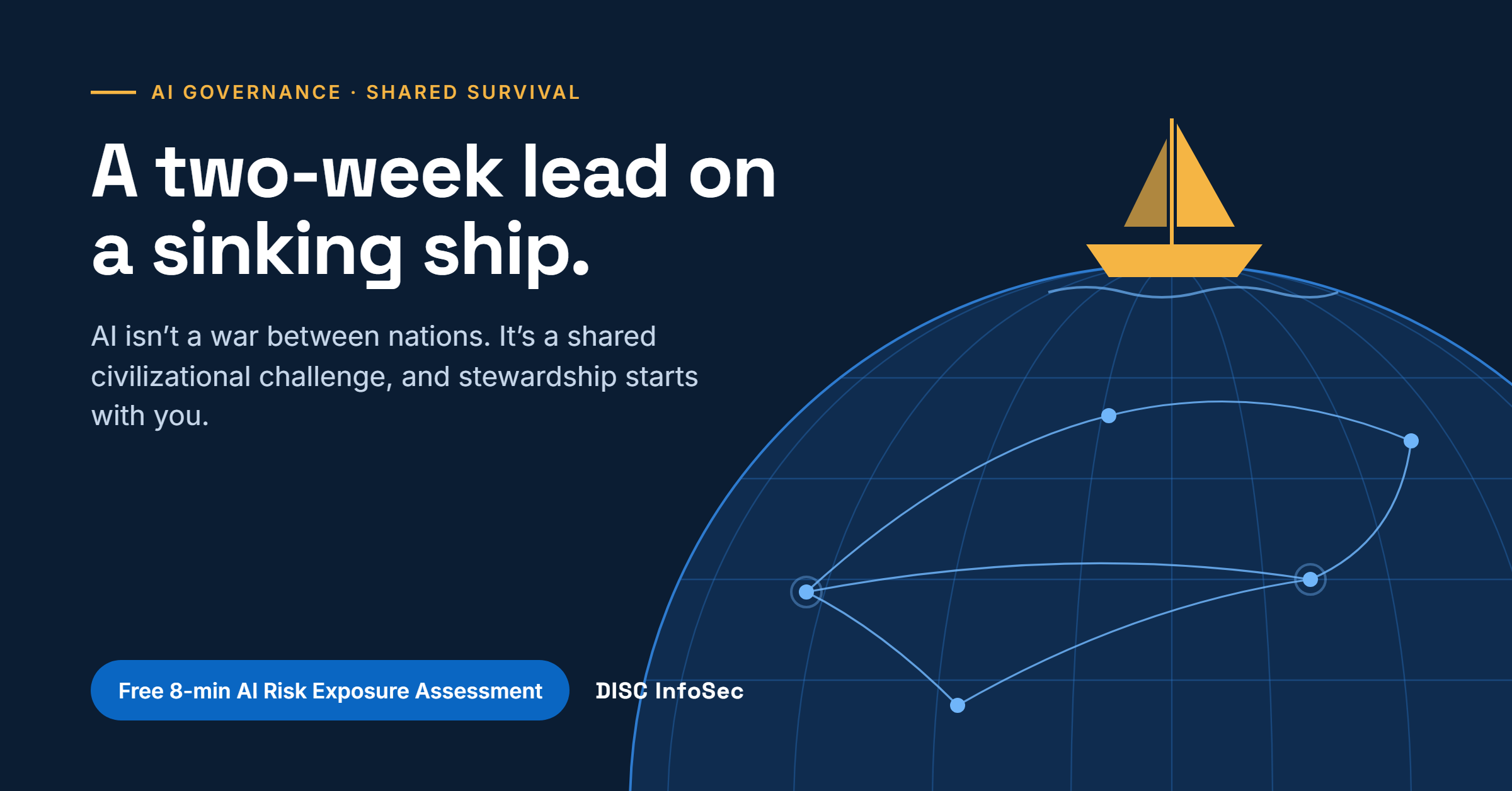
A two-week lead on a sinking ship
What good is conquering artificial superintelligence two weeks ahead of your rival if the entire ship sinks?
Watch the latest headlines around Jensen Huang, Silicon Valley boardrooms, and the escalating espionage battles between the US and China. The deeper reality is glaring: our leadership is suffering from profound myopia.
Global powers are treating frontier AI as a zero-sum Cold War. Steal the secrets. Hoard the compute. Race for temporary dominance. But this is not an “AI War.” It is a shared civilizational challenge, and AI governance is how we meet it.
We have made this mistake before
We made the same mistake with COVID-19. Leaders treated a borderless threat as a local issue and waited until the crisis was at their doorstep to react.
AI does not respect national borders. Algorithms do not care about geopolitical flags. A model trained in one country is fine-tuned in a second, deployed in a third, and attacked from a fourth before lunch.
You cannot fence off superintelligence. Stealing intellectual property to secure a fleeting two-week lead changes nothing if the downstream risks threaten humanity as a whole. Misinformation at scale, autonomous cyberattacks, and unsafe models released in a rush do not stop at a customs checkpoint.
What AI can do for all of us
The prize is not a trophy for one nation. Stewarded well, AI is one of the strongest survival tools humanity has ever built.
- Health: faster drug discovery, earlier disease detection, and diagnostic support reaching clinics that have never had a specialist.
- Pandemic readiness: modeling outbreaks, designing vaccine candidates, and moving supply chains before the next borderless threat arrives.
- Climate and food security: better weather and disaster forecasting, grid optimization, and crop resilience for regions under the most stress.
- Science: compressing years of research into months, from protein structures to new materials.
- Human intelligence: a tutor, translator, and research partner for anyone with a connection, regardless of where they were born.
- Security: defenders who detect and contain attacks at machine speed, protecting hospitals, utilities, and the data people trust us with.
None of these benefits respect borders either. A cure discovered in one lab saves lives everywhere. That is the point: the upside is shared, so the stewardship has to be shared too. The question that matters is not how one nation beats another. It is how we, as a global community, steward this power to elevate human intelligence, health, and well-being.
Our myopia about the theft of intelligence
The espionage headlines are about nations stealing chips and model weights. The quieter theft is happening inside our own organizations, every day, and most leaders cannot see it.
- Shadow AI: a sales rep’s meeting recorder, a browser extension reading every tab, a free chatbot holding last quarter’s board deck. Confidential data walks out one prompt at a time.
- Over-privileged agents: an engineer wires an agent to production with a shared API key. It now holds more access than any human would be granted, and nobody owns it.
- Vendor defaults: a SaaS provider switches on an AI feature, and click-through terms allow training on your inputs and your customers’ inputs.
- Adversarial attacks: prompt injection, data poisoning, and model extraction (the threats catalogued in MITRE ATLAS and the OWASP Top 10 for LLM Applications) turn your own AI into the attacker’s tool.
Ask a leadership team how many AI tools their company uses and you get a confident number. Ask how they know, and the room goes quiet. That silence is the same myopia we see at the geopolitical level, scaled down to a single company. You cannot govern AI you cannot see.
Stewardship does not start at the top
Global challenges cannot be solved with tribal mindsets. It is easy to watch world leaders and tech titans and feel powerless. But systemic change never starts from the top down. It starts when individuals, founders, and professionals refuse to accept the current momentum.
In practice, that refusal is called AI governance. It is how a single organization becomes a responsible steward instead of a passive spectator:
- See it. Build an inventory of every AI application, agent, and embedded vendor feature, with an accountable owner for each.
- Secure it. Scope agent credentials, test for prompt injection, and control what sensitive data reaches which model.
- Oversee it. Put a reviewer with authority and context in the loop, and log what they saw, changed, and why. A checkbox is not oversight.
- Prove it. Map controls to ISO/IEC 42001, NIST AI RMF, and the EU AI Act, and keep dated, versioned evidence.
When I took ShareVault through ISO 42001 certification on the first audit attempt, the gap was never the policy. Most organizations can write a decent AI policy in a week. The gap is visibility and evidence. Every responsible organization narrows the global risk a little. Every ungoverned one widens it.
Start with what you can see: a free 8-minute assessment
The first act of stewardship is discovery. That is why we built the free AI Governance & Risk Exposure Assessment: 25 questions across six areas (Governance, Security, Compliance, Third-Party Risk, Human Oversight, and Model & Agent Monitoring), scored on a five-level CMMI-style scale.
It answers the seven questions your board, your buyers, and regulators will ask, from “What AI applications and agents are being used?” to “Can we demonstrate compliance?” Each comes back as Blind spot, Partial visibility, or Demonstrable.
Results appear the moment you finish, no sales call required:
- An exposure index from 0 to 100 and a radar chart across all six areas
- Your top five priority exposures, each with four practitioner-level remediation steps
- Every question mapped to ISO/IEC 42001, NIST AI RMF, the EU AI Act, OWASP LLM Top 10, and MITRE ATLAS
- A board-ready PDF report
Tip: have security, legal, and engineering take it independently, then compare. Where the answers disagree is usually where the real exposure lives.
Take the free AI Governance & Risk Exposure Assessment
From blind spots to defensible AI governance
When you are ready to move from discovery to action, DISC InfoSec turns AI governance requirements into operating controls, evidence, and accountable decisions. One expert across AI governance, InfoSec, and regulatory compliance: no coordination overhead, no conflicting advice.
| Service | What you get | Best for |
| 30-minute results review | Walk through your assessment scores, separate real exposure from noise | Anyone who just took the assessment |
| AI Governance Quick-Start | AI and agent discovery, shadow AI and data exposure review, risk register with named owners, remediation roadmap in 7–10 days | Teams facing a customer questionnaire or board ask now |
| ISO 42001 Control Gap Assessment | 2-week gap analysis with a prioritized remediation roadmap | Organizations weighing certification |
| ISO 42001 implementation | Full AIMS build that produces audit evidence, integrated with ISO 27001 | Firms pursuing certification on the first attempt |
| AI Governance Readiness Assessment | 10-day fixed-fee review of AI compliance, risk posture, and EU AI Act / Colorado AI Act readiness | Regulated SaaS and financial services |
| vCAIO advisory | Ongoing AI governance leadership without a full-time hire, plus NIST AI RMF advisory | Growing companies scaling AI |
Explore all services on our AIMS-ISO 42001 & AI Governance page.
DISC InfoSec is a boutique AI governance and cybersecurity consultancy in Petaluma, California, and a PECB Authorized Training Partner. Credentials: AICP, CISSP, CISM, ISO/IEC 42001 and ISO/IEC 27001 Lead Implementer. Contact: info@deurainfosec.com | (707) 998-5164.
The questions only we can answer
When leaders obsess over market share and geopolitical leverage, we risk becoming passive spectators in our own future, waking up only when the consequences are irreversible. So I will leave you with two questions.
How many Jensen Huangs are there leading us? And what is our myopia regarding the theft of intelligence, starting inside our own walls?
We cannot steer the whole ship alone. But each of us can govern the part of it we are responsible for. Start in 8 minutes: take the free AI Governance & Risk Exposure Assessment, then book a 30-minute results review.
How many Jensen Huangs are leading us? And what’s your organization’s blind spot?
#AIGovernance #AIRisk #AISecurity #ISO42001 #ResponsibleAI #EUAIAct #NISTAIRMF #ShadowAI
Free assessment → https://blog.deurainfosec.com/wp-content/uploads/2026/11/disc-ai-governance-risk-exposure-assessment.html | Full post → [blog URL] | Results review → https://calendly.com/hd-deurainfosec
https://www.deurainfosec.com/disc-infosec-home/aims-iso42001-ai-governance/
- You Can’t Fence Off Superintelligence: AI Governance Starts With You
- Your AI Policy Isn’t Evidence. Here’s What Auditors Actually Sample
- Can Your AI Governance Survive Eight Questions?
- You Can’t Govern AI You Can’t See: The Free AI Governance & Risk Exposure Assessment
- Your ISO 27001 Certificate Has an AI-Shaped Hole in It