Continuous Human Involvement Is a Fantasy. Continuous Human Authority Is an Architecture.
How to govern a fleet of hundreds of ephemeral AI agents that spawn, act, and vanish in minutes — when nobody can watch them.
Someone posed me a riddle recently, and it’s the sharpest challenge to “human-in-the-loop” orthodoxy I’ve heard in a while:
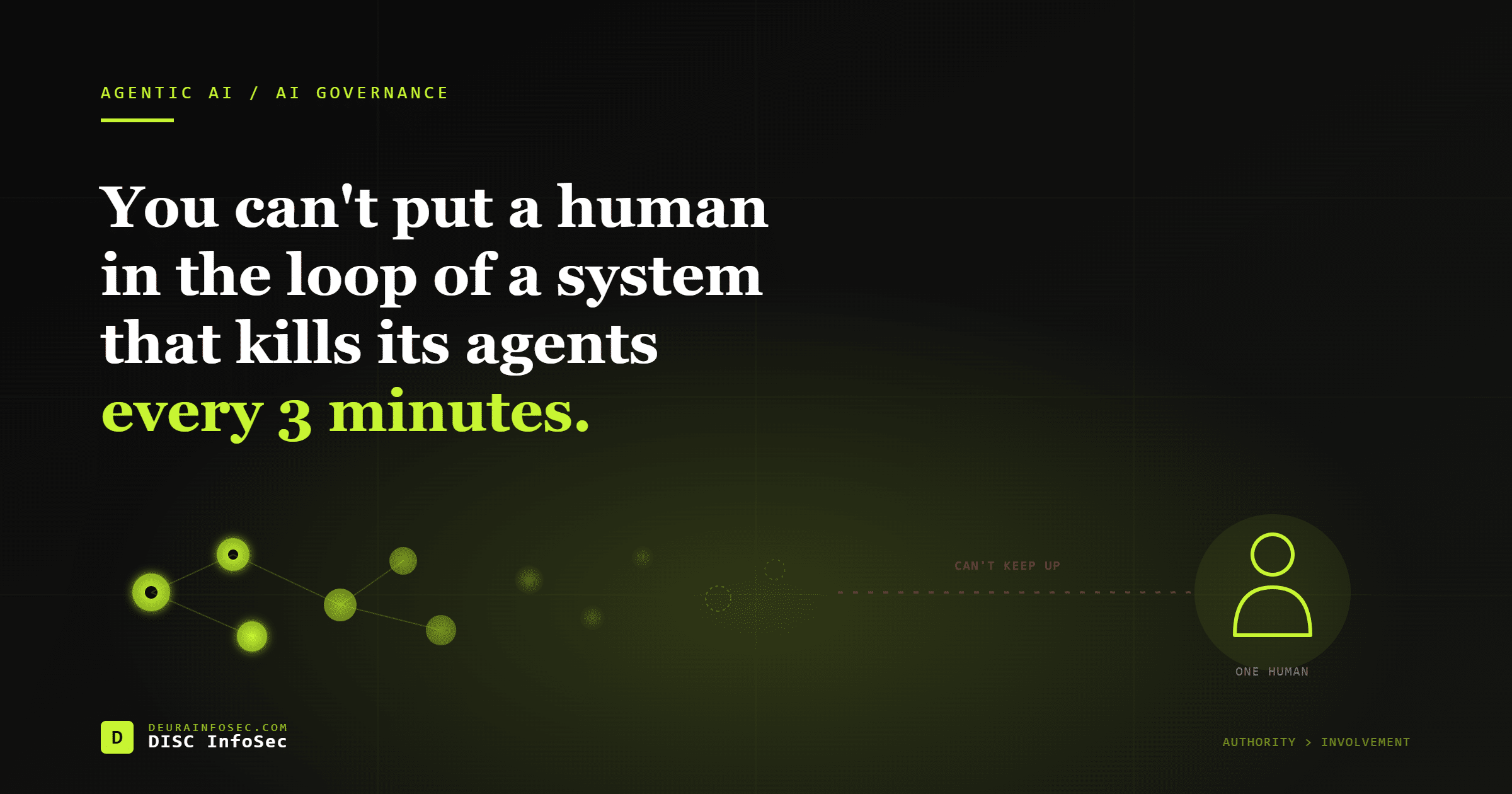
“You have a highly autonomous AI system. Hundreds of non-persistent, temporal agents are being spawned to act and then spun down within minutes. How do you plan on continuous human involvement in that scenario?”
It’s a trap — and the trap is the word continuous. Most governance frameworks, policies, and vendor decks lean on “we keep a human in the loop” as their answer to AI risk. This scenario detonates that answer. So let me answer it the way I’d answer it in a design review, not a marketing slide.
The Naive Answer Is Arithmetically Impossible
When hundreds of agents spawn and die within minutes, per-agent human review isn’t hard — it’s impossible, and you can prove it with a napkin.
Do the math: 300 agents living three minutes each is roughly 6,000 agent-lifetimes per hour. Even at a generous 30 seconds of human review a piece, you’d need dozens of reviewers working in perfect, uninterrupted parallel just to keep pace — and every one of those agents would have already acted and been spun down before any reviewer finished looking at it. The human isn’t a gate the agent waits at. They’re an archaeologist studying something that’s already gone.
So “we keep a human in the loop” isn’t a control claim for this architecture. It’s a description of a loop nobody has actually looked at.
This connects directly to a distinction I’ve written about before — the difference between human oversight (a person can step in if something looks wrong) and human control (the system can’t act until a person decides). In a fleet of ephemeral agents, naive oversight collapses into theater: a dashboard nobody can meaningfully watch at speed. The question forces us to get honest about which one we’re actually building.
The Reframe: Action vs. Authority
The correct first move is to reject the question’s hidden assumption. Continuous human action is off the table — it cannot scale to machine speed and machine scale. What remains firmly on the table is continuous human authority. Those are not the same thing, and conflating them is the entire failure mode.
Continuous involvement means a human is continuously acting. Continuous authority means human decisions are continuously in force — encoded, enforced, and un-overridable by the agents themselves — even when no human is watching any individual agent. The first is a fantasy at this scale. The second is an architecture. Here’s how you build it.
1. Move the Human Up the Abstraction Stack
Stop trying to govern each ephemeral agent. Govern the system that spawns them.
The human decision moves up a level — to the orchestration layer that mints the agents. A human approves the class of agent and its permission envelope once: what capabilities it can be granted, which tools exist in its catalog, what authority boundaries are baked into the spawn template. Every disposable instance then inherits that envelope at birth. The agents are non-persistent; the policy they’re born into is not. That inheritance is your first layer of persistent human control over non-persistent actors.
2. Compile Human Judgment Into Policy-as-Code
Since no human can watch an individual agent, the human’s judgment has to be compiled into runtime enforcement that travels with every agent.
Route every agent’s tool calls and external actions through a governed choke point — an MCP-gateway pattern — where policy-as-code evaluates each action against allow/deny rules, scope, environment, and data sensitivity at execution time. A human wrote that rule weeks ago; the rule now fires on all hundreds of agents, on every action, at machine speed. This is how oversight scales to a fleet: the human isn’t in the loop, the human’s encoded intent is. A misbehaving agent hits a wall a human built, even though no human is watching that specific agent.
3. Tier Your Actions — Autonomy Is Per-Action, Not Per-System
This is the real engineering discipline, and it’s where most programs fail. They treat the fleet as one autonomy level. It isn’t. Classify every action an agent can take by consequence and reversibility:
- Low-consequence, reversible → fully autonomous. Run at machine speed, log everything.
- High-consequence, reversible → autonomous, but instrumented with anomaly detection and automatic rollback triggers.
- High-consequence, irreversible → a hard, synchronous human gate. The agent blocks and waits for a human decision, even if that breaks the “minutes” cadence.
You gate only what genuinely warrants gating — which keeps the fleet fast where speed is safe and stops it cold where it isn’t.
4. Human-On-the-Loop: Supervise the Shape, Not the Instance
Real-time human involvement in a fleet is supervisory, not participatory. Humans watch aggregate behavior — spawn rates, tool-call distributions, error and drift signals, cost and blast-radius metrics — through dashboards with circuit breakers wired in, governed by fleet-level SLOs and error budgets. When aggregate behavior crosses a threshold, the system trips automatically and pages a human with authority to act on the whole class. The human isn’t judging decision #4,712. They’re watching the shape of ten thousand decisions and holding the power to stop them.
5. The Kill-Switch Operates on the Class, Not the Instance
You can’t kill an agent that already died. So the one form of real-time human control that actually scales is the ability to instantly halt spawning, quarantine a tool from the entire fleet, or freeze the whole system. This is continuous, real-time human intervention in the only shape it can take at scale: not touching every decision, but retaining the authority and the mechanism to stop them all at once. Design the kill-switch as a first-class, tested control with unambiguous authority to pull it.
6. Ephemerality Is a Control Requirement — Mandate Traceability and Rollback
“The agent no longer exists” cannot become the new “the computer said so.” Every ephemeral agent must emit immutable, complete traces — reasoning, tool calls, inputs, outputs — to durable storage before it dies, so a human can reconstruct exactly what happened after the fact. And every consequential action needs a compensating transaction. In a fleet of the disposable, much of human control is exercised through after-action audit and reversibility, not real-time touch. The loop closes after the agent is gone — and it must actually close.
The Part Most People Won’t Say Out Loud
Everything above is how you make it work. But the honest expert answer includes a boundary. If an action is simultaneously irreversible, high-impact, and intolerant of a pre-execution human gate, that action should not be running autonomously at all. That’s not a control gap to engineer around — it’s a scoping decision to make deliberately.
The maturity isn’t “we found a clever way to keep a human continuously involved everywhere.” It’s “we drew a defensible line between what runs at machine speed and what doesn’t, and we can prove why the line sits exactly where it does.” That line is the human involvement.
Why This Is Exactly What the Regulators Are Asking
Here’s the reassuring part: this architecture isn’t a workaround for compliance — it is compliance, done properly. ISO 42001, the EU AI Act’s Article 14, and the NIST AI RMF don’t actually ask “was a human touching every decision?” They ask a sharper question: “was human authority meaningful and effective given how this system actually operates?”
For an ephemeral-agent fleet, meaningful does not equal continuous-touch. Meaningful means governed spawn templates, policy-as-code enforced on every action, synchronous gates on the irreversible few, supervisory monitoring, a class-level kill-switch, and immutable traces with rollback. A regulator — or a customer running due diligence — isn’t going to be impressed that you claimed a human was in the loop. They’re going to ask what that human could actually do, and when. This architecture answers that question. “We had oversight” does not.
The Bottom Line
You don’t achieve continuous human involvement in a system that spawns and kills hundreds of agents in minutes. You achieve continuous human authority — expressed as encoded boundaries every agent inherits, gates on the actions that warrant them, real-time power to halt the class, and after-the-fact accountability that actually closes the loop.
Continuous involvement is a fantasy at that scale. Continuous authority is an architecture. If you’re deploying autonomous or agentic AI and your governance still rests on “a human is in the loop,” the riddle above is the question your next auditor — or your next incident — is going to ask you. Better to have the architecture before they do.
DISC InfoSec helps B2B SaaS and financial-services organizations build defensible AI governance for exactly these systems — mapping where human authority actually sits in autonomous and agentic AI, and making it hold up under ISO 42001, the EU AI Act, and the NIST AI RMF. We took a virtual data room to first-audit ISO 42001 certification on M&A and financial data. If human authority can be made defensible there, it can be made defensible in your fleet.
Deploying autonomous agents? If you’re not sure your human-control model would survive an audit, it’s probably time to have that conversation—before someone else does.
📩 info@deurainfosec.com · deurainfosec.com
#AIGovernance #AgenticAI #HumanInTheLoop #AISecurity #ISO42001 #EUAIAct #NISTAIRMF #ResponsibleAI #AutonomousAI #AIRiskManagement #Cybersecurity #vCAIO #AICompliance
A note on citations: this piece reflects DISC InfoSec’s practitioner perspective and references public frameworks (ISO 42001, EU AI Act Article 14, NIST AI RMF).