Continuous NIST 800-53 Compliance: How to Stop Failing in the Eleven Months Between Audits
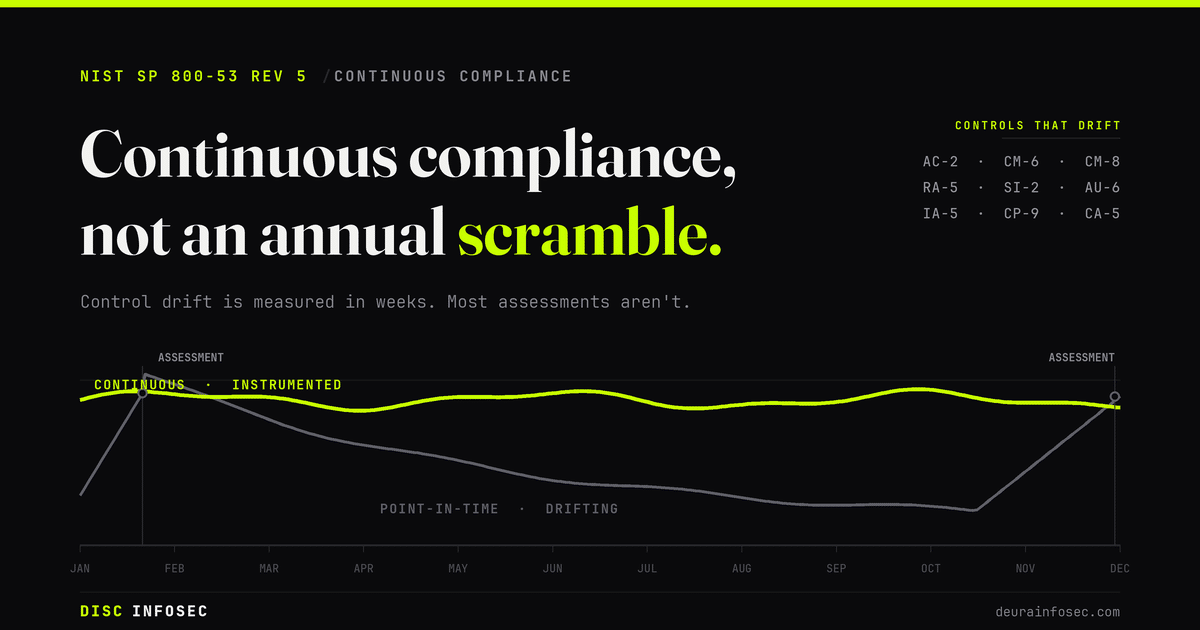
Most organizations do not fail NIST SP 800-53 during the assessment. They fail three months after it, quietly, and only find out the following year when an assessor pulls a sample and the sample doesn’t hold.
The pattern is always the same. A team spends four months assembling a System Security Plan, closes findings in a sprint, gets a favorable Security Assessment Report, and then goes back to shipping product. Accounts drift. Baselines drift. Scans get acknowledged instead of remediated. The POA&M becomes a graveyard of “in progress” line items with completion dates in the past. Twelve months later the control catalog hasn’t changed — the environment has.
This post is about the operating model that prevents that: what NIST 800-53 compliance is actually worth to a business, how often it genuinely needs to be assessed, and how to run it as a continuous process instead of an annual fire drill.
Part 1 — What NIST 800-53 compliance is actually worth
SP 800-53 Rev 5 is the control catalog mandated for federal information systems under FISMA. But the business case for a private company adopting it usually has nothing to do with FISMA.
Market access. This is the honest headline. SP 800-53 is the substrate underneath FedRAMP (Moderate/High baseline plus overlay parameters), CMMC 2.0 Level 2 (via SP 800-171, itself derived from the Moderate baseline), and most agency-specific security requirements you’ll see in a federal contract or subcontract flow-down. If you want to sell to a federal agency, a systems integrator, or a prime, this isn’t a differentiator — it’s the door.
Procurement leverage in the commercial market. Enterprise and financial-services security questionnaires increasingly ask questions that are 800-53 controls wearing a different hat. Being able to answer “here is our AC-2 implementation, here is the evidence, here is the ODV we assert and the metric that proves we hold it” shortens diligence cycles measurably. Security review is a sales-cycle line item; control maturity is how you shorten it.
Framework reuse. This is the underrated one. One well-run 800-53 Moderate program feeds ISO 27001:2022 Annex A, SOC 2 Trust Services Criteria, CSF 2.0, PCI DSS, and the HIPAA Security Rule with substantial overlap. The catalog is a superset of most of what your other auditors will ask for. Organizations that build the evidence pipeline once and map outward spend a fraction of what organizations spend running four parallel compliance programs with four sets of screenshots.
Risk reduction that survives contact with reality. The control families that generate the most audit findings — AC (access control), CM (configuration management), RA (vulnerability monitoring), SI (flaw remediation), AU (audit and accountability) — are also, not coincidentally, the ones that show up in the root-cause section of breach reports. Compliance is a lagging indicator of hygiene. Done right, it is also the forcing function that produces it.
What it is not worth. It is not worth building High-baseline controls for a commercial SaaS product with no federal pipeline. Over-scoping 800-53 is one of the most expensive mistakes I see, and I’ll come back to it at the end.
Part 2 — How often should it be audited?
There is no single answer, because “audited” collapses four different activities that run on four different clocks. Getting this straight is most of the discipline.
| Activity | Who | Cadence | Authority |
|---|---|---|---|
| Vulnerability scanning (OS, web app, DB) | Internal | Monthly minimum; weekly for databases under FedRAMP | RA-5, SI-2 |
| POA&M review and update | Internal | Monthly | CA-5 |
| Ongoing control assessment (rolling subset) | Internal / ISSO | Continuous or quarterly | CA-7 |
| Contingency plan test | Internal | Annual minimum | CP-4 |
| Security awareness and role-based training | Internal | Annual | AT-2, AT-3 |
| Penetration test | Independent | Annual for Moderate and above | CA-8 |
| Full control assessment | Independent assessor / 3PAO | Annual under FedRAMP; otherwise at reauthorization | CA-2 |
| Reauthorization | Authorizing Official | Every 3 years, or continuous authorization | RMF Step 6 |
Two things about assessor independence, because this is where organizations get caught:
- Low-impact systems may self-assess.
- Moderate-impact systems require an assessor independent of the implementation team — a different team inside your organization can qualify.
- High-impact and FedRAMP systems require an accredited third-party assessment organization.
My practical recommendation for a private company with no federal mandate: run a full internal control assessment annually against your tailored baseline, an independent external assessment every two years, monthly scanning and POA&M discipline without exception, and a rolling quarterly assessment of roughly one quarter of your control set so that every control gets touched inside twelve months. That last item is the one nobody does, and it’s the one that makes the annual assessment boring instead of terrifying.
The direction of travel matters here too. The federal program is actively moving off point-in-time assessment. FedRAMP announced its 20x modernization in March 2025 and has been building toward continuous, machine-readable evidence, Key Security Indicators, and automated validation in place of annual assessment plus monthly manual deliverables. FedRAMP published Consolidated Rules in June 2026, and legal analysts read those rules as transitioning existing Rev5 authorizations toward 20x with Rev5 status expected to end by 2028. Whatever the exact timeline turns out to be, the design intent is unambiguous: demonstrate the control working, don’t describe it. If your evidence is a human taking a screenshot, you are building technical debt.
Part 3 — The continuous compliance operating model
Here is how to actually run it.
1. Treat your control set as data, not as a document
The Word-document SSP is the single biggest structural cause of drift. A 400-page narrative cannot be diffed, tested, or queried, so it decays silently.
Move your control inventory into a structured form: one record per control, with implementation status, responsible role, inherited-vs-system-specific designation, the organization-defined values you assert, the evidence source, and the collection frequency. OSCAL is the NIST-developed format for exactly this — catalog, profile, component definition, SSP, assessment plan, assessment results, and POA&M all have machine-readable representations. Even if you never submit OSCAL to anyone, modeling your program that way means you can ask questions like “which controls have no automated evidence source?” and get an answer in seconds.
Rule of thumb: if you cannot generate your SSP from your control data, you have a document, not a program.
2. Instrument the controls that actually drift
Not all 323 Moderate controls decay at the same rate. Physical controls (PE) barely move. Policy controls (the -1 control in every family) move annually. The controls that break between audits are a predictable short list, and they deserve automated telemetry:
| Control | What drifts | Automate |
|---|---|---|
| AC-2, AC-2(3) | Orphaned accounts, stale privileges, inactive accounts past ODV | Daily IdP query against HR system of record |
| AC-6(7) | Privilege creep after project-based grants | Quarterly automated privileged-access review |
| CM-6 | Configuration baseline deviation | Continuous config scanning (SCAP/XCCDF, CSPM, policy-as-code) |
| CM-8 | Asset inventory divergence | Continuous discovery reconciled against CMDB |
| CM-3 | Undocumented changes | Change records generated from the deployment pipeline |
| RA-5 / SI-2 | Unpatched findings aging past ODV | Scanner-to-ticket integration with SLA clocks |
| IA-5(1) | Authenticator policy exceptions | Policy-as-code assertion in the IdP |
| AU-6 | Logs collected but never reviewed | Detection content plus documented review cadence |
| CP-9 | Backups running but never restore-tested | Scheduled automated restore verification |
Everything else can run on a documented periodic review. Focus the engineering effort where the decay rate is highest.
3. Build evidence pipelines, not evidence hunts
Grade your evidence honestly. There are three tiers:
- Machine-generated telemetry from the authoritative source. The IdP’s own account export. The scanner’s own output. Can’t be fabricated, can’t go stale.
- Automated validation results. A policy-as-code check that asserts the control condition and emits pass/fail on a schedule.
- Human-produced artifacts. Screenshots, meeting minutes, attestations.
Tier 3 is the tax you pay for every control you failed to instrument. Inventory your controls by evidence tier, then work the list. The goal is not perfection — it’s that the ratio moves in the right direction every quarter, and that no high-risk control depends on somebody remembering to take a screenshot in the week before the assessor arrives.
4. Convert your ODVs into service-level objectives
Organization-defined values (ODV) are the sharpest tool in the catalog and the most commonly wasted. When you write “disable inactive accounts after 90 days” into your SSP, you have just written an SLO. Treat it like one: instrument it, dashboard it, alert on breach, and report the metric — not the intention.
| Control | ODV you assert | The metric that proves it |
|---|---|---|
| AC-2(3) | Inactive accounts disabled within 90 days | Max account inactivity age, measured daily |
| SI-2 | Critical flaws remediated within 30 days | Age distribution of open critical findings |
| AU-11 | Audit records retained 3 years | Oldest retrievable record, verified quarterly |
| CA-7 | ConMon assessment frequency: monthly | % of scheduled assessments completed on time |
| IR-6 | Incident reported within [x] hours | Median detection-to-report time per incident |
Two failure modes to avoid. First, do not assert an ODV you cannot measure — assessors test exactly these values, and a missed ODV converts a satisfied control into an Other Than Satisfied finding. Second, do not set ODVs tighter than your operational reality to look good on paper. A 15-day critical patch ODV you breach every month is materially worse than a 30-day ODV you consistently hold.
5. Make change management the compliance trigger
Continuous compliance is really change control with a security-authorization boundary drawn around it. Every meaningful change to the system is a potential control-impact event, and CM-3 is where you catch it.
Wire a security-impact assessment into your change process. Three questions, answerable in a pull-request template:
- Does this change the authorization boundary or introduce a new external interface?
- Does this change how data is stored, transmitted, or classified?
- Does this alter the implementation of any control in the SSP?
Any “yes” routes to the ISSO or security owner, updates the affected control narrative, and — for significant changes — triggers reassessment of the affected controls before deployment rather than at the next annual cycle. A “significant change” that reaches the assessor before it reaches you is the worst possible sequencing.
6. Run the POA&M as an operational queue
The POA&M (CA-5) is either a live remediation backlog or a document you write to make an auditor go away. Make it the former:
- Every open item has a named owner and a real, defensible completion date
- Risk-based deadlines with a working clock — the FedRAMP model is a reasonable default: 30 days critical, 90 days high, 180 days moderate, one year low
- Monthly review with the same seriousness as a sprint review
- Risk acceptance is a documented decision with business justification and signature from the system owner, not a status you drift into
- Nothing sits in “risk accepted” indefinitely at high or critical severity
If your POA&M has items older than a year with no milestone movement, that is the finding. The underlying weakness is secondary.
7. Report metrics that predict the audit outcome
Board and executive reporting should not be a control count. Five numbers tell you whether the program is actually continuous:
- Evidence automation ratio — % of controls with Tier 1 or Tier 2 evidence
- ODV breach rate — % of asserted values held over the last 90 days
- POA&M aging — count and oldest age of items past their scheduled completion date
- Assessment coverage — % of the control set assessed within the last 12 months
- Mean time to control restoration — how long a drifted control stays drifted once detected
If those five are healthy, the annual assessment is a formality. If they aren’t, no amount of documentation effort in assessment month will save you.
Part 4 — The twelve-month operating calendar
| Cadence | Activities |
|---|---|
| Continuous | Config drift detection (CM-6), asset discovery (CM-8), account reconciliation (AC-2), log monitoring (AU-6, SI-4), automated control validation |
| Monthly | Vulnerability scans across OS / web / database (RA-5), POA&M update and review (CA-5), rolling control assessment slice (CA-7), security status report to the authorizing role |
| Quarterly | Privileged access review (AC-2, AC-6), risk register review (RA-3), supplier and supply-chain review (SR family), tabletop on one incident scenario (IR-3), backup restore verification (CP-9) |
| Annual | Full internal control assessment (CA-2), penetration test (CA-8), contingency plan test (CP-4), security awareness and role-based training (AT-2, AT-3), policy refresh across all -1 controls, privacy review (PT family), ODV re-validation |
| Every 3 years | Reauthorization / full independent assessment — or nothing at all, if you’ve achieved genuine ongoing authorization |
Part 5 — Where this goes wrong
Five failure modes account for most of what I see:
- Compliance owned entirely by GRC. If engineering doesn’t own control implementation, controls exist in documents only. GRC should own the framework, the evidence model, and the reporting. Engineering owns the controls.
- Inherited controls assumed rather than verified. Your cloud provider covers a large slice of PE, MA, and parts of SC — but the customer-responsibility side of every shared control is yours, and it’s where assessors concentrate. Read the responsibility matrix; don’t assume it.
- Tailoring never documented. Removing a control is legitimate. Removing it without a written scoping rationale is a finding, and a fast one.
- PT and SR treated as optional. Privacy controls apply to any system processing PII regardless of impact level, and supply chain risk management was added as a full family in Rev 5. Both are still routinely skipped in programs built on Rev 4 muscle memory.
- Screenshot-driven assessment prep. If the four weeks before an assessment look different from any other four weeks, the program isn’t continuous. That gap is exactly what the federal program’s shift to automated, machine-readable evidence is designed to eliminate.
My perspective: one catalog, two assurance markets
Here’s the view I’d argue for.
Stop thinking of NIST 800-53 as a federal framework you either need or don’t. It is the most complete security and privacy control catalog in public circulation, and it is free. Treat it as your internal control spine — the canonical statement of what your organization does about security — and treat every external framework as a rendering of that spine for a specific audience.
That reframing lets you stratify cleanly:
The private-sector expression is ISO 27001 and SOC 2. Both are audience-facing assurance products. Neither is as complete as 800-53, and both are heavily covered by an 800-53 Moderate implementation. If your market is commercial, do not chase federal-grade documentation artifacts. Implement against the Moderate baseline as an internal standard, tailor aggressively, and render your evidence into ISO Annex A and Trust Services Criteria formats. You will pass both audits with material effort savings, and you will have a substantially better security program than a SOC 2 report alone would produce.
The public-sector expression is FedRAMP, CMMC, and agency ATOs. This layer adds cost that has little to do with security and a lot to do with assurance formality: mandated ODVs, FIPS-validated cryptography, prescribed document templates, accredited third-party assessors, machine-readable submission formats, and a named official accepting risk on the government’s behalf. It is worth paying for only if there is a real federal revenue thesis behind it.
The strategic decision, then, is not “which framework.” It’s how high up the assurance ladder you climb, and when. My recommended sequencing:
- Adopt the Moderate baseline as internal policy now, regardless of market. It costs nothing to use as your control taxonomy, and it means every future framework is a mapping exercise rather than a program build.
- Automate evidence before you pursue certification. The organizations that struggle with FedRAMP are not the ones with weak controls — they’re the ones with strong controls and manual evidence. That constraint is getting sharper, not looser, as the program moves toward continuous machine-readable validation.
- Climb to the public-sector tier only against a named opportunity. A specific agency, a specific prime, a specific contract vehicle. “Federal might be interesting someday” is not a business case for a 3PAO engagement.
- Never run two programs. One control inventory. One evidence pipeline. Multiple renderings. The moment you have a FedRAMP evidence set and a separate SOC 2 evidence set, you’ve doubled your cost and halved your accuracy.
The organizations that get this right end up in an unusual position: continuous compliance stops being an expense line and becomes a sales asset. They answer security questionnaires in days instead of weeks, they enter federal procurement with the hard part already done, and their annual assessment is a review of numbers they were already watching.
That’s the whole objective. Not passing the audit — making the audit uninteresting.
HD “Disc” is Principal Consultant at DISC InfoSec, specializing in AI governance and information security compliance — ISO 42001, ISO 27001, NIST 800-53, and SOC 2 — for B2B SaaS and financial services organizations.
Working out where your organization sits on the assurance ladder, or trying to move an 800-53 program from annual scramble to continuous operation? Book a conversation. or email at info@deurainfosec.com
Sources: NIST SP 800-53 Rev 5, SP 800-53A Rev 5, SP 800-53B, SP 800-37 Rev 2, SP 800-137, FIPS 199/200. FedRAMP modernization details current as of July 2026 — verify against fedramp.gov before relying on specific dates.
DISC-AI-Governance-Readiness-Assessment-1-1 pdf downloadDownload
MachineLearning & Artificial Intelligence
AI Vulnerability Scorecard: Discover Your AI Attack Surface Before Attackers Do
Your Shadow AI Problem Has a Name-And Now It Has a Score
Most AI Security Tools Won’t Pass an Audit. Here’s a 15-Minute Way to Find Out.

InfoSec services | InfoSec books | Follow our blog | DISC llc is listed on The vCISO Directory | ISO 27k Chat bot | Comprehensive vCISO Services | ISMS Services | AIMS Services | Security Risk Assessment Services | Mergers and Acquisition Securit
- The Evidence Lifecycle: Which Organizational Events to Log for Liability — and How Long to Keep Them
- 14 Months to Comply. 12 Months of Work. The High-Risk AI Playbook Nobody Has Started
- Your biggest AI risk isn’t hackers. It’s your own data walking out the door
- The cheapest security control you’ll ever implement is the component you decided not to build
- AI Handoffs: How Uncertainty Propagates—and How to Fix It
DISC InfoSec blog | DISC InfoSec Site | Contact us at info@deurainfosec.com