“security against defeat implies defensive tactics; ability to defeat the enemy means taking the offensive” Sun Tzu
This quote is essentially saying:
If your goal is simply to avoid losing, you play defense. If your goal is to actually defeat the opponent, you must eventually take the initiative.
In simpler terms:
- “Security against defeat implies defensive tactics”
If you’re focused on preventing an attack or minimizing damage, you’re primarily reacting to what the adversary does. You protect assets, patch vulnerabilities, monitor systems, and respond to incidents. - “Ability to defeat the enemy means taking the offensive”
If you want to consistently outmaneuver the adversary, you need to be proactive. You look for weaknesses before the attacker does, hunt for threats, test your defenses, and anticipate attacks.
In cybersecurity
This maps very well to the difference between defensive security and proactive security:
| Defensive mindset | Offensive/proactive mindset |
|---|---|
| Patch vulnerabilities | Actively hunt for vulnerabilities |
| Monitor alerts | Threat hunt |
| Respond to attacks | Simulate attacks |
| Wait for indicators | Search for attacker behavior |
| Protect the perimeter | Assume the perimeter will be breached |
| Reduce damage | Find and eliminate attack paths |
For example, a company that only waits for a vulnerability scanner to tell it what is wrong is primarily defending against defeat.
A company that continuously performs threat hunting, penetration testing, attack-surface discovery, red teaming, and adversary simulation is taking the offensive.
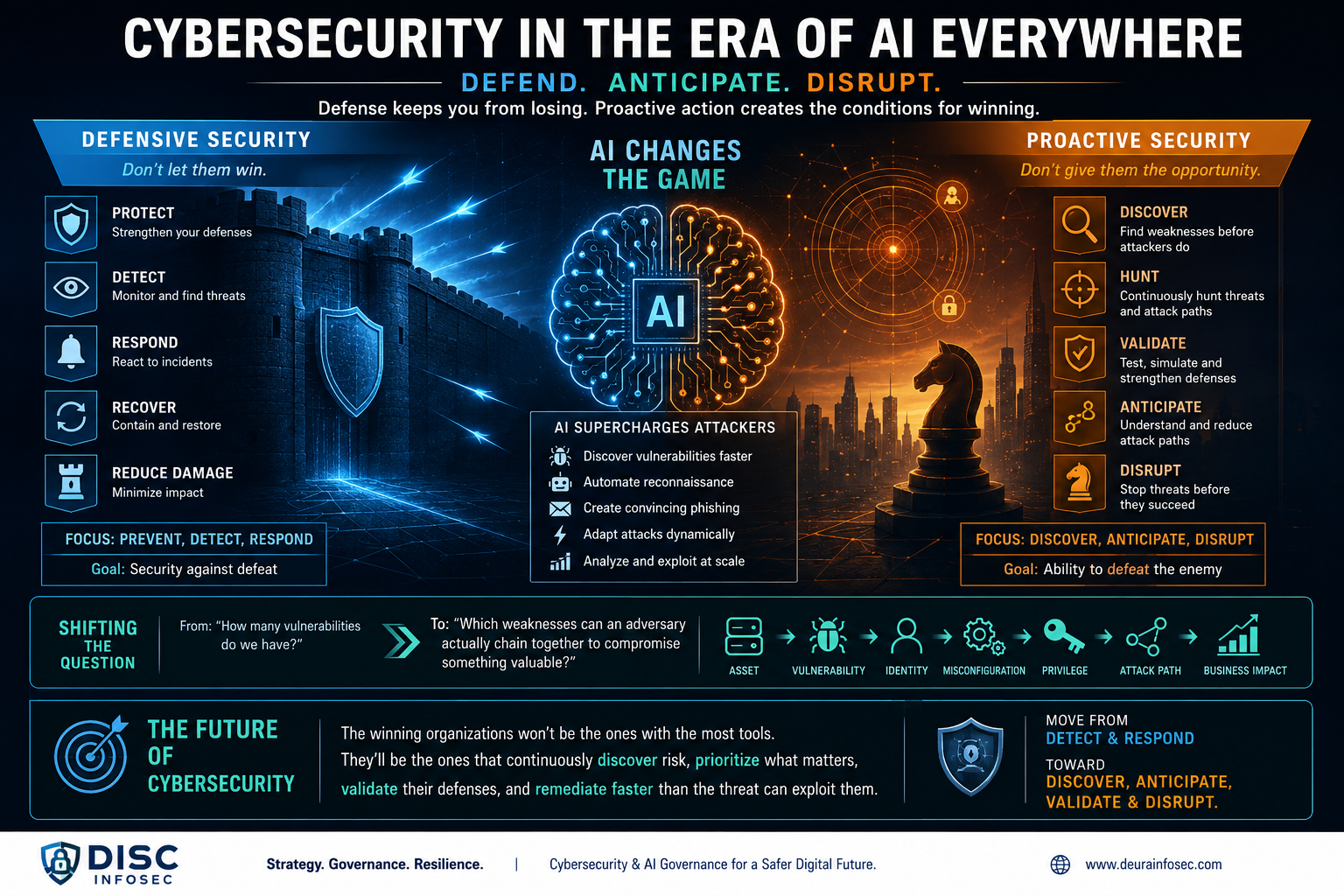
The deeper lesson: You cannot win a security war by merely absorbing attacks. Defense keeps you from losing; proactive action creates the conditions for winning.
That concept fits especially well with modern AI-accelerated vulnerability discovery: if attackers can discover weaknesses faster than your traditional security program can react, the defender has to become more proactive.
In the era of AI everywhere
Defensive security is no longer enough
Traditional defensive security assumes you can build a strong perimeter, deploy controls, monitor events, detect anomalies, and respond when something happens.
That model still matters—but AI is changing the economics of the attack.
Attackers can use AI to:
- Discover vulnerabilities faster
- Generate convincing phishing and social-engineering content
- Automate reconnaissance
- Adapt attacks dynamically
- Analyze large amounts of stolen data
- Scale attacks that previously required significant human effort
So the defender’s problem isn’t simply “Can we detect an attack?”
It’s increasingly:
“Can we discover and eliminate the attacker’s opportunities before they exploit them?”
Defensive vs. proactive security
Think of it as two layers:
Defensive security = Don’t let them win.
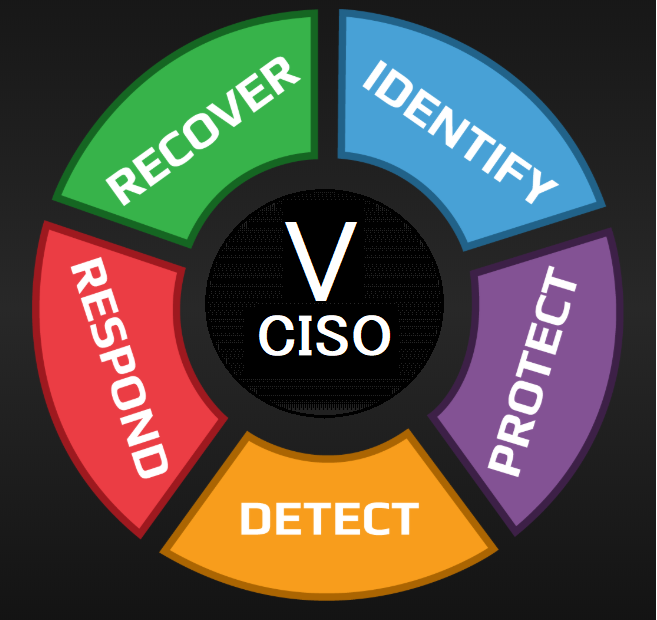
You protect, detect, respond, recover, and contain.
Proactive security = Don’t let them get the opportunity to attack successfully.
You continuously discover, test, validate, hunt, simulate, and remediate.
In an AI-driven environment, proactive security becomes much more important because the attacker can operate at machine speed.
The biggest shift: from alerts to attack paths
This is where I think cybersecurity is heading.
Instead of asking:
“How many vulnerabilities do we have?”
we should ask:
“Which weaknesses can an adversary actually chain together to compromise something valuable?”
AI can help defenders continuously analyze:
Asset → Vulnerability → Identity → Misconfiguration → Privilege → Attack Path → Business Impact
That changes vulnerability management from a batch process into a continuous risk-discovery process.
And there’s another problem: AI itself becomes part of the attack surface
Organizations now have:
- AI applications
- LLMs
- AI agents
- APIs
- RAG systems
- Vector databases
- Model providers
- AI-generated code
- Shadow AI
- Autonomous workflows
So we’re no longer protecting just IT infrastructure.
We’re protecting AI-enabled business processes.
That introduces risks such as prompt injection, data leakage, model abuse, excessive agent permissions, insecure AI integrations, supply-chain risks, and uncontrolled use of AI.
My perspective
I would summarize the future of cybersecurity as:
Defensive security keeps the adversary out. Proactive security assumes the adversary is looking for a way in—and continuously looks for that way first.
And with AI, the winning organizations won’t necessarily be the ones with the most security tools.
They’ll be the ones that can continuously discover risk, prioritize what matters, validate their defenses, and remediate faster than the threat can exploit them.
In the AI era, security has to move from “detect and respond” toward “discover, anticipate, validate, and disrupt.”
That is where I see the real evolution from defensive cybersecurity to proactive cybersecurity.
DISC-AI-Governance-Readiness-Assessment-1-1 pdf downloadDownload
MachineLearning & Artificial Intelligence
AI Vulnerability Scorecard: Discover Your AI Attack Surface Before Attackers Do
Your Shadow AI Problem Has a Name-And Now It Has a Score
Most AI Security Tools Won’t Pass an Audit. Here’s a 15-Minute Way to Find Out.

InfoSec services | InfoSec books | Follow our blog | DISC llc is listed on The vCISO Directory | ISO 27k Chat bot | Comprehensive vCISO Services | ISMS Services | AIMS Services | Security Risk Assessment Services | Mergers and Acquisition Securit
DISC InfoSec blog | DISC InfoSec Site | Contact us at info@deurainfosec.com
- The Controls Are Still Being Written: Governing AI When the Technology Outruns the Audit
- If Your Frontier Model Vanished for 3 Weeks, Would Your Business Stop?
- The Evidence Lifecycle: Which Organizational Events to Log for Liability — and How Long to Keep Them
- 14 Months to Comply. 12 Months of Work. The High-Risk AI Playbook Nobody Has Started
- Your biggest AI risk isn’t hackers. It’s your own data walking out the door