Why Supplier Security Is Under the Spotlight — and How to Build a Vendor Management Program for the AI Era
Your security program is only as strong as the weakest vendor with access to your environment. That’s not a slogan anymore — it’s what the breach data says, it’s what regulators are writing into law, and it’s what enterprise buyers are now testing before they sign anything.
The numbers stopped being deniable
For years, third-party risk was something organizations acknowledged in a policy document and revisited once a year with a questionnaire. That era is over, and the data explains why.
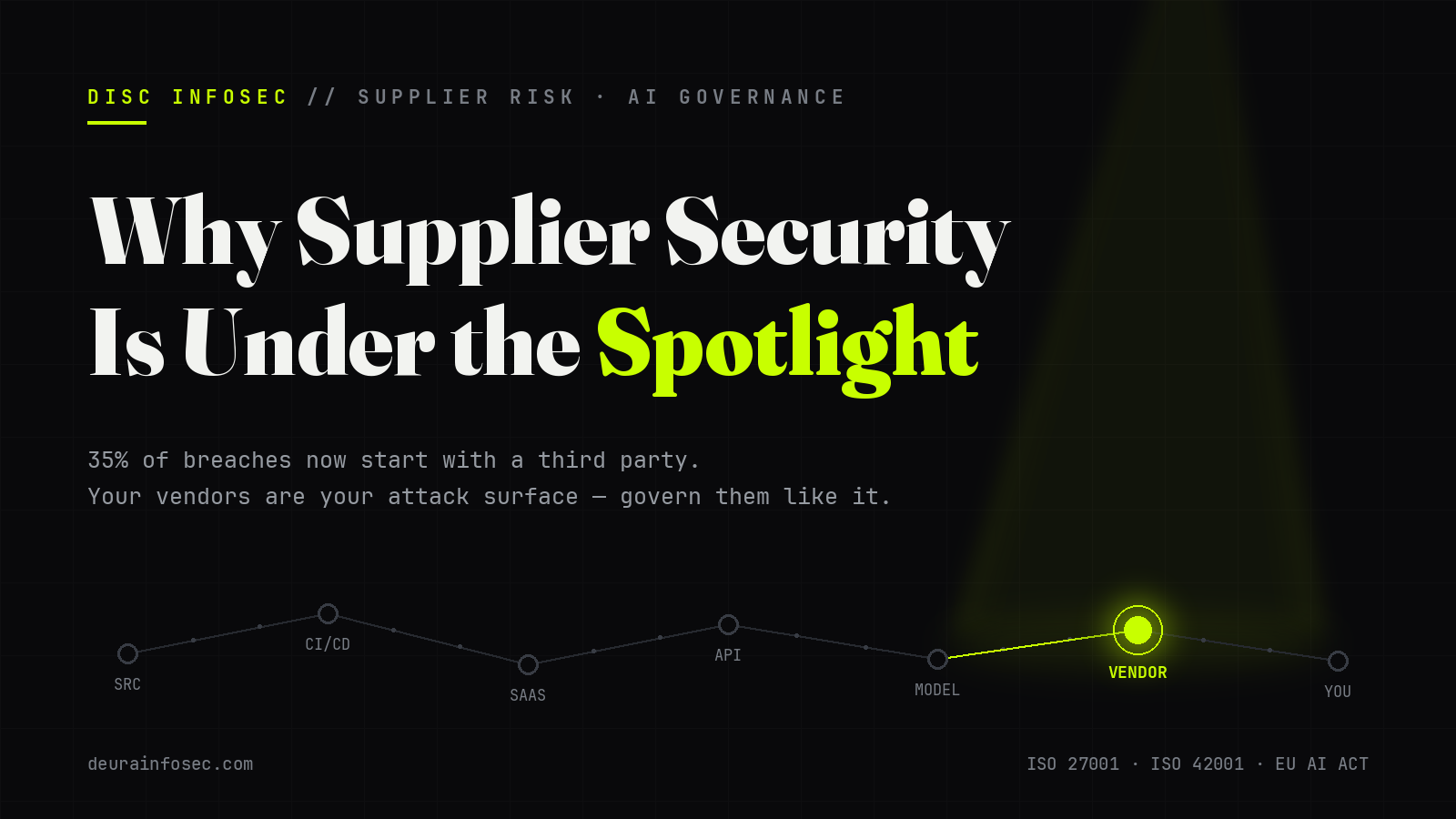
SecurityScorecard’s 2025 Global Third-Party Breach Report attributes roughly 35% of all breaches to third parties. Other industry research puts supply chain breach exposure near-universal — the overwhelming majority of organizations experienced some form of supply chain security incident in 2025. Meanwhile, fewer than half of organizations monitor even 50% of their supply chain. And on the regulatory side, an estimated three-quarters of GDPR fines have a third-party component.
Read those together and the picture is simple: attackers have figured out that the vendor is the door, most organizations aren’t watching the door, and regulators are fining the building owner anyway.
Attackers didn’t get smarter about your perimeter. They got smarter about economics. Why spend months trying to breach one hardened enterprise when you can compromise one widely-used tool and inherit access to thousands of downstream environments at once?
The AI supply chain made it worse
The recent Trivy and LiteLLM supply chain attacks are the clearest example of where this is heading. These weren’t obscure utilities — they were trusted security and AI tooling sitting inside CI/CD pipelines. Attackers compromised the tools upstream, and the malicious code did exactly what you’d fear: harvested secrets, cloud credentials, and SSH keys from inside trusted processes, then used that access to move downstream into additional systems. Almost no warning signs, because the attack ran inside software everyone had already decided to trust.
The lesson isn’t “stop using open source” or “stop using AI tooling.” The lesson is that trust without verification is now a documented attack vector, and the AI era multiplies it in three specific ways:
First, AI tools proliferate faster than procurement can see them. Every SaaS product your vendors use is quietly adding AI features. Your data processor is now also an AI deployer, whether their contract with you contemplated that or not. Shadow AI in your supply chain is shadow AI in your risk register — you just haven’t written it down yet.
Second, AI dependencies are deep and opaque. When a vendor says “we use AI,” the real question is: whose model, trained on what, hosted where, with what access to your data, and what happens when the model provider changes terms, deprecates a version, or gets compromised? Fourth-party AI risk is real, and most vendor questionnaires never touch it.
Third, regulation now assigns you obligations for AI you didn’t build. Under the EU AI Act, if your organization uses a high-risk AI system, Article 26 puts deployer obligations directly on you — following instructions for use, ensuring human oversight and staff competence, monitoring operation, retaining logs, and reporting serious incidents. The AI Omnibus agreed in May 2026 pushed the Annex III high-risk deadline to December 2027, which is breathing room, not a reprieve. NIS 2 and DORA are applying the same logic to supply chain security generally: you are accountable for what your vendors do.
What buyers are actually testing in 2026
If you sell into enterprises or regulated industries, you’ve already felt this from the other side. Buyer expectations have shifted from trust to verification, and the deal breakers are consistent: no recent penetration test results, missing security fundamentals, no ISO 27001 or equivalent certification, slow or incomplete responses to security questionnaires, and misalignment with the regulatory frameworks the buyer answers to.
Certifications get you in the door. Evidence wins the deal. The vendors closing enterprise contracts fastest are the ones who lead with proof — current pen test reports, accredited certification rather than “aligned with,” and documentation that’s ready to share the day the security review lands. Supplier security has become a revenue function, not just a risk function. That’s the same lens you should apply when you’re the buyer.
Building a vendor management program for the AI era
A modern program has to handle two things the traditional model didn’t: continuous change and AI-specific risk. Here’s the build sequence I use with clients.
1. Inventory everything — including the AI. You can’t govern what you haven’t cataloged. Build a vendor register that captures not just who the vendor is and what data they touch, but whether they use or embed AI in delivering the service, whose models sit underneath, and what your data’s role is in those systems. ISO 42001 makes this concrete: the AI system register under Clause 4 should include third-party AI, not just what you built in-house. Most organizations I audit miss the SaaS-embedded AI entirely.
2. Tier by real risk, not spend. Classify vendors by data sensitivity, access level, operational criticality, and — new for this era — AI impact. A vendor whose AI feature makes or influences decisions about your customers or employees belongs in a higher tier than their invoice size suggests. This is where ISO 42001’s impact assessment thinking (the AISIA) earns its keep: intended purpose, affected population, severity, reversibility, human oversight. Apply that lens to vendor AI, not just your own.
3. Move due diligence from questionnaire to evidence. Stop accepting “yes” as an answer. For your critical tier, require the same things enterprise buyers now require of you: current certifications (ISO 27001, and increasingly ISO 42001 for AI-heavy vendors), recent independent testing, SOC 2 reports, and for AI vendors specifically — model documentation, data handling terms, and incident notification commitments. Under ISO 27001:2022, controls A.5.19 through A.5.22 cover the supplier relationship lifecycle; under ISO 42001, control A.10.3 requires assessing suppliers of AI systems and services. If your vendor security policy hasn’t been updated to reference AI suppliers, it’s a 2022 policy living in a 2026 threat landscape.
4. Put obligations in the contract, not the questionnaire. Questionnaire answers expire the day they’re submitted. Contracts persist. Bake in security requirements, breach and AI-incident notification timelines, audit rights, subprocessor transparency (this is where fourth-party AI risk gets managed), and for EU-relevant AI, allocation of provider and deployer responsibilities under the AI Act. When the regulator asks who was responsible, “we assumed the vendor handled it” is not an answer.
5. Monitor continuously, not annually. The Trivy and LiteLLM attacks would not have been caught by an annual review cycle. Continuous assurance means external attack surface monitoring on critical vendors, tracking certificate status and expirations, watching for vendor breach disclosures, and — for AI suppliers — monitoring for model changes, terms-of-service changes, and deprecations that alter your risk position. This is exactly the shift regulators are codifying: DORA and NIS 2 both expect ongoing oversight, not point-in-time attestation.
6. Plan for vendor failure, because it will happen. Have an exit and containment plan for your critical vendors before you need one. Know how to revoke access fast, what data comes back and how, and what the operational fallback is. Incident response plans that don’t include supply-chain scenarios are incomplete — and ISO 42001’s incident management controls (A.8.4) expect AI-specific scenarios, including incidents originating in third-party models.
My perspective
After two decades of implementing and auditing security programs — most recently taking an AI-forward SaaS platform through ISO 42001 Stage 2 certification — here’s what I’ve come to believe about vendor management.
Most vendor risk programs are theater. A 300-question spreadsheet, answered optimistically by a vendor’s sales engineer, filed in a folder nobody reopens until renewal. That model was weak before AI; it’s indefensible now. The organizations getting this right have made one mental shift: they treat their vendors as an extension of their own attack surface and their own regulatory perimeter, because functionally, that’s what vendors are. The breach data proves it, and the EU AI Act’s deployer obligations make it legally explicit.
The second shift is recognizing that vendor security has flipped from a cost center to a commercial differentiator — in both directions. Run a rigorous program and you avoid becoming the 35%. Maintain rigorous, shareable evidence of your own posture and you close enterprise deals your competitors stall on. The same investment pays twice.
And the third: don’t wait for the AI-specific regulation to fully land before governing AI in your supply chain. The December 2027 high-risk deadline feels distant. It isn’t — not when your remediation path runs through contract renegotiations, vendor replacements, and evidence collection that takes quarters, not weeks. The organizations that treated GDPR as a 2018 problem in 2017 spent that year in triage. The ones building AI vendor governance now, on an ISO 42001 backbone that already integrates with their ISO 27001 ISMS, will spend 2027 selling trust while everyone else is buying consultants in a panic.
Your supply chain already has AI in it. The only question is whether your vendor management program knows that yet.
DISC InfoSec helps B2B SaaS and financial services firms build ISO 27001 and ISO 42001 programs that stand up to enterprise scrutiny and regulatory audit. If you want a straight answer on where your vendor management program stands, book a call: calendly.com/hd-deurainfosec.
AI Vulnerability Scorecard: Discover Your AI Attack Surface Before Attackers Do
Your Shadow AI Problem Has a Name-And Now It Has a Score
Most AI Security Tools Won’t Pass an Audit. Here’s a 15-Minute Way to Find Out.
InfoSec services | InfoSec books | Follow our blog | DISC llc is listed on The vCISO Directory | ISO 27k Chat bot | Comprehensive vCISO Services | ISMS Services | AIMS Services | Security Risk Assessment Services | Mergers and Acquisition Security
- Traditional vs. Agent Frameworks: Same Dimensions, Different Liabilities
- The Controls Are Still Being Written: Governing AI When the Technology Outruns the Audit
- If Your Frontier Model Vanished for 3 Weeks, Would Your Business Stop?
- The Evidence Lifecycle: Which Organizational Events to Log for Liability — and How Long to Keep Them
- 14 Months to Comply. 12 Months of Work. The High-Risk AI Playbook Nobody Has Started
DISC InfoSec blog | DISC InfoSec Site