InfoSec and Compliance – With 20 years of blogging experience, DISC InfoSec blog is dedicated to providing trusted insights and practical solutions for professionals and organizations navigating the evolving cybersecurity landscape. From cutting-edge threats to compliance strategies, this blog is your reliable resource for staying informed and secure. Dive into the content, connect with the community, and elevate your InfoSec expertise!
Researchers at the security consultancy Dolos Group, hired to test the security of one client’s network, received a new Lenovo computer preconfigured to use the standard security stack for the organization. They received no test credentials, configuration details, or other information about the machine.
They were not only able to get into the BitLocker-encrypted computer, but then use the computer to get into the corporate network.
Trusted Platform Modules: Why, when and how to use them
WordPress is a PHP-based content management system that may be used in conjunction with MySQL. The best part about WordPress is that it is free and open source software. It offers many plugins and themes that make it easier for non-technical users to deploy a website. It also allows continuous backup. And since it is open-source, there is no need to worry about security because most of the major flaws have already been addressed.
What Are the Basic WordPress Vulnerabilities and How Can I Patch Them?
Considering WordPress is open source and very customizable, there are a few issues to address while installing it on your server. We’ll go through some of the WordPress flaws and how to protect your installation.
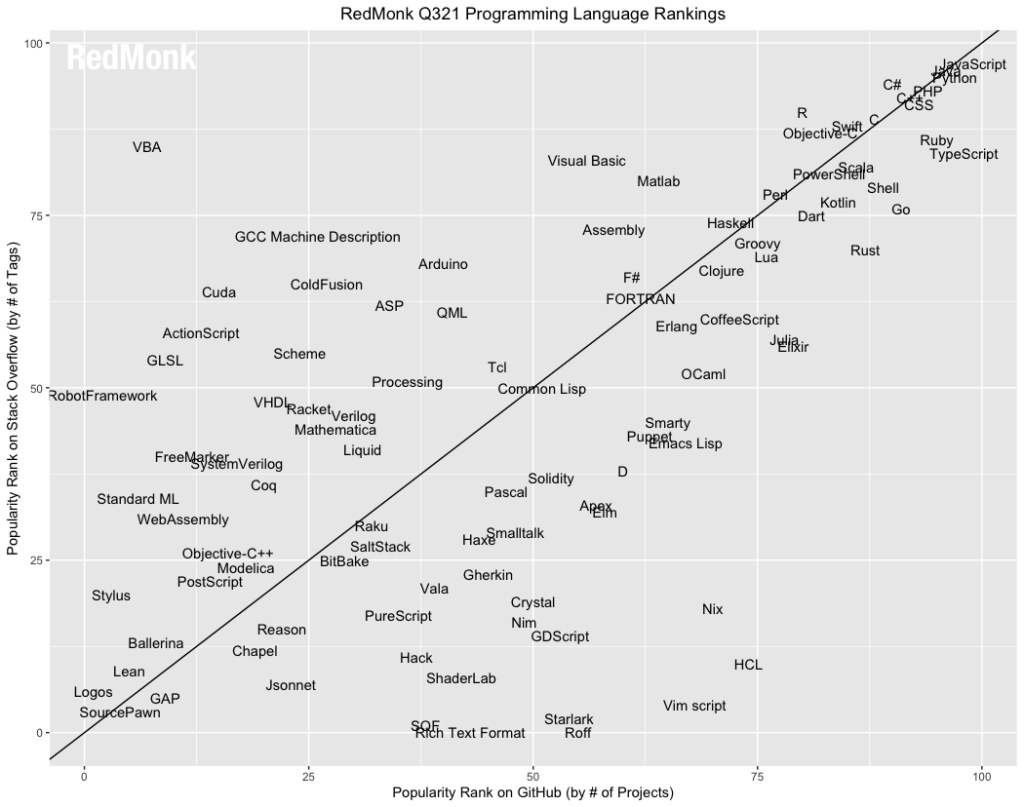
The RedMonk Programming Language Rankings: June 2021
This iteration of the RedMonk Programming Languages is brought to you by Microsoft. Developers build the future. Microsoft supports you in any language and Java is no exception; we love it. We offer the best Java dev tools, infrastructure, and modern framework support. Modernize your Java development with Microsoft.
While we generally try to have our rankings in July immediately after they are run, we generally operate these on a better late than never basis. On the assumption, then, that August is better than never, below are your RedMonk Q3 language rankings.
As always, these are a continuation of the work originally performed by Drew Conway and John Myles White late in 2010. While the specific means of collection has changed, the basic process remains the same: we extract language rankings from GitHub and Stack Overflow, and combine them for a ranking that attempts to reflect both code (GitHub) and discussion (Stack Overflow) traction. The idea is not to offer a statistically valid representation of current usage, but rather to correlate language discussion and usage in an effort to extract insights into potential future adoption trends.
Our Current Process
The data source used for the GitHub portion of the analysis is the GitHub Archive. We query languages by pull request in a manner similar to the one GitHub used to assemble the State of the Octoverse. Our query is designed to be as comparable as possible to the previous process.
Language is based on the base repository language. While this continues to have the caveats outlined below, it does have the benefit of cohesion with our previous methodology.
We exclude forked repos.
We use the aggregated history to determine ranking (though based on the table structure changes this can no longer be accomplished via a single query.)
For Stack Overflow, we simply collect the required metrics using their useful data explorer tool.
By 2022, API abuses will become the most frequent attack vector, predicts Gartner. We’re already witnessing new API exploits reach the headlines on a near-daily basis. Most infamous was the Equifax breach, an attack that exposed 147 million accounts in 2017. Since then, many more API breaches and major vulnerabilities have been detected at Experian, Geico, Facebook, Peleton and other organizations.
So, why are API attacks suddenly becoming so prevalent? Well, several factors are contributing to the rise in API exploits. As I’ve covered before, the use of RESTful web APIs is becoming more widespread through digital transformation initiatives and SaaS productization. And, the data these touchpoints transmit can carry a hefty price tag. Unfortunately, cybersecurity has not sufficiently progressed, making APIs ripe for the hacker’s picking.
I recently met with Roey Eliyahu, CEO of Salt Security, to better understand why more and more APIs hacks are making headlines. According to Eliyahu, a general lack of security awareness means these integration points are a low-effort, high-reward attack target. Establishing protection against zero-day threats means increasing the visibility of API holdings, testing for broken authorization and instigating ongoing monitoring of runtime environments.
Below, I’ll review the top factors contributing to the rise in API exploits. We’ll explore some of the top reasons why API attacks are increasing and consider how a zero-day protection mindset can mitigate common API vulnerabilities.
Considering that OT environments are increasingly in the crosshairs of attackers, the 14 vulnerabilities that JFrog and Forescout Research Labs recently discovered in NicheStack should make the likes of Siemens, Schneider Electric and Rockwell Automation take notice–and action.
Millions of programmable logic controllers (PLCs) and controllers from more than 200 device makers use NicheStack, a common, proprietary TCP/IP stack. NicheStack is employed in a wide array of critical infrastructure sectors globally like manufacturing plants, water treatment and power generation and transmission and distribution. It is the basis for numerous TCP/IP stacks and used by OEMS like Altera, Microchip, STMicroelectronics and Freescale.
“These vulnerabilities are very common in OT environments, as many major device vendors are listed as NicheStack customers,” said JFrog CTO Asaf Karas. “For instance, the stack is used in the Siemens S7 PLC, which is one of the most popular PLCs.”
The raft of flaws, dubbed INFRA:HALT, cover a wide gamut of threats–from remote code execution and denial of service (DoS) to TCP spoofing, information leak and DNS cache poisoning. The worst of the flaws, 2020-25928 and 2021-31226 logged CVSSv3.1 scores of 9.8 and 9.1, respectively.
At least for now, there’s a positive take: It seems adversaries have yet to stumble across the flaws. “We didn’t see any sign of exploitation,” said Karas.
He expressed surprise that the vulnerabilities had gone undiscovered. “The biggest surprise is that these kinds of vulnerabilities, that can be automatically detected, were not discovered for such a long time, especially given how critical they are and how common NicheStack is,” said Karas.
InterNiche Technologies has released patches for the vulnerabilities. Still, guarding against them is a thorny matter because, not surprisingly, patching across the supply chain is incredibly challenging from a logistics perspective and OT devices are critical in the environments that use them. So, while the best option for taking the teeth out of these flaws is upgrading to NicheStack v4.3, it might not be the route that many OT-driven businesses take.
The cloud broadens an organization’s attack surface to the point that CISOs must guard data across multiple clouds, tools, and on-premises locations. This further complicates their main objective of minimizing the risk of unauthorized data access and makes their job of ensuring information assets and technologies are adequately protected an arduous task.
Even worse, traditional security and governance models are ineffective for cloud architecture, partly because each cloud vendor has unique mechanisms for accessing data, which increases the chance of administrators making costly mistakes.
Conventional, centralized, or dictated approaches secure data by routing requests, access, and policies through IT – which limits the speed that a user could leverage the information. The array of clouds and cloud resources requires a more fluid approach to secure access.
Decentralized methods don’t work either, because business units have too much freedom in implementing policies about how data is used and with what tools. This creates silos and conflicts across business units and platforms, as cloud architectures need more uniformity across settings, tools, and departments.
The delegated governance model is becoming the more appropriate style, as it is ideal for streamlining multi-cloud security by combining the best of the above methods. It leverages IT’s uniform, top down policies (customized by line of business data stewards) and is based on IT’s provisioning of a secure platform for the business to access their tools of choice. The platform then distributes these central policies—configured by data stewards—into any repository or tool across clouds and on-premises for zero trust security.
Forgot the Kali Linux root password? Stress not! This tutorial discusses the steps to reset Kali Linux system password. Follow the steps, and you will get it done within minutes.
Creation of the Joint Cyber Defense Collaborative follows high-profile cyberattacks on critical U.S. infrastructure
The U.S. government is enlisting the help of tech companies, including Amazon.com Inc., Microsoft Corp. and Google, to bolster the country’s critical infrastructure defenses against cyber threats after a string of high-profile attacks.
The Department of Homeland Security, on Thursday, is formally unveiling the initiative called the Joint Cyber Defense Collaborative. The effort will initially focus on combating ransomware and cyberattacks on cloud-computing providers, said Jen Easterly, director of the DHS’s Cybersecurity and Infrastructure Security Agency. Ultimately, she said, it aims to improve defense planning and information sharing between government and the private sector.
“This will uniquely bring people together in peacetime, so that we can plan for how we’re going to respond in wartime,” she said in an interview. Ms. Easterly was sworn in as CISA’s director last month. She was previously a counterterrorism official in the Obama White House, and the commander of the Army’s first cyber operations unit at the National Security Agency, America’s cyberspy agency.
‘This will uniquely bring people together in peacetime, so that we can plan for how we’re going to respond in wartime.’— Jen Easterly, director of the Cybersecurity and Infrastructure Security Agency
Paragon’s product will also likely get spyware critics and surveillance experts alike rubbernecking: It claims to give police the power to remotely break into encrypted instant messaging communications, whether that’s WhatsApp, Signal, Facebook Messenger or Gmail, the industry sources said. One other spyware industry executive said it also promises to get longer-lasting access to a device, even when it’s rebooted.
Did you ever stop to think that the office smart TV used for company presentations, Zoom meetings, and other work-related activities may not be so trustworthy?
In our latest video, we demonstrate an attack scenario that can occur within any organization – hacking a smart TV. The video shows an insider plugging a USB Rubber Ducky into a smart TV in a company meeting room. Within less than a minute, a payload is executed to set up a Wi-Fi network for data exfiltration (called kitty3) and instructs the TV to connect to it. The payload then uploads a utility that captures the screen before the insider removes the rogue device.
Smart TV Security: Media Playback and Digital Video Broadcast
It guides system administrators and developers of National Security Systems on how to deploy Kubernetes with example configurations for the recommended hardening measures and mitigations.
Below is the list of mitigations provided by the US agencies:
Scan containers and Pods for vulnerabilities or misconfigurations.
Run containers and Pods with the least privileges possible.
Use network separation to control the amount of damage a compromise can cause.
Use firewalls to limit unneeded network connectivity and encryption to protect confidentiality.
Use strong authentication and authorization to limit user and administrator access as well as to limit the attack surface.
Use log auditing so that administrators can monitor activity and be alerted to potential malicious activity.
Periodically review all Kubernetes settings and use vulnerability scans to help ensure risks are appropriately accounted for and security patches are applied.
Learn Kubernetes Security: Securely orchestrate, scale, and manage your microservices in Kubernetes deployments
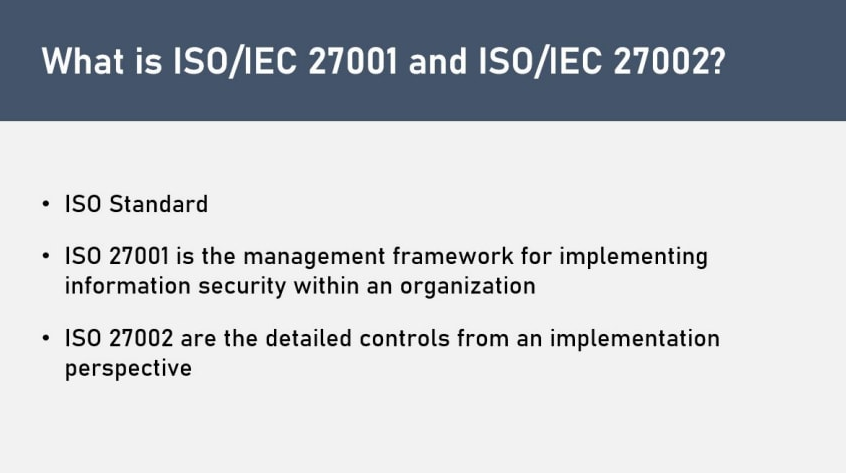
However, you might not be as familiar with ISO 27002. It’s a supplementary standard that provides advice on how to implement the security controls listed in Annex A of ISO 27001.
Although ISO 27001 is the more well-known standard – and the one that organisations certify to – neither can be considered in isolation. This blog explains why that’s the case, helping you understand how each standard works and the differences between them.
What is ISO 27001?
ISO 27001 is the central framework of the ISO 27000 series, which is a series of documents relating to various parts of information security management.
The Standard contains the implementation requirements for an ISMS. These are essentially an overview of everything you must do achieve compliance.
This is particularly useful at the start of your project, or if you’re looking for general advice but can’t commit to a full-scale implementation project.
ISO 27002 is a supplementary standard that focuses on the information security controls that organisations might choose to implement.
These controls are listed in Annex A of ISO 27001, which is what you’ll often see information security experts refer to when discussing information security controls. However, whereas Annex A simply outlines each control in one or two sentences, ISO 27002 dedicates an average of one page per control.
This is because the Standard explains how each control works, what its objective is, and how you can implement it.
The differences between ISO 27001 and ISO 27002
There are three main differences between ISO 27001 and ISO 27001:
Detail
If ISO 27001 went into as much detail as ISO 27002, it would be unnecessarily long and complicated.
Instead, it provides an outline of each aspect of an ISMS, with specific advice being found in additional standards. ISO 27002 is only one of these. For example, ISO 27003 covers ISMS implementation guidance and ISO 27004 covers the monitoring, measurement, analysis and evaluation of the ISMS.
Certification
You can certify to ISO 27001 but not to ISO 27002. That’s because ISO 27001 is a management standard that provides a full list of compliance requirements, whereas supplementary standards such as ISO 27002 address one specific aspect of an ISMS.
Applicability
A key thing to consider when implementing an ISMS is that not all information security controls will apply to your organisation.
ISO 27001 makes that clear, specifying that organisations conduct a risk assessment to identify and prioritise information security threats. ISO 27002 doesn’t mention this, so if you were to pick up the Standard by itself, it would be practically impossible to figure out which controls you should adopt.
When you should use each standard
ISO 27001 and ISO 27002 have different objectives and will be helpful in different circumstances.
If you’re starting out with the Standard or are planning your ISMS implementation framework, then ISO 27001 is ideal. You should refer to ISO 27002 once you’ve identified the controls that you’ll be implementing to learn more about how each one works.
This one-day course provides a comprehensive introduction to the key elements required to comply with ISO 27001. You’ll learn from expert information security consultants and have the chance to review case studies and participate in group discussions and practical exercises.
Developed by the team that led the world’s first successful ISO 27001 implementation project, this one-day course provides a comprehensive introduction to Standard.
You’ll learn from expert information security consultants, as they explain:
ISO 27001 management system documentation;.
How to plan, scope and communicate throughout your ISO 27001 project; and
The key steps involved in an ISO 27001 risk assessment.
You’re almost certainly familiar with vishing, a phone-based scam in which cybercriminals leave messages on your voicemail in the hope that you’ll call them back later to find out what’s going on.
In fact, if you have a long-standing phone number, like we do, you may well get more of these scam calls (perhaps even many more of them) than genuine calls, so you’ll know the sort of angle they take, which often goes along these lines:
[Synthetic voice] Your Amazon Prime subscription will auto-renew. Your card will be billed for [several tens of dollars]. To cancel your subscription or to discuss this renewal, press 1 now.
Sometimes, they’ll read out the number to call them back on, to re-iterate not only that it matches the number that shows up in your call history, but also that it’s a local number, right there in your own town or country.
The crooks do this to “prove” that caller is local too, rather than sitting overseas in some scammy boiler-room call centre, far from the reach of law enforcement and the regulators in your part of the world.
Female journalists and activists say they had their private photos shared on social media by governments seeking to intimidate and silence them.
‘I will not be silenced’: Women targeted in hack-and-leak attacks speak out about spyware
Ghada Oueiss, a Lebanese broadcast journalist at Al-Jazeera, was eating dinner at home with her husband last June when she received a message from a colleague telling her to check Twitter. Oueiss opened up the account and was horrified: A private photo taken when she was wearing a bikini in a jacuzzi was being circulated by a network of accounts, accompanied by false claims that the photos were taken at her boss’s house.
Over the next few days she was barraged with thousands of tweets and direct messages attacking her credibility as a journalist, describing her as a prostitute or telling her she was ugly and old. Many of the messages came from accounts that appeared to support Saudi Crown Prince Mohammed bin Salman Al Saud, known as MBS, including some verified accounts belonging to government officials.
“I immediately knew that my phone had been hacked,” said Oueiss, who believes she was targeted in an effort to silence her critical reporting on the Saudi regime. “Those photos were not published anywhere. They were only on my phone.”
“I am used to being harassed online. But this was different,” she added. “It was as if someone had entered my home, my bedroom, my bathroom. I felt so unsafe and traumatized.”
“Through this crowdsourcing platform, Federal Civilian Executive Branch (FCEB) agencies will now be able to coordinate with the security research community in a streamlined fashion and those reporting incidents enjoy a single, usable website to facilitate submission of findings. The platform encourages collaboration and information sharing between the public and private sectors by allowing uniquely skilled researchers to submit vulnerability reports, which agencies will use to understand and address vulnerabilities that were previously unidentified,” Eric Goldstein, Executive Assistant Director for Cybersecurity, CISA, explained.
At the moment, this newly established VDP platform collects eleven vulnerability disclosure programs, published by the:
Federal Communications Commission (FCC)
Department of Homeland Security (DHS)
National Labor Relations Board (NLRB)
Federal Retirement Thrift Investment Board (FRTIB)
Millennium Challenge Corporation (MCC)
Department of Agriculture (USDA)
Department of Labor (DOL)
Privacy and Civil Liberties Oversight Board (PCLOB)
Equal Employment Opportunity Commission (EEOC)
Occupational Safety and Health Review Commission (OSHRC)
Court Services and Offender Supervision Agency (CSOSA)
This newly established VDP platform is run by BugCrowd, a bug bounty and vulnerability disclosure company, and EnDyna, a government contractor that provides science and technology-based solutions to several US federal agencies.
Further, a recent Sophos survey found that the average post-attack remediation costs, including lost business, grew to nearly $2 million per incident in 2021, about 10 times the size of the ransom payment itself.
CISOs and hands-on security professionals are implementing several tactics to defend their organization, and these include proactive threat hunting and technical defenses like multi-factor authentication.
While these practices are helpful, they are focused on preventing attacks from happening in the first place while the harsh reality is that it’s no longer a question of if hackers are going to get in, but when. With so much at stake, why are data recovery and restoration often put on the back burner of the security conversationwhen it could be the most valuable tool in the security arsenal?
flaw has a critical severity score of 9.9 out of 10, it was addressed by Microsoft in May.
“This issue allows a guest VM to force the Hyper-V host’s kernel to read from an arbitrary, potentially invalid address. The contents of the address read would not be returned to the guest VM. In most circumstances, this would result in a denial of service of the Hyper-V host (bugcheck) due to reading an unmapped address. It is possible to read from a memory mapped device register corresponding to a hardware device attached to the Hyper-V host which may trigger additional, hardware device specific side effects that could compromise the Hyper-V host’s security.” reads the advisory published by the company.
vmswitch fails to validate the value of an OID (object identifier) request that is intended for a network adapter.
An attacker could exploit this vulnerability by sending a specially crafted packet from a guest virtual machine to the Hyper-V host.
“Some OID requests are destined to the external network adapter, or other network adapters connected to vmswitch. Such OID requests include, for example, hardware offloading, Internet Protocol security (IPsec) and single root I/O virtualization (SR-IOV) requests.” reads the post published by Guardicore.
“While processing OID requests, vmswitch traces their content for logging and debugging purposes; this also applies to OID_SWITCH_NIC_REQUEST. However, due to its encapsulated structure, vmswitch needs to have special handling of this request and dereference OidRequest to trace the inner request as well. The bug is that vmswitch never validates the value of OidRequest and can thus dereference an invalid pointer.”










![Department of Homeland Security and Information Sharing: Is It Working? by [United State Army War College, U.S Army U.S Army]](https://m.media-amazon.com/images/I/417d4jwJrTS.jpg)




![You Are Being Targeted – How to Keep Yourself Safe in a Connected World! (Survival and Security Series Book 1) by [Harvey Toogood]](https://m.media-amazon.com/images/I/51MetwIKKOL.jpg)


![CYBERSECURITY AND INFRASTRUCTURE SECURITY AGENCY: Actions Needed to Ensure Organizational Changes Result in More Effective Cybersecurity for Our Nation by [United States Government Accountability Office]](https://m.media-amazon.com/images/I/51FIzAXr-CL._SX260_.jpg)