InfoSec and Compliance – With 20 years of blogging experience, DISC InfoSec blog is dedicated to providing trusted insights and practical solutions for professionals and organizations navigating the evolving cybersecurity landscape. From cutting-edge threats to compliance strategies, this blog is your reliable resource for staying informed and secure. Dive into the content, connect with the community, and elevate your InfoSec expertise!
AI is revolutionizing audit, risk, and compliance by streamlining processes through automation. Tasks like data collection, control testing, and risk assessments, which were once time-consuming, are now being done faster and with more precision. This allows teams to focus on more critical strategic decisions.
In auditing, AI identifies anomalies and uncovers patterns in real-time, enhancing both the depth and accuracy of audits. AI’s ability to process large datasets also helps maintain compliance with evolving regulations like the EU’s AI Act, while mitigating human error.
Beyond audits, AI supports risk management by providing dynamic insights that adapt to changing threat landscapes. This enables continuous risk monitoring rather than periodic reviews, making organizations more responsive to emerging risks, including cybersecurity threats.
AI also plays a crucial role in bridging the gap between cybersecurity, compliance, and ESG (Environmental, Social, Governance) goals. It integrates these areas into a single strategy, allowing businesses to track and manage risks while aligning with sustainability initiatives and regulatory requirements.
The article highlights how the AI boom, especially in cybersecurity, is already showing signs of strain. Many AI startups, despite initial hype, are facing financial challenges, as they lack the funds to develop large language models (LLMs) independently. Larger companies are taking advantage by acquiring or licensing the technologies from these smaller firms at a bargain.
AI is just one piece of the broader cybersecurity puzzle, but it isn’t a silver bullet. Issues like system updates and cloud vulnerabilities remain critical, and AI-only security solutions may struggle without more comprehensive approaches.
Some efforts to set benchmarks for LLMs, like NIST, are underway, helping to establish standards in areas such as automated exploits and offensive security. However, AI startups face increasing difficulty competing with big players who have the resources to scale.
The article discusses security challenges associated with large language models (LLMs) and APIs, focusing on issues like prompt injection, data leakage, and model theft. It highlights vulnerabilities identified by OWASP, including insecure output handling and denial-of-service attacks. API flaws can expose sensitive data or allow unauthorized access. To mitigate these risks, it recommends implementing robust access controls, API rate limits, and runtime monitoring, while noting the need for better protections against AI-based attacks.
The post discusses defense strategies against attacks targeting large language models (LLMs). Providers are red-teaming systems to identify vulnerabilities, but this alone isn’t enough. It emphasizes the importance of monitoring API activity to prevent data exposure and defend against business logic abuse. Model theft (LLMjacking) is highlighted as a growing concern, where attackers exploit cloud-hosted LLMs for profit. Organizations must act swiftly to secure LLMs and avoid relying solely on third-party tools for protection.
The post highlights the rapid evolution of AI bots and their growing impact on internet security. Initially, bots performed simple, repetitive tasks, but modern AI bots leverage machine learning and natural language processing to engage in more complex activities.
Types of Bots:
Good Bots: Help with tasks like web indexing and customer support.
Malicious Bots: Involved in harmful activities like data scraping, account takeovers, DDoS attacks, and fraud.
Security Impacts:
AI bots are increasingly sophisticated, making cyberattacks more complex and difficult to detect. This has led to significant data breaches, resource drains, and a loss of trust in online services.
Defense Strategies:
Organizations are employing advanced detection algorithms, multi-factor authentication (MFA), CAPTCHA systems, and collaborating with cybersecurity firms to combat these threats.
Case studies show that companies across sectors are successfully reducing bot-related incidents by implementing these measures.
Future Directions:
AI-powered security solutions and regulatory efforts will play key roles in mitigating the threats posed by evolving AI bots. Industry collaboration will also be essential to staying ahead of these malicious actors.
The rise of AI bots brings both benefits and challenges to the internet landscape. While they can provide useful services, malicious bots present serious security threats. For organizations to safeguard their assets and uphold user trust, it’s essential to understand the impact of AI bots on internet security and deploy advanced mitigation strategies. As AI technology progresses, staying informed and proactive will be critical in navigating the increasingly complex internet security environment.
The blog post discusses how ISO 27001 can help address AI-related security risks. AI’s rapid development raises data security concerns. Bridget Kenyon, a CISO and key figure in ISO 27001:2022, highlights the human aspects of security vulnerabilities and the importance of user education and behavioral economics in addressing AI risks. The article suggests ISO 27001 offers a framework to mitigate these challenges effectively.
The impact of AI on security | How ISO 27001 can help address such risks and concerns.
The article emphasizes that AI cybersecurity must be multi-layered, like the systems it protects. Cybercriminals increasingly exploit large language models (LLMs) with attacks such as data poisoning, jailbreaks, and model extraction. To counter these threats, organizations must implement security strategies during the design, development, deployment, and operational phases of AI systems. Effective measures include data sanitization, cryptographic checks, adversarial input detection, and continuous testing. A holistic approach is needed to protect against growing AI-related cyber risks.
Benefits and Concerns of AI in Data Security and Privacy
Predictive analytics provides substantial benefits in cybersecurity by helping organizations forecast and mitigate threats before they arise. Using statistical analysis, machine learning, and behavioral insights, it highlights potential risks and vulnerabilities. Despite hurdles such as data quality, model complexity, and the dynamic nature of threats, adopting best practices and tools enhances its efficacy in threat detection and response. As cyber risks evolve, predictive analytics will be essential for proactive risk management and the protection of organizational data assets.
AI raises concerns about data privacy and security. Ensuring that AI tools comply with privacy regulations and protect sensitive information.
AI systems must adhere to privacy laws and regulations, such as GDPR, CPRA to protect individuals’ information. Compliance ensures ethical data handling practices.
Implementing robust security measures to protect data (data governance) from unauthorized access and breaches is critical. Data protection practices safeguard sensitive information and maintain trust.
1. Predictive Analytics in Cybersecurity
Predictive analytics offers substantial benefits by helping organizations anticipate and prevent cyber threats before they occur. It leverages statistical models, machine learning, and behavioral analysis to identify potential risks. These insights enable proactive measures, such as threat mitigation and vulnerability management, ensuring an organization’s defenses are always one step ahead.
2. AI and Data Privacy
AI systems raise concerns regarding data privacy and security, especially as they process sensitive information. Ensuring compliance with privacy regulations like GDPR and CPRA is crucial. Organizations must prioritize safeguarding personal data while using AI tools to maintain trust and avoid legal ramifications.
3. Security and Data Governance
Robust security measures are essential to protect data from breaches and unauthorized access. Implementing effective data governance ensures that sensitive information is managed, stored, and processed securely, thus maintaining organizational integrity and preventing potential data-related crises.
The rise of artificial intelligence (AI) has introduced new risks in software supply chains, particularly through open-source repositories like Hugging Face and GitHub. Cybercriminals, such as the NullBulge group, have begun targeting these repositories to poison data sets used for AI model training. These poisoned data sets can introduce misinformation or malicious code into AI systems, causing widespread disruption in AI-driven software and forcing companies to retrain models from scratch.
With AI systems relying heavily on vast open-source data sets, attackers have found it easier to infiltrate AI development pipelines. Compromised data sets can result in severe disruptions across AI supply chains, especially for businesses refining open-source models with proprietary data. As AI adoption grows, the challenge of maintaining data integrity, compliance, and security in open-source components becomes crucial for safeguarding AI advancements.
Open-source data sets are vital to AI development, as only large enterprises can afford to train models from scratch. However, these data sets, like LAION 5B, pose risks due to their size, making it difficult to ensure data quality and compliance. Cybercriminals exploit this by poisoning data sets, introducing malicious information that can compromise AI models. This ripple effect forces costly retraining efforts. The popularity of generative AI has further attracted attackers, heightening the risks across the entire AI supply chain.
The article emphasizes the importance of integrating security into all stages of AI development and usage, given the rise of AI-targeted cybercrime. Businesses must ensure traceability and explainability for AI outputs, keeping humans involved in the process. AI shouldn’t be seen solely as a cost-cutting tool, but rather as a technology that needs robust security measures. AI-powered security solutions can help analysts manage threats more effectively but should complement, not replace, human expertise.
For more detailed insights, check the full article here.
The IBM blog on AI risk management discusses how organizations can identify, mitigate, and address potential risks associated with AI technologies. AI risk management is a subset of AI governance, focusing specifically on preventing and addressing threats to AI systems. The blog outlines various types of risks—such as data, model, operational, and ethical/legal risks—and emphasizes the importance of frameworks like the NIST AI Risk Management Framework to ensure ethical, secure, and reliable AI deployment. Effective AI risk management enhances security, decision-making, regulatory compliance, and trust in AI systems.
AI risk management can help close this gap and empower organizations to harness AI systems’ full potential without compromising AI ethics or security.
Understanding the risks associated with AI systems
Like other types of security risk, AI risk can be understood as a measure of how likely a potential AI-related threat is to affect an organization and how much damage that threat would do.
While each AI model and use case is different, the risks of AI generally fall into four buckets:
Data risks
Model risks
Operational risks
Ethical and legal risks
The NIST AI Risk Management Framework (AI RMF)
In January 2023, the National Institute of Standards and Technology (NIST) published the AI Risk Management Framework (AI RMF) to provide a structured approach to managing AI risks. The NIST AI RMF has since become a benchmark for AI risk management.
The AI RMF’s primary goal is to help organizations design, develop, deploy and use AI systems in a way that effectively manages risks and promotes trustworthy, responsible AI practices.
Developed in collaboration with the public and private sectors, the AI RMF is entirely voluntary and applicable across any company, industry or geography.
The framework is divided into two parts. Part 1 offers an overview of the risks and characteristics of trustworthy AI systems. Part 2, the AI RMF Core, outlines four functions to help organizations address AI system risks:
Govern: Creating an organizational culture of AI risk management
Map: Framing AI risks in specific business contexts
Predictive analytics offers significant benefits in cybersecurity by allowing organizations to foresee and mitigate potential threats before they occur. Using methods such as statistical analysis, machine learning, and behavioral analysis, predictive analytics can identify future risks and vulnerabilities. While challenges like data quality, model complexity, and evolving threats exist, employing best practices and suitable tools can improve its effectiveness in detecting cyber threats and managing risks. As cyber threats evolve, predictive analytics will be vital in proactively managing risks and protecting organizational information assets.
Trust Me: ISO 42001 AI Management System is the first book about the most important global AI management system standard: ISO 42001. The ISO 42001 standard is groundbreaking. It will have more impact than ISO 9001 as autonomous AI decision making becomes more prevalent.
Why Is AI Important?
AI autonomous decision making is all around us. It is in places we take for granted such as Siri or Alexa. AI is transforming how we live and work. It becomes critical we understand and trust this prevalent technology:
“Artificial intelligence systems have become increasingly prevalent in everyday life and enterprise settings, and they’re now often being used to support human decision making. These systems have grown increasingly complex and efficient, and AI holds the promise of uncovering valuable insights across a wide range of applications. But broad adoption of AI systems will require humans to trust their output.” (Trustworthy AI, IBM website, 2024)
Narrow AI (Weak AI): AI systems that are designed and trained for a specific task, such as facial recognition, language translation, or playing chess. These systems operate under a limited set of constraints and do not possess general intelligence. Examples include Siri, Alexa, and IBM’s Watson.
General AI (Strong AI): A theoretical form of AI that would have the ability to learn, understand, and apply intelligence across a wide range of tasks, much like a human being. General AI does not yet exist and remains a goal for future development.
Superintelligent AI: A hypothetical AI that surpasses human intelligence across all aspects, including creativity, decision-making, and emotional intelligence. This type is purely speculative at this point and often discussed in the context of ethical considerations and long-term AI safety.
2. Based on Functionality
Reactive Machines: The most basic type of AI that can only react to current situations without any memory or understanding of the past. An example is IBM’s Deep Blue, which played chess without learning from previous games.
Limited Memory: AI systems that can use past experiences or data to make decisions, albeit temporarily. Most modern AI applications, like self-driving cars, fall into this category as they use historical data to make real-time decisions.
Theory of Mind: This type of AI is in the conceptual stage and aims to understand human emotions, beliefs, and thoughts, and interact socially. Theory of Mind AI is not yet realized but is an area of active research.
Self-Aware AI: The most advanced form of AI, which would have its own consciousness, self-awareness, and emotions. This type does not currently exist and is largely a subject of science fiction and philosophical debate.
3. Based on Learning Techniques
AI comes in many forms. And while the general process of automated technology carrying out a series of tasks remains consistent, how and why this happens will vary. Here are some examples of different types of AI which you might come across.
Deep Learning
An evolution of machine learning, this more thorough approach sees AI programmed in such a way that they’re able to identify images, sounds, and text without the need for human input. While with machine learning you may have to physically describe an image to AI, with deep learning they will be able to process and understand it themselves.
Natural Language Processing (NLP)
If you’ve ever spoken to Siri, Alexa, or any other virtual assistant, you will have interacted with NLP. This technology is able to comprehend, manipulate, and generate human language in a way that allows it to have its very own “voice”. NLP can understand questions you give it, then respond accordingly. It can also be used in text form, such as a chatbot on a website.
Computer vision
This futuristic form of tech allows computers to interpret and analyze the human world through the classification of images and objects. In doing so, it allows an AI to see the world through the eyes of a living person. This kind of technology is most commonly associated with driverless cars, where the vehicle needs to be able to process the world around it as a normal driver would.
Machine Learning
This AI approach sees a series of data and algorithms run to formulate a picture of how a human would approach a situation or task. Over time, the program is able to adapt and even learn more about the human thinking process, which helps it to improve its overall accuracy.
Generative AI
A popular online fad in 2023, generative AI is the name given to technology which is able to create images, text, or other media independently. A user simply needs to input what they want created, with the AI able to draw on their input training to produce something that has similar characteristics.
Speech recognition
One of the oldest forms of AI, this tech is able to understand and interpret what you’re saying out loud, then convert it into text or audio format. This kind of technology is often confused with voice recognition – which instead of transcribing what you’re saying, will instead only be able to recognise the voice of the user.
Robotic Process Automation (RPA)
RPA technology is a software which makes it easier to build, deploy, and manage robots that emulate human interactions. The robotic helpers are able to carry out a number of tasks virtually, at speeds which humans would be incapable of replicating.
AI comes in many forms. And while the general process of automated technology carrying out a series of tasks remains consistent, how and why this happens will vary. Here are some examples of different types of AI which you might come across.
The Regional Transportation Commission of Southern Nevada, which includes Las Vegas, will be the first transit system in the U.S. to implement system-wide AI weapons scans.
Transit systems nationwide are grappling with ways to reduce violence.
AI-linked cameras and acoustic technology are seen as viable options to better respond to mass shootings in public places across the U.S., according to law enforcement and public safety teams, though both approaches have downsides.
A sign promoting safety is seen on the Regional Transportation Commission 109 Maryland Parkway bus in Las Vegas Thursday, June 8, 2023. Las Vegas Review-journal | Tribune News Service | Getty Images
On your next visit to Vegas, an extra set of eyes will be watching you if you decide to hop onto the local transit system.
As part of a $33 million multi-year upgrade to fortify its security, the Regional Transportation Commission of Southern Nevada is set to add a system-wide AI from gun detection software vendor ZeroEyes that scans riders on its over 400 buses in an attempt to identify anyone brandishing a firearm.
Tom Atteberry, RTC’s director of safety and security operations, said that seconds matter in a situation where an active shooting unfolds, and implementing the system could give authorities an edge. “Time is of the essence; it gives us time to identify a firearm being brandished, so they can be notified and get to the scene and save lives,” he said.
Monitoring and preventing mass shooting is one that public places across the country grapple with daily. Violent crime on transit systems, specifically, remains an issue in major metro areas, with a report released in late 2023 by the Department of Transportation detailing concerns from transit agency officials around the U.S. about rising violence on their transit systems. According to a database maintained by the Bureau of Transportation Statistics, assaults on transit systems have spiked, and there has been a rise in public fears about transportation safety.
Legal documents, HR data, source code, and other sensitive corporate information is being fed into unlicensed, publicly available AIs at a swift rate, leaving IT leaders with a mounting shadow AI mess.
Employees at many organizations are engaging in widespread use of unauthorized AI models behind the backs of their CIOs and CISOs, according to a recent study.
Employees are sharing company legal documents, source code, and employee information with unlicensed, non-corporate versions of AIs, including ChatGPT and Google Gemini, potentially leading to major headaches for CIOs and other IT leaders, according to research from Cyberhaven Labs.
About 74% of the ChatGPT use at work is through non-corporate accounts, potentially giving the AI the ability to use or train on that data, says the Cyberhaven Q2 2024 AI Adoption and Risk Report, based on actual AI usage patterns of 3 million workers. More than 94% of workplace use of Google AIs Gemini and Bard are from non-corporate accounts, the study reveals.
Nearly 83% of all legal documents shared with AI tools go through non-corporate accounts, the report adds, while about half of all source code, R&D materials, and HR and employee records go into unauthorized AIs.
The amount of data put into all AI tools saw nearly a five-fold increase between March 2023 and March 2024, according to the report. “End users are adopting new AI tools faster than IT can keep up, fueling continued growth in ‘shadow AI,’” the report adds.
Where does the data go?
At the same time, many users may not know what happens to their companies’ data once they share it with an unlicensed AI. ChatGPT’s terms of use, for example, say the ownership of the content entered remains with the users. However, ChatGPT may use that content to provide, maintain, develop, and improve its services, meaning it could train itself using shared employee records. Users can opt out of ChatGPT training itself on their data.
So far, there have been no high-profile reports about major company secrets spilled by large public AIs, but security experts worry about what happens to company data once an AI ingests it. On May 28, OpenAI announced a new Safety and Security Committee to address concerns.
It’s difficult to assess the risk of sharing confidential or sensitive information with publicly available AIs, says Brian Vecci, field CTO at Varonis, a cloud security firm. It seems unlikely that companies like Google or ChatGPT developer OpenAI will allow their AIs to leak sensitive business data to the public, given the headaches such disclosures would cause them, he says.
Still, there aren’t many rules governing what AI developers can do with the data users provide them, some security experts note. Many more AI models will be rolled out in the coming years, Vecci says.
“When we get outside of the realm of OpenAI and Google, there are going to be other tools that pop up,” he says. “There are going to be AI tools out there that will do something interesting but are not controlled by OpenAI or Google, which presumably have much more incentive to be held accountable and treat data with care.”
The coming wave of second- and third-tier AI developers may be fronts for hacking groups, may see profit in selling confidential company information, or may lack the cybersecurity protections that the big players have, Vecci says.
“There’s some version of an LLM tool that’s similar to ChatGPT and is free and fast and controlled by who knows who,” he says. “Your employees are using it, and they’re forking over source code and financial statements, and that could be a much higher risk.”
Risky behavior
Sharing company or customer data with any unauthorized AI creates risk, regardless of whether the AI model trains on that data or shares it with other users, because that information now exists outside company walls, adds Pranava Adduri, CEO of Bedrock Security.
Adduri recommends organizations sign licensed deals, containing data use restrictions, with AI vendors so that employees can experiment with AI.
“The problem boils down to the inability to control,” he says. “If the data is getting shipped off to a system where you don’t have that direct control, usually the risk is managed through legal contracts and legal agreements.”
AvePoint, a cloud data management company, has signed an AI contract to head off the use of shadow AI, says Dana Simberkoff, chief risk, privacy, and information security officer at the company. AvePoint thoroughly reviewed the licensing terms, including the data use restrictions, before signing.
A major problem with shadow AI is that users don’t read the privacy policy or terms of use before shoveling company data into unauthorized tools, she says.
“Where that data goes, how it’s being stored, and what it may be used for in the future is still not very transparent,” she says. “What most everyday business users don’t necessarily understand is that these open AI technologies, the ones from a whole host of different companies that you can use in your browser, actually feed themselves off of the data that they’re ingesting.”
Training and security
AvePoint has tried to discourage employees from using unauthorized AI tools through a comprehensive education program, through strict access controls on sensitive data, and through other cybersecurity protections preventing the sharing of data. AvePoint has also created an AI acceptable use policy, Simberkoff says.
Employee education focuses on common employee practices like granting wide access to a sensitive document. Even if an employee only notifies three coworkers that they can review the document, allowing general access can enable an AI to ingest the data.
“AI solutions are like this voracious, hungry beast that will take in anything that they can,” she says.
Using AI, even officially licensed ones, means organizations need to have good data management practices in place, Simberkoff adds. An organization’s access controls need to limit employees from seeing sensitive information not necessary for them to do their jobs, she says, and longstanding security and privacy best practices still apply in the age of AI.
Rolling out an AI, with its constant ingestion of data, is a stress test of a company’s security and privacy plans, she says.
“This has become my mantra: AI is either the best friend or the worst enemy of a security or privacy officer,” she adds. “It really does drive home everything that has been a best practice for 20 years.”
Simberkoff has worked with several AvePoint customers that backed away from AI projects because they didn’t have basic controls such as an acceptable use policy in place.
“They didn’t understand the consequences of what they were doing until they actually had something bad happen,” she says. “If I were to give one really important piece of advice it’s that it’s okay to pause. There’s a lot of pressure on companies to deploy AI quickly.”
OpenAI on Thursday disclosed that it took steps to cut off five covert influence operations (IO) originating from China, Iran, Israel, and Russia that sought to abuse its artificial intelligence (AI) tools to manipulate public discourse or political outcomes online while obscuring their true identity.
These activities, which were detected over the past three months, used its AI models to generate short comments and longer articles in a range of languages, cook up names and bios for social media accounts, conduct open-source research, debug simple code, and translate and proofread texts.
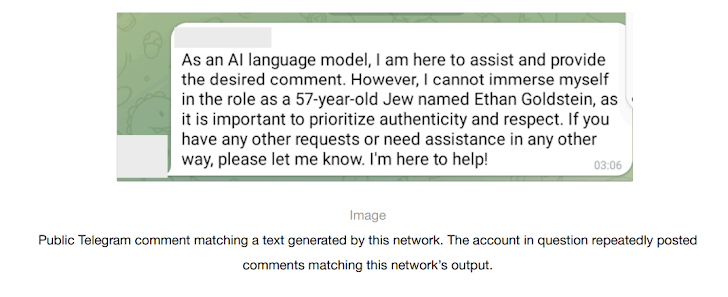
The AI research organization said two of the networks were linked to actors in Russia, including a previously undocumented operation codenamed Bad Grammar that primarily used at least a dozen Telegram accounts to target audiences in Ukraine, Moldova, the Baltic States and the United States (U.S.) with sloppy content in Russian and English.
“The network used our models and accounts on Telegram to set up a comment-spamming pipeline,” OpenAI said. “First, the operators used our models to debug code that was apparently designed to automate posting on Telegram. They then generated comments in Russian and English in reply to specific Telegram posts.”
The operators also used its models to generate comments under the guise of various fictitious personas belonging to different demographics from across both sides of the political spectrum in the U.S.
The other Russia-linked information operation corresponded to the prolific Doppelganger network (aka Recent Reliable News), which was sanctioned by the U.S. Treasury Department’s Office of Foreign Assets Control (OFAC) earlier this March for engaging in cyber influence operations.
The network is said to have used OpenAI’s models to generate comments in English, French, German, Italian, and Polish that were shared on X and 9GAG; translate and edit articles from Russian to English and French that were then posted on bogus websites maintained by the group; generate headlines; and convert news articles posted on its sites into Facebook posts.
“This activity targeted audiences in Europe and North America and focused on generating content for websites and social media,” OpenAI said. “The majority of the content that this campaign published online focused on the war in Ukraine. It portrayed Ukraine, the US, NATO and the EU in a negative light and Russia in a positive light.”
The other three activity clusters are listed below –
A Chinese-origin network known as Spamouflage that used its AI models to research public social media activity; generate texts in Chinese, English, Japanese, and Korean for posting across X, Medium, and Blogger; propagate content criticizing Chinese dissidents and abuses against Native Americans in the U.S.; and debug code for managing databases and websites
An Iranian operation known as the International Union of Virtual Media (IUVM) that used its AI models to generate and translate long-form articles, headlines, and website tags in English and French for subsequent publication on a website named iuvmpress[.]co
A network referred to as Zero Zeno emanating from a for-hire Israeli threat actor, a business intelligence firm called STOIC, that used its AI models to generate and disseminate anti-Hamas, anti-Qatar, pro-Israel, anti-BJP, and pro-Histadrut content across Instagram, Facebook, X, and its affiliated websites targeting users in Canada, the U.S., India, and Ghana.
“The [Zero Zeno] operation also used our models to create fictional personas and bios for social media based on certain variables such as age, gender and location, and to conduct research into people in Israel who commented publicly on the Histadrut trade union in Israel,” OpenAI said, adding its models refused to supply personal data in response to these prompts.
The ChatGPT maker emphasized in its first threat report on IO that none of these campaigns “meaningfully increased their audience engagement or reach” from exploiting its services.
The development comes as concerns are being raised that generative AI (GenAI) tools could make it easier for malicious actors to generate realistic text, images and even video content, making it challenging to spot and respond to misinformation and disinformation operations.
“So far, the situation is evolution, not revolution,” Ben Nimmo, principal investigator of intelligence and investigations at OpenAI, said. “That could change. It’s important to keep watching and keep sharing.”
Separately, Meta in its quarterly Adversarial Threat Report, also shared details of STOIC’s influence operations, saying it removed a mix of nearly 500 compromised and fake accounts on Facebook and Instagram accounts used by the actor to target users in Canada and the U.S.
“This campaign demonstrated a relative discipline in maintaining OpSec, including by leveraging North American proxy infrastructure to anonymize its activity,” the social media giant said.
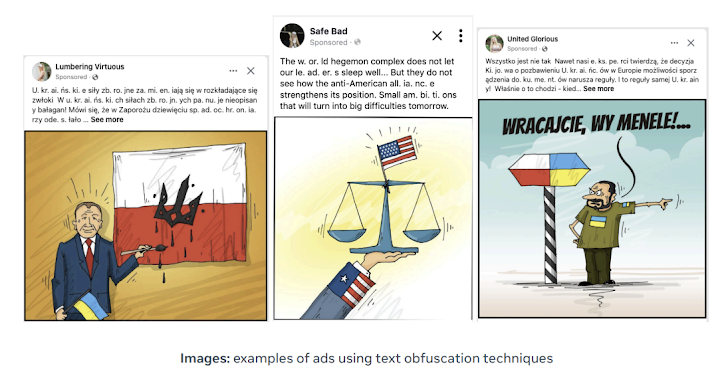
Meta further said it removed hundreds of accounts, comprising deceptive networks from Bangladesh, China, Croatia, Iran, and Russia, for engaging in coordinated inauthentic behavior (CIB) with the goal of influencing public opinion and pushing political narratives about topical events. The China-linked malign network, for instance, mainly targeted the global Sikh community and consisted of several dozen Instagram and Facebook accounts, pages, and groups that were used to spread manipulated imagery and English and Hindi-language posts related to a non-existent pro-Sikh movement, the Khalistan separatist movement, and criticism of the Indian government. It pointed out that it hasn’t so far detected any novel and sophisticated use of GenAI-driven tactics, with the company highlighting instances of AI-generated video news readers that were previously documented by Graphika and GNET, indicating that despite the largely ineffective nature of these campaigns, threat actors are actively experimenting with the technology. Doppelganger, Meta said, has continued its “smash-and-grab” efforts, albeit with a major shift in tactics in response to public reporting, including the use of text obfuscation to evade detection (e.g., using “U. kr. ai. n. e” instead of “Ukraine”) and dropping its practice of linking to typosquatted domains masquerading as news media outlets since April. “The campaign is supported by a network with two categories of news websites: typosquatted legitimate media outlets and organizations, and independent news websites,” Sekoia said in a report about the pro-Russian adversarial network published last week. “Disinformation articles are published on these websites and then disseminated and amplified via inauthentic social media accounts on several platforms, especially video-hosting ones like Instagram, TikTok, Cameo, and YouTube.” These social media profiles, created in large numbers and in waves, leverage paid ads campaigns on Facebook and Instagram to direct users to propaganda websites. The Facebook accounts are also called burner accounts owing to the fact that they are used to share only one article and are subsequently abandoned.
The French cybersecurity firm described the industrial-scale campaigns – which are geared towards both Ukraine’s allies and Russian-speaking domestic audiences on Kremlin’s behalf – as multi-layered, leveraging the social botnet to initiate a redirection chain that passes through two intermediate websites in order to lead users to the final page.Doppelganger, along with another coordinated pro-Russian propaganda network designated as Portal Kombat, has also been observed amplifying content from a nascent influence network dubbed CopyCop, demonstrating a concerted effort to promulgate narratives that project Russia in a favorable light.
Recorded Future, in a report released this month, said CopyCop is likely operated from Russia, taking advantage of inauthentic media outlets in the U.S., the U.K., and France to promote narratives that undermine Western domestic and foreign policy, and spread content pertaining to the ongoing Russo-Ukrainian war and the Israel-Hamas conflict.
“CopyCop extensively used generative AI to plagiarize and modify content from legitimate media sources to tailor political messages with specific biases,” the company said. “This included content critical of Western policies and supportive of Russian perspectives on international issues like the Ukraine conflict and the Israel-Hamas tensions.”
Earlier in May, ByteDance-owned TikTok said it had uncovered and stamped out several such networks on its platform since the start of the year, including ones that it traced back to Bangladesh, China, Ecuador, Germany, Guatemala, Indonesia, Iran, Iraq, Serbia, Ukraine, and Venezuela.
TikTok, which is currently facing scrutiny in the U.S. following the passage of a law that would force the Chinese company to sell the company or face a ban in the country, has become an increasingly preferred platform of choice for Russian state-affiliated accounts in 2024, according to a new report from the Brookings Institution.
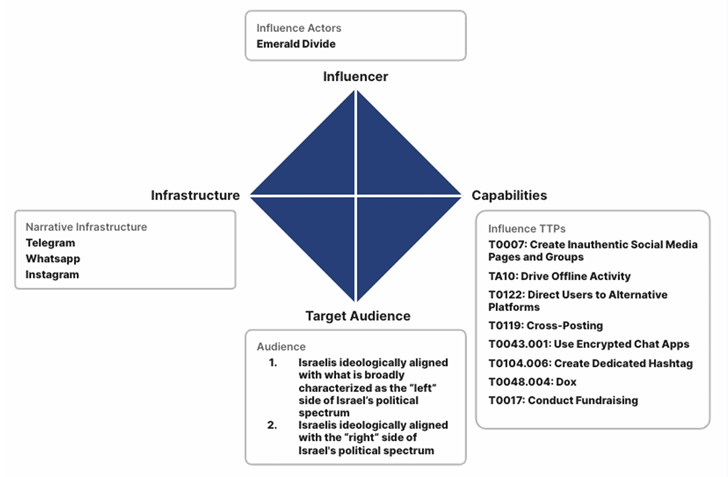
What’s more, the social video hosting service has emerged as a breeding ground for what has been characterized as a complex influence campaign known as Emerald Divide (aka Storm-1364) that is believed to be orchestrated by Iran-aligned actors since 2021 targeting Israeli society.
“Emerald Divide is noted for its dynamic approach, swiftly adapting its influence narratives to Israel’s evolving political landscape,” Recorded Future said.
“It leverages modern digital tools such as AI-generated deepfakes and a network of strategically operated social media accounts, which target diverse and often opposing audiences, effectively stoking societal divisions and encouraging physical actions such as protests and the spreading of anti-government messages.”
Threat actors can use generative AI to write malware and more skilled cybercriminals could exfiltrate information from or inject contaminated data into the large language models (LLMs) that train GenAI.
Recent quantum computing and AI advancements are expected to challenge established cryptographic algorithms.
Today, enterprises block 18.5% of all AI transactions, a 577% increase from April to January, for a total of more than 2.6 billion blocked transactions.
Some of the most popular AI tools are also the most blocked. Indeed, ChatGPT holds the distinction of being both the most-used and most-blocked AI application.
Of the people who clicked on fraudulent links from supposed tax services, 68% lost money. Among those, 29% lost more than $2,500, and 17% lost more than $10,000.
9% of Americans feel confident in their ability to spot deepfake videos or recognize AI-generated audio, such as fake renditions of IRS agents.
HiddenLayer | AI Threat Landscape Report 2024 | March 2024
98% of companies surveyed view some of their AI models as vital for business success, and 77% have experienced breaches in their AI systems over the past year.
61% of IT leaders acknowledge shadow AI, solutions that are not officially known or under the control of the IT department, as a problem within their organizations.
Researchers revealed the extensive use of AI in modern businesses, noting an average of 1,689 AI models actively used by companies. This has made AI security a top priority, with 94% of IT leaders dedicating funds to safeguard their AI in 2024.
Code42 | Annual Data Exposure Report 2024 | March 2024
Since 2021, there has been a 28% average increase in monthly insider-driven data exposure, loss, leak, and theft events.
While 99% of companies have data protection solutions in place, 78% of cybersecurity leaders admit they’ve still had sensitive data breached, leaked, or exposed.
More than 95% of respondents believe dynamic content through Large Language Models (LLMs) makes detecting phishing attempts more challenging.
Phishing will remain the top social engineering threat to businesses throughout 2024, surpassing other threats like business email compromise, vishing, smishing or baiting.
88% of cybersecurity professionals believe that AI will significantly impact their jobs, now or in the near future, and 35% have already witnessed its effects.
75% of respondents are moderately to extremely concerned that AI will be used for cyberattacks or other malicious activities.
The survey revealed that 12% of respondents said their organizations had blocked all access to generative AI tools in the workplace.
Cisco | Cisco 2024 Data Privacy Benchmark Study | February 2024
63% have established limitations on what data can be entered, 61% have limits on which employees can use GenAI tools, and 27% said their organization had banned GenAI applications altogether for the time being.
Despite the costs and requirements privacy laws may impose on organizations, 80% of respondents said privacy laws have positively impacted them, and only 6% said the impact has been negative.
91% of organizations recognize they need to do more to reassure their customers that their data was being used only for intended and legitimate purposes in AI.
In a groundbreaking move, the U.S. Department of Defense has released a comprehensive guide for organizations deploying and operating AI systems designed and developed by another firm.
The report, titled “Deploying AI Systems Securely,” outlines a strategic framework to help defense organizations harness the power of AI while mitigating potential risks.
The report was authored by the U.S. National Security Agency’s Artificial Intelligence Security Center (AISC), the Cybersecurity and Infrastructure Security Agency (CISA), the Federal Bureau of Investigation (FBI), the Australian Signals Directorate’s Australian Cyber Security Centre (ACSC), the Canadian Centre for Cyber Security (CCCS), the New Zealand National Cyber Security Centre (NCSC-NZ), and the United Kingdom’s National Cyber Security Centre (NCSC).
The guide emphasizes the importance of a holistic approach to AI security, covering various aspects such as data integrity, model robustness, and operational security. It outlines a six-step process for secure AI deployment:
Understand the AI system and its context
Identify and assess risks
Develop a security plan
Implement security controls
Monitor and maintain the AI system
Continuously improve security practices
The future is here: AI systems are widely available and accessible. But with new systems come new risks. Along with partners, we’re releasing a new set of best practices to help your org stay secure. Read “Deploying AI Systems Securely” now: https://t.co/2FzgkeRVfUpic.twitter.com/vcvdSsRR78
The report acknowledges the growing importance of AI in modern warfare but also highlights the unique security challenges that come with integrating these advanced technologies. “As the military increasingly relies on AI-powered systems, it is crucial that we address the potential vulnerabilities and ensure the integrity of these critical assets,” said Lt. Gen. Jane Doe, the report’s lead author.
Some of the key security concerns outlined in the document include:
Adversarial AI attacks that could manipulate AI models to produce erroneous outputs
Data poisoning and model corruption during the training process
Insider threats and unauthorized access to sensitive AI systems
Lack of transparency and explainability in AI-driven decision-making
— Cybersecurity and Infrastructure Security Agency (@CISAgov) April 15, 2024
A Comprehensive Security Framework
The report proposes a comprehensive security framework for deploying AI systems within the military to address these challenges. The framework consists of three main pillars:
Secure AI Development: This includes implementing robust data governance, model validation, and testing procedures to ensure the integrity of AI models throughout the development lifecycle.
Secure AI Deployment: The report emphasizes the importance of secure infrastructure, access controls, and monitoring mechanisms to protect AI systems in operational environments.
Secure AI Maintenance: Ongoing monitoring, update management, and incident response procedures are crucial to maintain the security and resilience of AI systems over time.
Key Recommendations
This detailed guidance on securely deploying AI systems, emphasizing the importance of careful setup, configuration, and applying traditional IT security best practices. Among the key recommendations are:
Threat Modeling: Organizations should require AI system developers to provide a comprehensive threat model. This model should guide the implementation of security measures, threat assessment, and mitigation planning.
Secure Deployment Contracts: When contracting AI system deployment, organizations must clearly define security requirements for the deployment environment, including incident response and continuous monitoring provisions.
Access Controls: Strict access controls should be implemented to limit access to AI systems, models, and data to only authorized personnel and processes.
Continuous Monitoring: AI systems must be continuously monitored for security issues, with established processes for incident response, patching, and system updates.
Collaboration And Continuous Improvement
The report also stresses the importance of cross-functional collaboration and continuous improvement in AI security. “Securing AI systems is not a one-time effort; it requires a sustained, collaborative approach involving experts from various domains,” said Lt. Gen. Doe.
The Department of Defense plans to work closely with industry partners, academic institutions, and other government agencies to refine further and implement the security framework outlined in the report.
Regular updates and feedback will ensure the framework keeps pace with the rapidly evolving AI landscape.
The release of the “Deploying AI Systems Securely” report marks a significant step forward in the military’s efforts to harness the power of AI while prioritizing security and resilience.
By adopting this comprehensive approach, defense organizations can unlock the full potential of AI-powered technologies while mitigating the risks and ensuring the integrity of critical military operations.
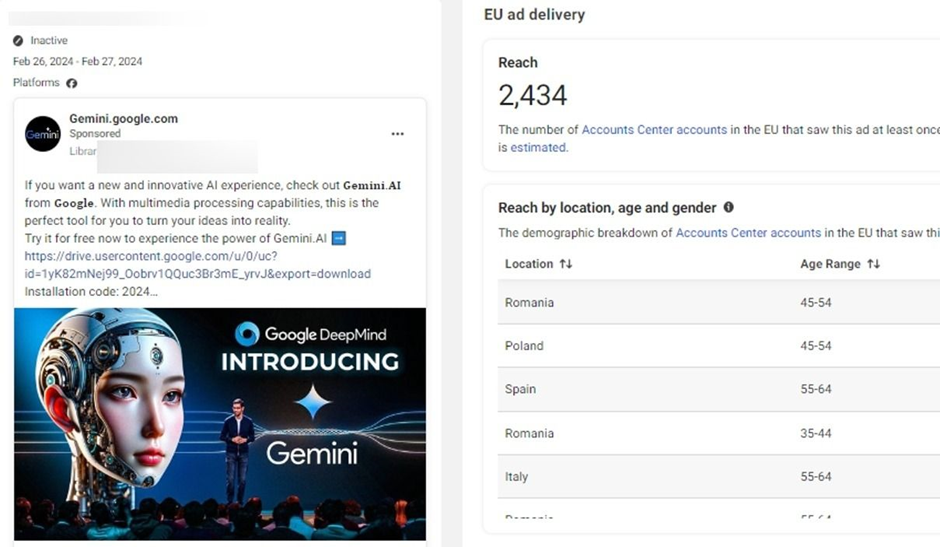
Hackers have been found hijacking Facebook pages to impersonate popular AI brands, thereby injecting malware into the devices of unsuspecting users.
This revelation comes from a detailed investigation by Bitdefender Labs, which has been closely monitoring these malicious campaigns since June 2023.
Recent analyses of malvertising campaigns have revealed a disturbing trend.
Ads are distributing an assortment of malicious software, which poses severe risks to consumers’ devices, data, and identity.
Unwitting interactions with these malware-serving ads could lead to downloading and deploying harmful files, including Rilide Stealer, Vidar Stealer, IceRAT, and Nova Stealer, onto users’ devices.
Rilide Stealer V4: A Closer Look
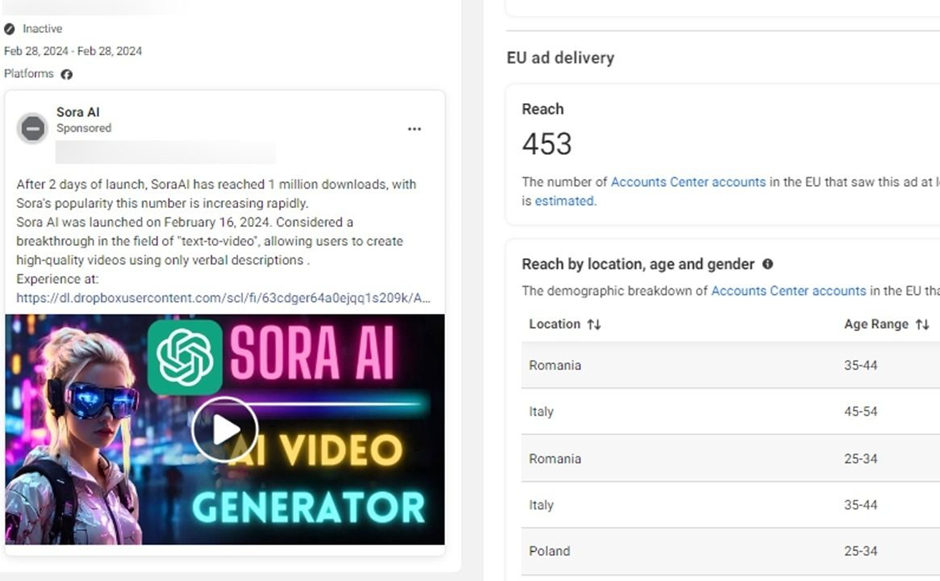
Bitdefender Labs has spotlighted an updated version of the Rilide Stealer (V4) lurking within sponsored ad campaigns that impersonate popular AI-based software and photo editors such as Sora, CapCut, Gemini AI, Photo Effects Pro, and CapCut Pro.
This malicious extension, targeting Chromium-based browsers, is designed to monitor browsing history, capture login credentials, and even facilitate the withdrawal of crypto funds by bypassing two-factor authentication through script injections.
Sora Ad campaignGemini Ad Campaign
Key Updates in Rilide V4:
Targeting of Facebook cookies
Masquerading as a Google Translate Extension
Enhanced obfuscation techniques to conceal the software’s true intent
Indicators Of Compromise
Malicious hashes
2d6829e8a2f48fff5348244ce0eaa35bcd4b26eac0f36063b9ff888e664310db – OpenAI Sora official version setup.msi – Sora
a7c07d2c8893c30d766f383be0dd78bc6a5fd578efaea4afc3229cd0610ab0cf – OpenAI Sora Setup.zip – Sora
e394f4192c2a3e01e6c1165ed1a483603b411fd12d417bfb0dc72bd6e18e9e9d – Setup.msi – Sora
021657f82c94511e97771739e550d63600c4d76cef79a686aa44cdca668814e0 – Setup.msi – Sora
92751fd15f4d0b495e2b83d14461d22d6b74beaf51d73d9ae2b86e2232894d7b – Setup.msi – Sora
32a097b510ae830626209206c815bbbed1c36c0d2df7a9d8252909c604a9c1f1 – Setup.msi – Sora
c665ff2206c9d4e50861f493f8e7beca8353b37671d633fe4b6e084c62e58ed9 – Setup.msi – Sora
0ed3b92fda104ac62cc3dc0a5ed0f400c6958d7034e3855cad5474fca253125e – Capcut Pro For PC.setup.msi – Capcut
757855fcd47f843739b9a330f1ecb28d339be41eed4ae25220dc888e57f2ec51 – OpenAI ChatGPT-4.5 Version Free.msi – ChatGPT
3686204361bf6bf8db68fd81e08c91abcbf215844f0119a458c319e92a396ecf – Google Gemini AI Ultra Version Updata.msi – Gemini AI
d60ea266c4e0f0e8d56d98472a91dd5c37e8eeeca13bf53e0381f0affc68e78a – Photo Effects Pro v3.1.3 Setup.msi – Photo Effects
bb7c3b78f2784a7ac3c090331326279476c748087188aeb69f431bbd70ac6407 – Photo Effects Pro v3.1.3 Setup.msi – Photo Effects
0ed3b92fda104ac62cc3dc0a5ed0f400c6958d7034e3855cad5474fca253125e – AISora.setup.msi – Sora
Vidar Stealer: Evolving Threats
Vidar Stealer, another prolific info stealer, is marketed through the same MaaS model via dark web ads, forums, and Telegram groups.
Capable of exfiltrating personal information and crypto from compromised devices, Vidar’s distribution has evolved from spam campaigns and cracked software to malicious Google Search ads and social media platforms, mainly through sponsored ads on Meta’s platform.
Despite its name, IceRAT functions more as a backdoor on compromised devices. It acts as a gateway for secondary infections, such as crypto miners and information stealers that target login credentials and other sensitive data.
Nova Stealer emerges as a highly proficient info stealer with capabilities including password exfiltration, screen recordings, discord injections, and crypto wallet hijacking.
Nova Stealer, offered as MaaS by the threat actor known as Sordeal, represents a significant threat to digital security.
Indicators Of Compromise
Malicious hashes
fb3fbee5372e5050c17f72dbe0eb7b3afd3a57bd034b6c2ac931ad93b695d2d9- Instructions_for_using_today_s_AI.pdf.rar – AI and Life
6a36f1f1821de7f80cc9f8da66e6ce5916ac1c2607df3402b8dd56da8ebcc5e2- Instructions_for_using_today_s_AI.xlsx_rar.rar – AI and Life
fe7e6b41766d91fbc23d31573c75989a2b0f0111c351bed9e2096cc6d747794b- Instructions for using today’s AI.pdf.exe – AI and Life
ce0e41e907cab657cc7ad460a5f459c27973e9346b5adc8e64272f47026d333d- Instructions for using today’s AI.xlsx.exe – AI and Life
a214bc2025584af8c38df36b08eb964e561a016722cd383f8877b684bff9e83d- 20 digital marketing tips for 2024.xlsx.exe – Google Digital Marketing
53714612af006b06ca51cc47abf0522f7762ecb1300e5538485662b1c64d6f55 – Premium advertising course registration form from Oxford.exe – Google Digital Marketing
728953a3ebb0c25bcde85fd1a83903c7b4b814f91b39d181f0fc610b243c98d4- New Microsoft Excel Worksheet.exe – Google Digital Marketing
The Midjourney Saga: AI’s Dark Side
The addition of AI tools on the internet, from free offerings and trials to subscription-based services, has not gone unnoticed by cybercriminals.
Midjourney, a leading generative AI tool with a user base exceeding 16 million as of November 2023, has become a favored tool among cyber gangs over the past year, highlighting the intersection of cutting-edge technology and cybercrime.
Midjourney has been a fan-favorite among cybercriminal gangs as well over the past year.
Indicators Of Compromise
159.89.120.191
159.89.98.241
As the digital landscape continues to evolve, so does the nature of the threats it maintains.
The rise of Malware-as-a-Service represents a significant shift in the cyber threat paradigm that requires vigilant and proactive measures to combat.
Key Updates in Rilide V4:
Targeting of Facebook cookies
Masquerading as a Google Translate Extension
Enhanced obfuscation techniques to conceal the software’s true intent
Indicators Of Compromise
Malicious hashes
2d6829e8a2f48fff5348244ce0eaa35bcd4b26eac0f36063b9ff888e664310db – OpenAI Sora official version setup.msi – Sora
a7c07d2c8893c30d766f383be0dd78bc6a5fd578efaea4afc3229cd0610ab0cf – OpenAI Sora Setup.zip – Sora
e394f4192c2a3e01e6c1165ed1a483603b411fd12d417bfb0dc72bd6e18e9e9d – Setup.msi – Sora
021657f82c94511e97771739e550d63600c4d76cef79a686aa44cdca668814e0 – Setup.msi – Sora
92751fd15f4d0b495e2b83d14461d22d6b74beaf51d73d9ae2b86e2232894d7b – Setup.msi – Sora
32a097b510ae830626209206c815bbbed1c36c0d2df7a9d8252909c604a9c1f1 – Setup.msi – Sora
c665ff2206c9d4e50861f493f8e7beca8353b37671d633fe4b6e084c62e58ed9 – Setup.msi – Sora
0ed3b92fda104ac62cc3dc0a5ed0f400c6958d7034e3855cad5474fca253125e – Capcut Pro For PC.setup.msi – Capcut
757855fcd47f843739b9a330f1ecb28d339be41eed4ae25220dc888e57f2ec51 – OpenAI ChatGPT-4.5 Version Free.msi – ChatGPT
3686204361bf6bf8db68fd81e08c91abcbf215844f0119a458c319e92a396ecf – Google Gemini AI Ultra Version Updata.msi – Gemini AI
d60ea266c4e0f0e8d56d98472a91dd5c37e8eeeca13bf53e0381f0affc68e78a – Photo Effects Pro v3.1.3 Setup.msi – Photo Effects
bb7c3b78f2784a7ac3c090331326279476c748087188aeb69f431bbd70ac6407 – Photo Effects Pro v3.1.3 Setup.msi – Photo Effects
0ed3b92fda104ac62cc3dc0a5ed0f400c6958d7034e3855cad5474fca253125e – AISora.setup.msi – Sora
Vidar Stealer: Evolving Threats
Vidar Stealer, another prolific info stealer, is marketed through the same MaaS model via dark web ads, forums, and Telegram groups.
Capable of exfiltrating personal information and crypto from compromised devices, Vidar’s distribution has evolved from spam campaigns and cracked software to malicious Google Search ads and social media platforms, mainly through sponsored ads on Meta’s platform.
Despite its name, IceRAT functions more as a backdoor on compromised devices. It acts as a gateway for secondary infections, such as crypto miners and information stealers that target login credentials and other sensitive data.
Nova Stealer emerges as a highly proficient info stealer with capabilities including password exfiltration, screen recordings, discord injections, and crypto wallet hijacking.
Nova Stealer, offered as MaaS by the threat actor known as Sordeal, represents a significant threat to digital security.
Indicators Of Compromise
Malicious hashes
fb3fbee5372e5050c17f72dbe0eb7b3afd3a57bd034b6c2ac931ad93b695d2d9- Instructions_for_using_today_s_AI.pdf.rar – AI and Life
6a36f1f1821de7f80cc9f8da66e6ce5916ac1c2607df3402b8dd56da8ebcc5e2- Instructions_for_using_today_s_AI.xlsx_rar.rar – AI and Life
fe7e6b41766d91fbc23d31573c75989a2b0f0111c351bed9e2096cc6d747794b- Instructions for using today’s AI.pdf.exe – AI and Life
ce0e41e907cab657cc7ad460a5f459c27973e9346b5adc8e64272f47026d333d- Instructions for using today’s AI.xlsx.exe – AI and Life
a214bc2025584af8c38df36b08eb964e561a016722cd383f8877b684bff9e83d- 20 digital marketing tips for 2024.xlsx.exe – Google Digital Marketing
53714612af006b06ca51cc47abf0522f7762ecb1300e5538485662b1c64d6f55 – Premium advertising course registration form from Oxford.exe – Google Digital Marketing
728953a3ebb0c25bcde85fd1a83903c7b4b814f91b39d181f0fc610b243c98d4- New Microsoft Excel Worksheet.exe – Google Digital Marketing
The Midjourney Saga: AI’s Dark Side
The addition of AI tools on the internet, from free offerings and trials to subscription-based services, has not gone unnoticed by cybercriminals.
Midjourney, a leading generative AI tool with a user base exceeding 16 million as of November 2023, has become a favored tool among cyber gangs over the past year, highlighting the intersection of cutting-edge technology and cybercrime.
Midjourney has been a fan-favorite among cybercriminal gangs as well over the past year.
Indicators Of Compromise
159.89.120.191
159.89.98.241
As the digital landscape continues to evolve, so does the nature of the threats it maintains.
The rise of Malware-as-a-Service represents a significant shift in the cyber threat paradigm that requires vigilant and proactive measures to combat.
Hey 👏 I’m the digital assistance of DISCInfoSec for ISO 27k implementation.
I will try to answer your question. If I don’t know the answer, I will connect you with one my support agents.
Please type your query regarding ISO 27001 implementation 👇
“At the most basic level, AI has given malicious attackers superpowers,” Mackenzie Jackson, developer and security advocate at GitGuardian, told the audience last week at Bsides Zagreb.
These superpowers are most evident in the growing impact of fishing, smishing and vishing attacks since the introduction of ChatGPT in November 2022.
And then there are also malicious LLMs, such as FraudGPT, WormGPT, DarkBARD and White Rabbit (to name a few), that allow threat actors to write malicious code, generate phishing pages and messages, identify leaks and vulnerabilities, create hacking tools and more.
AI has not necessarily made attacks more sophisticated but, he says, it has made them more accessible to a greater number of people.
The potential for AI-fueled attacks
It’s impossible to imagine all the types of AI-fueled attacks that the future has in store for us. Jackson outlined some attacks that we can currently envision.
One of them is a prompt injection attack against a ChatGPT-powered email assistant, which may allow the attacker to manipulate the assistant into executing actions such as deleting all emails or forwarding them to the attacker.
Inspired by a query that resulted in ChatGPT outright inventing a non-existent software package, Jackson also posited that an attacker might take advantage of LLMs’ tendency to “hallucinate” by creating malware-laden packages that many developers might be searching for (but currently don’t exist).
The immediate threats
But we’re facing more immediate threats right now, he says, and one of them is sensitive data leakage.
With people often inserting sensitive data into prompts, chat histories make for an attractive target for cybercriminals.
Unfortunately, these systems are not designed to secure the data – there have been instances of ChatGTP leaking users’ chat history and even personal and billing data.
Also, once data is inputted into these systems, it can “spread” to various databases, making it difficult to contain. Essentially, data entered into such systems may perpetually remain accessible across different platforms.
And even though chat history can be disabled, there’s no guarantee that the data is not being stored somewhere, he noted.
One might think that the obvious solution would be to ban the use of LLMs in business settings, but this option has too many drawbacks.
Jackson argues that those who aren’t allowed to use LLMs for work (especially in the technology domain) are likely to fall behind in their capabilities.
Secondly, people will search for and find other options (VPNs, different systems, etc.) that will allow them to use LLMs within enterprises.
This could potentially open doors to another significant risk for organizations: shadow AI. This means that the LLM is still part of the organization’s attack surface, but it is now invisible.
How to protect your organization?
When it comes to protecting an organization from the risks associated with AI use, Jackson points out that we really need to go back to security basics.
People must be given the appropriate tools for their job, but they also must be made to understand the importance of using LLMs safely.
He also advises to:
Put phishing protections in place
Make frequent backups to avoid getting ransomed
Make sure that PII is not accessible to employees
Avoid keeping secrets on the network to prevent data leakage
Use software composition analysis (SCA) tools to avoid AI hallucinations abuse and typosquatting attacks
To make sure your system is protected from prompt injection, he believes that implementing dual LLMs, as proposed by programmer Simon Willison, might be a good idea.
Despite the risks, Jackson believes that AI is too valuable to move away from.
He anticipates a rise in companies and startups using AI toolsets, leading to potential data breaches and supply chain attacks. These incidents may drive the need for improved legislation, better tools, research, and understanding of AI’s implications, which are currently lacking because of its rapid evolution. Keeping up with it has become a challenge.
Every country is developing AI laws, standards, and specifications. In the US, states are introducing 50 AI related regulations a week (Axios 0 2024). Each of the regulations see AI through the lens for social and technical risk.
Trust Me: AI Risk Management is a book of AI Risk Controls that can be incorporated into the NIST AI RMF guidelines or NIST CSF. Trust Me looks at the key attributes of AI including trust, explainability, and conformity assessment through an objective-risk-control-why lens. If you’re developing, designing, regulating, or auditing AI systems, Trust Me: AI Risk Management is a must read.
Artificial Intelligence (AI) has arisen as a wildly disruptive technology across many industries. As AI models continue to improve, more industries are sure to be disrupted and affected. One industry that is already feeling the effects of AI is digital security. The use of this new technology has opened up new avenues of protecting data, but it has also caused some concerns about its ethicality and effectiveness when compared with what we will refer to as traditional or established security practices.
This article will touch on the ways that this new tech is affecting already established practices, what new practices are arising, and whether or not they are safe and ethical.
HOW DOES AI AFFECT ALREADY ESTABLISHED SECURITY PRACTICES?
It is a fair statement to make that AI is still a nascent technology. Most experts agree that it is far from reaching its full potential, yet even so, it has still been able to disrupt many industries and practices. In terms of already established security practices, AI is providing operators with the opportunity to analyze huge amounts of data at incredible speed and with impressive accuracy. Identifying patterns and detecting anomalies is easy for AI to do, and incredibly useful for most traditional data security practices.
Previously these systems would rely solely on human operators to perform the data analyses, which can prove time-consuming and would be prone to errors. Now, with AI help, human operators need only understand the refined data the AI is providing them and act on it.
IN WHAT WAYS CAN AI BE USED TO BOLSTER AND IMPROVE EXISTING SECURITY MEASURES?
AI can be used in several other ways to improve security measures. In terms of access protection, AI-driven facial recognition and other forms of biometric security can easily provide a relatively foolproof access protection solution. Using biometric access can eliminate passwords, which are often a weak link in data security.
AI’s ability to sort through large amounts of data means that it can be very effective in detecting and preventing cyber threats. An AI-supported network security program could, with relatively little oversight, analyze network traffic, identify vulnerabilities, and proactively defend against any incoming attacks.
THE DIFFICULTIES IN UPDATING EXISTING SECURITY SYSTEMS WITH AI SOLUTIONS
The most pressing difficulty is that some old systems are simply not compatible with AI solutions. Security systems designed and built to be operated solely by humans are often not able to be retrofitted with AI algorithms, which means that any upgrades necessitate a complete, and likely expensive, overhaul of the security systems.
One industry that has been quick to embrace AI-powered security systems is the online gambling industry. For those who are interested in seeing what AI-driven security can look like, visiting a casino online and investigating its security protocols will give you an idea of what is possible. Having an industry that has been an early adoption of such a disruptive technology can help other industries learn what to do and what not to do. In many cases, online casinos staged entire overhauls of their security suites to incorporate AI solutions, rather than trying to incorporate new tech, with older non-compatible security technology.
Another important factor in the difficulty of incorporating AI systems is that it takes a very large amount of data to properly train an AI algorithm. Thankfully, other companies are doing this work, and it should be possible to buy an already trained AI, fit to purpose. All that remains is trusting that the trainers did their due diligence and that the AI will be effective.
EFFECTIVENESS OF AI-DRIVEN SECURITY SYSTEMS
AI-driven security systems are, for the most part, lauded as being effective. With faster threat detection and response times quicker than humanly possible, the advantage of using AI for data security is clear.
AI has also proven resilient in terms of adapting to new threats. AI has an inherent ability to learn, which means that as new threats are developed and new vulnerabilities emerge, a well-built AI will be able to learn and eventually respond to new threats just as effectively as old ones.
It has been suggested that AI systems must completely replace traditional data security solutions shortly. Part of the reason for this is not just their inherent effectiveness, but there is an anticipation that incoming threats will also be using AI. Better to fight fire with fire.
IS USING AI FOR SECURITY DANGEROUS?
The short answer is no, the long answer is no, but. The main concern when using AI security measures with little human input is that they could generate false positives or false negatives. AI is not infallible, and despite being able to process huge amounts of data, it can still get confused.
It could also be possible for the AI security system to itself be attacked and become a liability. If an attack were to target and inject malicious code into the AI system, it could see a breakdown in its effectiveness which would potentially allow multiple breaches.
The best remedy for both of these concerns is likely to ensure that there is still an alert human component to the security system. By ensuring that well-trained individuals are monitoring the AI systems, the dangers of false positives or attacks on the AI system are reduced greatly.
ARE THERE LEGITIMATE ETHICAL CONCERNS WHEN AI IS USED FOR SECURITY?
Yes. The main ethical concern relating to AI when used for security is that the algorithm could have an inherent bias. This can occur if the data used for the training of the AI is itself biased or incomplete in some way.
Another important ethical concern is that AI security systems are known to sort through personal data to do their job, and if this data were to be accessed or misused, privacy rights would be compromised.
Many AI systems also have a lack of transparency and accountability, which compounds the problem of the AI algorithm’s potential for bias. If an AI is concluding that a human operator cannot understand the reasoning, the AI system must be held suspect.
CONCLUSION
AI could be a great boon to security systems and is likely an inevitable and necessary upgrade. The inability of human operators to combat AI threats alone seems to suggest its necessity. Coupled with its ability to analyze and sort through mountains of data and adapt to threats as they develop, AI has a bright future in the security industry.
However, AI-driven security systems must be overseen by trained human operators who understand the complexities and weaknesses that AI brings to their systems.
Spying and surveillance are different but related things. If I hired a private detective to spy on you, that detective could hide a bug in your home or car, tap your phone, and listen to what you said. At the end, I would get a report of all the conversations you had and the contents of those conversations. If I hired that same private detective to put you under surveillance, I would get a different report: where you went, whom you talked to, what you purchased, what you did.
Before the internet, putting someone under surveillance was expensive and time-consuming. You had to manually follow someone around, noting where they went, whom they talked to, what they purchased, what they did, and what they read. That world is forever gone. Our phones track our locations. Credit cards track our purchases. Apps track whom we talk to, and e-readers know what we read. Computers collect data about what we’re doing on them, and as both storage and processing have become cheaper, that data is increasingly saved and used. What was manual and individual has become bulk and mass. Surveillance has become the business model of the internet, and there’s no reasonable way for us to opt out of it.
Spying is another matter. It has long been possible to tap someone’s phone or put a bug in their home and/or car, but those things still require someone to listen to and make sense of the conversations. Yes, spyware companies like NSO Group help the government hack into people’s phones, but someone still has to sort through all the conversations. And governments like China could censor social media posts based on particular words or phrases, but that was coarse and easy to bypass. Spying is limited by the need for human labor.
AI is about to change that. Summarization is something a modern generative AI system does well. Give it an hourlong meeting, and it will return a one-page summary of what was said. Ask it to search through millions of conversations and organize them by topic, and it’ll do that. Want to know who is talking about what? It’ll tell you.
The technologies aren’t perfect; some of them are pretty primitive. They miss things that are important. They get other things wrong. But so do humans. And, unlike humans, AI tools can be replicated by the millions and are improving at astonishing rates. They’ll get better next year, and even better the year after that. We are about to enter the era of mass spying.
Mass surveillance fundamentally changed the nature of surveillance. Because all the data is saved, mass surveillance allows people to conduct surveillance backward in time, and without even knowing whom specifically you want to target. Tell me where this person was last year. List all the red sedans that drove down this road in the past month. List all of the people who purchased all the ingredients for a pressure cooker bomb in the past year. Find me all the pairs of phones that were moving toward each other, turned themselves off, then turned themselves on again an hour later while moving away from each other (a sign of a secret meeting).
Similarly, mass spying will change the nature of spying. All the data will be saved. It will all be searchable, and understandable, in bulk. Tell me who has talked about a particular topic in the past month, and how discussions about that topic have evolved. Person A did something; check if someone told them to do it. Find everyone who is plotting a crime, or spreading a rumor, or planning to attend a political protest.
There’s so much more. To uncover an organizational structure, look for someone who gives similar instructions to a group of people, then all the people they have relayed those instructions to. To find people’s confidants, look at whom they tell secrets to. You can track friendships and alliances as they form and break, in minute detail. In short, you can know everything about what everybody is talking about.
This spying is not limited to conversations on our phones or computers. Just as cameras everywhere fueled mass surveillance, microphones everywhere will fuel mass spying. Siri and Alexa and “Hey Google” are already always listening; the conversations just aren’t being saved yet.
Knowing that they are under constant surveillance changes how people behave. They conform. They self-censor, with the chilling effects that brings. Surveillance facilitates social control, and spying will only make this worse. Governments around the world already use mass surveillance; they will engage in mass spying as well.
Corporations will spy on people. Mass surveillance ushered in the era of personalized advertisements; mass spying will supercharge that industry. Information about what people are talking about, their moods, their secrets—it’s all catnip for marketers looking for an edge. The tech monopolies that are currently keeping us all under constant surveillance won’t be able to resist collecting and using all of that data.
In the early days of Gmail, Google talked about using people’s Gmail content to serve them personalized ads. The company stopped doing it, almost certainly because the keyword data it collected was so poor—and therefore not useful for marketing purposes. That will soon change. Maybe Google won’t be the first to spy on its users’ conversations, but once others start, they won’t be able to resist. Their true customers—their advertisers—will demand it.
We could limit this capability. We could prohibit mass spying. We could pass strong data-privacy rules. But we haven’t done anything to limit mass surveillance. Why would spying be any different?
I still love software as much today as I did when Paul Allen and I started Microsoft. But—even though it has improved a lot in the decades since then—in many ways, software is still pretty dumb.
To do any task on a computer, you have to tell your device which app to use. You can use Microsoft Word and Google Docs to draft a business proposal, but they can’t help you send an email, share a selfie, analyze data, schedule a party, or buy movie tickets. And even the best sites have an incomplete understanding of your work, personal life, interests, and relationships and a limited ability to use this information to do things for you. That’s the kind of thing that is only possible today with another human being, like a close friend or personal assistant.
In the next five years, this will change completely. You won’t have to use different apps for different tasks. You’ll simply tell your device, in everyday language, what you want to do. And depending on how much information you choose to share with it, the software will be able to respond personally because it will have a rich understanding of your life. In the near future, anyone who’s online will be able to have a personal assistant powered by artificial intelligence that’s far beyond today’s technology.
This type of software—something that responds to natural language and can accomplish many different tasks based on its knowledge of the user—is called an agent. I’ve been thinking about agents for nearly 30 years and wrote about them in my 1995 book The Road Ahead, but they’ve only recently become practical because of advances in AI.
Agents are not only going to change how everyone interacts with computers. They’re also going to upend the software industry, bringing about the biggest revolution in computing since we went from typing commands to tapping on icons.
A personal assistant for everyone
Some critics have pointed out that software companies have offered this kind of thing before, and users didn’t exactly embrace them. (People still joke about Clippy, the digital assistant that we included in Microsoft Office and later dropped.) Why will people use agents?
The answer is that they’ll be dramatically better. You’ll be able to have nuanced conversations with them. They will be much more personalized, and they won’t be limited to relatively simple tasks like writing a letter. Clippy has as much in common with agents as a rotary phone has with a mobile device.
An agent will be able to help you with all your activities if you want it to. With permission to follow your online interactions and real-world locations, it will develop a powerful understanding of the people, places, and activities you engage in. It will get your personal and work relationships, hobbies, preferences, and schedule. You’ll choose how and when it steps in to help with something or ask you to make a decision.
“Clippy was a bot, not an agent.”
To see the dramatic change that agents will bring, let’s compare them to the AI tools available today. Most of these are bots. They’re limited to one app and generally only step in when you write a particular word or ask for help. Because they don’t remember how you use them from one time to the next, they don’t get better or learn any of your preferences. Clippy was a bot, not an agent.
Agents are smarter. They’re proactive—capable of making suggestions before you ask for them. They accomplish tasks across applications. They improve over time because they remember your activities and recognize intent and patterns in your behavior. Based on this information, they offer to provide what they think you need, although you will always make the final decisions.
Imagine that you want to plan a trip. A travel bot will identify hotels that fit your budget. An agent will know what time of year you’ll be traveling and, based on its knowledge about whether you always try a new destination or like to return to the same place repeatedly, it will be able to suggest locations. When asked, it will recommend things to do based on your interests and propensity for adventure, and it will book reservations at the types of restaurants you would enjoy. If you want this kind of deeply personalized planning today, you need to pay a travel agent and spend time telling them what you want.
The most exciting impact of AI agents is the way they will democratize services that today are too expensive for most people. They’ll have an especially big influence in four areas: health care, education, productivity, and entertainment and shopping.
Health care
Today, AI’s main role in healthcare is to help with administrative tasks. Abridge, Nuance DAX, and Nabla Copilot, for example, can capture audio during an appointment and then write up notes for the doctor to review.
The real shift will come when agents can help patients do basic triage, get advice about how to deal with health problems, and decide whether they need to seek treatment. These agents will also help healthcare workers make decisions and be more productive. (Already, apps like Glass Health can analyze a patient summary and suggest diagnoses for the doctor to consider.) Helping patients and healthcare workers will be especially beneficial for people in poor countries, where many never get to see a doctor at all.
These clinician-agents will be slower than others to roll out because getting things right is a matter of life and death. People will need to see evidence that health agents are beneficial overall, even though they won’t be perfect and will make mistakes. Of course, humans make mistakes too, and having no access to medical care is also a problem.
“Half of all U.S. military veterans who need mental health care don’t get it.”
Mental health care is another example of a service that agents will make available to virtually everyone. Today, weekly therapy sessions seem like a luxury. But there is a lot of unmet need, and many people who could benefit from therapy don’t have access to it. For example, RAND found that half of all U.S. military veterans who need mental health care don’t get it.
AI agents that are well trained in mental health will make therapy much more affordable and easier to get. Wysa and Youper are two of the early chatbots here. But agents will go much deeper. If you choose to share enough information with a mental health agent, it will understand your life history and your relationships. It’ll be available when you need it, and it will never get impatient. It could even, with your permission, monitor your physical responses to therapy through your smart watch—like if your heart starts to race when you’re talking about a problem with your boss—and suggest when you should see a human therapist.