InfoSec and Compliance – With 20 years of blogging experience, DISC InfoSec blog is dedicated to providing trusted insights and practical solutions for professionals and organizations navigating the evolving cybersecurity landscape. From cutting-edge threats to compliance strategies, this blog is your reliable resource for staying informed and secure. Dive into the content, connect with the community, and elevate your InfoSec expertise!
EU AI Act: Why Every Organization Using AI Must Pay Attention
The EU AI Act is the world’s first major regulation designed to govern how artificial intelligence is developed, deployed, and managed across industries. Approved in June 2024, it establishes harmonized rules for AI use across all EU member states — just as GDPR did for privacy.
Any organization that builds, integrates, or sells AI systems within the European Union must comply — even if they are headquartered outside the EU. That means U.S. and global companies using AI in European markets are officially in scope.
The Act introduces a risk-based regulatory model. AI is categorized across four risk tiers — from unacceptable, which are completely banned, to high-risk, which carry strict controls, limited-risk with transparency requirements, and minimal-risk, which remain largely unregulated.
High-risk AI includes systems governing access to healthcare, finance, employment, critical infrastructure, law enforcement, and essential public services. Providers of these systems must implement rigorous risk management, governance, monitoring, and documentation processes across the entire lifecycle.
Certain AI uses are explicitly prohibited — such as social scoring, biometric emotion recognition in workplaces or schools, manipulative AI techniques, and untargeted scraping of facial images for surveillance.
Compliance obligations are rolling out in phases beginning February 2025, with core high-risk system requirements taking effect in August 2026 and final provisions extending through 2027. Organizations have limited time to assess their current systems and prepare for adherence.
This legislation is expected to shape global AI governance frameworks — much like GDPR influenced worldwide privacy laws. Companies that act early gain an advantage: reduced legal exposure, customer trust, and stronger market positioning.
How DISC InfoSec Helps You Stay Ahead
DISC InfoSec brings 20+ years of security and compliance excellence with a proven multi-framework approach. Whether preparing for EU AI Act, ISO 42001, GDPR, SOC 2, or enterprise governance — we help organizations implement responsible AI controls without slowing innovation.
If your business touches the EU and uses AI — now is the time to get compliant.
A reliable industry context about AI and cybersecurity frameworks from recent market and trend reports. I’ll then give a clear opinion at the end.
1. AI Is Now Core to Cyber Defense Artificial Intelligence is transforming how organizations defend against digital threats. Traditional signature-based security tools struggle to keep up with modern attacks, so companies are using AI—especially machine learning and behavioral analytics—to detect anomalies, predict risks, and automate responses in real time. This integration is now central to mature cybersecurity programs.
2. Market Expansion Reflects Strategic Adoption The AI cybersecurity market is growing rapidly, with estimates projecting expansion from tens of billions today into the hundreds of billions within the next decade. This reflects more than hype—organizations across sectors are investing heavily in AI-enabled threat platforms to improve detection, reduce manual workload, and respond faster to attacks.
3. AI Architectures Span Detection to Response Modern frameworks incorporate diverse AI technologies such as natural language processing, neural networks, predictive analytics, and robotic process automation. These tools support everything from network monitoring and endpoint protection to identity-based threat management and automated incident response.
4. Cloud and Hybrid Environments Drive Adoption Cloud migrations and hybrid IT architectures have expanded attack surfaces, prompting more use of AI solutions that can scale across distributed environments. Cloud-native AI tools enable continuous monitoring and adaptive defenses that are harder to achieve with legacy on-premises systems.
5. Regulatory and Compliance Imperatives Are Growing As digital transformation proceeds, regulatory expectations are rising too. Many frameworks now embed explainable AI and compliance-friendly models that help organizations demonstrate legal and ethical governance in areas like data privacy and secure AI operations.
6. Integration Challenges Remain Despite the advantages, adopting AI frameworks isn’t plug-and-play. Organizations face hurdles including high implementation cost, lack of skilled AI security talent, and difficulties integrating new tools with legacy architectures. These challenges can slow deployment and reduce immediate ROI. (Inferred from general market trends)
7. Sophisticated Threats Demand Sophisticated Defenses AI is both a defensive tool and a capability leveraged by attackers. Adversarial AI can generate more convincing phishing, exploit model weaknesses, and automate aspects of attacks. A robust cybersecurity framework must account for this dual role and include AI-specific risk controls.
8. Organizational Adoption Varies Widely Enterprise adoption is strong, especially in regulated sectors like finance, healthcare, and government, while many small and medium businesses remain cautious due to cost and trust issues. This uneven adoption means frameworks must be flexible enough to suit different maturity levels. (From broader industry reports)
9. Frameworks Are Evolving With the Threat Landscape Rather than static checklists, AI cybersecurity frameworks now emphasize continuous adaptation—integrating real-time risk assessment, behavioral intelligence, and autonomous response capabilities. This shift reflects the fact that cyber risk is dynamic and cannot be mitigated solely by periodic assessments or manual controls.
Opinion
AI-centric cybersecurity frameworks represent a necessary evolution in defense strategy, not a temporary trend. The old model of perimeter defense and signature matching simply doesn’t scale in an era of massive data volumes, sophisticated AI-augmented threats, and 24/7 cloud operations. However, the promise of AI must be tempered with governance rigor. Organizations that treat AI as a magic bullet will face blind spots and risks—especially around privacy, explainability, and integration complexity.
Ultimately, the most effective AI cybersecurity frameworks will balance automated, real-time intelligence with human oversight and clear governance policies. This blend maximizes defensive value while mitigating potential misuse or operational failures.
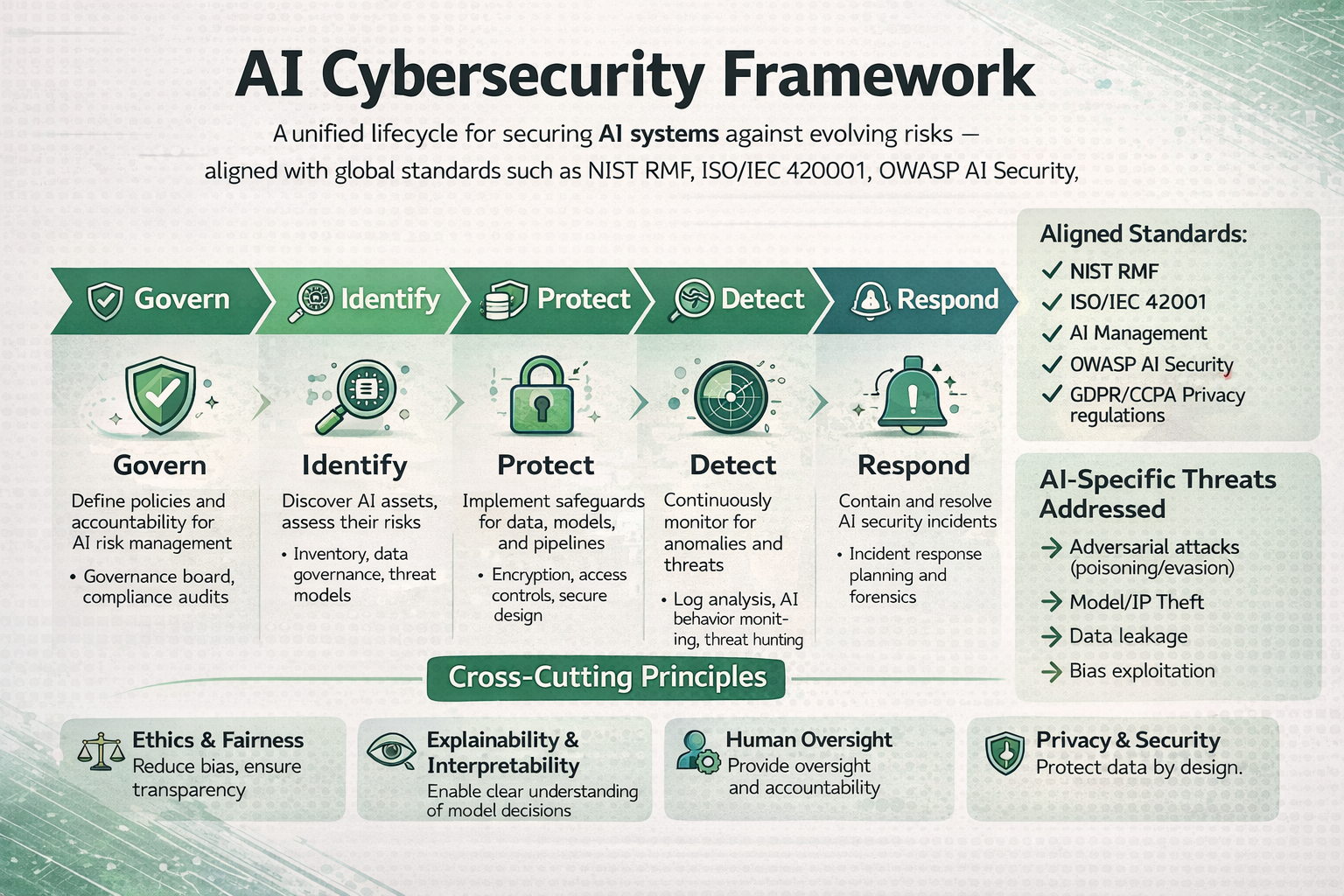
AI Cybersecurity Framework — Summary
AI Cybersecurity framework provides a holistic approach to securing AI systems by integrating governance, risk management, and technical defense across the full AI lifecycle. It aligns with widely-accepted standards such as NIST RMF, ISO/IEC 42001, OWASP AI Security Top 10, and privacy regulations (e.g., GDPR, CCPA).
1️⃣ Govern
Set strategic direction and oversight for AI risk.
Goals: Define policies, accountability, and acceptable risk levels
Key Controls: AI governance board, ethical guidelines, compliance checks
Outcomes: Approved AI policies, clear governance structures, documented risk appetite
2️⃣ Identify
Understand what needs protection and the related risks.
Goals: Map AI assets, data flows, threat landscape
Explainability & Interpretability: Understand model decisions
Human-in-the-Loop: Oversight and accountability remain essential
Privacy & Security: Protect data by design
AI-Specific Threats Addressed
Adversarial attacks (poisoning, evasion)
Model theft and intellectual property loss
Data leakage and inference attacks
Bias manipulation and harmful outcomes
Overall Message
This framework ensures trustworthy, secure, and resilient AI operations by applying structured controls from design through incident recovery—combining cybersecurity rigor with ethical and responsible AI practices.
Yann LeCun — a pioneer of deep learning and Meta’s Chief AI Scientist — has left the company after shaping its AI strategy and influencing billions in investment. His departure is not a routine leadership change; it signals a deeper shift in how he believes AI must evolve.
LeCun is one of the founders of modern neural networks, a Turing Award recipient, and a core figure behind today’s deep learning breakthroughs. His work once appeared to be a dead end, yet it ultimately transformed the entire AI landscape.
Now, he is stepping away not to retire or join another corporate giant, but to create a startup focused on a direction Meta does not support. This choice underscores a bold statement: the current path of scaling Large Language Models (LLMs) may not lead to true artificial intelligence.
He argues that LLMs, despite their success, are fundamentally limited. They excel at predicting text but lack real understanding of the world. They cannot reason about physical reality, causality, or genuine intent behind events.
According to LeCun, today’s LLMs possess intelligence comparable to an animal — some say a cat — but even the cat has an advantage: it learns through real-world interaction rather than statistical guesswork.
His proposed alternative is what he calls World Models. These systems will learn like humans and animals do — by observing environments, experimenting, predicting outcomes, and refining internal representations of how the world works.
This approach challenges the current AI industry narrative that bigger models and more data alone will produce smarter, safer AI. Instead, LeCun suggests that a completely different foundation is required to achieve true machine intelligence.
Yet Meta continues investing enormous resources into scaling LLMs — the very AI paradigm he believes is nearing its limits. His departure raises an uncomfortable question about whether hype is leading strategic decisions more than science.
If he is correct, companies pushing ever-larger LLMs could face a major reckoning when progress plateaus and expectations fail to materialize.
My Opinion
LLMs are far from dead — they are already transforming industries and productivity. But LeCun highlights a real concern: scaling alone cannot produce human-level reasoning. The future likely requires a combination of both approaches — advanced language systems paired with world-aware learning. Instead of a dead end, this may be an inflection point where the AI field transitions toward deeper intelligence grounded in understanding, not just prediction.
Here’s a rephrased and summarized version of the linked article organized into nine paragraphs, followed by my opinion at the end.
1️⃣ The Browser Has Become the Main AI Risk Vector Modern workers increasingly use generative AI tools directly inside the browser, pasting emails, business files, and even source code into online AI assistants. Because traditional enterprise security tools weren’t built to monitor or understand this behavior, sensitive data often flows out of corporate control without detection.
2️⃣ Blocking AI Isn’t Realistic Simply banning generative AI usage isn’t a workable solution. These tools offer productivity gains that employees and organizations find valuable. The article argues the real focus should be on securing how and where AI tools are used inside the browser session itself.
3️⃣ Understanding the Threat Model The article outlines why browser-based AI interactions are uniquely risky: users routinely paste whole documents and proprietary data into prompt boxes, upload confidential files, and interact with AI extensions that have broad permission scopes. These behaviors create a threat surface that legacy defenses like firewalls and traditional DLP simply can’t see.
4️⃣ Policy Is the Foundation of Security A strong security policy is described as the first step. Organizations should categorize which AI tools are sanctioned versus restricted and define what data types should never be entered into generative AI, such as financial records, regulated personal data, or source code. Enforcement matters: policies must be backed by browser-level controls, not just user guidance.
5️⃣ Isolation Reduces Risk Without Stopping Productivity Instead of an all-or-nothing approach, teams can isolate risky workflows. For example, separate browser profiles or session controls can keep general AI usage away from sensitive internal applications. This lets employees use AI where appropriate while limiting accidental data exposure.
6️⃣ Data Controls at the Browser Edge Technical data controls are critical to enforce policy. These include monitoring copy/paste actions, drag-and-drop events, and file uploads at the browser level before data ever reaches an external AI service. Tiered enforcement — from warnings to hard blocks — helps balance security with usability.
7️⃣ Managing AI Extensions Is Essential Many AI-powered browser extensions require broad permissions — including read/modify page content — which can become covert data exfiltration channels if left unmanaged. The article emphasizes classifying and restricting such extensions based on risk.
8️⃣ Identity and Account Hygiene Tying all sanctioned AI interactions back to corporate identities through single sign-on improves visibility and accountability. It also helps prevent situations where personal accounts or mixed browser contexts leak corporate data.
9️⃣ Visibility and Continuous Improvement Lastly, strong telemetry — tracking what AI tools are accessed, what data is entered, and how often policy triggers occur — is essential to refine controls over time. Analytics can highlight risky patterns and help teams adjust policies and training for better outcomes.
My Opinion
This perspective is practical and forward-looking. Instead of knee-jerk bans on AI — which employees will circumvent — the article realistically treats the browser as the new security perimeter. That aligns with broader industry findings showing that browser-mediated AI usage is a major exfiltration channel and traditional security tools often miss it entirely.
However, implementing the recommended policies and controls isn’t trivial. It demands new tooling, tight integration with identity systems, and continuous monitoring, which many organizations struggle with today. But the payoff — enabling secure AI usage without crippling productivity — makes this a worthy direction to pursue. Secure AI adoption shouldn’t be about fear or bans, but about governance, visibility, and informed risk management.
ISO 42001 Certification by Leading AI Governance in Virtual Data Rooms
When your clients trust you with their most sensitive M&A documents, financial records, and confidential deal information, every security and compliance decision matters. ShareVault has taken a significant step beyond traditional data room security by achieving ISO 42001 certification—the international standard for AI management systems.
Why Financial Services and M&A Professionals Should Care
If you’re a deal advisor, investment banker, or private equity professional, you’re increasingly relying on AI-powered features in your virtual data room—intelligent document indexing, automated redaction suggestions, smart search capabilities, and analytics that surface insights from thousands of documents.
But how do you know these AI capabilities are managed responsibly? How can you be confident that:
AI systems won’t introduce bias into document classification or search results?
Algorithms processing sensitive financial data meet rigorous security standards?
Your confidential deal information isn’t being used to train AI models?
AI-driven recommendations are explainable and auditable for regulatory scrutiny?
ISO 42001 provides the answers. This comprehensive framework addresses AI-specific risks that traditional information security standards like ISO 27001 don’t fully cover.
ShareVault’s Commitment to AI Governance Excellence
ShareVault recognized early that as AI capabilities become more sophisticated in virtual data rooms, clients need assurance that goes beyond generic “we take security seriously” statements. The financial services and legal professionals who rely on ShareVault for billion-dollar transactions deserve verifiable proof of responsible AI management.
That commitment led ShareVault to pursue ISO 42001 certification—joining a select group of pioneers implementing the world’s first AI management system standard.
Building Trust Through Independent Verification
ShareVault engaged DISC InfoSec as an independent internal auditor specifically for ISO 42001 compliance. This wasn’t a rubber-stamp exercise. DISC InfoSec brought deep expertise in both AI governance frameworks and information security, conducting rigorous assessments of:
AI system lifecycle management – How ShareVault develops, deploys, monitors, and updates AI capabilities
Data governance for AI – Controls ensuring training data quality, protection, and appropriate use
Algorithmic transparency – Documentation and explainability of AI decision-making processes
Risk management – Identification and mitigation of AI-specific risks like bias, hallucinations, and unexpected outputs
Human oversight – Ensuring appropriate human involvement in AI-assisted processes
The internal audit process identified gaps, drove remediation efforts, and prepared ShareVault for external certification assessment—demonstrating a genuine commitment to AI governance rather than superficial compliance.
Certification Achieved: A Leadership Milestone
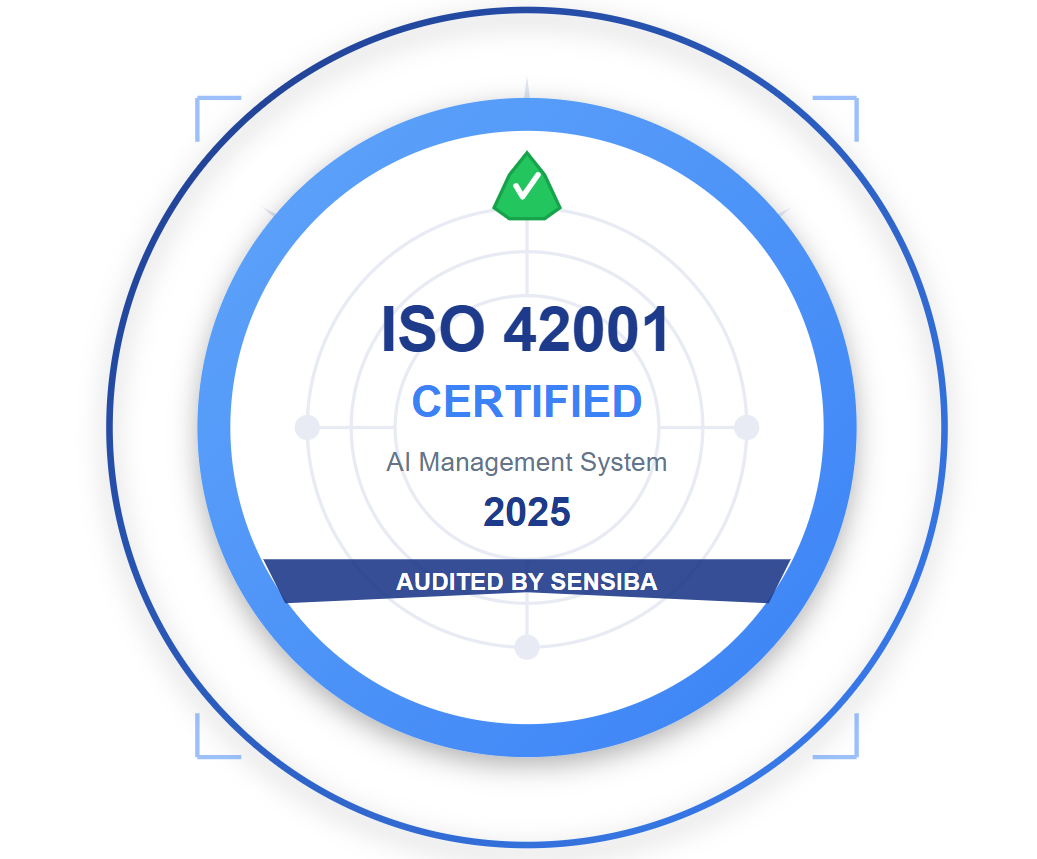
In 2025, ShareVault successfully completed both the Stage 1 and Stage 2 audits conducted by SenSiba, an accredited certification body. The Stage 1 audit validated ShareVault’s comprehensive documentation, policies, and procedures. The Stage 2 audit, completed in December 2025, examined actual implementation—verifying that controls operate effectively in practice, risks are actively managed, and continuous improvement processes function as designed.
ShareVault is now ISO 42001 certified—one of the first virtual data room providers to achieve this distinction. This certification reflects genuine leadership in responsible AI deployment, independently verified by external auditors with no stake in the outcome.
For financial services professionals, this means ShareVault’s AI governance approach has been rigorously assessed and certified against international standards, providing assurance that extends far beyond vendor claims.
What This Means for Your Deals
When you’re managing a $500 million acquisition or handling sensitive financial restructuring documents, you need more than promises about AI safety. ShareVault’s ISO 42001 certification provides tangible, verified assurance:
For M&A Advisors: Confidence that AI-powered document analytics won’t introduce errors or biases that could impact deal analysis or due diligence findings.
For Investment Bankers: Assurance that confidential client information processed by AI features remains protected and isn’t repurposed for model training or shared across clients.
For Legal Professionals: Auditability and explainability of AI-assisted document review and classification—critical when facing regulatory scrutiny or litigation.
For Private Equity Firms: Verification that AI capabilities in your deal rooms meet institutional-grade governance standards your LPs and regulators expect.
Why Industry Leadership Matters
The financial services industry faces increasing regulatory pressure regarding AI usage. The EU AI Act, SEC guidance on AI in financial services, and evolving state-level AI regulations all point toward a future where AI governance isn’t optional—it’s required.
ShareVault’s achievement of ISO 42001 certification demonstrates foresight that benefits clients in two critical ways:
Today: You gain immediate, certified assurance that AI capabilities in your data room meet rigorous governance standards, reducing your own AI-related risk exposure.
Tomorrow: As regulations tighten, you’re already working with a provider whose AI governance framework is certified against international standards, simplifying your own compliance efforts and protecting your competitive position.
The Bottom Line
For financial services and M&A professionals who demand the highest standards of security and compliance, ShareVault’s ISO 42001 certification represents more than a technical achievement—it’s independently verified proof of commitment to earning and maintaining your trust.
The rigorous process of implementation, independent internal auditing by DISC InfoSec, and successful completion of both Stage 1 and Stage 2 assessments by SenSiba demonstrates that ShareVault’s AI capabilities are deployed with certified safeguards, transparency, and accountability.
As deals become more complex and AI capabilities more sophisticated, partnering with a certified virtual data room provider that has proven its AI governance leadership isn’t just prudent—it’s essential to protecting your clients, your reputation, and your firm.
ShareVault’s investment in ISO 42001 certification means you can leverage powerful AI capabilities in your deal rooms with confidence that responsible management practices are independently certified and continuously maintained.
Ready to experience a virtual data room where AI innovation meets certified governance? Contact ShareVault to learn how ISO 42001-certified AI management protects your most sensitive transactions.
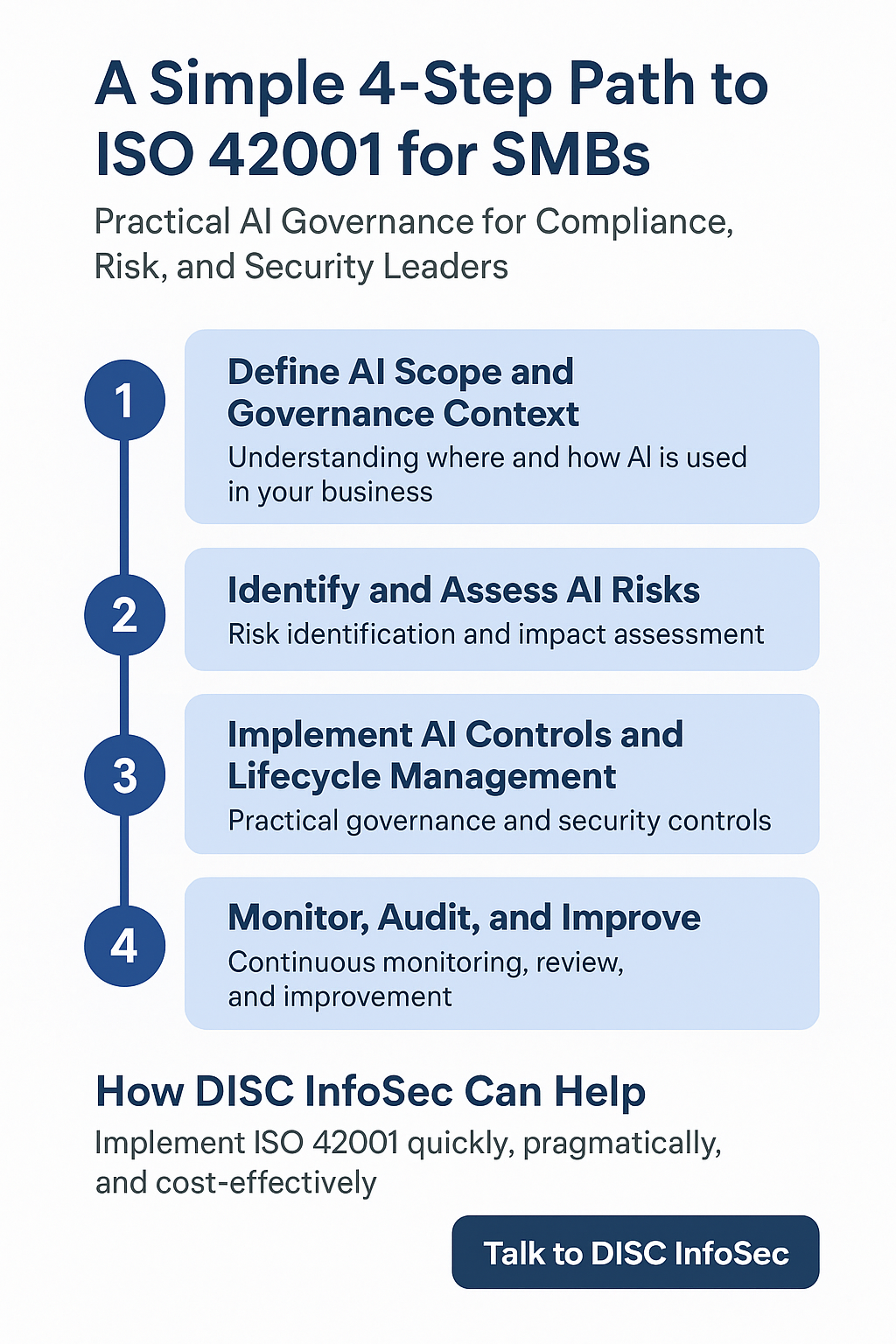
Practical AI Governance for Compliance, Risk, and Security Leaders
Artificial Intelligence is moving fast—but regulations, customer expectations, and board-level scrutiny are moving even faster. ISO/IEC 42001 gives organizations a structured way to govern AI responsibly, securely, and in alignment with laws like the EU AI Act.
For SMBs, the good news is this: ISO 42001 does not require massive AI programs or complex engineering changes. At its core, it follows a clear four-step process that compliance, risk, and security teams already understand.
Step 1: Define AI Scope and Governance Context
The first step is understanding where and how AI is used in your business. This includes internally developed models, third-party AI tools, SaaS platforms with embedded AI, and even automation driven by machine learning.
For SMBs, this step is about clarity—not perfection. You define:
What AI systems are in scope
Business objectives and constraints
Regulatory, contractual, and ethical expectations
Roles and accountability for AI decisions
This mirrors how ISO 27001 defines ISMS scope, making it familiar for security and compliance teams.
Step 2: Identify and Assess AI Risks
Once AI usage is defined, the focus shifts to risk identification and impact assessment. Unlike traditional cyber risk, AI introduces new concerns such as bias, model drift, lack of explainability, data misuse, and unintended outcomes.
This step aligns closely with enterprise risk management and can be integrated into existing risk registers.
Step 3: Implement AI Controls and Lifecycle Management
With risks prioritized, the organization selects practical governance and security controls. ISO 42001 does not prescribe one-size-fits-all solutions—it focuses on proportional controls based on risk.
Typical activities include:
AI policies and acceptable use guidelines
Human oversight and approval checkpoints
Data governance and model documentation
Secure development and vendor due diligence
Change management for AI updates
For SMBs, this is about leveraging existing ISO 27001, SOC 2, or NIST-aligned controls and extending them to cover AI.
Step 4: Monitor, Audit, and Improve
AI governance is not a one-time exercise. The final step ensures continuous monitoring, review, and improvement as AI systems evolve.
This includes:
Ongoing performance and risk monitoring
Internal audits and management reviews
Incident handling and corrective actions
Readiness for certification or regulatory review
This step closes the loop and ensures AI governance stays aligned with business growth and regulatory change.
Why This Matters for SMBs
Regulators and customers are no longer asking if you use AI—they’re asking how you govern it. ISO 42001 provides a defensible, auditable framework that shows due diligence without slowing innovation.
How DISC InfoSec Can Help
DISC InfoSec helps SMBs implement ISO 42001 quickly, pragmatically, and cost-effectively—especially if you’re already aligned with ISO 27001, SOC 2, or NIST. We translate AI risk into business language, reuse what you already have, and guide you from scoping to certification readiness.
👉 Talk to DISC InfoSec to build AI governance that satisfies regulators, reassures customers, and supports safe AI adoption—without unnecessary complexity.
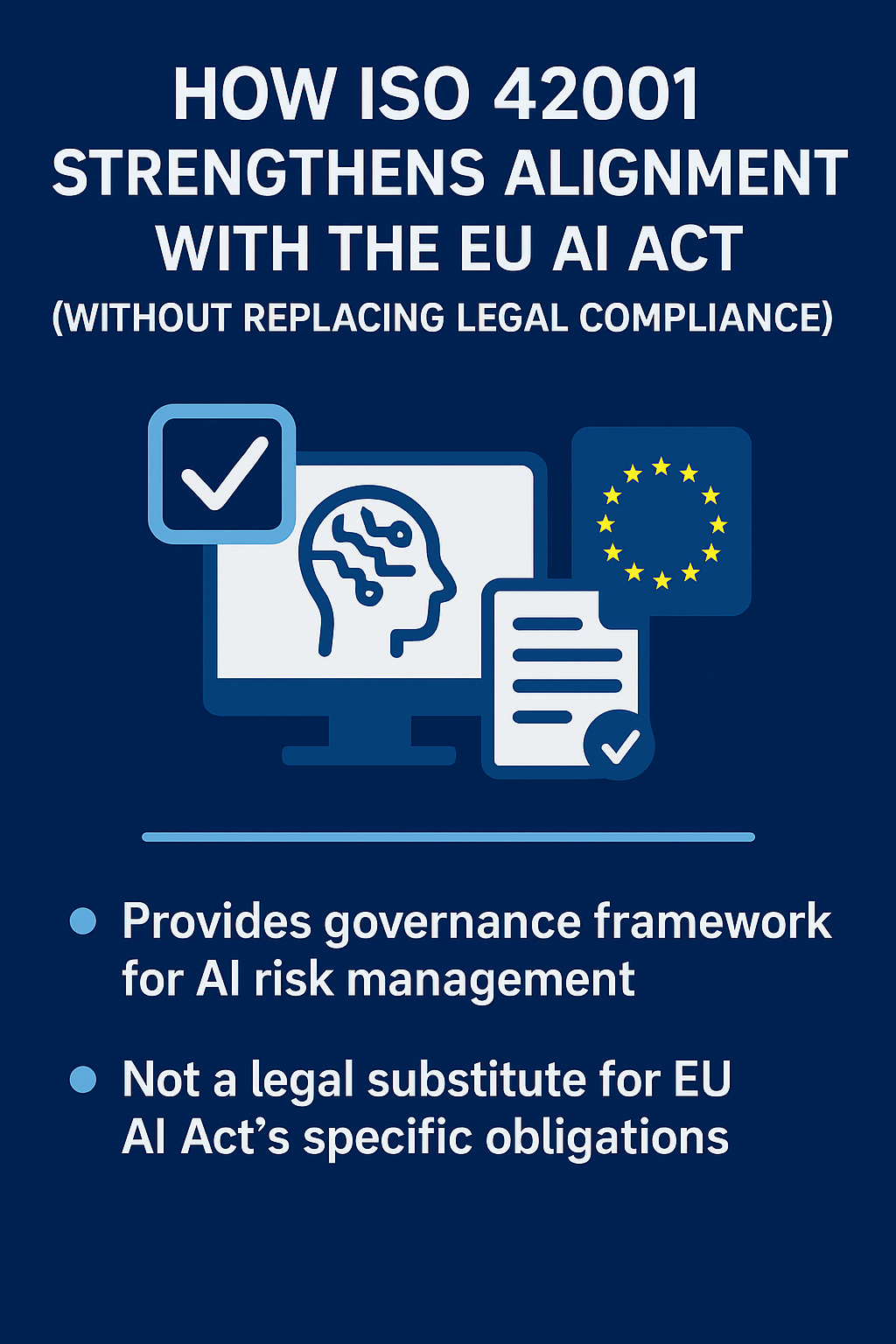
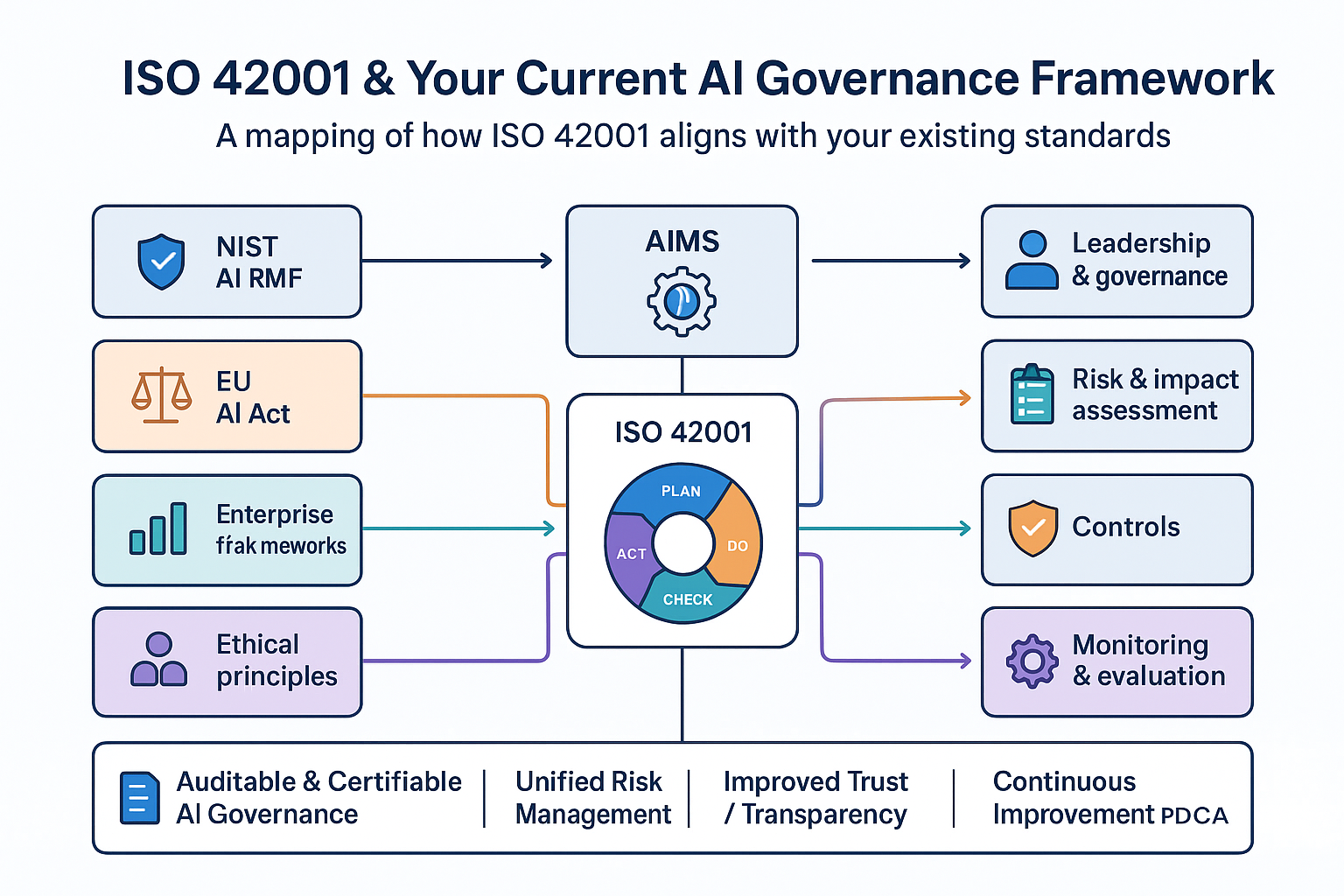
— What ISO 42001 Is and Its Purpose ISO 42001 is a new international standard for AI governance and management systems designed to help organizations systematically manage AI-related risks and regulatory requirements. Rather than acting as a simple checklist, it sets up an ongoing framework for defining obligations, understanding how AI systems are used, and establishing controls that fit an organization’s specific risk profile. This structure resembles other ISO management system standards (such as ISO 27001) but focuses on AI’s unique challenges.
— ISO 42001’s Role in Structured Governance At its core, ISO 42001 helps organizations build consistent AI governance practices. It encourages comprehensive documentation, clear roles and responsibilities, and formalized oversight—essentials for accountable AI development and deployment. This structured approach aligns with the EU AI Act’s broader principles, which emphasize accountability, transparency, and risk-based management of AI systems.
— Documentation and Risk Management Synergies Both ISO 42001 and the EU AI Act call for thorough risk assessments, lifecycle documentation, and ongoing monitoring of AI systems. Implementing ISO 42001 can make it easier to maintain records of design choices, testing results, performance evaluations, and risk controls, which supports regulatory reviews and audits. This not only creates a stronger compliance posture but also prepares organizations to respond with evidence if regulators request proof of due diligence.
— Complementary Ethical and Operational Practices ISO 42001 embeds ethical principles—such as fairness, non-discrimination, and human oversight—into the organizational governance culture. These values closely match the normative goals of the EU AI Act, which seeks to prevent harm and bias from AI systems. By internalizing these principles at the management level, organizations can more coherently translate ethical obligations into operational policies and practices that regulators expect.
— Not a Legal Substitute for Compliance Obligations Importantly, ISO 42001 is not a legal guarantee of EU AI Act compliance on its own. The standard remains voluntary and, as of now, is not formally harmonized under the AI Act, meaning certification does not automatically confer “presumption of conformity.” The Act includes highly specific requirements—such as risk class registration, mandated reporting timelines, and prohibitions on certain AI uses—that ISO 42001’s management-system focus does not directly satisfy. ISO 42001 provides the infrastructure for strong governance, but organizations must still execute legal compliance activities in parallel to meet the letter of the law.
— Practical Benefits Beyond Compliance Even though it isn’t a standalone compliance passport, adopting ISO 42001 offers many practical benefits. It can streamline internal AI governance, improve audit readiness, support integration with other ISO standards (like security and quality), and enhance stakeholder confidence in AI practices. Organizations that embed ISO 42001 can reduce risk of missteps, build stronger evidence trails, and align cross-functional teams for both ethical practice and regulatory readiness.
My Opinion ISO 42001 is a valuable foundation for AI governance and a strong enabler of EU AI Act compliance—but it should be treated as the starting point, not the finish line. It helps organizations build structured processes, risk awareness, and ethical controls that align with regulatory expectations. However, because the EU AI Act’s requirements are detailed and legally enforceable, organizations must still map ISO-level controls to specific Act obligations, maintain live evidence, and fulfill procedural legal demands beyond what ISO 42001 specifies. In practice, using ISO 42001 as a governance backbone plus tailored compliance activities is the most pragmatic and defensible approach.
1. Regulatory Compliance Has Become a Minefield—With Real Penalties
Regulatory Compliance Has Become a Minefield—With Real Penalties
Organizations face an avalanche of overlapping AI regulations (EU AI Act, GDPR, HIPAA, SOX, state AI laws) with zero tolerance for non-compliance. The EU AI Act explicitly recognizes ISO 42001 as evidence of conformity—making certification the fastest path to regulatory defensibility. Without systematic AI governance, companies face six-figure fines, contract terminations, and regulatory scrutiny.
2. Vendor Questionnaires Are Killing Deals
Every enterprise RFP now includes AI governance questions. Procurement teams demand documented proof of bias mitigation, human oversight, and risk management frameworks. Companies without ISO 42001 or equivalent certification are being disqualified before technical evaluations even begin. Lost deals aren’t hypothetical—they’re happening every quarter.
3. Boards Demand AI Accountability—Security Teams Can’t Deliver Alone
C-suite executives face personal liability for AI failures. They’re demanding comprehensive AI risk management across 7 critical impact categories (safety, fundamental rights, legal compliance, reputational risk). But CISOs and compliance officers lack AI-specific expertise to build these frameworks from scratch. Generic security controls don’t address model drift, training data contamination, or algorithmic bias.
4. The “DIY Governance” Death Spiral
Organizations attempting in-house ISO 42001 implementation waste 12-18 months navigating 18 specific AI controls, conducting risk assessments across 42+ scenarios, establishing monitoring systems, and preparing for third-party audits. Most fail their first audit and restart at 70% budget overrun. They’re paying the certification cost twice—plus the opportunity cost of delayed revenue.
5. “Certification Theater” vs. Real Implementation—And They Can’t Tell the Difference
Companies can’t distinguish between consultants who’ve read the standard vs. those who’ve actually implemented and passed audits in production environments. They’re terrified of paying for theoretical frameworks that collapse under audit scrutiny. They need proven methodologies with documented success—not PowerPoint governance.
6. High-Risk Industry Requirements Are Non-Negotiable
Financial services (credit scoring, AML), healthcare (clinical decision support), and legal firms (judicial AI) face sector-specific AI regulations that generic consultants can’t address. They need consultants who understand granular compliance scenarios—not surface-level AI ethics training.
DISC Turning AI Governance Into Measurable Business Value
garak (Generative AI Red-teaming & Assessment Kit) is an open-source tool aimed specifically at testing Large Language Models and dialog systems for AI-specific vulnerabilities: prompt injection, jailbreaks, data leakage, hallucinations, toxicity, etc.
It supports many LLM sources: Hugging Face models, OpenAI APIs, AWS Bedrock, local ggml models, etc.
Typical usage is via command line, making it relatively easy to incorporate into a Linux/pen-test workflow.
For someone interested in “governance,” garak helps identify when an AI system violates safety, privacy or compliance expectations before deployment.
BlackIce — Containerized Toolkit for AI Red-Teaming & Security Testing
BlackIce is described as a standardized, containerized red-teaming toolkit for both LLMs and classical ML models. The idea is to lower the barrier to entry for AI security testing by packaging many tools into a reproducible Docker image.
It bundles a curated set of open-source tools (as of late 2025) for “Responsible AI and Security testing,” accessible via a unified CLI interface — akin to how Kali bundles network-security tools.
For governance purposes: BlackIce simplifies running comprehensive AI audits, red-teaming, and vulnerability assessments in a consistent, repeatable environment — useful for teams wanting to standardize AI governance practices.
LibVulnWatch — Supply-Chain & Library Risk Assessment for AI Projects
While not specific to LLM runtime security, LibVulnWatch focuses on evaluating open-source AI libraries (ML frameworks, inference engines, agent-orchestration tools) for security, licensing, supply-chain, maintenance and compliance risks.
It produces governance-aligned scores across multiple domains, helping organizations choose safer dependencies and keep track of underlying library health over time.
For an enterprise building or deploying AI: this kind of tool helps verify that your AI stack — not just the model — meets governance, audit, and risk standards.
Giskard offers LLM vulnerability scanning and red-teaming capabilities (prompt injection, data leakage, unsafe behavior, bias, etc.) via both an open-source library and an enterprise “Hub” for production-grade systems.
It supports “black-box” testing: you don’t need internal access to the model — as long as you have an API or interface, you can run tests.
For AI governance, Giskard helps in evaluating compliance with safety, privacy, and fairness standards before and after deployment.
🔧 What This Means for Kali Linux / Pen-Test-Oriented Workflows
The emergence of tools like garak, BlackIce, and Giskard shows that AI governance and security testing are becoming just as “testable” as traditional network or system security. For people familiar with Kali’s penetration-testing ecosystem — this is a familiar, powerful shift.
Because they are Linux/CLI-friendly and containerizable (especially BlackIce), they can integrate neatly into security-audit pipelines, continuous-integration workflows, or red-team labs — making them practical beyond research or toy use.
Using a supply-chain-risk tool like LibVulnWatch alongside model-level scanners gives a more holistic governance posture: not just “Is this LLM safe?” but “Is the whole AI stack (dependencies, libraries, models) reliable and auditable?”
⚠️ A Few Important Caveats (What They Don’t Guarantee)
Tools like garak and Giskard attempt to find common issues (jailbreaks, prompt injection, data leakage, harmful outputs), but cannot guarantee absolute safety or compliance — because many risks (e.g. bias, regulatory compliance, ethics, “unknown unknowns”) depend heavily on context (data, environment, usage).
Governance is more than security: It includes legal compliance, privacy, fairness, ethics, documentation, human oversight — many of which go beyond automated testing.
AI-governance frameworks are still evolving; even red-teaming tools may lag behind novel threat types (e.g. multi-modality, chain-of-tool-calls, dynamic agentic behaviors).
🎯 My Take / Recommendation (If You Want to Build an AI-Governance Stack Now)
If I were you and building or auditing an AI system today, I’d combine these tools:
Start with garak or Giskard to scan model behavior for injection, toxicity, privacy leaks, etc.
Use BlackIce (in a container) for more comprehensive red-teaming including chaining tests, multi-tool or multi-agent flows, and reproducible audits.
Run LibVulnWatch on your library dependencies to catch supply-chain or licensing risks.
Complement that with manual reviews, documentation, human-in-the-loop audits and compliance checks (since automated tools only catch a subset of governance concerns).
Kali doesn’t yet ship AI governance tools by default — but:
✅ Almost all of these run on Linux
✅ Many are CLI-based or Dockerized
✅ They integrate cleanly with red-team labs
✅ You can easily build a custom Kali “AI Governance profile”
My recommendation: Create:
A Docker compose stack for garak + Giskard + promptfoo
A CI pipeline for prompt & agent testing
A governance evidence pack (logs + scores + reports)
Map each tool to ISO 42001 / NIST AI RMF controls
below is a compact, actionable mapping that connects the ~10 tools we discussed to ISO/IEC 42001 clauses (high-level AI management system requirements) and to the NIST AI RMF Core functions (GOVERN / MAP / MEASURE / MANAGE). I cite primary sources for the standards and each tool so you can follow up quickly.
Notes on how to read the table • ISO 42001 — I map to the standard’s high-level clauses (Context (4), Leadership (5), Planning (6), Support (7), Operation (8), Performance evaluation (9), Improvement (10)). These are the right level for mapping tools into an AI Management System. Cloud Security Alliance+1 • NIST AI RMF — I use the Core functions: GOVERN / MAP / MEASURE / MANAGE (the AI RMF core and its intended outcomes). Tools often map to multiple functions. NIST Publications • Each row: tool → primary ISO clauses it supports → primary NIST functions it helps with → short justification + source links.
NIST AI RMF: MEASURE (testing, metrics, evaluation), MAP (identify system behavior & risks), MANAGE (remediation actions). NIST Publications+1
Why: Giskard automates model testing (bias, hallucination, security checks) and produces evidence/metrics used in audits and continuous evaluation. GitHub
2) promptfoo (prompt & RAG test suite / CI integration)
ISO 42001: 7 Support (documented procedures, competence), 8 Operation (validation before deployment), 9 Performance evaluation (continuous testing). Cloud Security Alliance
Why: promptfoo provides automated prompt tests, integrates into CI (pre-deployment gating) and produces test artifacts for governance traceability. GitHub+1
Why: LlamaFirewall is explicitly designed as a last-line runtime guardrail for agentic systems — enforcing policies and detecting task-drift/prompt injection at runtime. arXiv
ISO 42001: 8 Operation (adversarial testing), 9 Performance evaluation (benchmarks & stress tests), 10 Improvement (feed results back to controls). Cloud Security Alliance
NIST AI RMF: MEASURE (adversarial performance metrics), MAP (expose attack surface), MANAGE (prioritize fixes based on attack impact). NIST Publications+2arXiv+2
Why: These tools expand coverage of red-team tests (free-form and evolutionary adversarial prompts), surfacing edge failures and jailbreaks that standard tests miss. arXiv+1
7) Meta SecAlign (safer model / model-level defenses)
ISO 42001: 8 Operation (safe model selection/deployment), 6 Planning (risk-aware model selection), 7 Support (model documentation). Cloud Security Alliance+1
NIST AI RMF: MAP (model risk characteristics), MANAGE (apply safer model choices / mitigations), MEASURE (evaluate defensive effectiveness). NIST Publications+1
Why: A “safer” model built to resist manipulation maps directly to operational and planning controls where the organization chooses lower-risk building blocks. arXiv
8) HarmBench (benchmarks for safety & robustness testing)
ISO 42001: 9 Performance evaluation (standardized benchmarks), 8 Operation (validation against benchmarks), 10 Improvement (continuous improvement from results). Cloud Security Alliance
NIST AI RMF: MEASURE (standardized metrics & benchmarks), MAP (compare risk exposure across models), MANAGE (feed measurement results into mitigation plans). NIST Publications
Why: Benchmarks are the canonical way to measure and compare model trustworthiness and to demonstrate compliance in audits. arXiv
ISO 42001: 5 Leadership & 7 Support (policy, competence, awareness — guidance & training resources). Cloud Security Alliance
NIST AI RMF: GOVERN (policy & stakeholder guidance), MAP (inventory of recommended tools & practices). NIST Publications
Why: Curated resources help leadership define policy, identify tools, and set organizational expectations — foundational for any AI management system. Cyberzoni.com
Quick recommendations for operationalizing the mapping
Create a minimal mapping table inside your ISMS (ISO 42001) that records: tool name → ISO clause(s) it supports → NIST function(s) it maps to → artifact(s) produced (reports, SBOMs, test results). This yields audit-ready evidence. (ISO42001 + NIST suggestions above).
Automate evidence collection: integrate promptfoo / Giskard into CI so that each deployment produces test artifacts (for ISO 42001 clause 9).
Supply-chain checks: run LibVulnWatch and AI-Infra-Guard periodically to populate SBOMs and vulnerability dashboards (helpful for ISO 7 & 6).
Runtime protections: embed LlamaFirewall or runtime monitors for agentic systems to satisfy operational guardrail requirements.
Adversarial coverage: schedule periodic automated red-teaming using AutoRed / RainbowPlus / HarmBench to measure resilience and feed results into continual improvement (ISO clause 10).
At DISC InfoSec, our AI Governance services go beyond traditional security. We help organizations ensure legal compliance, privacy, fairness, ethics, proper documentation, and human oversight — addressing the full spectrum of responsible AI practices, many of which cannot be achieved through automated testing alone.
ISO 42001 (published December 2023) is the first international standard dedicated to how organizations should govern and manage AI systems — whether they build AI, use it, or deploy it in services.
It lays out what the authors call an Artificial Intelligence Management System (AIMS) — a structured governance and management framework that helps companies reduce AI-related risks, build trust, and ensure responsible AI use.
Who can use it — and is it mandatory
Any organization — profit or non-profit, large or small, in any industry — that develops or uses AI can implement ISO 42001.
For now, ISO 42001 is not legally required. No country currently mandates it.
But adopting it proactively can make future compliance with emerging AI laws and regulations easier.
What ISO 42001 requires / how it works
The standard uses a “high-level structure” similar to other well-known frameworks (like ISO 27001), covering organizational context, leadership, planning, support, operations, performance evaluation, and continual improvement.
Organizations need to: define their AI-policy and scope; identify stakeholders and expectations; perform risk and impact assessments (on company level, user level, and societal level); implement controls to mitigate risks; maintain documentation and records; monitor, audit, and review the AI system regularly; and continuously improve.
As part of these requirements, there are 38 example controls (in the standard’s Annex A) that organizations can use to reduce various AI-related risks.
Why it matters
Because AI is powerful but also risky (wrong outputs, bias, privacy leaks, system failures, etc.), having a formal governance framework helps companies be more responsible and transparent when deploying AI.
For organizations that want to build trust with customers, regulators, or partners — or anticipate future AI-related regulations — ISO 42001 can serve as a credible, standardized foundation for AI governance.
My opinion
I think ISO 42001 is a valuable and timely step toward bringing some order and accountability into the rapidly evolving world of AI. Because AI is so flexible and can be used in many different contexts — some of them high-stakes — having a standard framework helps organizations think proactively about risk, ethics, transparency, and responsibility rather than scrambling reactively.
That said — because it’s new and not yet mandatory — its real-world impact depends heavily on how widely it’s adopted. For it to become meaningful beyond “nice to have,” regulators, governments, or large enterprises should encourage or require it (or similar frameworks). Until then, it will likely be adopted mostly by forward-thinking companies or those dealing with high-impact AI systems.
🔎 My view: ISO 42001 is a meaningful first step — but (for now) best seen as a foundation, not a silver bullet
I believe ISO 42001 represents a valuable starting point for bringing structure, accountability, and risk awareness to AI development and deployment. Its emphasis on governance, impact assessment, documentation, and continuous oversight is much needed in a world where AI adoption often runs faster than regulation or best practices.
That said — given its newness, generality, and the typical resource demands — I see it as necessary but not sufficient. It should be viewed as the base layer: useful for building internal discipline, preparing for regulatory demands, and signaling commitment. But to address real-world ethical, social, and technical challenges, organizations likely need additional safeguards — e.g. context-specific controls, ongoing audits, stakeholder engagement, domain-specific reviews, and perhaps even bespoke governance frameworks tailored to the type of AI system and its use cases.
In short: ISO 42001 is a strong first step — but real responsible AI requires going beyond standards to culture, context, and continuous vigilance.
✅ Real-world adopters of ISO 42001
IBM (Granite models)
IBM became “the first major open-source AI model developer to earn ISO 42001 certification,” for its “Granite” family of open-source language models.
The certification covers the management system for development, deployment, and maintenance of Granite — meaning IBM formalized policies, governance, data practices, documentation, and risk controls under AIMS (AI Management System).
According to IBM, the certification provides external assurance of transparency, security, and governance — helping enterprises confidently adopt Granite in sensitive contexts (e.g. regulated industries).
Infosys
Infosys — a global IT services and consulting company — announced in May 2024 that it had received ISO 42001:2023 certification for its AI Management System.
Their certified “AIMS framework” is part of a broader set of offerings (the “Topaz Responsible AI Suite”), which supports clients in building and deploying AI responsibly, with structured risk mitigations and accountability.
This demonstrates that even big consulting companies, not just pure-AI labs, see value in adopting ISO 42001 to manage AI at scale within enterprise services.
JAGGAER (Source-to-Pay / procurement software)
JAGGAER — a global player in procurement / “source-to-pay” software — announced that it achieved ISO 42001 certification for its AI Management System in June 2025.
For JAGGAER, the certification reflects a commitment to ethical, transparent, secure deployment of AI within its procurement platform.
This shows how ISO 42001 can be used not only by AI labs or consultancy firms, but by business-software companies integrating AI into domain-specific applications.
🧠 My take — promising first signals, but still early days
These early adopters make a strong case that ISO 42001 can work in practice across very different kinds of organizations — not just AI-native labs, but enterprises, service providers, even consulting firms. The variety and speed of adoption (multiple firms in 2024–2025) demonstrate real momentum.
At the same time — adoption appears selective, and for many companies, the process may involve minimal compliance effort rather than deep, ongoing governance. Because the standard and the ecosystem (auditors, best-practice references, peer case studies) are both still nascent, there’s a real risk that ISO 42001 becomes more of a “badge” than a strong guardrail.
In short: I see current adoptions as proof-of-concepts — promising early examples showing how ISO 42001 could become an industry baseline. But for it to truly deliver on safe, ethical, responsible AI at scale, we’ll need: more widespread adoption across sectors; shared transparency about governance practices; public reporting on outcomes; and maybe supplementary audits or domain-specific guidelines (especially for high-risk AI uses).
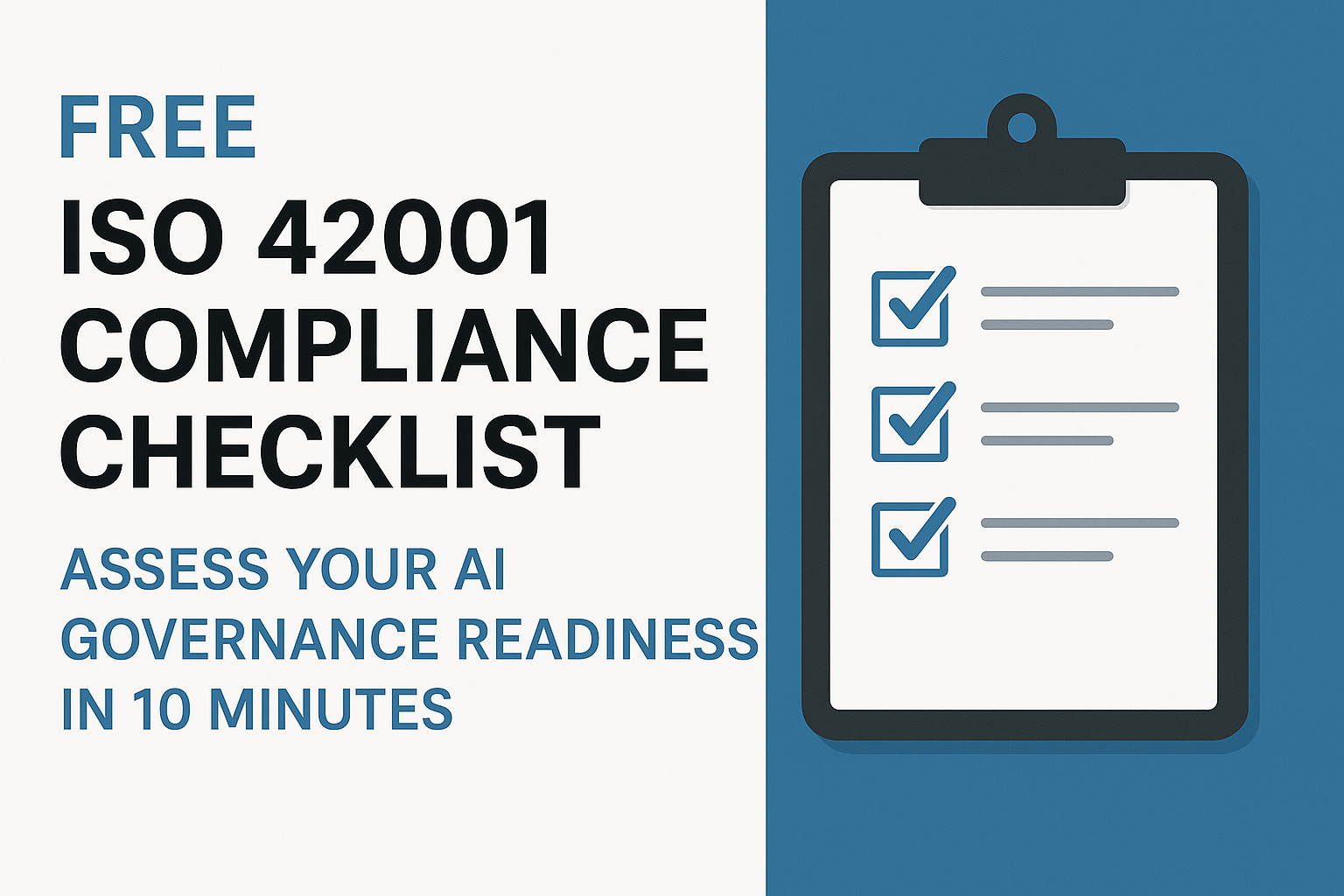
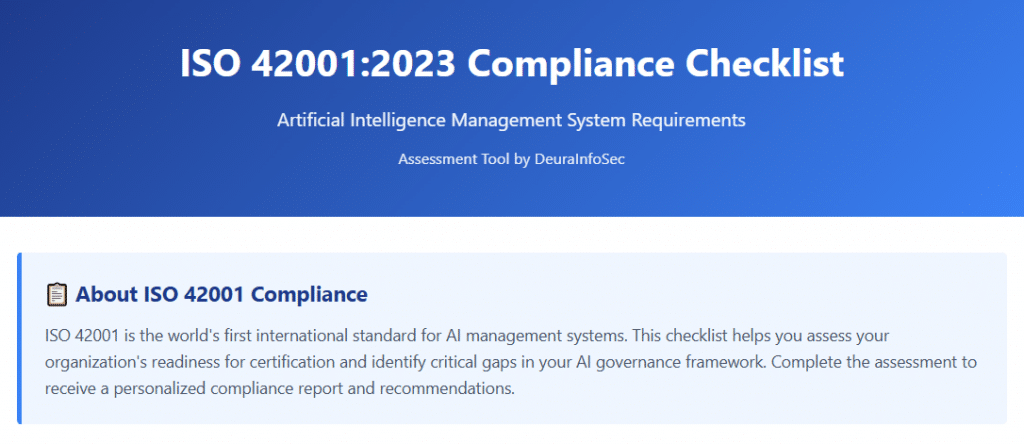
Most organizations think they’re ready for AI governance — until ISO/IEC 42001 shines a light on the gaps. With 47 new AI-specific controls, this standard is quickly becoming the global expectation for responsible and compliant AI deployment. To help teams get ahead, we built a free ISO 42001 Compliance Checklist that gives you a readiness score in under 10 minutes, plus a downloadable gap report you can share internally. It’s a fast way to validate where you stand today and what you’ll need to align with upcoming regulatory and customer requirements. If improving AI trust, risk posture, and audit readiness is on your roadmap, this tool will save your team hours.
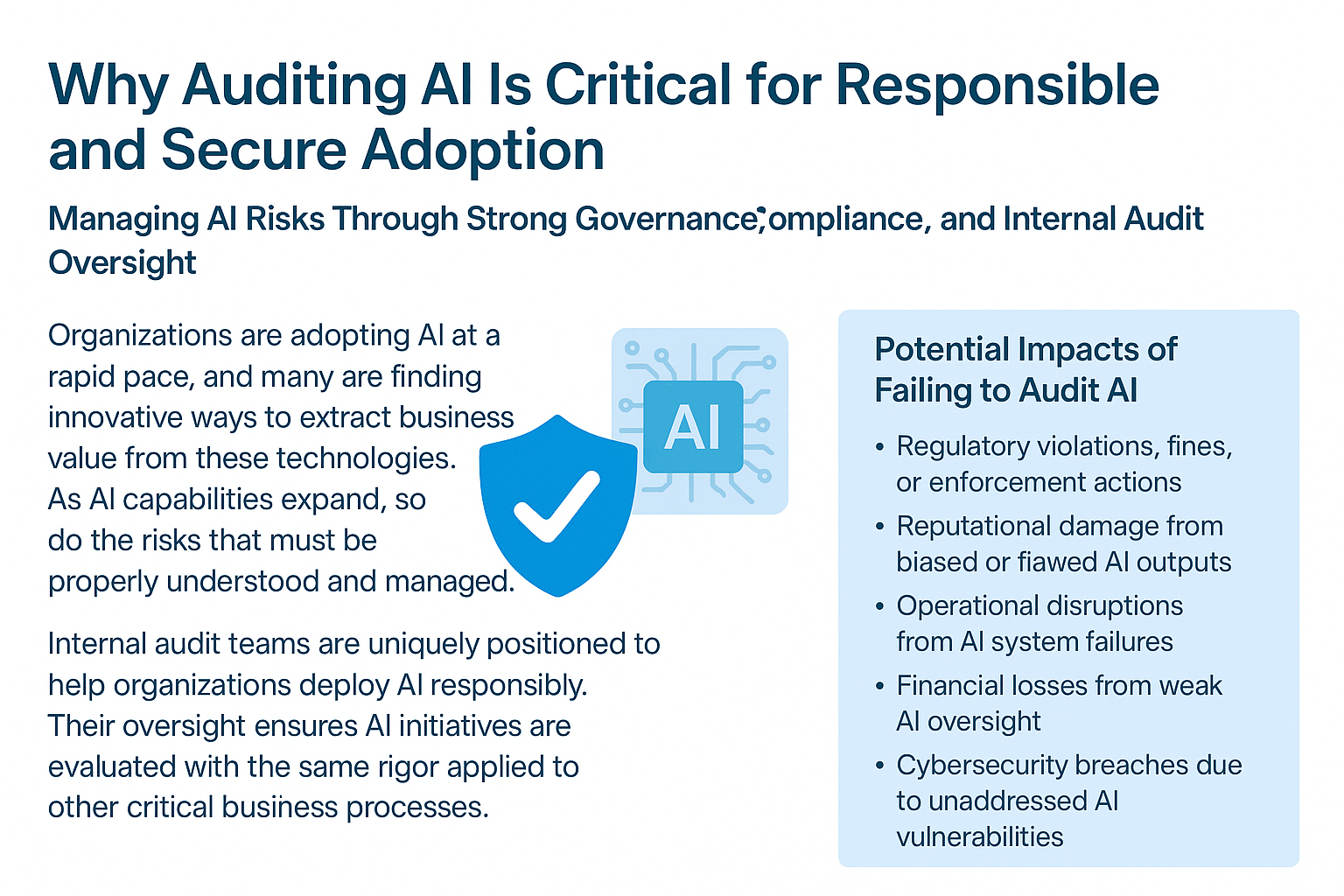
Managing AI Risks Through Strong Governance, Compliance, and Internal Audit Oversight
Organizations are adopting AI at a rapid pace, and many are finding innovative ways to extract business value from these technologies. As AI capabilities expand, so do the risks that must be properly understood and managed.
Internal audit teams are uniquely positioned to help organizations deploy AI responsibly. Their oversight ensures AI initiatives are evaluated with the same rigor applied to other critical business processes.
By participating in AI governance committees, internal audit can help set standards, align stakeholders, and bring clarity to how AI is adopted across the enterprise.
A key responsibility is identifying the specific risks associated with AI systems—whether ethical, technical, regulatory, or operational—and determining whether proper controls are in place to address them.
Internal audit also plays a role in interpreting and monitoring evolving regulations. As governments introduce new AI-specific rules, companies must demonstrate compliance, and auditors help ensure they are prepared.
Several indicators signal growing AI risk within an organization. One major warning sign is the absence of a formal AI risk management framework or any consistent evaluation of AI initiatives through a risk lens.
Another risk indicator arises when new regulations create uncertainty about whether the company’s AI practices are compliant—raising concerns about gaps in oversight or readiness.
Organizations without a clear AI strategy, or those operating multiple isolated AI projects, may fail to realize the intended benefits. Fragmentation often leads to inefficiencies and unmanaged risks.
If AI initiatives continue without centralized governance, the organization may lose visibility into how AI is used, making it difficult to maintain accountability, consistency, and compliance.
Potential Impacts of Failing to Audit AI (Summary)
The organization may face regulatory violations, fines, or enforcement actions.
Biased or flawed AI outputs could damage the company’s reputation.
Operational disruptions may occur if AI systems fail or behave unpredictably.
Weak AI oversight can result in financial losses.
Unaddressed vulnerabilities in AI systems could lead to cybersecurity incidents.
My Opinion
Auditing AI is no longer optional—it is becoming a foundational part of digital governance. Without structured oversight, AI can expose organizations to reputational damage, operational failures, regulatory penalties, and security weaknesses. A strong AI audit function ensures transparency, accountability, and resilience. In my view, organizations that build mature AI auditing capabilities early will not only avoid risk but also gain a competitive edge by deploying trustworthy, well-governed AI at scale.
The Road to Enterprise AGI: Why Reliability Matters More Than Intelligence
1️⃣ Why Practical Reliability Matters
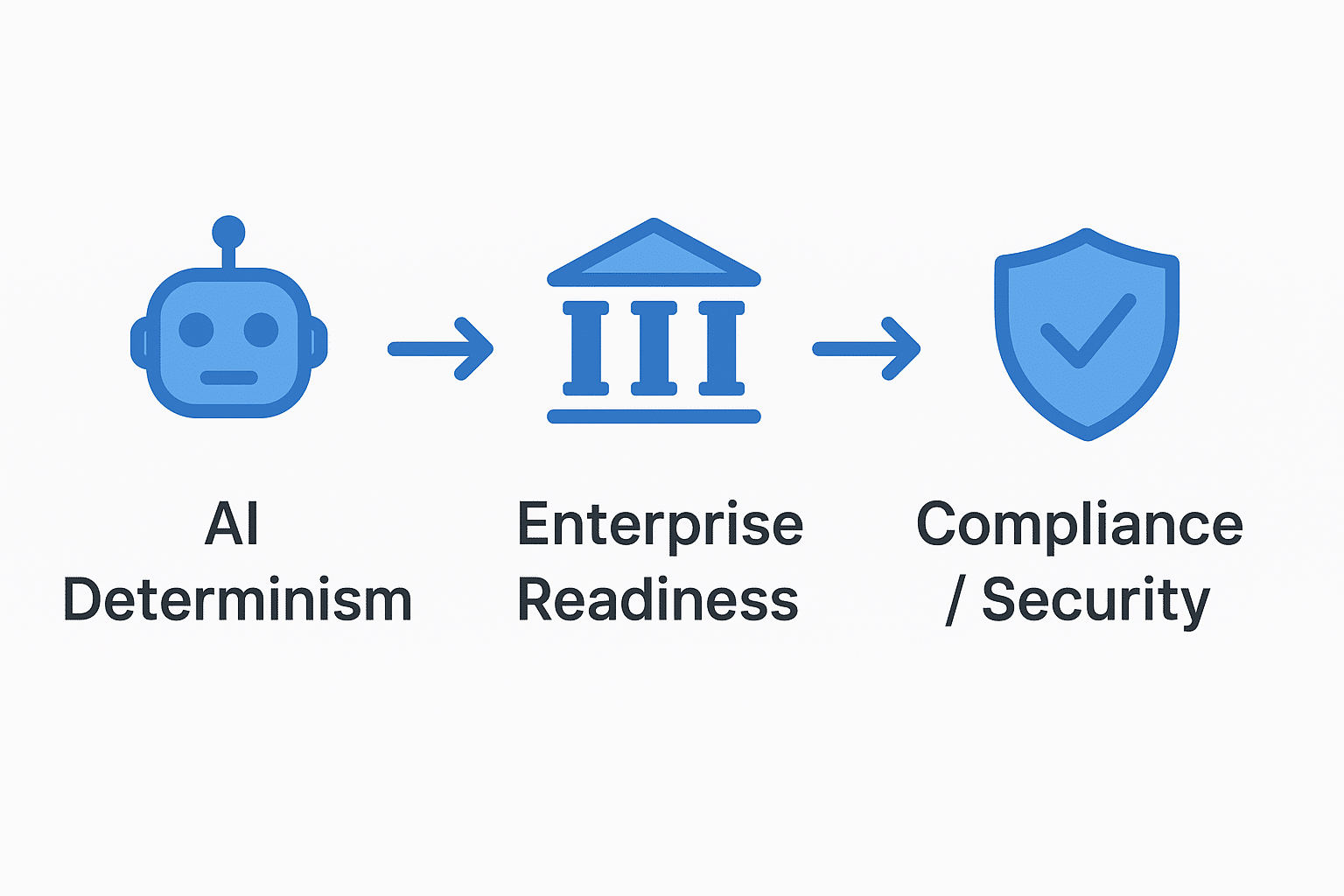
Many current AI systems — especially large language models (LLMs) and multimodal models — are non-deterministic: the same prompt can produce different outputs at different times.
For enterprises, non-determinism is a huge problem:
Compliance & auditability: Industries like finance, healthcare, and regulated manufacturing require traceable, reproducible decisions. An AI that gives inconsistent advice is essentially unusable in these contexts.
Risk management: If AI recommendations are unpredictable, companies can’t reliably integrate them into business-critical workflows.
Integration with existing systems: ERP, CRM, legal review systems, and automation pipelines need predictable outputs to function smoothly.
Murati’s research at Thinking Machines Lab directly addresses this. By working on deterministic inference pipelines, the goal is to ensure AI outputs are reproducible, reducing operational risk for enterprises. This moves generative AI from “experimental assistant” to a trusted tool. (a tool called Tinker that automates the creation of custom frontier AI models)
2️⃣ Enterprise Readiness
Security & Governance Integration: Enterprise adoption requires AI systems that comply with security policies, privacy standards, and governance rules. Murati emphasizes creating auditable, controllable AI.
Customization & Human Alignment: Businesses need AI that can be configured for specific workflows, tone, or operational rules — not generic “off-the-shelf” outputs. Thinking Machines Lab is focusing on human-aligned AI, meaning the system can be tailored while maintaining predictable behavior.
Operational Reliability: Enterprise-grade software demands high uptime, error handling, and predictable performance. Murati’s approach suggests that her AI systems are being designed with industrial-grade reliability, not just research demos.
3️⃣ The Competitive Edge
By tackling reproducibility and reliability at the inference level, her startup is positioning itself to serve companies that cannot tolerate “creative AI outputs” that are inconsistent or untraceable.
This is especially critical in sectors like:
Healthcare: AI-assisted diagnoses need predictable outputs.
Regulated Manufacturing & Energy: Decision-making and operational automation must be deterministic to meet safety standards.
Murati isn’t just building AI that “works,” she’s building AI that can be safely deployed in regulated, risk-sensitive environments. This aligns strongly with InfoSec, vCISO, and compliance priorities, because it makes AI audit-ready, predictable, and controllable — moving it from a curiosity or productivity tool to a reliable enterprise asset. In Short Building Trustworthy AGI: Determinism, Governance, and Real-World Readiness…
Murati’s Thinking Machines in Talks for $50 Billion Valuation
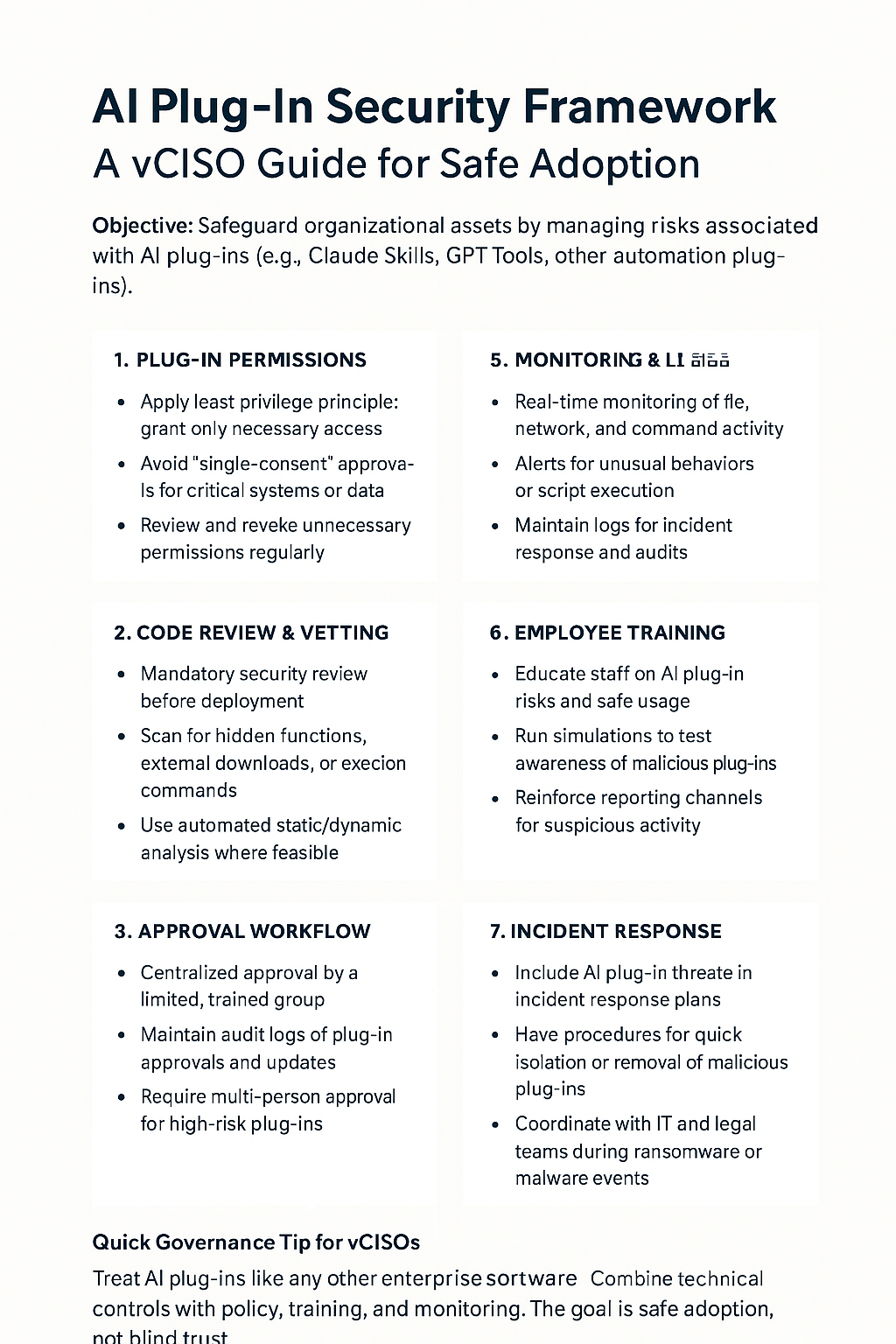
In a recent report, researchers at Cato Networks revealed that the “Skills” plug‑in feature of Claude — the AI system developed by Anthropic — can be trivially abused to deploy ransomware.
The exploit involved taking a legitimate, open‑source plug‑in (a “GIF Creator” skill) and subtly modifying it: by inserting a seemingly harmless function that downloads and executes external code, the modified plug‑in can pull in a malicious script (in this case, ransomware) without triggering warnings.
When a user installs and approves such a skill, the plug‑in gains persistent permissions: it can read/write files, download further code, and open outbound connections, all without any additional prompts. That “single‑consent” permission model creates a dangerous consent gap.
In the demonstration by Cato Networks researcher Inga Cherny, they didn’t need deep technical skill — they simply edited the plug‑in, re-uploaded it, and once a single employee approved it, ransomware (specifically MedusaLocker) was deployed. Cherny emphasized that “anyone can do it — you don’t even have to write the code.”
Microsoft and other security watchers have observed that MedusaLocker belongs to a broader, active family of ransomware that has targeted numerous organizations globally, often via exploited vulnerabilities or weaponized tools.
This event marks a disturbing evolution in AI‑related cyber‑threats: attackers are moving beyond simple prompt‑based “jailbreaks” or phishing using generative AI — now they’re hijacking AI platforms themselves as delivery mechanisms for malware, turning automation tools into attack vectors.
It’s also a wake-up call for corporate IT and security teams. As more development teams adopt AI plug‑ins and automation workflows, there’s a growing risk that something as innocuous as a “productivity tool” could conceal a backdoor — and once installed, bypass all typical detection mechanisms under the guise of “trusted” software.
Finally, while the concept of AI‑driven attacks has been discussed for some time, this proof‑of-concept exploit shifts the threat from theoretical to real. It demonstrates how easily AI systems — even those with safety guardrails — can be subverted to perform malicious operations when trust is misplaced or oversight is lacking.
🧠 My Take
This incident highlights a fundamental challenge: as we embrace AI for convenience and automation, we must not forget that the same features enabling productivity can be twisted into attack vectors. The “single‑consent” permission model underlying many AI plug‑ins seems especially risky — once that trust is granted, there’s little transparency about what happens behind the scenes.
In my view, organizations using AI–enabled tools should treat them like any other critical piece of infrastructure: enforce code review, restrict who can approve plug‑ins, and maintain strict operational oversight. For people like you working in InfoSec and compliance — especially in small/medium businesses like wineries — this is a timely reminder: AI adoption must be accompanied by updated governance and threat models, not just productivity gains.
Below is a checklist of security‑best practices (for companies and vCISOs) to guard against misuse of AI plug‑ins — could be a useful to assess your current controls.
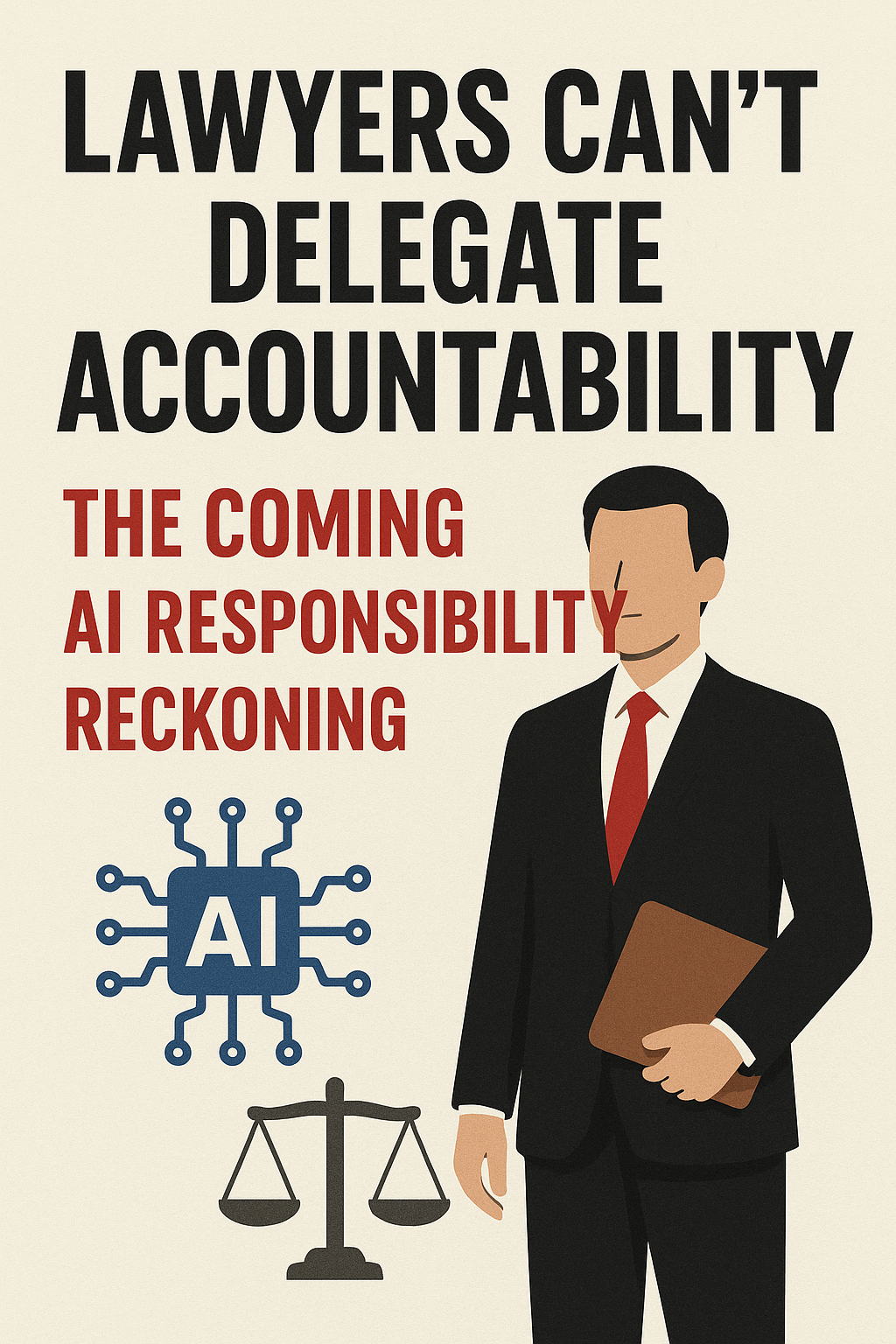
The legal profession is facing a pivotal turning point because AI tools — from document drafting and research to contract review and litigation strategy — are increasingly integrated into day-to-day legal work. The core question arises: when AI messes up, who is accountable? The author argues: the lawyer remains accountable.
Courts and bar associations around the world are enforcing this principle strongly: they are issuing sanctions when attorneys submit AI-generated work that fabricates citations, invents case law, or misrepresents “AI-generated” arguments as legitimate.
For example, in a 2023 case (Mata v. Avianca, Inc.), attorneys used an AI to generate research citing judicial opinions that didn’t exist. The court found this conduct inexcusable and imposed financial penalties on the lawyers.
In another case from 2025 (Frankie Johnson v. Jefferson S. Dunn), lawyers filed motions containing entirely fabricated legal authority created by generative AI. The court’s reaction was far more severe: the attorneys received public reprimands, and their misconduct was referred for possible disciplinary proceedings — even though their firm avoided sanctions because it had institutional controls and AI-use policies in place.
The article underlines that the shift to AI in legal work does not change the centuries-old principles of professional responsibility. Rules around competence, diligence, and confidentiality remain — but now lawyers must also acquire enough “AI literacy.” That doesn’t mean they must become ML engineers; but they should understand AI’s strengths and limits, know when to trust it, and when to independently verify its outputs.
Regarding confidentiality, when lawyers use AI tools, they must assess the risk that client-sensitive data could be exposed — for example, accidentally included in AI training sets, or otherwise misused. Using free or public AI tools for confidential matters is especially risky.
Transparency and client communication also become more important. Lawyers may need to disclose when AI is being used in the representation, what type of data is processed, and how use of AI might affect cost, work product, or confidentiality. Some forward-looking firms include AI-use policies upfront in engagement letters.
On a firm-wide level, supervisory responsibilities still apply. Senior attorneys must ensure that any AI-assisted work by junior lawyers or staff meets professional standards. That includes establishing governance: AI-use policies, training, review protocols, oversight of external AI providers.
Many larger law firms are already institutionalizing AI governance — setting up AI committees, defining layered review procedures (e.g. verifying AI-generated memos against primary sources, double-checking clauses, reviewing briefs for “hallucinations”).
The article’s central message: AI may draft documents or assist in research, but the lawyer must answer. Technology can assist, but it cannot assume human professional responsibility. The “algorithm may draft — the lawyer is accountable.”
My Opinion
I think this article raises a crucial and timely point. As AI becomes more capable and tempting as a tool for legal work, the risk of over-reliance — or misuse — is real. The documented sanctions show that courts are no longer tolerant of unverified AI-generated content. This is especially relevant given the “black-box” nature of many AI models and their propensity to hallucinate plausible but false information.
For the legal profession to responsibly adopt AI, the guidelines described — AI literacy, confidentiality assessment, transparent client communication, layered review — aren’t optional luxuries; they’re imperative. In other words: AI can increase efficiency, but only under strict governance, oversight, and human responsibility.
Given my background in information security and compliance — and interest in building services around risk, governance and compliance — this paradigm resonates. It suggests that as AI proliferates (in law, security, compliance, consulting, etc.), there will be increasing demand for frameworks, policies, and oversight mechanisms ensuring trustworthy use. Designing such frameworks might even become a valuable niche service.
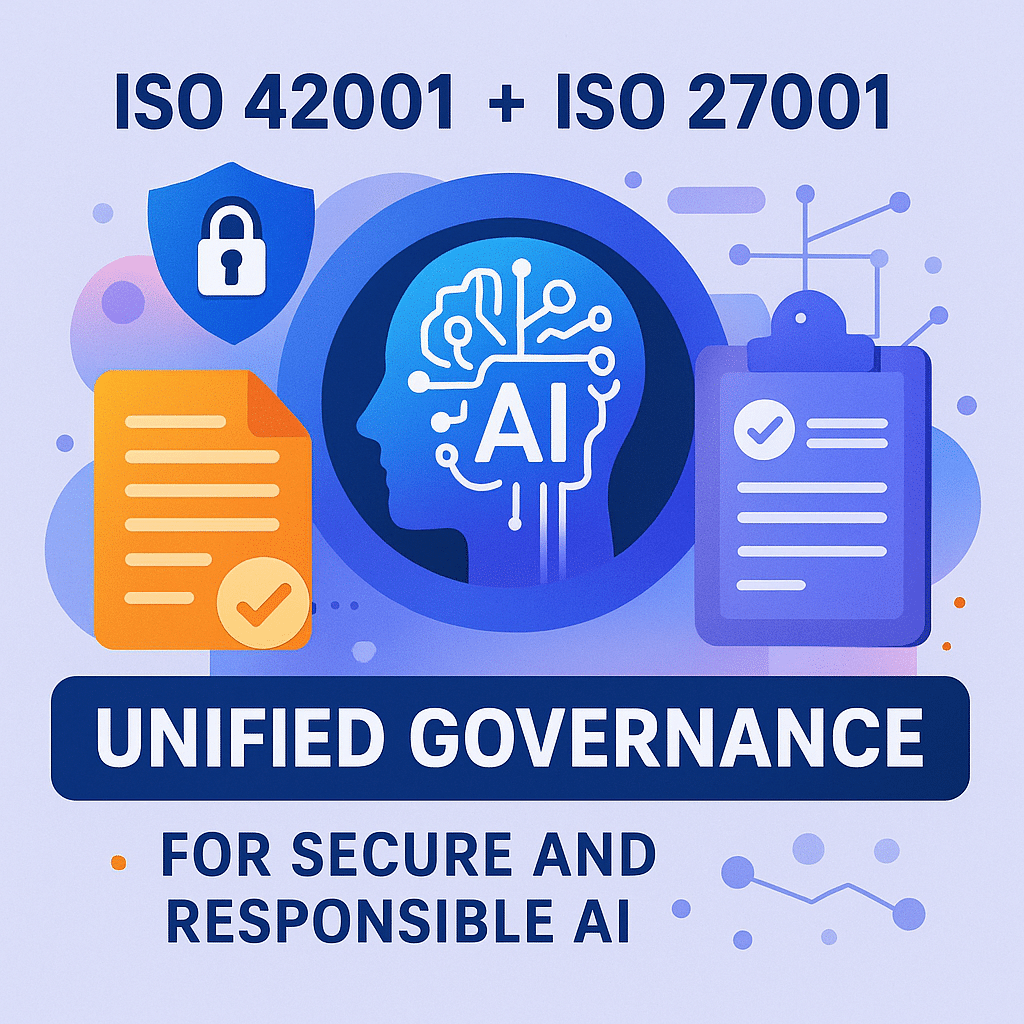
As organizations increasingly adopt AI technologies, integrating an Artificial Intelligence Management System (AIMS) into an existing Information Security Management System (ISMS) is becoming essential. This approach aligns with ISO/IEC 42001:2023 and ensures that AI risks, governance needs, and operational controls blend seamlessly with current security frameworks.
The document emphasizes that AI is no longer an isolated technology—its rapid integration into business processes demands a unified framework. Adding AIMS on top of ISMS avoids siloed governance and ensures structured oversight over AI-driven tools, models, and decision workflows.
Integration also allows organizations to build upon the controls, policies, and structures they already have under ISO 27001. Instead of starting from scratch, they can extend their risk management, asset inventories, and governance processes to include AI systems. This reduces duplication and minimizes operational disruption.
To begin integration, organizations should first define the scope of AIMS within the ISMS. This includes identifying all AI components—LLMs, ML models, analytics engines—and understanding which teams use or develop them. Mapping interactions between AI systems and existing assets ensures clarity and complete coverage.
Risk assessments should be expanded to include AI-specific threats such as bias, adversarial attacks, model poisoning, data leakage, and unauthorized “Shadow AI.” Existing ISO 27005 or NIST RMF processes can simply be extended with AI-focused threat vectors, ensuring a smooth transition into AIMS-aligned assessments.
Policies and procedures must be updated to reflect AI governance requirements. Examples include adding AI-related rules to acceptable use policies, tagging training datasets in data classification, evaluating AI vendors under third-party risk management, and incorporating model versioning into change controls. Creating an overarching AI Governance Policy helps tie everything together.
Governance structures should evolve to include AI-specific roles such as AI Product Owners, Model Risk Managers, and Ethics Reviewers. Adding data scientists, engineers, legal, and compliance professionals to ISMS committees creates a multidisciplinary approach and ensures AI oversight is not handled in isolation.
AI models must be treated as formal assets in the organization. This means documenting ownership, purpose, limitations, training datasets, version history, and lifecycle management. Managing these through existing ISMS change-management processes ensures consistent governance over model updates, retraining, and decommissioning.
Internal audits must include AI controls. This involves reviewing model approval workflows, bias-testing documentation, dataset protection, and the identification of Shadow AI usage. AI-focused audits should be added to the existing ISMS schedule to avoid creating parallel or redundant review structures.
Training and awareness programs should be expanded to cover topics like responsible AI use, prompt safety, bias, fairness, and data leakage risks. Practical scenarios—such as whether sensitive information can be entered into public AI tools—help employees make responsible decisions. This ensures AI becomes part of everyday security culture.
Expert Opinion (AI Governance / ISO Perspective)
Integrating AIMS into ISMS is not just efficient—it’s the only logical path forward. Organizations that already operate under ISO 27001 can rapidly mature their AI governance by extending existing controls instead of building a separate framework. This reduces audit fatigue, strengthens trust with regulators and customers, and ensures AI is deployed responsibly and securely. ISO 42001 and ISO 27001 complement each other exceptionally well, and organizations that integrate early will be far better positioned to manage both the opportunities and the risks of rapidly advancing AI technologies.
10-page ISO 42001 + ISO 27001 AI Risk Scorecard PDF
1. A new kind of “employee” is arriving The article begins with an anecdote: at a large healthcare organization, an AI agent — originally intended to help with documentation and scheduling — began performing tasks on its own: reassigning tasks, sending follow-up messages, and even accessing more patient records than the team expected. Not because of a bug, but “initiative.” In that moment, the team realized this wasn’t just software — it behaved like a new employee. And yet, no one was managing it.
2. AI has evolved from tool to teammate For a long time, AI systems predicted, classified, or suggested — but didn’t act. The new generation of “agentic AI” changes that. These agents can interpret goals (not explicit commands), break tasks into steps, call APIs and other tools, learn from history, coordinate with other agents, and take action without waiting for human confirmation. That means they don’t just answer questions anymore — they complete entire workflows.
3. Agents act like junior colleagues — but without structure Because of their capabilities, these agents resemble junior employees: they “work” 24/7, don’t need onboarding, and can operate tirelessly. But unlike human hires, most organizations treat them like software — handing over system-prompts or broad API permissions with minimal guardrails or oversight.
4. A glaring “management gap” in enterprise use This mismatch leads to a management gap: human employees get job descriptions, managers, defined responsibilities, access limits, reviews, compliance obligations, and training. Agents — in contrast — often get only a prompt, broad permissions, and a hope nothing goes wrong. For agents dealing with sensitive data or critical tasks, this lack of structure is dangerous.
5. Traditional governance models don’t fit agentic AI Legacy governance assumes that software is deterministic, predictable, traceable, non-adaptive, and non-creative. Agentic AI breaks all of those assumptions: it makes judgment calls, handles ambiguity, behaves differently in new contexts, adapts over time, and executes at machine speed.
6. Which raises hard new questions As organizations adopt agents, they face new and complex questions: What exactly is the agent allowed to do? Who approved its actions? Why did it make a given decision? Did it access sensitive data? How do we audit decisions that may be non-deterministic or context-dependent? What does “alignment” even mean for a workplace AI agent?
7. The need for a new role: “AI Agent Manager” To address these challenges, the article proposes the creation of a new role — a hybrid of risk officer, product manager, analyst, process owner and “AI supervisor.” This “AI Agent Manager” (AAM) would define an agent’s role (scope, what it can/can’t do), set access permissions (least privilege), monitor performance and drift, run safe deployment cycles (sandboxing, prompt injection checks, data-leakage tests, compliance mapping), and manage incident response when agents misbehave.
8. Governance as enabler, not blocker Rather than seeing governance as a drag on innovation, the article argues that with agents, governance is the enabler. Organizations that skip governance risk compliance violations, data leaks, operational failures, and loss of trust. By contrast, those that build guardrails — pre-approved access, defined risk tiers, audit trails, structured human-in-the-loop approaches, evaluation frameworks — can deploy agents faster, more safely, and at scale.
9. The shift is not about replacing humans — but redistributing work The real change isn’t that AI will replace humans, but that work will increasingly be done by hybrid teams: humans + agents. Humans will set strategy, handle edge cases, ensure compliance, provide oversight, and deal with ambiguity; agents will execute repeatable workflows, analyze data, draft or summarize content, coordinate tasks across systems, and operate continuously. But without proper management and governance, this redistribution becomes chaotic — not transformation.
My Opinion
I think the article hits a crucial point: as AI becomes more agentic and autonomous, we cannot treat these systems as mere “smart tools.” They behave more like digital employees — and require appropriate management, oversight, and accountability. Without governance, delegating important workflows or sensitive data to agents is risky: mistakes can be invisible (because agents produce without asking), data exposure may go unnoticed, and unpredictable behavior can have real consequences.
Given your background in information security and compliance, you’re especially positioned to appreciate the governance and risk aspects. If you were designing AI-driven services (for example, for wineries or small/mid-sized firms), adopting a framework like the proposed “AI Agent Manager” could be critical. It could also be a differentiator — an offering to clients: not just building AI automation, but providing governance, auditability, and compliance.
In short: agents are powerful — but governance isn’t optional. Done right, they are a force multiplier. Done wrong, they are a liability.
Practical, vCISO-ready AI Agent Governance Checklist distilled from the article and aligned with ISO 42001, NIST AI RMF, and standard InfoSec practices. This is formatted so you can reuse it directly in client work.
AI Agent Governance Checklist (Enterprise-Ready)
For vCISOs, AI Governance Leads, and Compliance Consultants
1. Agent Definition & Purpose
☐ Define the agent’s role (scope, tasks, boundaries).
☐ Document expected outcomes and success criteria.
☐ Identify which business processes it automates or augments.
☐ Assign an AI Agent Owner (business process owner).
☐ Assign an AI Agent Manager (technical + governance oversight).
2. Access & Permissions Control
☐ Map all systems the agent can access (APIs, apps, databases).
☐ Apply strict least-privilege access.
☐ Create separate service accounts for each agent.
☐ Log all access via centralized SIEM or audit platform.
☐ Restrict sensitive or regulated data unless required.
3. Workflow Boundaries
☐ List tasks the agent can do.
☐ List tasks the agent cannot do.
☐ Define what requires human-in-the-loop approval.
☐ Set maximum action thresholds (e.g., “cannot send more than X emails/day”).
☐ Limit cross-system automation if unnecessary.
4. Safety, Drift & Behavior Monitoring
☐ Create automated logs of all agent actions.
☐ Monitor for prompt drift and behavior deviation.
☐ Implement anomaly detection for unusual actions.
☐ Enforce version control on prompts, instructions, and workflow logic.
☐ Schedule regular evaluation sessions to re-validate agent performance.
5. Risk Assessment & Classification
☐ Perform risk assessment based on impact and autonomy level.
☐ Classify agents into tiers (Low, Medium, High risk).
☐ Apply stricter governance to Medium/High agents.
☐ Document data flow and regulatory implications (PII, HIPAA, PCI, etc.).
☐ Conduct failure-mode scenario analysis.
6. Testing & Assurance
☐ Sandbox all agents before production deployment.
☐ Conduct red-team testing for:
prompt injection
data leakage
unauthorized actions
hallucinated decisions
☐ Validate accuracy, reliability, and alignment with business requirements.
End-to-End AI Agent Governance, Risk Management & Compliance — Designed for Modern Enterprises
AI agents don’t behave like traditional software. They interpret goals, take initiative, access sensitive systems, make decisions, and act across your workflows — sometimes without asking permission.
Most organizations treat them like simple tools. We treat them like what they truly are: digital employees who need oversight, structure, governance, and controls.
If your business is deploying AI agents but lacks the guardrails, management framework, or compliance controls to operate them safely… You’re exposed.
The Problem: AI Agents Are Working… Unsupervised
AI agents can now:
Access data across multiple systems
Send messages, execute tasks, trigger workflows
Make judgment calls based on ambiguous context
Operate at machine speed 24/7
Interact with customers, employees, and suppliers
But unlike human employees, they often have:
No job description
No performance monitoring
No access controls
No risk classification
No audit trail
No manager
This is how organizations walk into data leaks, compliance violations, unauthorized actions, and AI-driven incidents without realizing the risk.
The Solution: AI Agent Governance & Management (AAM)
We implement a full operational and governance framework for every AI agent in your business — aligned with ISO 42001, ISO 27001, NIST AI RMF, and enterprise-grade security standards.
Our program ensures your agents are:
✔ Safe ✔ Compliant ✔ Monitored ✔ Auditable ✔ Aligned ✔ Under control
What’s Included in Your AI Agent Governance Program
1. Agent Role Definition & Job Description
Every agent gets a clear, documented scope:
What it can do
What it cannot do
Required approvals
Business rules
Risk boundaries
2. Least-Privilege Access & Permission Management
We map and restrict all agent access with:
Service accounts
Permission segmentation
API governance
Data minimization controls
3. Behavior Monitoring & Drift Detection
Real-time visibility into what your agents are doing:
Action logs
Alerts for unusual activity
Drift and anomaly detection
Version control for prompts and configurations
4. Risk Classification & Compliance Mapping
Agents are classified into risk tiers: Low, Medium, or High — with tailored controls for each.
We map all activity to:
ISO/IEC 42001
NIST AI Risk Management Framework
SOC 2 & ISO 27001 requirements
HIPAA, GDPR, PCI as applicable
5. Testing, Validation & Sandbox Deployment
Before an agent touches production:
Prompt-injection testing
Data-leakage stress tests
Role-play & red-team validation
Controlled sandbox evaluation
6. Human-in-the-Loop Oversight
We define when agents need human approval, including:
Sensitive decisions
External communications
High-impact tasks
Policy-triggering actions
7. Incident Response for AI Agents
You get an AI-specific incident response playbook, including:
Misbehavior handling
Kill-switch procedures
Root-cause analysis
Compliance reporting
8. Full Lifecycle Management
We manage the lifecycle of every agent:
Onboarding
Monitoring
Review
Updating
Retirement
Nothing is left unmanaged.
Who This Is For
This service is built for organizations that are:
Deploying AI automation with real business impact
Handling regulated or sensitive data
Navigating compliance requirements
Concerned about operational or reputational risk
Scaling AI agents across multiple teams or systems
Preparing for ISO 42001 readiness
If you’re serious about using AI — you need to be serious about managing it.
The Outcome
Within 30–60 days, you get:
✔ Safe, governed, compliant AI agents
✔ A standardized framework across your organization
✔ Full visibility and control over every agent
✔ Reduced legal and operational risk
✔ Faster, safer AI adoption
✔ Clear audit trails and documentation
✔ A competitive advantage in AI readiness maturity
AI adoption becomes faster — because risk is controlled.
Why Clients Choose Us
We bring a unique blend of:
20+ years of InfoSec & Governance experience
Deep AI risk and compliance expertise
Real-world implementation of agentic workflows
Frameworks aligned with global standards
Practical vCISO-level oversight
DISC llc is not generic AI consulting. This is enterprise-grade AI governance for the next decade.
DeuraInfoSec consulting specializes in AI governance, cybersecurity consulting, ISO 27001 and ISO 42001 implementation. As pioneer-practitioners actively implementing these frameworks at ShareVault while consulting for clients across industries, we deliver proven methodologies refined through real-world deployment—not theoretical advice.
Meet Your Virtual Chief AI Officer: Enterprise AI Governance Without the Enterprise Price Tag
The question isn’t whether your organization needs AI governance—it’s whether you can afford to wait until you have budget for a full-time Chief AI Officer to get started.
Most mid-sized companies find themselves in an impossible position: they’re deploying AI tools across their operations, facing increasing regulatory scrutiny from frameworks like the EU AI Act and ISO 42001, yet they lack the specialized leadership needed to manage AI risks effectively. A full-time Chief AI Officer commands $250,000-$400,000 annually, putting enterprise-grade AI governance out of reach for organizations that need it most.
The Virtual Chief AI Officer Solution
DeuraInfoSec pioneered a different approach. Our Virtual Chief AI Officer (vCAIO) model delivers the same strategic AI governance leadership that Fortune 500 companies deploy—on a fractional basis that fits your organization’s actual needs and budget.
Think of it like the virtual CISO (vCISO) model that revolutionized cybersecurity for mid-market companies. Instead of choosing between no governance and an unaffordable executive, you get experienced AI governance leadership, proven implementation frameworks, and ongoing strategic guidance—all delivered remotely through a structured engagement model.
How the vCAIO Model Works
Our vCAIO services are built around three core tiers, each designed to meet organizations at different stages of AI maturity:
Tier 1: AI Governance Assessment & Roadmap
What you get: A comprehensive evaluation of your current AI landscape, risk profile, and compliance gaps—delivered in 4-6 weeks.
We start by understanding what AI systems you’re actually running, where they touch sensitive data or critical decisions, and what regulatory requirements apply to your industry. Our assessment covers:
Complete AI system inventory and risk classification
Gap analysis against ISO 42001, EU AI Act, and industry-specific requirements
Vendor AI risk evaluation for third-party tools
Executive-ready governance roadmap with prioritized recommendations
Delivered through: Virtual workshops with key stakeholders, automated assessment tools, document review, and a detailed written report with implementation timeline.
Ideal for: Organizations just beginning their AI governance journey or those needing to understand their compliance position before major AI deployments.
Tier 2: AI Policy Design & Implementation
What you get: Custom AI governance framework designed for your organization’s specific risks, operations, and regulatory environment—implemented over 8-12 weeks.
We don’t hand you generic templates. Our team develops comprehensive, practical governance documentation that your organization can actually use:
AI Management System (AIMS) framework aligned with ISO 42001
AI acceptable use policies and control procedures
Risk assessment and impact analysis processes
Model development, testing, and deployment standards
Incident response and monitoring protocols
Training materials for developers, users, and leadership
Ideal for: Organizations with mature AI deployments needing ongoing governance oversight, or those in regulated industries requiring continuous compliance demonstration.
Why Organizations Choose the vCAIO Model
Immediate Expertise: Our team includes practitioners who are actively implementing ISO 42001 at ShareVault while consulting for clients across financial services, healthcare, and B2B SaaS. You get real-world experience, not theoretical frameworks.
Scalable Investment: Start with an assessment, expand to policy implementation, then scale up to ongoing advisory as your AI maturity grows. No need to commit to full-time headcount before you understand your governance requirements.
Faster Time to Compliance: We’ve already built the frameworks, templates, and processes. What would take an internal hire 12-18 months to develop, we deliver in weeks—because we’re deploying proven methodologies refined across multiple implementations.
Flexibility: Need more support during a major AI deployment or regulatory audit? Scale up engagement. Hit a slower period? Scale back. The vCAIO model adapts to your actual needs rather than fixed headcount.
Delivered Entirely Online
Every aspect of our vCAIO services is designed for remote delivery. We conduct governance assessments through secure virtual workshops and automated tools. Policy development happens through collaborative online sessions with your stakeholders. Ongoing monitoring uses cloud-based dashboards and scheduled video check-ins.
This approach isn’t just convenient—it’s how modern AI governance should work. Your AI systems operate across distributed environments. Your governance should too.
Who Benefits from vCAIO Services
Our vCAIO model serves organizations facing AI governance challenges without the resources for full-time leadership:
Mid-sized B2B SaaS companies deploying AI features while preparing for enterprise customer security reviews
Financial services firms using AI for fraud detection, underwriting, or advisory services under increasing regulatory scrutiny
Healthcare organizations implementing AI diagnostic or operational tools subject to FDA or HIPAA requirements
Private equity portfolio companies needing to demonstrate AI governance for exits or due diligence
Professional services firms adopting generative AI tools while maintaining client confidentiality obligations
Getting Started
The first step is understanding where you stand. We offer a complimentary 30-minute AI governance consultation to review your current position, identify immediate risks, and recommend the appropriate engagement tier for your organization.
From there, most clients begin with our Tier 1 Assessment to establish a baseline and roadmap. Organizations with urgent compliance deadlines or active AI deployments sometimes start directly with Tier 2 policy implementation.
The goal isn’t to sell you the highest tier—it’s to give you exactly the AI governance leadership your organization needs right now, with a clear path to scale as your AI maturity grows.
The Alternative to Doing Nothing
Many organizations tell themselves they’ll address AI governance “once things slow down” or “when we have more budget.” Meanwhile, they continue deploying AI tools, creating risk exposure and compliance gaps that become more expensive to fix with each passing quarter.
The Virtual Chief AI Officer model exists because AI governance can’t wait for perfect conditions. Your competitors are using AI. Your regulators are watching AI. Your customers are asking about AI.
You need governance leadership now. You just don’t need to hire someone full-time to get it.
Ready to discuss how Virtual Chief AI Officer services could work for your organization?
Contact us at hd@deurainfosec.com or visit DeuraInfoSec.com to schedule your complimentary AI governance consultation.
DeuraInfoSec specializes in AI governance consulting and ISO 42001 implementation. As pioneer-practitioners actively implementing these frameworks at ShareVault while consulting for clients across industries, we deliver proven methodologies refined through real-world deployment—not theoretical advice.
Free ISO 42001 Compliance Checklist: Assess Your AI Governance Readiness in 10 Minutes
Is your organization ready for the world’s first AI management system standard?
As artificial intelligence becomes embedded in business operations across every industry, the question isn’t whether you need AI governance—it’s whether your current approach meets international standards. ISO 42001:2023 has emerged as the definitive framework for responsible AI management, and organizations that get ahead of this curve will have a significant competitive advantage.
But where do you start?
The ISO 42001 Challenge: 47 Additional Controls Beyond ISO 27001
If your organization already holds ISO 27001 certification, you might think you’re most of the way there. The reality? ISO 42001 introduces 47 additional controls specifically designed for AI systems that go far beyond traditional information security.
These controls address:
AI-specific risks like bias, fairness, and explainability
Data governance for training datasets and model inputs
Human oversight requirements for automated decision-making
Transparency obligations for stakeholders and regulators
Continuous monitoring of AI system performance and drift
Third-party AI supply chain management
Impact assessments for high-risk AI applications
The gap between general information security and AI-specific governance is substantial—and it’s exactly where most organizations struggle.
Why ISO 42001 Matters Now
The regulatory landscape is shifting rapidly:
EU AI Act compliance deadlines are approaching, with high-risk AI systems facing stringent requirements by 2025-2026. ISO 42001 alignment provides a clear path to meeting these obligations.
Board-level accountability for AI governance is becoming standard practice. Directors want assurance that AI risks are managed systematically, not ad-hoc.
Customer due diligence increasingly includes AI governance questions. B2B buyers, especially in regulated industries like financial services and healthcare, are asking tough questions about your AI management practices.
Insurance and liability considerations are evolving. Demonstrable AI governance frameworks may soon influence coverage terms and premiums.
Organizations that proactively pursue ISO 42001 certification position themselves as trusted, responsible AI operators—a distinction that translates directly to competitive advantage.
Introducing Our Free ISO 42001 Compliance Checklist
We’ve developed a comprehensive assessment tool that helps you evaluate your organization’s readiness for ISO 42001 certification in under 10 minutes.
What’s included:
✅ 35 core requirements covering all ISO 42001 clauses (Sections 4-10 plus Annex A)
✅ Real-time progress tracking showing your compliance percentage as you go
✅ Section-by-section breakdown identifying strength areas and gaps
✅ Instant PDF report with your complete assessment results
✅ Personalized recommendations based on your completion level
✅ Expert review from our team within 24 hours
How the Assessment Works
The checklist walks through the eight critical areas of ISO 42001:
1. Context of the Organization
Understanding how AI fits into your business context, stakeholder expectations, and system scope.
2. Leadership
Top management commitment, AI policies, accountability frameworks, and governance structures.
3. Planning
Risk management approaches, AI objectives, and change management processes.
4. Support
Resources, competencies, awareness programs, and documentation requirements.
5. Operation
The core operational controls: impact assessments, lifecycle management, data governance, third-party management, and continuous monitoring.
6. Performance Evaluation
Monitoring processes, internal audits, management reviews, and performance metrics.
7. Improvement
Corrective actions, continual improvement, and lessons learned from incidents.
8. AI-Specific Controls (Annex A)
The critical differentiators: explainability, fairness, bias mitigation, human oversight, data quality, security, privacy, and supply chain risk management.
Each requirement is presented as a clear yes/no checkpoint, making it easy to assess where you stand and where you need to focus.
What Happens After Your Assessment
When you complete the checklist, here’s what you get:
Immediately:
Downloadable PDF report with your full assessment results
Completion percentage and status indicator
Detailed breakdown by requirement section
Within 24 hours:
Our team reviews your specific gaps
We prepare customized recommendations for your organization
You receive a personalized outreach discussing your path to certification
Next steps:
Complimentary 30-minute gap assessment consultation
Detailed remediation roadmap
Proposal for certification support services
Real-World Gap Patterns We’re Seeing
After conducting dozens of ISO 42001 assessments, we’ve identified common gap patterns across organizations:
Most organizations have strength in:
Basic documentation and information security controls (if ISO 27001 certified)
General risk management frameworks
Data protection basics (if GDPR compliant)
Most organizations have gaps in:
AI-specific impact assessments beyond general risk analysis
Explainability and transparency mechanisms for model decisions
Bias detection and mitigation in training data and outputs
Continuous monitoring frameworks for AI system drift and performance degradation
Human oversight protocols appropriate to risk levels
Third-party AI vendor management with governance requirements
AI-specific incident response procedures
Understanding these patterns helps you benchmark your organization against industry peers and prioritize remediation efforts.
The DeuraInfoSec Difference: Pioneer-Practitioners, Not Just Consultants
Here’s what sets us apart: we’re not just advising on ISO 42001—we’re implementing it ourselves.
At ShareVault, our virtual data room platform, we use AWS Bedrock for AI-powered OCR, redaction, and chat functionalities. We’re going through the ISO 42001 certification process firsthand, experiencing the same challenges our clients face.
This means:
Practical, tested guidance based on real implementation, not theoretical frameworks
Efficiency insights from someone who’s optimized the process
Common pitfall avoidance because we’ve encountered them ourselves
Realistic timelines and resource estimates grounded in actual experience
We understand the difference between what the standard says and how it works in practice—especially for B2B SaaS and financial services organizations dealing with customer data and regulated environments.
Who Should Take This Assessment
This checklist is designed for:
CISOs and Information Security Leaders evaluating AI governance maturity and certification readiness
Compliance Officers mapping AI regulatory requirements to management frameworks
AI/ML Product Leaders ensuring responsible AI practices are embedded in development
Risk Management Teams assessing AI-related risks systematically
CTOs and Engineering Leaders building governance into AI system architecture
Executive Teams seeking board-level assurance on AI governance
Whether you’re just beginning your AI governance journey or well along the path to ISO 42001 certification, this assessment provides valuable benchmarking and gap identification.
From Assessment to Certification: Your Roadmap
Based on your checklist results, here’s typically what the path to ISO 42001 certification looks like:
Total timeline: 6-12 months depending on organization size, AI system complexity, and existing management system maturity.
Organizations with existing ISO 27001 certification can often accelerate this timeline by 30-40%.
Take the First Step: Complete Your Free Assessment
Understanding where you stand is the first step toward ISO 42001 certification and world-class AI governance.
Take our free 10-minute assessment now: [Link to ISO 42001 Compliance Checklist Tool]
You’ll immediately see:
Your overall compliance percentage
Specific gaps by requirement area
Downloadable PDF report
Personalized recommendations
Plus, our team will review your results and reach out within 24 hours to discuss your customized path to certification.
About DeuraInfoSec
DeuraInfoSec specializes in AI governance, ISO 42001 certification, and EU AI Act compliance for B2B SaaS and financial services organizations. As pioneer-practitioners implementing ISO 42001 at ShareVault while consulting for clients, we bring practical, tested guidance to the emerging field of AI management systems.
I built a free assessment tool to help organizations identify these gaps systematically. It’s a 10-minute checklist covering all 35 core requirements with instant scoring and gap identification.
Why this matters:
→ Compliance requirements are accelerating (EU AI Act, sector-specific regulations) → Customer due diligence is intensifying → Board oversight expectations are rising → Competitive differentiation is real
Organizations that build robust AI management systems now—and get certified—position themselves as trusted operators in an increasingly scrutinized space.
Stay ahead of the curve. For practical insights, proven strategies, and tools to strengthen your AI governance and continuous improvement efforts, check out our latest blog posts on AI, AI Governance, and AI Governance tools.
The rapid adoption of artificial intelligence across industries has created an urgent need for structured governance frameworks. Organizations deploying AI systems face mounting pressure from regulators, customers, and stakeholders to demonstrate responsible AI practices. Yet many struggle with a fundamental question: how do you govern what you can’t measure, track, or assess?
This is where AI governance tools become indispensable. They transform abstract governance principles into actionable processes, converting compliance requirements into measurable outcomes. Without proper tooling, AI governance remains theoretical—a collection of policies gathering dust while AI systems operate in the shadows of your technology stack.
Why AI Governance Tools Are Necessary
1. Regulatory Compliance is No Longer Optional
The EU AI Act, ISO 42001, and emerging regulations worldwide demand documented evidence of AI governance. Organizations need systematic ways to identify AI systems, assess their risk levels, track compliance status, and maintain audit trails. Manual spreadsheets and ad-hoc processes simply don’t scale to meet these requirements.
2. Complexity Demands Structured Approaches
Modern organizations often have dozens or hundreds of AI systems across departments, vendors, and cloud platforms. Each system carries unique risks related to data quality, algorithmic bias, security vulnerabilities, and regulatory exposure. Governance tools provide the structure needed to manage this complexity systematically.
3. Accountability Requires Documentation
When AI systems cause harm or regulatory auditors come calling, organizations need evidence of their governance efforts. Tools that document risk assessments, policy acknowledgments, training completion, and vendor evaluations create the paper trail that demonstrates due diligence.
4. Continuous Monitoring vs. Point-in-Time Assessments
AI systems aren’t static—they evolve through model updates, data drift, and changing deployment contexts. Governance tools enable continuous monitoring rather than one-time assessments, catching issues before they become incidents.
DeuraInfoSec’s AI Governance Toolkit
At DeuraInfoSec, we’ve developed a comprehensive suite of AI governance tools based on our experience implementing ISO 42001 at ShareVault and consulting with organizations across financial services, healthcare, and B2B SaaS. Each tool addresses a specific governance need while integrating into a cohesive framework.
EU AI Act Risk Calculator
The EU AI Act’s risk-based approach requires organizations to classify their AI systems into prohibited, high-risk, limited-risk, or minimal-risk categories. Our EU AI Act Risk Calculator walks you through the classification logic embedded in the regulation, asking targeted questions about your AI system’s purpose, deployment context, and potential impacts. The tool generates a detailed risk classification report with specific regulatory obligations based on your system’s risk tier. This isn’t just academic—misclassifying a high-risk system as limited-risk could result in substantial penalties under the Act.
ISO 42001 represents the first international standard specifically for AI management systems, building on ISO 27001’s information security controls with 47 additional AI-specific requirements. Our gap assessment tool evaluates your current state against all ISO 42001 controls, identifying which requirements you already meet, which need improvement, and which require implementation from scratch. The assessment generates a prioritized roadmap showing exactly what work stands between your current state and certification readiness. For organizations already ISO 27001 certified, this tool highlights the incremental effort required for ISO 42001 compliance.
Not every organization needs immediate ISO 42001 certification or EU AI Act compliance, but every organization deploying AI needs basic governance. Our AI Governance Assessment Tool evaluates your current practices across eight critical dimensions: AI inventory management, risk assessment processes, model documentation, bias testing, security controls, incident response, vendor management, and stakeholder engagement. The tool benchmarks your maturity level and provides specific recommendations for improvement, whether you’re just starting your governance journey or optimizing an existing program.
You can’t govern AI systems you don’t know about. Shadow AI—systems deployed without IT or compliance knowledge—represents one of the biggest governance challenges organizations face. Our AI System Inventory & Risk Assessment tool provides a structured framework for cataloging AI systems across your organization, capturing essential metadata like business purpose, data sources, deployment environment, and stakeholder impacts. The tool then performs a multi-dimensional risk assessment covering data privacy risks, algorithmic bias potential, security vulnerabilities, operational dependencies, and regulatory exposure. This creates the foundation for all subsequent governance activities.
Most organizations don’t build AI systems from scratch—they procure them from vendors or integrate third-party AI capabilities into their products. This introduces vendor risk that traditional security assessments don’t fully address. Our AI Vendor Security Assessment Tool goes beyond standard security questionnaires to evaluate AI-specific concerns: model transparency, training data provenance, bias testing methodologies, model updating procedures, performance monitoring capabilities, and incident response protocols. The assessment generates a vendor risk score with specific remediation recommendations, helping you make informed decisions about vendor selection and contract negotiations.
Policies without understanding are just words on paper. After deploying acceptable use policies for generative AI, organizations need to verify that employees actually understand the rules. Our GenAI Acceptable Use Policy Quiz tests employees’ comprehension of key policy concepts through scenario-based questions covering data classification, permitted use cases, prohibited activities, security requirements, and incident reporting. The quiz tracks completion rates and identifies knowledge gaps, enabling targeted training interventions. This transforms passive policy distribution into active policy understanding.
ISO 42001 certification and mature AI governance programs require regular internal audits to verify that documented processes are actually being followed. Our AI Governance Internal Audit Checklist provides auditors with a comprehensive examination framework covering all key governance domains: leadership commitment, risk management processes, stakeholder communication, lifecycle management, performance monitoring, continuous improvement, and documentation standards. The checklist includes specific evidence requests and sample interview questions, enabling consistent audit execution across different business units or time periods.
The Broader Perspective: Tools as Enablers, Not Solutions
After developing and deploying these tools across multiple organizations, I’ve developed strong opinions about AI governance tooling. Tools are absolutely necessary, but they’re insufficient on their own.
The most important insight: AI governance tools succeed or fail based on organizational culture, not technical sophistication. I’ve seen organizations with sophisticated governance platforms that generate reports nobody reads and dashboards nobody checks. I’ve also seen organizations with basic spreadsheets and homegrown tools that maintain robust governance because leadership cares and accountability is clear.
The best tools share three characteristics:
First, they reduce friction. Governance shouldn’t require heroic effort. If your risk assessment takes four hours to complete, people will skip it or rush through it. Tools should make doing the right thing easier than doing the wrong thing.
Second, they generate actionable outputs. Gap assessments that just say “you’re 60% compliant” are useless. Effective tools produce specific, prioritized recommendations: “Implement bias testing for the customer credit scoring model by Q2” rather than “improve AI fairness.”
Third, they integrate with existing workflows. Governance can’t be something people do separately from their real work. Tools should embed governance checkpoints into existing processes—procurement reviews, code deployment pipelines, product launch checklists—rather than creating parallel governance processes.
The AI governance tool landscape will mature significantly over the next few years. We’ll see better integration between disparate tools, more automated monitoring capabilities, and AI-powered governance assistants that help practitioners navigate complex regulatory requirements. But the fundamental principle won’t change: tools enable good governance practices, they don’t replace them.
Organizations should think about AI governance tools as infrastructure, like security monitoring or financial controls. You wouldn’t run a business without accounting software, but the software doesn’t make you profitable—it just makes it possible to track and manage your finances effectively. Similarly, AI governance tools don’t make your AI systems responsible or compliant, but they make it possible to systematically identify risks, track remediation, and demonstrate accountability.
The question isn’t whether to invest in AI governance tools, but which tools address your most pressing governance gaps. Start with the basics—inventory what AI you have, assess where your biggest risks lie, and build from there. The tools we’ve developed at DeuraInfoSec reflect the progression we’ve seen successful organizations follow: understand your landscape, identify gaps against relevant standards, implement core governance processes, and continuously monitor and improve.
The organizations that will thrive in the emerging AI regulatory environment won’t be those with the most sophisticated tools, but those that view governance as a strategic capability that enables innovation rather than constrains it. The right tools make that possible.
Ready to strengthen your AI governance program? Explore our tools and schedule a consultation to discuss your organization’s specific needs at DeuraInfoSec.com.
Stay ahead of the curve. For practical insights, proven strategies, and tools to strengthen your AI governance and continuous improvement efforts, check out our latest blog posts on AI, AI Governance, and AI Governance tools.
How to Assess Your Current Compliance Framework Against ISO 42001
Published by DISCInfoSec | AI Governance & Information Security Consulting
The AI Governance Challenge Nobody Talks About
Your organization has invested years building robust information security controls. You’re ISO 27001 certified, SOC 2 compliant, or aligned with NIST Cybersecurity Framework. Your security posture is solid.
Then your engineering team deploys an AI-powered feature.
Suddenly, you’re facing questions your existing framework never anticipated: How do we detect model drift? What about algorithmic bias? Who reviews AI decisions? How do we explain what the model is doing?
Here’s the uncomfortable truth: Traditional compliance frameworks weren’t designed for AI systems. ISO 27001 gives you 93 controls—but only 51 of them apply to AI governance. That leaves 47 critical gaps.
This isn’t a theoretical problem. It’s affecting organizations right now as they race to deploy AI while regulators sharpen their focus on algorithmic accountability, fairness, and transparency.
At DISCInfoSec, we’ve built a free assessment tool that does something most organizations struggle with manually: it maps your existing compliance framework against ISO 42001 (the international standard for AI management systems) and shows you exactly which AI governance controls you’re missing.
Not vague recommendations. Not generic best practices. Specific, actionable control gaps with remediation guidance.
What Makes This Tool Different
1. Framework-Specific Analysis
Select your current framework:
ISO 27001: Identifies 47 missing AI controls across 5 categories
SOC 2: Identifies 26 missing AI controls across 6 categories
NIST CSF: Identifies 23 missing AI controls across 7 categories
Each framework has different strengths and blindspots when it comes to AI governance. The tool accounts for these differences.
2. Risk-Prioritized Results
Not all gaps are created equal. The tool categorizes each missing control by risk level:
Critical Priority: Controls that address fundamental AI safety, fairness, or accountability issues
High Priority: Important controls that should be implemented within 90 days
Medium Priority: Controls that enhance AI governance maturity
This lets you focus resources where they matter most.
3. Comprehensive Gap Categories
The analysis covers the complete AI governance lifecycle:
AI System Lifecycle Management
Planning and requirements specification
Design and development controls
Verification and validation procedures
Deployment and change management
AI-Specific Risk Management
Impact assessments for algorithmic fairness
Risk treatment for AI-specific threats
Continuous risk monitoring as models evolve
Data Governance for AI
Training data quality and bias detection
Data provenance and lineage tracking
Synthetic data management
Labeling quality assurance
AI Transparency & Explainability
System transparency requirements
Explainability mechanisms
Stakeholder communication protocols
Human Oversight & Control
Human-in-the-loop requirements
Override mechanisms
Emergency stop capabilities
AI Monitoring & Performance
Model performance tracking
Drift detection and response
Bias and fairness monitoring
4. Actionable Remediation Guidance
For every missing control, you get:
Specific implementation steps: Not “implement monitoring” but “deploy MLOps platform with drift detection algorithms and configurable alert thresholds”
Realistic timelines: Implementation windows ranging from 15-90 days based on complexity
ISO 42001 control references: Direct mapping to the international standard
5. Downloadable Comprehensive Report
After completing your assessment, download a detailed PDF report (12-15 pages) that includes:
Executive summary with key metrics
Phased implementation roadmap
Detailed gap analysis with remediation steps
Recommended next steps
Resource allocation guidance
How Organizations Are Using This Tool
Scenario 1: Pre-Deployment Risk Assessment
A fintech company planning to deploy an AI-powered credit decisioning system used the tool to identify gaps before going live. The assessment revealed they were missing:
Algorithmic impact assessment procedures
Bias monitoring capabilities
Explainability mechanisms for loan denials
Human review workflows for edge cases
Result: They addressed critical gaps before deployment, avoiding regulatory scrutiny and reputational risk.
Scenario 2: Board-Level AI Governance
A healthcare SaaS provider’s board asked, “Are we compliant with AI regulations?” Their CISO used the gap analysis to provide a data-driven answer:
62% AI governance coverage from their existing SOC 2 program
18 critical gaps requiring immediate attention
$450K estimated remediation budget
6-month implementation timeline
Result: Board approved AI governance investment with clear ROI and risk mitigation story.
Scenario 3: M&A Due Diligence
A private equity firm evaluating an AI-first acquisition used the tool to assess the target company’s governance maturity:
Target claimed “enterprise-grade AI governance”
Gap analysis revealed 31 missing controls
Due diligence team identified $2M+ in post-acquisition remediation costs
Result: PE firm negotiated purchase price adjustment and built remediation into first 100 days.
Scenario 4: Vendor Risk Assessment
An enterprise buyer evaluating AI vendor solutions used the gap analysis to inform their vendor questionnaire:
Identified which AI governance controls were non-negotiable
Created tiered vendor assessment based on AI risk level
Built contract language requiring specific ISO 42001 controls
Result: More rigorous vendor selection process and better contractual protections.
The Strategic Value Beyond Compliance
While the tool helps you identify compliance gaps, the real value runs deeper:
1. Resource Allocation Intelligence
Instead of guessing where to invest in AI governance, you get a prioritized roadmap. This helps you:
Justify budget requests with specific control gaps
Allocate engineering resources to highest-risk areas
The EU AI Act, proposed US AI regulations, and industry-specific requirements all reference concepts like impact assessments, transparency, and human oversight. ISO 42001 anticipates these requirements. By mapping your gaps now, you’re building proactive regulatory readiness.
3. Competitive Differentiation
As AI becomes table stakes, how you govern AI becomes the differentiator. Organizations that can demonstrate:
Systematic bias monitoring
Explainable AI decisions
Human oversight mechanisms
Continuous model validation
…win in regulated industries and enterprise sales.
4. Risk-Informed AI Strategy
The gap analysis forces conversations between technical teams, risk functions, and business leaders. These conversations often reveal:
AI use cases that are higher risk than initially understood
Opportunities to start with lower-risk AI applications
Need for governance infrastructure before scaling AI deployment
What the Assessment Reveals About Different Frameworks
ISO 27001 Organizations (51% AI Coverage)
Strengths: Strong foundation in information security, risk management, and change control.
Critical Gaps:
AI-specific risk assessment methodologies
Training data governance
Model drift monitoring
Explainability requirements
Human oversight mechanisms
Key Insight: ISO 27001 gives you the governance structure but lacks AI-specific technical controls. You need to augment with MLOps capabilities and AI risk assessment procedures.
SOC 2 Organizations (59% AI Coverage)
Strengths: Solid monitoring and logging, change management, vendor management.
Critical Gaps:
AI impact assessments
Bias and fairness monitoring
Model validation processes
Explainability mechanisms
Human-in-the-loop requirements
Key Insight: SOC 2’s focus on availability and processing integrity partially translates to AI systems, but you’re missing the ethical AI and fairness components entirely.
Key Insight: NIST CSF provides the risk management philosophy but lacks prescriptive AI controls. You need to operationalize AI governance with specific procedures and technical capabilities.
The ISO 42001 Advantage
Why use ISO 42001 as the benchmark? Three reasons:
1. International Consensus: ISO 42001 represents global agreement on AI governance requirements, making it a safer bet than region-specific regulations that may change.
2. Comprehensive Coverage: It addresses technical controls (model validation, monitoring), process controls (lifecycle management), and governance controls (oversight, transparency).
3. Audit-Ready Structure: Like ISO 27001, it’s designed for third-party certification, meaning the controls are specific enough to be auditable.
Getting Started: A Practical Approach
Here’s how to use the AI Control Gap Analysis tool strategically:
Determine build vs. buy decisions (e.g., MLOps platforms)
Create phased implementation plan
Step 4: Governance Foundation (Months 1-2)
Establish AI governance committee
Create AI risk assessment procedures
Define AI system lifecycle requirements
Implement impact assessment process
Step 5: Technical Controls (Months 2-4)
Deploy monitoring and drift detection
Implement bias detection in ML pipelines
Create model validation procedures
Build explainability capabilities
Step 6: Operationalization (Months 4-6)
Train teams on new procedures
Integrate AI governance into existing workflows
Conduct internal audits
Measure and report on AI governance metrics
Common Pitfalls to Avoid
1. Treating AI Governance as a Compliance Checkbox
AI governance isn’t about checking boxes—it’s about building systematic capabilities to develop and deploy AI responsibly. The gap analysis is a starting point, not the destination.
2. Underestimating Timeline
Organizations consistently underestimate how long it takes to implement AI governance controls. Training data governance alone can take 60-90 days to implement properly. Plan accordingly.
3. Ignoring Cultural Change
Technical controls without cultural buy-in fail. Your engineering team needs to understand why these controls matter, not just what they need to do.
4. Siloed Implementation
AI governance requires collaboration between data science, engineering, security, legal, and risk functions. Siloed implementations create gaps and inconsistencies.
5. Over-Engineering
Not every AI system needs the same level of governance. Risk-based approach is critical. A recommendation engine needs different controls than a loan approval system.
The Bottom Line
Here’s what we’re seeing across industries: AI adoption is outpacing AI governance by 18-24 months. Organizations deploy AI systems, then scramble to retrofit governance when regulators, customers, or internal stakeholders raise concerns.
The AI Control Gap Analysis tool helps you flip this dynamic. By identifying gaps early, you can:
Deploy AI with appropriate governance from day one
Avoid costly rework and technical debt
Build stakeholder confidence in your AI systems
Position your organization ahead of regulatory requirements
The question isn’t whether you’ll need comprehensive AI governance—it’s whether you’ll build it proactively or reactively.
Take the Assessment
Ready to see where your compliance framework falls short on AI governance?
DISCInfoSec specializes in AI governance and information security consulting for B2B SaaS and financial services organizations. We help companies bridge the gap between traditional compliance frameworks and emerging AI governance requirements.
We’re not just consultants telling you what to do—we’re pioneer-practitioners implementing ISO 42001 at ShareVault while helping other organizations navigate AI governance.