InfoSec Compliance & AI Governance For over 20 years, DISC InfoSec has been a trusted voice for cybersecurity professionals—sharing practical insights, compliance strategies, and AI governance guidance to help you stay informed, connected, and secure in a rapidly evolving landscape.
This October is Cyber Security Awareness Month, an event designed to educate people about information security and the steps they can take to stay safe online.
Now in its nineteenth year, the campaign provides tools and resources to help people learn more about the cyber security industry and the ways they can get involved.
This year’s event focuses on phishing and ransomware – two of the biggest threats that organisations currently face.
The attack method is often used to deliver ransomware, which itself is responsible for significant damage. Our research discovered more than 100 publicly disclosed ransomware attacks in the first half of 2022, with intrusions shuttering businesses and creating huge financial problems.
Getting involved
There are events being held throughout October as part of National Cyber Security Awareness Month. Both national governments and private organisations have supported the campaign and are running programmes online and in person.
You can find a full list of events on Stay Safe Online, where you can also find information security tips.
The theme of this year’s campaign is ‘See Yourself in Cyber’, and individuals are encouraged to get involved online with the hashtag #BeCyberSmart.
A key component of that is protecting yourself from scams. The campaign reminds people that: “The signs can be subtle, but once you recognize a phishing attempt you can avoid falling for it.
“Before clicking any links or downloading attachments, take a few seconds (like literally 4 seconds) and ensure the email looks legit.”
The campaign also highlights the benefits of multi-factor authentication, strong passwords and regularly updating software.
How IT Governance can help
You can also follow the latest developments with Cyber Security Awareness Month by following us on LinkedIn. We’ll will provide the latest updates on the campaign to help you get involved in events near you.
Plus, our experts will provide quick and simple tips to boost your cyber security awareness. Did you know, for example, that one of the most effective ways to boost your defences is also one of the simplest – ensuring that your accounts are protected by strong, unique passwords.
This applies not only to login credentials but also to databases and other sensitive information that you store online. The InterContinental Hotel Group was recently caught out by a cyber attack, after criminal hackers discovered a database protected by the password ‘Qwerty1234’.
The breach enabled the attackers to access the most sensitive parts of the hotel giant’s computer systems, and ultimately led to a phishing attack in which an employee was duped into downloading malware that destroyed huge volumes of sensitive data.
Another top tip for preventing cyber attacks is to test your employees with Phishing Challenge E-learning Game. These are messages that use the same techniques as genuine scams without the malicious payload.
The attacks give you the opportunity to monitor how your employees respond to a bogus email. Do they click a link right away? Do they recognise that it’s a scam and delete it? Do they contact the IT team to alert them of the threat?
Simulated phishing is an essential technique in an organisation’s cyber security practices. It complements traditional staff awareness training to assess the effectiveness of your programme in a real-world scenario.
In the private sector, hackers and cybercriminals are prone to leaving organizations with good security infrastructures alone. Because they often go after low-hanging fruit, hacking into a well-protected network is perceived as more trouble than it’s worth.
But the public sector is a different matter entirely. The government and government agencies have access to assets and data that criminals would love to get their hands on, even with the added trouble. So, even though the public sector is well protected, it will not stop cybercriminals from attempting to break in.
An IRONSCALES survey published in October 2021 shows over 80% of respondents experienced an increase in email phishing attacks since the start of the pandemic.
Phishing involves the utilization of legitimate-looking emails to steal the login credentials or other sensitive information of a target organization. While it’s just as much a risk for small and medium-sized businesses, in the public sector, phishing attacks could potentially be nation-state sponsored, making it a possible double whammy.
While taking advantage of the latest and greatest software to protect yourself from top cybersecurity threats is par for the course, what makes phishing so pernicious is that it relies on human error. With phishing emails looking more authentic than ever, they are harder to catch.
Distributed Denial of Service (DDoS) Attacks
A recent report says ransom DDoS attacks increased 29% year over year and 175% quarter over quarter in quarter four of 2021. Some of the biggest targets were the public sector, schools, travel organizations, and credit unions.
DDoS attacks are known to bring down some of the largest websites and are quite difficult to prevent. They are considered by some to be the most “powerful weapon” on the internet, easily making DDoS attacks one of the top cyber security threats to the government.
DDoS attacks can happen at any time, affect any part of a website, and disrupt and interrupt services, usually leading to massive financial damage.
Nation-State Sponsored Cyber Attacks
With mainstream media daily broadcasting events as they are occurring to every channel imaginable (cable TV, smartphones, social media, etc.) cyber warfare has become an increasingly common way to launch disinformation campaigns, perform cyber espionage or terrorism, and even cyber-sabotage targets.
Nation-state-sponsored cyber attacks aim to
Hinder communication
Gather intelligence
Steal intellectual property
Damage to digital and physical infrastructure
They are even used for financial gain.
Though cyber attacks are sometimes used in tandem with real life attacks, what makes cyber warfare especially challenging is that it happens virtually and often covertly. There usually isn’t any declaration of war. That makes it difficult to prove who is responsible for the attack.
Ransomware
Ransomware attacks may not be an emerging trend by any means. They may not even be anything new. But they do have a history of wreaking havoc on the public sector and therefore need to be taken seriously.
Rewind to 2019 when the U.S. was hit by an unrelenting barrage of ransomware attacks that ultimately affected at least 966 government agencies, educational establishments, and healthcare providers to $7.5 billion (Emsisoft).
These attacks resulted in 911 services being interrupted, surveillance systems going offline, badge scanners and building access systems not working, websites going down, extended tax payment deadlines, and much more.
The threat of ransomware attacks still looms today and is no less a concern in 2022 than they were in 2019. As far as cyber security threats to the government are concerned, ransomware attacks should be kept on the cybersecurity radar.
What The Public Sector Can Do to Stay Ahead?
Beyond taking full advantage of the latest tech, for the public sector to stay ahead of cyber security in the public sector, you have to create a culture of cybersecurity within your organizations, offering ongoing training to their teams.
You need to secure all infrastructure, including cloud, mobile, and Internet of Things (IoT). You also want to improve compromise detection and be fully prepared for any attack. Plans should be documented and practiced regularly, so detection and response are immediate.
If you’re into web API security testing, then you know that API hacking books are a valuable resource. They can teach you new things, introduce you to new concepts around breaking web application programming and help you stay up-to-date on the latest trends in your field. That’s why I’ve put together this list of 5 essential books for any API hacker!
API security and you
So before I go through the list of book recommendations, I want to preface that if you are a security researcher who wants to conduct web API security testing, the reality is it’s just as important to focus on the web applications themselves.
As such, a crash course in web hacking fundamentals never hurts. So some of my recommendations may seem more focused on that than on breaking web application programming interfaces.
You may also notice that I also recommend a few books that focus on bounty programs and make it possible to make a living as you break APIs.
The point is, regardless of where you are in your API hacking career, these books can help. I have organized them in such a way that if you can’t afford to buy them all just yet, start from the top and work your way down.
Book #1 : Hacking APIs: Breaking Web Application Programming Interfaces
This is one of the few books that is actually dedicated to API hacking.
This book is a great resource for anyone who wants to learn more about API security and how to hack into web applications. It provides in-depth information on how to break through various types of APIs, as well as tips on how to stay ahead of the curve in this rapidly changing field. Corey also shares his own personal experiences with API hacking, which makes the content even more valuable. If you’re interested in learning more about API security and want to start from the basics, then this is the perfect book for you!
Book #2 : The Web Application Hacker’s Handbook: Finding and Exploiting Security Flaws
This book is a tomb of information. It’s the oldest book on the list and by far the largest.
The Web Application Hacker’s Handbook is an essential read for anyone looking to understand how web application vulnerabilities are discovered and exploited. The book is filled with in-depth technical information and real-world examples that will help you understand the inner workings of web applications and how to protect them from potential attacks.
One of the best features of this book is the “Hands-On” sections, which provide you with step-by-step instructions on how to find and exploit various vulnerabilities. This makes it an ideal resource for both beginner and experienced hackers alike.
If you’re looking to beef up your skills in web application security, then The Web Application Hacker’s Handbook is a must-read!
Book #3 : Web Application Security: Exploitation and Countermeasures for Modern Web Applications
Sometimes before focusing on offense, we have to know defensive tactics.
This book provides in-depth coverage of all the major areas of web application security, from vulnerabilities and exploits to countermeasures and defense strategies. Written by security expert Andrew Hoffman, this book is packed with real-world examples and step-by-step instructions that will help you understand how developers protect their web applications from potential attacks.
If you’re serious about web application security, then this is the perfect book for you!
Book #4 : Bug Bounty Bootcamp: The Guide to Finding and Reporting Web Vulnerabilities
If you are looking at being an independent security researcher focused on web API security testing, finding high payout API bugs may be important.
Bug Bounty Bootcamp is a guide to becoming a bug bounty hunter. The book covers the basics of hunting for bugs, including how to find and report them. It also includes a number of case studies of successful bug bounty hunting, detailing methods and strategies.
In chapter 24 of the Expert Techniques section, Vicki goes deeper into discussing multiple API attack techniques.
Overall, Bug Bounty Bootcamp is an informative and well-written guide that should be of interest to anyone considering a career in API hacking through bug bounty hunting.
Book #5 : Real-World Bug Hunting: A Field Guide to Web Hacking
“Real-World Bug Hunting” is a brilliant resource for anyone who aspires to be a professional bug hunter. The book is written by Peter Yaworski, who is himself a professional bug hunter.
He begins by delving into the mindset of a bug hunter – what drives them to find vulnerabilities in software and systems? He then provides an overview of the bug hunting process, from identifying potential targets to writing up a report. The bulk of the book is devoted to teaching readers how to find and exploit common web application vulnerabilities.
Yaworski provides clear and concise explanations of each vulnerability, along with examples of real-world exploits. He also offers advice on how to avoid getting caught by security teams and how to maximize the value of your findings. “Real-World Bug Hunting” is an essential read for anyone who wants to make a career out of finding bugs.
Conclusion
These five books are essential readings for anyone interested in hacking APIs. They provide detailed information on how to find and exploit vulnerabilities, as well as defensive tactics and strategies. If you want to be a successful API bug bounty hunter, then these books will also give you the tools and techniques you need to get started.
Can a device be hacked when switched off? Recent studies suggest so. Let’s see how this is even possible.
Researchers from the Secure Mobile Networking Lab at the University of Darmstadt, Germany, have published a paper describing a theoretical method for hacking an iPhone — even if the device is off. The study examined the operation of the wireless modules, found ways to analyze the Bluetooth firmware and, consequently, to introduce malware capable of running completely independently of iOS, the device’s operating system.
With a little imagination, it’s not hard to conceive of a scenario in which an attacker holds an infected phone close to the victim’s device and transfers malware, which then steals payment card information or even a virtual car key.
The reason it requires any imagination at all is because the authors of the paper didn’t actually demonstrate this, stopping one step short of a practical attack implementation in which something really useful nasty is loaded into the smartphone. All the same, even without this, the researchers did a lot to analyze the undocumented functionality of the phone, reverse-engineer its Bluetooth firmware, and model various scenarios for using wireless modules.
So, if the attack didn’t play out, what’s this post about? We’ll explain, don’t worry, but first an important statement: if a device is powered off, but interaction with it (hacking, for example) is somehow still possible, then guess what — it’s not completely off!
How did we get to the point where switching something off doesn’t necessarily mean it’s actually off? Let’s start from the beginning…
Apple’s Low Power Mode
In 2021, Apple announced that the Find My service, which is used for locating a lost device, will now work even if the device is switched off. This improvement is available in all Apple smartphones since the iPhone 11.
If, for example, you lose your phone somewhere and its battery runs out after a while, it doesn’t turn off completely, but switches to Low Power Mode, in which only a very limited set of modules are kept alive. These are primarily the Bluetooth and Ultra WideBand (UWB) wireless modules, as well as NFC. There’s also the so-called Secure Element — a secure chip that stores your most precious secrets like credit card details for contactless payments or car keys — the latest feature available since 2020 for a limited number of vehicles.
Bluetooth in Low Power Mode is used for data transfer, while UWB — for determining the smartphone’s location. In Low Power Mode, the smartphone sends out information about itself, which the iPhones of passers-by can pick up. If the owner of a lost phone logs in to their Apple account online and marks the phone as lost, information from surrounding smartphones is then used to determine the whereabouts of the device. For details of how this works, see our recent post about AirTag stalking.
The announcement quickly prompted a heated discussion among information security experts about the maze of potential security risks. The research team from Germany decided to test out possible attack scenarios in practice.
When powering off the phone, the user now sees the “iPhone Remains Findable After Power Off” message. Source
Find My after power off
First of all, the researchers carried out a detailed analysis of the Find My service in Low Power Mode, and discovered some previously unknown traits. After power off, most of the work is handled by the Bluetooth module, which is reloaded and configured by a set of iOS commands. It then periodically sends data packets over the air, allowing other devices to detect the not-really-off iPhone.
It turned out that the duration of this mode is limited: in version iOS 15.3 only 96 broadcast sessions are set with an interval of 15 minutes. That is, a lost and powered-off iPhone will be findable for just 24 hours. If the phone powered off due to a low battery, the window is even shorter — about five hours. This can be considered a quirk of the feature, but a real bug was also found: sometimes when the phone is off, the “beacon” mode is not activated at all, although it should be.
Of most interest here is that the Bluetooth module is reprogrammed before power off; that is, its functionality is fundamentally altered. But what if it can be reprogrammed to the detriment of the owner?
Attack on a powered-off phone
In fact, the team’s main discovery was that the firmware of the Bluetooth module is not encrypted and not protected by Secure Boot technology. Secure Boot involves multistage verification of the program code at start-up, so that only firmware authorized by the device manufacturer can be run.
The lack of encryption permits analysis of the firmware and a search for vulnerabilities, which can later be used in attacks. But the absence of Secure Boot allows an attacker to go further and completely replace the manufacturer’s code with their own, which the Bluetooth module then executes. For comparison, analysis of the iPhone’s UWB module firmware revealed that it’s protected by Secure Boot, although the firmware isn’t encrypted either.
Of course, that’s not enough for a serious, practical attack. For that, an attacker needs to analyze the firmware, try to replace it with something of their own making, and look for ways to break in. The authors of the paper describe in detail the theoretical model of the attack, but don’t show practically that the iPhone is hackable through Bluetooth, NFC or UWB. What’s clear from their findings is that if these modules are always on, the vulnerabilities likewise will always work.
Apple was unimpressed by the study, and declined to respond. This in itself, however, says little: the company is careful to keep a poker face even in cases when a threat is serious and demonstrated to be so in practice.
Bear in mind that Apple goes to great lengths to keep its secrets under wraps: researchers have to deal with closed software code, often encrypted, on Apple’s own hardware, with made-to-order third-party modules. A smartphone is a large, complex system that’s hard to figure out, especially if the manufacturer hinders rather than helps.
No one would describe the team’s findings as breathtaking, but they are the result of lots of painstaking work. The paper has merit for questioning the security policy of powering off the phone, but keeping some modules alive. The doubts were shown to be justified.
A half powered-off device
The paper concludes that the Bluetooth firmware is not sufficiently protected. It’s theoretically possible either to modify it in iOS or to reprogram the same Low Power Mode by expanding or changing its functionality. The UWB firmware can also be examined for vulnerabilities. The main problem, however, is that these wireless modules (as well as NFC) communicate directly with the protected enclave that is Secure Element. Which brings us to some of the paper’s most exciting conclusions:
Theoretically, it’s possible to steal a virtual car key from an iPhone — even if the device is powered off! Clearly, if the iPhone is the car key, losing the device could mean losing the car. However, in this case the actual phone remains in your possession while the key is stolen. Imagine it like this: an intruder approaches you at the mall, brushes their phone against your bag, and steals your virtual key.
It is theoretically possible to modify the data sent by the Bluetooth module, for example, in order to use a smartphone to spy on a victim — again, even if the phone is powered off.
Having payment card information stolen from your phone is another theoretical possibility.
But all this of course still remains to be proven. The work of the team from Germany shows once more that adding new functionality carries certain security risks that must be taken into account. Especially when the reality is so different from the perception: you think your phone is fully off, when in fact it isn’t.
This is not a completely new problem, mind. The Intel Management Engine and AMD Secure Technology, which also handle system protection and secure remote management, are active whenever the motherboard of a laptop or desktop computer is connected to a power source. As in the case of the Bluetooth/UWB/NFC/Secure Element bundle in iPhones, these systems have extensive rights inside the computer, and vulnerabilities in them can be very dangerous.
On the bright side, the paper has no immediate impact on ordinary users: the data obtained in the study is insufficient for a practical attack. As a surefire solution, the authors suggest that Apple should implement a hardware switch that kills the power to the phone completely. But given Apple’s physical-button phobia, you can be sure that won’t happen.
Han Bing allegedly felt undervalued after his security warnings were ignored, and decided to prove his point by trashing four financial servers.
(Image credit: Getty – Andrew Aitchison)
An indignant IT admin, seemingly aiming to prove the lax security his employer had hitherto ignored, proceeded to delete a bunch of vital financial databases, and has subsequently been given seven years in prison as a result. It’s what’s known in the IT trade as ‘cutting your nose off to spite your face,’ or inadvisably hulking out on a server you’re known to have access to and have already complained about.
Han Bing, a database administrator for Lianjia, a Chinese real estate brokerage, previously known as Homelink, was allegedly one of only five people in the security team with access to the company’s financial system databases. So when someone logged in with root access to Lianjia’s financial system and deleted the lot(opens in new tab) (via Bleeping Computer(opens in new tab)), the company already had a handful of suspects.
Four of the five handed over their laptops and passwords immediately, while Bing refused to hand over his password, claiming that it held private information. He agreed to access the device for the company’s investigators while he was present, and no incriminating evidence was found on his machine.
The company, however, claimed the attack could be done simply by connecting to the server in a way that would leave no residual trace on the client laptop.
Subsequent electronic forensic analysis of the company’s server logs, alongside the use of CCTV footage, linked records held on the server with the host name of Bing’s MacBook, “Yggdrasil,” as well as certain MAC and IP addresses linked on his computer.
Yeah, Yggdrasil. The tree of life. The roots of which can be seen sprawling across the sky in Valheim, and as that big f-off plant glowing away in Elden Ring. Everything in 2022 always seems to lead back to Elden Ring. This whole case is probably in the game somewhere as lore.
With all the evidence in hand, the Beijing Tongda Fazheng Forensic Identification Centre concluded none of the other potential suspects could be linked to the attack on June 4, 2018, and Han Bing was found guilty of damaging computer information and sentenced to seven years in prison.
Initially that feels a bit harsh on the guy, but he did basically destroy four different servers, salting the earth so nothing could be recovered, and grinding the company’s operation to a halt. It then had to pay some $30,000 as amends for the fact that Lianjia employees were left without pay for an extended amount of time.
Which is also pretty harsh.
Bing’s colleagues have suggested that the reasoning behind his deletion of company records was down to the fact he discovered the security of the financial system was compromised, and his concerns were ignored.
He worked with another database admin to bring the issues to his seniors in the organisation but was apparently dismissed. It’s alleged this led to Bing arguing with other colleagues, and after his office was relocated it is suggested that he no longer felt valued by the company, was “passive and sluggish, often late and early, and there is also the phenomenon of absenteeism.” That’s according to the Edge machine translation, so make of that what you will.
Maybe Bing thought he was going to be rewarded for highlighting the problems more obviously, or maybe he was just a grumpy, vengeful admin by the end of it. Either way going to prison for seven years was most definitely not what he was aiming to get out of this.
I just wanted to inform you that, at the end of September, Advisera launched “Second Course Exam for Free” promotional campaign. The campaign will start on September 22, and end on September 29, 2022.
In this promotion the second course exam is completely FREE OF CHARGE.
The bundles are displayed on two landing pages, one with bundles related to ISO 9001 and another with bundles related to ISO 27001.
Foundations course exam bundles:
ISO 9001 Foundations exam + ISO 14001 Foundation exam
ISO 9001 Foundations exam + ISO 27001 Foundation exam
ISO 9001 Foundations exam + ISO 13485 Foundation exam
ISO 9001 Foundations exam + ISO 45001 Foundation exam
ISO 14001 Foundations exam + ISO 45001 Foundation exam
Internal Auditor course exam bundles:
ISO 9001 Internal Auditor exam + ISO 14001 Internal Auditor exam
ISO 9001 Internal Auditor exam + ISO 27001 Internal Auditor exam
ISO 9001 Internal Auditor exam + ISO 13485 Internal Auditor exam
ISO 9001 Internal Auditor exam + ISO 45001 Internal Auditor exam
ISO 14001 Internal Auditor exam + ISO 45001 Internal Auditor exam
Lead Auditor course exam bundles:
ISO 9001 Lead Auditor exam + ISO 14001 Lead Auditor exam
ISO 9001 Lead Auditor exam + ISO 13485 Lead Auditor exam
ISO 9001 Lead Auditor exam + ISO 45001 Lead Auditor exam
ISO 14001 Lead Auditor exam + ISO 45001 Lead Auditor exam
Lead Implementer course exam bundles:
ISO 9001 Lead Implementer exam + ISO 14001 Lead Implementer exam
ISO 9001 Lead Implementer exam + ISO 13485 Lead Implementer exam
ISO 9001 Lead Implementer exam + ISO 45001 Lead Implementer exam
ISO 14001 Lead Implementer exam + ISO 45001 Lead Implementer exam
2/ ISO 27001/EU GDPR-related bundles:
ISO 27001 Foundations exam + EU GDPR Foundations exam
ISO 27001 Foundations exam + ISO 9001 Foundation exam
ISO 27001 Internal Auditor exam + EU GDPR Data Protection Officer exam
ISO 27001 Internal Auditor exam + ISO 9001 Internal Auditor exam
ISO 27001 Lead Auditor exam + ISO 9001 Lead Auditor exam
ISO 27001 Lead Implementer exam + ISO 9001 Lead Implementer exam
Take ISO 27001 course exam and get the EU GDPR course exam for Free
This document provides guidance on how operators should assess the security of vendor’s security processes and vendor equipment and is referenced in the Telecom Security Act Code of Practice.
The purpose of the guidance is to allow operators to objectively assess the cyber risk due to use of the vendor’s equipment. This is performed by gathering objective, repeatable evidence on the security of the vendor’s processes and network equipment.
It has been discovered recently by the European security and compliance assessment company Onekey that arbitrary code may be injected into multiple Netgear router models through FunJSQ in a malicious manner.
In order to accelerate online games, Xiamen Xunwang Network Technology has developed a third-party module known as FunJSQ. In short, FunJSQ is a third-party gaming module.
Along with routers there are some Orbi WiFi Systems that are also affected. If your WiFi password is known to an attacker or your router’s Ethernet cable is connected to your computer, then this vulnerability is exploitable.
Affected Routers and WiFi Systems
Here below we have mentioned the all the router models and WiFi systems that are affected. Not only that even we have also mention their respective fixed firmware versions as well:-
Routers:-
R6230 fixed in firmware version 1.1.0.112
R6260 fixed in firmware version 1.1.0.88
R7000 fixed in firmware version 1.0.11.134
R8900 fixed in firmware version 1.0.5.42
R9000 fixed in firmware version 1.0.5.42
RAX120 fixed in firmware version 1.2.8.40
RAX120v2 fixed in firmware version 1.2.8.40
XR300 fixed in firmware version 1.0.3.72
Orbi WiFi Systems
RBR20 fixed in firmware version 2.7.2.26
RBR50 fixed in firmware version 2.7.4.26
RBS20 fixed in firmware version 2.7.2.26
RBS50 fixed in firmware version 2.7.4.26
Illicit Actions
The FunJSQ gaming module does not have a secure update process. Update packages that are sent from the server to the FunJSQ module are only superficially checked.
A hash checksum is used to validate the packages on the device as they are unsigned.
There are a number of actions that an attacker can take in order to exploit an insecure communication channel, such as:-
The data that has been returned from the server can be tampered with.
A package can be extracted with elevated privileges from its contents and placed in the root folder.
It is possible to overwrite anything on the device by taking control of the update package.
There is a potential for arbitrary code to be executed from the WAN interface as a result of these factors combined.
CVE-2022-40620 has been assigned to the issue relating to an insecure update mechanism introduced in the release. CVE-2022-40619 was the CVE ID number assigned to the flaw related to unauthenticated command injections.
Download the Latest Firmware
To begin with, you will need to visit the NETGEAR Support page.
In the search box, you will need to enter your model number.
Once the drop-down menu appears, you can select the model you are looking for from it.
After that, click on the Downloads tab.
If the title of your first download starts with the firmware version under Current Versions, then pick that one.
The next thing you need to do is click the Release Notes button.
For instructions on downloading and installing the new firmware, please refer to the firmware release notes.
It should be noted that Netgear has not yet divulged a workaround for this vulnerability. The latest firmware from NETGEAR should be downloaded as soon as possible, as NETGEAR strongly recommends you do so.
DISC LLC presents a phase approach to deliver ISO 27001 Internal Audit services to SaaS businesses.
The Engagement:
We understand that your core business is your SaaS application and you desire an audit. The audit is to be an independent assessment of the company’s ISMS, to measure the maturity of the program, to identify if the program is ready to pass the certification audit for ISO 27001:2013 certification, and provide strategic guidance for achieving the certification. Our focus will be your application which is hosted at AWS/Azure and you have xxx employees who create, maintain, and manage the application.
The audit will be conducted remotely and we will have a dedicated contact person assigned to our audit team to facilitate access to documentation, records, and select staff for interviews. We will complete your standard audit process documentation according to the ISO 27001 standard.
The Plan:
Below is our high-level audit plan for your ISO 27001internal audit. We propose a staged and flexible approach so we may progressively tune our audit process to deliver maximum business value to you.
Phase 1: This phase starts within a week one of signing of an engagement contract. First step is a kickoff meeting to discuss the overall audit engagement, to finalize the formal audit plan, and to establish access to documents to be reviewed. We will review the available documents based on the ISO27001 standard. At the end of this phase we will present our findings in a briefing session.
Phase2: Phase 2 kickoff will be based on the document review and coordinate scheduling interviews that focus on critical processes to establishing the degree that the various control procedures have been activated. This is a critical part of the audit process. We will measure the maturity of required controls that has been implemented and present the findings for review within another review session (schedule subject to availability for interviews).
Phase 3: Recommendations will be the focus of this phase. This will also start with a kickoff meeting to establish a coordinated plan for what measures are already planned and what new measures are required to actually pass (to-be state) the certification audit. This final step can save you a lot of effort as we can help you navigate to the end goal of passing the audit and also create the precise measures that have maximum business value. The closing meeting of this phase will present our collective recommendations.
All of the efforts outlined above are aligned to a compliant internal audit process with a few enhancements that are value-add. These audit records will likely be a primary target of the certification audit so they need to be well executed. Your controls also have to be tailored to your business. We can help get you certified but that doesn’t mean you are actually secure. We can help you do both. Missing the secure part would be devastating to you and to all of your customers. This is our value-add.
If you have a question about ISO 27001 internal audit:
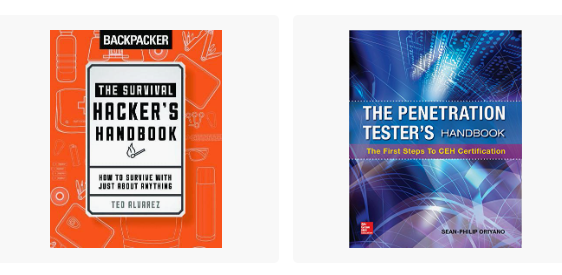
This book is the hands-on and methodology guide for pentesting with Kali Linux. You’ll discover everything you need to know about the tools and techniques hackers use to gain access to systems like yours so you can erect reliable defenses for your virtual assets. Whether you’re new to the field or an established pentester, you’ll find what you need in this comprehensive guide.
Build a modern dockerized environment
Discover the fundamentals of the bash language in Linux
Use a variety of effective techniques to find vulnerabilities (OSINT, Network Scan, and more)
Analyze your findings and identify false positives and uncover advanced subjects, like buffer overflow, lateral movement, and privilege escalation
Apply practical and efficient pentesting workflows
Learn about Modern Web Application Security Secure SDLC
If you’re getting started along the exciting path of hacking, cybersecurity, and pentesting, Linux Basics for Hackers is an excellent first step. Using Kali Linux, an advanced penetration testing distribution of Linux, you’ll learn the basics of using the Linux operating system and acquire the tools and techniques you’ll need to take control of a Linux environment.
First, you’ll learn how to install Kali on a virtual machine and get an introduction to basic Linux concepts. Next, you’ll tackle broader Linux topics like manipulating text, controlling file and directory permissions, and managing user environment variables. You’ll then focus in on foundational hacking concepts like security and anonymity and learn scripting skills with bash and Python. Practical tutorials and exercises throughout will reinforce and test your skills as you learn how to:
Cover your tracks by changing your network information and manipulating the rsyslog logging utility
Write a tool to scan for network connections, and connect and listen to wireless networks
Keep your internet activity stealthy using Tor, proxy servers, VPNs, and encrypted email
Write a bash script to scan open ports for potential targets
Use and abuse services like MySQL, Apache web server, and OpenSSH
Build your own hacking tools, such as a remote video spy camera and a password cracker
In this book you’ll learn an offensive approach to enhance your penetration testing skills by testing the sophisticated tactics employed by real hackers. You’ll go through laboratory integration to cloud services so that you learn another dimension of exploitation that is typically forgotten during a penetration test. You’ll explore different ways of installing and running Kali Linux in a VM and containerized environment and deploying vulnerable cloud services on AWS using containers, exploiting misconfigured S3 buckets to gain access to EC2 instances.
This book delves into passive and active reconnaissance, from obtaining user information to large-scale port scanning. Building on this, different vulnerability assessments are explored, including threat modeling. See how hackers use lateral movement, privilege escalation, and command and control (C2) on compromised systems. By the end of this book, you’ll have explored many advanced pentesting approaches and hacking techniques employed on networks, IoT, embedded peripheral devices, and radio frequencies.
For more information about this book, we have a video with the author you can watch here.
This is a comprehensive guide for those who are new to Kali Linux and penetration testing that will have you up to speed in no time. Using real-world scenarios, you’ll understand how to set up a lab and explore core penetration testing concepts.
Throughout this book, you’ll focus on information gathering and even discover different vulnerability assessment tools bundled in Kali Linux. You’ll learn to discover target systems on a network, identify security flaws on devices, exploit security weaknesses and gain access to networks, set up Command and Control (C2) operations, and perform web application penetration testing. In this updated second edition, you’ll be able to compromise Active Directory and exploit enterprise networks.
Finally, this book covers best practices for performing complex web penetration testing techniques in a highly secured environment.
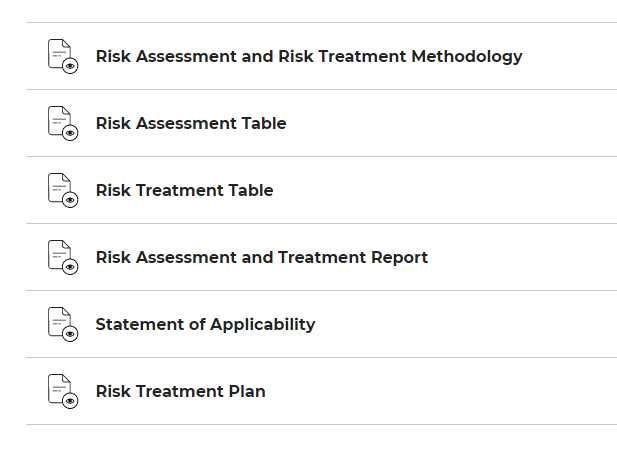
The purpose of this document is to define the methodology for assessment and treatment of information risks, and to define the acceptable level of risk.
The document is optimized for small and medium-sized organizations – we believe that overly complex and lengthy documents are just overkill for you.
There are 3 appendices related to this document. The appendices are not included in the price of this document and can be purchased separately
The purpose of this table is to list all information resources, vulnerabilities and threats, and assess the level of risk. The table includes catalogues of vulnerabilities and threats.
The document is optimized for small and medium-sized organizations – we believe that overly complex and lengthy documents are just overkill for you.
This document is an appendix. The main document is not included in the price of this document and can be purchased separately
The purpose of this table is to determine options for the treatment of risks and appropriate controls for unacceptable risks. This table includes a catalogue of options for treatment of risks as well as a catalogue of 114 controls prescribed by ISO 27001.
The document is optimized for small and medium-sized organizations – we believe that overly complex and lengthy documents are just overkill for you.
This document is an appendix. The main document is not included in the price of this document and can be purchased separately
The purpose of this document is to define which controls are appropriate to be implemented in the organization, what are the objectives of these controls, how they are implemented, as well as to approve residual risks and formally approve the implementation of the said controls.
The document is optimized for small and medium-sized organizations – we believe that overly complex and lengthy documents are just overkill for you.
The purpose of this document is to determine precisely who is responsible for the implementation of controls, in which time frame, with what budget, etc.
The document is optimized for small and medium-sized organizations – we believe that overly complex and lengthy documents are just overkill for you.
Google announced the completion of the $5.4 billion acquisition of threat intelligence firm Mandiant. The acquisition was announced in March 2022 by both companies:
“RESTON, Va., March 8, 2022 – Mandiant, Inc. (NASDAQ: MNDT) today announced that it has entered into a definitive agreement to be acquired by Google LLC for $23.00 per share in an all-cash transaction valued at approximately $5.4 billion, inclusive of Mandiant’s net cash.” reported the press release.
Mandiant is considered a leading cyber security firm, in 2013 FireEye acquired it, but FireEye separated Mandiant Solutions in 2021 as part of a $1.2 billion private equity transaction.
The cybersecurity firm will join Google Cloud, but despite the acquisition, Google will maintain the Mandiant brand.
Google is expanding its offer adding cybersecurity services to its portfolio, as part of this strategy the company also acquired the Israeli Israeli startup Siemplify which has developed a SOAR (security orchestration, automation and response) technology.
“Today we’re excited to share the next step in this journey with the completion of our acquisition of Mandiant, a leader in dynamic cyber defense, threat intelligence and incident response services. Mandiant shares our cybersecurity vision and will join Google Cloud to help organizations improve their threat, incident and exposure management.” reads the Google’s announcement.
“Combining Google Cloud’s existing security portfolio with Mandiant’s leading cyber threat intelligence will allow us to deliver a security operations suite to help enterprises globally stay protected at every stage of the security lifecycle. With the scale of Google’s data processing, novel analytics approaches with AI and machine learning, and a focus on eliminating entire classes of threats, Google Cloud and Mandiant will help organizations reinvent security to meet the requirements of our rapidly changing world.”
State of the Hack discusses the latest in information security, digital forensics, incident response, cyber espionage, APT attack trends, and tales from the front lines of significant targeted intrusions.
HP Secure Erase; HP Sure Click; HP BIOSphere Gen6; HP Sure Admin; Hood Sensor Optional Kit; HP Client Security Manager Gen6; HP Sure Start Gen7; HP Sure Recover Gen4; HP Sure Sense Gen2; HP Sure Run Gen5[19,20,21,22,23,24,25,26,31]
Cobalt’s has announced a new offering, Agile Pentesting! With Agile Pentesting, conduct a pentest that has a targeted scope focused on a specific area of an asset, or a specific vulnerability across an asset. Agile Penesting is flexible in nature, and aligns pentesting to DevSecOps workflows in a way that’s friction-free.
Leverage Agile Pentesting to level up your security program for:
* New Release Testing: pentest a new release before or shortly after it reaches production
* Delta Testing: pentest for incremental improvements based on code differences since date or version
* Single OWASP Category Testing: pentest a single vulnerability or small subset of vulnerabilities across an asset to validate fixes
* Microservice Testing: pentest Kubernetes within AWS, Azure, or GCP, as well as hosted network devicesReady to ship code securely with Cobalt’s Agile Pentesting?
Ready to ship code securely with Cobalt’s Agile Pentesting?
Enter to Win a Free Cobalt Agile Pentest!Sometimes the best things in life actually are free! Click here to enter your information to be one of the three lucky winners to receive a free Agile Pentest from Cobalt, worth $6,600 in value! The drawing will take place on September 22nd.
ust as developers and security teams were getting ready to take a breather and fire up the BBQ for the holiday weekend, the U.S.’s most prestigious security agencies (NSA, CISA, and ODNI) dropped a 60+ page recommended practice guide, Securing the Software Supply Chain for Developers.
My first reaction was that it’s great to see these agencies adding to the public discourse in these still heady days where we’re all sorting out software supply chain security best practices. This is an important voice in shaking out the still many requirements, frameworks, and best practices, and kudos to them for sharing some of their hard-fought lessons learned.
But I think it’s also important for developers at large to weigh what makes sense in the most extraordinarily sensitive national security environments, versus what makes sense for the average enterprise developer and security team.
Here’s what stuck out to me as the good, bad, and ugly implications of the report.
The good
There are some excellent, prescriptive recommendations in the report where these agencies are advocating specific frameworks like Supply chain Levels for Software Artifacts (SLSA, pronounced “salsa”) and Secure Software Development Framework (SSDF). The report mentions these frameworks 14 and 38 times, respectively, and for developers and security teams that realize they have a software supply chain security problem but don’t know where to start, now they have a clear path to take their first steps.
The upshot of these frameworks is they give developers clear guidance on (1) how to develop secure code, from design issues to organizational structure issues for more secure software; (2) build system integrity (making sure malicious code isn’t being injected in our build systems); and (3) what happens after software is built and how to operate systems security (vulnerability remediation, monitoring, those types of aspects).
I also think the report does an excellent job of emphasizing what software signing buys developers in terms of artifact security, and how by making the investment in signing and verifying at the start of the software development lifecycle, you can save yourself a lot of toil not having to worry about the security of the package managers further down the line.
The bad
The guide suggests that “all development systems must be restricted to development operations only” … and goes on to say “no other activity such as email should be conducted for business nor personal use.”
I can’t see a future where developers are told they can’t do Slack, email and web browsing on their dev machines, and here’s an example where what’s mandatory in air-gapped environments like the NSA don’t really map out to mainstream developer scenarios.
I also find that the SBOM guidance has great points, but also misses concrete threats and mitigation examples. Overall the industry continues to tell everyone to use SBOMs, but doesn’t really explain what to do with them or what the real benefits are. And while I like the guidance to compare SBOMs with software composition analysis (SCA) results, the reality is that today’s vulnerability scanners actually miss a lot of the transitive dependencies that make software supply chains an attractive threat surface in the first place.
The ugly
While open source is mentioned 31 times in the guide, it’s mostly superficial references, with no new recommendations. We all know most source code being used today is open source, and it has unique aspects for security – the report doesn’t pay any care to how to choose which open source projects to use, what to look for when deciding on a new dependency, approaches to scoring systems, or how to tell the security health of an OSS project.
There’s quite a bit of information overload. Half of the document explains what its contents are, and the other half presents a couple of frameworks and the intersections of those frameworks. I think what we’re going to see next is a tidal wave of security vendor product whitewashing, claiming to have the first capabilities conforming to these guidelines – but it’s important to remember that there is no accreditation process, and most of this will simply be marketing bluster.
What’s next
Software supply chain security is pretty unique – you’ve got a whole lot of different types of attacks that can target a lot of different points in the software lifecycle. You can’t just take one piece of security software, turn it on, and get protected from everything.
Guides and recommendations like this that come down from the most sophisticated organizations that have gone through the early paces give a lot of great clues for developers at large, and I hope the NSA/CSA/ODNI will continue to disclose this type of insight … even if it may require some decoding for what applies to more mainstream developer scenarios outside of the Pentagon.
August 2022 has been a lesson in being careful with whom you provide sensitive information. In a month that saw the former US president accused of misappropriating classified government documents, there were also a spate of malicious insiders compromising their employer’s systems.
Meanwhile, the bastion of password security, LastPass, announced that its systems had been breached – although the organisation is confident that customers’ details remain secure.
In total, we identified 112 publicly disclosed security incidents in August, resulting in 97,456,345 compromised records.
You can find the full list of incidents below, broken into their respective categories.
The role of the Chief Information Security Officer (CISO) is a relatively new senior-level executive position within most organizations, and is still evolving.
To find out how current CISOs landed in that role, their aspirations, the compensation they receive, and which risks they face and responsibilities they shoulder, analysts with international executive search firm Heidrick & Struggles have asked 327 CISOs (and CISOs in all but name) to participate in their 2022 Global CISO Survey.
The results of the survey revealed these main takeaways:
Who reports to CISOs and to whom do the CISOs report?
The main organizational functions that report to CISOs are SecOps (88%); governance, risk, and compliance (87%); penetration testing (87%); security architecture (86%); product and application security (79%); and business continuity planning or disaster recovery (79%).
CISOs mostly report to the CIO (38%); the CTO or senior engineering executive (15%); the COO or CAO (9%); the global CISO (8%); and the CEO (8%). But 88% of them also report to the company board and/or advisory committee.
CISO roles are often terminal
Most CISOs move laterally into their current role and the career path forward for CISOs is most often to another CISO role, the analysts found.
If they were not CISOs before – and 53% of them were! – they were mostly a deputy CISO, a regional or business unit CISO, and the senior information security executive in their organization.
Many CISOs aspire to be a board member next, but that ambition is unlikely to be realized. Even though cybersecurity experience is sorely needed on boards, many boards still frequently prefer board members with prior board experience, the analysts pointed out.
The Chief Security Officer (CSO) or the Chief Information Officer (CIO) roles are also coveted by many of the respondents.
Threats CISOs are facing and personal risks they are worried about
CISOs say ransomware attacks are the most significant cyber risk to their organization (67%), followed by insider threats (32%) and nation/state attacks (31%).
On a more personal note, CISOs are most worried about stress related to the role (59%) and burnout (48%), and much less about job loss as a result of a breach (25%) or being faced with personal financial accountability for a breach (11%).
“Our survey responses here tell a few different stories,” the analysts noted.
“One is that there is burnout and stress associated with this role, which should lead organizations to consider succession plans and/or retention strategies so that CISOs don’t make unnecessary exits. The second story is that CISOs feel relatively secure in their jobs—job loss as a result of a breach wasn’t the highest risk. That is, in part, because the best CISOs are able to command executive-level protections (D&O insurance coverage and severance, for example) that enable them to do their jobs unencumbered by the threat of career risk.”
CISO compensation keeps rising
“In the United States, reported median cash CISO compensation has risen to $584,000 this year, up from $509,000 last year and $473,000 in 2020. Median total compensation, including any annualized equity grants or long-term incentives, also increased, to $971,000 from $936,000,” the company found.
New CISOs, in particular, saw the highest rises in overall compensation – probably because talent to fill out the role is hard to find and organizations are competing fiercely to take hold of it.
In the UK, the median cash CISO compensation has risen to £318,000 this year, but there was a 14% drop in annual equity.
For those interested, Heidrick & Struggles’s report offers more granular insight on the various factors that impact CISO compensation in different geographical locations.
The U.S. Cybersecurity and Infrastructure Security Agency (CISA) added 10 new vulnerabilities to its Known Exploited Vulnerabilities Catalog, including a high-severity security flaw (
Experts recommend also private organizations review the Catalog and address the vulnerabilities in their infrastructure.
According to the US agency, Delta Electronics DOPSoft 2 lacks proper validation of user-supplied data when parsing specific project files (improper input validation). An attacker can trigger the flaw to cause an out-of-bounds write and achieve code execution.
It is important to highlight that there are no security patches to fix this issue and that the impacted product is end-of-life.
CISA also added to the catalog a Sanbox Bypass Vulnerability, tracked as CVE-2021-31010 (CVSS score: 7.5), in Apple iOS, macOS, and watchOS.
“In affected versions of Apple iOS, macOS, and watchOS, a sandboxed process may be able to circumvent sandbox restrictions.” reads the advisory.
The other vulnerabilities added to the catalog are:
CVE-2022-26352 – dotCMS Unrestricted Upload of File Vulnerability
CVE-2022-24706 – Apache CouchDB Insecure Default Initialization of Resource Vulnerability
CyberWire Inc. (Author)Flash cybersecurity advisories from the US Government. These alerts provide timely technical and operational information, indicators of compromise, and mitigations for current major security threats, vulnerabilities, and exploits. These alerts have been edited and adapted for audio by The CyberWire as a public service.