Apr 06 2026

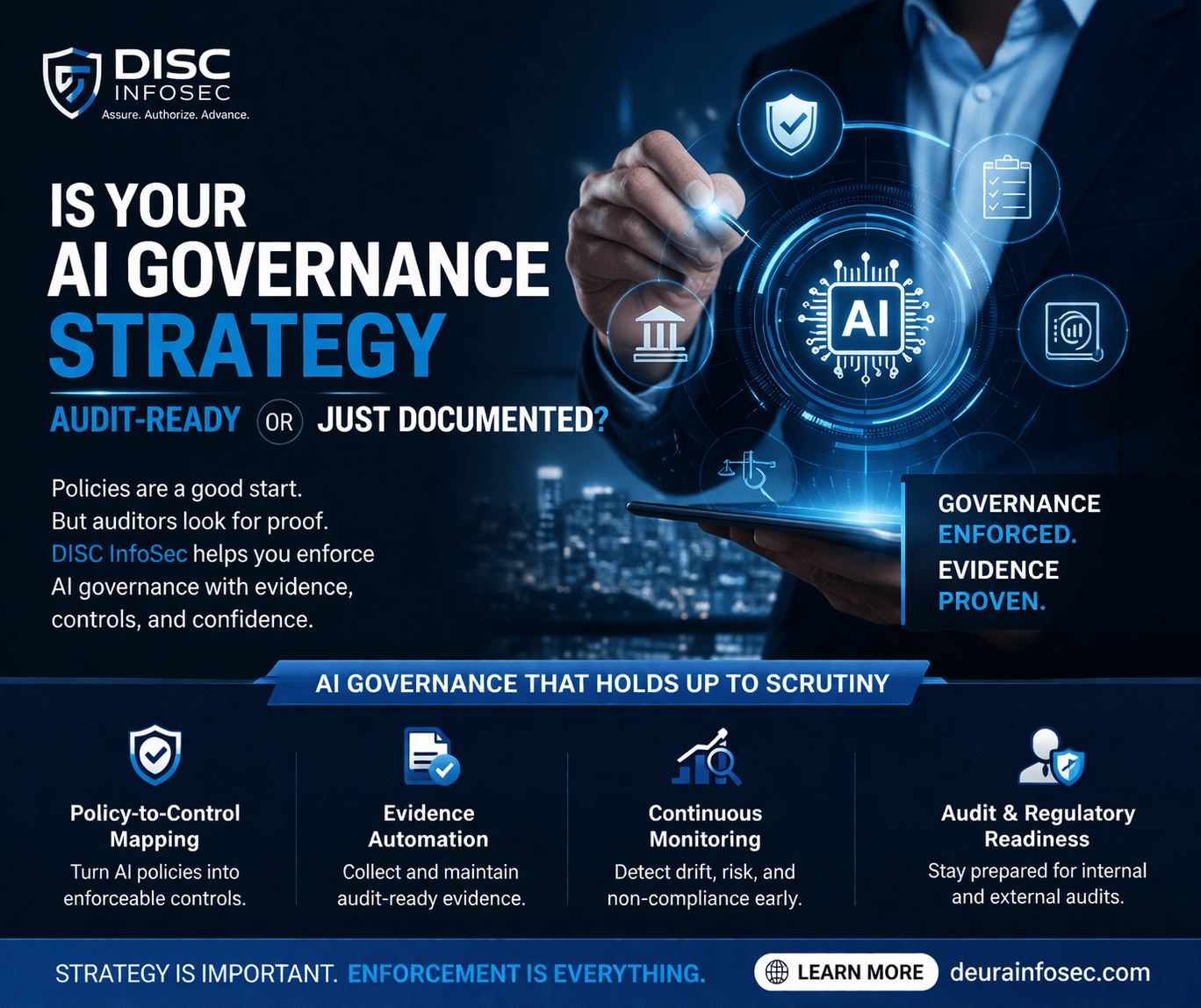
Is Your AI Governance Strategy Audit-Ready—or Just Documented?

1. The Audit Question Organizations Must Answer
Is your AI governance strategy ready for audit? This is no longer a theoretical concern. As AI adoption accelerates, organizations are being evaluated not just on innovation, but on how well they govern, control, and document their AI systems.

2. AI Governance Is No Longer Optional
AI governance has shifted from a best practice to a business requirement. Organizations that fail to establish clear governance risk regulatory exposure, operational failures, and loss of customer trust. Governance is now a foundational pillar of responsible AI adoption.

3. Compliance Is Driving Business Outcomes
Frameworks like ISO 42001, NIST AI RMF, and the EU AI Act are no longer just compliance checkboxes—they are directly influencing contract decisions. Companies with strong governance are winning deals faster and reducing enterprise risk, while others are being left behind.

4. Proven Execution Matters
Deura Information Security Consulting (DISC InfoSec) positions itself as a trusted partner with a strong track record, including a proven certification success rate. Their team brings structured expertise, helping organizations navigate complex compliance requirements with confidence.

5. Integrated Framework Approach
Rather than treating frameworks in isolation, integrating multiple standards into a unified governance model simplifies the compliance journey. This approach reduces duplication, improves efficiency, and ensures broader coverage across AI risks.

6. Governance as a Competitive Advantage
Clear, well-implemented governance does more than protect—it differentiates. Organizations that can demonstrate control, transparency, and accountability in their AI systems gain a measurable edge in the market.

7. Taking the Next Step
The message is clear: organizations must act now. Engaging with experienced partners and building a robust governance strategy is essential to staying compliant, competitive, and secure in an AI-driven world.


Perspective: Why AI Governance Enforcement Is Critical

Most organizations are focusing on AI governance frameworks, but frameworks alone don’t reduce risk—enforcement does.

Having policies aligned to ISO 42001 or NIST AI RMF is important, but auditors and regulators are increasingly asking a deeper question:
👉 Can you prove those policies are actually enforced at runtime?

This is where many AI governance strategies fall apart.

AI systems are dynamic, API-driven, and often autonomous. Without real-time enforcement:

  • Policies remain static documents
  • Controls are inconsistently applied
  • Risks emerge during actual execution—not design

AI governance enforcement bridges that gap. It ensures that:

  • Prompts, responses, and agent actions are monitored in real time
  • Policy violations are detected and blocked instantly
  • Data exposure and misuse are prevented before impact

In short, enforcement turns governance from intent into control.

Bottom line:
If your AI governance strategy cannot demonstrate continuous monitoring, control, and enforcement, it is unlikely to stand up to audit—or real-world threats.

That’s why AI governance enforcement is not just a feature—it’s the foundation for making AI governance actually work at scale.

Ready to Operationalize AI Governance?

If you’re serious about moving from **AI governance theory → real enforcement**,
DISC InfoSec can help you build the control layer your AI systems need.

Most organizations have AI governance documents — but auditors now want proof of enforcement.

Policies alone don’t reduce AI risk. Real‑time monitoring, control, and enforcement do.

If your AI governance strategy can’t demonstrate continuous oversight, it won’t stand up to audit or real‑world threats.

DISC InfoSec helps organizations operationalize AI governance with integrated frameworks, runtime controls, and proven certification success.

Move from AI governance theory to enforcement.

🔗 Read the full post: Is Your AI Governance Strategy Audit‑Ready — or Just Documented? 📞 Schedule a consultation: info@deurainfosec.com

DISC InfoSec — Your partner for AI governance that actually works.

InfoSec services | InfoSec books | Follow our blog | DISC llc is listed on The vCISO Directory | ISO 27k Chat bot | Comprehensive vCISO Services | ISMS Services | AIMS Services | Security Risk Assessment Services | Mergers and Acquisition Security

Is your AI strategy truly audit-ready today?

AI governance is no longer optional. Frameworks like ISO/IEC 42001 AI Management System Standard and regulations such as the EU AI Act are rapidly reshaping compliance expectations for organizations using AI.

DISC InfoSec brings deep expertise across AI, cybersecurity, and regulatory compliance to help you build trust, reduce risk, and stay ahead of evolving mandates—with a proven track record of success.

Ready to lead with confidence? Let’s start the conversation.

At DISC InfoSec, we help organizations navigate this landscape by aligning AI risk management, governance, security, and compliance into a single, practical roadmap. Whether you are experimenting with AI or deploying it at scale, we help you choose and operationalize the right frameworks to reduce risk and build trust. Learn more at DISC InfoSec.

Tags: AI Governance Enforcement, EU AI Act, ISO 42001, NIST AI RMF


Apr 06 2026

AI-Native Risk: Why AI Security Is Still an API Security Problem

1. Defining Risk in AI-Native Systems
AI-native systems introduce a new class of risk driven by autonomy, scale, and complexity. Unlike traditional applications, these systems rely on dynamic decision-making, continuous learning, and interconnected services. As a result, risks are no longer confined to static vulnerabilities—they emerge from unpredictable behaviors, opaque logic, and rapidly evolving interactions across systems.

2. Why AI Security Is Still an API Security Problem
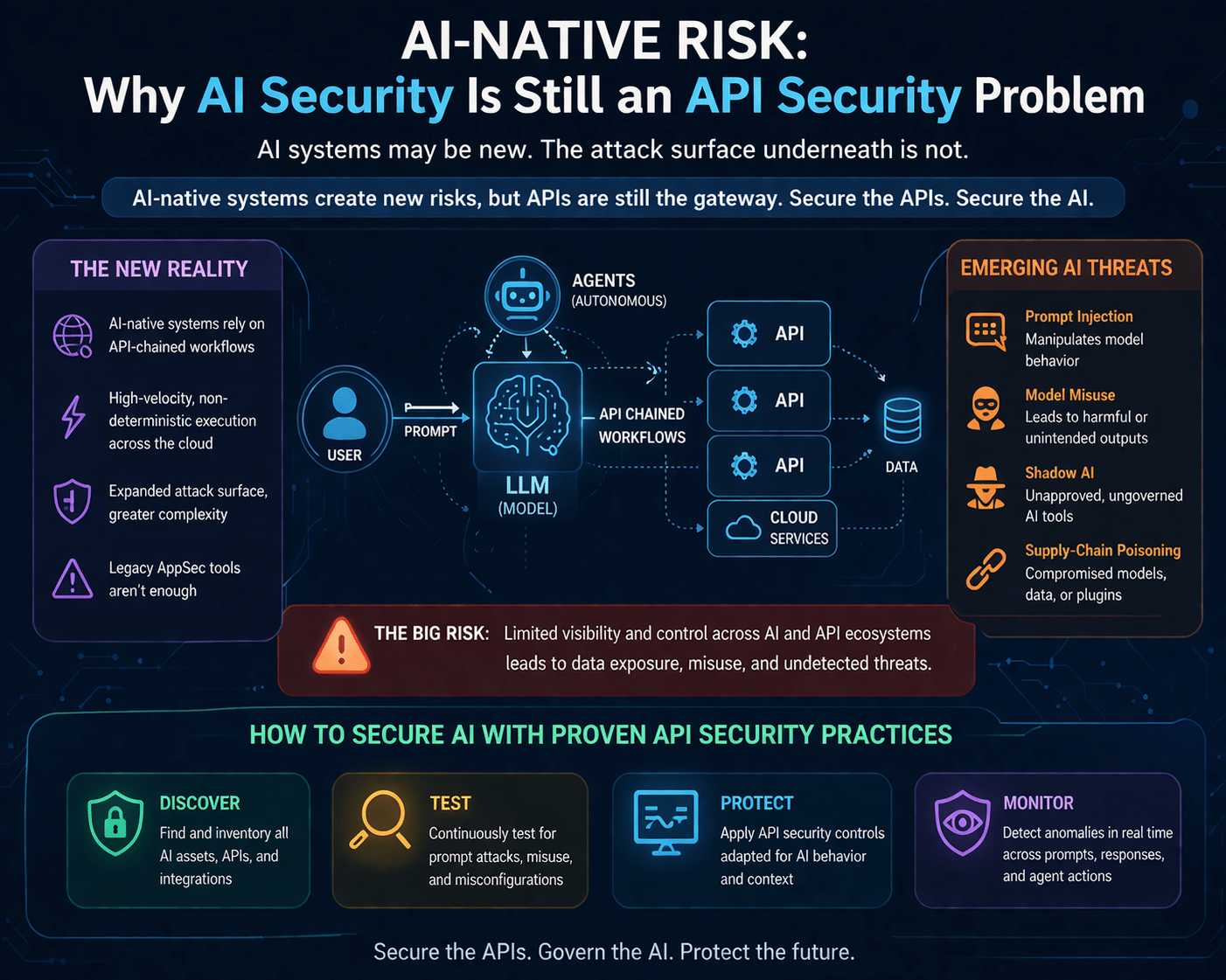
At its core, AI security remains an API security challenge. Modern AI systems—especially those powered by large language models (LLMs) and autonomous agents—operate through API-driven architectures. Every prompt, response, and action is mediated through APIs, making them the primary attack surface. The difference is that AI introduces non-deterministic behavior, increasing the difficulty of predicting and controlling how these APIs are used.

3. Expansion of the Attack Surface
The shift to AI-native design significantly expands the enterprise attack surface. AI workflows often involve chained APIs, third-party integrations, and cloud-based services operating at high speed. This creates complex execution paths that are harder to monitor and secure, exposing organizations to a broader range of potential entry points and attack vectors.

4. Emerging AI-Specific Threats
AI-native environments face unique threats that go beyond traditional API risks. Prompt injection can manipulate model behavior, model misuse can lead to unintended outputs, shadow AI introduces ungoverned tools, and supply-chain poisoning compromises upstream data or models. These threats exploit both the AI logic and the APIs that deliver it, creating layered security challenges.

5. Visibility and Control Gaps
A major risk factor is the lack of visibility and control across AI and API ecosystems. Security teams often struggle to track how data flows between models, agents, and services. Without clear insight into these interactions, it becomes difficult to enforce policies, detect anomalies, or prevent sensitive data exposure.

6. Applying API Security Best Practices
Organizations can reduce AI risk by extending proven API security practices into AI environments. This includes strong authentication, rate limiting, schema validation, and continuous monitoring. However, these controls must be adapted to account for AI-specific behaviors such as context handling, prompt variability, and dynamic execution paths.

7. Strengthening AI Discovery, Testing, and Protection
To secure AI-native systems effectively, organizations must improve discovery, testing, and runtime protection. This involves identifying all AI assets, continuously testing for adversarial inputs, and deploying real-time safeguards against misuse and anomalies. A layered approach—combining API security fundamentals with AI-aware controls—is essential to building resilient and trustworthy AI systems.

This post lands on the right core insight: AI security isn’t a brand-new discipline—it’s an evolution of API security under far more dynamic and unpredictable conditions. That framing is powerful because it grounds the conversation in something security teams already understand, while still acknowledging the real shift in risk introduced by AI-native architectures.

Where I strongly agree is the emphasis on API-chained workflows and non-deterministic behavior. In practice, this is exactly where most organizations underestimate risk. Traditional API security assumes predictable inputs and outputs, but LLM-driven systems break that assumption. The same API can behave differently based on subtle prompt variations, context memory, or agent decision paths. That unpredictability is the real multiplier of risk—not just the APIs themselves.

I also think the callout on identity and agent behavior is critical and often overlooked. In AI systems, identity is no longer just “user or service”—it becomes “agent acting on behalf of a user with partial autonomy.” That creates a blurred accountability model. Who is responsible when an agent chains five APIs and exposes sensitive data? This is where most current security models fall short.

On threats like prompt injection, shadow AI, and supply-chain poisoning, we’re highlighting the right categories, but the deeper issue is that these attacks bypass traditional controls entirely. They don’t exploit code—they exploit logic and trust boundaries. That’s why legacy AppSec tools (SAST, DAST, even WAFs) struggle—they’re not designed to understand intent or context.

The point about visibility gaps is probably the most urgent operational problem. Most teams simply don’t know:

  • Which AI models are in use
  • What data is being sent to them
  • What downstream actions agents are taking

Without that, governance becomes theoretical. You can’t secure what you can’t see—especially when execution paths are being created in real time.

Where I’d push the perspective further is this:
AI security is not just API security with “extra controls”—it requires runtime governance.
Static controls and pre-deployment testing are not enough. You need continuous AI Governance enforcement at execution time—monitoring prompts, responses, and agent actions as they happen.

Finally, your recommendation to extend API security practices is absolutely right—but success depends on how deeply organizations adapt them. Basic controls like authentication and rate limiting are table stakes. The real maturity comes from:

  • Context-aware inspection (prompt + response)
  • Behavioral baselining for agents
  • Policy enforcement tied to business risk (not just endpoints)

If you’re serious about moving from **AI governance theory → real enforcement**,
DISC InfoSec can help you build the control layer your AI systems need.

Schedule a free consultation or drop a comment below: info@deurainfosec.com

Tags: AI security, API Security


Apr 03 2026

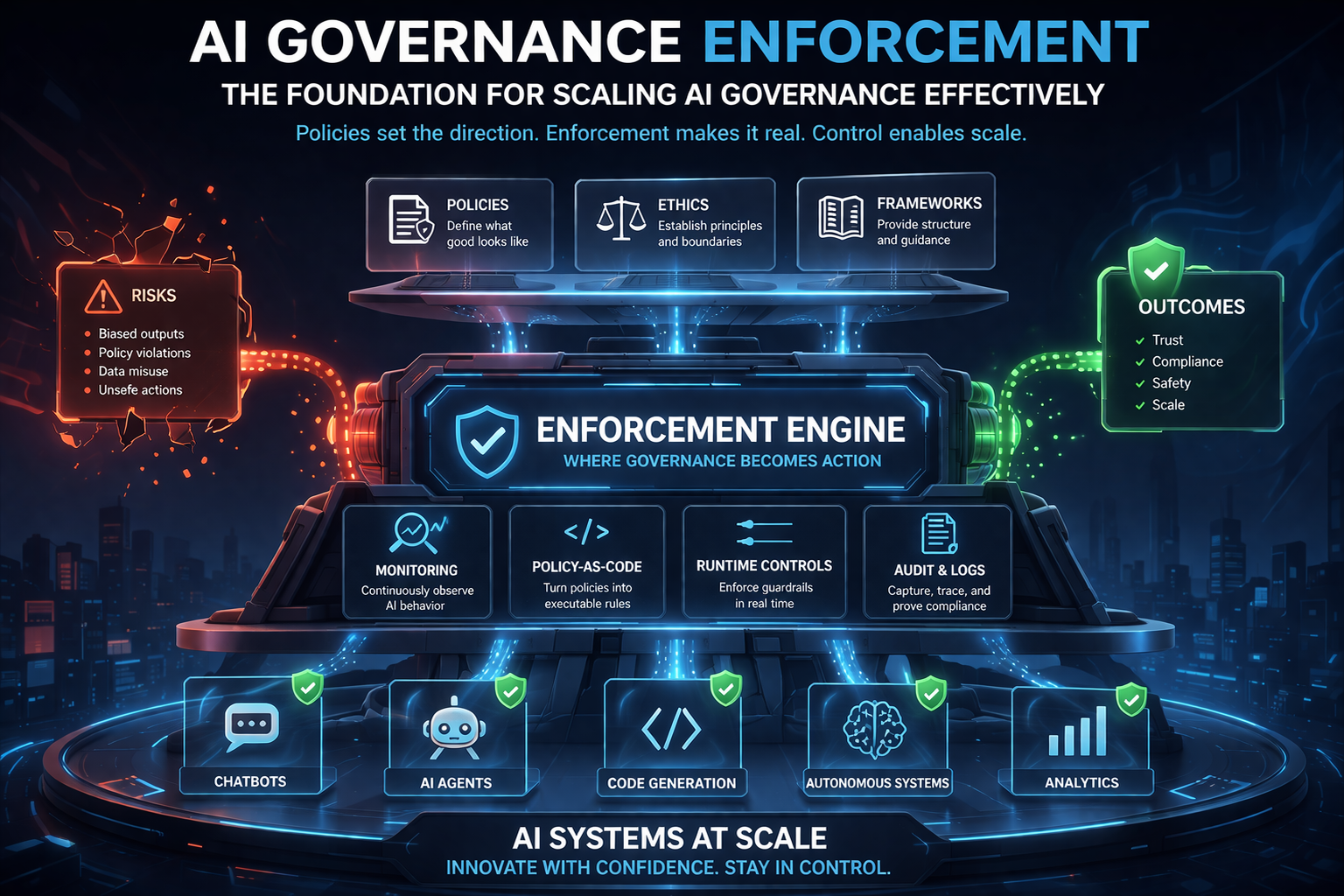
AI Governance Enforcement: The Foundation for Scaling AI Governance Effectively

Category: AI,AI Governance,AI Governance Enforcementdisc7 @ 3:22 pm


AI Governance Enforcement

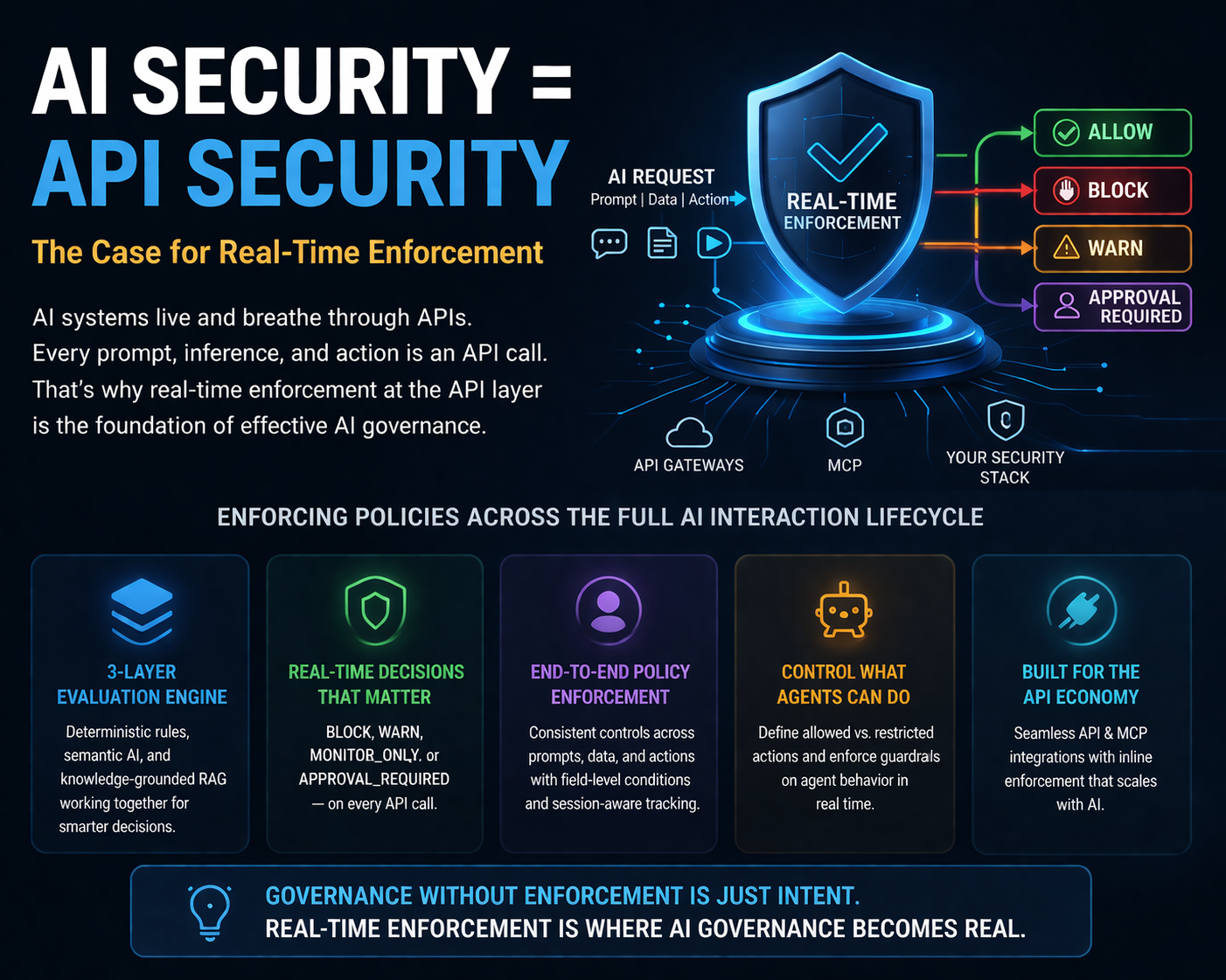
AI governance enforcement is the operational layer that turns policies into real-time controls across AI systems. Instead of relying on static documents or post-incident monitoring, enforcement evaluates every AI action—prompts, outputs, code, documents, and messages—against defined policies and either allows, blocks, or flags them instantly. This ensures that compliance, security, and ethical requirements are actively upheld at runtime, with continuous audit evidence generated automatically.


Three-Layer Governance Engine

A three-layer governance engine combines deterministic rules, semantic AI reasoning, and organization-specific knowledge to evaluate AI behavior. Deterministic rules handle structured, pattern-based checks (e.g., PII detection), semantic AI interprets context and intent, and the knowledge layer applies company-specific policies derived from internal documents. Together, these layers provide fast, context-aware, and comprehensive enforcement without relying on a single method of evaluation.


What You Can Govern

AI governance enforcement can be applied across the entire AI ecosystem, including LLM prompts and responses, AI agents, source code, documents, emails, and messaging platforms. Any interaction where AI generates, processes, or transmits data can be evaluated against policies, ensuring consistent compliance across all systems and workflows rather than isolated checkpoints.


Govern Your AI System

Governing an AI system involves registering and classifying it by risk, applying relevant policy frameworks, integrating it with operational tools, and continuously enforcing policies at runtime. Every action taken by the AI is evaluated in real time, with violations blocked or flagged and all decisions logged for auditability. This creates a closed-loop system of classification, enforcement, and evidence generation that keeps AI aligned with regulatory and organizational requirements.


Perspective: Why AI Governance Enforcement Is the Key

AI governance fails when it remains theoretical. Policies, frameworks, and ethics statements mean little unless they are enforced at execution time. The shift happening now—driven by regulations and real-world risk—is from “intent” to “proof.” Organizations are no longer judged by what policies they publish, but by what they can demonstrably enforce and audit.

Enforcement is the missing link because it creates accountability, consistency, and evidence:

  • Accountability: Every AI decision is evaluated against rules.
  • Consistency: Policies apply uniformly across all systems and channels.
  • Evidence: Audit trails are generated automatically, not reconstructed later.

In simple terms:
👉 Without enforcement, governance is documentation.
👉 With enforcement, governance becomes control.

That’s why AI governance enforcement is not just a feature—it’s the foundation for making AI governance actually work at scale.

## 🚀 Ready to Operationalize AI Governance?

If you’re serious about moving from **AI governance theory → real enforcement**,
DISC InfoSec can help you build the control layer your AI systems need.

📩 Book a free consultation: [info@deurainfosec.com]

InfoSec services | InfoSec books | Follow our blog | DISC llc is listed on The vCISO Directory | ISO 27k Chat bot | Comprehensive vCISO Services | ISMS Services | AIMS Services | Security Risk Assessment Services | Mergers and Acquisition Security

Is your AI strategy truly audit-ready today?

AI governance is no longer optional. Frameworks like ISO/IEC 42001 AI Management System Standard and regulations such as the EU AI Act are rapidly reshaping compliance expectations for organizations using AI.

DISC InfoSec brings deep expertise across AI, cybersecurity, and regulatory compliance to help you build trust, reduce risk, and stay ahead of evolving mandates—with a proven track record of success.

Ready to lead with confidence? Let’s start the conversation.

At DISC InfoSec, we help organizations navigate this landscape by aligning AI risk management, governance, security, and compliance into a single, practical roadmap. Whether you are experimenting with AI or deploying it at scale, we help you choose and operationalize the right frameworks to reduce risk and build trust. Learn more at DISC InfoSec.

Tags: AI Governance Enforcement


« Previous Page