InfoSec Compliance & AI Governance For over 20 years, DISC InfoSec has been a trusted voice for cybersecurity professionals—sharing practical insights, compliance strategies, and AI governance guidance to help you stay informed, connected, and secure in a rapidly evolving landscape.
A WOMAN IN TEHRAN CLIMBED ONTO A CAR AND SET HER HIJAB ABLAZE. “AMIN” WAS JUST FIVE METERS AWAY. (PHOTO CREDIT: TWITTER)
The death of 22-year-old Mahsa Amini in Iran has ignited the most powerful protests the country has seen in years. Authorities there have rolled out a host of new tools to throttle mobile phone connections, block social media sites, and make it harder for people on the ground to organize. Our Click Here team spoke to one man who has been protesting since Amini’s death was announced, and he talked to us about the dangers of using social media and technology while participating in street demonstrations. He asked us not to use his real name because speaking to foreign reporters could get him arrested. Amin talked with us about getting around internet restrictions, the dangers of using social media in Iran, and how protesters handle their passwords.
Our interview with him has been edited and condensed for clarity.
BidenCash, a popular dark web carding site, released a dump of more than 1.2 million credit cards to promote its service.
Operators behind the popular dark web carding market ‘BidenCash’ have released a dump of 1,221,551 credit cards to promote their underground payment card shop. Multiple security firms, noticed the promotional activity, but the news was first reported by threat intelligence firm Cyble and the Italian firm D3Lab.
It is a great gift to fraudsters that can download for free the dump and use it for fraudulent activities.
The announcement of the availability of the dataset consisting of over 1.2 million credit and debit cards information on a notorious cybercrime forum mainly hosting Russian and English-speaking Threat Actors.
Not too long ago, the role of chief information security officer was a purely technical position designed to help an organization overcome cybersecurity challenges. Today, however, the CISO role has evolved — growing both in responsibility and stature within a company. The CISO is now a critical member of the executive team, responsible for tying not only cybersecurity, but overall risk management, to the company’s business strategy and operations.
The modern CISO is involved in strategic decision-making, for example, ensuring the business securely embraces digital transformation while assuring the board, clients, and investors that cyber capabilities and defenses are active and evolving with current threats. And they are responsible for leveraging people, processes, and technologies to enable their organization to fulfill its overarching business objectives securely.
Given this evolution in responsibilities, a CISO’s first 90 days on the job should look a lot different today than it did even several years ago.
The First 90 Days
While many CISOs want to immediately demonstrate value by jumping in with big ideas and projects on day one, they will be able to make much more of a long-term impact if they first take the time to understand the company’s mission, values, and business objectives. They also need to get up to speed on core activities, products, services, research and development, intellectual property, and merger and acquisition plans. And they need to understand all potential issues, previous breaches, regulatory or external obligations, and existing technical debt.
With this in mind, here are a few recommendations on what a CISO’s focus should be during their first 90 days on the job.
Gain An Understanding of the Organization’s Larger Mission and Culture
The very first day, begin to deploy a collection of interview and interrogation techniques with a goal of understanding the business, its purposes and its priorities. Interview your employees, midlevel business leaders, and customers to get a sense of all key stakeholders, initial pain points, and how mature the cybersecurity culture is within the organization. Finally, gently interrogate your partners, suppliers, and vendors to determine who is just selling and who is a trusted advisor. Going through this process will open lines of communication, uncover challenges, and help build a 90-day action plan and road map.
Identify the Crown Jewels
Determine which data and systems underpin the company’s strategic mission and core competencies, represent intellectual property, differentiate the enterprise from its competitors, or support major customer segments or revenue lines. These crown jewels are the digital assets that are most likely to be targeted by threat actors, and thus must have their cyber-hygiene efforts accelerated. If the C-suite and board understand these critical areas, they can tell you their risk appetite, and you can implement security strategies accordingly.
Develop a Plan Based on the Company’s Current IT and Business Landscape
Once assets are identified and prioritized, develop a written risk management plan with checklists for deliverables, structure and communication between key internal and external stakeholders. On this latter point, the CISO always must act as an information broker and as a partner to all the key organizational decision-makers. One effective way to do this is to establish formal and informal communication with these roles, so the organization can move forward strategically.
Master the Basics
There are many technologies needed to secure the modern company, but there are a few must-haves that should be implemented right away, if they aren’t already. These are baseline controls, including vulnerability management and anti-malware defenses for the endpoint, and non-negotiable controls, including multifactor authentication, sensitive data encryption, application whitelisting, 24/7 security monitoring, file integrity monitoring, privileged access management, network segmentation, data loss prevention, and a rigorous assessment and audit function connected to vulnerability and patching strategies.
Implement Benchmarks
Prove the value of security plans, processes, and technologies to the C-suite, business unit executives, and the board by implementing benchmarks and maturity assessments that show how the company stacks up against competitors, how security strategies stack up against industry best practices and frameworks, and how security initiatives are enabling the business with secure operations.
Always Treat Security as a Business Problem
Security incidents can result in myriad consequences on the business, and conversely, strong security can help the business succeed in a secure fashion. This is why it’s so important that IT and security teams always remain integrated with the business side of the organization. As part of this, ensure ongoing communication and collaboration between executive leaders, the board, and security leaders. When management understands the business risks posed by cybersecurity threats, they’ll be more apt to pay attention and participate in security efforts.
At the end of the first 90 days, a CISO should be able to answer questions such as: How well protected is the organization? What is our capability maturity against industry standard frameworks? What are our most critical vulnerabilities and cyber-risk scenarios? What data is most important to the organization? What data risks could have the most significant negative impact on the organization? And what will it take to improve the organization’s security posture, and do we have a road map?
While this may seem like a lot to get to the bottom of in a three-month timespan, following these six steps will set your company up for both short- and long-term security and business success.
An intrusion detection system (IDS) is a type of security software designed to automatically alert administrators when someone or something is trying to compromise information system through malicious activities such as DDOS Attacks or security policy violations.
An IDS works by monitoring system activity through examining vulnerabilities in the system, the integrity of files and analyzing patterns based on already known attacks. It also automatically monitors the Internetto search for any of the latest threatswhich could result in a future attack.
Detection Methods
An IDS can only detect an attack. It cannot prevent attacks. In contrast, an IPS prevents attacks by detecting them and stopping them before they reach the target.
An attack is an attempt to compromise confidentiality, integrity, or availability. The two primary methods of detection are signature-based and anomaly-based. Any type of IDS (HIDS or NIDS) can detect attacks based on signatures, anomalies, or both.
The HIDS monitors the network traffic reaching its NIC, and the NIDS monitors the traffic on the network.
Host Based intrusion detection system (HIDS)
A host-based intrusion detection system (HIDS) is additional software installed on a system such as a workstation or a server.
It provides protection to the individual host and can detect potential attacks and protect critical operating system files. The primary goal of any IDS is to monitor traffic.
The role of a host Intrusion Detection System is passive, only gathering, identifying, logging, and alerting. Examples of HIDS:
The primary goal of any IDS is to monitor traffic. For a HIDS, this traffic passes through the network interface card (NIC). Many host-based IDSs have expanded to monitor application activity on the system.
As one example, you can install a HIDS on different Internet-facing servers, such as web servers, mail servers, and database servers. In addition to monitoring the network traffic reaching the servers, the HIDS can also monitor the server applications.
It’s worth stressing that a HIDS can help detect malicious software (malware) that traditional anti-virus software might miss.
Because of this, many organizations install a HIDS on every workstation as an extra layer of protection, in addition to traditional anti-virus software. Just as the HIDS on a server is used primarily to monitor network traffic, a workstation HIDS is mainly used to monitor network traffic reaching the workstation. However, a HIDS can also monitor some applications and can protect local resources such as operating system files. In other organizations, administrators only install a HIDS when there’s a perceived need.
For example, if an administrator is concerned that a specific server with proprietary data is at increased risk of an attack, the administrator might choose to install a HIDS on this system as an extra layer of protection.
Each uncompleted session consumes resources on the server, and if the SYN flood attack continues, it can crash the server.
Some servers reserve a certain number of resources for connections, and once the attack consumes these resources, the system blocks additional connections. Instead of crashing the server, the attack prevents legitimate users from connecting to the server.
IDSs and IPSs can detect an SYN flood attack and respond to block the attack. Additionally, many firewalls include a flood guard that can detect SYN flood attacks and take steps to close the open sessions.
About 1 in 5 phishing email messages reach workers’ inboxes, as attackers get better at dodging Microsoft’s platform defenses and defenders run into processing limitations.
Source: Andrea Danti via Alamy Stock Photo
This week’s report that cyberattackers are laser-focused on crafting attacks specialized to bypass Microsoft’s default security showcases an alarming evolution in phishing tactics, security experts said this week.
Threat actors are getting better at slipping phishing attacks through the weak spots in platform email defenses, using a variety of techniques, such as zero-point font obfuscation, hiding behind cloud-messaging services, and delaying payload activation, for instance. They’re also doing more targeting and research on victims.
As a result, nearly 1 in 5 phishing emails (18.8%) bypassed Microsoft’s platform defenses and landed in workers’ inboxes in 2022, a rate that increased 74% compared to 2020, according to research published on Oct. 6 by cybersecurity firm Check Point Software. Attackers increasingly used techniques to pass security checks, such as Sender Policy Framework (SPF), and obfuscate functional components of an e-mail, such as using zero-size fonts or hiding malicious URLs from analysis.
The increasing capabilities of attackers is due to the better understanding of current defenses, says Gil Friedrich, vice president of email security at Avanan, an email security firm acquired by Check Point in August 2021.
“It is a family of 10 to 20 techniques, but they all lead to the objective of deceiving a company’s security layers,” he says. “The end result is always an email that looks genuine to the recipient but looks different to the algorithm that analyzes the content.”
Meanwhile, cybercriminals services, such as phishing-as-a-service and malware-as-a-service, are encapsulating the most successful techniques into easy-to-use offerings. In a survey of penetration testers and red teams, nearly half (49%) considered phishing and social engineering to be the attack techniques with the best return on investment.
This October is Cyber Security Awareness Month, an event designed to educate people about information security and the steps they can take to stay safe online.
Now in its nineteenth year, the campaign provides tools and resources to help people learn more about the cyber security industry and the ways they can get involved.
This year’s event focuses on phishing and ransomware – two of the biggest threats that organisations currently face.
The attack method is often used to deliver ransomware, which itself is responsible for significant damage. Our research discovered more than 100 publicly disclosed ransomware attacks in the first half of 2022, with intrusions shuttering businesses and creating huge financial problems.
Getting involved
There are events being held throughout October as part of National Cyber Security Awareness Month. Both national governments and private organisations have supported the campaign and are running programmes online and in person.
You can find a full list of events on Stay Safe Online, where you can also find information security tips.
The theme of this year’s campaign is ‘See Yourself in Cyber’, and individuals are encouraged to get involved online with the hashtag #BeCyberSmart.
A key component of that is protecting yourself from scams. The campaign reminds people that: “The signs can be subtle, but once you recognize a phishing attempt you can avoid falling for it.
“Before clicking any links or downloading attachments, take a few seconds (like literally 4 seconds) and ensure the email looks legit.”
The campaign also highlights the benefits of multi-factor authentication, strong passwords and regularly updating software.
How IT Governance can help
You can also follow the latest developments with Cyber Security Awareness Month by following us on LinkedIn. We’ll will provide the latest updates on the campaign to help you get involved in events near you.
Plus, our experts will provide quick and simple tips to boost your cyber security awareness. Did you know, for example, that one of the most effective ways to boost your defences is also one of the simplest – ensuring that your accounts are protected by strong, unique passwords.
This applies not only to login credentials but also to databases and other sensitive information that you store online. The InterContinental Hotel Group was recently caught out by a cyber attack, after criminal hackers discovered a database protected by the password ‘Qwerty1234’.
The breach enabled the attackers to access the most sensitive parts of the hotel giant’s computer systems, and ultimately led to a phishing attack in which an employee was duped into downloading malware that destroyed huge volumes of sensitive data.
Another top tip for preventing cyber attacks is to test your employees with Phishing Challenge E-learning Game. These are messages that use the same techniques as genuine scams without the malicious payload.
The attacks give you the opportunity to monitor how your employees respond to a bogus email. Do they click a link right away? Do they recognise that it’s a scam and delete it? Do they contact the IT team to alert them of the threat?
Simulated phishing is an essential technique in an organisation’s cyber security practices. It complements traditional staff awareness training to assess the effectiveness of your programme in a real-world scenario.
In the private sector, hackers and cybercriminals are prone to leaving organizations with good security infrastructures alone. Because they often go after low-hanging fruit, hacking into a well-protected network is perceived as more trouble than it’s worth.
But the public sector is a different matter entirely. The government and government agencies have access to assets and data that criminals would love to get their hands on, even with the added trouble. So, even though the public sector is well protected, it will not stop cybercriminals from attempting to break in.
An IRONSCALES survey published in October 2021 shows over 80% of respondents experienced an increase in email phishing attacks since the start of the pandemic.
Phishing involves the utilization of legitimate-looking emails to steal the login credentials or other sensitive information of a target organization. While it’s just as much a risk for small and medium-sized businesses, in the public sector, phishing attacks could potentially be nation-state sponsored, making it a possible double whammy.
While taking advantage of the latest and greatest software to protect yourself from top cybersecurity threats is par for the course, what makes phishing so pernicious is that it relies on human error. With phishing emails looking more authentic than ever, they are harder to catch.
Distributed Denial of Service (DDoS) Attacks
A recent report says ransom DDoS attacks increased 29% year over year and 175% quarter over quarter in quarter four of 2021. Some of the biggest targets were the public sector, schools, travel organizations, and credit unions.
DDoS attacks are known to bring down some of the largest websites and are quite difficult to prevent. They are considered by some to be the most “powerful weapon” on the internet, easily making DDoS attacks one of the top cyber security threats to the government.
DDoS attacks can happen at any time, affect any part of a website, and disrupt and interrupt services, usually leading to massive financial damage.
Nation-State Sponsored Cyber Attacks
With mainstream media daily broadcasting events as they are occurring to every channel imaginable (cable TV, smartphones, social media, etc.) cyber warfare has become an increasingly common way to launch disinformation campaigns, perform cyber espionage or terrorism, and even cyber-sabotage targets.
Nation-state-sponsored cyber attacks aim to
Hinder communication
Gather intelligence
Steal intellectual property
Damage to digital and physical infrastructure
They are even used for financial gain.
Though cyber attacks are sometimes used in tandem with real life attacks, what makes cyber warfare especially challenging is that it happens virtually and often covertly. There usually isn’t any declaration of war. That makes it difficult to prove who is responsible for the attack.
Ransomware
Ransomware attacks may not be an emerging trend by any means. They may not even be anything new. But they do have a history of wreaking havoc on the public sector and therefore need to be taken seriously.
Rewind to 2019 when the U.S. was hit by an unrelenting barrage of ransomware attacks that ultimately affected at least 966 government agencies, educational establishments, and healthcare providers to $7.5 billion (Emsisoft).
These attacks resulted in 911 services being interrupted, surveillance systems going offline, badge scanners and building access systems not working, websites going down, extended tax payment deadlines, and much more.
The threat of ransomware attacks still looms today and is no less a concern in 2022 than they were in 2019. As far as cyber security threats to the government are concerned, ransomware attacks should be kept on the cybersecurity radar.
What The Public Sector Can Do to Stay Ahead?
Beyond taking full advantage of the latest tech, for the public sector to stay ahead of cyber security in the public sector, you have to create a culture of cybersecurity within your organizations, offering ongoing training to their teams.
You need to secure all infrastructure, including cloud, mobile, and Internet of Things (IoT). You also want to improve compromise detection and be fully prepared for any attack. Plans should be documented and practiced regularly, so detection and response are immediate.
There are several open-source packet analyzers available, but Wireshark is among the most popular. Moreover, the application has been upgraded to version 4.0.0 and comes with multiple new features and fixes.
It is not only network administrators who use Wireshark packet analyzers to analyze packets, but also security analysts to analyze packets.
Wireshark network protocol analyzer can be used for the following primary purposes:-
Troubleshooting
Analysis
Development
Education
An array of organizations use the tool to manage their business activities related to their business, and it has been adopted by organizations of all sizes.
The official Windows 32-bit package of Wireshark is no longer being distributed with the release of this version. Here below we have mentioned all the new additions:-
With many new extensions available, the display filter syntax has become much more powerful.
Redesigns have been made to the Conversation and Endpoint dialogs.
Packet Detail and Packet Bytes are now displayed underneath the Packet List pane in the default layout for the main window.
A number of improvements have been made to the hex dump import from Wireshark and from text2pcap.
A great deal of improvement has been made in the performance of using MaxMind geolocation.
New and Updated Features
In this latest release, Here below we have mentioned all the new and updated features:-
The macOS packages now ship with Qt 6.2.4 and require macOS 10.14. They previously shipped with Qt 5.15.3.
The Windows installers now ship with Npcap 1.71. They previously shipped with Npcap 1.70.
The Windows installers now ship with Npcap 1.70. They previously shipped with Npcap 1.60.
The ‘v’ (lower case) and ‘V’ (upper case) switches have been swapped for editcap and mergecap to match the other command line utilities.
The ip.flags field is now only the three high bits, not the full byte. Display filters and Coloring rules using the field will need to be adjusted.
New address type AT_NUMERIC allows simple numeric addresses for protocols which do not have a more common-style address approach, analog to AT_STRINGZ.
The Conversation and Endpoint dialogs have been redesigned.
The Windows installers now ship with Qt 6.2.3. They previously shipped with Qt 6.2.4.
The Windows installers now ship with Npcap 1.60. They previously shipped with Npcap 1.55.
The Windows installers now ship with Qt 6.2.4. They previously shipped with Qt 5.12.2.
The display filter syntax has been updated and enhanced.The default main window layout has been changed so that the Packet Detail and Packet Bytes are side by side underneath the Packet List pane.
The HTTP2 dissector now supports using fake headers to parse the DATAs of streams captured without first HEADERS frames of a long-lived stream (such as a gRPC streaming call which allows sending many request or response messages in one HTTP2 stream). Users can specify fake headers using an existing stream’s server port, stream id and direction.
The IEEE 802.11 dissector supports Mesh Connex (MCX).
The “Capture Options” dialog contains the same configuration icon as the Welcome Screen. It is now possible to configure interfaces there.
The “Extcap” dialog remembers password items during runtime, which makes it possible to run extcaps multiple times in row without having to reenter the password each time. Passwords are never stored on disk.
It is possible to set extcap passwords in tshark and other CLI tools.
The extcap configuration dialog now supports and remembers empty strings. There are new buttons to reset values back to their defaults.
Support to display JSON mapping for Protobuf message has been added.
macOS debugging symbols are now shipped in separate packages, similar to Windows packages.
In the ZigBee ZCL Messaging dissector the zbee_zcl_se.msg.msg_ctrl.depreciated field has been renamed to zbee_zcl_se.msg.msg_ctrl.deprecated
The interface list on the welcome page sorts active interfaces first and only displays sparklines for active interfaces. Additionally, the interfaces can now be hidden and shown via the context menu in the interface list
The Event Tracing for Windows (ETW) file reader now supports displaying IP packets from an event trace logfile or an event trace live session.
ciscodump now supports IOS, IOS-XE and ASA remote capturing.
The PCRE2 library is now required to build Wireshark.
You must now have a compiler with C11 support in order to build Wireshark.
A cybersecurity framework provides a formal and comprehensive set of guidelines to help organizations define their security policies, assess cybersecurity posture, and improve resilience. Cybersecurity frameworks specify security controls, risk assessment methods, and suitable safeguards to protect information systems and data from cyberthreats. Though originally developed for government agencies and other large organizations, cybersecurity frameworks can also be a useful source of security best practices for medium and small businesses. Without getting too formal, let’s see what cybersecurity frameworks exist, why you may want to use one, and how to hand-pick the cybersecurity processes and actions that apply to your specific web application security program.
Why cybersecurity frameworks exist
Depending on the organization, a successful cyberattack can have serious social, economic, or even political consequences. Whether they result in a denial of service, a data breach, or a stealthy and persistent presence in targeted systems, cyberattacks are now a permanent concern not only for business and government but even for military operations. Well-defined cybersecurity programs are vital for organizations of all sizes, but simply saying “secure everything” isn’t good enough, especially given the complexity of today’s interconnected information systems and supply chains. And with data security and privacy high on the agenda, a systematic and formalized approach is necessary to identify specific security controls that keep sensitive information inaccessible to malicious actors.
With public and private organizations of all sizes facing similar cybersecurity events and challenges, it became clear that a common cybersecurity framework would benefit everyone. By working to a common set of best-practice policies and recommendations, everyone would be able to define their own cybersecurity practices and protective technologies while maintaining a common baseline for auditing and certification. And for organizations that may lack the resources or technical resources to design their own policies from scratch, having such a starter policy kit could be the only way to come up with a reasonably complete and effective cybersecurity policy.
Commonly used cybersecurity frameworks
You can think of a cybersecurity framework as a common box of parts for building cybersecurity policies. More formally, a cybersecurity framework can be any document that defines procedures and goals to guide more detailed policies. Existing documents that contain such cybersecurity guidelines include:
The NIST Cybersecurity Framework: The most widely used document for cybersecurity policy and planning, developed by the National Institute of Standards and Technology.
ISO 27001 Information Security Management: Guidelines for information security management systems (ISMS) prepared by the International Organization for Standardization.
Risk management frameworks: Documents such as NIST’s Risk Management Framework (NIST SP 800-37 Rev. 2) and the ISO 27005:2018 standard for Information Security Risk Management focus on risk management strategies, including cybersecurity risk management.
Industry-specific frameworks: Many industries have their own security standards for these sectors, such as PCI DSS for electronic payment processing, HIPAA rules for healthcare, or COBIT for IT management and governance.
A closer look at the NIST cybersecurity framework
In 2013, a US presidential executive order was issued calling for a standardized cybersecurity framework to describe and structure activities and methodologies related to cybersecurity. In response to this, NIST developed its Framework for Improving Critical Infrastructure Cybersecurity, commonly called the NIST Cybersecurity Framework (NIST CSF). It is a detailed policy document created not only to help organizations manage and reduce their cybersecurity risk but also to create a common language for communicating about cybersecurity activities. While the framework was initially intended only for companies managing critical infrastructure services in the US private sector, it is now widely used by public and private organizations of all sizes.
The NIST CSF is divided into three main components:
Framework core: The main informational part of the document, defining common activities and outcomes related to cybersecurity. All the core information is organized into functions, categories, and subcategories.
Framework profile: A subset of core categories and subcategories that a specific organization has chosen to apply based on its needs and risk assessments.
Implementation tiers: A set of policy implementation levels, intended to help organizations in defining and communicating their approach and the identified level of risk for their specific business environment.
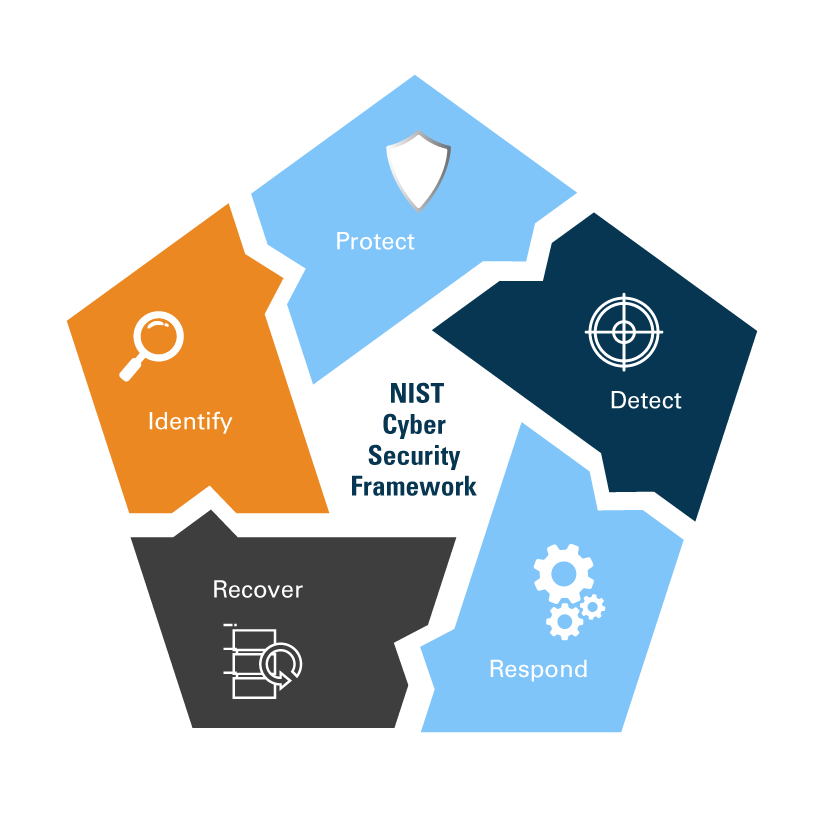
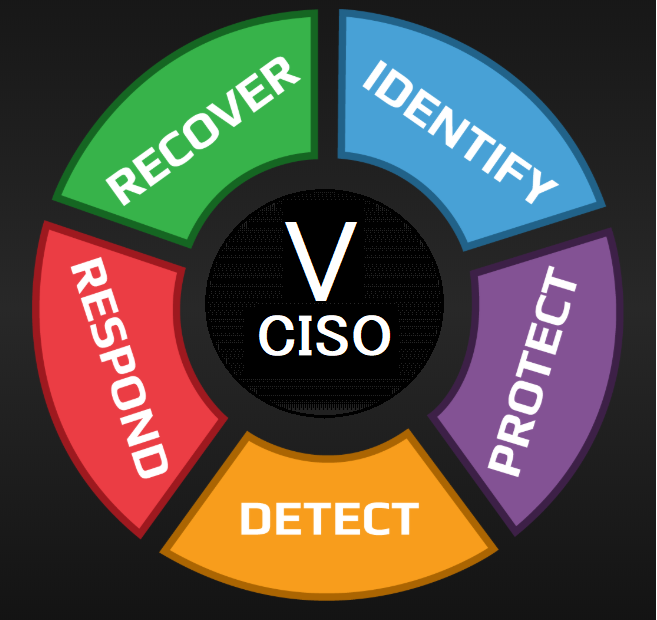
The framework core provides a unified structure of cybersecurity management processes, with the five main functions being Identify, Protect, Detect, Respond, and Recover. For each function, multiple categories and subcategories are then defined. This is where organizations can pick and mix to put together a set of items for each function that corresponds to their individual risks, requirements, and expected outcomes. For clarity and brevity, each function and category has a unique letter identifier, so for example Asset Management within the Identify function is denoted as ID.AM, while Response Planning within the Response function is RS.RP.
Each category includes subcategories that correspond to specific activities, and these subcategories get numerical identifiers. To give another example, subcategory Detection processes are tested under the Detection Processes category and Detect function is identified as DE.DP-3. Subcategory definitions are accompanied by references to the relevant sections of standards documents for quick access to the normative guidelines for each action.
Applying the NIST framework to application security
By design, the NIST CSF has an extremely broad scope and covers far more activities than any specific organization is likely to need. To apply the framework to web application security, you start by analyzing each of the five functions as they relate to your existing and planned application security activities and risk management processes. Then, you select the categories and subcategories relevant to your specific needs and use them as the backbone of your own security policy to ensure you cover all the risks and activities you need. For general web application security, a skeleton cybersecurity policy would need to include at least the following subcategories for each function:
Identify:
ID.AM-2: Software platforms and applications within the organization are inventoried
ID.RA-1: Asset vulnerabilities are identified and documented
Protect:
PR.AC-4: Access permissions and authorizations are managed, incorporating the principles of least privilege and separation of duties
Learn to identify security vulnerabilities in applications and implement secure code practices to prevent events like data breaches and leaks. Become familiar with DevSecOps practices, and SAST for identifying security flaws.
The Chrome web browser was recently updated to a new stable version released by Google. Google Chrome’s updated version Chrome 106 offers a number of brand-new features and improvements, and it also includes a number of security updates.
The new version of Chrome 106 has been already released by Google to the stable channel for all the major platforms:-
Windows (Chrome 106.0.5249.61/62)
Mac (Chrome 106.0.5249.61)
Linux (Chrome 106.0.5249.61)
In the course of hours, days, or even weeks, the update will be rolled out to all devices throughout the world in phases.
Security fixes
This update contains 20 security fixes that have been applied to Chrome 106 Stable so far. As usual, the official release notes only include a list of security issues that were reported externally to the developers.
There are different levels of security ratings, the highest being high. There have been at least five security issues that have been publicly disclosed. These five flaws were rated as high, while the remaining have been rated between medium and low.
Here below we have mentioned those five high severity security vulnerabilities:-
CVE-2022-3304: Use after free in CSS.
CVE-2022-3201: Insufficient validation of untrusted input in Developer Tools.
CVE-2022-3305: Use after free in Survey.
CVE-2022-3306: Use after free in Survey.
CVE-2022-3307: Use after free in Media.
There seem to be no exploits in the wild that take advantage of any of the issues. The release notes for this version do not mention anything about that.
Update Now
To speed up the installation of the Chrome 106 update, Chrome users can load the following URL in the address bar of the browser:-
chrome://settings/help
Whenever you open this webpage in Chrome, it will display the current version and automatically check for any updates that have been released.
NJVC has been added to the victim list of the BlackCat (ALPHV) ransomware gang. NJVC provides IT support to the US government’s intelligence and defense organizations.
With annual revenue of over $290 million, the company NJVC has a very impressive record. It is claimed that the BlackCat Ransomware Gang has hacked the Department of Defense of the United States of America.
DarkFeed, a deep web intelligence company that operates on the dark web, spotted the message on 28 September. There was a breach declaration provided by BlackCat, which resulted in its immediate suspension. TheRegister said.
Until 30 September, the Dark Web site that hosted BlackCat’s leak site was accessible. NJVC is no longer listed as a victim of the gang and has been removed from its website.
“We strongly recommend that you contact us to discuss your situation. Otherwise, the confidential data in our possession will be released in stages every 12 hours. There is a lot of material,” ALPHV said, per the screenshot.
Earlier today it was reported that ALPHV ransomware group had breached a United States Department of Defense contracting company which provides IT infrastructure services.
In late 2021, the first outbreaks of BlackCat ransomware were observed, and the Rust programming language was used in BlackCat.
Ransomware-as-a-service (RaaS) is one of the business models operated by this organization, just like so many others in the criminal underworld.
A number of prominent ransomware families are known to have been used by threat actors who started deploying BlackCat ransomware.
Here below we have mentioned those ransomware families:-
Conti
LockBit
REvil
Darkside and Blackmatter ransomware cartels are linked with the BlackCat cartel. This group may have a well-established network with close ties to the ransomware industry in the case of the ransomware business.
As one of the most active ransomware gangs in recent years, BlackCat has been among the most prominent. It is estimated that in 2022, near about 12% of all attacks were perpetrated by this group.
It is estimated that the group’s activity has increased by 117% since the quarter before, in comparison with the quarter prior. Moreover, as part of the group’s strategy, high-profile, critical industries are being targeted by the group.
The Italian luxury sports car manufacturer Ferrari confirmed the availability of internal documents online, but said it has no evidence of cyber attack.
Documents belonging to the Italian luxury sports car manufacturer Ferrari are circulating online, the company confirmed their authenticity stating it is not aware of cyber attacks.
Ferrari is investigating the leak of the internal documents and announced it will implement all the necessary actions.
While the circumstance suggests the company could have suffered a ransomware attack, the car manufacturer that it has no evidence of a compromise of its systems or ransomware, it also added that its business and operations were not impacted.
The news of the alleged cyber attack was first reported by the Italian website Red Hot Cyber which first reported that the ransomware gang RansomEXX claimed to have breached the popular car maker on its Tor leak site.
The ransomware group claimed to have stolen 6.99GB of data, including internal documents, datasheets, repair manuals, etc.
The source of the documents is still unclear. In the past, the ransomware gang Everest breached the systems of the Speroni SPA, a company in the supply chain of multiple car makers, including Ferrari and leaked company documents online.
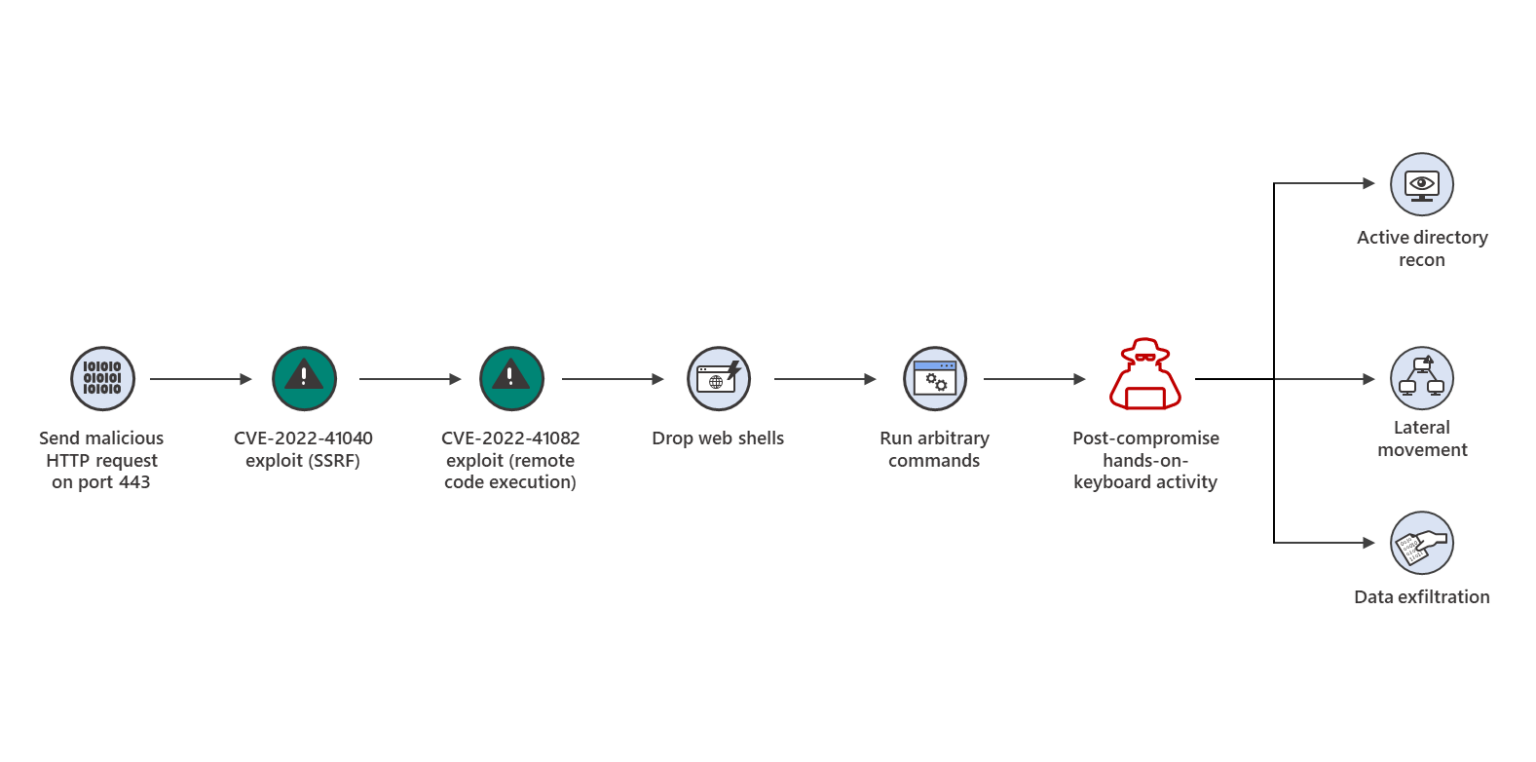
In August 2022, hackers launched a limited wave of attacks that targeted at least 10 organizations around the world.
There are two newly disclosed zero-day vulnerabilities being exploited by the hackers in these attacks in order to gain access to and compromise Exchange servers in these attacks.
Chopper web shell was installed during these attacks in order to make hands-on keyboard access more convenient. Attackers utilize this technique to gain access to Active Directory in order to perform reconnaissance and exfiltration of data.
As a result of these wild exploits, it is likely that these vulnerabilities will be weaponized further in the coming days due to the growing trend toward weaponizing them.
0-Day Flaws Exploited
Here below we have mentioned the two 0-Day flaws exploited by the hackers in the wild to attack 10 organizations:-
CVE-2022-41040: Microsoft Exchange Server Elevation of Privilege Vulnerability with CVSS score: 8.8.
CVE-2022-41082: Microsoft Exchange Server Remote Code Execution Vulnerability with CVSS score: 8.8.
The combination of these two zero-day vulnerabilities together has been named “ProxyNotShell.” The exploitation of these vulnerabilities is possible by using a standard account with a standard authentication process.
In many different ways, it is possible to acquire the credentials of standard users. While the GTSC, a Vietnamese cybersecurity company, was the first to discover the vulnerabilities that have been exploited.
It is suspected that these intrusions were carried out by a Chinese threat actor.
Mitigation
No action is required on the part of Microsoft Exchange Online customers. Microsoft recommended reviewing the URL Rewriting Instructions for Microsoft Exchange customers using on-premises Exchange and also recommended users implement them immediately.
If you are a Microsoft Exchange Server user using Microsoft 365 Defender, then you have to follow the following checklist provided by Microsoft:-
Enable cloud-based protection in Microsoft Defender Antivirus.
Protect security services from being interrupted by attackers by enabling tamper protection.
Microsoft Defender for Endpoint can detect malicious artifacts when EDR is operating in block mode.
Protect the Internet network from malicious domains and other malicious content by enabling network protection.
Enable full automation for investigation and remediation. By doing so Microsoft Defender for Endpoint can be notified of breaches immediately, allowing it to take immediate action.
Discovering your network’s devices will allow you to have greater visibility into what’s going on.
While as additional prevention measures they also recommended users to:-
The White House published a memo requiring agencies to comply with guidance from the Office of Management and Budget (OMB) which aims to improve software supply chain integrity and security.
Signed by OMB Director Shalanda Young, the memo builds on Executive Order (EO) 14028, Improving the Nation’s Cybersecurity from May 2021, which is focused on the security and integrity of the software supply chain.
That EO emphasized the importance of secure software development environments and directed the National Institute of Standards and Technology (NIST) to issue guidance identifying practices that enhance the security of the software supply chain.
The recent memo, published on September 14, requires each federal agency to comply with the NIST guidance when using third-party software on the agency’s information systems or otherwise affecting the agency’s information.
Tim Mackey, principal security strategist at the Synopsys Cybersecurity Research Center, said it is heartening to see the memo establish a desire for consistency in the process by which they obtain self-attestations from suppliers.
“Such consistency and any eventually-centralized repository should help minimize the burden suppliers have in complying with the requirements of this memo,” he explained. “This is the first point where we have a directive for agencies to comply with guidance emerging from EO 14028.”
Software Supply Chain Security: A Challenging Space
Mackey said the single most important thing to realize is that software security is a problem space and that there is no silver bullet.
“No single action will prevent the next ransomware attack and the execution of tools doesn’t inherently fix vulnerabilities,” he said. “This is a highly technical space that is rather complex and nuanced. Well-intentioned humans will always make some mistakes and perfection isn’t attainable.”
That means the IT security industry needs to accept that software will always have weaknesses that can be exploited in certain circumstances.
“The moment you combine software into a supply chain, the potential for weaknesses increases and the potential for the authors of components within the supply chain to know the circumstances of how their software is used goes down,” Mackey said.
Rick Holland, CISO and vice president of strategy at Digital Shadows, a provider of digital risk protection solutions, said from his perspective, the White House’s EO on improving the nation’s cybersecurity was a step in the right direction.
He said the OMB guidance is another good step; however, he added that this is a very long journey that will be measured not in months, but in years and, possibly, decades.
“The guidance focuses on vendor self-attestations and not independent validation,” he pointed out. “A government software supplier could claim to comply with NIST standards, but without third-party confirmation, the agency won’t know for sure. Zero-trust principles should apply here, too; don’t trust that a supplier is compliant—confirm it.”
He argued that the biggest threat to supply chain security is the complexity in defending against supply chain threats.
“Point-in-time security questionnaires are a legal requirement, not a preventive control. The number of third-party providers can be staggering, with security teams having to assess hundreds of providers,” he said.
Holland pointed out that security teams often don’t know the sensitive data their suppliers can access or the attack paths coming from their partners.
“Adversaries often do a better job of data discovery than defenders,” he added.
A Plan For Moving Forward
Mike Parkin, senior technical engineer at Vulcan Cyber, a provider of SaaS for enterprise cybersecurity risk remediation, said the idea behind the government’s plan is good and the NIST guidelines are solid.
“What remains to be seen is how vendors will implement the guidance and whether it is enough to deal with a very dynamic threat space,” he added.
He said while zero-day vulnerabilities still get the biggest headlines, the fact remains that users represent the broadest threat surface.
“Phishing, social engineering and other attacks against personnel remain consistent threat vectors and will almost certainly remain so,” he explained. “Having the most secure application code and supply chain won’t help when users are still giving up their passwords.”
Parkin said by requiring third-party vendors to adhere to the NIST standards, they can encourage them to develop software that is more secure and more robust—but that only really applies to vendors that want to work in the government space.
“They can’t necessarily push those standards on the public sector,” he noted. “And without a robust testing scheme to assure that when a vendor says ‘We comply’, that they actually do, some risks will remain.”
Mackey said mitigating software supply chain threats requires an understanding of the risk such threats pose to both the production of software and its associated operation and communicating the nature of those risks from producers to operators.
Properly managing software supply risk requires teams to move from a paradigm where tools are run and teams “do security” to one where the impact of findings from tools are understood and mitigations are made based on the context of how the given application runs.
“Solving this problem requires teams to think in terms of risk analysis first and then identify which tooling is best positioned to provide data supporting the analysis,” he explained.
Parkin added that threat actors have always adapted to the defenses put in place to stop them, and it’s difficult to say what technique they’ll shift to next.
“They will continue to look for vulnerabilities in the software, and they will continue to go after the users using whatever technique they find works,” he warned.
WhatsApp silently fixed two critical zero-day vulnerabilities that affect both Android & iOS versions allowing attackers to execute an arbitrary code remotely.
Facebook-owned messenger WhatsApp is one of the Top-ranked Messenger apps with more than Billion users around the world in both Android and iPhone.
Both vulnerabilities are marked under “critical” severity with a CVE Score of 10/10 and found by the WhatsApp internal security Team.
WhatsApp 0-Day Bugs
CVE-2022-36934 – An integer overflow in WhatsApp for Android prior to v2.22.16.12, Business for Android prior to v2.22.16.12, iOS prior to v2.22.16.12, Business for iOS prior to v2.22.16.12 could result in remote code execution in an established video call.
Simplifying these following vulnerabilities, Whatsapp could cause your device to be hacked by receiving a Video File or When on a Video call.
CVE-2022-36934 – Integer Overflow Bug
An Integer overflow bug that affects WhatsApp allows attackers to execute the specially crafted arbitrary code during an established Video call without any sort of user interaction.
An integer overflow also know as “wraparound” occurs when an integer value is incremented to a value that is too large to store in the associated representation.
This RCE bug affects an unknown code of the WhatsApp component Video Call Handler, which allows an attacker to manipulate the bug to trigger a heap-based buffer overflow and take complete control of WhatsApp Messenger.
“A heap overflow condition is a buffer overflow, where the buffer that can be overwritten is allocated in the heap portion of memory, generally meaning that the buffer was allocated using a routine such as malloc().”
Hackers can take advantage of this remote code execution vulnerability to deploy the malware on the user’s device to steal sensitive files and also used for surveillance purposes.
According to WhatsApp Advisory “An integer overflow in WhatsApp for Android prior to v2.22.16.12, Business for Android prior to v2.22.16.12, iOS prior to v2.22.16.12, Business for iOS prior to v2.22.16.12 could result in remote code execution in an established video call.”
Parrot created the latest release of the operating system to ensure it was as stable and adaptable as possible. There are a number of factors that have contributed to the success of this project.
Here below we have mentioned all the new additions:-
New kernel 5.18
Updated docker containers
Updated backports
System updates
Firefox profile overhault
Major updates for tools
New AnonSurf 4.0
Parrot IoT improvements
Architect Edition improvements
New infrastructure powered by Parrot and Kubernetes
How to Download or Update?
The Parrot OS 5.1 can be downloaded by clicking on the following link. In order to keep users safe, ParrotSec always recommends to users that third-party sources should never be trusted.
You can also use the official torrent files for these downloads if the direct downloads are not working for you. As in most cases, the firewall and network restrictions can be circumvented by doing so.
If you are already using any older version of Parrot OS then you can update to the latest version and to do so you have to follow a few commands that we have mentioned below:-
If you’re into ISO implementation or auditing, then you know that ISO books are a valuable resource. They can teach you new things, introduce you to new concepts around implementation, auditing and help you stay up-to-date on the latest trends in your field. That’s why I’ve put together this list of 6 essential reference eBooks for ISO professional.
THE SHORT HANDBOOK CONTAINING EXPERT GUIDANCE ON ISO INTERNAL AUDIT
Author, auditor, and experienced ISO consultant Dejan Kosutic has created this shorter book, as part of the handbook ISO pocket book series, focused solely on preparing for the ISO internal audit.
This book, ISO Internal Audit: A Plain English Guide, is based on Advisera’s internal auditor online courses. It provides a quick read for people who are focused solely on preparing for ISO 9001, ISO 14001, ISO 27001, OHSAS 18001, ISO 22000, ISO 20000, or internal audits against any other ISO standard, and don’t have the time (or need) to read a comprehensive book about ISO implementation. It has one aim in mind: to give you the knowledge and practical tips to prepare for the ISO internal audit without struggle, stress, or headaches.
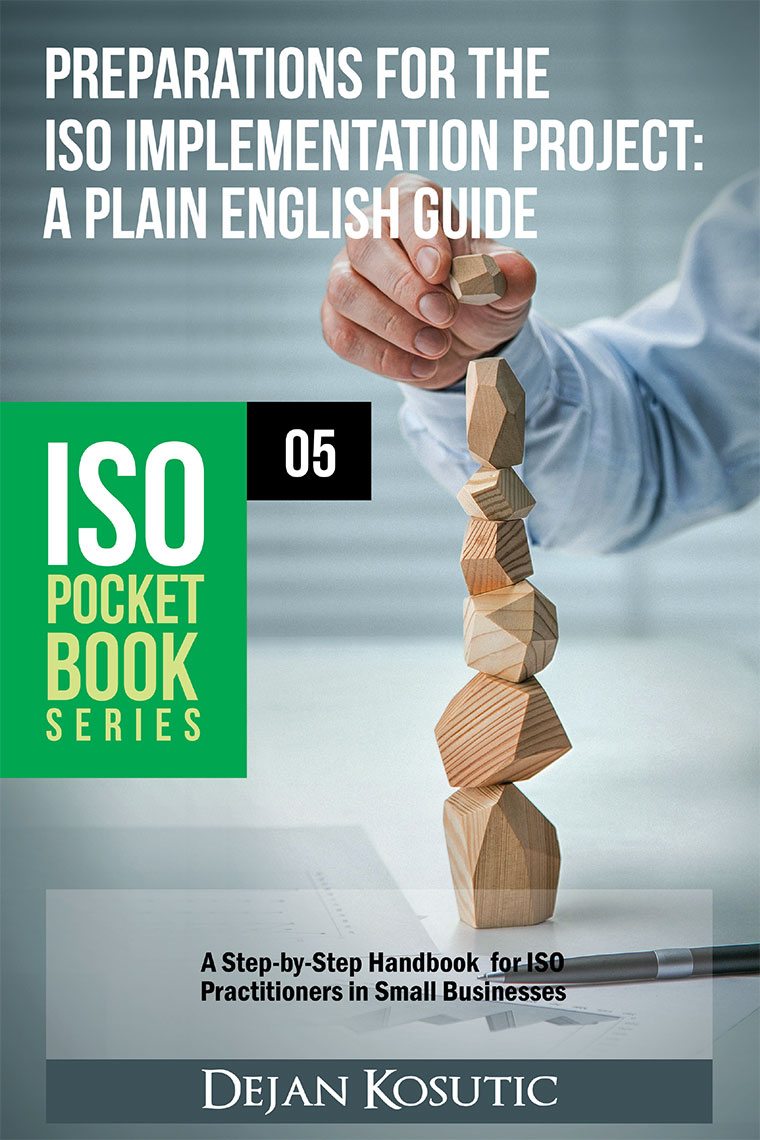
Author and experienced ISO consultant Dejan Kosutic has created this shorter book as part of the ISO pocket book series, focused solely on preparation for the ISO implementation.
This book, Preparations for the ISO Implementation Project: A Plain English Guide, is based on an excerpt from Kosutic’s previous book Secure & Simple. It provides a quick read for people who are focused solely on preparation for the implementation of an ISO standard (e.g., ISO 9001, ISO 14001, ISO 27001, ISO 20000, ISO 22000, OHSAS 18001, ISO 13485, or IATF 16949), and who don’t have the time (or need) to read a comprehensive book about ISO implementation. It has one aim in mind: to give you the knowledge and practical advice you need to prepare for your ISO implementation without struggle, stress, or headaches.
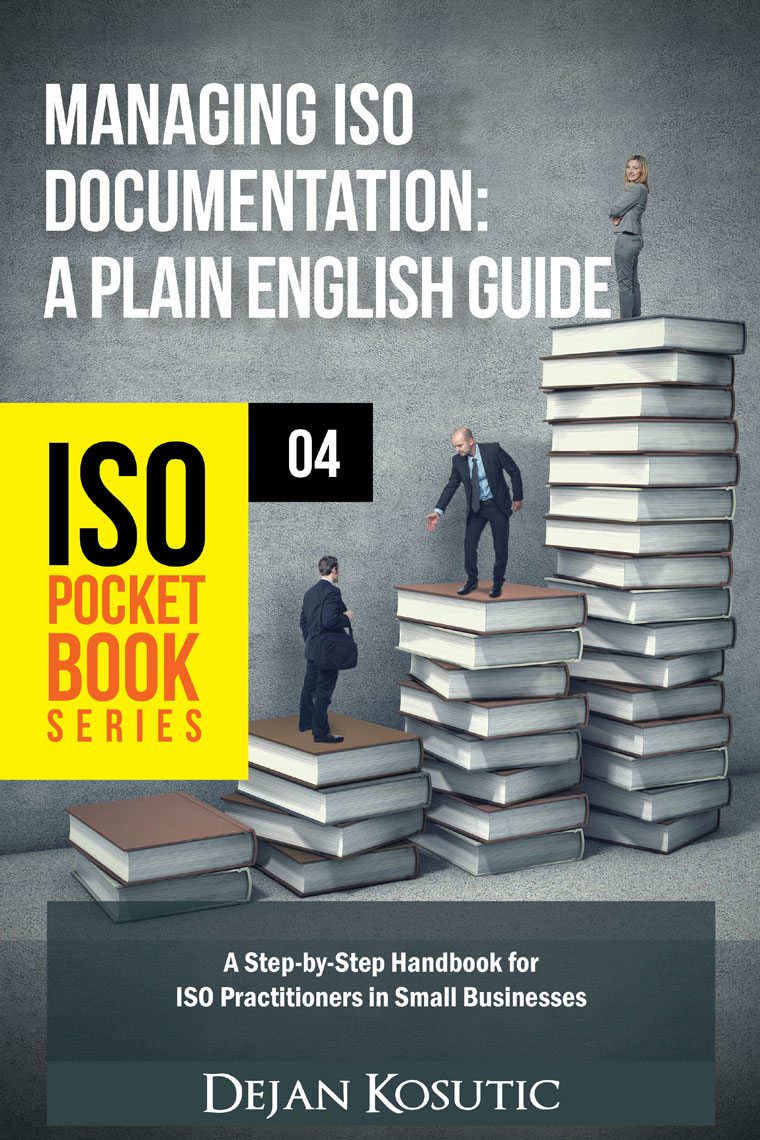
Author and experienced ISO consultant Dejan Kosutic has created this shorter book, as part of the ISO pocket book series, focused solely on managing ISO documentation.
This book, Managing ISO Documentation: A Plain English Guide, is based on an excerpt from Kosutic’s previous book Secure & Simple. It provides a quick read for people who are focused solely on preparing documentation for ISO 9001, ISO 14001, ISO 27001, ISO 20000, ISO 22000, OHSAS 18001, ISO 13485, and/or IATF 16949, and don’t have the time (or need) to read a comprehensive book about ISO implementation. It has one aim in mind: to give you the knowledge and practical tips to manage your ISO documentation without struggle, stress, or headaches.
Author, certification auditor, and experienced ISO consultant Dejan Kosutic has created this shorter book, as part of the handbook ISO pocket book series, focused solely on preparing for the ISO 9001/ISO 14001/ISO 27001 certification audit.
This book, Preparing for ISO Certification Audit: A Plain English Guide, is based on an excerpt from Kosutic’s previous book Secure & Simple. It provides a quick read for people who are focused solely on preparing for ISO 9001, ISO 14001, ISO 27001, or certification audit against any other ISO standard, and don’t have the time (or need) to read a comprehensive book about ISO implementation. It has one aim in mind: to give you the knowledge and practical tips to prepare for the ISO certification audit process and pass the certification without struggle, stress, or headaches.
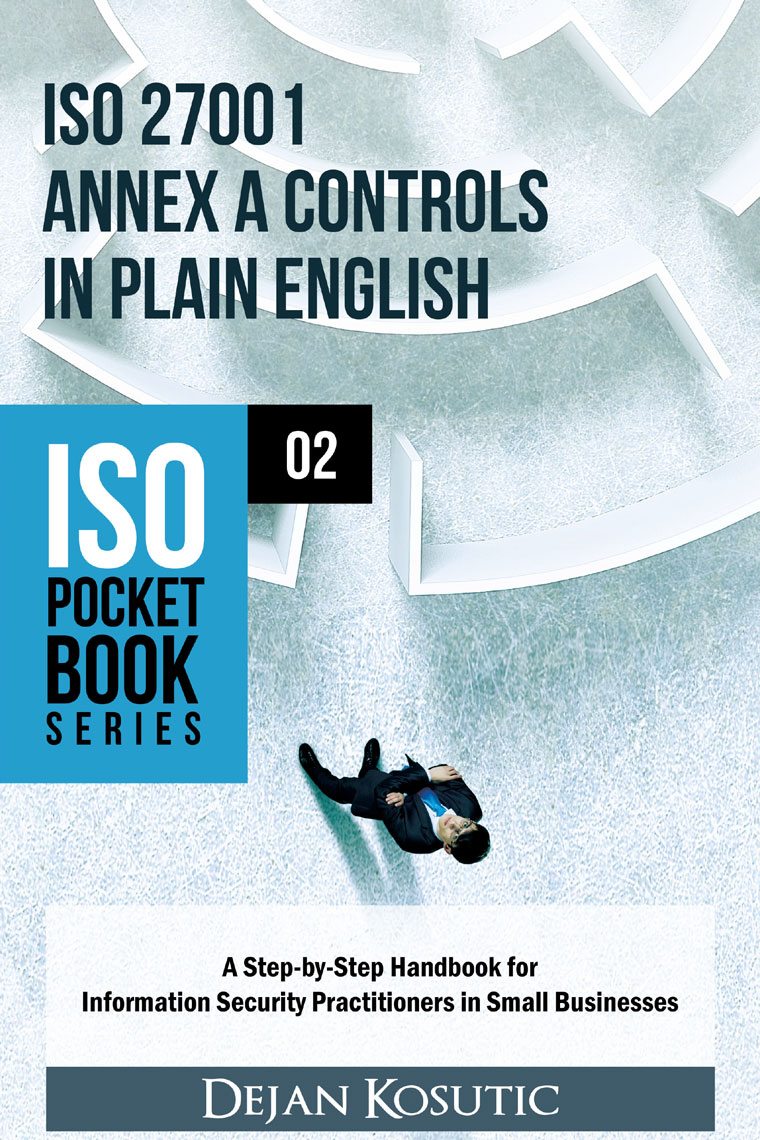
Author and experienced information security consultant Dejan Kosutic has created this shorter book, as part of the ISO pocket book series, focused solely on safeguards specified in ISO 27001:2013.
This book, ISO 27001 Annex A Controls in Plain English, is based on an excerpt from his previous book Secure & Simple. It provides a quick read for people who are focused solely on security controls, and don’t have the time (or need) to read a comprehensive book about ISO 27001. This series of handbooks has one aim in mind: To help you understand what these 114 controls are all about. In the second book of this series, ISO 27001 Annex A Controls in Plain English.
THE SHORT HANDBOOK CONTAINING EXPERT GUIDANCE FOR THE RISK MANAGEMENT OF ISO 27001
Author and experienced information security consultant Dejan Kosutic has created this shorter book, as part of the handbook ISO pocket book series, focused solely on the issues of risk management according to ISO 27001.
This book, ISO 27001 Risk Management in Plain English, is based on an excerpt from his previous book Secure & Simple. It provides a quick read for people who are focused solely on risk management, and don’t have the time (or need) to read a comprehensive book about ISO 27001. It has one aim in mind: to give you the knowledge and practical step-by-step process you need to successfully implement ISO 27001 risk assessment and treatment – without struggle, stress, or headaches.
The Brute Ratel post-exploitation toolkit has been cracked and now is available in the underground hacking and cybercrime communities.
Threat actors have cracked the Brute Ratel C4 (BRC4) post-exploitation toolkit and leaked it for free in the cybercrime underground. The availability of the cracked version of the tool was first reported by the cybersecurity researcher Will Thomas (@BushidoToken),
ICYMI, threat actors on multiple underground forums are sharing around a copy of a cracked version of Brute Ratel (aka BRC4), brace for attacks
Unlike Cobalt strike beacons, BRc4 payloads are less popular, but with similar capabilities. The tool was specifically designed to avoid detection by security solutions such as endpoint detection and response (EDR) and antivirus (AV). Its effectiveness at doing so can clearly be witnessed by the aforementioned lack of detection across vendors on VirusTotal.
“Brute Ratel is the most advanced Red Team & Adversary Simulation Software in the current C2 Market. It can not only emulate different stages of an attacker killchain, but also provide a systematic timeline and graph for each of the attacks executed to help the Security Operations Team validate the attacks and improve the internal defensive mechanisms.” reads the description of the tool on its website. “Brute Ratel comes prebuilt with several opsOpec features which can ease a Red Team’s task to focus more on the analytical part of an engagement instead of focusing or depending on Open source tools for post-exploitation. Brute Ratel is a post-exploitation C2 in the end and however does not provide exploit generation features like metasploit or vulnerability scanning features like Nessus, Acunetix or BurpSuite.”
In June, researchers from Palo Alto Networks Unit 42 warned that threat actors are abusing legitimate adversary simulation software BRc4 in their campaigns to evade detection.
In July 2022, Sophos investigated an incident involving the use of the Brute Ratel tool in the wild, alongside Cobalt Strike, that was carried out by ALPHV/BlackCat ransomware gang.
Thomas is warning that a cracked copy of Brute Ratel is now circulating on multiple underground forums.
On 13 September 2022, an archive file called “bruteratel_1.2.2.Scandinavian_Defense.tar.gz” was uploaded to VirusTotal. This file contains a valid copy of BRC4 version 1.2.2/5.
Two weeks later, on 28 September, the author of BRC4, Chetan Nayak, confirmed the leak of the tool by MdSec, he blamed a Russian-speaking group known as Molecules for the leak of the cracked copy.
Brc4 v1.2.2/5 was leaked by MdSec and is circling the internet. I am tracking it over the past few weeks. MdSec uploaded the whole package to VT which was cracked by a Russian group Molecules, and now used by TAs which will most likely create an irrepairable damage. blog incoming pic.twitter.com/3NpUh2lOYF
— Chetan Nayak (Author of Brute Ratel C4) (@NinjaParanoid) September 28, 2022
“This means that with the right instructions, the cracked tool can now be run without the activation key that is required to launch the full software and use its features.” wrote Thomas. “There are now multiple posts on multiple of the most populated cybercrime forums where data brokers, malware developers, initial access brokers, and ransomware affiliates all hang out. This includes BreachForums, CryptBB, RAMP, Exploit[.]in, and Xss[.]is, as well as various Telegram and Discord groups. Threat actors connected to various organized cybercrime groups have expressed interest in the leak of the new tool.”
Searching for active threads on hacking forums like XSS it is already possible to find the cracked version of Brute Ratel C4 version 1.2.2.
The availability of the tool in the wild is very concerning because the post-exploitation tool can generate shellcode that is undetected by many EDR and AV products.
“This extended window of detection evasion can give threat actors enough time to establish initial access, begin lateral movement, and achieve persistence elsewhere. Due to its evasive generation of new payloads it renders stopping Brute Ratel by the traditional blocking of Indicators of Compromise (IOCs) inadequate. It is recommended that defenders use behaviour-based detection opportunities to thwart attacks, like the ones outlined in MdSec’s blog (see here).” concludes Thomas. “Overall, enterprises and public sector organizations must recognize the imminent threat of the proliferation of this tool. Its capabilities closely align with the objectives of ransomware groups that are already highly active and looking for new windows of opportunity.”
If you’re into web API security testing, then you know that API hacking books are a valuable resource. They can teach you new things, introduce you to new concepts around breaking web application programming and help you stay up-to-date on the latest trends in your field. That’s why I’ve put together this list of 5 essential books for any API hacker!
API security and you
So before I go through the list of book recommendations, I want to preface that if you are a security researcher who wants to conduct web API security testing, the reality is it’s just as important to focus on the web applications themselves.
As such, a crash course in web hacking fundamentals never hurts. So some of my recommendations may seem more focused on that than on breaking web application programming interfaces.
You may also notice that I also recommend a few books that focus on bounty programs and make it possible to make a living as you break APIs.
The point is, regardless of where you are in your API hacking career, these books can help. I have organized them in such a way that if you can’t afford to buy them all just yet, start from the top and work your way down.
Book #1 : Hacking APIs: Breaking Web Application Programming Interfaces
This is one of the few books that is actually dedicated to API hacking.
This book is a great resource for anyone who wants to learn more about API security and how to hack into web applications. It provides in-depth information on how to break through various types of APIs, as well as tips on how to stay ahead of the curve in this rapidly changing field. Corey also shares his own personal experiences with API hacking, which makes the content even more valuable. If you’re interested in learning more about API security and want to start from the basics, then this is the perfect book for you!
Book #2 : The Web Application Hacker’s Handbook: Finding and Exploiting Security Flaws
This book is a tomb of information. It’s the oldest book on the list and by far the largest.
The Web Application Hacker’s Handbook is an essential read for anyone looking to understand how web application vulnerabilities are discovered and exploited. The book is filled with in-depth technical information and real-world examples that will help you understand the inner workings of web applications and how to protect them from potential attacks.
One of the best features of this book is the “Hands-On” sections, which provide you with step-by-step instructions on how to find and exploit various vulnerabilities. This makes it an ideal resource for both beginner and experienced hackers alike.
If you’re looking to beef up your skills in web application security, then The Web Application Hacker’s Handbook is a must-read!
Book #3 : Web Application Security: Exploitation and Countermeasures for Modern Web Applications
Sometimes before focusing on offense, we have to know defensive tactics.
This book provides in-depth coverage of all the major areas of web application security, from vulnerabilities and exploits to countermeasures and defense strategies. Written by security expert Andrew Hoffman, this book is packed with real-world examples and step-by-step instructions that will help you understand how developers protect their web applications from potential attacks.
If you’re serious about web application security, then this is the perfect book for you!
Book #4 : Bug Bounty Bootcamp: The Guide to Finding and Reporting Web Vulnerabilities
If you are looking at being an independent security researcher focused on web API security testing, finding high payout API bugs may be important.
Bug Bounty Bootcamp is a guide to becoming a bug bounty hunter. The book covers the basics of hunting for bugs, including how to find and report them. It also includes a number of case studies of successful bug bounty hunting, detailing methods and strategies.
In chapter 24 of the Expert Techniques section, Vicki goes deeper into discussing multiple API attack techniques.
Overall, Bug Bounty Bootcamp is an informative and well-written guide that should be of interest to anyone considering a career in API hacking through bug bounty hunting.
Book #5 : Real-World Bug Hunting: A Field Guide to Web Hacking
“Real-World Bug Hunting” is a brilliant resource for anyone who aspires to be a professional bug hunter. The book is written by Peter Yaworski, who is himself a professional bug hunter.
He begins by delving into the mindset of a bug hunter – what drives them to find vulnerabilities in software and systems? He then provides an overview of the bug hunting process, from identifying potential targets to writing up a report. The bulk of the book is devoted to teaching readers how to find and exploit common web application vulnerabilities.
Yaworski provides clear and concise explanations of each vulnerability, along with examples of real-world exploits. He also offers advice on how to avoid getting caught by security teams and how to maximize the value of your findings. “Real-World Bug Hunting” is an essential read for anyone who wants to make a career out of finding bugs.
Conclusion
These five books are essential readings for anyone interested in hacking APIs. They provide detailed information on how to find and exploit vulnerabilities, as well as defensive tactics and strategies. If you want to be a successful API bug bounty hunter, then these books will also give you the tools and techniques you need to get started.