InfoSec Compliance & AI Governance For over 20 years, DISC InfoSec has been a trusted voice for cybersecurity professionals—sharing practical insights, compliance strategies, and AI governance guidance to help you stay informed, connected, and secure in a rapidly evolving landscape.
Creation of the Joint Cyber Defense Collaborative follows high-profile cyberattacks on critical U.S. infrastructure
The U.S. government is enlisting the help of tech companies, including Amazon.com Inc., Microsoft Corp. and Google, to bolster the country’s critical infrastructure defenses against cyber threats after a string of high-profile attacks.
The Department of Homeland Security, on Thursday, is formally unveiling the initiative called the Joint Cyber Defense Collaborative. The effort will initially focus on combating ransomware and cyberattacks on cloud-computing providers, said Jen Easterly, director of the DHS’s Cybersecurity and Infrastructure Security Agency. Ultimately, she said, it aims to improve defense planning and information sharing between government and the private sector.
“This will uniquely bring people together in peacetime, so that we can plan for how we’re going to respond in wartime,” she said in an interview. Ms. Easterly was sworn in as CISA’s director last month. She was previously a counterterrorism official in the Obama White House, and the commander of the Army’s first cyber operations unit at the National Security Agency, America’s cyberspy agency.
‘This will uniquely bring people together in peacetime, so that we can plan for how we’re going to respond in wartime.’— Jen Easterly, director of the Cybersecurity and Infrastructure Security Agency
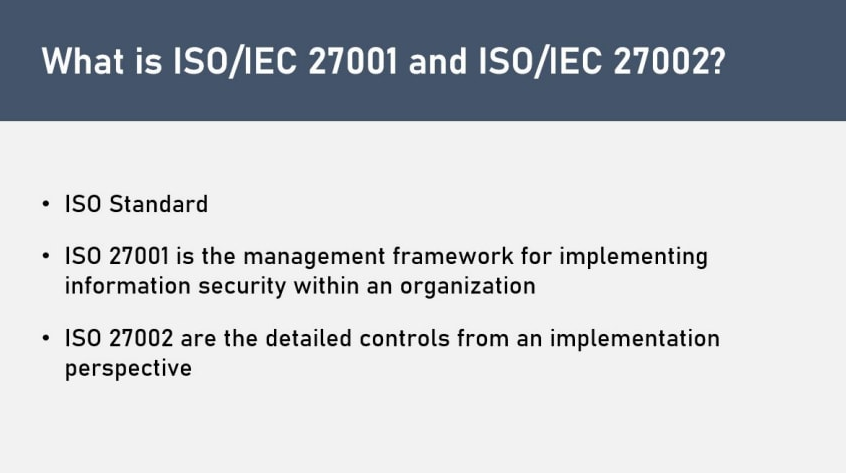
However, you might not be as familiar with ISO 27002. It’s a supplementary standard that provides advice on how to implement the security controls listed in Annex A of ISO 27001.
Although ISO 27001 is the more well-known standard – and the one that organisations certify to – neither can be considered in isolation. This blog explains why that’s the case, helping you understand how each standard works and the differences between them.
What is ISO 27001?
ISO 27001 is the central framework of the ISO 27000 series, which is a series of documents relating to various parts of information security management.
The Standard contains the implementation requirements for an ISMS. These are essentially an overview of everything you must do achieve compliance.
This is particularly useful at the start of your project, or if you’re looking for general advice but can’t commit to a full-scale implementation project.
ISO 27002 is a supplementary standard that focuses on the information security controls that organisations might choose to implement.
These controls are listed in Annex A of ISO 27001, which is what you’ll often see information security experts refer to when discussing information security controls. However, whereas Annex A simply outlines each control in one or two sentences, ISO 27002 dedicates an average of one page per control.
This is because the Standard explains how each control works, what its objective is, and how you can implement it.
The differences between ISO 27001 and ISO 27002
There are three main differences between ISO 27001 and ISO 27001:
Detail
If ISO 27001 went into as much detail as ISO 27002, it would be unnecessarily long and complicated.
Instead, it provides an outline of each aspect of an ISMS, with specific advice being found in additional standards. ISO 27002 is only one of these. For example, ISO 27003 covers ISMS implementation guidance and ISO 27004 covers the monitoring, measurement, analysis and evaluation of the ISMS.
Certification
You can certify to ISO 27001 but not to ISO 27002. That’s because ISO 27001 is a management standard that provides a full list of compliance requirements, whereas supplementary standards such as ISO 27002 address one specific aspect of an ISMS.
Applicability
A key thing to consider when implementing an ISMS is that not all information security controls will apply to your organisation.
ISO 27001 makes that clear, specifying that organisations conduct a risk assessment to identify and prioritise information security threats. ISO 27002 doesn’t mention this, so if you were to pick up the Standard by itself, it would be practically impossible to figure out which controls you should adopt.
When you should use each standard
ISO 27001 and ISO 27002 have different objectives and will be helpful in different circumstances.
If you’re starting out with the Standard or are planning your ISMS implementation framework, then ISO 27001 is ideal. You should refer to ISO 27002 once you’ve identified the controls that you’ll be implementing to learn more about how each one works.
This one-day course provides a comprehensive introduction to the key elements required to comply with ISO 27001. You’ll learn from expert information security consultants and have the chance to review case studies and participate in group discussions and practical exercises.
Developed by the team that led the world’s first successful ISO 27001 implementation project, this one-day course provides a comprehensive introduction to Standard.
You’ll learn from expert information security consultants, as they explain:
ISO 27001 management system documentation;.
How to plan, scope and communicate throughout your ISO 27001 project; and
The key steps involved in an ISO 27001 risk assessment.
Check Point Research (CPR) experts have spotted a cheap malware, dubbed XLoader variant, which was upgraded to target both Windows and macOS PCs.
XLoader is a very cheap malware strain that is based on the popular Formbook Windows malware.
FormBook is a data-stealing malware that is used in cyber espionage campaigns, like other spyware it is capable of extracting data from HTTP sessions, keystroke logging, stealing clipboard contents. FormBook can also receive commands from a command-and-control (C2) server to perform many malicious activities, such as downloading more payloads. FormBook was offered for sale in the criminal underground since July, it goes for $29 a week up to a $299 full-package “pro” deal. The customers pay for access to the platform and generate their executable files as a service.
The malware was pulled from sale in 2017, but it continued to infect systems across the world. In March 2020, MalwareHunterTeam uncovered a Coronavirus (COVID-19)-themed campaign that was distributing a malware downloader that delivers the FormBook information-stealing Trojan.
CPR team has now monitored XLoader since it first appeared in the threat landscape in February. XLoader borrows the code base with Formbook, but it also included major improvements, such as the capability of compromising macOS systems.
“On February 6, 2020 a new era began: the era of the Formbook successor called XLoader. On this day, XLoader was advertised for sale in one of the underground groups.” states the report published by CheckPoint.“On October 20, 2020, XLoader was offered for sale on the same forum which was used for selling Formbook.”
Whether employees have been with the company for seven years or seven months, when they return to the office they should be treated as if it’s their first day at the company. All members of the team, no matter how veteran, should go through a refresher on security practices.
Your security team can do this by teaching or reminding staff how to properly manage and move data within its appropriate environment to minimize possible data exposure. This promotes healthy security practices and provides regular and customized training for the entire team.
If your company is moving to a hybrid workforce approach, ensure your employees are set up with the right knowledge and/or equipment they need for dual offices to minimize data loss. For instance, encourage use of company drives to access data from both locations rather than porting data via thumb drives.
There are many factors to considered when selecting a public cloud provider, but 56% in a recent survey said security concerns had the most significant influence during the selection process for public cloud providers, IT services management company Ensono said.
Above: Ensono Cloud Clarity Report uncovered several areas that significantly influenced buying decisions.
If you’re building a career in information security the Certified Information Systems Security Professional (CISSP) is the must-have qualification to help you progress. It is a globally recognized standard that demonstrates your competence as an IT professional.
This course will prepare you with the knowledge and skills to complete the CISSP exam, which will get you Certified Information Systems Security Professional status. professional. Covering topics including cloud computing, mobile security, application development security, and risk management, you will gain the knowledge to best manage information security issues back in your organization.
Duration: 5 days
“I would highly recommend the course to a friend, and in fact I already have! I’d also recommend it to a security team within an organization, even if they’re not specifically targeting a CISSP certification as it teaches a broad range of best practices and will help instill a culture of security and best practice in any organization.”
Who should attend?
This training course is intended for professionals who have at least 5 years of recent full-time professional work experience in 2 or more of the 8 domains of the CISSP common body of knowledge (CBK), such as:
Security consultants
Security managers
IT directors/managers
Security auditors
Security architects
Security analysts
Security systems engineers
Chief information security officers
Security directors
Network architects
Please note: A one year experience waiver is available with a 4-year college degree, or regional equivalent, or additional credentials from the (ISC)² approved list, thus requiring four years of direct full-time professional security work experience in 2 or more of the 8 domains of the CISSP CBK.
Don’t have 5 years of experience? – Become an Associate of (ISC)²
We all ought to know by now that passwords that are easy to guess will get guessed.
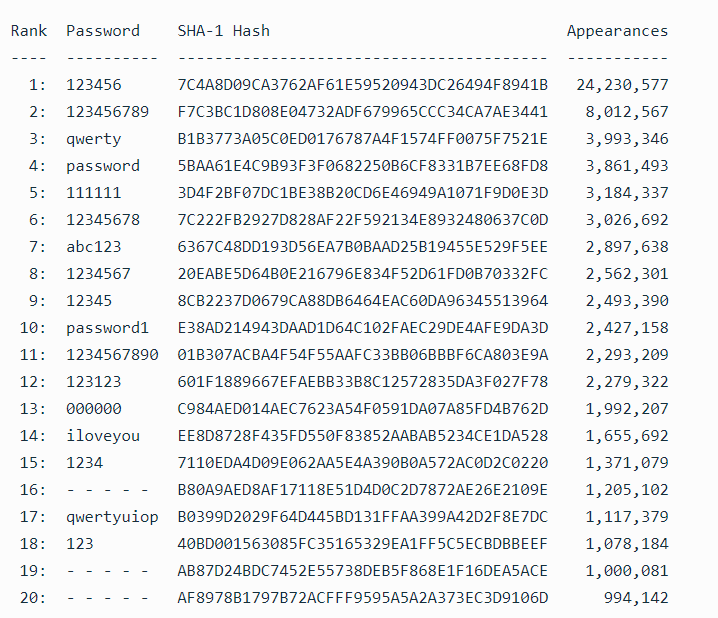
We recently reminded ourselves of that by guessing, by hand, 17 of the top 20 passwords in the Have I Been Pwned (HIBP) Pwned Passwords database in under two minutes.
We tried the 10 all-digit sequences 1, 12, 123 and so on up to 1234567890, and eight of them were in the top 20.
Then we tried other obvious digit combos such as 000000, 111111 and 123123 (we started with six digits because that’s Apple’s current minimum length, and because we noted that 123456 came out well ahead of 12345 and 1234).
The others were equally easy: qwerty, password, abc123, password1, iloveyou and qwertyuiop, the last being a useful reminder that length alone counts for very little.
Don’t re-use passwords. And don’t try to invent a technique for modifying each password slightly from an original template to make them seem different, because the crooks are on the lookout for that.
Consider a password manager. Password managers generate random and unrelated passwords for each account, so there are no similarities a crook could figure out, even if one of the password gets compromised. Remember that you don’t have to put all your passwords into the manager app if you don’t want to: it’s OK to have a special way of dealing with your most important accounts, especially if you don’t use them often.
Turn on 2FA if you can. Two-factor authentication doesn’t guarantee to keep the crooks out, but it stops attacks like this one from being carried out so easily and on such a broad scale, because the passwords alone would not have been enough.
Report payment anomalies. Obviously, you need to look for outgoing payments that shouldn’t have happened, and for incoming payments that never arrived. But also look out for outgoing payments that somehow failed when they should have gone through, or for incoming funds you didn’t expect, no matter how small the amount. The sooner you report any errors, even if you didn’t lose any money, the sooner you help both yourself and everyone else.
Our community – that is, technologists, mathematicians and information assurance professionals – has generally adapted well to changes in the technology landscape.
At the start of the Cold War, the western security apparatus sought to understand the actions of their adversaries by intercepting radio signals bouncing off the ionosphere and analyzing the messages they carried. Later, when the Soviets moved to microwave transmissions, that same security apparatus deployed cutting-edge line-of-sight interception techniques.
Then, in 1977, after the Soviets began to successfully encrypt their communications, the NSA launched the Bauded Signals Upgrade program, delivering a supercomputer designed to compare encrypted messages with elements of plain text transmitted by mistake, allowing the agency to break many of the Soviets’ high-level codes. Time and time again, our innovation has kept us safe, but only when we have prepared to meet the threat.
Quantum information theory, which has been explored since the beginning of the 20th century, has led to an exciting yet dangerous new prospect: new quantum algorithms to solve computational problems which have thus far proven to be intractable – or at least unachievable within a useful period – by classical computers. One such problem is the breaking of the Advanced Encryption Standard, a key pillar of modern data encryption.
A joint research team of engineers from Google and the Swedish Royal Institute of Technology published a study that theorized the breaking of a 2048 bit key in just 8 hours, something that would take today’s classical computers over 300 trillion years. The catch? This theory requires a 20 million-qubit computer, and the largest quantum computer that exists today has only 65.
Their study, alongside many like it, tells us that quantum technology will present the greatest threat to the security of our critical systems in the history of computing. It may even be useful to us in future conflicts. However, quantum computers will need considerably more processing power than is available today and will require a significantly lower error rate if they are to be utilized for cyberspace operations.
To meet this challenge, institutions across the world are rushing to develop quantum computers that are capable of delivering on the promising theory.
The U.S. National Institute of Standards and Technology is currently evaluating over 60 methods for post-quantum cryptography, quantum key distribution, and other security applications. Early indications are that quantum technology will provide an ability to detect, defend, and even retaliate against all manner of future threats.
Away from security, most people understand that quantum computing has immense potential for good – with applications in the scientific and medical research fields easy to imagine. However, this vast computing power could also be used to undermine the classical computer systems that our nation relies upon so heavily.
In the modern cloud-based application era, securing hardware is often neglected, so the volume of unmanaged devices noted above is not surprising. Endpoint management is hard, it’s boring, it’s time-consuming — but it’s nevertheless extremely important to a robust security strategy.
Why? Bad actors know that machines aren’t getting configured and maintained at the rate at which they should. This makes them ripe for exploitation. One of the easiest ways to attack corporate networks is through a machine that is not configured correctly or that hasn’t downloaded a patch to shore up a certain vulnerability.
Endpoint management: Scaling for a new world
VPNs have been under significant strain throughout the pandemic, and bandwidth is at a premium. This is part of the reason we’re seeing such rapid migration to the cloud. While there are numerous benefits to this move, it still doesn’t protect actual endpoints. To do this, regardless of environment, you need to find an endpoint management solution that can scale rapidly and not affect network performance.
This requires a novel approach to drive continuous compliance and configuration management across the enterprise. Of note, the latest peer-to-peer solutions can check the configuration of local or remote endpoints, diagnose problems, and/or remediate any issues found. Because of the nature of peer-to-peer, these solutions can conduct routine and advanced endpoint management at massive scale, addressing hundreds of thousands of endpoints without bandwidth throttling or hindering network performance.
Workers don’t even realize their systems are being updated. Being able to protect endpoints at scale without degrading the user experience or getting in the way of business processes is a game-changer in the remote world. It means that you can institute or return to a regular endpoint management schedule.
One of the biggest cities in the US by population size, the City of Tulsa, was victim of a ransomware attack that affected its government’s network and forced the shutdown of official websites over the weekend.
Shortly after the attack, that took place Friday night, the city issued a statement to inform that no customer information has been comprised in the security breach.
The City’s IT and security staff have shut down impacted internal systems to avoid the spreading of the threat. Emergency services such as 911 and the city’s public safety response will continue to operate normally.
“According to the Tulsa Police Department (TPD), 911 is operational and Tulsa’s public safety response is continuing as normal.” reported the Krmg website.
“As for utility billing, Tulsa police say new account registration is currently unavailable. Tulsans can make a payment on their account and view their bill as a guest as long as they have their new account number and customer ID, plus the name on their account exactly as it appears on their bill.”
The City of Tulsa reported the incident to the authorities and is investigating the infection with the help of external security experts.
The impact is believed to have impacted a small portion of the infrastructure, and internal experts are attempting to recover impacted systems from backups.
Unfortunately, ransomware attacks against cities in the US are very frequent and in many cases the victims opted to pay the ransomware to restore the operations.
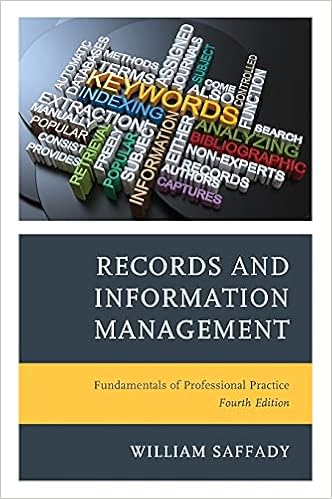
Records and Information Management: Fundamentals of Professional Practice, Fourth Edition presents principles and practices for systematic management of recorded information. It is an authoritative resource for newly appointed records managers and information governance specialists as well as for experienced records management and information governance professionals who want a review of specific topics. It is also a textbook for undergraduate and graduate students of records management or allied disciplines—such as library science, archives management, information systems, and office administration—that are concerned with the storage, organization, retrieval, retention, or protection of recorded information.
The fourth edition has been thoroughly updated and expanded to:
Set the professional discipline of RIM in the context of information governance, risk mitigation, and compliance and indicate how it contributes to those initiatives in government agencies, businesses, and not-for-profit organizations
Provide a global perspective, with international examples and a discussion of the differences in records management issues in different parts of the world. Its seven chapters are practical, rather than theoretical, and reflect the scope and responsibilities of RIM programs in all types of organizations.
Emphasize best practices and relevant standards.
The book is organized into seven chapters that reflect the scope and responsibilities of records and information management programs in companies, government agencies, universities, cultural and philanthropic institutions, professional services firms, and other organizations. Topics covered include the conceptual foundations of systematic records management, the role of records management as a business discipline, fundamentals of record retention, management of active and inactive paper records, document imaging technologies and methods, concepts and technologies for organization and retrieval of digital documents, and protection of mission-critical records. In every chapter, the treatment is practical rather than theoretical. Drawing on the author’s extensive experience supplemented by insights from records management publications, the book emphasizes key concepts and proven methods that readers can use to manage electronic and physical records.
A Californian hospital operator has made the move to take is network offline after it was hit by a major cyberattack.
Reports state that the Scripps Health computer network that operates across half a dozen hospitals and a number of outpatient facilities in the San Diego, California area was forced to move to offline procedures after hackers launched a major cyberattack.
The Californian hospital operator says it has contacted law enforcement and government agencies of the cyberattack, but failed to mention specifics of the departments it has informed of the potential data breach.
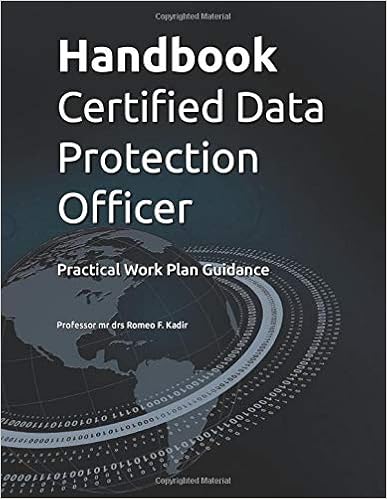
The role of a Data Protection Officer (DPO) is a fairly new one in many companies. What’s more, the need to hire a DPO often comes as a response to the General Data Protection Regulations (GDPR) which were implemented back in 2018. As such, the responsibilities, reporting and structure of the role are primarily defined by GDPR guidelines.
But though it might be a fairly new role, it can be a very exciting and rewarding one. So if you’re considering a career as a data protection officer, this guide is for you. Below, we’ll take a look at what the role entails and what you need to do to get a job as a DPO.
What is a Data Protection Officer and What Do They Do?
In a nutshell, a data protection officer is a steward for data protection and privacy within a business. They must implement effective data protection strategies and facilitate a culture of data protection throughout the company. This is to ensure companywide compliance with GDPR. The appointment of a DPO is mandatory in some businesses, particularly those in the public sector or those that process a large amount of personal data. That being said, some businesses choose to appoint a DPO even though they are not legally required to as it pays to have someone in charge of compliance and data privacy.
In the general data protection regulations, it is stated that the DPO should report directly to the highest management level. As a DPO, some of the key responsibilities include:
Ensuring that a business applies the laws of data protection appropriately and effectively, as well as following these regulations and legislations.
Educating and training management and all other employees about GDPR and other data protection statutes as well as about compliance and demonstrating effective measures and strategies for data handling and processing.
Conducting regular security audits.
Acting as the point of contact between the company and any supervisory authorities (SAs). For example, if there is a data breach, it is the job of the DPO to report this to the relevant authorities.
With this in mind, here’s how you can tailor your career path to lead to the role of a data protection officer.
In order to become a DPO, What skills you may need…
“One of the biggest challenges we have in cybersecurity is an acute lack of market awareness about what cybersecurity jobs entail,” said Clar Rosso, CEO of (ISC)². “There are wide variations in the kinds of tasks entry-level and junior staff can expect. Hiring organizations and their cybersecurity leadership need to adopt more mature strategies for building teams.
“Many organizations still default to job descriptions that rely on cybersecurity ‘all stars’ who can do it all. The reality is that there are not enough of those individuals to go around, and the smart bet is to hire and invest in people with an ability to learn, who fit your culture and who can be a catalyst for robust, resilient teams for years to come.”
A task force of more than 60 experts from industry, government, nonprofits and academia is urging the U.S. government and global allies to take immediate steps to stem a growing global crisis of cyberattacks in which hackers seize computer systems and data in exchange for a ransom.
The group, which issued a report today, says swift, coordinated action can disrupt and deter the growing threat of cyberattacks that use ransomware, a malicious software that locks up computer systems so that criminals can demand ransom in exchange for access.
“We’re seeing critical parts of the economy being hit by ransomware, including, for example, health care in particular,” says task force co-chair Megan Stifel, executive director of Americas at the Global Cyber Alliance. “When you start to see a broad scale of victims across multiple elements of the economy being hit there can ultimately, if not abated, be catastrophic consequences.”
For some time, the public cloud has actually been able to offer more protection than traditional on-site environments. Dedicated expert teams ensure that cloud servers, for example, maintain an optimal security posture against external threats.
But that level of security comes at a price. Those same extended teams increase insider exposure to private data—which leads to a higher risk of an insider data breach and can complicate compliance efforts.
Recent developments in data security technology—in chips, software, and the cloud infrastructure—are changing that. New security capabilities transform the public cloud into a trusted data-secure environment by effectively locking data access to insiders or external attackers
This eliminates the last security roadblock to full cloud migration for even the most sensitive data and applications. Leveraging this confidential cloud, organizations for the first time can now exclusively own their data, workloads, and applications—wherever they work.
Even some of the most security-conscious organizations in the world are now seeing the confidential cloud as the safest option for the storage, processing, and management of their data. The attraction to the confidential cloud is based on the promise of exclusive data control and hardware-grade minimization of data risk.
What is the confidential cloud?
Over the last year, there’s been a great deal of talk about confidential computing—including secure enclaves or TEEs (Trusted Execution Environments). These are now available in servers built on chips from Amazon Nitro Enclaves, Intel SGX (Software Guard Extensions), and AMD SEV (Secure Encrypted Virtualization).
Microsoft announced that Microsoft Defender for Endpoint, its commercial version of Windows 10 Defender antivirus, implements a new mechanism that leverages Intel’s Threat Detection Technology (TDT) to block cryptojacking malware using
Cryptojacking malware allows threat actors to secretly mine for cryptocurrency abusing computational resources of the infected devices.
The Intel TDT technology allows sharing heuristics and telemetry with security software that could use this data to detect the activity associated with a malicious code. Intel TDT leverages machine learning to analyze low-level hardware telemetry produced by the CPU performance monitoring unit (PMU) and uses it to detect the malware code execution “fingerprint” at runtime. TDT is currently implemented in Intel Core processors and any Intel CPU series that supports Intel vPro technologies, 6th Generation or later.
“Today, we are announcing the integration of Intel Threat Detection Technology (TDT) into Microsoft Defender for Endpoint, an addition that enhances the detection capability and protection against cryptojacking malware.” reads the announcement published by Microsoft. “TDT leverages a rich set of performance profiling events available in Intel SoCs (system-on-a-chip) to monitor and detect malware at their final execution point (the CPU). This happens irrespective of obfuscation techniques, including when malware hides within virtualized guests, without needing intrusive techniques like code injection or performing complex hypervisor introspection. TDT can further offload machine learning inference to the integrated graphics processing unit (GPU), enabling continuous monitoring with negligible overhead.”
When it comes to all the various types of malware out there, none has ever dominated the headlines quite as much as ransomware.
Sure, several individual malware outbreaks have turned into truly global stories over the years.
The LoveBugmass-mailing virus of 2000 springs to mind, which blasted itself into hundreds of millions of mailboxes within a few days; so does CodeRed in 2001, the truly fileless network worm that squeezed itself into a single network packet and spread worldwide literally within minutes.
There was Conficker, a globally widespread botnet attack from 2008 that was programmed to deliver an unknown warhead on April Fool’s Day, but never did. (Conficker remains a sort-of unsolved mystery: no one ever figured out what it was really for.)
And, there was Stuxnet, discovered in 2010 but probably secretively active for years before that, carefully orchestrated to spread via hand-carried USB drives in the hope of making it across security airgaps and into undislosed industrial plantrooms (allegedly Iran’s uranium enrichment facility at Natanz).
But none of these stories, as dramatic and as alarming as they were at the time, ever held the public’s attention as durably or as dramatically as ransomware has done since the early 2010s.


![Department of Homeland Security and Information Sharing: Is It Working? by [United State Army War College, U.S Army U.S Army]](https://m.media-amazon.com/images/I/417d4jwJrTS.jpg)