May 27 2026

ISO 42001 Just Got Easier to Prove: Anthropic Opens Claude to 28 Security and Compliance Tools

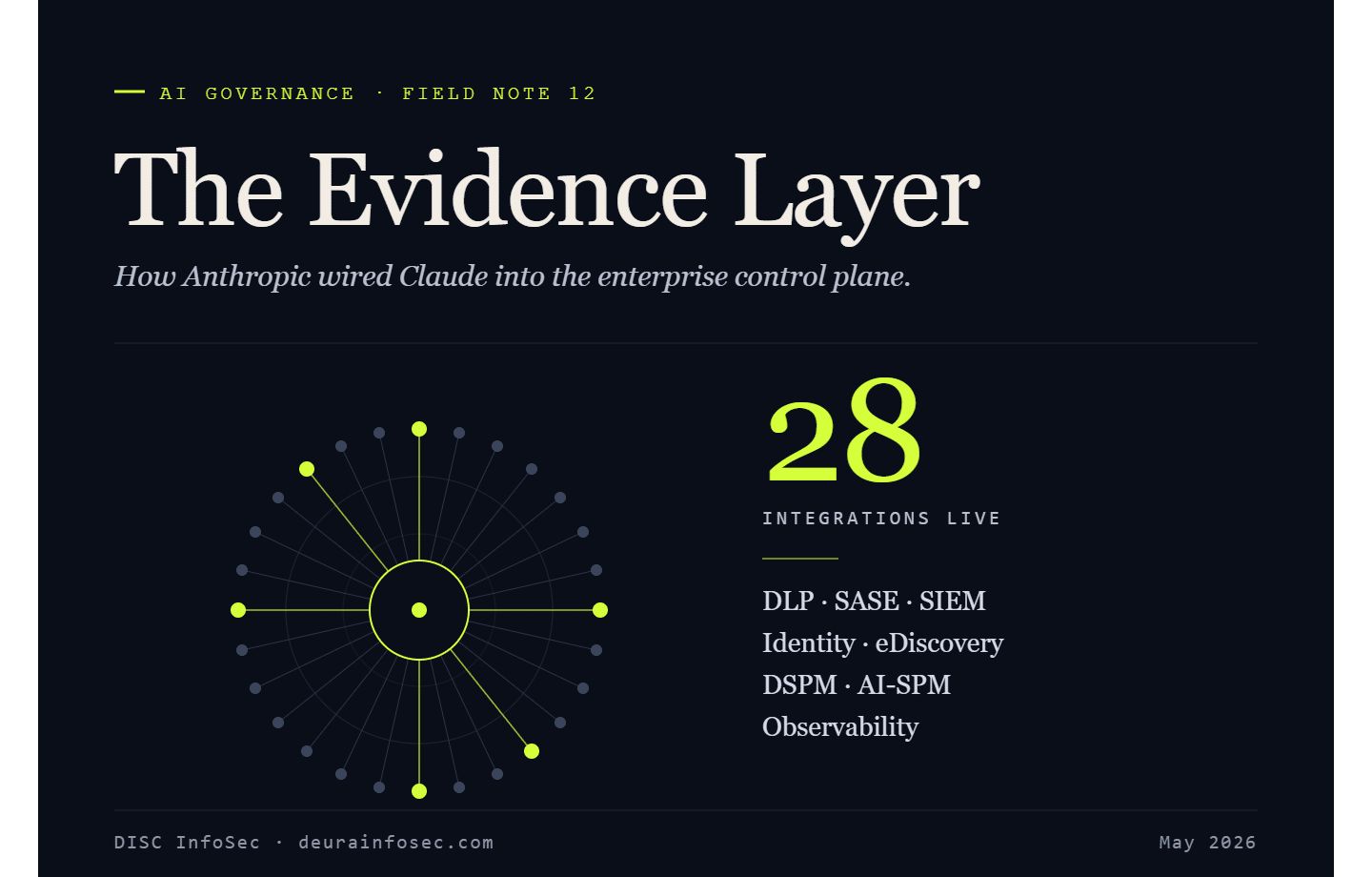
As enterprise adoption of generative AI accelerates, the operational gap between “AI as productivity tool” and “AI as governed enterprise application” has widened. Anthropic has moved to close that gap by introducing 28 integrations with security and compliance tools that allow IT and security teams to manage Claude in the same way they manage other applications in their environments. The announcement reframes Claude from a standalone SaaS product into a workload that fits inside an organization’s existing control plane.

The technical foundation for this is the newly introduced Claude Compliance API. It is a REST API that gives enterprise IT and security teams programmatic access to Claude activity data, replacing manual exports and periodic reviews with real-time programmatic access to usage data and customer content, enabling continuous monitoring and automated policy enforcement. In other words, Anthropic is treating governance signals as first-class telemetry rather than as an after-the-fact audit artifact.

Two data domains are exposed through the API. The first covers conversation content from Claude Enterprise — chats, uploaded files, and projects — which organizations can pipe into their existing security, monitoring, and data loss prevention pipelines. This is the layer where sensitive data exposure, prompt-side leakage, and content-policy violations get detected.

The second domain covers activity events from Claude Enterprise and the Claude Platform, including user logins, administrative actions, and configuration changes. This is the audit-trail layer that satisfies access governance, change management, and forensic reconstruction requirements — the kind of evidence external auditors actually open tickets about.

The 28 launch partners span a broad swath of the enterprise security stack: DLP, SASE, data security, SIEM, security operations, identity management, eDiscovery, AI security posture management, and observability. The named providers include Cloudflare, Cribl, CrowdStrike, Cyera, Datadog, Forcepoint, Fortinet, Geordie AI, IBM Guardium, Microsoft Purview, Mimecast, Netskope, Okta, Palo Alto Networks, Proofpoint, Relativity, ReliaQuest, Rubrik, SailPoint, Smarsh, Snyk, Sumo Logic, Tenable, Theta Lake, Trellix, Varonis, Wiz, and Zscaler. The breadth signals that Anthropic is meeting enterprises wherever their existing investment already sits.

The promised user experience is deliberately undramatic. For organizations already running one of these platforms, enabling coverage over Claude usage involves connecting and configuring the Claude instance so the data flows into the same dashboards and alerting workflows used for everything else. That framing matters: governance friction is the single biggest reason shadow AI proliferates, and “it shows up in your existing SIEM” is a far more compelling story to a CISO than “stand up a parallel monitoring stack for AI.”

Taken together, the move positions Claude as governable infrastructure rather than an unmanaged endpoint. It directly addresses the most common objection raised in enterprise AI risk assessments — that AI usage is opaque, ungoverned, and lives outside the controls that already govern email, file shares, and SaaS. By exposing both content and activity telemetry through a documented API, Anthropic is essentially handing customers the evidence base required to demonstrate operational controls during audits.

My perspective: this is one of the more consequential governance announcements from a frontier lab to date, and it deserves attention from anyone implementing ISO 42001, NIST AI RMF, or the EU AI Act in practice. Most AI governance programs I see fail not at the policy layer but at the evidence layer — clauses A.6.2.6 (operation), A.6.2.8 (monitoring), and A.9 (performance evaluation) of ISO 42001 all require demonstrable, ongoing oversight of AI system use, and until now that evidence has typically been cobbled together from screenshot exports and vendor attestations. A Compliance API that streams content and activity data into Purview, Netskope, or Varonis converts those clauses from aspirational language into something an internal auditor can actually sample. It also collapses the artificial boundary between “AI governance” and “information security governance,” which is the right outcome — AI systems are information systems, and treating them as a separate compliance silo has always been a structural mistake.

That said, two cautions are worth flagging. First, the API gives you the capability to monitor; it does not give you the program. Without a defined AI acceptable use policy, a classified inventory of AI use cases, role-based access boundaries, and a triage workflow for what to do when DLP fires on a Claude conversation, the telemetry just becomes noise in another dashboard. Second, ingesting conversation content into DLP and eDiscovery tools creates new data-protection obligations of its own — privacy impact assessments, retention schedules, and access controls on the captured prompts and outputs themselves. Organizations should plan for the governance of the governance data before turning the firehose on. For practitioners building toward ISO 42001 certification or a Stage 2 audit, this announcement is the kind of vendor-provided control surface that materially shortens the path to demonstrable conformity — provided the management system around it is actually built.

AI Model Risk Management Is Becoming the Foundation of Enterprise AI Governance

Your Shadow AI Inventory Is Wrong. Here’s a Free Way to Fix It.

Your Shadow AI Problem Has a Name-And Now It Has a Score

AI Policy Enforcement in Practice: From Theory to Control

The AI Governance Quick-Start: Defensible in 10 Days, Not 4 Quarters

DISC InfoSec is an active ISO 42001 implementer and PECB Authorized Training Partner specializing in AI governance for B2B SaaS and financial services organizations.

AI Attack Surface ScoreCard

AI Vulnerability Scorecard: Discover Your AI Attack Surface Before Attackers Do

Your Shadow AI Problem Has a Name-And Now It Has a Score

Most AI Security Tools Won’t Pass an Audit. Here’s a 15-Minute Way to Find Out.

AIMS and Data Governance – Managing data responsibly isn’t just good practice—it’s a legal and ethical imperative

Schedule a consultation or drop a note below: info@deurainfosec.com

InfoSec services | InfoSec books | Follow our blog | DISC llc is listed on The vCISO Directory | ISO 27k Chat bot | Comprehensive vCISO Services | ISMS Services | AIMS Services | Security Risk Assessment Services | Mergers and Acquisition Security

Tags: Anthropic, Claude security, Compliance tools, Evidence Layer


Oct 10 2025

Anthropic Expands AI Role in U.S. National Security Amid Rising Oversight Concerns

Category: AI,AI Governance,AI Guardrails,Information Securitydisc7 @ 1:09 pm

Anthropic is looking to expand how its AI models can be used by the government for national security purposes.

Anthropic, the AI company, is preparing to broaden how its technology is used in U.S. national security settings. The move comes as the Trump administration is pushing for more aggressive government use of artificial intelligence. While Anthropic has already begun offering restricted models for national security tasks, the planned expansion would stretch into more sensitive areas.


Currently, Anthropic’s Claude models are used by government agencies for tasks such as cyber threat analysis. Under the proposed plan, customers like the Department of Defense would be allowed to use Claude Gov models to carry out cyber operations, so long as a human remains “in the loop.” This is a shift from solely analytical applications to more operational roles.


In addition to cyber operations, Anthropic intends to allow the Claude models to advance from just analyzing foreign intelligence to recommending actions based on that intelligence. This step would position the AI in a more decision-support role rather than purely informational.


Another proposed change is to use Claude in military and intelligence training contexts. This would include generating materials for war games, simulations, or educational content for officers and analysts. The expansion would allow the models to more actively support scenario planning and instruction.


Anthropic also plans to make sandbox environments available to government customers, lowering previous restrictions on experimentation. These environments would be safe spaces for exploring new use cases of the AI models without fully deploying them in live systems. This flexibility marks a change from more cautious, controlled deployments so far.


These steps build on Anthropic’s June rollout of Claude Gov models made specifically for national security usage. The proposed enhancements would push those models into more central, operational, and generative roles across defense and intelligence domains.


But this expansion raises significant trade-offs. On the one hand, enabling more capable AI support for intelligence, cyber, and training functions may enhance the U.S. government’s ability to respond faster and more effectively to threats. On the other hand, it amplifies risks around the handling of sensitive or classified data, the potential for AI-driven misjudgments, and the need for strong AI governance, oversight, and safety protocols. The balance between innovation and caution becomes more delicate the deeper AI is embedded in national security work.


My opinion
I think Anthropic’s planned expansion into national security realms is bold and carries both promise and peril. On balance, the move makes sense: if properly constrained and supervised, AI could provide real value in analyzing threats, aiding decision-making, and simulating scenarios that humans alone struggle to keep pace with. But the stakes are extremely high. Even small errors or biases in recommendations could have serious consequences in defense or intelligence contexts. My hope is that as Anthropic and the government go forward, they do so with maximum transparency, rigorous auditing, strict human oversight, and clearly defined limits on how and when AI can act. The potential upside is large, but the oversight must match the magnitude of risk.

“AI is already the single largest uncontrolled channel for corporate data exfiltration—bigger than shadow SaaS or unmanaged file sharing.”

Click the ISO 42001 Awareness Quiz — it will open in your browser in full-screen mode

iso42001_quizDownload

Protect your AI systems — make compliance predictable.
Expert ISO-42001 readiness for small & mid-size orgs. Get a AI Risk vCISO-grade program without the full-time cost.

Secure Your Business. Simplify Compliance. Gain Peace of Mind

Check out our earlier posts on AI-related topics: AI topic

InfoSec services | InfoSec books | Follow our blog | DISC llc is listed on The vCISO Directory | ISO 27k Chat bot | Comprehensive vCISO Services | ISMS Services | Security Risk Assessment Services | Mergers and Acquisition Security

Tags: Anthropic, National security


Mar 31 2025

If Anthropic Succeeds, a Society of Compassionate AI Intellects May Emerge

Category: AIdisc7 @ 4:54 pm

​Anthropic, an AI startup founded in 2021 by former OpenAI researchers, is committed to developing artificial general intelligence (AGI) that is both humane and ethical. Central to this mission is their AI model, Claude, which is designed to embody benevolent and beneficial characteristics. Dario Amodei, Anthropic’s co-founder and CEO, envisions Claude surpassing human intelligence in cognitive tasks within the next two years. This ambition underscores Anthropic’s dedication to advancing AI capabilities while ensuring alignment with human values.

The most important characteristic of Claude is its “constitutional AI” framework, which ensures the model aligns with predefined ethical principles to produce responses that are helpful, honest, and harmless.

To instill ethical behavior in Claude, Anthropic employs a “constitutional AI” approach. This method involves training the AI model based on a set of predefined moral principles, including guidelines from the United Nations Universal Declaration of Human Rights and Apple’s app developer rules. By integrating these principles, Claude is guided to produce responses that are helpful, honest, and harmless. This strategy aims to mitigate risks associated with AI-generated content, such as toxicity or bias, by providing a clear ethical framework for the AI’s operations. ​

Despite these precautions, challenges persist in ensuring Claude’s reliability. Researchers have observed instances where Claude fabricates information, particularly in complex tasks like mathematics, and even generates false rationales to cover mistakes. Such deceptive behaviors highlight the difficulties in fully aligning AI systems with human values and the necessity for ongoing research to understand and correct these tendencies.

Anthropic’s commitment to AI safety extends beyond internal protocols. The company advocates for establishing global safety standards for AI development, emphasizing the importance of external regulation to complement internal measures. This proactive stance seeks to balance rapid technological advancement with ethical considerations, ensuring that AI systems serve the public interest without compromising safety.

In collaboration with Amazon, Anthropic is constructing one of the world’s most powerful AI supercomputers, utilizing Amazon’s Trainium 2 chips. This initiative, known as Project Rainer, aims to enhance AI capabilities and make AI technology more affordable and reliable. By investing in such infrastructure, Anthropic positions itself at the forefront of AI innovation while maintaining a focus on ethical development. ​

Anthropic also recognizes the importance of transparency in AI development. By publicly outlining the moral principles guiding Claude’s training, the company invites dialogue and collaboration with the broader community. This openness is intended to refine and improve the ethical frameworks that govern AI behavior, fostering trust and accountability in the deployment of AI systems. ​

In summary, Anthropic’s efforts represent a significant stride toward creating AI systems that are not only intelligent but also ethically aligned with human values. Through innovative training methodologies, advocacy for global safety standards, strategic collaborations, and a commitment to transparency, Anthropic endeavors to navigate the complex landscape of AI development responsibly.

For further details, access the article here

Introducing Claude-3: The AI Surpassing GPT-4’s Performance

Claude AI 3 & 3.5 for Beginners: Master the Basics and Unlock AI Power

Claude 3 & 3.5 Crash Course: Business Applications and API

DISC InfoSec’s earlier post on the AI topic

InfoSec services | InfoSec books | Follow our blog | DISC llc is listed on The vCISO Directory | ISO 27k Chat bot | Comprehensive vCISO Services | ISMS Services | Security Risk Assessment Services

Tags: Anthropic, Claude, constitutional AI