Mar 31 2026

Which AI Governance Framework Should You Adopt First? A Practical Guide for U.S., EU, and Global Organizations

Category: AI Governance,ISO 42001 — disc7 @ 9:28 am

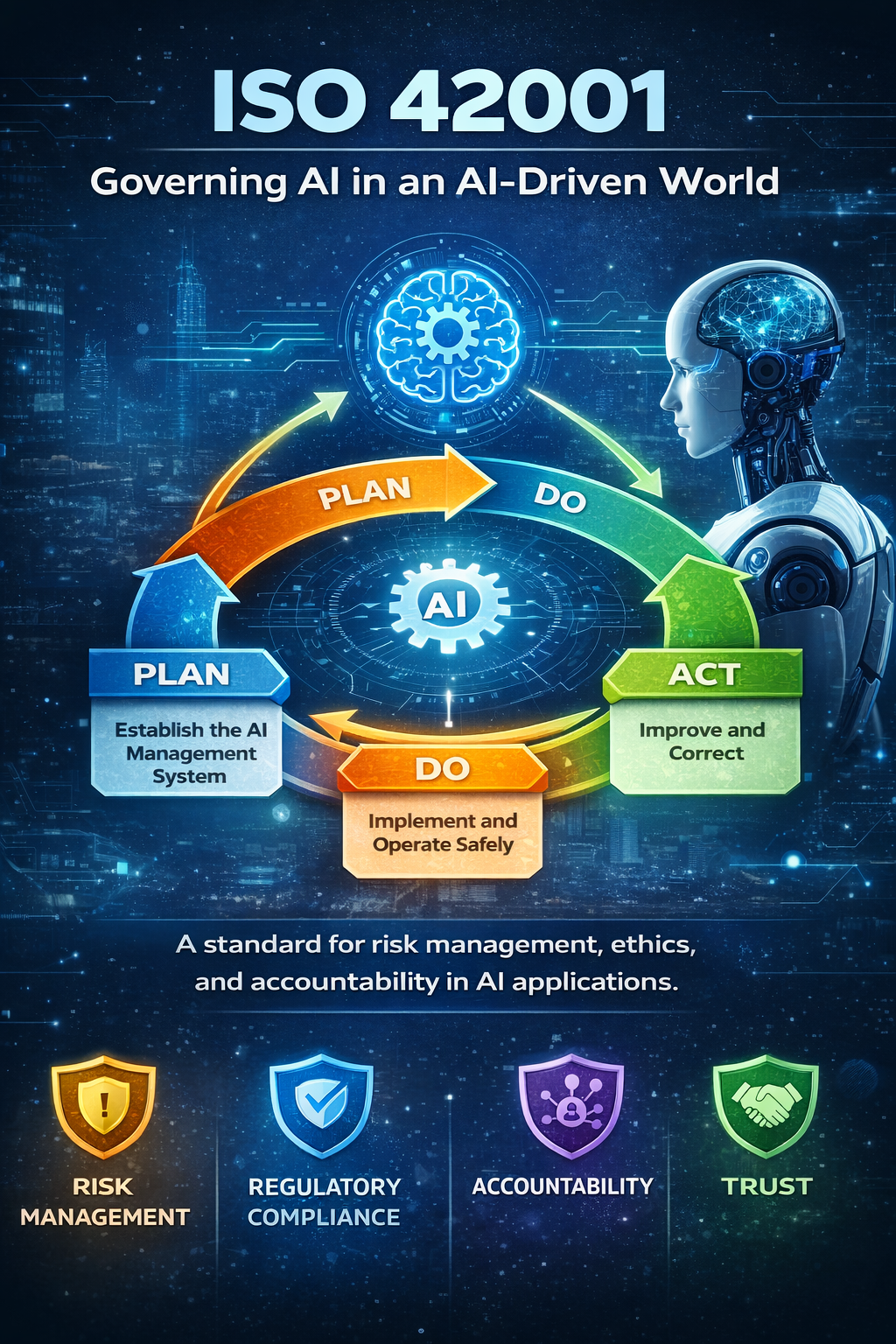
ISO/IEC 42001, the EU AI Act, and the NIST AI Risk Management Framework (AI RMF) represent three distinct but complementary approaches to governing artificial intelligence. ISO 42001 is a formal management system standard designed to institutionalize AI governance within organizations. Its core concept is continuous improvement through structured controls, with a primary focus on embedding AI risk management into business processes. It applies broadly across industries and is certifiable, making it attractive for organizations seeking formal assurance. Its scope covers governance, lifecycle management, and accountability, using a risk-based, auditable approach. Globally, it is emerging as the backbone for standardized AI governance, especially for enterprises seeking international credibility.

The EU AI Act is fundamentally different, operating as a regulatory framework rather than a voluntary standard. Its core concept is risk classification of AI systems (e.g., unacceptable, high-risk), with a primary focus on protecting individuals’ rights and safety. It applies to any organization that develops, deploys, or offers AI systems within the European Union, regardless of where the company is based. Compliance is mandatory, not certifiable, and enforced through legal mechanisms. Its scope is extensive, covering use cases, data governance, transparency, and human oversight. The risk approach is prescriptive and tiered, and its global impact is significant, as it effectively sets a de facto regulatory benchmark for companies operating internationally.

The NIST AI RMF takes a more flexible, guidance-driven approach. Its core concept is trustworthy AI built on principles like fairness, accountability, and transparency. The primary focus is helping organizations identify, assess, and manage AI risks without imposing strict requirements. It is applicable to organizations of all sizes, particularly in the U.S., but is not certifiable or legally binding. Its scope spans the AI lifecycle, emphasizing governance, mapping, measurement, and management functions. The risk approach is adaptive and contextual rather than prescriptive. Globally, it serves as a practical playbook and is widely referenced as a baseline for AI risk discussions.

When compared, ISO 42001 provides structure and certifiability, the EU AI Act enforces legal accountability, and NIST AI RMF offers operational flexibility. ISO is ideal for organizations wanting to operationalize governance programs with measurable controls. The EU AI Act is unavoidable for companies interacting with EU markets, demanding strict adherence to compliance requirements. NIST AI RMF, meanwhile, is best suited for organizations seeking to mature their AI risk posture without the overhead of certification or regulatory burden.

Together, these frameworks form a layered model of AI governance: NIST AI RMF as the foundation for understanding and managing risk, ISO 42001 as the system for institutionalizing and auditing those practices, and the EU AI Act as the regulatory overlay enforcing accountability. Organizations that align across all three are better positioned to move from reactive compliance to proactive, continuous AI risk management—something that is quickly becoming a competitive differentiator in the global market.

If you’re deciding which framework to adopt first, the answer isn’t “one-size-fits-all”—it depends heavily on where you operate, your regulatory exposure, and how mature your AI usage is. But there is a practical sequencing that works in most real-world scenarios.


🇺🇸 U.S.-based organizations (like you in California)

Start with NIST AI Risk Management Framework.

Image

The reason is simple: it’s flexible, fast to adopt, and aligns well with how U.S. companies already think about risk (similar to NIST CSF). It gives you an immediate way to structure AI governance without slowing innovation.

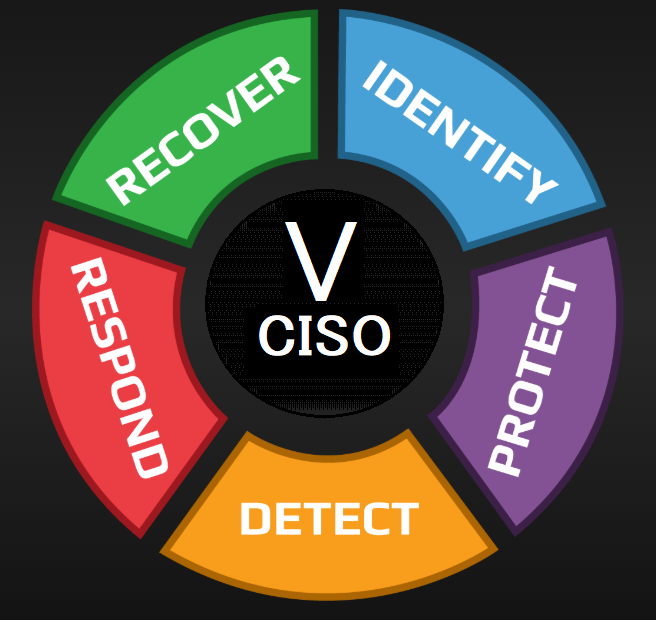
From a vCISO or GRC standpoint, this is your “operational foundation”—you can quickly map risks, define controls, and start producing defensible outputs for clients or regulators.

👉 My take: If you skip this step and jump straight into compliance-heavy frameworks, you’ll create “paper governance” without real risk visibility.


🇪🇺 If you touch EU markets (customers, users, or data)

Prioritize the EU AI Act immediately—even before anything else if exposure is high.

Image

This is not optional. If your AI system falls into “high-risk,” you’re dealing with legal obligations, audits, and potential penalties.

👉 My take: This is the “hard boundary” framework. It defines what you must do, not what you should do.

Even U.S. companies often underestimate this—if your product scales, EU rules will reach you faster than expected.


🌍 When you want credibility, scale, or enterprise trust

Adopt ISO/IEC 42001 after you’ve operationalized risk (typically after NIST AI RMF).

Image
Image

ISO 42001 is where governance becomes institutionalized and auditable. It’s especially valuable if you:

  • Sell to enterprises
  • Need third-party assurance
  • Want to productize your AI governance (e.g., your DISC InfoSec offering)

👉 My take: This is your “trust multiplier.” It turns internal practices into something marketable and defensible.


🔑 Practical adoption sequence (what I recommend)

For most organizations (especially in the U.S.):

  1. Start with NIST AI RMF → build real risk visibility
  2. Overlay EU AI Act (if applicable) → ensure regulatory compliance
  3. Formalize with ISO 42001 → scale, certify, and monetize trust


💡 My blunt perspective

  • If you start with ISO 42001 → you risk over-engineering too early
  • If you ignore EU AI Act → you risk legal exposure
  • If you skip NIST AI RMF → you risk fake governance (compliance theater)

Comparing of ISO 27001 with ISO 42001

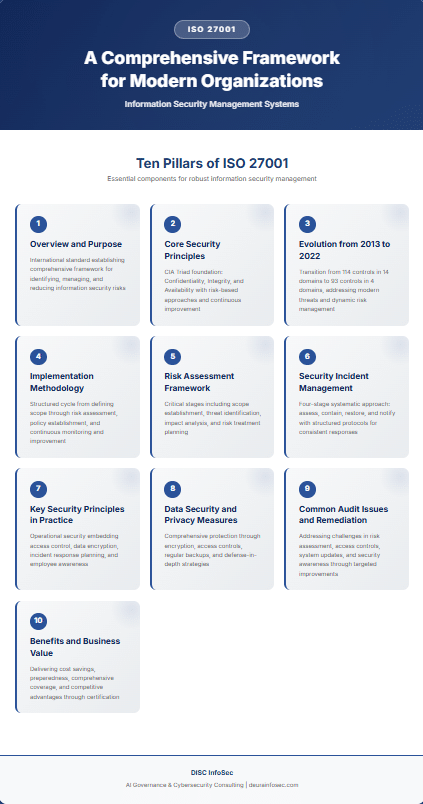
ISO/IEC 42001 builds directly on the structure of ISO/IEC 27001, so at first glance the two frameworks look similar in clauses, risk assessment approach, and use of Annex A controls. However, their intent and scope diverge significantly. ISO 27001 is inward-focused, centered on protecting an organization’s information assets and managing risks that could impact the business. In contrast, ISO/IEC 42001 is outward-looking and expands accountability beyond the organization to include impacts—both negative and positive—on society, individuals, and other stakeholders arising from AI use. It also shifts emphasis from purely information protection to governance of AI-driven products and services, making it closer to a quality management system in practice. Key differences include the introduction of AI system impact assessments (evaluating societal harms and benefits), distinct and more AI-specific Annex A controls, and additional guidance annexes. While many governance elements (e.g., audits, nonconformities) remain structurally similar, ISO 42001 requires deeper scrutiny of ethical, societal, and product-level risks, making it broader, more externally accountable, and more aligned with AI lifecycle management than ISO 27001.


      At DISC InfoSec:
      👉 “We move you from AI chaos → risk visibility → compliance → certification”

      AI Governance Playbook: How to Secure, Control, and Optimize Artificial Intelligence Initiatives

      InfoSec services | InfoSec books | Follow our blog | DISC llc is listed on The vCISO Directory | ISO 27k Chat bot | Comprehensive vCISO Services | ISMS Services | AIMS Services | Security Risk Assessment Services | Mergers and Acquisition Security

      At DISC InfoSec, we help organizations navigate this landscape by aligning AI risk management, governance, security, and compliance into a single, practical roadmap. Whether you are experimenting with AI or deploying it at scale, we help you choose and operationalize the right frameworks to reduce risk and build trust. Learn more at DISC InfoSec.

      Tags: AI Governance Playbook, EU AI Act, ISO 42001, NIST AI RMF


      Mar 20 2026

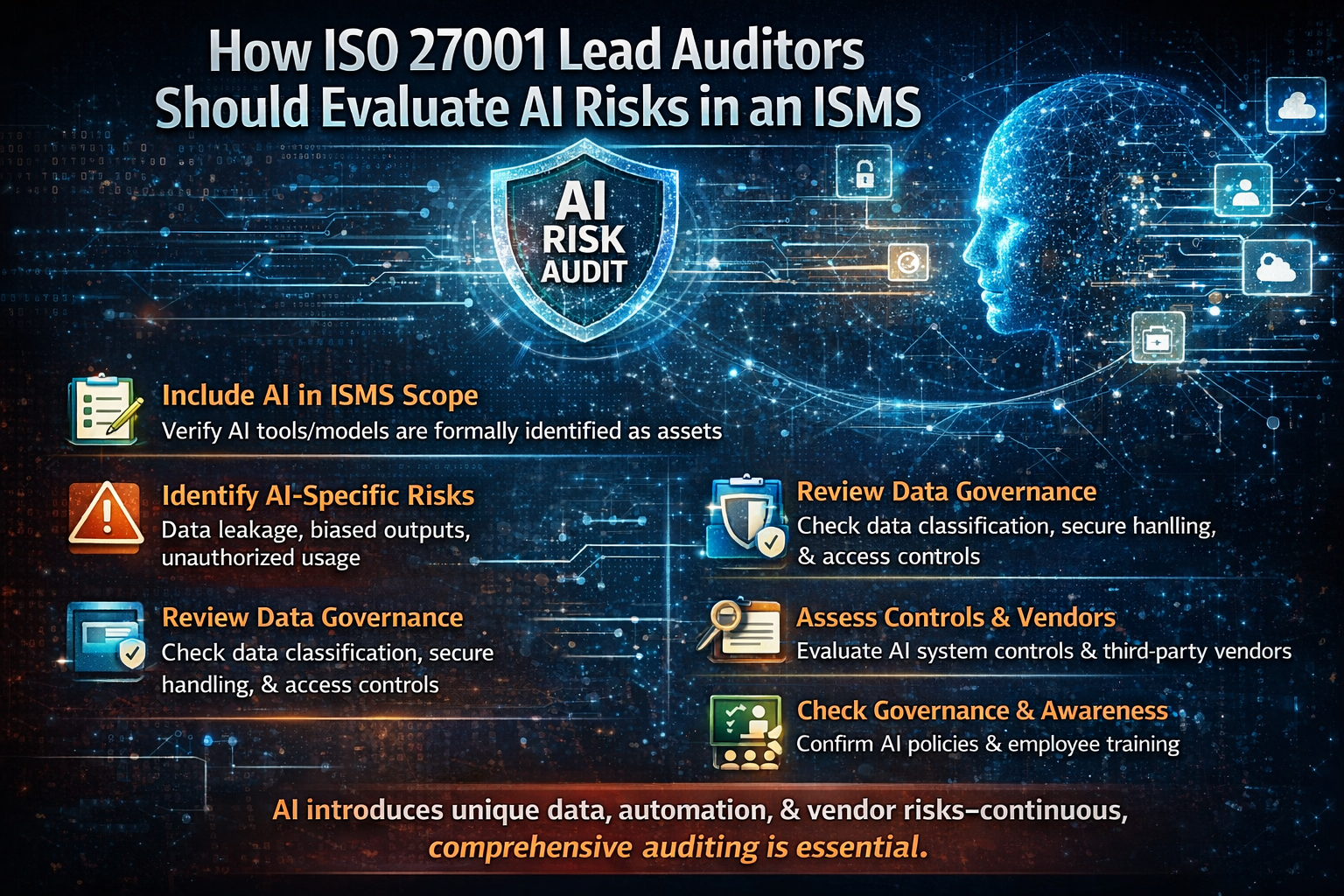
      How ISO 27001 Lead Auditors Should Evaluate AI Risks in an ISMS

      Category: Information Security,ISO 27k,ISO 42001,vCISO — disc7 @ 9:45 am

      With AI adoption accelerating, ISO 27001 lead auditors must expand how they evaluate risks within an ISMS. AI is not just another technology component—it introduces new challenges related to data usage, automation, and decision-making. As a result, auditors need to move beyond traditional controls and ensure AI is properly integrated into the organization’s risk and governance framework.

      First, AI must be explicitly included within the ISMS scope. Auditors should verify that all AI tools, models, and platforms are formally identified as assets. If organizations are using AI without documenting it, this creates a significant visibility gap and undermines the effectiveness of the ISMS.

      Second, auditors need to identify and assess AI-specific risks that are often overlooked in traditional risk assessments. These include data leakage through prompts or training datasets, biased or unreliable outputs, unauthorized use of public AI tools, and risks such as model manipulation or poisoning. These threats should be formally captured and managed within the risk register.

      Third, strong data governance becomes even more critical in an AI-driven environment. Since AI systems rely heavily on data, auditors should ensure proper data classification, access controls, and secure handling of sensitive information. Additionally, there must be transparency into how AI systems process and use data, as this directly impacts risk exposure.

      Fourth, auditors should review controls around AI systems and assess third-party risks. This includes verifying access controls, monitoring mechanisms, secure deployment practices, and ongoing updates. Given that many AI capabilities rely on external vendors or cloud providers, thorough vendor risk management is essential to prevent external dependencies from becoming security weaknesses.

      Fifth, governance and awareness play a key role in managing AI risks. Organizations should establish clear policies for AI usage and ensure employees understand how to use AI tools securely and responsibly. Without proper governance and training, even well-designed controls can fail due to misuse or lack of awareness.

      My perspective: AI is fundamentally reshaping the ISMS landscape, and auditors who treat it as just another asset will miss critical risks. The real shift is toward continuous, data-centric, and vendor-aware risk management. AI introduces dynamic risks that evolve quickly, so static, annual risk assessments are no longer sufficient. Organizations need ongoing monitoring, tighter integration with DevSecOps, and alignment with emerging frameworks like ISO 42001. Those who adapt early will not only reduce risk but also gain a competitive advantage by demonstrating mature, AI-aware security governance.

      Ensure your ISMS is AI-ready. Partner with DISC InfoSec to assess, govern, and secure your AI systems before risks become incidents. Learn more today!

      InfoSec services | InfoSec books | Follow our blog | DISC llc is listed on The vCISO Directory | ISO 27k Chat bot | Comprehensive vCISO Services | ISMS Services | AIMS Services | Security Risk Assessment Services | Mergers and Acquisition Security

      At DISC InfoSec, we help organizations navigate this landscape by aligning AI risk management, governance, security, and compliance into a single, practical roadmap. Whether you are experimenting with AI or deploying it at scale, we help you choose and operationalize the right frameworks to reduce risk and build trust. Learn more at DISC InfoSec.

      Tags: AIMS, isms, ISO 27001 Lead Auditors


      Mar 12 2026

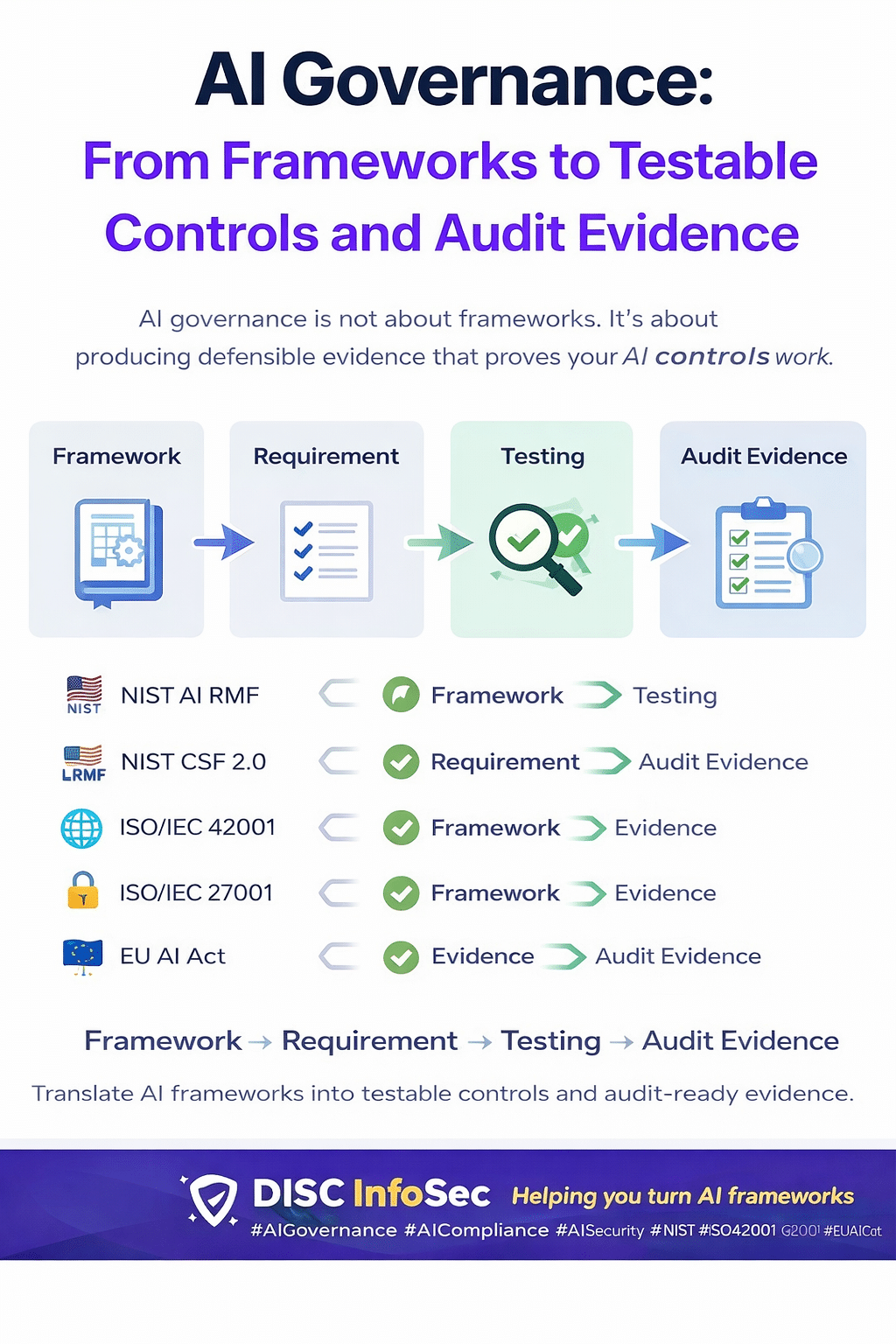
      AI Governance: From Frameworks to Testable Controls and Audit Evidence

      Category: AI,AI Governance,Internal Audit,ISO 42001 — disc7 @ 9:12 am

      AI Governance is becoming operational.

      Most organizations talk about frameworks — but very few can prove their AI controls actually work.

      AI governance is the system organizations use to ensure AI systems are safe, fair, compliant, and accountable. Frameworks provide the guidance, but testing produces the proof.

      Here’s the practical reality across the major frameworks:

      🇺🇸 NIST AI Risk Management Framework
      Organizations must identify and measure AI risks. In practice, that means testing models for bias, hallucinations, and performance drift. Evidence includes risk registers, evaluation scorecards, and drift monitoring logs.

      🔐 NIST Cybersecurity Framework 2.0
      Cybersecurity applied to AI. Organizations must know what AI systems exist and who has access. Testing focuses on shadow AI discovery, access control validation, and security testing. Evidence includes AI asset inventories, penetration test reports, and access matrices.

      🌐 ISO/IEC 42001
      The emerging AI management system standard. It requires organizations to assess AI impact and monitor performance. Testing includes misuse scenarios, regression testing, and anomaly detection. Evidence includes AI impact assessments, red-team results, and KPI monitoring reports.

      🔒 ISO/IEC 27001
      Security for AI pipelines and training data. Controls must protect models, code, and personal data. Testing focuses on code vulnerabilities, PII leakage, and data memorization risks. Evidence includes SAST reports, PII scan results, and data masking logs.

      🇪🇺 EU Artificial Intelligence Act
      The first binding AI law. High-risk AI must be governed, explainable, and built on quality data. Testing evaluates misuse scenarios, bias in datasets, and decision traceability. Evidence includes risk management plans, model cards, data quality reports, and output logs.

      The pattern across all frameworks is simple:

      Framework → Requirement → Testing → Evidence.

      AI governance isn’t about memorizing regulations.

      It’s about building repeatable testing processes that produce defensible evidence.

      Organizations that succeed with AI governance will treat compliance like engineering:

      • Test the controls
      • Monitor continuously
      • Produce verifiable evidence

      That’s how AI governance moves from policy to proof.

      At DISC InfoSec, we help organizations translate AI frameworks into testable controls and audit-ready evidence pipelines.

      #AIGovernance #AICompliance #AISecurity #NIST #ISO42001 #ISO27001 #EUAIAct #RiskManagement #CyberSecurity #AIRegulation #AITrust

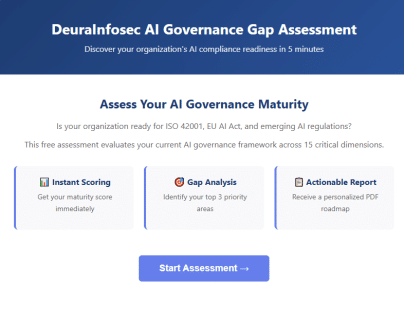
      Get Your Free AI Governance Readiness Assessment â€“ Is your organization ready for ISO 42001, EU AI Act, and emerging AI regulations?

      AI Governance Gap Assessment tool

      1. 15 questions
      2. Instant maturity score 
      3. Detailed PDF report 
      4. Top 3 priority gaps

      Click below to open an AI Governance Gap Assessment in your browser or click the image to start assessment.

      ai_governance_assessment-v1.5Download

      Built by AI governance experts. Used by compliance leaders.

      InfoSec services | InfoSec books | Follow our blog | DISC llc is listed on The vCISO Directory | ISO 27k Chat bot | Comprehensive vCISO Services | ISMS Services | AIMS Services | Security Risk Assessment Services | Mergers and Acquisition Security

      At DISC InfoSec, we help organizations navigate this landscape by aligning AI risk management, governance, security, and compliance into a single, practical roadmap. Whether you are experimenting with AI or deploying it at scale, we help you choose and operationalize the right frameworks to reduce risk and build trust. Learn more at DISC InfoSec.

      Tags: Audit Evidence


      Mar 10 2026

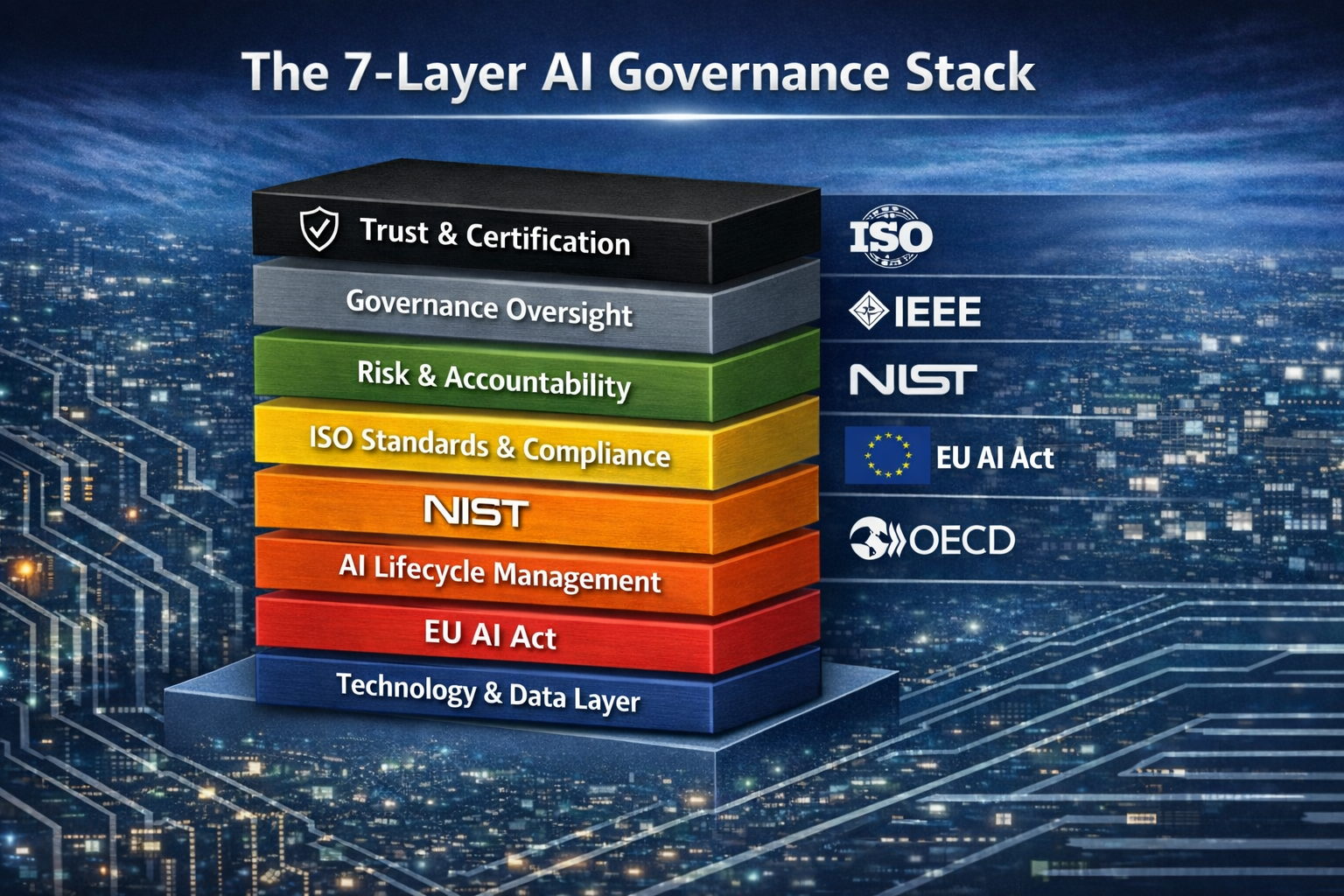
      AI Governance Is Becoming Infrastructure: The Layer Governance Stack Organizations Need

      Category: AI,AI Governance,Information Security,ISO 42001 — disc7 @ 2:17 pm

      Defining the AI Governance Stack (Layers + Countermeasures)

      1. Technology & Data Layer
      This is the foundational layer where AI systems are built and operate. It includes infrastructure, datasets, machine learning models, APIs, cloud environments, and development platforms that power AI applications. Risks at this level include data poisoning, model manipulation, unauthorized access, and insecure pipelines.
      Countermeasures: Secure data governance, strong access control, encryption, secure MLOps pipelines, dataset validation, and adversarial testing to protect model integrity.

      2. AI Lifecycle Management
      This layer governs the entire lifecycle of AI systems—from design and training to deployment, monitoring, and retirement. Without lifecycle oversight, models may drift, produce harmful outputs, or operate outside their intended purpose.
      Countermeasures: Implement lifecycle governance frameworks such as the National Institute of Standards and Technology AI Risk Management Framework and ISO model lifecycle practices. Continuous monitoring, model validation, and AI system documentation are essential.

      3. Regulation Layer
      Regulation defines the legal obligations governing AI development and use. Governments worldwide are establishing regulatory regimes to address safety, privacy, and accountability risks associated with AI technologies.
      Countermeasures: Regulatory compliance programs, legal monitoring, AI impact assessments, and alignment with frameworks like the EU AI Act and other national laws.

      4. Standards & Compliance Layer
      Standards translate regulatory expectations into operational requirements and technical practices that organizations can implement. They provide structured guidance for building trustworthy AI systems.
      Countermeasures: Adopt international standards such as ISO/IEC 42001 and governance engineering frameworks from Institute of Electrical and Electronics Engineers to ensure responsible design, transparency, and accountability.

      5. Risk & Accountability Layer
      This layer focuses on identifying, evaluating, and managing AI-related risks—including bias, privacy violations, security threats, and operational failures. It also defines who is responsible for decisions made by AI systems.
      Countermeasures: Enterprise risk management integration, algorithmic risk assessments, impact analysis, internal audit oversight, and adoption of principles such as the OECD AI Principles.

      6. Governance Oversight Layer
      Governance oversight ensures that leadership, ethics boards, and risk committees supervise AI strategy and operations. This layer connects technical implementation with corporate governance and accountability structures.
      Countermeasures: Establish AI governance committees, board-level oversight, policy frameworks, and internal controls aligned with organizational governance models.

      7. Trust & Certification Layer
      The top layer focuses on demonstrating trust externally through certification, assurance, and transparency. Organizations must show regulators, partners, and customers that their AI systems operate responsibly and safely.
      Countermeasures: Independent audits, third-party certification programs, transparency reporting, and responsible AI disclosures aligned with global assurance standards.


      AI Governance Is Becoming Infrastructure

      The real challenge of AI governance has never been simply writing another set of ethical principles. While ethics guidelines and policy statements are valuable, they do not solve the structural problem organizations face: how to manage dozens of overlapping regulations, standards, and governance expectations across the AI lifecycle.

      The fundamental issue is governance architecture. Organizations do not need more isolated principles or compliance checklists. What they need is a structured system capable of integrating multiple governance regimes into a single operational framework.

      In practical terms, such governance architectures must integrate multiple frameworks simultaneously. These may include regulatory systems like the EU AI Act, governance standards such as ISO/IEC 42001, technical risk frameworks from the National Institute of Standards and Technology, engineering ethics guidance from the Institute of Electrical and Electronics Engineers, and global governance principles like the OECD AI Principles.

      The complexity of the governance environment is significant. Today, organizations face more than one hundred AI governance frameworks, regulatory initiatives, standards, and guidelines worldwide. These systems frequently overlap, creating fragmentation that traditional compliance approaches struggle to manage.

      Historically, global discussions about AI governance focused primarily on ethics principles, isolated compliance frameworks, or individual national regulations. However, the rapid expansion of AI technologies has transformed the governance landscape into a dense ecosystem of interconnected governance regimes.

      This shift is reflected in emerging policy guidance, particularly the due diligence frameworks being promoted by international institutions. These approaches emphasize governance processes such as risk identification, mitigation, monitoring, and remediation across the entire lifecycle of AI systems rather than relying on standalone regulatory requirements.

      As a result, organizations are no longer dealing with a single governance framework. They are operating within a layered governance stack where regulations, standards, risk management frameworks, and operational controls must work together simultaneously.


      Perspective on the Future of AI Governance

      From my perspective, the next phase of AI governance will not be defined by new frameworks alone. The real transformation will occur when governance becomes infrastructure—a structured system capable of integrating regulations, standards, and operational controls at scale.

      In other words, AI governance is evolving from policy into governance engineering. Organizations that build governance architectures—rather than simply chasing compliance—will be far better positioned to manage AI risk, demonstrate trust, and adapt to the rapidly expanding global regulatory environment.

      For cybersecurity and governance leaders, this means treating AI governance the same way we treat cloud architecture or security architecture: as a foundational system that enables resilience, accountability, and trust in AI-driven organizations. 🔐🤖📊

      Get Your Free AI Governance Readiness Assessment â€“ Is your organization ready for ISO 42001, EU AI Act, and emerging AI regulations?

      AI Governance Gap Assessment tool

      1. 15 questions
      2. Instant maturity score 
      3. Detailed PDF report 
      4. Top 3 priority gaps

      Click below to open an AI Governance Gap Assessment in your browser or click the image to start assessment.

      ai_governance_assessment-v1.5Download

      Built by AI governance experts. Used by compliance leaders.

      InfoSec services | InfoSec books | Follow our blog | DISC llc is listed on The vCISO Directory | ISO 27k Chat bot | Comprehensive vCISO Services | ISMS Services | AIMS Services | Security Risk Assessment Services | Mergers and Acquisition Security

      At DISC InfoSec, we help organizations navigate this landscape by aligning AI risk management, governance, security, and compliance into a single, practical roadmap. Whether you are experimenting with AI or deploying it at scale, we help you choose and operationalize the right frameworks to reduce risk and build trust. Learn more at DISC InfoSec.

      Tags: AI Life cycle management, EU AI Act, Governance oversight, ISO 42001, NIST AI RMF


      Mar 06 2026

      AI Governance Assessment for ISO 42001 Readiness

      Category: AI,AI Governance,Information Security,ISO 42001 — disc7 @ 8:12 am


      AI is transforming how organizations innovate, but without strong governance it can quickly become a source of regulatory exposure, data risk, and reputational damage. With the Artificial Intelligence Management System (AIMS) aligned to ISO/IEC 42001, DISC InfoSec helps leadership teams build structured AI governance and data governance programs that ensure AI systems are secure, ethical, transparent, and compliant. Our approach begins with a rapid compliance assessment and gap analysis that identifies hidden risks, evaluates maturity, and delivers a prioritized roadmap for remediation—so executives gain immediate visibility into their AI risk posture and governance readiness.

      DISC InfoSec works alongside CEOs, CTOs, CIOs, engineering leaders, and compliance teams to implement policies, risk controls, and governance frameworks that align with global standards and regulations. From data governance policies and bias monitoring to AI lifecycle oversight and audit-ready documentation, we help organizations deploy AI responsibly while maintaining security, trust, and regulatory confidence. The result: faster innovation, stronger stakeholder trust, and a defensible AI governance strategy that positions your organization as a leader in responsible AI adoption.


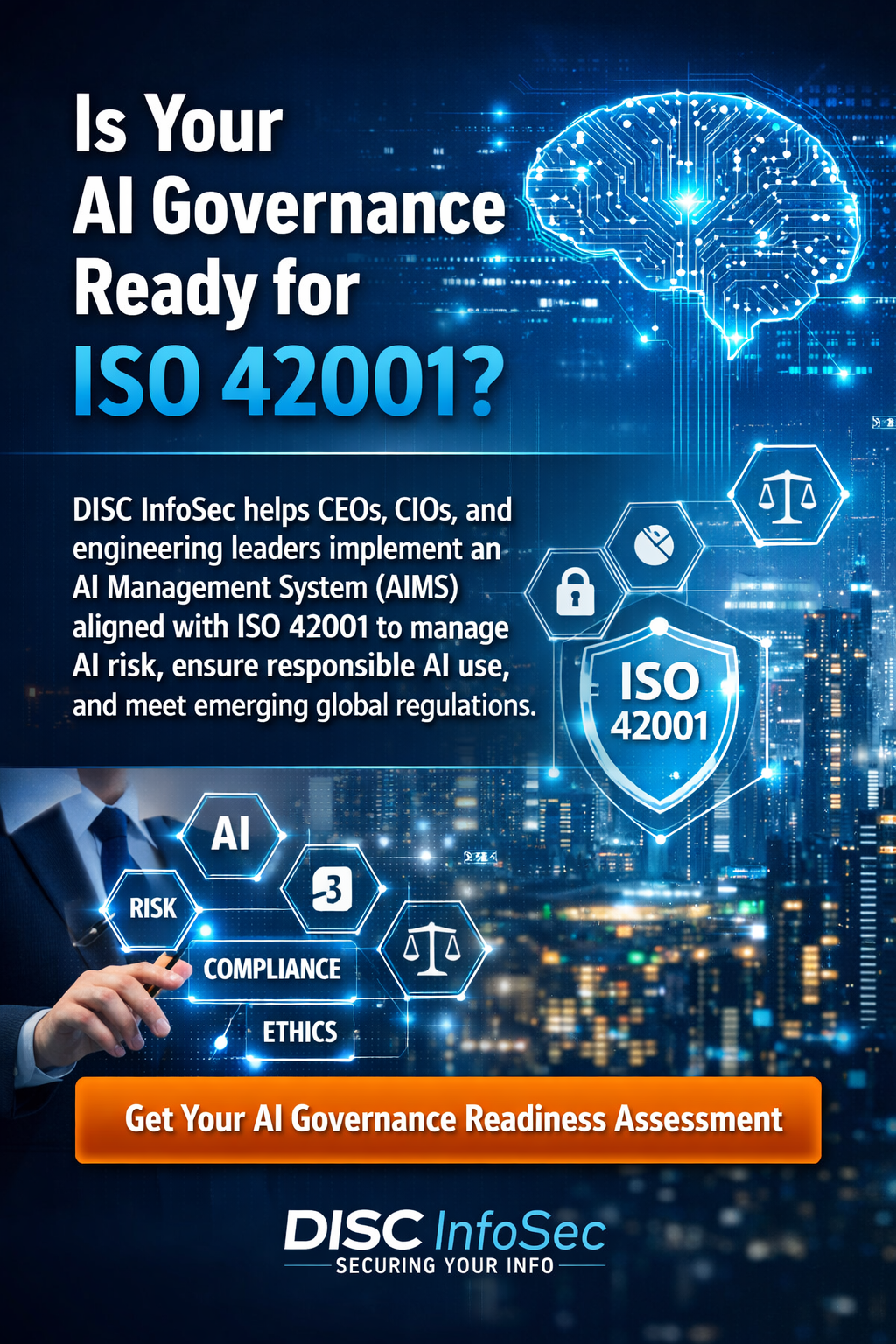
      DISC InfoSec helps CEOs, CIOs, and engineering leaders implement an AI Management System (AIMS) aligned with ISO 42001 to manage AI risk, ensure responsible AI use, and meet emerging global regulations.


      Get Your Free AI Governance Readiness Assessment – Is your organization ready for ISO 42001, EU AI Act, and emerging AI regulations?

      AI Governance Gap Assessment tool

      1. 15 questions
      2. Instant maturity score 
      3. Detailed PDF report 
      4. Top 3 priority gaps

      Click below to open an AI Governance Gap Assessment in your browser or click the image to start assessment.

      ai_governance_assessment-v1.5Download

      Built by AI governance experts. Used by compliance leaders.

      AI & Data Governance: Power with Responsibility – AI Security Risk Assessment – ISO 42001 AI Governance

      In today’s digital economy, data is the foundation of innovation, and AI is the engine driving transformation. But without proper data governance, both can become liabilities. Security risks, ethical pitfalls, and regulatory violations can threaten your growth and reputation. Developers must implement strict controls over what data is collected, stored, and processed, often requiring Data Protection Impact Assessment.

      With AIMS (Artificial Intelligence Management System) & Data Governance, you can unlock the true potential of data and AI, steering your organization towards success while navigating the complexities of power with responsibility.

       Limited-Time Offer: ISO/IEC 42001 Compliance Assessment – Clauses 4-10

      Evaluate your organization’s compliance with mandatory AIMS clauses & sub clauses through our 5-Level Maturity Model

      Limited-Time Offer — Available Only Till the End of This Month!
      Get your Compliance & Risk Assessment today and uncover hidden gaps, maturity insights, and improvement opportunities that strengthen your organization’s AI Governance and Security Posture.

      Click the image below to open your Compliance & Risk Assessment in your browser.

      ✅ Identify compliance gaps
      ✅ Receive actionable recommendations
      ✅ Boost your readiness and credibility

      Built by AI governance experts. Used by compliance leaders.

      AI Governance Policy template
      Free AI Governance Policy template you can easily tailor to fit your organization.
      AI_Governance_Policy template.pdf
      Adobe Acrobat document [283.8 KB]

      InfoSec services | InfoSec books | Follow our blog | DISC llc is listed on The vCISO Directory | ISO 27k Chat bot | Comprehensive vCISO Services | ISMS Services | AIMS Services | Security Risk Assessment Services | Mergers and Acquisition Security

      At DISC InfoSec, we help organizations navigate this landscape by aligning AI risk management, governance, security, and compliance into a single, practical roadmap. Whether you are experimenting with AI or deploying it at scale, we help you choose and operationalize the right frameworks to reduce risk and build trust. Learn more at DISC InfoSec.

      Tags: AI Governance Assessment


      Feb 23 2026

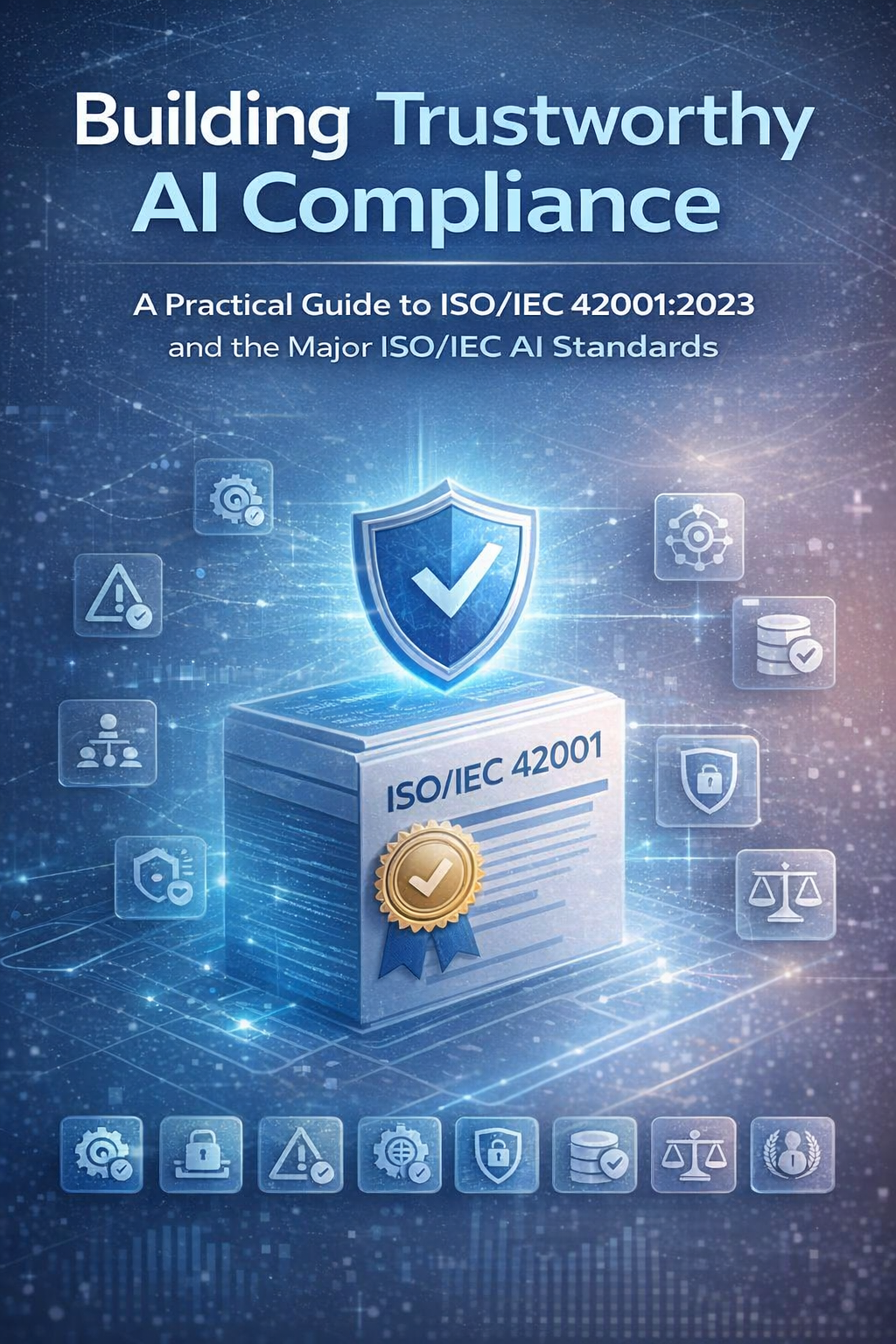
      Building Trustworthy AI Compliance: A Practical Guide to ISO/IEC 42001:2023 and the Major ISO/IEC AI Standards

      Category: CISO,Information Security,ISO 27k,ISO 42001,vCISO — disc7 @ 8:56 am

      Major ISO/IEC Standards in AI Compliance — Summary & Significance

      1. ISO/IEC 42001:2023 — AI Management System (AIMS)
      This standard defines the requirements for establishing, implementing, maintaining, and continually improving an Artificial Intelligence Management System. It focuses on organizational governance, accountability, and structured oversight of AI lifecycle activities. Its significance lies in providing a formal management framework that embeds responsible AI practices into daily operations, enabling organizations to systematically manage risks, document decisions, and demonstrate compliance to regulators and stakeholders.

      2. ISO/IEC 23894:2023 — AI Risk Management
      This standard offers guidance for identifying, assessing, and monitoring risks associated with AI systems across their lifecycle. It promotes a risk-based approach aligned with enterprise risk management. Its importance in AI compliance is that it helps organizations proactively detect technical, operational, and ethical risks, ensuring structured mitigation strategies that reduce unexpected failures and compliance gaps.

      3. ISO/IEC 38507:2022 — Governance of AI
      This framework provides principles for boards and executive leadership to oversee AI responsibly. It emphasizes strategic alignment, accountability, and ethical decision-making. Its compliance value comes from strengthening executive oversight, ensuring AI initiatives align with organizational values, regulatory expectations, and long-term strategy.

      4. ISO/IEC 22989:2022 — AI Concepts & Architecture
      This standard establishes shared terminology and reference architectures for AI systems. It ensures stakeholders use consistent language and system classifications. Its significance lies in reducing ambiguity in policy, governance, and compliance discussions, which improves collaboration between legal, technical, and business teams.

      5. ISO/IEC 23053:2022 — Machine Learning System Framework
      This framework describes the structure and lifecycle of ML-based AI systems, including system components and data-model interactions. It is significant because it guides organizations in designing AI systems with traceability and control, supporting auditability and lifecycle governance required for compliance.

      6. ISO/IEC 5259 — Data Quality for AI
      This series focuses on dataset governance, quality metrics, and bias-aware controls. It emphasizes the integrity and reliability of training and operational data. Its compliance relevance is critical, as poor data quality directly affects fairness, performance, and legal defensibility of AI outcomes.

      7. ISO/IEC TR 24027:2021 — Bias in AI
      This technical report explains sources of bias in AI systems and outlines mitigation and measurement techniques. It is significant for compliance because it supports fairness and non-discrimination objectives, helping organizations implement defensible controls against biased outcomes.

      8. ISO/IEC TR 24028:2020 — Trustworthiness in AI
      This report defines key attributes of trustworthy AI, including robustness, transparency, and reliability. Its role in compliance is to provide practical benchmarks for evaluating system dependability and stakeholder trust.

      9. ISO/IEC TR 24368:2022 — Ethical & Societal Concerns
      This guidance examines the broader human and societal impacts of AI deployment. It encourages responsible implementation that considers social risk and ethical implications. Its significance is in aligning AI programs with public expectations and emerging regulatory ethics requirements.


      Overview: How ISO Standards Build AIMS and Reduce AI Risk

      Major ISO/IEC standards form an integrated ecosystem that supports organizations in building a robust Artificial Intelligence Management System (AIMS) and achieving effective AI compliance. ISO/IEC 42001 serves as the structural backbone by defining management system requirements that embed governance, accountability, and continuous improvement into AI operations. ISO/IEC 23894 complements this by providing a structured risk management methodology tailored to AI, ensuring risks are systematically identified and mitigated.

      Supporting standards strengthen specific pillars of AI governance. ISO/IEC 27001 and ISO/IEC 27701 reinforce data security and privacy protection, safeguarding sensitive information used in AI systems. ISO/IEC 22989 establishes shared terminology that reduces ambiguity across teams, while ISO/IEC 23053 and the ISO/IEC 5259 series enhance lifecycle management and data quality controls. Technical reports addressing bias, trustworthiness, and ethical concerns further ensure that AI systems operate responsibly and transparently.

      Together, these standards create a comprehensive compliance architecture that improves accountability, supports regulatory readiness, and minimizes operational and ethical risks. By integrating governance, risk management, security, and quality assurance into a unified framework, organizations can deploy AI with greater confidence and resilience.


      My Perspective

      ISO’s AI standards represent a shift from ad-hoc AI experimentation toward disciplined, auditable AI governance. What makes this ecosystem powerful is not any single standard, but how they interlock: management systems provide structure, risk frameworks guide decision-making, and ethical and technical standards shape implementation. Organizations that adopt this integrated approach are better positioned to scale AI responsibly while maintaining stakeholder trust. In practice, the biggest value comes when these standards are operationalized — embedded into workflows, metrics, and leadership oversight — rather than treated as checkbox compliance.

      InfoSec services | InfoSec books | Follow our blog | DISC llc is listed on The vCISO Directory | ISO 27k Chat bot | Comprehensive vCISO Services | ISMS Services | AIMS Services | Security Risk Assessment Services | Mergers and Acquisition Security

      At DISC InfoSec, we help organizations navigate this landscape by aligning AI risk management, governance, security, and compliance into a single, practical roadmap. Whether you are experimenting with AI or deploying it at scale, we help you choose and operationalize the right frameworks to reduce risk and build trust. Learn more at DISC InfoSec.

      Tags: Major ISO Standards in AI compliance


      Feb 23 2026

      Mastering the ISO Certification Journey: From Gap Assessment to Audit Readiness

      Category: ISO 27k,ISO 42001 — disc7 @ 8:31 am

      ISO certification is a structured process organizations follow to demonstrate that their management systems meet internationally recognized standards such as International Organization for Standardization frameworks like ISO 27001 or ISO 27701. The journey typically begins with understanding the standard’s requirements, defining the scope of certification, and aligning internal practices with those requirements. Organizations document their controls, implement processes, train staff, and conduct internal reviews before engaging an certification body for an external audit. The goal is not just to pass an audit, but to build a repeatable, risk-driven management system that improves security, privacy, and operational discipline over time.

      Gap assessment & scoring is the diagnostic phase where the organization’s current practices are compared against the selected ISO standard. Each requirement of the standard is reviewed to identify missing controls, weak processes, or incomplete documentation. The “scoring” aspect prioritizes gaps by severity and business impact, helping leadership understand where the biggest risks and compliance shortfalls exist. This structured baseline gives a clear roadmap, timeline, and resource estimate for achieving certification, turning a complex standard into an actionable improvement plan.

      Risk assessment & control selection focuses on identifying threats to the organization’s information assets and evaluating their likelihood and impact. Based on this analysis, appropriate security and privacy controls are selected to reduce risks to acceptable levels. Rather than blindly implementing every possible control, the organization applies a risk-based approach to choose measures that are proportional, cost-effective, and aligned with business objectives. This ensures the certification effort strengthens real security posture instead of becoming a checkbox exercise.

      Policy and process definition translates ISO requirements and chosen controls into formal governance documents and operational workflows. Policies set management intent and direction, while processes define how daily activities are performed, monitored, and improved. Clear documentation creates consistency, accountability, and auditability across teams. It also ensures that responsibilities are well defined and that employees understand how their roles contribute to compliance and risk management.

      Implementation support and internal audit is the execution and validation stage. Organizations deploy the defined controls, integrate them into everyday operations, and provide training to staff. Internal audits are then conducted to independently verify that processes are being followed and that controls are effective. Findings from these audits drive corrective actions and continuous improvement, helping the organization resolve issues before the external certification audit.

      Pre-certification readiness review is a final mock audit that simulates the certification body’s assessment. It checks documentation completeness, evidence of control operation, and overall system maturity. Any remaining weaknesses are addressed quickly, reducing the risk of surprises during the official audit. This step increases confidence that the organization is fully prepared to demonstrate compliance.

      Perspective: The ISO certification process is most valuable when treated as a long-term governance framework rather than a one-time project. Organizations that focus on embedding risk management, accountability, and continuous improvement into their culture gain far more than a certificate—they build resilient systems that scale with the business. When done properly, certification becomes a catalyst for operational maturity, customer trust, and measurable risk reduction.

      InfoSec services | InfoSec books | Follow our blog | DISC llc is listed on The vCISO Directory | ISO 27k Chat bot | Comprehensive vCISO Services | ISMS Services | AIMS Services | Security Risk Assessment Services | Mergers and Acquisition Security

      At DISC InfoSec, we help organizations navigate this landscape by aligning AI risk management, governance, security, and compliance into a single, practical roadmap. Whether you are experimenting with AI or deploying it at scale, we help you choose and operationalize the right frameworks to reduce risk and build trust. Learn more at DISC InfoSec.

      Tags: iso 27001, ISO 27701, ISO 42001, ISO Certification Services


      Feb 17 2026

      AI Exposure Readiness assessment: A Practical Framework for Identifying and Managing Emerging Risks

      Category: AI,AI Governance,AI Governance Tools,ISO 42001 — disc7 @ 3:19 pm


      AI access to sensitive data

      When AI systems are connected to internal databases or proprietary intellectual property, they effectively become another privileged user in your environment. If this access is not tightly scoped and continuously monitored, sensitive information can be unintentionally exposed, copied, or misused. A proper diagnostic question is: Do we clearly know what data each AI system can see, and is that access minimized to only what is necessary? Data exposure through AI is often silent and cumulative, making early control essential.

      AI systems that can execute actions

      AI-driven workflows that trigger operational or financial actions—such as approving transactions, modifying configurations, or initiating automated processes—introduce execution risk. Errors, prompt manipulation, or unexpected model behavior can directly impact business operations. Organizations should treat these systems like automated decision engines and require guardrails, approval thresholds, and rollback mechanisms. The key issue is not just what AI recommends, but what it is allowed to do autonomously.

      Overprivileged service accounts

      Service accounts connected to AI platforms frequently inherit broad permissions for convenience. Over time, these accounts accumulate access that exceeds their intended purpose. This creates a high-value attack surface: if compromised, they can be used to pivot across systems. A mature posture requires least-privilege design, periodic permission reviews, and segmentation of AI-related credentials from core infrastructure.

      Insufficiently isolated AI logging

      When AI logs are mixed with general system logging, it becomes difficult to trace model behavior, investigate incidents, or audit decisions. AI systems generate unique telemetry—inputs, prompts, outputs, and decision paths—that require dedicated visibility. Without separated and structured logging, organizations lose the ability to reconstruct events and detect misuse patterns. Clear audit trails are foundational for both security and accountability.

      Lack of centralized AI inventory

      If there is no centralized inventory of AI tools, integrations, and models in use, governance becomes reactive instead of intentional. Shadow AI adoption spreads quickly across departments, creating blind spots in risk management. A centralized registry helps organizations understand where AI exists, what it does, who owns it, and how it connects to critical systems. You cannot manage or secure what you cannot see.

      Weak third-party AI vendor assessment

      AI vendors often process sensitive data or embed deeply into workflows, yet many organizations evaluate them using standard vendor checklists that miss AI-specific risks. Enhanced third-party reviews should examine model transparency, data handling practices, security controls, and long-term dependency risks. Without this scrutiny, external AI services can quietly expand your attack surface and compliance exposure.

      Missing human oversight for high-impact outputs

      When high-impact AI outputs—such as legal decisions, financial approvals, or customer-facing actions—are not subject to human validation, the organization assumes algorithmic risk without a safety net. Human-in-the-loop controls act as a checkpoint against model errors, bias, or unexpected behavior. The diagnostic question is simple: Where do we deliberately require human judgment before consequences become irreversible?


      Perspective

      This readiness assessment highlights a central truth: AI exposure is less about exotic threats and more about governance discipline. Most risks arise from familiar issues—access control, visibility, vendor management, and accountability—amplified by the speed and scale of AI adoption. Visibility is indeed the first layer of control. When organizations lack a clear architectural view of how AI interacts with their systems, decisions are driven by assumptions and convenience rather than intentional design.

      In my view, the organizations that succeed with AI will treat it as a core infrastructure layer, not an experimental add-on. They will build inventories, enforce least privilege, require auditable logging, and embed human oversight where impact is high. This doesn’t slow innovation; it stabilizes it. Strong governance creates the confidence to scale AI responsibly, turning potential exposure into managed capability rather than unmanaged risk.

      InfoSec services | InfoSec books | Follow our blog | DISC llc is listed on The vCISO Directory | ISO 27k Chat bot | Comprehensive vCISO Services | ISMS Services | AIMS Services | Security Risk Assessment Services | Mergers and Acquisition Security

      At DISC InfoSec, we help organizations navigate this landscape by aligning AI risk management, governance, security, and compliance into a single, practical roadmap. Whether you are experimenting with AI or deploying it at scale, we help you choose and operationalize the right frameworks to reduce risk and build trust. Learn more at DISC InfoSec.

      Tags: AI Exposure Readiness assessment:


      Feb 11 2026

      Below the Waterline: Why AI Strategy Fails Without Data Foundations

      Category: AI,AI Governance,ISO 42001 — disc7 @ 8:53 am

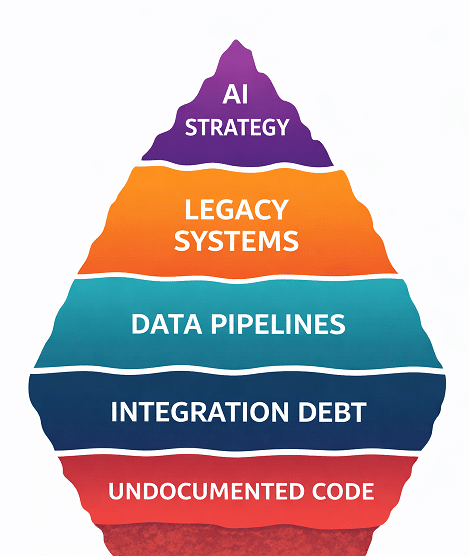
      The iceberg captures the reality of AI transformation.

      At the very top of the iceberg sits “AI Strategy.” This is the visible, exciting part—the headlines about GenAI, AI agents, copilots, and transformation. On the surface, leaders are saying, “AI will transform us,” and teams are eager to “move fast.” This is where ambition lives.

      Just below the waterline, however, are the layers most organizations prefer not to talk about.

      First come legacy systems—applications stitched together over decades through acquisitions, quick fixes, and short-term decisions. These systems were never designed to support real-time AI workflows, yet they hold critical business data.

      Beneath that are data pipelines—fragile processes moving data between systems. Many break silently, rely on manual intervention, or produce inconsistent outputs. AI models don’t fail dramatically at first; they fail subtly when fed inconsistent or delayed data.

      Below that lies integration debt—APIs, batch jobs, and custom connectors built years ago, often without clear ownership. When no one truly understands how systems talk to each other, scaling AI becomes risky and slow.

      Even deeper is undocumented code—business logic embedded in scripts and services that only a few long-tenured employees understand. This is the most dangerous layer. When AI systems depend on logic no one can confidently explain, trust erodes quickly.

      This is where the real problems live—beneath the surface. Organizations are trying to place advanced AI strategies on top of foundations that are unstable. It’s like installing smart automation in a building with unreliable wiring.

      We’ve seen what happens when the foundation isn’t ready:

      • AI systems trained on “clean” lab data struggle in messy real-world environments.
      • Models inherit bias from historical datasets and amplify it.
      • Enterprise AI pilots stall—not because the algorithms are weak, but because data quality, workflows, and integrations can’t support them.

      If AI is to work at scale, the invisible layers must become the priority.

      Clean Data

      Clean data means consistent definitions, deduplicated records, validated inputs, and reconciled sources of truth. It means knowing which dataset is authoritative. AI systems amplify whatever they are given—if the data is flawed, the intelligence will be flawed. Clean data is the difference between automation and chaos.

      Strong Pipelines

      Strong pipelines ensure data flows reliably, securely, and in near real time. They include monitoring, error handling, lineage tracking, and version control. AI cannot depend on pipelines that break quietly or require manual fixes. Reliability builds trust.

      Disciplined Integration

      Disciplined integration means structured APIs, documented interfaces, clear ownership, and controlled change management. AI agents must interact with systems in predictable ways. Without integration discipline, AI becomes brittle and risky.

      Governance

      Governance defines accountability—who owns the data, who approves models, who monitors bias, who audits outcomes. It aligns AI usage with regulatory, ethical, and operational standards. Without governance, AI becomes experimentation without guardrails.

      Documentation

      Documentation captures business logic, data definitions, workflows, and architectural decisions. It reduces dependency on tribal knowledge. In AI governance, documentation is not bureaucracy—it is institutional memory and operational resilience.


      The Bigger Picture

      GenAI is powerful. But it is not magic. It does not repair fragmented data landscapes or reconcile conflicting system logic. It accelerates whatever foundation already exists.

      The organizations that succeed with AI won’t be the ones that move fastest at the top of the iceberg. They will be the ones willing to strengthen what lies beneath the waterline.

      AI is the headline.
      Data infrastructure is the foundation.
      AI Governance is the discipline that makes transformation real.

      My perspective: AI Governance is not about controlling innovation—it’s about preparing the enterprise so innovation doesn’t collapse under its own ambition. The “boring” work—data quality, integration discipline, documentation, and oversight—is not a delay to transformation. It is the transformation.

      InfoSec services | InfoSec books | Follow our blog | DISC llc is listed on The vCISO Directory | ISO 27k Chat bot | Comprehensive vCISO Services | ISMS Services | AIMS Services | Security Risk Assessment Services | Mergers and Acquisition Security

      At DISC InfoSec, we help organizations navigate this landscape by aligning AI risk management, governance, security, and compliance into a single, practical roadmap. Whether you are experimenting with AI or deploying it at scale, we help you choose and operationalize the right frameworks to reduce risk and build trust. Learn more at DISC InfoSec.

      Tags: AI Strategy


      Feb 10 2026

      From Ethics to Enforcement: The AI Governance Shift No One Can Ignore

      Category: AI,AI Governance,Information Security,ISO 42001 — disc7 @ 1:24 pm

      AI Governance Defined
      AI governance is the framework of rules, controls, and accountability that ensures AI systems behave safely, ethically, transparently, and in compliance with law and business objectives. It goes beyond principles to include operational evidence — inventories, risk assessments, audit logs, human oversight, continuous monitoring, and documented decision ownership. In 2026, governance has moved from aspirational policy to mission-critical operational discipline that reduces enterprise risk and enables scalable, responsible AI adoption.


      1. From Model Outputs → System Actions

      What’s Changing:
      Traditionally, risk focus centered on the outputs models produce — e.g., biased text or inaccurate predictions. But as AI systems become agentic (capable of acting autonomously in the world), the real risks lie in actions taken, not just outputs. That means governance must now cover runtime behaviour, include real-time monitoring, automated guardrails, and defined escalation paths.

      My Perspective:
      This shift recognizes that AI isn’t just a prediction engine — it can initiate transactions, schedule activities, and make decisions with real consequences. Governance must evolve accordingly, embedding control closer to execution and amplifying responsibilities around when and how the system interacts with people, data, and money. It’s a maturity leap from “what did the model say?” to “what did the system do?” — and that’s critical for legal defensibility and trust.


      2. Enforcement Scales Beyond Pilots

      What’s Changing:
      What was voluntary guidance has become enforceable regulation. The EU AI Act’s high-risk rules kick in fully in 2026, and U.S. states are applying consumer protection and discrimination laws to AI behaviours. Regulators are even flagging documentation gaps as violations. Compliance can no longer be a single milestone; it must be a continuous operational capability similar to cybersecurity controls.

      My Perspective:
      This shift is seismic: AI governance now carries real legal and financial consequences. Organizations can’t rely on static policies or annual audits — they need ongoing evidence of how models are monitored, updated, and risk-assessed. Treating governance like a continuous control discipline closes the gap between intention and compliance, and is essential for risk-aware, evidence-ready AI adoption at scale.


      3. Healthcare AI Signals Broader Direction

      What’s Changing:
      Regulated sectors like healthcare are pushing transparency, accountability, explainability, and documented risk assessments to the forefront. “Black-box” clinical algorithms are increasingly unacceptable; models must justify decisions before being trusted or deployed. What happens in healthcare is a leading indicator of where other regulated industries — finance, government, critical infrastructure — will head.

      My Perspective:
      Healthcare is a proving ground for accountable AI because the stakes are human lives. Requiring explainability artifacts and documented risk mitigation before deployment sets a new bar for governance maturity that others will inevitably follow. This trend accelerates the demise of opaque, undocumented AI practices and reinforces governance not as overhead, but as a deployment prerequisite.


      4. Governance Moves Into Executive Accountability

      What’s Changing:
      AI governance is no longer siloed in IT or ethics committees — it’s now a board-level concern. Leaders are asking not just about technology but about risk exposure, audit readiness, and whether governance can withstand regulatory scrutiny. “Governance debt” (inconsistent, siloed, undocumented oversight) becomes visible at the highest levels and carries cost — through fines, forced system rollbacks, or reputational damage.

      My Perspective:
      This shift elevates governance from a back-office activity to a strategic enterprise risk function. When executives are accountable for AI risk, governance becomes integrated with legal, compliance, finance, and business strategy, not just technical operations. That integration is what makes governance resilient, auditable, and aligned with enterprise risk tolerance — and it signals that responsible AI adoption is a competitive differentiator, not just a compliance checkbox.


      In Summary: The 2026 AI Governance Reality

      AI governance in 2026 isn’t about writing policies — it’s about operationalizing controls, documenting evidence, and embedding accountability into AI lifecycles. These four shifts reflect the move from static principles to dynamic, enterprise-grade governance that manages risk proactively, satisfies regulators, and builds trust with stakeholders. Organizations that embrace this shift will not only reduce risk but unlock AI’s value responsibly and sustainably.


      InfoSec services | InfoSec books | Follow our blog | DISC llc is listed on The vCISO Directory | ISO 27k Chat bot | Comprehensive vCISO Services | ISMS Services | AIMS Services | Security Risk Assessment Services | Mergers and Acquisition Security

      At DISC InfoSec, we help organizations navigate this landscape by aligning AI risk management, governance, security, and compliance into a single, practical roadmap. Whether you are experimenting with AI or deploying it at scale, we help you choose and operationalize the right frameworks to reduce risk and build trust. Learn more at DISC InfoSec.

      Tags: AI Governance


      Feb 10 2026

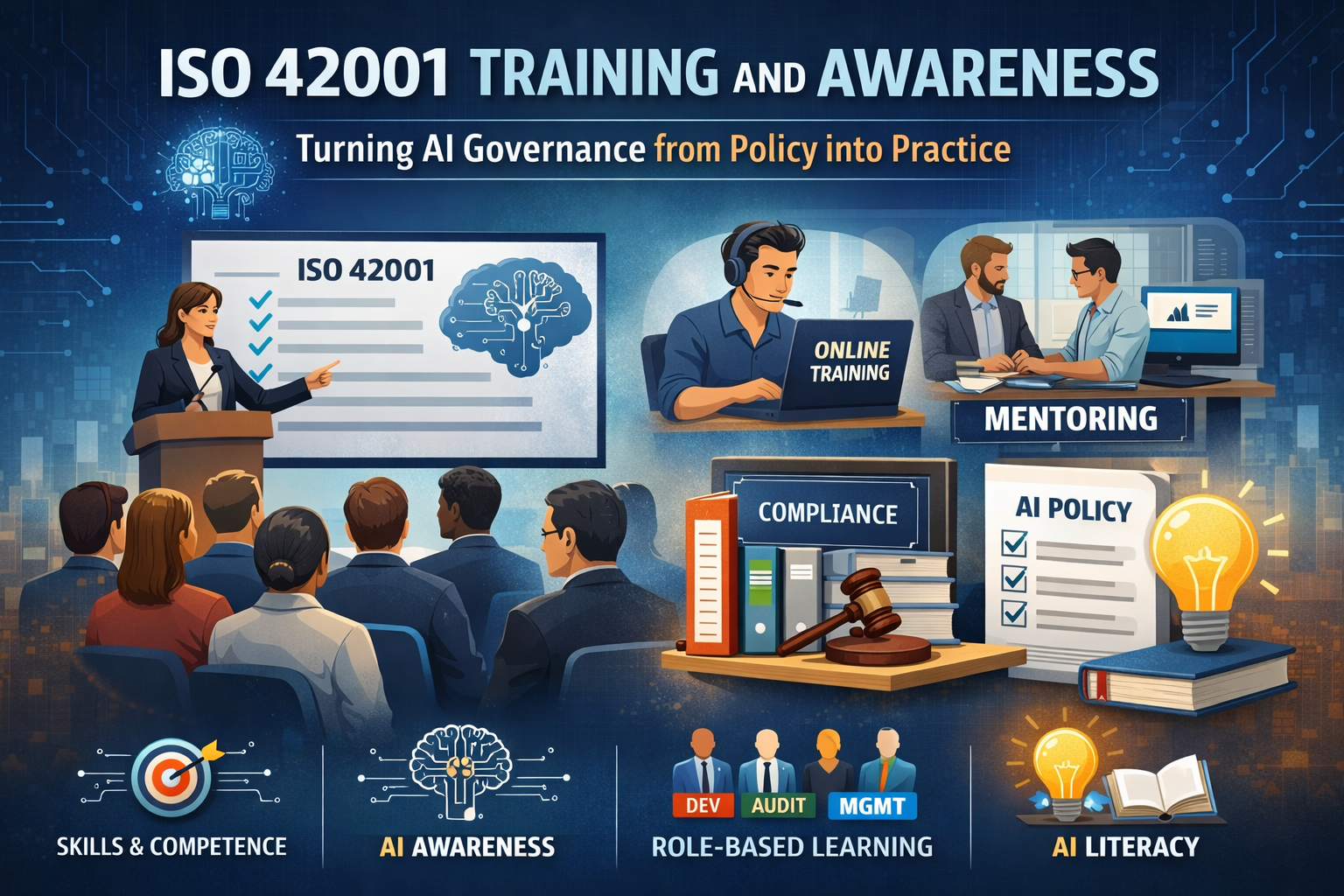
      ISO 42001 Training and Awareness: Turning AI Governance from Policy into Practice

      Category: ISO 42001,Security Awareness,Security training — disc7 @ 12:34 pm

      Turning AI Governance from Policy into Practice


      Why ISO 42001 training and awareness matter
      ISO/IEC 42001 places strong emphasis on ensuring that people involved in AI design, development, deployment, and oversight understand their responsibilities. This is not just a “checkbox” requirement; effective training and awareness directly influence how well AI risks are identified, managed, and governed in practice. With AI technologies evolving rapidly and regulations such as the EU AI Act coming into force, organizations need structured, role-appropriate education to prevent misuse, ethical failures, and compliance gaps.

      Competence requirements (Clause 7.2)
      Clause 7.2 focuses on competence and requires organizations to identify the skills and knowledge needed for specific AI-related roles. Companies must assess whether individuals already possess these competencies through education, training, or experience, and take action where gaps exist. This means competence must be intentional and evidence-based—organizations should be able to show why someone is qualified for a role such as AI governance lead, implementer, or internal auditor, and how missing capabilities are addressed.

      Awareness requirements (Clause 7.3)
      Clause 7.3 shifts the focus from deep expertise to general awareness. Employees must understand the organization’s AI policy, how their work contributes to AI governance, and the consequences of not following AI-related policies and procedures. Awareness is about shaping behavior at scale, ensuring that AI risks are not created unintentionally by uninformed decisions, shortcuts, or misuse of AI systems.

      Training methods and delivery options
      ISO 42001 allows flexibility in how competencies are built. Training can be delivered through formal courses, in-house sessions, mentorship, or structured self-study. Formal courses are well suited for specialized roles, while in-house training works best for groups with similar needs. Reading materials and mentorship typically complement other methods rather than replacing them. The key is aligning the training approach with the role, maturity level, and risk exposure of the audience.

      Role-based and audience-specific training
      Effective training starts with segmentation. Employees should be grouped based on function, seniority, or involvement in AI-related processes. Training topics, depth, and duration should then be tailored accordingly—for example, short, high-level sessions for senior leadership and more detailed, technical sessions for developers or AI operators. This ensures relevance and avoids overtraining or undertraining critical roles.

      AI awareness and AI literacy
      Beyond formal training, ISO 42001 emphasizes ongoing awareness, increasingly referred to as “AI literacy,” especially in the context of the EU AI Act. Awareness can be raised through videos, internal articles, presentations, and discussions. These methods help employees understand why AI governance matters, not just what the rules are. Continuous communication reinforces expectations and keeps AI risks visible as technologies and use cases evolve.

      Modes of delivering training at scale
      Organizations can choose between instructor-led classroom sessions, live online training, or pre-recorded courses delivered via learning management systems. Instructor-led formats allow interaction but are harder to scale, while pre-recorded training is easier to manage and track. The choice depends on organizational size, geographic spread, and the need for interaction versus efficiency.


      My perspective

      ISO 42001 gets something very important right: AI governance will fail if it lives only in policies and documents. Training and awareness are the mechanisms that translate governance into day-to-day decisions. In practice, I see many organizations default to generic AI awareness sessions that satisfy auditors but don’t change behavior. The real value comes from role-based training tied directly to AI risk scenarios the organization actually faces.

      I also believe ISO 42001 training should not be treated as a standalone initiative. It works best when integrated with security awareness, privacy training, and risk management programs—especially for organizations already aligned with ISO 27001 or similar frameworks. As AI becomes embedded across business functions, AI literacy will increasingly resemble “digital hygiene”: something everyone must understand at a basic level, with deeper expertise reserved for those closest to the risk.

      InfoSec services | InfoSec books | Follow our blog | DISC llc is listed on The vCISO Directory | ISO 27k Chat bot | Comprehensive vCISO Services | ISMS Services | AIMS Services | Security Risk Assessment Services | Mergers and Acquisition Security

      At DISC InfoSec, we help organizations navigate this landscape by aligning AI risk management, governance, security, and compliance into a single, practical roadmap. Whether you are experimenting with AI or deploying it at scale, we help you choose and operationalize the right frameworks to reduce risk and build trust. Learn more at DISC InfoSec.

      Tags: ISO 42001 Awareness, ISO 42001 Training


      Feb 09 2026

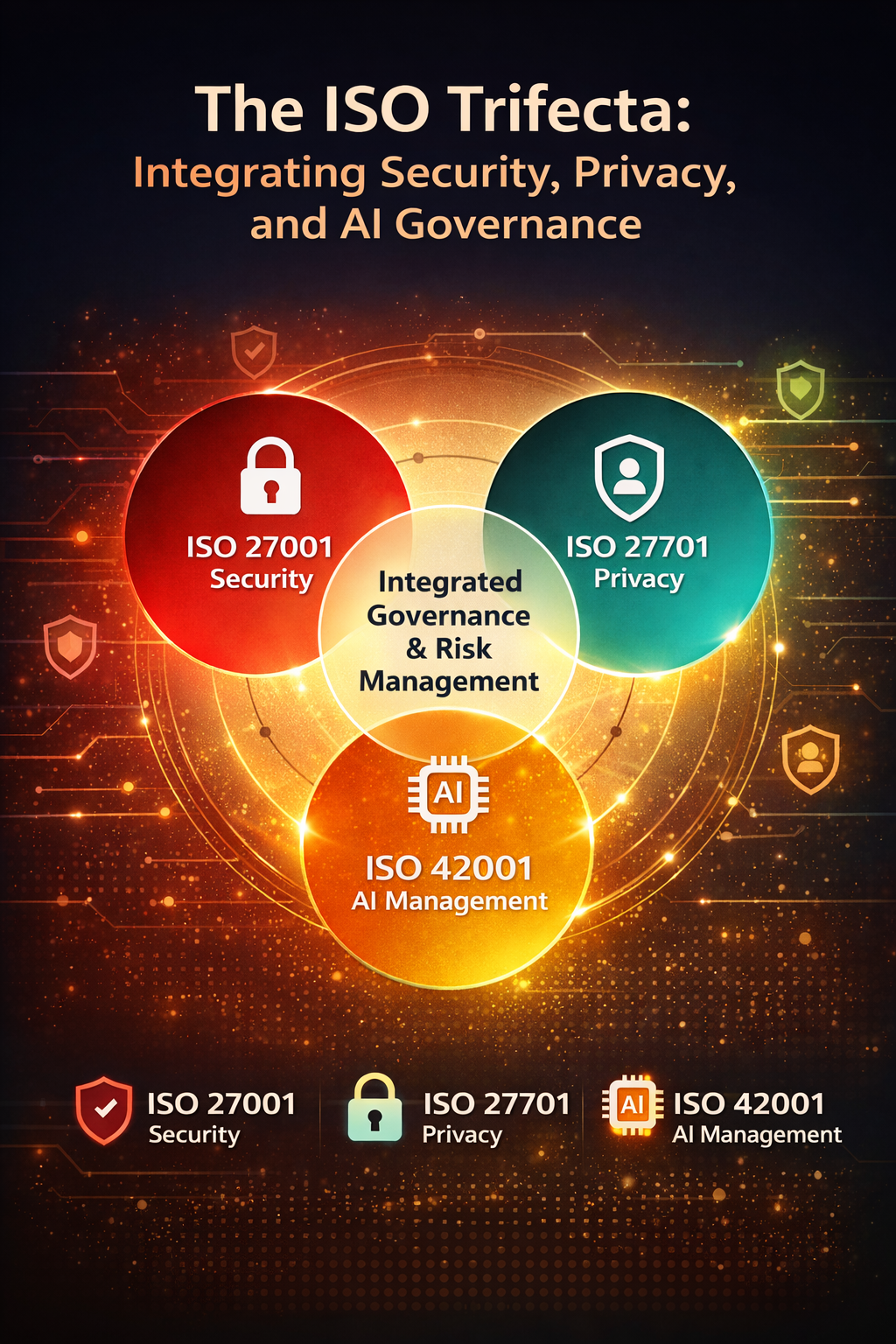
      The ISO Trifecta: Integrating Security, Privacy, and AI Governance

      Category: AI Governance,CISO,ISO 27k,ISO 42001,vCISO — disc7 @ 12:09 pm

      ISO 27001: The Security Foundation
      ISO/IEC 27001 is the global standard for establishing, implementing, and maintaining an Information Security Management System (ISMS). It focuses on protecting the confidentiality, integrity, and availability of information through risk-based security controls. For most organizations, this is the bedrock—governing infrastructure security, access control, incident response, vendor risk, and operational resilience. It answers the question: Are we managing information security risks in a systematic and auditable way?

      ISO 27701: Extending Security into Privacy
      ISO/IEC 27701 builds directly on ISO 27001 by extending the ISMS into a Privacy Information Management System (PIMS). It introduces structured controls for handling personally identifiable information (PII), clarifying roles such as data controllers and processors, and aligning security practices with privacy obligations. Where ISO 27001 protects data broadly, ISO 27701 adds explicit guardrails around how personal data is collected, processed, retained, and shared—bridging security operations with privacy compliance.

      ISO 42001: Governing AI Systems
      ISO/IEC 42001 is the emerging standard for AI management systems. Unlike traditional IT or privacy standards, it governs the entire AI lifecycle—from design and training to deployment, monitoring, and retirement. It addresses AI-specific risks such as bias, explainability, model drift, misuse, and unintended impact. Importantly, ISO 42001 is not a bolt-on framework; it assumes security and privacy controls already exist and focuses on how AI systems amplify risk if governance is weak.

      Integrating the Three into a Unified Governance, Risk, and Compliance Model
      When combined, ISO 27001, ISO 27701, and ISO 42001 form an integrated governance and risk management structure—the “ISO Trifecta.” ISO 27001 provides the secure operational foundation, ISO 27701 ensures privacy and data protection are embedded into processes, and ISO 42001 acts as the governance engine for AI-driven decision-making. Together, they create mutually reinforcing controls: security protects AI infrastructure, privacy constrains data use, and AI governance ensures accountability, transparency, and continuous risk oversight. Instead of managing three separate compliance efforts, organizations can align policies, risk assessments, controls, and audits under a single, coherent management system.

      Perspective: Why Integrated Governance Matters
      Integrated governance is no longer optional—especially in an AI-driven world. Treating security, privacy, and AI risk as separate silos creates gaps precisely where regulators, customers, and attackers are looking. The real value of the ISO Trifecta is not certification; it’s coherence. When governance is integrated, risk decisions are consistent, controls scale across technologies, and AI systems are held to the same rigor as legacy systems. Organizations that adopt this mindset early won’t just be compliant—they’ll be trusted.

      InfoSec services | InfoSec books | Follow our blog | DISC llc is listed on The vCISO Directory | ISO 27k Chat bot | Comprehensive vCISO Services | ISMS Services | AIMS Services | Security Risk Assessment Services | Mergers and Acquisition Security

      At DISC InfoSec, we help organizations navigate this landscape by aligning AI risk management, governance, security, and compliance into a single, practical roadmap. Whether you are experimenting with AI or deploying it at scale, we help you choose and operationalize the right frameworks to reduce risk and build trust. Learn more at DISC InfoSec.

      Tags: iso 27001, ISO 27701, ISO 42001


      Feb 09 2026

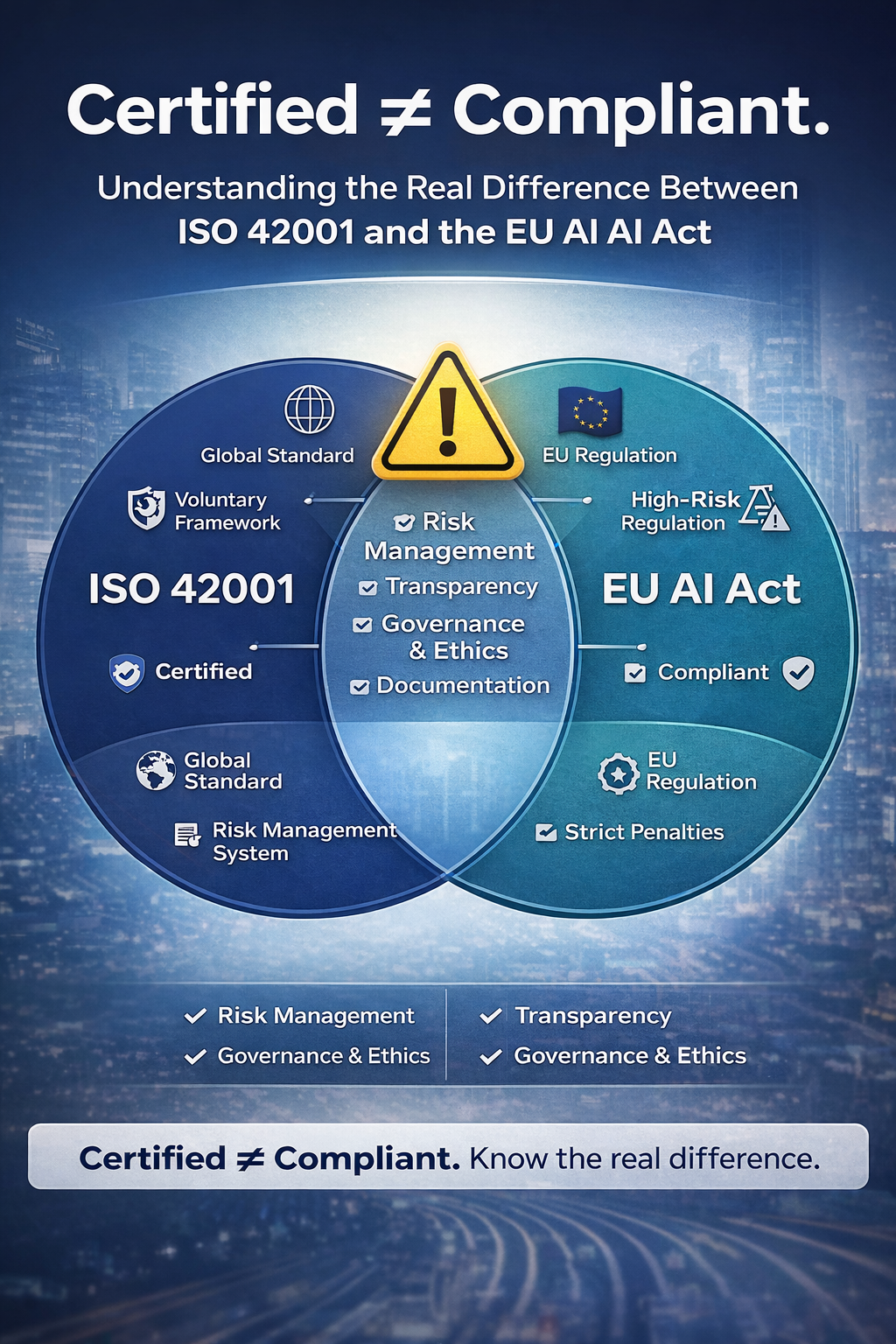
      Understanding the Real Difference Between ISO 42001 and the EU AI Act

      Category: AI,AI Governance,Information Security,ISO 42001 — disc7 @ 8:41 am

      Certified ≠ Compliant

      1. The big picture
      The image makes one thing very clear: ISO/IEC 42001 and the EU AI Act are related, but they are not the same thing. They overlap in intent—safe, responsible, and trustworthy AI—but they come from two very different worlds. One is a global management standard; the other is binding law.

      2. What ISO/IEC 42001 really is
      ISO/IEC 42001 is an international, voluntary standard for establishing an AI Management System (AIMS). It focuses on how an organization governs AI—policies, processes, roles, risk management, and continuous improvement. Being certified means you have a structured system to manage AI risks, not that your AI systems are legally approved for use in every jurisdiction.

      3. What the EU AI Act actually does
      The EU AI Act is a legal and regulatory framework specific to the European Union. It defines what is allowed, restricted, high-risk, or outright prohibited in AI systems. Compliance is mandatory, enforceable by regulators, and tied directly to penalties, market access, and legal exposure.

      4. The shared principles that cause confusion
      The overlap is real and meaningful. Both ISO 42001 and the EU AI Act emphasize transparency and accountability, risk management and safety, governance and ethics, documentation and reporting, data quality, human oversight, and trustworthy AI outcomes. This shared language often leads companies to assume one equals the other.

      5. Where ISO 42001 stops short
      ISO 42001 does not classify AI systems by risk level. It does not tell you whether your system is “high-risk,” “limited-risk,” or prohibited. Without that classification, organizations may build solid governance processes—while still governing the wrong risk category.

      6. Conformity versus certification
      ISO 42001 certification is voluntary and typically audited by certification bodies against management system requirements. The EU AI Act, however, can require formal conformity assessments, sometimes involving notified third parties, especially for high-risk systems. These are different auditors, different criteria, and very different consequences.

      7. The blind spot around prohibited AI practices
      ISO 42001 contains no explicit list of banned AI use cases. The EU AI Act does. Practices like social scoring, certain emotion recognition in workplaces, or real-time biometric identification may be illegal regardless of how mature your management system is. A well-run AIMS will not automatically flag illegality.

      8. Enforcement and penalties change everything
      Failing an ISO audit might mean corrective actions or losing a certificate. Failing the EU AI Act can mean fines of up to €35 million or 7% of global annual turnover, plus reputational and operational damage. The risk profiles are not even in the same league.

      9. Certified does not mean compliant
      This is the core message in the image and the text: ISO 42001 certification proves governance maturity, not legal compliance. The EU AI Act qualification proves regulatory alignment, not management system excellence. One cannot substitute for the other.

      10. My perspective
      Having both ISO 42001 certification and EU AI Act qualification exposes a hard truth many consultants gloss over: compliance frameworks do not stack automatically. ISO 42001 is a strong foundation—but it is not the finish line. Your certificate shows you are organized; it does not prove you are lawful. In AI governance, certified ≠ compliant, and knowing that difference is where real expertise begins.

      InfoSec services | InfoSec books | Follow our blog | DISC llc is listed on The vCISO Directory | ISO 27k Chat bot | Comprehensive vCISO Services | ISMS Services | AIMS Services | Security Risk Assessment Services | Mergers and Acquisition Security

      At DISC InfoSec, we help organizations navigate this landscape by aligning AI risk management, governance, security, and compliance into a single, practical roadmap. Whether you are experimenting with AI or deploying it at scale, we help you choose and operationalize the right frameworks to reduce risk and build trust. Learn more at DISC InfoSec.

      Tags: EU AI Act, ISO 42001


      Jan 30 2026

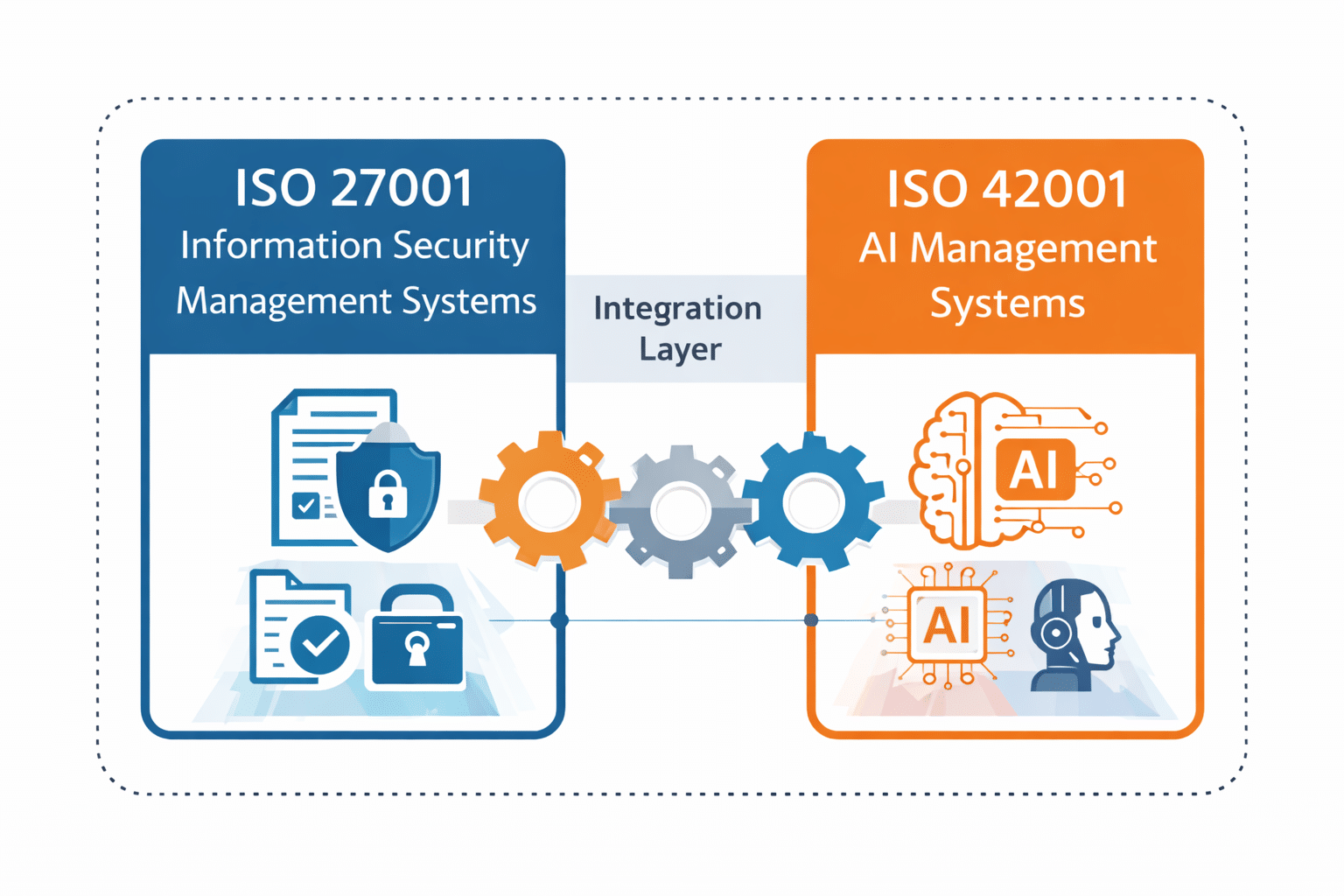
      Integrating ISO 42001 AI Management Systems into Existing ISO 27001 Frameworks

      Category: AI,AI Governance,AI Guardrails,ISO 27k,ISO 42001,vCISO — disc7 @ 12:36 pm

      Key Implementation Steps

      Defining Your AI Governance Scope

      The first step in integrating AI management systems is establishing clear boundaries within your existing information security framework. Organizations should conduct a comprehensive inventory of all AI systems currently deployed, including machine learning models, large language models, and recommendation engines. This involves identifying which departments and teams are actively using or developing AI capabilities, and mapping how these systems interact with assets already covered under your ISMS such as databases, applications, and infrastructure. For example, if your ISMS currently manages CRM and analytics platforms, you would extend coverage to include AI-powered chatbots or fraud detection systems that rely on that data.

      Expanding Risk Assessment for AI-Specific Threats

      Traditional information security risk registers must be augmented to capture AI-unique vulnerabilities that fall outside conventional cybersecurity concerns. Organizations should incorporate risks such as algorithmic bias and discrimination in AI outputs, model poisoning and adversarial attacks, shadow AI adoption through unauthorized LLM tools, and intellectual property leakage through training data or prompts. The ISO 42001 Annex A controls provide valuable guidance here, and organizations can leverage existing risk methodologies like ISO 27005 or NIST RMF while extending them with AI-specific threat vectors and impact scenarios.

      Updating Governance Policies for AI Integration

      Rather than creating entirely separate AI policies, organizations should strategically enhance existing ISMS documentation to address AI governance. This includes updating Acceptable Use Policies to restrict unauthorized use of public AI tools, revising Data Classification Policies to properly tag and protect training datasets, strengthening Third-Party Risk Policies to evaluate AI vendors and their model provenance, and enhancing Change Management Policies to enforce model version control and deployment approval workflows. The key is creating an AI Governance Policy that references and builds upon existing ISMS documents rather than duplicating effort.

      Building AI Oversight into Security Governance Structures

      Effective AI governance requires expanding your existing information security committee or steering council to include stakeholders with AI-specific expertise. Organizations should incorporate data scientists, AI/ML engineers, legal and privacy professionals, and dedicated risk and compliance leads into governance structures. New roles should be formally defined, including AI Product Owners who manage AI system lifecycles, Model Risk Managers who assess AI-specific threats, and Ethics Reviewers who evaluate fairness and bias concerns. Creating an AI Risk Subcommittee that reports to the existing ISMS steering committee ensures integration without fragmenting governance.

      Managing AI Models as Information Assets

      AI models and their associated components must be incorporated into existing asset inventory and change management processes. Each model should be registered with comprehensive metadata including training data lineage and provenance, intended purpose with performance metrics and known limitations, complete version history and deployment records, and clear ownership assignments. Organizations should leverage their existing ISMS Change Management processes to govern AI model updates, retraining cycles, and deprecation decisions, treating models with the same rigor as other critical information assets.

      Aligning ISO 42001 and ISO 27001 Control Frameworks

      To avoid duplication and reduce audit burden, organizations should create detailed mapping matrices between ISO 42001 and ISO 27001 Annex A controls. Many controls have significant overlap—for instance, ISO 42001’s AI Risk Management controls (A.5.2) extend existing ISO 27001 risk assessment and treatment controls (A.6 & A.8), while AI System Development requirements (A.6.1) build upon ISO 27001’s secure development lifecycle controls (A.14). By identifying these overlaps, organizations can implement unified controls that satisfy both standards simultaneously, documenting the integration for auditor review.

      Incorporating AI into Security Awareness Training

      Security awareness programs must evolve to address AI-specific risks that employees encounter daily. Training modules should cover responsible AI use policies and guidelines, prompt safety practices to prevent data leakage through AI interactions, recognition of bias and fairness concerns in AI outputs, and practical decision-making scenarios such as “Is it acceptable to input confidential client data into ChatGPT?” Organizations can extend existing learning management systems and awareness campaigns rather than building separate AI training programs, ensuring consistent messaging and compliance tracking.

      Auditing AI Governance Implementation

      Internal audit programs should be expanded to include AI-specific checkpoints alongside traditional ISMS audit activities. Auditors should verify AI model approval and deployment processes, review documentation demonstrating bias testing and fairness assessments, investigate shadow AI discovery and remediation efforts, and examine dataset security and access controls throughout the AI lifecycle. Rather than creating separate audit streams, organizations should integrate AI-specific controls into existing ISMS audit checklists for each process area, ensuring comprehensive coverage during regular audit cycles.


      My Perspective

      This integration approach represents exactly the right strategy for organizations navigating AI governance. Having worked extensively with both ISO 27001 and ISO 42001 implementations, I’ve seen firsthand how creating parallel governance structures leads to confusion, duplicated effort, and audit fatigue. The Rivedix framework correctly emphasizes building upon existing ISMS foundations rather than starting from scratch.

      What particularly resonates is the focus on shadow AI risks and the practical awareness training recommendations. In my experience at DISC InfoSec and through ShareVault’s certification journey, the biggest AI governance gaps aren’t technical controls—they’re human behavior patterns where well-meaning employees inadvertently expose sensitive data through ChatGPT, Claude, or other LLMs because they lack clear guidance. The “47 controls you’re missing” concept between ISO 27001 and ISO 42001 provides excellent positioning for explaining why AI-specific governance matters to executives who already think their ISMS “covers everything.”

      The mapping matrix approach (point 6) is essential but often overlooked. Without clear documentation showing how ISO 42001 requirements are satisfied through existing ISO 27001 controls plus AI-specific extensions, organizations end up with duplicate controls, conflicting procedures, and confused audit findings. ShareVault’s approach of treating AI systems as first-class assets in our existing change management processes has proven far more sustainable than maintaining separate AI and IT change processes.

      If I were to add one element this guide doesn’t emphasize enough, it would be the importance of continuous monitoring and metrics. Organizations should establish AI-specific KPIs—model drift detection, bias metric trends, shadow AI discovery rates, training data lineage coverage—that feed into existing ISMS dashboards and management review processes. This ensures AI governance remains visible and accountable rather than becoming a compliance checkbox exercise.

      InfoSec services | InfoSec books | Follow our blog | DISC llc is listed on The vCISO Directory | ISO 27k Chat bot | Comprehensive vCISO Services | ISMS Services | AIMS Services | Security Risk Assessment Services | Mergers and Acquisition Security

      At DISC InfoSec, we help organizations navigate this landscape by aligning AI risk management, governance, security, and compliance into a single, practical roadmap. Whether you are experimenting with AI or deploying it at scale, we help you choose and operationalize the right frameworks to reduce risk and build trust. Learn more at DISC InfoSec.

      Tags: Integrating ISO 42001, iso 27001, ISO 27701


      Jan 27 2026

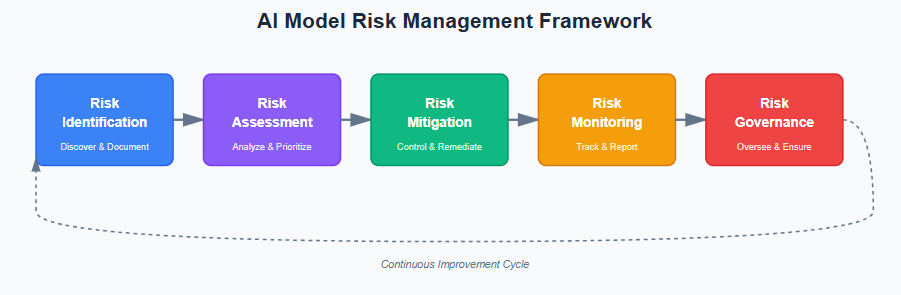
      AI Model Risk Management: A Five-Stage Framework for Trust, Compliance, and Control

      Category: AI,AI Governance,AI Guardrails,ISO 42001 — disc7 @ 3:15 pm


      Stage 1: Risk Identification – What could go wrong?

      Risk Identification focuses on proactively uncovering potential issues before an AI model causes harm. The primary challenge at this stage is identifying all relevant risks and vulnerabilities, including data quality issues, security weaknesses, ethical concerns, and unintended biases embedded in training data or model logic. Organizations must also understand how the model could fail or be misused across different contexts. Key tasks include systematically identifying risks, mapping vulnerabilities across the AI lifecycle, and recognizing bias and fairness concerns early so they can be addressed before deployment.


      Stage 2: Risk Assessment – How severe is the risk?

      Risk Assessment evaluates the significance of identified risks by analyzing their likelihood and potential impact on the organization, users, and regulatory obligations. A key challenge here is accurately measuring risk severity while also assessing whether the model performs as intended under real-world conditions. Organizations must balance technical performance metrics with business, legal, and ethical implications. Key tasks include scoring and prioritizing risks, evaluating model performance, and determining which risks require immediate mitigation versus ongoing monitoring.


      Stage 3: Risk Mitigation – How do we reduce the risk?

      Risk Mitigation aims to reduce exposure by implementing controls and corrective actions that address prioritized risks. The main challenge is designing safeguards that effectively reduce risk without degrading model performance or business value. This stage often requires technical and organizational coordination. Key tasks include implementing safeguards, mitigating bias, adjusting or retraining models, enhancing explainability, and testing controls to confirm that mitigation measures supports responsible and reliable AI operation.


      Stage 4: Risk Monitoring – Are new risks emerging?

      Risk Monitoring ensures that AI models remain safe, reliable, and compliant after deployment. A key challenge is continuously monitoring model performance in dynamic environments where data, usage patterns, and threats evolve over time. Organizations must detect model drift, emerging risks, and anomalies before they escalate. Key tasks include ongoing oversight, continuous performance monitoring, detecting and reporting anomalies, and updating risk controls to reflect new insights or changing conditions.


      Stage 5: Risk Governance – Is risk management effective?

      Risk Governance provides the oversight and accountability needed to ensure AI risk management remains effective and compliant. The main challenges at this stage are establishing clear accountability and ensuring alignment with regulatory requirements, internal policies, and ethical standards. Governance connects technical controls with organizational decision-making. Key tasks include enforcing policies and standards, reviewing and auditing AI risk management practices, maintaining documentation, and ensuring accountability across stakeholders.


      Closing Perspective

      A well-structured AI Model Risk Management framework transforms AI risk from an abstract concern into a managed, auditable, and defensible process. By systematically identifying, assessing, mitigating, monitoring, and governing AI risks, organizations can reduce regulatory, financial, and reputational exposure—while enabling trustworthy, scalable, and responsible AI adoption.

      InfoSec services | InfoSec books | Follow our blog | DISC llc is listed on The vCISO Directory | ISO 27k Chat bot | Comprehensive vCISO Services | ISMS Services | AIMS Services | Security Risk Assessment Services | Mergers and Acquisition Security

      At DISC InfoSec, we help organizations navigate this landscape by aligning AI risk management, governance, security, and compliance into a single, practical roadmap. Whether you are experimenting with AI or deploying it at scale, we help you choose and operationalize the right frameworks to reduce risk and build trust. Learn more at DISC InfoSec.

      Tags: AI Model Risk Management


      Jan 27 2026

      Why ISO 42001 Matters: Governing Risk, Trust, and Accountability in AI Systems

      Category: AI Governance,ISO 42001 — disc7 @ 10:46 am

      What is ISO/IEC 42001 in today’s AI-infested apps?

      ISO/IEC 42001 is the first international standard for establishing, implementing, maintaining, and continually improving an Artificial Intelligence Management System (AIMS). In an era where AI is deeply embedded into everyday applications—recommendation engines, copilots, fraud detection, decision automation, and generative systems—ISO 42001 provides a governance backbone. It helps organizations ensure that AI systems are trustworthy, transparent, accountable, risk-aware, and aligned with business and societal expectations, rather than being ad-hoc experiments running in production.

      At its core, ISO 42001 adapts the familiar Plan–Do–Check–Act (PDCA) lifecycle to AI, recognizing that AI risk is dynamic, context-dependent, and continuously evolving.


      PLAN – Establish the AIMS

      The Plan phase focuses on setting the foundation for responsible AI. Organizations define the context, identify stakeholders and their expectations, determine the scope of AI usage, and establish leadership commitment. This phase includes defining AI policies, assigning roles and responsibilities, performing AI risk and impact assessments, and setting measurable AI objectives. Planning is critical because AI risks—bias, hallucinations, misuse, privacy violations, and regulatory exposure—cannot be mitigated after deployment if they were never understood upfront.

      Why it matters: Without structured planning, AI governance becomes reactive. Plan turns AI risk from an abstract concern into deliberate, documented decisions aligned with business goals and compliance needs.


      DO – Implement the AIMS

      The Do phase is where AI governance moves from paper to practice. Organizations implement controls through operational planning, resource allocation, competence and training, awareness programs, documentation, and communication. AI systems are built, deployed, and operated with defined safeguards, including risk treatment measures and impact mitigation controls embedded directly into AI lifecycles.

      Why it matters: This phase ensures AI governance is not theoretical. It operationalizes ethics, risk management, and accountability into day-to-day AI development and operations.


      CHECK – Maintain and Evaluate the AIMS

      The Check phase emphasizes continuous oversight. Organizations monitor and measure AI performance, reassess risks, conduct internal audits, and perform management reviews. This is especially important in AI, where models drift, data changes, and new risks emerge long after deployment.

      Why it matters: AI systems degrade silently. Check ensures organizations detect bias, failures, misuse, or compliance gaps early—before they become regulatory, legal, or reputational crises.


      ACT – Improve the AIMS

      The Act phase focuses on continuous improvement. Based on evaluation results, organizations address nonconformities, apply corrective actions, and refine controls. Lessons learned feed back into planning, ensuring AI governance evolves alongside technology, regulation, and organizational maturity.

      Why it matters: AI governance is not a one-time effort. Act ensures resilience and adaptability in a fast-changing AI landscape.


      Opinion: How ISO 42001 strengthens AI Governance

      In my view, ISO 42001 transforms AI governance from intent into execution. Many organizations talk about “responsible AI,” but without a management system, accountability is fragmented and risk ownership is unclear. ISO 42001 provides a repeatable, auditable, and scalable framework that integrates AI risk into enterprise governance—similar to how ISO 27001 did for information security.

      More importantly, ISO 42001 helps organizations shift from using AI to governing AI. It creates clarity around who is responsible, how risks are assessed and treated, and how trust is maintained over time. For organizations deploying AI at scale, ISO 42001 is not just a compliance exercise—it is a strategic enabler for safe innovation, regulatory readiness, and long-term trust.

      InfoSec services | InfoSec books | Follow our blog | DISC llc is listed on The vCISO Directory | ISO 27k Chat bot | Comprehensive vCISO Services | ISMS Services | AIMS Services | Security Risk Assessment Services | Mergers and Acquisition Security

      At DISC InfoSec, we help organizations navigate this landscape by aligning AI risk management, governance, security, and compliance into a single, practical roadmap. Whether you are experimenting with AI or deploying it at scale, we help you choose and operationalize the right frameworks to reduce risk and build trust. Learn more at DISC InfoSec.

      Tags: AI Apps, AI Governance, PDCA


      Jan 24 2026

      ISO 27001 Information Security Management: A Comprehensive Framework for Modern Organizations

      Category: ISO 27k,ISO 42001,vCISO — disc7 @ 4:01 pm

      ISO 27001: Information Security Management Systems

      Overview and Purpose

      ISO 27001 represents the international standard for Information Security Management Systems (ISMS), establishing a comprehensive framework that enables organizations to systematically identify, manage, and reduce information security risks. The standard applies universally to all types of information, whether digital or physical, making it relevant across industries and organizational sizes. By adopting ISO 27001, organizations demonstrate their commitment to protecting sensitive data and maintaining robust security practices that align with global best practices.

      Core Security Principles

      The foundation of ISO 27001 rests on three fundamental principles known as the CIA Triad. Confidentiality ensures that information remains accessible only to authorized individuals, preventing unauthorized disclosure. Integrity maintains the accuracy, completeness, and reliability of data throughout its lifecycle. Availability guarantees that information and systems remain accessible when required by authorized users. These principles work together to create a holistic approach to information security, with additional emphasis on risk-based approaches and continuous improvement as essential methodologies for maintaining effective security controls.

      Evolution from 2013 to 2022

      The transition from ISO 27001:2013 to ISO 27001:2022 brought significant updates to the standard’s control framework. The 2013 version organized controls into 14 domains covering 114 individual controls, while the 2022 revision restructured these into 93 controls across 4 domains, eliminating fragmented controls and introducing new requirements. The updated version shifted from compliance-driven, static risk treatment to dynamic risk management, placed greater emphasis on business continuity and organizational resilience, and introduced entirely new controls addressing modern threats such as threat intelligence, ICT readiness, data masking, secure coding, cloud security, and web filtering.

      Implementation Methodology

      Implementing ISO 27001 follows a structured cycle beginning with defining the scope by identifying boundaries, assets, and stakeholders. Organizations then conduct thorough risk assessments to identify threats, vulnerabilities, and map risks to affected assets and business processes. This leads to establishing ISMS policies that set security objectives and demonstrate organizational commitment. The cycle continues with sustaining and monitoring through internal and external audits, implementing security controls with protective strategies, and maintaining continuous monitoring and review of risks while implementing ongoing security improvements.

      Risk Assessment Framework

      The risk assessment process comprises several critical stages that form the backbone of ISO 27001 compliance. Organizations must first establish scope by determining which information assets and risk assessment criteria require protection, considering impact, likelihood, and risk levels. The identification phase requires cataloging potential threats, vulnerabilities, and mapping risks to affected assets and business processes. Analysis and evaluation involve determining likelihood and assessing impact including financial exposure, reputational damage, and utilizing risk matrices. Finally, defining risk treatment plans requires selecting appropriate responses—avoiding, mitigating, transferring, or accepting risks—documenting treatment actions, assigning teams, and establishing timelines.

      Security Incident Management

      ISO 27001 requires a systematic approach to handling security incidents through a four-stage process. Organizations must first assess incidents by identifying their type and impact. The containment phase focuses on stopping further damage and limiting exposure. Restoration and securing involves taking corrective actions to return to normal operations. Throughout this process, organizations must notify affected parties and inform users about potential risks, report incidents to authorities, and follow legal and regulatory requirements. This structured approach ensures consistent, effective responses that minimize damage and facilitate learning from security events.

      Key Security Principles in Practice

      The standard emphasizes several operational security principles that organizations must embed into their daily practices. Access control restricts unauthorized access to systems and data. Data encryption protects sensitive information both at rest and in transit. Incident response planning ensures readiness for cyber threats and establishes clear protocols for handling breaches. Employee awareness maintains accurate and up-to-date personnel data, ensuring staff understand their security responsibilities. Audit and compliance checks involve regular assessments for continuous improvement, verifying that controls remain effective and aligned with organizational objectives.

      Data Security and Privacy Measures

      ISO 27001 requires comprehensive data protection measures spanning multiple areas. Data encryption involves implementing encryption techniques to protect personal data from unauthorized access. Access controls restrict system access based on least privilege and role-based access control (RBAC). Regular data backups maintain copies of personal data to prevent loss or corruption, adding an extra layer of protection by requiring multiple forms of authentication before granting access. These measures work together to create defense-in-depth, ensuring that even if one control fails, others remain in place to protect sensitive information.

      Common Audit Issues and Remediation

      Organizations frequently encounter specific challenges during ISO 27001 audits that require attention. Lack of risk assessment remains a critical issue, requiring organizations to conduct and document thorough risk analysis. Weak access controls necessitate implementing strong, password-protected policies and role-based access along with regularly updated systems. Outdated security systems require regular updates to operating systems, applications, and firmware to address known vulnerabilities. Lack of security awareness demands conducting periodic employee training to ensure staff understand their roles in maintaining security and can recognize potential threats.

      Benefits and Business Value

      Achieving ISO 27001 certification delivers substantial organizational benefits beyond compliance. Cost savings result from reducing the financial impact of security breaches through proactive prevention. Preparedness encourages organizations to regularly review and update their ISMS, maintaining readiness for evolving threats. Coverage ensures comprehensive protection across all information types, digital and physical. Attracting business opportunities becomes easier as certification showcases commitment to information security, providing competitive advantages and meeting client requirements, particularly in regulated industries where ISO 27001 is increasingly expected or required.

      My Opinion

      This post on ISO 27001 provides a remarkably comprehensive overview that captures both the structural elements and practical implications of the standard. I find the comparison between the 2013 and 2022 versions particularly valuable—it highlights how the standard has evolved to address modern threats like cloud security, data masking, and threat intelligence, demonstrating ISO’s responsiveness to the changing cybersecurity landscape.

      The emphasis on dynamic risk management over static compliance represents a crucial shift in thinking that aligns with your work at DISC InfoSec. The idea that organizations must continuously assess and adapt rather than simply check boxes resonates with your perspective that “skipping layers in governance while accelerating layers in capability is where most AI risk emerges.” ISO 27001:2022’s focus on business continuity and organizational resilience similarly reflects the need for governance frameworks that can flex and scale alongside technological capability.

      What I find most compelling is how the framework acknowledges that security is fundamentally about business enablement rather than obstacle creation. The benefits section appropriately positions ISO 27001 certification as a business differentiator and cost-reduction strategy, not merely a compliance burden. For our ShareVault implementation and DISC InfoSec consulting practice, this framing helps bridge the gap between technical security requirements and executive business concerns—making the case that robust information security management is an investment in organizational capability and market positioning rather than overhead.

      The document could be strengthened by more explicitly addressing the integration challenges between ISO 27001 and emerging AI governance frameworks like ISO 42001, which represents the next frontier for organizations seeking comprehensive risk management across both traditional and AI-augmented systems.

      Download A Comprehensive Framwork for Modern Organizations

      InfoSec services | InfoSec books | Follow our blog | DISC llc is listed on The vCISO Directory | ISO 27k Chat bot | Comprehensive vCISO Services | ISMS Services | AIMS Services | Security Risk Assessment Services | Mergers and Acquisition Security

      At DISC InfoSec, we help organizations navigate this landscape by aligning AI risk management, governance, security, and compliance into a single, practical roadmap. Whether you are experimenting with AI or deploying it at scale, we help you choose and operationalize the right frameworks to reduce risk and build trust. Learn more at DISC InfoSec.

      Tags: isms, iso 27001


      Jan 22 2026

      CrowdStrike Sets the Standard for Responsible AI in Cybersecurity with ISO/IEC 42001 Certification

      Category: AI,AI Governance,ISO 42001 — disc7 @ 9:47 am


      CrowdStrike has achieved ISO/IEC 42001:2023 certification, demonstrating a mature, independently audited approach to the responsible design, development, and operation of AI-powered cybersecurity. The certification covers key components of the CrowdStrike Falcon® platform, including Endpoint Security, Falcon® Insight XDR, and Charlotte AI, validating that AI governance is embedded across its core capabilities.

      ISO 42001 is the world’s first AI management system standard and provides organizations with a globally recognized framework for managing AI risks while aligning with emerging regulatory and ethical expectations. By achieving this certification, CrowdStrike reinforces customer trust in how it governs AI and positions itself as a leader in safely scaling AI innovation to counter AI-enabled cyber threats.

      CrowdStrike leadership emphasized that responsible AI governance is foundational for cybersecurity vendors. Being among the first in the industry to achieve ISO 42001 signals operational maturity and discipline in how AI is developed and operated across the Falcon platform, rather than treating AI governance as an afterthought.

      The announcement also highlights the growing reality of AI-accelerated threats. Adversaries are increasingly using AI to automate and scale attacks, forcing defenders to rely on AI-powered security tools. Unlike attackers, defenders must operate under governance, accountability, and regulatory constraints, making standards-based and risk-aware AI essential for effective defense.

      CrowdStrike’s AI-native Falcon platform continuously analyzes behavior across the attack surface to deliver real-time protection. Charlotte AI represents the shift toward an “agentic SOC,” where intelligent agents automate routine security tasks under human supervision, enabling analysts to focus on higher-value strategic decisions instead of manual alert handling.

      Key components of this agentic approach include mission-ready security agents trained on real-world incident response expertise, no-code tools that allow organizations to build custom agents, and an orchestration layer that coordinates CrowdStrike, custom, and third-party agents into a unified defense system guided by human oversight.

      Importantly, CrowdStrike positions Charlotte AI within a model of bounded autonomy. This ensures security teams retain control over AI-driven decisions and automation, supported by strong governance, data protection, and controls suitable for highly regulated environments.

      The ISO 42001 certification was awarded following an extensive independent audit that assessed CrowdStrike’s AI management system, including governance structures, risk management processes, development practices, and operational controls. This reinforces CrowdStrike’s broader commitment to protecting customer data and deploying AI responsibly in the cybersecurity domain.

      ISO/IEC 42001 certifications need to be carried out by an accredited certification body recognized by an ISO accreditation forum (e.g., ANAB, UKAS, NABCB). Many organizations disclose the auditor (e.g., TÜV SÜD, BSI, Schellman, Sensiba) to add credibility, but CrowdStrike’s announcement omitted that detail.


      Opinion: Benefits of ISO/IEC 42001 Certification

      ISO/IEC 42001 certification provides tangible strategic and operational benefits, especially for security and AI-driven organizations. First, it establishes a common, auditable framework for AI governance, helping organizations move beyond vague “responsible AI” claims to demonstrable, enforceable practices. This is increasingly critical as regulators, customers, and boards demand clarity on how AI risks are managed.

      Second, ISO 42001 creates trust at scale. For customers, it reduces due diligence friction by providing third-party validation of AI governance maturity. For vendors like CrowdStrike, it becomes a competitive differentiator—particularly in regulated industries where buyers need assurance that AI systems are controlled, explainable, and accountable.

      Finally, ISO 42001 enables safer innovation. By embedding risk management, oversight, and lifecycle controls into AI development and operations, organizations can adopt advanced and agentic AI capabilities with confidence, without increasing systemic or regulatory risk. In practice, this allows companies to move faster with AI—paradoxically by putting stronger guardrails in place.

      InfoSec services | InfoSec books | Follow our blog | DISC llc is listed on The vCISO Directory | ISO 27k Chat bot | Comprehensive vCISO Services | ISMS Services | AIMS Services | Security Risk Assessment Services | Mergers and Acquisition Security

      At DISC InfoSec, we help organizations navigate this landscape by aligning AI risk management, governance, security, and compliance into a single, practical roadmap. Whether you are experimenting with AI or deploying it at scale, we help you choose and operationalize the right frameworks to reduce risk and build trust. Learn more at DISC InfoSec.

      Tags: CrowdStrike


      Jan 21 2026

      The Hidden Cyber Risks of AI Adoption No One Is Managing

      Category: AI,AI Governance,Information Security,ISO 42001 — disc7 @ 9:47 am

      “Why AI adoption requires a dedicated approach to cyber governance”


      1. Rapid AI Adoption and Rising Risks
      AI tools are being adopted at an extraordinary pace across businesses, offering clear benefits like efficiency, reduced errors, and increased revenue. However, this rapid uptake also dramatically expands the enterprise attack surface. Each AI model, prompt, plugin, API connection, training dataset, or dependency introduces new vulnerability points, requiring stronger and continuous security measures than traditional SaaS governance frameworks were designed to handle.

      2. Traditional Governance Falls Short for AI
      Many security teams simply repurpose existing governance approaches designed for SaaS vendors when evaluating AI tools. This is problematic because data fed into AI systems can be exposed far more widely and may even be retained permanently by the AI provider—something that most conventional governance models don’t account for.

      3. Explainability and Trust Issues
      AI outputs can be opaque due to black-box models and phenomena like “hallucinations,” where the system generates confident but incorrect information. These characteristics make verification difficult and can introduce false data into important business decisions—another challenge existing governance frameworks weren’t built to manage.

      4. Pressure to Move Fast
      Business units are pushing for rapid AI adoption to stay competitive, which puts security teams in a bind. Existing third-party risk processes are slow, manual, and rigid, creating bottlenecks that force organizations to choose between agility and safety. Modern governance must be agile and scalable to match the pace of AI integration.

      5. Gaps in Current Cyber Governance
      Governance and Risk Compliance (GRC) programs commonly monitor direct vendors but often fail to extend visibility far enough into fourth or Nth-party risks. Even when organizations are compliant with regulations like DORA or NIS2, they may still face significant vulnerabilities because compliance checks only provide snapshots in time, missing dynamic risks across complex supply chains.

      6. Limited Tool Effectiveness and Emerging Solutions
      Most organizations acknowledge that current GRC tools are inadequate for managing AI risks. In response, many CISOs are turning to AI-based vendor risk assessment solutions that can monitor dependencies and interactions continuously rather than relying solely on point-in-time assessments. However, these tools must themselves be trustworthy and validated to avoid generating misleading results.

      7. Practical Risk-Reduction Strategies
      Effective governance requires proactive strategies like mapping data flows to uncover blind spots, enforcing output traceability, keeping humans in the oversight loop, and replacing one-off questionnaires with continuous monitoring. These measures help identify and mitigate risks earlier and more reliably.

      8. Safe AI Management Is Possible
      Deploying AI securely is achievable, but only with robust, AI-adapted governance—dynamic vendor onboarding, automated monitoring, continuous risk evaluation, and policies tailored to the unique nature of AI tools. Security teams must evolve their practices and frameworks to ensure AI is both adopted responsibly and aligned with business goals.


      My Opinion

      The article makes a compelling case that treating AI like traditional software or SaaS tools is a governance mistake. AI’s dynamic nature—its opaque decision processes, broad data exposure, and rapid proliferation via APIs and plugins—demands purpose-built governance mechanisms that are continuous, adaptive, and integrated with how organizations actually operate, not just how they report. This aligns with broader industry observations that shadow AI and decentralized AI use (e.g., “bring your own AI”) create blind spots that static governance models can’t handle.

      In short, cybersecurity leaders should move beyond check-the-box compliance and toward risk-based, real-time oversight that embraces human-AI collaboration, leverages AI for risk monitoring, and embeds governance throughout the AI lifecycle. Done well, this strengthens security and unlocks AI’s value; done poorly, it exposes organizations to unnecessary harm.

      InfoSec services | InfoSec books | Follow our blog | DISC llc is listed on The vCISO Directory | ISO 27k Chat bot | Comprehensive vCISO Services | ISMS Services | AIMS Services | Security Risk Assessment Services | Mergers and Acquisition Security

      At DISC InfoSec, we help organizations navigate this landscape by aligning AI risk management, governance, security, and compliance into a single, practical roadmap. Whether you are experimenting with AI or deploying it at scale, we help you choose and operationalize the right frameworks to reduce risk and build trust. Learn more at DISC InfoSec.

      Tags: Cyber Governance Model


      Jan 16 2026

      AI Cybersecurity and Standardisation: Bridging the Gap Between ISO Standards and the EU AI Act

      Summary of Sections 2.0 to 5.2 from the ENISA report Cybersecurity of AI and Standardisation, followed by my opinion.


      2. Scope: Defining AI and Cybersecurity of AI

      The report highlights that defining AI remains challenging due to evolving technology and inconsistent usage of the term. To stay practical, ENISA focuses mainly on machine learning (ML), as it dominates current AI deployments and introduces unique security vulnerabilities. AI is considered across its entire lifecycle, from data collection and model training to deployment and operation, recognizing that risks can emerge at any stage.

      Cybersecurity of AI is framed in two ways. The narrow view focuses on protecting confidentiality, integrity, and availability (CIA) of AI systems, data, and processes. The broader view expands this to include trustworthiness attributes such as robustness, explainability, transparency, and data quality. ENISA adopts the narrow definition but acknowledges that trustworthiness and cybersecurity are tightly interconnected and cannot be treated independently.


      3. Standardisation Supporting AI Cybersecurity

      Standardisation bodies are actively adapting existing frameworks and developing new ones to address AI-related risks. The report emphasizes ISO/IEC, CEN-CENELEC, and ETSI as the most relevant organisations due to their role in harmonised standards. A key assumption is that AI is fundamentally software, meaning traditional information security and quality standards can often be extended to AI with proper guidance.

      CEN-CENELEC separates responsibilities between cybersecurity-focused committees and AI-focused ones, while ETSI takes a more technical, threat-driven approach through its Security of AI (SAI) group. ISO/IEC SC 42 plays a central role globally by developing AI-specific standards for terminology, lifecycle management, risk management, and governance. Despite this activity, the landscape remains fragmented and difficult to navigate.


      4. Analysis of Coverage – Narrow Cybersecurity Sense

      When viewed through the CIA lens, AI systems face distinct threats such as model theft, data poisoning, adversarial inputs, and denial-of-service via computational abuse. The report argues that existing standards like ISO/IEC 27001, ISO/IEC 27002, ISO 42001, and ISO 9001 can mitigate many of these risks if adapted correctly to AI contexts.

      However, limitations exist. Most standards operate at an organisational level, while AI risks are often system-specific. Challenges such as opaque ML models, evolving attack techniques, continuous learning, and immature defensive research reduce the effectiveness of static standards. Major gaps remain around data and model traceability, metrics for robustness, and runtime monitoring, all of which are critical for AI security.


      4.2 Coverage – Trustworthiness Perspective

      The report explains that cybersecurity both enables and depends on AI trustworthiness. Requirements from the draft AI Act—such as data governance, logging, transparency, human oversight, risk management, and robustness—are all supported by cybersecurity controls. Standards like ISO 9001 and ISO/IEC 31000 indirectly strengthen trustworthiness by enforcing disciplined governance and quality practices.

      Yet, ENISA warns of a growing risk: parallel standardisation tracks for cybersecurity and AI trustworthiness may lead to duplication, inconsistency, and confusion—especially in areas like conformity assessment and robustness evaluation. A coordinated, unified approach is strongly recommended to ensure coherence and regulatory usability.


      5. Conclusions and Recommendations (5.1–5.2)

      The report concludes that while many relevant standards already exist, AI-specific guidance, integration, and maturity are still lacking. Organisations should not wait for perfect AI standards but instead adapt current cybersecurity, quality, and risk frameworks to AI use cases. Standards bodies are encouraged to close gaps around lifecycle traceability, continuous learning, and AI-specific metrics.

      In preparation for the AI Act, ENISA recommends better alignment between AI governance and cybersecurity governance frameworks to avoid overlapping compliance efforts. The report stresses that some gaps will only become visible as AI technologies and attack methods continue to evolve.


      My Opinion

      This report gets one critical thing right: AI security is not a brand-new problem—it is a complex extension of existing cybersecurity and governance challenges. Treating AI as “just another system” under ISO 27001 without AI-specific interpretation is dangerous, but reinventing security from scratch for AI is equally inefficient.

      From a practical vCISO and governance perspective, the real gap is not standards—it is operationalisation. Organisations struggle to translate abstract AI trustworthiness principles into enforceable controls, metrics, and assurance evidence. Until standards converge into a clear, unified control model (especially aligned with ISO 27001, ISO 42001, and the NIST AI RMF), AI security will remain fragmented and audit-driven rather than risk-driven.

      In short: AI cybersecurity maturity will lag unless governance, security, and trustworthiness are treated as one integrated discipline—not three separate conversations.

      Source: ENISA – Cybersecurity of AI and Standardisation

      InfoSec services | InfoSec books | Follow our blog | DISC llc is listed on The vCISO Directory | ISO 27k Chat bot | Comprehensive vCISO Services | ISMS Services | AIMS Services | Security Risk Assessment Services | Mergers and Acquisition Security

      At DISC InfoSec, we help organizations navigate this landscape by aligning AI risk management, governance, security, and compliance into a single, practical roadmap. Whether you are experimenting with AI or deploying it at scale, we help you choose and operationalize the right frameworks to reduce risk and build trust. Learn more at DISC InfoSec.

      Tags: AI Cybersecurity, EU AI Act, ISO standards


      « Previous Page — Next Page »