Jun 04 2026

GRC at Machine Speed: How AI Is Reshaping Governance, Risk, and Compliance

Category: AI,AI Governance,GRC,Information Securitydisc7 @ 8:28 am

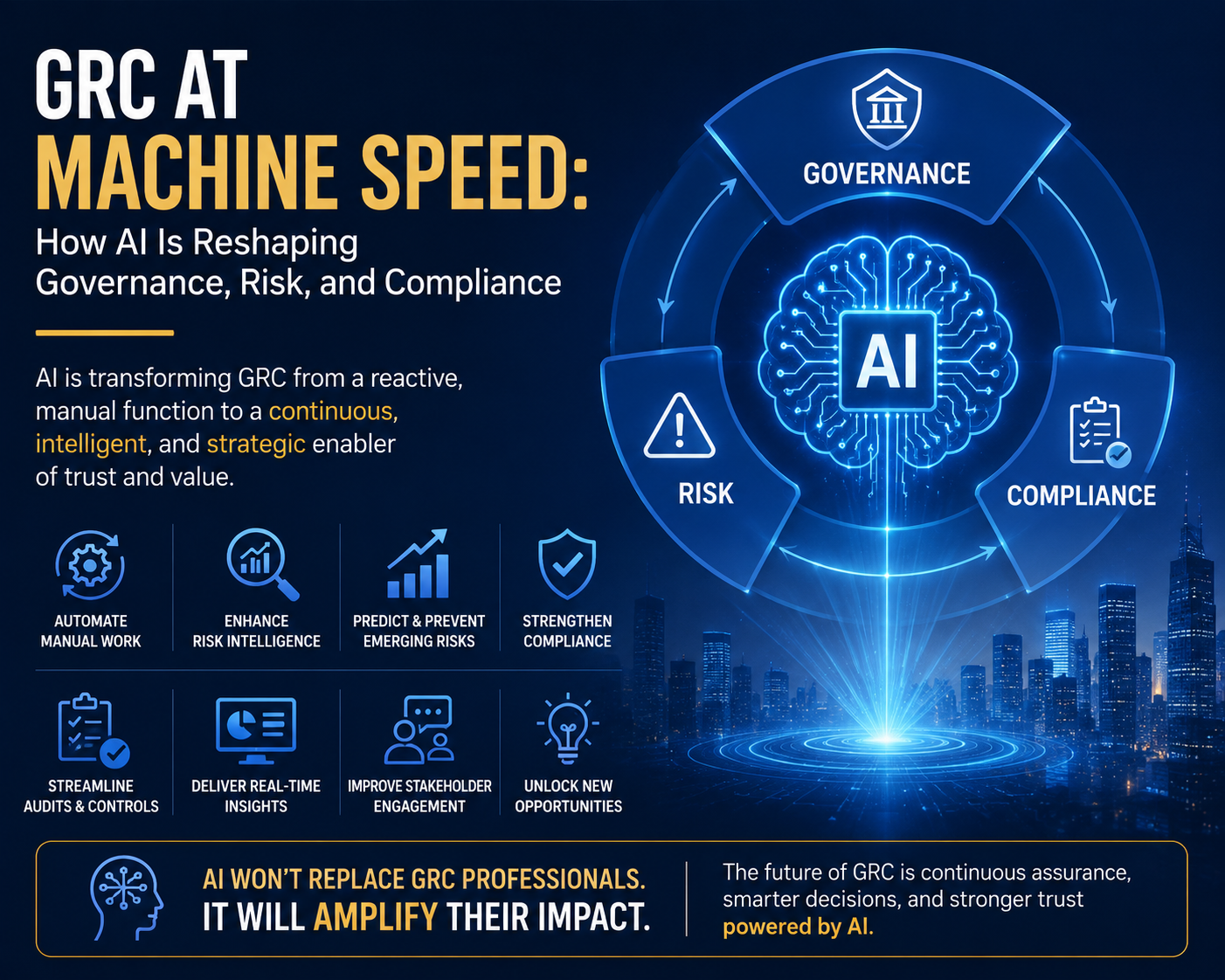
AI is not simply another technology that GRC teams will govern — it will fundamentally reshape how GRC is practiced, measured, and delivered.

From an AI governance perspective, the biggest shift over the next few years is that GRC will move from periodic, documentation-heavy activities toward continuous assurance. Traditional models built around annual assessments, point-in-time audits, and manually maintained control libraries are increasingly misaligned with AI systems that learn, adapt, and change rapidly. Governance programs will need near real-time monitoring, automated evidence collection, and dynamic risk scoring to keep pace with AI-enabled businesses.

AI will also force GRC teams to rethink what risk means. Historically, cybersecurity, privacy, operational, and regulatory risks were often managed in separate silos. AI collapses these boundaries. A single AI system can simultaneously create security risks, bias risks, privacy concerns, intellectual property exposure, regulatory obligations, and reputational damage. Future GRC programs will need integrated risk models that account for technical, legal, ethical, and business impacts together rather than independently.

The role of GRC professionals is also likely to evolve significantly. Much of today’s work — control mapping, evidence collection, questionnaire reviews, policy maintenance, risk reporting, and audit preparation — is highly automatable. The value of future practitioners will shift away from administration and toward interpretation, governance design, and decision support. Organizations will increasingly expect GRC teams to explain not only whether AI systems comply with requirements, but whether they are trustworthy, resilient, and aligned with business objectives.

Another major change is that AI itself becomes both the subject and operator of governance. Organizations will use AI agents to perform risk analysis, review controls, monitor compliance, generate policies, and identify anomalies. This creates a recursive challenge: organizations must govern the AI systems that are helping govern the organization. Oversight mechanisms, human review checkpoints, and assurance controls around AI-generated outputs will become critical.

Regulatory pressure will accelerate this transformation. New AI-focused requirements are emerging globally, but organizations cannot rely solely on regulations to define good governance. Compliance-based thinking alone will struggle because AI technology evolves faster than legislation. Forward-looking organizations will need governance models based on principles such as accountability, transparency, explainability, resilience, and human oversight.

One overlooked area is evidence and auditability. AI systems often operate as probabilistic systems rather than deterministic ones. Traditional audit approaches designed for fixed software systems may not adequately assess AI outcomes, model drift, or decision quality. Future audits may increasingly examine datasets, model lifecycle controls, prompt management, human oversight processes, and monitoring mechanisms rather than only reviewing policies and procedures.

The organizations that adapt fastest will likely treat GRC less as a control function and more as an engineering discipline. Governance controls will increasingly be embedded into development pipelines, procurement workflows, cloud infrastructure, and AI deployment processes rather than documented after implementation.

My perspective: AI is unlikely to eliminate GRC functions — but it will compress manual work, increase the speed of decision-making, and raise expectations for business alignment. The biggest risk for GRC teams is not automation itself; it is remaining dependent on slow, reactive governance models while businesses adopt AI at machine speed. Future GRC leaders will need to become part governance expert, part technologist, and part business strategist.

The GRC Function Is Changing: Are You Ready for AI-Native Governance?

GRC Engineering Is the Future of Cloud Compliance

Four risks, three frameworks, and what real-world mapping across ISO 27001, ISO 42001, and NIST 800-53 Rev. 5 actually looks like

The AI Governance Quick-Start: Defensible in 10 Days, Not 4 Quarters

DISC InfoSec is an active ISO 42001 implementer and PECB Authorized Training Partner specializing in AI governance for B2B SaaS and financial services organizations.

AI Attack Surface ScoreCard

AI Vulnerability Scorecard: Discover Your AI Attack Surface Before Attackers Do

Your Shadow AI Problem Has a Name-And Now It Has a Score

Most AI Security Tools Won’t Pass an Audit. Here’s a 15-Minute Way to Find Out.
AIMS and Data Governance – Managing data responsibly isn’t just good practice—it’s a legal and ethical imperative

Schedule a consultation or drop a note below: info@deurainfosec.com

InfoSec services | InfoSec books | Follow our blog | DISC llc is listed on The vCISO Directory | ISO 27k Chat bot | Comprehensive vCISO Services | ISMS Services | AIMS Services | Security Risk Assessment Services | Mergers and Acquisition Security

Tags: and Compliance, Governance, GRC, Risk


Feb 17 2026

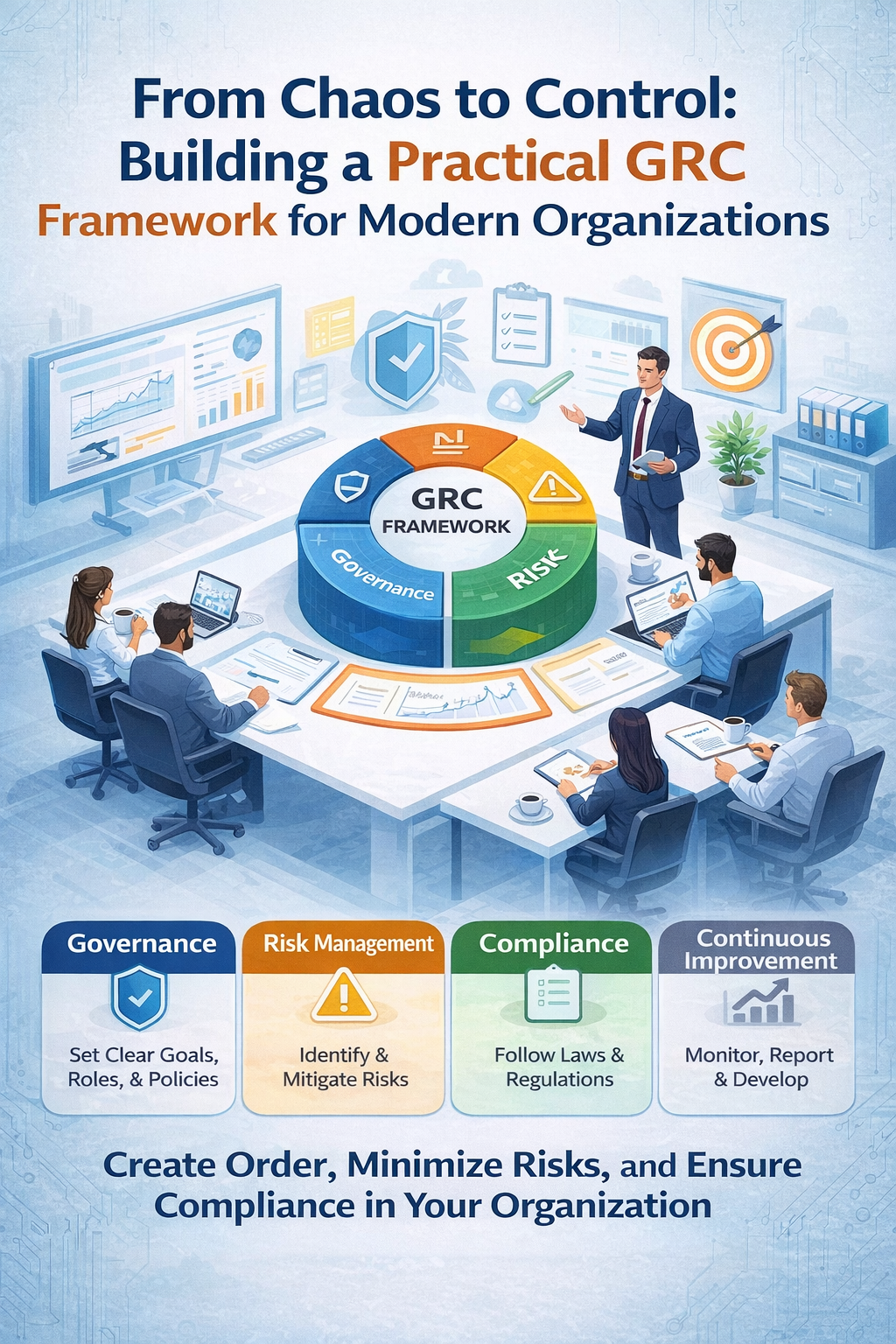
From Chaos to Control: Building a Practical GRC Framework for Modern Organizations

Category: GRCdisc7 @ 11:03 am

Governance, Risk, and Compliance (GRC) — A Practical Summary

What GRC Means in Practice

A Governance, Risk, and Compliance (GRC) framework is a structured way to bring order, accountability, and consistency to how an organization manages decisions, risks, and regulatory obligations. Governance sets the direction by defining goals, leadership responsibilities, and policies so everyone understands their role and the company’s priorities. Risk management focuses on identifying threats—such as cyber incidents, operational failures, or legal exposure—and reducing their likelihood or impact. Compliance ensures the organization follows laws, standards, and internal rules. Together, these elements create an integrated system that improves oversight, reduces surprises, and builds trust with stakeholders.


GRC Success Metrics and Value

A mature GRC program improves risk visibility and decision-making by linking priorities to measurable value and protection outcomes. Organizations with effective GRC frameworks typically see stronger alignment between business goals and risk controls, better resource prioritization, and improved protection against operational and regulatory failures. By tracking key performance indicators (KPIs) and formulas—such as risk scoring (likelihood × impact) and control effectiveness—leaders can quantify how well the organization is managing uncertainty and compliance. This data-driven approach helps convert abstract risk into actionable insights.


Step-by-Step GRC Framework

Building a GRC framework follows a logical progression. It starts with establishing a governance structure and charter that defines authority and accountability. Next comes defining risk appetite—how much risk the organization is willing to accept. A policy framework is then developed to translate strategy into practical rules. Regulatory mapping ensures all legal and industry requirements are addressed. Risk identification and assessment help prioritize threats, followed by implementing appropriate controls. Continuous monitoring through key risk indicators (KRIs), reporting dashboards, and feedback loops supports ongoing improvement. The process is cyclical: document, monitor, and refine regularly to keep the framework relevant.


Core GRC Components

At the center of a GRC framework is an integrated system that connects governance, risk management, and compliance activities. Core components include strategy and governance oversight, risk assessment and management processes, compliance tracking, internal controls, and audit and assurance functions. Supporting artifacts—such as a GRC charter, risk register, policy library, control matrix, compliance tracker, and audit reports—provide the documentation backbone. Together, these components ensure that risks are systematically identified, controls are enforced, and compliance is continuously validated.


Essential Formulas, KPIs, and Documentation

Effective GRC relies on measurable indicators and structured documentation. Key formulas and KPIs evaluate performance, risk exposure, and control effectiveness, allowing leaders to monitor progress objectively. Essential document outputs—such as risk registers, policy libraries, and control matrices—create transparency and consistency. A clear approval workflow (draft → review → approval → implementation → monitoring → improvement) ensures accountability and continuous oversight. These mechanisms transform GRC from a theoretical model into an operational discipline.


Common GRC Mistakes

Many organizations struggle with GRC because of cultural and structural gaps. Weak leadership commitment, unclear risk appetite, inconsistent policy enforcement, and lack of continuous monitoring are common pitfalls. Without executive support and regular review, frameworks become paperwork exercises rather than living systems. Avoiding these mistakes requires strong tone at the top, simple and well-documented processes, and frequent reassessment.


Final Perspective

A well-designed GRC framework acts as a stabilizing force for an organization. It clarifies governance, reduces risk exposure, strengthens compliance posture, and supports sustainable performance. By keeping the framework simple, documented, and continuously reviewed, companies can transform GRC into a practical operating system that guides everyday decisions rather than a one-time compliance project.

InfoSec services | InfoSec books | Follow our blog | DISC llc is listed on The vCISO Directory | ISO 27k Chat bot | Comprehensive vCISO Services | ISMS Services | AIMS Services | Security Risk Assessment Services | Mergers and Acquisition Security

At DISC InfoSec, we help organizations navigate this landscape by aligning AI risk management, governance, security, and compliance into a single, practical roadmap. Whether you are experimenting with AI or deploying it at scale, we help you choose and operationalize the right frameworks to reduce risk and build trust. Learn more at DISC InfoSec.

Tags: and Compliance, Governance, Risk