Jun 04 2026

GRC at Machine Speed: How AI Is Reshaping Governance, Risk, and Compliance

Category: AI,AI Governance,GRC,Information Securitydisc7 @ 8:28 am

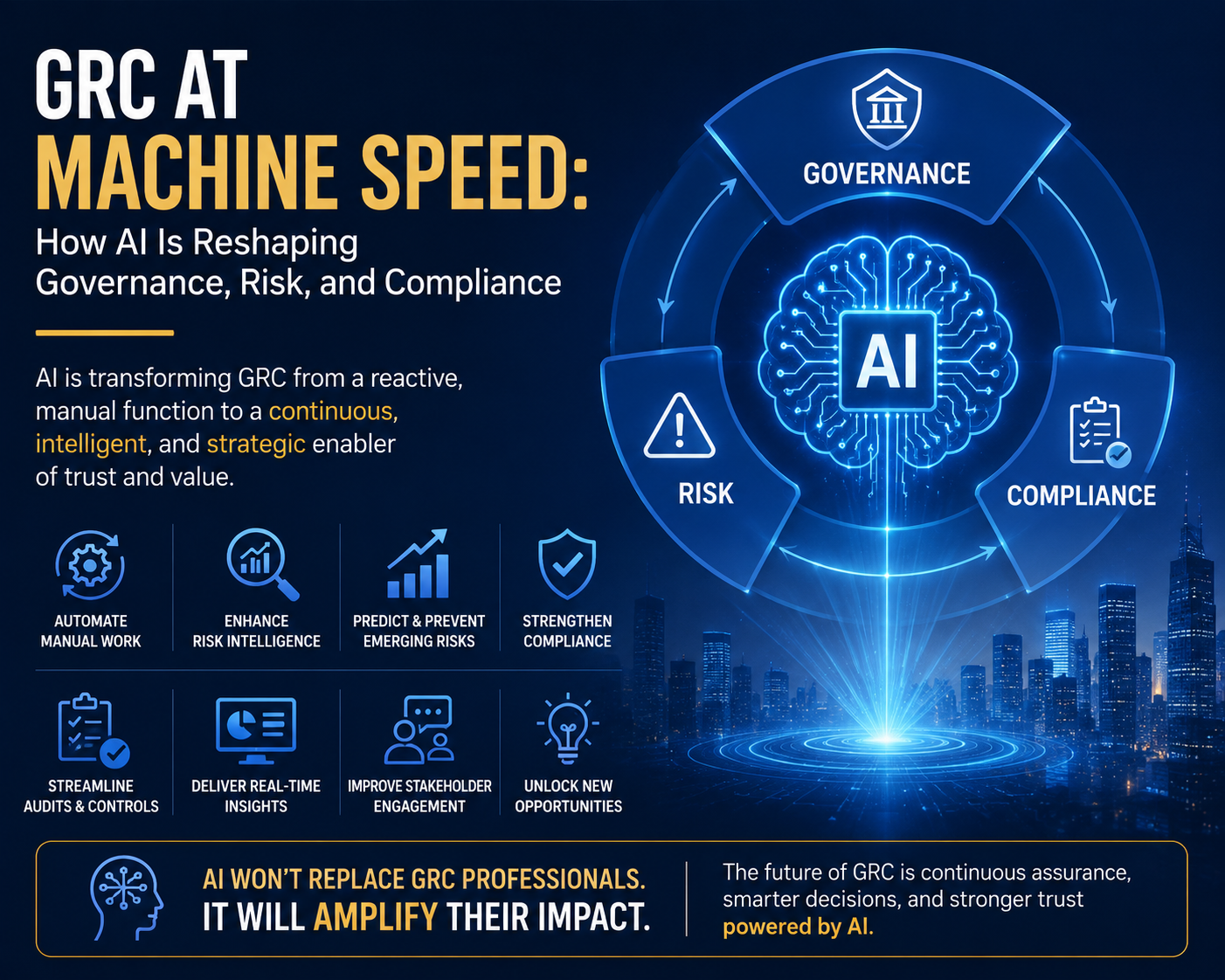
AI is not simply another technology that GRC teams will govern — it will fundamentally reshape how GRC is practiced, measured, and delivered.

From an AI governance perspective, the biggest shift over the next few years is that GRC will move from periodic, documentation-heavy activities toward continuous assurance. Traditional models built around annual assessments, point-in-time audits, and manually maintained control libraries are increasingly misaligned with AI systems that learn, adapt, and change rapidly. Governance programs will need near real-time monitoring, automated evidence collection, and dynamic risk scoring to keep pace with AI-enabled businesses.

AI will also force GRC teams to rethink what risk means. Historically, cybersecurity, privacy, operational, and regulatory risks were often managed in separate silos. AI collapses these boundaries. A single AI system can simultaneously create security risks, bias risks, privacy concerns, intellectual property exposure, regulatory obligations, and reputational damage. Future GRC programs will need integrated risk models that account for technical, legal, ethical, and business impacts together rather than independently.

The role of GRC professionals is also likely to evolve significantly. Much of today’s work — control mapping, evidence collection, questionnaire reviews, policy maintenance, risk reporting, and audit preparation — is highly automatable. The value of future practitioners will shift away from administration and toward interpretation, governance design, and decision support. Organizations will increasingly expect GRC teams to explain not only whether AI systems comply with requirements, but whether they are trustworthy, resilient, and aligned with business objectives.

Another major change is that AI itself becomes both the subject and operator of governance. Organizations will use AI agents to perform risk analysis, review controls, monitor compliance, generate policies, and identify anomalies. This creates a recursive challenge: organizations must govern the AI systems that are helping govern the organization. Oversight mechanisms, human review checkpoints, and assurance controls around AI-generated outputs will become critical.

Regulatory pressure will accelerate this transformation. New AI-focused requirements are emerging globally, but organizations cannot rely solely on regulations to define good governance. Compliance-based thinking alone will struggle because AI technology evolves faster than legislation. Forward-looking organizations will need governance models based on principles such as accountability, transparency, explainability, resilience, and human oversight.

One overlooked area is evidence and auditability. AI systems often operate as probabilistic systems rather than deterministic ones. Traditional audit approaches designed for fixed software systems may not adequately assess AI outcomes, model drift, or decision quality. Future audits may increasingly examine datasets, model lifecycle controls, prompt management, human oversight processes, and monitoring mechanisms rather than only reviewing policies and procedures.

The organizations that adapt fastest will likely treat GRC less as a control function and more as an engineering discipline. Governance controls will increasingly be embedded into development pipelines, procurement workflows, cloud infrastructure, and AI deployment processes rather than documented after implementation.

My perspective: AI is unlikely to eliminate GRC functions — but it will compress manual work, increase the speed of decision-making, and raise expectations for business alignment. The biggest risk for GRC teams is not automation itself; it is remaining dependent on slow, reactive governance models while businesses adopt AI at machine speed. Future GRC leaders will need to become part governance expert, part technologist, and part business strategist.

The GRC Function Is Changing: Are You Ready for AI-Native Governance?

GRC Engineering Is the Future of Cloud Compliance

Four risks, three frameworks, and what real-world mapping across ISO 27001, ISO 42001, and NIST 800-53 Rev. 5 actually looks like

The AI Governance Quick-Start: Defensible in 10 Days, Not 4 Quarters

DISC InfoSec is an active ISO 42001 implementer and PECB Authorized Training Partner specializing in AI governance for B2B SaaS and financial services organizations.

AI Attack Surface ScoreCard

AI Vulnerability Scorecard: Discover Your AI Attack Surface Before Attackers Do

Your Shadow AI Problem Has a Name-And Now It Has a Score

Most AI Security Tools Won’t Pass an Audit. Here’s a 15-Minute Way to Find Out.
AIMS and Data Governance – Managing data responsibly isn’t just good practice—it’s a legal and ethical imperative

Schedule a consultation or drop a note below: info@deurainfosec.com

InfoSec services | InfoSec books | Follow our blog | DISC llc is listed on The vCISO Directory | ISO 27k Chat bot | Comprehensive vCISO Services | ISMS Services | AIMS Services | Security Risk Assessment Services | Mergers and Acquisition Security

Tags: and Compliance, Governance, GRC, Risk


Jun 25 2024

In what situations would a vCISO or CISOaaS service be appropriate?

Category: CISO,vCISOdisc7 @ 11:48 am

A virtual Chief Information Security Officer (vCISO) service or (CISOaaS) may be appropriate for a variety of scenarios, including:

Your clients, collaborators (partners) and some regulatory requirements anticipate the presence of an individual fulfilling the position of Chief Information Security Officer (CISO).
  1. Companies without an in-house CISO: Small and medium-sized companies may not have the budget or need for a full-time CISO. A vCISO service can provide these companies with access to a seasoned cybersecurity professional without having to hire a full-time employee.
  1. Companies experiencing rapid growth or change: Companies that are growing quickly or undergoing significant changes, such as mergers or acquisitions, may benefit from the expertise of a vCISO to help them navigate the cybersecurity implications of these changes.
  1. Companies with limited cybersecurity resources: Some companies may have an IT team but lack dedicated cybersecurity resources. A vCISO can help fill this gap by providing strategic guidance and oversight of the company’s cybersecurity program.
  1. Compliance requirements: Companies in regulated industries, such as healthcare or financial services, may require a CISO to meet regulatory requirements. A vCISO can help these companies meet compliance requirements with standards (ISO 27001) and regulations (PCI, HIPAA, NIST CSF, etc.) without having to hire a full-time CISO.
  1. Cybersecurity incident response: In the event of a cybersecurity incident, a vCISO can provide expertise and guidance to help the company respond effectively and minimize the impact of the incident.

Overall, a vCISO service can be a cost-effective way for companies to gain access to the expertise of a seasoned cybersecurity professional without having to hire a full-time employee.

Which organizations may need vCISO services:

  1. Small to Medium-Sized Enterprises (SMEs):
    • These businesses may not have the resources to hire a full-time CISO but still require expert guidance to manage their cybersecurity needs.
    • Industries: Technology startups, healthcare practices, legal firms, financial services, retail businesses, etc.
  2. Large Enterprises:
    • Large companies with existing security teams may use vCISO services for additional expertise, specific projects, or temporary coverage to assist in house CISO.
    • Industries: Finance, healthcare, manufacturing, utilities, telecommunications, etc.
  3. Non-Profit Organizations:
    • These organizations often need to protect sensitive donor and beneficiary information but might lack the budget for a full-time CISO.
    • Examples: Charitable organizations, educational institutions, and research entities.
  4. Government Agencies:
    • Small to mid-sized government entities may utilize vCISO services to bolster their cybersecurity posture and comply with regulations.
    • Examples: Local municipalities, state agencies, and public health departments.
  5. Regulated Industries:
    • Companies in heavily regulated industries need to adhere to strict compliance standards and may require specialized cybersecurity expertise.
    • Industries: Healthcare (HIPAA), finance (GLBA, SOX), and retail (PCI-DSS).
  6. Organizations Undergoing Digital Transformation:
    • Businesses that are adopting new technologies, moving to the cloud, or modernizing their IT infrastructure may need vCISO services to manage the associated security risks.
    • Examples: Companies implementing IoT, AI, or big data solutions.
  7. Businesses Experiencing Rapid Growth:
    • Fast-growing companies may face evolving cybersecurity challenges and can benefit from the strategic oversight of a vCISO.
    • Examples: Tech startups, e-commerce platforms, and fintech companies.
  8. Companies Preparing for Mergers and Acquisitions:
    • Businesses involved in M&A activities need to ensure that cybersecurity due diligence is performed and that their security posture is strong to protect sensitive data.
    • Examples: Investment firms, private equity groups, and merging corporations.
  9. Organizations Recovering from a Security Incident:
    • Companies that have experienced a breach or other security incident may hire a vCISO to help with incident response, recovery, and the implementation of stronger security measures.
    • Examples: Any business recovering from ransomware attacks, data breaches, or significant cybersecurity incidents to mitigate risk to an acceptable level and improves security posture

DISC InfoSec can offer tailored cybersecurity solutions that align with the specific needs and constraints of different types of organizations.

DISC vCISO services pricing

CISOaaS

Organizations committed to prioritizing security encounter the difficulty of locating a Chief Information Security Officer (CISO) possessing the appropriate skills and knowledge. It becomes necessary for someone to take charge of the security and compliance strategy, but this requirement often surpasses the expertise possessed by operational IT/CIO.

What is CISOaaS?
Chief Information Security Officer-as-a-Service (CISOaaS) provides information security leadership from an appropriate pool of expertise. CISOaaS provides security guidance to senior management and drives the organization’s information security program.

Cert-In issues new guidelines for government bodies, mandates appointment of CISO, Read more at: https://lnkd.in/dKcdHMtP

The benefits of our CISOaaS

  • Gain access to a diverse pool of highly experienced and specialized senior cyber security professionals.
  • Rapidly access valuable resources and eliminate the necessity of retaining talent.
  • Reduce your expenses by paying solely for the necessary support, effectively minimizing costs.
  • Based on CISOaaS being engaged for four days a month annually at current prices. 
  • Based on your requirements, you can hire a vCISO 5-10 hours a week or per month.
  • Mitigate your risk by strengthening your cyber and information strategy through the implementation of a clearly defined roadmap, thereby enhancing your overall security posture.
  • Acquire valuable experience in effectively educating and presenting to board members, and non-technical senior staff across functional diverse backgrounds.
  • Leverage our independent perspective and established credibility to secure comprehensive cross-business support and successfully accomplish your information security objectives.

Are you Ready? DISC InfoSec offers a free consultation to evaluate your security posture and GRC requirements, providing you with an actionable plan that starts here…

Deura InfoSec Partners with Ostendio to Streamline Compliance & Security Offerings

  • Strategic Partnership: Ostendio and Deura InfoSec have formed a partnership to enhance compliance and risk management services for Deura InfoSec clients using Ostendio’s GRC platform.
  • Efficiency Gains: Deura InfoSec will leverage Ostendio’s platform to streamline compliance processes, significantly reducing the time clients spend on information security management by up to 50%.
  • Client Benefits: The partnership allows Deura InfoSec to overcome the challenges of fragmented security and simplify the processes and costs of delivering complex cybersecurity programs.

DISC-vCISO-v3-0-1Download

Previous posts on vCISO/CISO

CISO Conversations: The Role of the vCISO

6 ways the CISO role is evolving today

A CISO’s Guide to Avoiding Jail After a Breach

Cybersecurity: The CISO’s View

We’d love to hear from you! If you have any questions, comments, or feedback, don’t hesitate to get in touch. Our team is here to help, and we’re always looking to improve our services. You can reach us by email at info@deurainfosec.com or through our website. contact form.

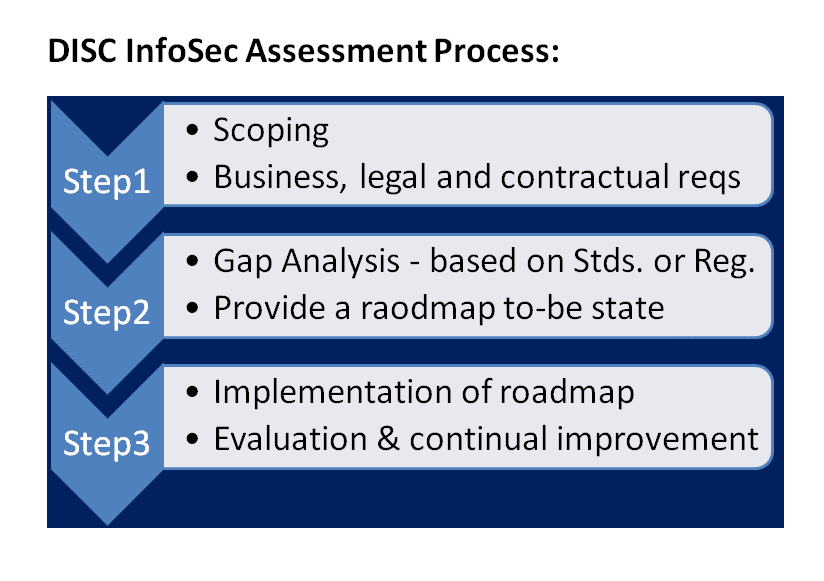
We offer discounted initial assessment based on various industry standards and regulations to demonstrate our value and identify possible areas for improvement. Potentially a roadmap for the to-be state.

InfoSec services | InfoSec books | Follow our blog | DISC llc is listed on The vCISO Directory | ISO 27k Chat bot

Tags: CISO, CISOaaS, FractionalCISO, GRC, Ostendio, vCISO


Mar 01 2023

Best GRC tools in 2023

Category: GRC,Security Risk AssessmentDISC @ 1:28 pm

Best GRC tools

GRC (Governance, Risk, and Compliance) online tools are designed to help organizations manage their internal processes, risk assessments, compliance, and audits. Here are some of the best GRC online tools available:

  1. ZenGRC: ZenGRC is a cloud-based GRC tool that offers risk management, compliance management, and vendor management solutions. It allows users to streamline compliance tasks, track risks, and manage third-party vendors.
  2. LogicManager: LogicManager is a GRC platform that helps businesses identify, assess, and manage risks. It offers a variety of modules, including regulatory compliance, vendor risk management, and incident management.
  3. RSA Archer: RSA Archer is an enterprise GRC platform that helps businesses manage risk, compliance, and audit processes. It offers a variety of modules, including risk management, compliance management, and policy management.
  4. SAP GRC: SAP GRC is a suite of GRC tools that helps businesses manage risk, compliance, and audit processes. It offers a variety of modules, including access control, process control, and risk management.
  5. MetricStream: MetricStream is a cloud-based GRC platform that helps businesses manage compliance, risk, and audit processes. It offers a variety of modules, including regulatory compliance, risk management, and quality management.
  6. NAVEX Global: NAVEX Global is a GRC platform that helps businesses manage compliance, risk, and ethics. It offers a variety of modules, including policy management, incident management, and third-party risk management.
  7. Compliance 360: Compliance 360 is a GRC platform that helps businesses manage compliance, risk, and audit processes. It offers a variety of modules, including risk management, compliance management, and incident management.

Each of these tools offers unique features and benefits, so it’s important to evaluate your organization’s specific needs before choosing the best GRC tool for your business.

Cybersecurity Risk and Strategy

Gain the frameworks and vocabulary to make better strategic decisions that boost your organization’s cyber resilience from top to bottom.

ISO 27001/ISO 22301 RISK ASSESSMENT TOOLKIT

InfoSec Threats | InfoSec books | InfoSec tools | InfoSec services

Tags: GRC, GRC tools


Nov 26 2013

New IT-GRC Glossary designed to simplify industry terms

Category: IT GovernanceDISC @ 11:29 am

Glossary_banner

New IT-GRC Glossary from IT Governance designed to simplify industry terms

IT Governance Ltd, the single source provider of IT governance, risk management and compliance (IT-GRC), has just published a glossary on their website.

The IT-GRC glossary is designed to help IT professionals recognize the wide range of acronyms used within the industry to further their understanding and avoid confusion.

Currently there are 70 terms in the glossary and IT Governance is looking to grow this significantly. IT Governance is encouraging readers to contribute to the glossary with new terms or refined definitions so that the glossary continues to develop and become a resource for IT professionals to use worldwide.

The glossary contains a wide range of IT governance terms, including information security, business continuity, quality management, IT service management and IT governance topics. The glossary is arranged alphabetically and provides easy-to-use definitions that drop down when clicked. The definitions have been written and edited by industry experts and link to information pages for further guidance. View the glossary:

Founder and Executive Chairman of IT Governance Ltd, Alan Calder, explains the reasons behind developing the glossary: “The industry within which we operate in contains a huge number of shortened phrases and acronyms which can be somewhat confusing for those starting out in their career. With different associations, institutions, standards, frameworks and certificates to remember, we decided it was important to start documenting these terms so that beginners would have a useful source to refer to.”

This new resource further strengthens the IT Governance mission statement of “approaching IT from a non-technology background and talking to management in their own language”. The glossary reduces industry jargon and simplifies terms for IT professionals.

The glossary has been added to the growing number of resources offered from IT Governance, which includes a wide number of green papers, product demos and case studies – all which are freely available to download.


Tags: Dictionaries, Governance risk management and compliance, GRC, Risk management