Mar 13 2026

AI Security for LLMs: From Prompts to Trust Boundaries

Category: AI,AI Governance,AI Guardrailsdisc7 @ 11:59 am


Large Language Models (LLMs) are revolutionizing the way developers interact with code, automating tasks from code generation to debugging. While this boosts productivity, it also introduces new security risks. For example, maliciously crafted prompts or inputs can trick an LLM into producing insecure code or leaking sensitive data. Countermeasures include rigorous input validation, sandboxing generated code, and implementing access controls to prevent execution of untrusted outputs. Continuous monitoring and testing of LLM outputs is also essential to catch anomalies before they escalate into vulnerabilities.

The prompt itself has become a critical component of the attack surface. Prompt injection attacks—where attackers manipulate input to influence the model’s behavior—pose a novel security threat. Risks include unauthorized data exfiltration, execution of harmful instructions, or bypassing model safety mechanisms. Effective countermeasures involve prompt sanitization, context isolation, and using “safe mode” configurations in LLMs that limit the scope of model responses. Organizations must treat prompt security with the same seriousness as traditional code security.

Securing the code alone is no longer sufficient. Organizations must also focus on securing prompts, as they now represent a vector through which attacks can propagate. Insecure prompt handling can allow attackers to manipulate outputs, expose confidential information, or perform unintended actions. Countermeasures include designing prompts with strict templates, implementing input/output validation, and logging prompt interactions to detect anomalies. Additionally, access controls and role-based permissions can reduce the risk of malicious or accidental misuse.

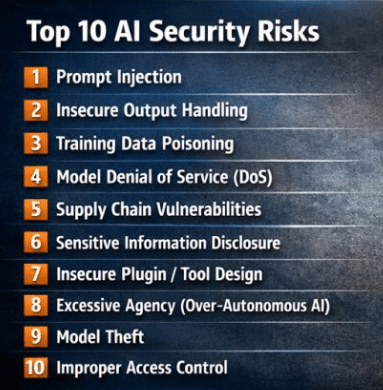
Understanding the OWASP Top 10 for LLM-powered applications is crucial for identifying and mitigating security risks. These risks range from injection attacks and data leakage to model misuse and broken access control. Awareness of these threats allows organizations to implement targeted countermeasures, such as secure coding practices for generated code, API rate limiting, proper authentication and authorization, and robust monitoring of model behavior. Mapping LLM-specific risks to established security frameworks helps ensure a comprehensive approach to security.

Building trust boundaries and practicing ethical research are essential as we navigate this emerging cybersecurity frontier. Risks include model bias, unintentional harm through unsafe outputs, and misuse of generated information. Countermeasures involve clearly defining trust boundaries between users and models, implementing human-in-the-loop review processes, conducting regular audits of model outputs, and following ethical guidelines for data handling and AI experimentation. Transparency with stakeholders and responsible disclosure practices further strengthen trust.

From my perspective, while these areas cover the most immediate LLM security challenges, organizations should also consider supply chain risks (like vulnerabilities in model weights or third-party APIs), adversarial attacks on training data, and model inversion risks where sensitive information can be inferred from outputs. A proactive, layered approach combining technical controls, governance, and continuous monitoring is critical to safely leverage LLMs in production environments.


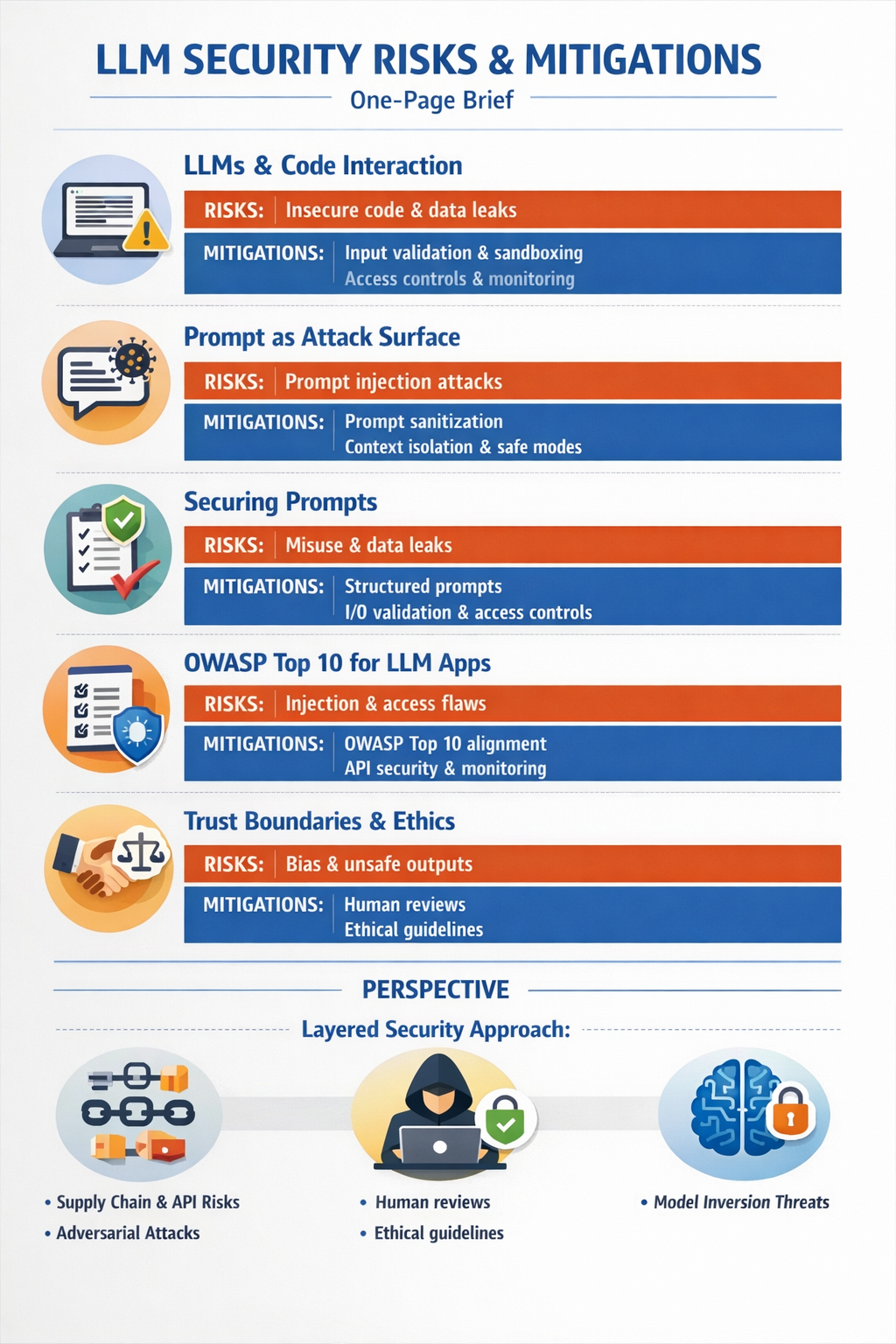
Here’s a concise one-page visual brief version of the LLM security risks and mitigations.


LLM Security Risks & Mitigations: One-Page Brief

1. LLMs and Code Interaction

  • Risk: LLMs can generate insecure code, leak secrets, or introduce vulnerabilities.
  • Countermeasures:
    • Input validation on user prompts
    • Sandbox execution for generated code
    • Access controls and monitoring outputs


2. Prompt as an Attack Surface

  • Risk: Prompt injection can manipulate the model to exfiltrate data or bypass safety mechanisms.
  • Countermeasures:
    • Prompt sanitization and template enforcement
    • Context isolation to limit exposure
    • Safe-mode configurations to restrict outputs


3. Securing Prompts

  • Risk: Insecure prompt handling can allow misuse, data leaks, or unintended actions.
  • Countermeasures:
    • Structured prompt templates
    • Input/output validation
    • Logging and monitoring prompt interactions
    • Role-based access control for sensitive prompts


4. OWASP Top 10 for LLM Apps

  • Risk: Injection attacks, broken access control, data leakage, and model misuse.
  • Countermeasures:
    • Map LLM risks to OWASP Top 10 framework
    • Secure coding for generated code
    • API rate limiting and authentication
    • Continuous behavior monitoring

5. Trust Boundaries & Ethical Practices

  • Risk: Model bias, unsafe outputs, misuse of information.
  • Countermeasures:
    • Define trust boundaries between users and LLMs
    • Human-in-the-loop review
    • Ethical AI guidelines and audits
    • Transparency with stakeholders


Perspective

  • LLM security requires a layered approach: technical controls, governance, and continuous monitoring.
  • Additional risks to consider:
    • Supply chain vulnerabilities (third-party models, APIs)
    • Adversarial attacks on training data
    • Model inversion and data inference attacks
  • Organizations must treat prompts as first-class security artifacts alongside traditional code.

Get Your Free AI Governance Readiness Assessment – Is your organization ready for ISO 42001, EU AI Act, and emerging AI regulations?

AI Governance Gap Assessment tool

  1. 15 questions
  2. Instant maturity score 
  3. Detailed PDF report 
  4. Top 3 priority gaps

Click below to open an AI Governance Gap Assessment in your browser or click the image to start assessment.

ai_governance_assessment-v1.5Download
Built by AI governance experts. Used by compliance leaders.

InfoSec services | InfoSec books | Follow our blog | DISC llc is listed on The vCISO Directory | ISO 27k Chat bot | Comprehensive vCISO Services | ISMS Services | AIMS Services | Security Risk Assessment Services | Mergers and Acquisition Security

At DISC InfoSec, we help organizations navigate this landscape by aligning AI risk management, governance, security, and compliance into a single, practical roadmap. Whether you are experimenting with AI or deploying it at scale, we help you choose and operationalize the right frameworks to reduce risk and build trust. Learn more at DISC InfoSec.

Tags: AI security, LLM security, Prompt security, Trust Boundaries


Jan 21 2026

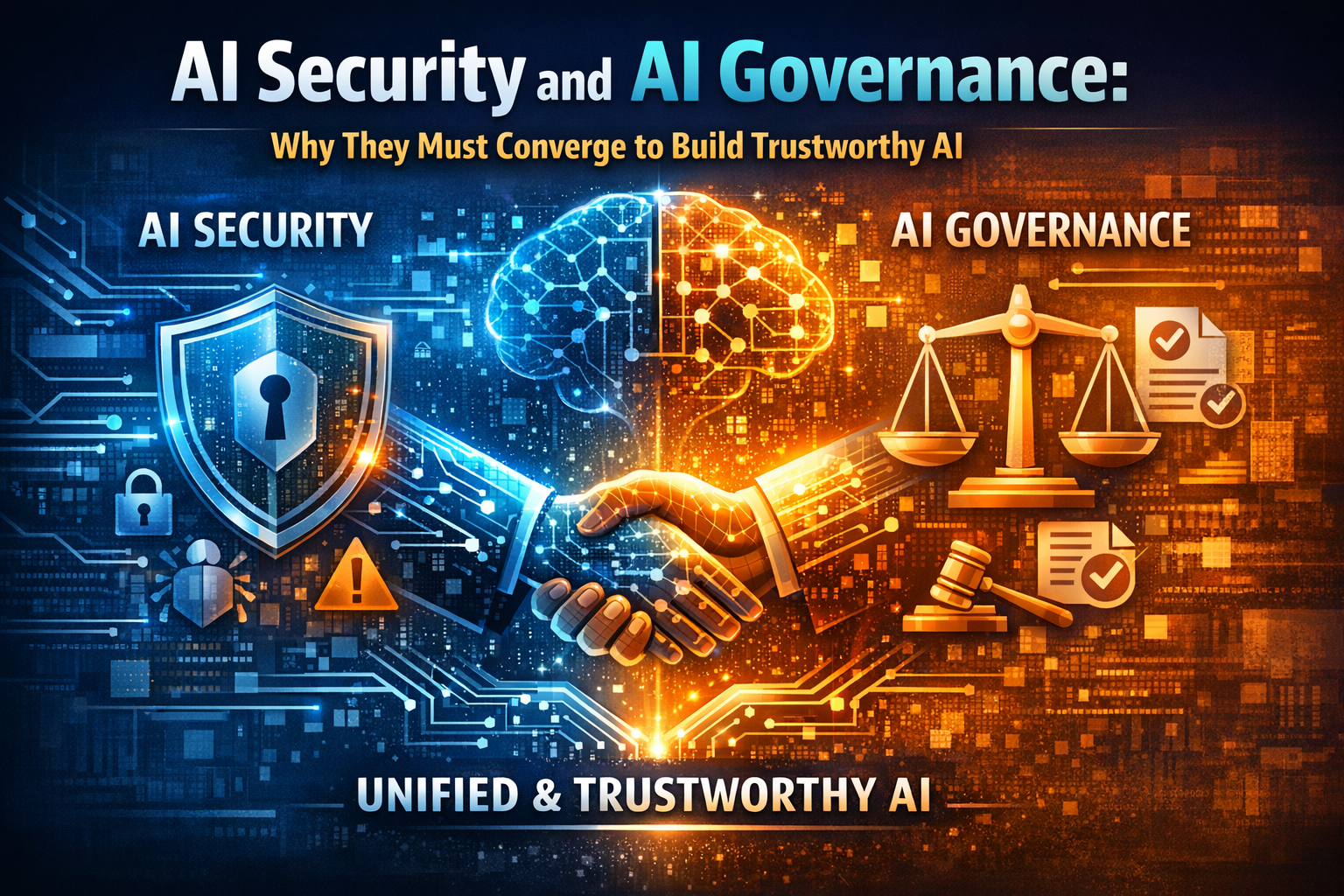
AI Security and AI Governance: Why They Must Converge to Build Trustworthy AI

Category: AI,AI Governance,AI Guardrailsdisc7 @ 1:42 pm

AI Security and AI Governance are often discussed as separate disciplines, but the industry is realizing they are inseparable. Over the past year, conversations have revolved around AI governance—whether AI should be used and under what principles—and AI security—how AI systems are protected from threats. This separation is no longer sustainable as AI adoption accelerates.

The core reality is simple: governance without security is ineffective, and security without governance is incomplete. If an organization cannot secure its AI systems, it has no real control over them. Likewise, securing systems without clear governance leaves unanswered questions about legality, ethics, and accountability.

This divide exists largely because governance and security evolved in different organizational domains. Governance typically sits with legal, risk, and compliance teams, focusing on fairness, transparency, and ethical use. Security, on the other hand, is owned by technical teams and SOCs, concentrating on attacks such as prompt injection, model manipulation, and data leakage.

When these functions operate in silos, organizations unintentionally create “Shadow AI” risks. Governance teams may publish policies that lack technical enforcement, while security teams may harden systems without understanding whether the AI itself is compliant or trustworthy.

The governance gap appears when policies exist only on paper. Without security controls to enforce them, rules become optional guidance rather than operational reality, leaving organizations exposed to regulatory and reputational risk.

The security gap emerges when protection is applied without context. Systems may be technically secure, yet still rely on biased, non-compliant, or poorly governed models, creating hidden risks that security tooling alone cannot detect.

To move forward, AI risk must be treated as a unified discipline. A combined “Governance-Security” mindset requires shared inventories of models and data pipelines, continuous monitoring of both technical vulnerabilities and ethical drift, and automated enforcement that connects policy directly to controls.

Organizations already adopting this integrated approach are gaining a competitive advantage. Their objective goes beyond compliance checklists; they are building AI systems that are trustworthy, resilient by design, and compliant by default—earning confidence from regulators, customers, and partners alike.

My opinion: AI governance and AI security should no longer be separate conversations or teams. Treating them as one integrated function is not just best practice—it is inevitable. Organizations that fail to unify these disciplines will struggle with unmanaged risk, while those that align them early will define the standard for trustworthy and resilient AI.

InfoSec services | InfoSec books | Follow our blog | DISC llc is listed on The vCISO Directory | ISO 27k Chat bot | Comprehensive vCISO Services | ISMS Services | AIMS Services | Security Risk Assessment Services | Mergers and Acquisition Security

At DISC InfoSec, we help organizations navigate this landscape by aligning AI risk management, governance, security, and compliance into a single, practical roadmap. Whether you are experimenting with AI or deploying it at scale, we help you choose and operationalize the right frameworks to reduce risk and build trust. Learn more at DISC InfoSec.

Tags: AI Governance, AI security


Sep 09 2025

Exploring AI security, privacy, and the pressing regulatory gaps—especially relevant to today’s fast-paced AI landscape

Category: AI,AI Governance,Information Securitydisc7 @ 12:44 pm

Featured Read: Securing the AI Frontier: Urgent Ethical and Regulatory Imperatives for AI-Driven Cybersecurity

  • Overview: This academic paper examines the growing ethical and regulatory challenges brought on by AI’s integration with cybersecurity. It traces the evolution of AI regulation, highlights pressing concerns—like bias, transparency, accountability, and data privacy—and emphasizes the tension between innovation and risk mitigation.
  • Key Insights:
    • AI systems raise unique privacy/security issues due to their opacity and lack of human oversight.
    • Current regulations are fragmented—varying by sector—with no unified global approach.
    • Bridging the regulatory gap requires improved AI literacy, public engagement, and cooperative policymaking to shape responsible frameworks.
  • Source: Authored by Vikram Kulothungan, published in January 2025, this paper cogently calls for a globally harmonized regulatory strategy and multi-stakeholder collaboration to ensure AI’s secure deployment.

Why This Post Stands Out

  • Comprehensive: Tackles both cybersecurity and privacy within the AI context—not just one or the other.
  • Forward-Looking: Addresses systemic concerns, laying the groundwork for future regulation rather than retrofitting rules around current technology.
  • Action-Oriented: Frames AI regulation as a collaborative challenge involving policymakers, technologists, and civil society.

Additional Noteworthy Commentary on AI Regulation

1. Anthropic CEO’s NYT Op-ed: A Call for Sensible Transparency

Anthropic CEO Dario Amodei criticized a proposed 10-year ban on state-level AI regulation as “too blunt.” He advocates a federal transparency standard requiring AI developers to disclose testing methods, risk mitigation, and pre-deployment safety measures.

2. California’s AI Policy Report: Guarding Against Irreversible Harms

A report commissioned by Governor Newsom warns of AI’s potential to facilitate biological and nuclear threats. It advocates “trust but verify” frameworks, increased transparency, whistleblower protections, and independent safety validation.

3. Mutually Assured Deregulation: The Risks of a Race Without Guardrails

Gilad Abiri argues that dismantling AI safety oversight in the name of competition is dangerous. Deregulation doesn’t give lasting advantages—it undermines long-term security, enabling proliferation of harmful AI capabilities like bioweapon creation or unstable AGI.


Broader Context & Insights

  • Fragmented Landscape: U.S. lacks unified privacy or AI laws; even executive orders remain limited in scope.
  • Data Risk: Many organizations suffer from unintended AI data exposure and poor governance despite having some policies in place.
  • Regulatory Innovation: Texas passed a law focusing only on government AI use, signaling a partial step toward regulation—but private sector oversight remains limited.
  • International Efforts: The Council of Europe’s AI Convention (2024) is a rare international treaty aligning AI development with human rights and democratic values.
  • Research Proposals: Techniques like blockchain-enabled AI governance are being explored as transparency-heavy, cross-border compliance tools.

Opinion

AI’s pace of innovation is extraordinary—and so are its risks. We’re at a crossroads where lack of regulation isn’t a neutral stance—it accelerates inequity, privacy violations, and even public safety threats.

What’s needed:

  1. Layered Regulation: From sector-specific rules to overarching international frameworks; we need both precision and stability.
  2. Transparency Mandates: Companies must be held to explicit standards—model testing practices, bias mitigation, data usage, and safety protocols.
  3. Public Engagement & Literacy: AI literacy shouldn’t be limited to technologists. Citizens, policymakers, and enforcement institutions must be equipped to participate meaningfully.
  4. Safety as Innovation Avenue: Strong regulation doesn’t kill innovation—it guides it. Clear rules create reliable markets, investor confidence, and socially acceptable products.

The paper “Securing the AI Frontier” sets the right tone—urging collaboration, ethics, and systemic governance. Pair that with state-level transparency measures (like Newsom’s report) and critiques of over-deregulation (like Abiri’s essay), and we get a multi-faceted strategy toward responsible AI.

Anthropic CEO says proposed 10-year ban on state AI regulation ‘too blunt’ in NYT op-ed

California AI Policy Report Warns of ‘Irreversible Harms’ 

Responsible AI in the Age of Generative Models: Governance, Ethics and Risk Management 

AI Governance: Applying AI Policy and Ethics through Principles and Assessments

AIMS and Data Governance – Managing data responsibly isn’t just good practice—it’s a legal and ethical imperative. 

DISC InfoSec previous posts on AI category

InfoSec services | InfoSec books | Follow our blog | DISC llc is listed on The vCISO Directory | ISO 27k Chat bot | Comprehensive vCISO Services | ISMS Services | Security Risk Assessment Services | Mergers and Acquisition Security

Tags: AI privacy, AI Regulations, AI security, AI standards


Apr 09 2025

NIST: AI/ML Security Still Falls Short

Category: AI,Cyber Attack,cyber security,Cyber Threatsdisc7 @ 8:47 am

​The U.S. National Institute of Standards and Technology (NIST) has raised concerns about the security vulnerabilities inherent in artificial intelligence (AI) systems. In a recent report, NIST emphasizes that there is currently no foolproof method to defend AI technologies from adversarial attacks. The institute warns against accepting vendor claims of absolute AI security, noting that developers and users should be cautious of such assurances. ​

NIST’s research highlights several types of attacks that can compromise AI systems:​

  • Evasion Attacks: These occur when adversaries manipulate inputs to deceive AI models, leading to incorrect outputs.​
  • Poisoning Attacks: In these cases, attackers corrupt training data, causing the AI system to learn incorrect behaviors.​
  • Privacy Attacks: These involve extracting sensitive information from AI models, potentially leading to data breaches.​
  • Abuse Attacks: Here, legitimate sources of information are compromised to mislead the AI system’s operations. ​

NIST underscores that existing defenses against such attacks are insufficient and lack robust assurances. The agency calls on the broader tech community to develop more effective security measures to protect AI systems. ​

In response to these challenges, NIST has launched the Cybersecurity, Privacy, and AI Program. This initiative aims to support organizations in adapting their risk management strategies to address the evolving landscape of AI-related cybersecurity and privacy risks. ​

Overall, NIST’s findings serve as a cautionary reminder of the current limitations in AI security and the pressing need for continued research and development of robust defense mechanisms.

For further details, access the article here

While no AI system is fully immune, several practical strategies can reduce the risk of evasion, poisoning, privacy, and abuse attacks:


🔐 1. Evasion Attacks

(Manipulating inputs to fool the model)

  • Adversarial Training: Include adversarial examples in training data to improve robustness.
  • Input Validation: Use preprocessing techniques to sanitize or detect manipulated inputs.
  • Model Explainability: Apply tools like SHAP or LIME to understand decision logic and spot anomalies.


🧪 2. Poisoning Attacks

(Injecting malicious data into training sets)

  • Data Provenance & Validation: Track and vet data sources to prevent tampered datasets.
  • Anomaly Detection: Use statistical analysis to spot outliers in the training set.
  • Robust Learning Algorithms: Choose models that are more resistant to noise and outliers (e.g., RANSAC, robust SVM).


🔍 3. Privacy Attacks

(Extracting sensitive data from the model)

  • Differential Privacy: Add noise during training or inference to protect individual data points.
  • Federated Learning: Train models across multiple devices without centralizing data.
  • Access Controls: Limit who can query or download the model.


🎭 4. Abuse Attacks

(Misusing models in unintended ways)

  • Usage Monitoring: Log and audit usage patterns for unusual behavior.
  • Rate Limiting: Throttle access to prevent large-scale probing or abuse.
  • Red Teaming: Regularly simulate attacks to identify weaknesses.


📘 Bonus Best Practices

  • Threat Modeling: Apply STRIDE or similar frameworks focused on AI.
  • Model Watermarking: Identify ownership and detect unauthorized use.
  • Continuous Monitoring & Patching: Keep models and pipelines under review and updated.

STRIDE stands for a threat modeling methodology that categorizes security threats into six types: SpoofingTamperingRepudiationInformation DisclosureDenial of Service, and Elevation of Privilege

DISC InfoSec’s earlier post on the AI topic

Trust Me – ISO 42001 AI Management System

 Adversarial AI Attacks, Mitigations, and Defense Strategies: A cybersecurity professional’s guide to AI attacks, threat modeling, and securing AI with MLSecOps

What You Are Not Told About ChatGPT: Key Insights into the Inner Workings of ChatGPT & How to Get the Most Out of It

Digital Ethics in the Age of AI – Navigating the ethical frontier today and beyond

Artificial intelligence – Ethical, social, and security impacts for the present and the future

InfoSec services | InfoSec books | Follow our blog | DISC llc is listed on The vCISO Directory | ISO 27k Chat bot | Comprehensive vCISO Services | ISMS Services | Security Risk Assessment Services

Tags: AI security, ML Security


Mar 25 2025

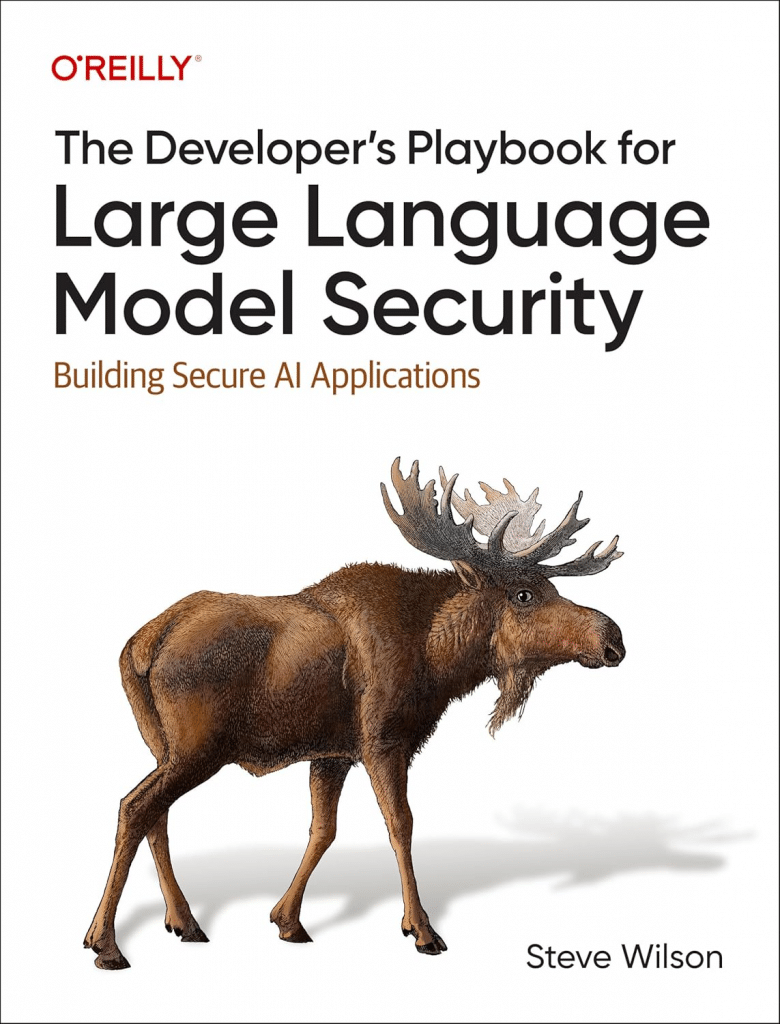
The Developer’s Playbook for Large Language Model Security Review

Category: AI,Information Security,Security playbookdisc7 @ 12:06 pm

In “The Developer’s Playbook for Large Language Model Security,” Steve Wilson, Chief Product Officer at Exabeam, addresses the growing integration of large language models (LLMs) into various industries and the accompanying security challenges. Leveraging over two decades of experience in AI, cybersecurity, and cloud computing, Wilson offers a practical guide for security professionals to navigate the complex landscape of LLM vulnerabilities.

A notable aspect of the book is its alignment with the OWASP Top 10 for LLM Applications project, which Wilson leads. This connection ensures that the security risks discussed are vetted by a global network of experts. The playbook delves into critical threats such as data leakage, prompt injection attacks, and supply chain vulnerabilities, providing actionable mitigation strategies for each.

Wilson emphasizes the unique security challenges posed by LLMs, which differ from traditional web applications due to new trust boundaries and attack surfaces. The book offers defensive strategies, including runtime safeguards and input validation techniques, to harden LLM-based systems. Real-world case studies illustrate how attackers exploit AI-driven applications, enhancing the practical value of the guidance provided.

Structured to serve both as an introduction and a reference guide, “The Developer’s Playbook for Large Language Model Security” is an essential resource for security professionals tasked with safeguarding AI-driven applications. Its technical depth, practical strategies, and real-world examples make it a timely and relevant addition to the field of AI security.

Sources

The Developer’s Playbook for Large Language Model Security: Building Secure AI Applications

InfoSec services | InfoSec books | Follow our blog | DISC llc is listed on The vCISO Directory | ISO 27k Chat bot | Comprehensive vCISO Services | ISMS Services | Security Risk Assessment Services

Tags: AI security, Large Language Model


Jan 29 2025

Basic Principle to Enterprise AI Security

Category: AIdisc7 @ 12:24 pm

Securing AI in the Enterprise: A Step-by-Step Guide

  1. Establish AI Security Ownership
    Organizations must define clear ownership and accountability for AI security. Leadership should decide whether AI governance falls under a cross-functional committee, IT/security teams, or individual business units. Establishing policies, defining decision-making authority, and ensuring alignment across departments are key steps in successfully managing AI security from the start.
  2. Identify and Mitigate AI Risks
    AI introduces unique risks, including regulatory compliance challenges, data privacy vulnerabilities, and algorithmic biases. Organizations must evaluate legal obligations (such as GDPR, HIPAA, and the EU AI Act), implement strong data protection measures, and address AI transparency concerns. Risk mitigation strategies should include continuous monitoring, security testing, clear governance policies, and incident response plans.
  3. Adopt AI Security Best Practices
    Businesses should follow security best practices, such as starting with small AI implementations, maintaining human oversight, establishing technical guardrails, and deploying continuous monitoring. Strong cybersecurity measures—such as encryption, access controls, and regular security audits—are essential. Additionally, comprehensive employee training programs help ensure responsible AI usage.
  4. Assess AI Needs and Set Measurable Goals
    AI implementation should align with business objectives, with clear milestones set for six months, one year, and beyond. Organizations should define success using key performance indicators (KPIs) such as revenue impact, efficiency improvements, and compliance adherence. Both quantitative and qualitative metrics should guide AI investments and decision-making.
  5. Evaluate AI Tools and Security Measures
    When selecting AI tools, organizations must assess security, accuracy, scalability, usability, and compliance. AI solutions should have strong data protection mechanisms, clear ROI, and effective customization options. Evaluating AI tools using a structured approach ensures they meet security and business requirements.
  6. Purchase and Implement AI Securely
    Before deploying AI solutions, businesses must ask key questions about effectiveness, performance, security, scalability, and compliance. Reviewing trial options, pricing models, and regulatory alignment (such as GDPR or CCPA compliance) is critical to selecting the right AI tool. AI security policies should be integrated into the organization’s broader cybersecurity framework.
  7. Launch an AI Pilot Program with Security in Mind
    Organizations should begin with a controlled AI pilot to assess risks, validate performance, and ensure compliance before full deployment. This includes securing high-quality training data, implementing robust authentication controls, continuously monitoring performance, and gathering user feedback. Clear documentation and risk management strategies will help refine AI adoption in a secure and scalable manner.

By following these steps, enterprises can securely integrate AI, protect sensitive data, and ensure regulatory compliance while maximizing AI’s potential.

Adversarial AI Attacks, Mitigations, and Defense Strategies: A cybersecurity professional’s guide to AI attacks, threat modeling, and securing AI with MLSecOps

New regulations and AI hacks drive cyber security changes in 2025

Threat modeling your generative AI workload to evaluate security risk

How CISOs Can Drive the Adoption of Responsible AI Practices

Hackers will use machine learning to launch attacks

To fight AI-generated malware, focus on cybersecurity fundamentals

4 ways AI is transforming audit, risk and compliance

Artificial Intelligence Hacks

InfoSec services | InfoSec books | Follow our blog | DISC llc is listed on The vCISO Directory | ISO 27k Chat bot | Comprehensive vCISO Services | ISMS Services | Security Risk Assessment Services

Tags: AI Governance, AI privacy, AI Risk Management, AI security


Oct 03 2024

AI security bubble already springing leaks

Category: AIdisc7 @ 1:17 pm

AI security bubble already springing leaks

The article highlights how the AI boom, especially in cybersecurity, is already showing signs of strain. Many AI startups, despite initial hype, are facing financial challenges, as they lack the funds to develop large language models (LLMs) independently. Larger companies are taking advantage by acquiring or licensing the technologies from these smaller firms at a bargain.

AI is just one piece of the broader cybersecurity puzzle, but it isn’t a silver bullet. Issues like system updates and cloud vulnerabilities remain critical, and AI-only security solutions may struggle without more comprehensive approaches.

Some efforts to set benchmarks for LLMs, like NIST, are underway, helping to establish standards in areas such as automated exploits and offensive security. However, AI startups face increasing difficulty competing with big players who have the resources to scale.

For more information, you can visit here

Adversarial AI Attacks, Mitigations, and Defense Strategies: A cybersecurity professional’s guide to AI attacks, threat modeling, and securing AI with MLSecOps

Could APIs be the undoing of AI?

Previous posts on AI

AI Security risk assessment quiz

Implementing BS ISO/IEC 42001 will demonstrate that you’re developing AI responsibly

InfoSec services | InfoSec books | Follow our blog | DISC llc is listed on The vCISO Directory | ISO 27k Chat bot

Tags: Adversarial AI Attacks, AI security


Sep 09 2024

AI cybersecurity needs to be as multi-layered as the system it’s protecting

The article emphasizes that AI cybersecurity must be multi-layered, like the systems it protects. Cybercriminals increasingly exploit large language models (LLMs) with attacks such as data poisoning, jailbreaks, and model extraction. To counter these threats, organizations must implement security strategies during the design, development, deployment, and operational phases of AI systems. Effective measures include data sanitization, cryptographic checks, adversarial input detection, and continuous testing. A holistic approach is needed to protect against growing AI-related cyber risks.

For more details, visit the full article here

Benefits and Concerns of AI in Data Security and Privacy

Predictive analytics provides substantial benefits in cybersecurity by helping organizations forecast and mitigate threats before they arise. Using statistical analysis, machine learning, and behavioral insights, it highlights potential risks and vulnerabilities. Despite hurdles such as data quality, model complexity, and the dynamic nature of threats, adopting best practices and tools enhances its efficacy in threat detection and response. As cyber risks evolve, predictive analytics will be essential for proactive risk management and the protection of organizational data assets.

AI raises concerns about data privacy and security. Ensuring that AI tools comply with privacy regulations and protect sensitive information.

AI systems must adhere to privacy laws and regulations, such as GDPR, CPRA to protect individuals’ information. Compliance ensures ethical data handling practices.

Implementing robust security measures to protect data (data governance) from unauthorized access and breaches is critical. Data protection practices safeguard sensitive information and maintain trust.

1. Predictive Analytics in Cybersecurity

Predictive analytics offers substantial benefits by helping organizations anticipate and prevent cyber threats before they occur. It leverages statistical models, machine learning, and behavioral analysis to identify potential risks. These insights enable proactive measures, such as threat mitigation and vulnerability management, ensuring an organization’s defenses are always one step ahead.

2. AI and Data Privacy

AI systems raise concerns regarding data privacy and security, especially as they process sensitive information. Ensuring compliance with privacy regulations like GDPR and CPRA is crucial. Organizations must prioritize safeguarding personal data while using AI tools to maintain trust and avoid legal ramifications.

3. Security and Data Governance

Robust security measures are essential to protect data from breaches and unauthorized access. Implementing effective data governance ensures that sensitive information is managed, stored, and processed securely, thus maintaining organizational integrity and preventing potential data-related crises.

Adversarial AI Attacks, Mitigations, and Defense Strategies: A cybersecurity professional’s guide to AI attacks, threat modeling, and securing AI with MLSecOps

Data Governance: The Definitive Guide: People, Processes, and Tools to Operationalize Data Trustworthiness

InfoSec services | InfoSec books | Follow our blog | DISC llc is listed on The vCISO Directory | ISO 27k Chat bot

Tags: AI attacks, AI security, Data Governance


Jan 22 2024

AI AND SECURITY: ARE THEY AIDING EACH OTHER OR CREATING MORE ISSUES? EXPLORING THE COMPLEX RELATIONSHIP IN TECHNOLOGY

Category: AI,cyber securitydisc7 @ 12:13 pm

Artificial Intelligence (AI) has arisen as a wildly disruptive technology across many industries. As AI models continue to improve, more industries are sure to be disrupted and affected. One industry that is already feeling the effects of AI is digital security. The use of this new technology has opened up new avenues of protecting data, but it has also caused some concerns about its ethicality and effectiveness when compared with what we will refer to as traditional or established security practices.

This article will touch on the ways that this new tech is affecting already established practices, what new practices are arising, and whether or not they are safe and ethical.

HOW DOES AI AFFECT ALREADY ESTABLISHED SECURITY PRACTICES?

It is a fair statement to make that AI is still a nascent technology. Most experts agree that it is far from reaching its full potential, yet even so, it has still been able to disrupt many industries and practices. In terms of already established security practices, AI is providing operators with the opportunity to analyze huge amounts of data at incredible speed and with impressive accuracy. Identifying patterns and detecting anomalies is easy for AI to do, and incredibly useful for most traditional data security practices. 

Previously these systems would rely solely on human operators to perform the data analyses, which can prove time-consuming and would be prone to errors. Now, with AI help, human operators need only understand the refined data the AI is providing them and act on it.

IN WHAT WAYS CAN AI BE USED TO BOLSTER AND IMPROVE EXISTING SECURITY MEASURES?

AI can be used in several other ways to improve security measures. In terms of access protection, AI-driven facial recognition and other forms of biometric security can easily provide a relatively foolproof access protection solution. Using biometric access can eliminate passwords, which are often a weak link in data security.

AI’s ability to sort through large amounts of data means that it can be very effective in detecting and preventing cyber threats. An AI-supported network security program could, with relatively little oversight, analyze network traffic, identify vulnerabilities, and proactively defend against any incoming attacks. 

THE DIFFICULTIES IN UPDATING EXISTING SECURITY SYSTEMS WITH AI SOLUTIONS

The most pressing difficulty is that some old systems are simply not compatible with AI solutions. Security systems designed and built to be operated solely by humans are often not able to be retrofitted with AI algorithms, which means that any upgrades necessitate a complete, and likely expensive, overhaul of the security systems. 

One industry that has been quick to embrace AI-powered security systems is the online gambling industry. For those who are interested in seeing what AI-driven security can look like, visiting a casino online and investigating its security protocols will give you an idea of what is possible. Having an industry that has been an early adoption of such a disruptive technology can help other industries learn what to do and what not to do. In many cases, online casinos staged entire overhauls of their security suites to incorporate AI solutions, rather than trying to incorporate new tech, with older non-compatible security technology.

Another important factor in the difficulty of incorporating AI systems is that it takes a very large amount of data to properly train an AI algorithm. Thankfully, other companies are doing this work, and it should be possible to buy an already trained AI, fit to purpose. All that remains is trusting that the trainers did their due diligence and that the AI will be effective.

EFFECTIVENESS OF AI-DRIVEN SECURITY SYSTEMS

AI-driven security systems are, for the most part, lauded as being effective. With faster threat detection and response times quicker than humanly possible, the advantage of using AI for data security is clear.

AI has also proven resilient in terms of adapting to new threats. AI has an inherent ability to learn, which means that as new threats are developed and new vulnerabilities emerge, a well-built AI will be able to learn and eventually respond to new threats just as effectively as old ones.

It has been suggested that AI systems must completely replace traditional data security solutions shortly. Part of the reason for this is not just their inherent effectiveness, but there is an anticipation that incoming threats will also be using AI. Better to fight fire with fire.

IS USING AI FOR SECURITY DANGEROUS?

The short answer is no, the long answer is no, but. The main concern when using AI security measures with little human input is that they could generate false positives or false negatives. AI is not infallible, and despite being able to process huge amounts of data, it can still get confused.

It could also be possible for the AI security system to itself be attacked and become a liability. If an attack were to target and inject malicious code into the AI system, it could see a breakdown in its effectiveness which would potentially allow multiple breaches.

The best remedy for both of these concerns is likely to ensure that there is still an alert human component to the security system. By ensuring that well-trained individuals are monitoring the AI systems, the dangers of false positives or attacks on the AI system are reduced greatly.

ARE THERE LEGITIMATE ETHICAL CONCERNS WHEN AI IS USED FOR SECURITY?

Yes. The main ethical concern relating to AI when used for security is that the algorithm could have an inherent bias. This can occur if the data used for the training of the AI is itself biased or incomplete in some way. 

Another important ethical concern is that AI security systems are known to sort through personal data to do their job, and if this data were to be accessed or misused, privacy rights would be compromised.

Many AI systems also have a lack of transparency and accountability, which compounds the problem of the AI algorithm’s potential for bias. If an AI is concluding that a human operator cannot understand the reasoning, the AI system must be held suspect.

CONCLUSION

AI could be a great boon to security systems and is likely an inevitable and necessary upgrade. The inability of human operators to combat AI threats alone seems to suggest its necessity. Coupled with its ability to analyze and sort through mountains of data and adapt to threats as they develop, AI has a bright future in the security industry.

However, AI-driven security systems must be overseen by trained human operators who understand the complexities and weaknesses that AI brings to their systems.

Must Learn AI Security

Artificial Intelligence (AI) Governance and Cyber-Security: A beginner’s handbook on securing and governing AI systems

InfoSec tools | InfoSec services | InfoSec books | Follow our blog | DISC llc is listed on The vCISO Directory

Tags: AI security, Artificial Intelligence (AI) Governance, Must Learn AI Security