InfoSec and Compliance – With 20 years of blogging experience, DISC InfoSec blog is dedicated to providing trusted insights and practical solutions for professionals and organizations navigating the evolving cybersecurity landscape. From cutting-edge threats to compliance strategies, this blog is your reliable resource for staying informed and secure. Dive into the content, connect with the community, and elevate your InfoSec expertise!
We have build cybersecurity solution sheets for our clients which we would like to share with you. This can be a useful resource when there is a need to remediate risk. These are in pdf format which you can download.
You can choose the course based on your specific needs:
ISO 27001 Foundations course – you’ll learn about all of the standard’s requirements and the best practices for compliance.
ISO 27001 Internal Auditor course – besides the knowledge about the standard, you’ll also learn how to perform an internal audit in the company.
ISO 27001 Lead Auditor course – besides the knowledge about the standard, it also includes the training you need to become certified as a certification auditor.
ISO 27001 Lead Implementer course – besides the knowledge about the standard, it also includes the training you need to become an independent consultant for Information Security Management System implementation.
The online courses are suitable both for beginners and experienced professionals.
Learn at your preferred speed from any location at any time.
If you have any questions, feel free to send us an email to info@deurainfosec.com
Whether you are getting ready for back-to-school season, getting new work laptop or fancying a new gamer’s pc, learn the steps to protect your new PC from cyberthreats.
With Windows 11 making headlines for all the right reasons, it could be a great time to invest in a new PC for the family or the home office. But any new household computing device should come with an attendant safety warning. Hackers will be after your data the minute it’s connected to the internet. And they have numerous ways to get it.
That’s why you need to think about cybersecurity even before plugging your machine in and switching it on. Take time out now to refresh your memory and make cyber-hygiene a number one priority.
What are the main threats to my PC?
As soon as you’re connected to the internet, malicious actors will be looking to steal your data, encrypt and hold your machine ransom, lift financial details, secretly mine for cryptocurrency, and much more. They’ll do so via some tried and true methods, which often rely on cracking, stealing or guessing passwords, or exploiting software vulnerabilities. Top threats include:
Phishing: One of the oldest con tricks in the book. Cybercriminals masquerade as legitimate and trustworthy sources (banks, tech providers, retailers etc) and try to persuade users into clicking on links and/or opening attachments in emails. Doing so will take users to a spoofed site requesting that they fill in personal information (like logins and/or address/financial details) or could trigger a covert malware download.
Drive-by downloads and malicious ads: Sometimes merely visiting an infested website or a site running a malicious ad could trigger a malware download. We may think that well-known sites may be less compromised in this way as they are better resourced and can afford enhanced protection. But there have been plenty of counter-example through the years showing that it’s not always the case. That’s why its essential to invest in security software from a reputable provider and ensure that your browser’s security settings are correct.
Digital skimming: Hackers may also compromise the payment pages of e-commerce sites with malware designed to silently harvest your card data as it is entered. This is difficult to guard against as the issue is with the provider. However, shopping with better-known sites can reduce risk. Malicious apps and files: Cybercriminals also hide malware inside legitimate-looking applications and downloads. Many of these are posted to online forums, P2P sites, and other third-party platforms. That’s why it makes sense to download only from trusted sources, and to use an effective security software tool to scan for malicious software.
Ten tips to keep your computer safe
Many of the below steps may be taken care of automatically by your PC manufacturer/Microsoft, but it pays to dig a little deeper to make sure all the settings are as secure as you need them to be. Here are our top 10 tips for computer safety:
Apply automatic updates for the OS and any software running on the PC
Remove bloatware that often comes with PCs. Check beforehand if you don’t recognize any software to ensure removing it won’t degrade the performance. The fewer pieces of software on the machine, the less opportunity for attackers to exploit bugs in it
Install multi-layered security software from a reputable third-party vendor and keep it up to date
Configure backups, and ideally back up a copy of data to a remote storage device kept offline
Secure the browser by adjusting privacy and security settings and ensuring it is on the latest version
Switch on and configure your firewall on the OS and home router, ensuring it is protected with a strong password
Download a multi-factor authentication app in order to help protect your accounts from being hijacked via phishing and other attacks
Avoid using USBs that you don’t own, in case they are loaded with malware
Use a password manager to ensure that all your credentials are unique, strong, and hard-to-crack
Only download apps/files from trusted sources and avoid pirated material, which can often be booby-trapped with malware
It goes without saying that, even by following these best practices, you could still be at risk when browsing online. Always proceed with caution, don’t reply to unsolicited emails/online messages, and ensure device encryption is switched on.
Internet attack on computer systems is pervasive. It can take from less than a minute to as much as eight hours for an unprotected machine connected to the Internet to be completely compromised. It is the information security architect’s job to prevent attacks by securing computer systems. This book describes both the process and the practice of assessing a computer system’s existing information security posture. Detailing the time-tested practices of experienced security architects, Securing systems explains how to deliver the right security at the right time in the implementation lifecycle.
State of Cybersecurity 2022, Global Update on Workforce Efforts, Resources and Cyberoperations reports the results of an eighth annual global study that looks at the following topics and more:
What are the top cybersecurity hiring challenges today?
Which cybersecurity skills are in highest demand?
How can companies improve retention?
How are cybersecurity budgets changing?
Which threat vectors are the most concerning?
How frequently are companies conducting cyber risk assessments?
See what your peers have to say and how your organization’s challenges, actions and priorities compare to other companies around the world.
Built-in Telegram and Discord services are fertile ground for storing stolen data, hosting malware and using bots for nefarious purposes.
Cybercriminals are tapping the built-in services of popular messaging apps like Telegram and Discord as ready-made platforms to help them perform their nefarious activity in persistent campaigns that threaten users, researchers have found.
Threat actors are tapping the multi-feature nature of messaging apps—in particularly their content-creation and program-sharing components—as a foundation for info-stealing, according to new research from Intel 471.
Specifically, they use the apps “to host, distribute, and execute various functions that ultimately allow them to steal credentials or other information from unsuspecting users,” researchers wrote in a blog post published Tuesday.
“While messaging apps like Discord and Telegram are not primarily used for business operations, their popularity coupled with the rise in remote work means a cybercriminal has a bigger attack surface at their disposal than in past years,” researchers wrote.
Intel 471 identified three key ways in which threat actors are leveraging built-in features of popular messaging apps for their own gain: storing stolen data, hosting malware payloads, and using bots that perform their dirty work, they said.
Storing Exfiltrated Data
Having one’s own dedicated and secure network to store data stolen from unsuspecting victims of cybercrime can be costly and time-consuming. Instead, threat actors are using data-storage features of Discord and Telegram as repositories for info-stealers that actually depend upon the apps for this aspect of functionality, researchers have found.
Indeed, novel malware dubbed Ducktail that steals data from Facebook Business users was recently seen storing exfiltrated data in a Telegram channel, and it’s far from the only one.
Researchers from Intel 471 observed a bot known as X-Files that uses bot commands inside Telegram to steal and store data, they said. Once the malware infects a system, threat actors can swipe passwords, session cookies, login credentials and credit-card details from popular browsers– including Google Chrome, Chromium, Opera, Slimjet and Vivaldi–and then deposit that stolen info “into a Telegram channel of their choosing,” researchers said.
Another stealer known as Prynt Stealer functions in a similar fashion, but does not have the built-in Telegram commands, they added.
Other stealers use Discord as their messaging platform of choice for storing stolen data. One stealer observed by Intel 471, known as Blitzed Grabber, uses Discord’s webhooks feature to deposit data lifted by the malware, including autofill data, bookmarks, browser cookies, VPN client credentials, payment card information, cryptocurrency wallets and passwords, researchers said. Webhooks are similar to APIs in that they simplify the transmission of automated messages and data updates from a victim’s machine to a particular messaging channel.
Blitzed Grabber and two other stealers observed using messaging apps for data storage–—Mercurial Grabber and 44Caliber–also target credentials for the Minecraft and Roblox gaming platforms, researchers added.
“Once the malware spits that stolen information back into Discord, actors can then use it to continue their own schemes or move to sell the stolen credentials on the cybercrime underground,” researchers noted.
ENISA published a report that includes anonymised and aggregated information about major telecom security incidents in 2021.
ENISA published a report that provides anonymized and aggregated information about major telecom security incidents in 2021.
Every European telecom operator that suffers a security incident, notifies its national authorities which share a summary of these reports to ENISA at the start of every calendar year.
The reporting of security incidents has been part of the EU’s regulatory framework for telecoms since the 2009 reform of the telecoms package.
This year the report includes data related to reports of 168 incidents submitted by national authorities from 26 EU Member States (MS) and 2 EFTA countries.
The incident had a significant impact on the victim, the total user hours lost (resulted by multiplying for each incident the number of users by the number of hours) was 5,106 million user hours. Experts noticed a huge increase compared to 841 million user hours lost in 2020. The reason for this is the impact of a notable EU-wide incident that was reported separately by three MS. ENISA has published technical guidelines on incident reporting under the EECC1, including on thresholds and calculating hours lost.
Below are the takeaways from incidents that took place in 2021:
4,16% of reported incidents in 2021 refer to OTT communication services, for this reason the European Agency required further attention for security incidents related to OTT services.
This is the first time that incidents concerning confidentiality and authenticity were reported.
The number of incidents labeled as malicious actions passed from 4% in 2020 to 8% in 2021.
System failures continue to dominate in terms of impact but the downward trend continues. System failures accounted for 363 million user hours lost compared to 419 million user hours in 2020.
The number of Incidents caused by human errors is the same as in 2020.
Only 22% of incidents were reported as being related to third-party failures compared to 29%
Let me suggest reading the full report for additional information:
American investigative reporter Emma Best knows how arduous it is to ask for information from government agencies.
She made more than 5,000 such requests during her career at MuckRock, a non-profit news site that publishes original government documents and conducts investigations based on them. Best was so persistent that the FBI temporarily banned her from filing any more information requests.
She found a way to cut through the government bureaucracy. Together with an anonymous partner known as The Architect, Best founded the whistleblower site Distributed Denial of Secrets (DDoSecrets) in 2018.
Since then, it has distributed hacked and leaked data from more than 200 entities, including U.S. law enforcement agencies, fascist groups, shell companies, tax havens, and the far-right social media sites Gab and Parler.
Unlike cybercriminals who sell hacked data on the darknet for personal gain, DDoSecrets says it exposes leaked information for the public good. “Secrets can be used for extortion by threatening to make it public, while public information can’t,” Best said.
Her website has become a go-to place for whistleblowers and hackers, especially given the absence of its most famous predecessor, WikiLeaks, which has been inactive for the last two years.
Instances of phishing attacks leveraging the Microsoft brand increased 266 percent in Q1 compared to the year prior.
The bloom is back on phishing attacks with criminals doubling down on fake messages abusing popular brands compared to the year prior. Microsoft, Facebook and French bank Crédit Agricole are the top abused brands in attacks, according to study on phishing released Tuesday.
According to the report by researchers at Vade, phishing attacks abusing the Microsoft brand increased 266 percent in the first quarter of 2022, compared to the year prior. Fake Facebook messages are up 177 percent in the second quarter of 2022 within the same timeframe.
The study by Vade analyzed unique instances of phishing URLs used by criminals carrying out phishing attacks and not the number of phishing emails associated with the URLs. The report tallied the 25 most commonly targeted companies, along with the most abused industries and days of the week for phishing emails.
Phishing By the Numbers
Other top abused brands in phishing attacks include Credit Agricole, WhatsApp, and French telecommunications company Orange. Popular brands also included PayPal, Google and Apple (see chart).
Through the first half of 2022, 34 percent of all unique phishing attacks tracked by the researchers impersonated financial services brands. The next most popular industry for criminals to abuse is cloud and the firms Microsoft, Google and Adobe. Social media was also a popular target with Facebook, WhatsApp and Instagram leading the list of brands leveraged in attacks.
The report revealed the most popular days for sending phishing emails is between Monday and Wednesday. Less than 20 percent of malicious emails are sent on the weekend.
“Phishing attacks are more sophisticated than ever,” wrote Adrien Gendre, chief tech and product officer at Vade in an email to Threatpost.
“Hackers have an arsenal of tools at their disposal to manipulate end users and evade email security, including phishing kits that can identify when they are being scanned by a vendor and trigger benign webpages to avoid detection. End users need to be continually trained to identify the latest phishing techniques,” he wrote.
Over 5.4 million Twitter users have reportedly been targeted in a major breach of personal data following revelations earlier this year that the site had a serious security flaw.
The security flaw came to light in January, when a user on HackerOne named “zhirinovskiy” pointed out that Twitter was vulnerable to hackers seeking to use information for malicious purposes.
At the time, Zhirinovskiy detailed exactly how to exploit the bug and described it as a “serious threat” even in the hands of those with only a “basic knowledge” of scripting and coding.
Twitter acknowledged the problem five days later and appeared to have fixed the problem a week after that, when it rewarded Zhirinovskiy with a $5,040 bounty for bringing the vulnerability to its attention.
A seller with the username ‘devil’ claims that “Celebrities, to Companies, randoms, OGs, etc” are included in the data set and is asking for at least $30,000, RestorePrivacy says.
A spokesperson from Twitter told Fortune: “We received a report of this incident several months ago through our bug bounty program, immediately investigated thoroughly and fixed the vulnerability.”
The spokesperson added that Twitter was “reviewing the latest data to verify the authenticity of the claims and ensure the security of the accounts in question.”
Also known as the Atlantis Cyber-Army, the emerging organization has an enigmatic leader and a core set of admins that offer a range of services, including exclusive data leaks, DDoS and RDP.
A for-hire cybercriminal group is feeling the talent-drought in tech just like the rest of the sector and has resorted to recruiting so-called “cyber-mercenaries” to carry out specific illicit hacks that are part of larger criminal campaigns.
Dubbed Atlas Intelligence Group (A.I.G.), the cybergang has been spotted by security researchers recruiting independent black-hat hackers to execute specific aspects of its own campaigns. A.I.G., also known as Atlantis Cyber-Army, functions as a cyber-threats-as-a-service criminal enterprise. The threat group markets services that include data leaks, distributed denial of service (DDoS), remote desktop protocol (RDP) hijacking and additional network penetration services, according to a Thursday report by threat intelligence firm Cyberint.
“[A.I.G.] has introduced us to out-of-the-box thinking,” Cyberint’s Shmuel Gihon wrote in the report.
[FREE On-demand Event: Join Keeper Security’s Zane Bond in a Threatpost roundtable and learn how to securely access your machines from anywhere and share sensitive documents from your home office. WATCH HERE.]
A.I.G., according to researchers, is unique in its outsourcing approach to committing cybercrimes. Organized threat groups tend to recruit individuals with certain capabilities that they can reuse and incent them with profit sharing. For example, Ransomware-as-a-Service organized crime campaigns can involve multiple threat actors – each getting a cut of any extorted lucre or digital assets stolen. What makes A.I.G. different is it outsources specific aspects of an attack to “mercenaries” who have no further involvement in an attack.
The report’s author, Gihon, said only A.I.G. administrators and the group’s leader—dubbed Mr. Eagle—know fully what the campaign will be and outsource isolated tasks to hired guns based on their skillsets.
Unique Business Model
This uncommon business model also allows the group, which has been operating since the beginning of May, to offer a range of cybercriminal services instead of a single core competency, he said.
“While many groups are focusing on one, maybe two, services that they offer, Atlas seems to grow rapidly and expand its operations in an efficient way which allows them to offer many services,” Gihon wrote.
A.I.G. tends to target government and state assets in countries all over the world, including the United States, Pakistan, Israel, Colombia and United Arab Emirates, researchers found.
Mr. Eagle not only leads the campaigns but also doubles as a chief marketing officer of sorts, putting a significant effort into advertising A.I.G.’s various cybercriminal services, he said.
A poor, permanent hire can be a very expensive error, whereas a mis-hire on a virtual CISO can be rapidly corrected.
The cybersecurity challenges that companies are facing today are vast, multidimensional, and rapidly changing. Exacerbating the issue is the relentless evolution of threat actors and their ability to outmaneuver security controls effortlessly.
As technology races forward, companies without a full-time CISO are struggling to keep pace. For many, finding, attracting, retaining, and affording the level of skills and experience needed is out of reach or simply unrealistic. Enter the virtual CISO (vCISO). These on-demand experts provide security insights to companies on an ongoing basis and help ensure that security teams have the resources they need to be successful.
How a vCISO Works Typically, an engagement with a vCISO is long lasting, but in a fractional delivery model. This is very different from a project-oriented approach that requires a massive investment and results in a stack of deliverables for the internal team to implement and maintain. A vCISO not only helps to form the approach, define the action plan, and set the road map but, importantly, stays engaged throughout the implementation and well into the ongoing management phases.
The best vCISO engagements are long-term contracts, such as 12 to 24 months. Typically, there’s an upfront effort where the vCISO is more engaged in the first few months to establish an understanding, develop a road map, and create a rhythm with the team. Then, their support drops into a regular pace which can range from two to three days per week or five to ten days per month.
What to Expect From a vCISO When bringing a vCISO on board, it’s important that person has three key attributes: broad and extensive experience in addressing cybersecurity challenges across many industries; business acumen and the ability to rapidly absorb complex business models and strategies; and knowledge of technology solutions and dynamics that can be explored to meet specific organizational needs.
The first thing a vCISO will focus on is prioritization, beginning with understanding a company’s risks. They will then organize actions that provide the greatest positive influence on mitigating these risks while ensuring sustainability in the program. The goal is to establish a security approach that addresses the greatest risks to the business in a way that has staying power and can provide inherent value to additional downstream controls.
Having extensive experience in the technical space, a vCISO can take into consideration the full spectrum of options — those existing within the business environment, established products and services in the marketplace, and new solutions entering the market. Just within that context, a vCISO can collaborate with the technical team to take advantage of existing solutions and identify enhancements that can further capabilities in a cost-efficient manner.
The Value of a vCISO One of the most common findings is that companies often have a large portfolio of cybersecurity technology, but very little is fully deployed. Additionally, most tech teams are not leveraging all of the capabilities, much less integrating with other systems to get greater value. Virtual CISOs help companies save money by exploiting existing technical investments that dramatically improve security. And, since the improvement is focused on existing tools, the transition for the IT and security staff is virtually eliminated due to established familiarity with the environment.
Another essential value point of a vCISO is access to an informed and well-balanced view on risk and compliance. While cybersecurity is dominated by technical moving parts, the reality is the board, executive leadership, and management team needs to incorporate cyber-risks and related liabilities into the overall scope of risk across the business at an executive level. In this sense, leadership has a vast array of competing challenges, demands, and risks and some can be even more impactful than cybersecurity.
How to Convince the Executive Team A CEO is under a constant barrage of challenges, problems, risks, and opportunities. Cybersecurity needs to be part of that formula. If one of the core values of having a vCISO is getting meaningful cyber-risk insights, then trust and confidence in that person is paramount and needs to be established from the beginning.
Another challenge is the team dynamic — at the heart of being a CEO is their success as a leader. Introducing what is essentially a consultant can be an adjustment for the team. It’s important that the vCISO hire fits the culture and can easily integrate with everyone on the team including the CIO, CTO, CPO, CRO, etc.
The conversation with the CFO will understandably have a heavy financial tone. For companies debating between a full-time CISO or a vCISO, it’s clear a poor permanent hire can be a very expensive error, whereas a mis-hire on a vCISO can be rapidly corrected.
As organizations continue to come to grips with the byproducts of digitization and new security challenges that often seem insurmountable, a vCISO can be an enormous value. Beyond offering an efficient and cost-effective model, they bring many advantages to businesses with fewer risks than a dedicated resource.
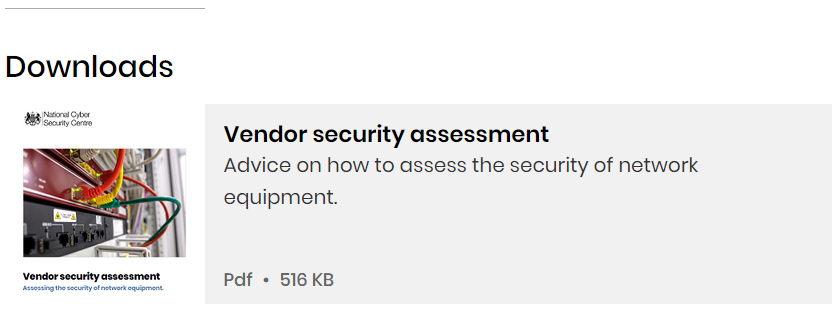
This document provides guidance on how operators should assess the security of vendor’s security processes and vendor equipment and is referenced in the Telecom Security Act Code of Practice.
The purpose of the guidance is to allow operators to objectively assess the cyber risk due to use of the vendor’s equipment. This is performed by gathering objective, repeatable evidence on the security of the vendor’s processes and network equipment.
Often we see stories about cyber attacks that breached an organisations’ security parameters, and advice on how we can protect against future threats. However, what is often missed, is just how these threat actors managed to breach a system, and as such, the fact that the Domain Name System (DNS) probably played a very large role in the attacker’s entry point.
In this Help Net Security video, Chris Buijs, Chief Evangelist at EfficientIP, talks about the importance of making the DNS as part of an organisation’s security strategy.
Expert discovered a remote memory-corruption vulnerability affecting the latest version of the OpenSSL library.
Security expert Guido Vranken discovered a remote memory-corruption vulnerability in the recently released OpenSSL version 3.0.4. The library was released on June 21, 2022, and affects x64 systems with the AVX-512 instruction set.
“OpenSSL version 3.0.4, released on June 21th 2022, is susceptible to remote memory corruption which can be triggered trivially by an attacker. BoringSSL, LibreSSL and the OpenSSL 1.1.1 branch are not affected. Furthermore, only x64 systems with AVX512 support are affected. The bug is fixed in the repository but a new release is still pending.” reads the post published by Vranken.
The issue can be easily exploited by threat actors and it will be addressed with the next release.
Google researcher David Benjamin that has analyzed the vulnerability argues that the bug does not constitute a security risk. Benjamin also found an apparent bug in the paper by Shay Gueron upon which the RSAZ code is based.
Cybersecurity is required to be a dynamic industry because cybercriminals don’t take days off. Cybersecurity professionals must be innovative, creative, and attentive to keep gaining the upper hand on cybercriminals. Unfortunately, there are millions of unfilled cybersecurity job openings around the globe.
The gender divide
The problem of not enough cybersecurity professionals is exacerbated by a lack of diversity in the sector. There is a disproportionately low ratio of women to men within the entire technology industry. In the science, technology, engineering and math (STEM) industries, women make up only 24% of the workforce, and while this has increased from just 11% in 2017, there is clearly still a sizeable disparity.
The cybersecurity industry is performing only marginally better than STEM, with women making up roughly 24% of cybersecurity jobs globally, according to (ISC)².
There is also a parallel trend here: women have superior qualifications in cybersecurity than their male counterparts. Over half of women – 52% – have postgraduate degrees, compared to just 44% of men. More importantly, 28% of women have cybersecurity-related qualifications, while only 20% of men do. This raises one important point, which is that women feel that they must be more qualified than men to compete for and hold the same cybersecurity roles. The industry is, therefore, losing a significant pool of talent because of this perception. Untapped talent means less innovation and dynamism in the products and services businesses offer.
Unfortunately, the challenges for women do not appear to stop once they enter the cybersecurity workforce. Pay disparity continues to blight the industry. Women reported being on smaller salaries at a higher proportion than men. 17% of women reported earning between $50,000 and $99,000 compared to 29% of men. However, there are signs that this disparity in pay is closing. For those in cybersecurity who earned over $100,000, the difference in percentage between men and women was much closer. This is encouraging and shows that once women are in the industry, they can enjoy as much success as men.
Nevertheless, reaching these higher levels of the cybersecurity industry is far from straightforward for women at present. It is an unavoidable fact that women still struggle to progress as easily compared to male counterparts. A key reason for this is cultural: women are disinclined to shout about their achievements, as such they regularly go unnoticed when promotions and other opportunities come round.
The cybersecurity industry is starting to embrace diversity in the workforce, but there is a long way to go before women are as valued in cybersecurity as men. With the current skills deficit hampering the growth of cybersecurity providers, this is a perfect opportunity for the industry and individual providers to break the bias and turn to women to speed up innovation and improve defense against cybercriminals.
Welcome to our May 2022 review of data breaches and cyber attacks. We identified 77 security incidents during the month, resulting in 49,782,129 compromised records.
You can find the full list below, with incidents affecting UK organisations listed in bold.
Many security engineers are already one foot out the door. Why?
The position of securityengineer has become a pivotal role for modern security teams. Practitioners are responsible for critical monitoring of networks and systems to identify threats or intrusions that could cause immense harm to an organization.
They must analyze troves of security-related data, detect immediate threats as early as possible on the cyber kill chain. From their vantage point, they are often best positioned to evaluate security monitoring solutions and recommend security operations improvement to management.
In this video for Help Net Security, Jack Naglieri, CEO of Panther Labs, discusses a recent report which found that 80% of security engineers are experiencing burnout.
Security researchers at the NCC Group have developed a tool to carry out a Bluetooth Low Energy (BLE) relay attack that bypasses all existing protections to authenticate on target devices.
BLE technology is used in a wide spectrum of products, from electronics like laptops, mobile phones, smart locks, and building access control systems to cars like Tesla Model 3 and Model Y.
Pushing out fixes for this security problem is complicated, and even if the response is immediate and coordinated, it would still take a long time for the updates to trickle to impacted products.
How the attack works
In this type of relay attacks, an adversary intercepts and can manipulate the communication between two parties, such as the key fob that unlocks and operates the car and the vehicle itself.
This places the attacker in the middle of the two ends of the communication, allowing them to relay the signal as if they were standing right next to the car.
Products that rely on BLE for proximity-based authentication protect against known relay attack methods by introducing checks based on precise amounts of latency and also link-layer encryption.
NCC Group has developed a tool that operates at the link layer and with a latency of 8ms that is within the accepted 30ms range of the GATT (Generic ATTribute Profile) response.
“Since this relay attack operates at the link layer, it can forward encrypted link layer PDUs. It is also capable of detecting encrypted changes to connection parameters (such as connection interval, WinOffset, PHY mode, and channel map) and continuing to relay connections through parameter changes. Thus, neither link layer encryption nor encrypted connection parameter changes are defences against this type of relay attack.” – NCC Group
According to Sultan Qasim Khan, a senior security consultant at NCC Group, it takes about ten seconds to run the attack and it can be repeated endlessly.
Both the Tesla Model 3 and Model Y use a BLE-based entry system, so NCC’s attack could be used to unlock and start the cars.
While technical details behind this new BLE relay attack have not been published, the researchers say that they tested the method on a Tesla Model 3 from 2020 using an iPhone 13 mini running version 4.6.1-891 of the Tesla app.
“NCC Group was able to use this newly developed relay attack tool to unlock and operate the vehicle while the iPhone was outside the BLE range of the vehicle” – NCC Group
During the experiment, they were able to deliver to the car the communication from the iPhone via two relay devices, one placed seven meters away from the phone, the other sitting three meters from the car. The distance between the phone and the car was 25 meters.
The experiment was also replicated successfully on a Tesla Model Y from 2021, since it uses similar technologies. Below is a demonstration of the attack:
These findings were reported to Tesla on April 21st. A week later, the company responded by saying “that relay attacks are a known limitation of the passive entry system.”
The researchers also notified Spectrum Brands, the parent company behind Kwikset (makers of the Kevo line of smart locks).
What can be done
NCC Group’s research on this new proximity attack is available in three separate advisories, for BLE in general, one for Tesla cars, and another for Kwikset/Weiser smart locks, each illustrating the issue on the tested devices and how it affects a larger set of products from other vendors.
The Bluetooth Core Specification warns device makers about relay attacks and notes that proximity-based authentication shouldn’t be used for valuable assets.
This leaves users with few possibilities, one being to disable it, if possible, and switch to an alternative authentication method that requires user interaction.
Another solution would be for makers to adopt a distance bounding solution such as UWB (ultra-wideband) radio technology instead of Bluetooth.
Tesla owners are encouraged to use the ‘PIN to Drive’ feature, so even if their car is unlocked, at least the attacker won’t be able to drive away with it.
Additionally, disabling the passive entry functionality in the mobile app when the phone is stationary would make the relay attack impossible to carry out.
If none of the above is possible on your device, keep in mind the possibility of relay attacks and implement additional protection measures accordingly.