May 20 2026

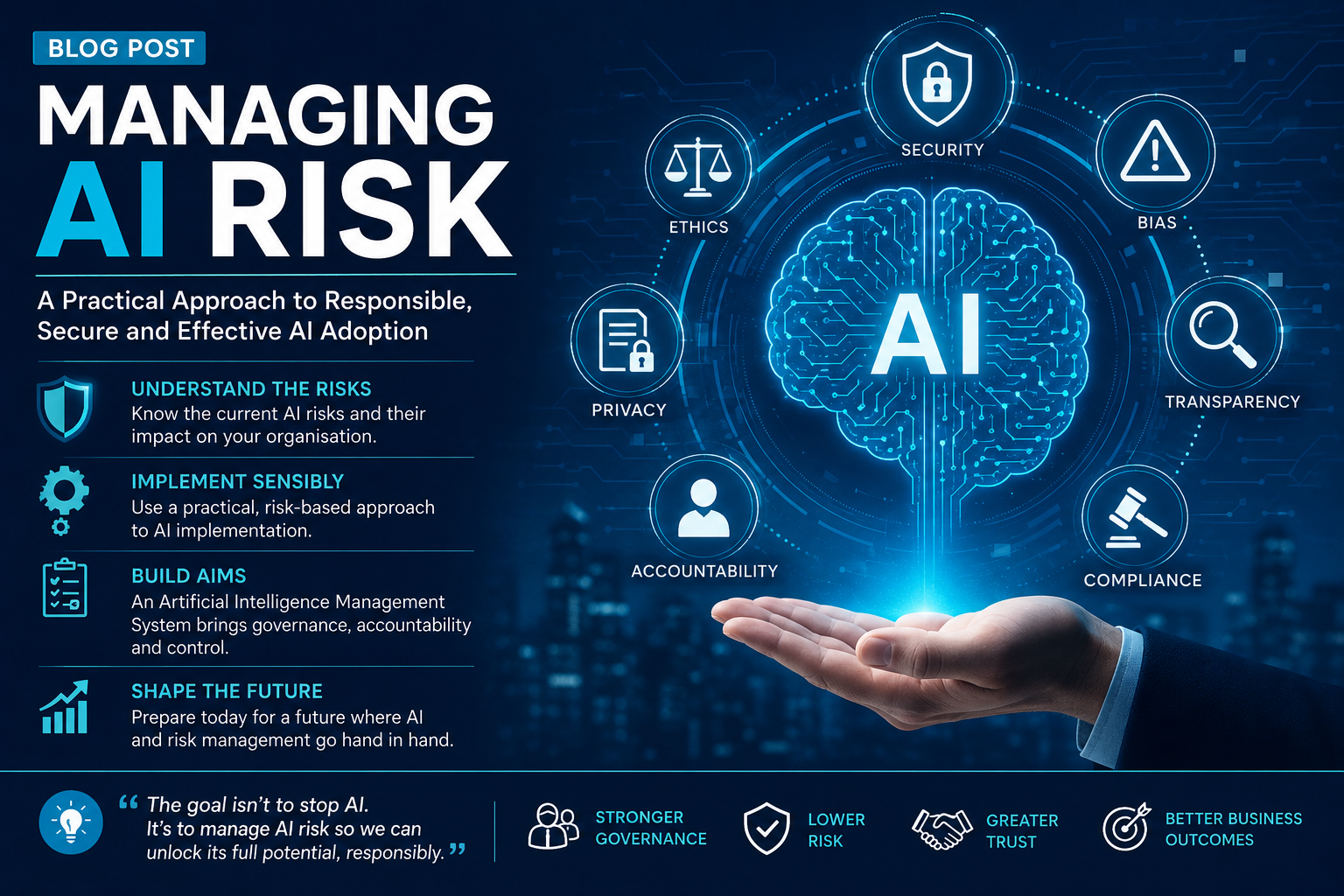
Managing AI Risk: A Practical Approach to Secure, Responsible, and Effective AI Adoption

Category: AI,AI Governance,AI Riskdisc7 @ 8:04 am

Managing AI Risk: A Practical Approach to Secure, Responsible, and Effective AI Adoption

Artificial Intelligence is transforming how organizations operate, compete, and innovate. From automating business workflows to enhancing cybersecurity detection and accelerating decision-making, AI offers enormous opportunities. Yet alongside these benefits comes a rapidly expanding landscape of risks that organizations can no longer ignore.

Books like Managing AI Risk help leaders understand that AI implementation is not simply a technology project — it is a governance, security, compliance, and business resilience challenge.

You can explore the book here:
Managing AI Risk on Amazon

The Current AI Risk Landscape

Organizations are rushing to deploy generative AI, large language models (LLMs), autonomous agents, and AI-powered analytics. Unfortunately, many businesses are adopting AI faster than they can govern it.

Today’s AI risks include:

  • Data leakage through public AI tools
  • Hallucinations and inaccurate outputs
  • Prompt injection attacks
  • AI model manipulation and poisoning
  • Bias and discrimination in automated decisions
  • Intellectual property and copyright exposure
  • Regulatory non-compliance
  • Shadow AI usage by employees
  • Lack of transparency and explainability
  • Overreliance on AI-generated decisions

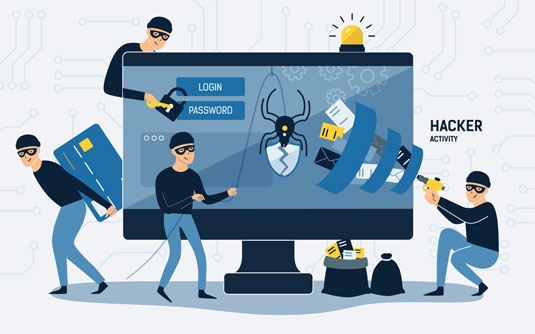
Cybersecurity teams are now facing a new reality where attackers also use AI to automate phishing, malware development, social engineering, and vulnerability discovery. AI has become both a defensive tool and an offensive weapon.

This creates a critical challenge for leadership: how can organizations embrace AI innovation while still maintaining trust, security, compliance, and operational control?

A Practical and Sensible Approach to AI Implementation

Successful AI adoption requires more than experimentation. Organizations need a structured and practical framework that balances innovation with governance.

A sensible AI strategy should include:

1. AI Governance First

Before deploying AI systems, organizations must establish governance policies defining:

  • Acceptable AI usage
  • Risk ownership
  • Data handling requirements
  • Human oversight responsibilities
  • Vendor assessment criteria
  • Ethical AI principles

Without governance, AI deployments quickly become fragmented and difficult to control.

2. Risk-Based AI Deployment

Not all AI systems carry the same level of risk. Organizations should classify AI use cases based on:

  • Business impact
  • Sensitivity of data
  • Regulatory exposure
  • Customer impact
  • Automation level

High-risk AI systems require stronger validation, monitoring, and approval processes.

3. Continuous Security and Monitoring

AI systems are not “set and forget” technologies. Organizations must continuously monitor:

  • Model drift
  • Data quality
  • Security vulnerabilities
  • User misuse
  • Adversarial attacks
  • Compliance violations

AI security must become part of enterprise cybersecurity and GRC programs.

Why an Artificial Intelligence Management System (AIMS) Matters

One of the most important emerging concepts in AI governance is the Artificial Intelligence Management System (AIMS).

An AIMS provides organizations with a formal structure for managing AI responsibly across the enterprise. Similar to how ISO 27001 supports information security management, AI governance frameworks such as International Organization for Standardization ISO/IEC 42001 are helping organizations operationalize AI governance and risk management.

An effective AIMS helps organizations:

  • Establish AI accountability
  • Standardize AI governance processes
  • Improve regulatory readiness
  • Reduce operational risk
  • Build stakeholder trust
  • Align AI initiatives with business objectives

As regulators worldwide continue introducing AI laws and compliance requirements, organizations without structured AI governance will face increasing operational and legal challenges.

The Future of AI and Risk Management

The future of AI risk management will revolve around resilience, transparency, and adaptive governance.

In the coming years, organizations will move beyond basic AI experimentation into enterprise-scale AI ecosystems involving autonomous agents, decision automation, AI copilots, and machine-driven business operations. This evolution will dramatically increase both efficiency and risk exposure.

My perspective is that future AI governance will become deeply integrated with cybersecurity, privacy, enterprise risk management, and compliance functions. AI risk management will no longer be optional — it will become a core business discipline.

We will also see:

  • Increased global AI regulations
  • AI security becoming a dedicated cybersecurity domain
  • Greater emphasis on explainable and auditable AI
  • Mandatory AI risk assessments
  • Expansion of third-party AI assurance programs
  • AI governance becoming part of board-level oversight

Organizations that succeed will not necessarily be the ones adopting AI the fastest, but the ones implementing AI responsibly, securely, and strategically.

At DISC InfoSec, we believe organizations must approach AI with both innovation and discipline. Effective AI governance is not about slowing down adoption — it is about enabling sustainable, trustworthy, and resilient AI transformation.

The AI Governance Quick-Start: Defensible in 10 Days, Not 4 Quarters

DISC InfoSec is an active ISO 42001 implementer and PECB Authorized Training Partner specializing in AI governance for B2B SaaS and financial services organizations.

AI Attack Surface ScoreCard

AI Vulnerability Scorecard: Discover Your AI Attack Surface Before Attackers Do

Your Shadow AI Problem Has a Name-And Now It Has a Score

Most AI Security Tools Won’t Pass an Audit. Here’s a 15-Minute Way to Find Out.

AIMS and Data Governance – Managing data responsibly isn’t just good practice—it’s a legal and ethical imperative

Schedule a consultation or drop a note below: info@deurainfosec.com

InfoSec services | InfoSec books | Follow our blog | DISC llc is listed on The vCISO Directory | ISO 27k Chat bot | Comprehensive vCISO Services | ISMS Services | AIMS Services | Security Risk Assessment Services | Mergers and Acquisition Security

Tags: Managing AI Risk


Sep 18 2025

Managing AI Risk: Building a Risk-Aware Strategy with ISO 42001, ISO 27001, and NIST

Category: AI,AI Governance,CISO,ISO 27k,ISO 42001,vCISOdisc7 @ 7:59 am

Managing AI Risk: A Practical Approach to Responsibly Managing AI with ISO 42001 treats building a risk-aware strategy, relevant standards (ISO 42001, ISO 27001, NIST, etc.), the role of an Artificial Intelligence Management System (AIMS), and what the future of AI risk management might look like.


1. Framing a Risk-Aware AI Strategy
The book begins by laying out the need for organizations to approach AI not just as a source of opportunity (innovation, efficiency, etc.) but also as a domain rife with risk: ethical risks (bias, fairness), safety, transparency, privacy, regulatory exposure, reputational risk, and so on. It argues that a risk-aware strategy must be integrated into the whole AI lifecycle—from design to deployment and maintenance. Key in its framing is that risk management shouldn’t be an afterthought or a compliance exercise; it should be embedded in strategy, culture, governance structures. The idea is to shift from reactive to proactive: anticipating what could go wrong, and building in mitigations early.

2. How the book leverages ISO 42001 and related standards
A core feature of the book is that it aligns its framework heavily with ISO IEC 42001:2023, which is the first international standard to define requirements for establishing, implementing, maintaining, and continuously improving an Artificial Intelligence Management System (AIMS). The book draws connections between 42001 and adjacent or overlapping standards—such as ISO 27001 (information security), ISO 31000 (risk management in general), as well as NIST’s AI Risk Management Framework (AI RMF 1.0). The treatment helps the reader see how these standards can interoperate—where one handles confidentiality, security, access controls (ISO 27001), another handles overall risk governance, etc.—and how 42001 fills gaps specific to AI: lifecycle governance, transparency, ethics, stakeholder traceability.

3. The Artificial Intelligence Management System (AIMS) as central tool
The concept of an AI Management System (AIMS) is at the heart of the book. An AIMS per ISO 42001 is a set of interrelated or interacting elements of an organization (policies, controls, processes, roles, tools) intended to ensure responsible development and use of AI systems. The author Andrew Pattison walks through what components are essential: leadership commitment; roles and responsibilities; risk identification, impact assessment; operational controls; monitoring, performance evaluation; continual improvement. One strength is the practical guidance: not just “you should do these”, but how to embed them in organizations that don’t have deep AI maturity yet. The book emphasizes that an AIMS is more than a set of policies—it’s a living system that must adapt, learn, and respond as AI systems evolve, as new risks emerge, and as external demands (laws, regulations, public expectations) shift.

4. Comparison and contrasts: ISO 42001, ISO 27001, and NIST
In comparing standards, the book does a good job of pointing out both overlaps and distinct value: for example, ISO 27001 is strong on information security, confidentiality, integrity, availability; it has proven structures for risk assessment and for ensuring controls. But AI systems pose additional, unique risks (bias, accountability of decision-making, transparency, possible harms in deployment) that are not fully covered by a pure security standard. NIST’s AI Risk Management Framework provides flexible guidance especially for U.S. organisations or those aligning with U.S. governmental expectations: mapping, measuring, managing risks in a more domain-agnostic way. Meanwhile, ISO 42001 brings in the notion of an AI-specific management system, lifecycle oversight, and explicit ethical / governance obligations. The book argues that a robust strategy often uses multiple standards: e.g. ISO 27001 for information security, ISO 42001 for overall AI governance, NIST AI RMF for risk measurement & tools.

5. Practical tools, governance, and processes
The author does more than theory. There are discussions of impact assessments, risk matrices, audit / assurance, third-party oversight, monitoring for model drift / unanticipated behavior, documentation, and transparency. Some of the more compelling content is about how to do risk assessments early (before deployment), how to engage stakeholders, how to map out potential harms (both known risks and emergent/unknown ones), how governance bodies (steering committees, ethics boards) can play a role, how responsibility should be assigned, how controls should be tested. The book does point out real challenges: culture change, resource constraints, measurement difficulties, especially for ethical or fairness concerns. But it provides guidance on how to surmount or mitigate those.

6. What might be less strong / gaps
While the book is very useful, there are areas where some readers might want more. For instance, in scaling these practices in organizations with very little AI maturity: the resource costs, how to bootstrap without overengineering. Also, while it references standards and regulations broadly, there may be less depth on certain jurisdictional regulatory regimes (e.g. EU AI Act in detail, or sector-specific requirements). Another area that is always hard—and the book is no exception—is anticipating novel risks: what about very advanced AI systems (e.g. generative models, large language models) or AI in uncontrolled environments? Some of the guidance is still high-level when it comes to edge-cases or worst-case scenarios. But this is a natural trade-off given the speed of AI advancement.

7. Future of AI & risk management: trends and implications
Looking ahead, the book suggests that risk management in AI will become increasingly central as both regulatory pressure and societal expectations grow. Standards like ISO 42001 will be adopted more widely, possibly even made mandatory or incorporated into regulation. The idea of “certification” or attestation of compliance will gain traction. Also, the monitoring, auditing, and accountability functions will become more technically and institutionally mature: better tools for algorithmic transparency, bias measurement, model explainability, data provenance, and impact assessments. There’ll also be more demand for cross-organizational cooperation (e.g. supply chains and third-party models), for oversight of external models, for AI governance in ecosystems rather than isolated systems. Finally, there is an implication that organizations that don’t get serious about risk will pay—through regulation, loss of trust, or harm. So the future is of AI risk management moving from “nice-to-have” to “mission-critical.”


Overall, Managing AI Risk is a strong, timely guide. It bridges theory (standards, frameworks) and practice (governance, processes, tools) well. It makes the case that ISO 42001 is a useful centerpiece for any AI risk strategy, especially when combined with other standards. If you are planning or refining an AI strategy, building or implementing an AIMS, or anticipating future regulatory change, this book gives a solid and actionable foundation.

Secure Your Business. Simplify Compliance. Gain Peace of Mind

InfoSec services | InfoSec books | Follow our blog | DISC llc is listed on The vCISO Directory | ISO 27k Chat bot | Comprehensive vCISO Services | ISMS Services | Security Risk Assessment Services | Mergers and Acquisition Security

Tags: iso 27001, ISO 42001, Managing AI Risk, NIST