Nov 20 2026

Question 14 Is Stalling Your Enterprise Deals

Category: AI Management System,ISO 42001 — disc7 @ 10:16 am

Do You Have an Operational AI Management System?

Nov 20, 2026 · @disc

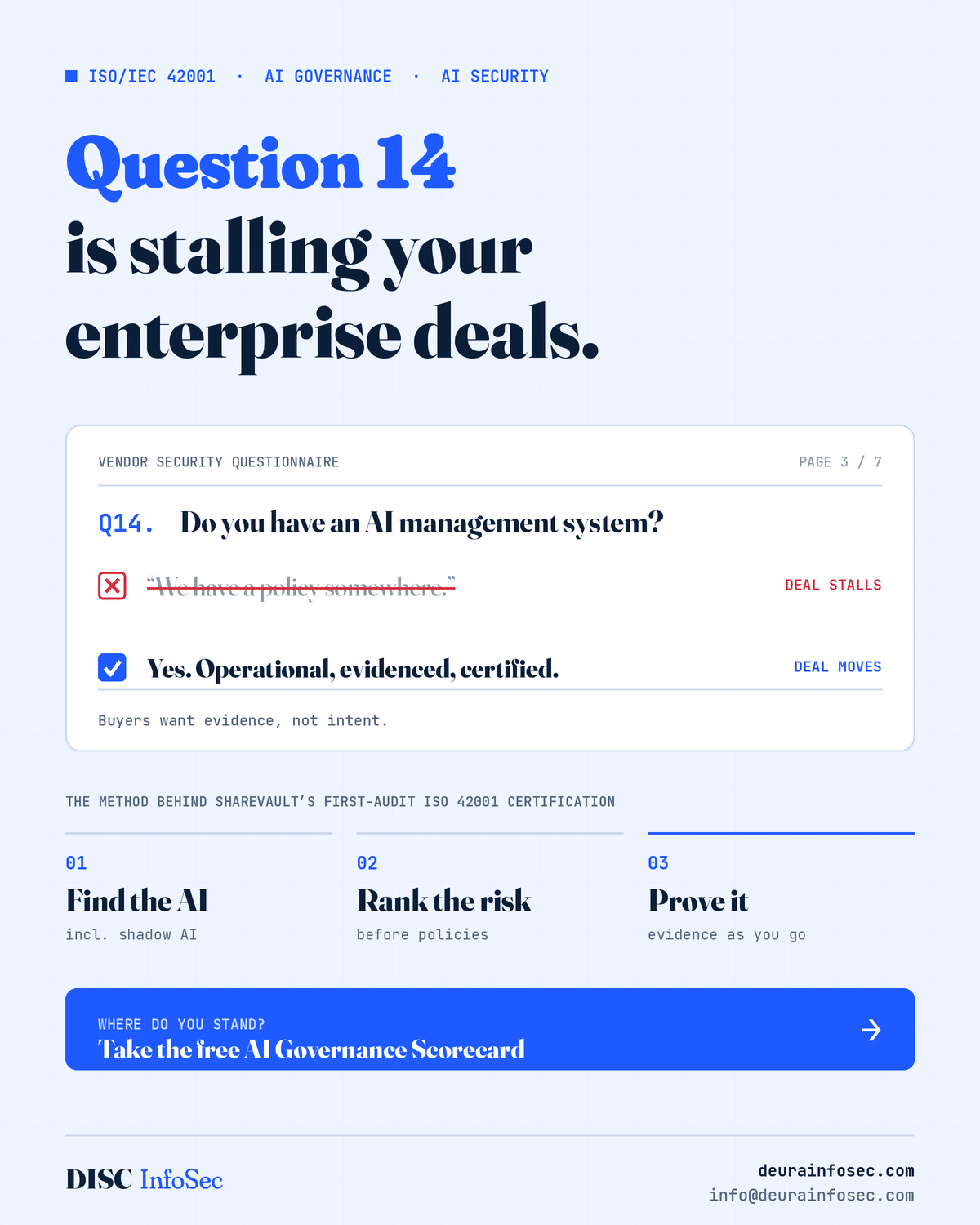
Your biggest enterprise customer just sent a security questionnaire. Question 14 reads: “Do you have an AI management system?”

If your honest answer is “we have a policy somewhere,” the deal can stall. Procurement wants proof, not intent. Their security team wants to know which AI touches their data, who owns the risk, and what happens when it goes wrong.

Most companies already use AI everywhere: in the product, in support, in sales tools and in browser plug-ins nobody approved. Very few can show that it is governed. That gap is now showing up in revenue, not just in audits.

Paper AIMS vs operational AIMS

An operational AI management system is one that runs every week and leaves evidence behind. A paper AIMS is a set of documents that describe a system nobody operates.

ISO/IEC 42001 makes the difference testable. Clauses 4 to 10 are mandatory, and an auditor will ask for records, not slides. Enterprise buyers increasingly ask the same questions.

What gets askedPaper AIMS answerOperational AIMS answer
Which AI systems do you use? (Clause 4)A list from last yearA live AI system register, including shadow AI, with an owner per system
Who is accountable? (Clause 5)“The CTO, generally”A signed AI policy and named owners for each system and risk
How do you assess AI risk? (Clause 6)A generic risk matrixAn AI risk register and impact assessments tied to real use cases
How do you control AI in production? (Clause 8)A policy says soChange records, supplier AI reviews, human-oversight checks, incident logs
How do you know it works? (Clause 9)We’d find outMetrics, internal audit reports and management review minutes
What do you fix? (Clause 10)Ad hocA corrective action log with closure dates

If your answers sit in the middle column, you do not have an AIMS yet. You have its outline.

Why it matters now

Four forces are turning AI governance from a nice-to-have into a sales requirement.

Buyers are asking. AI questions now sit in standard vendor assessments next to SOC 2 and ISO 27001. A vague answer adds weeks of follow-up, legal review and, sometimes, a lost deal.

AI threats move fast. In our recent post on the Optimizely attack, one poisoned vendor script reached 178 major brands in a single day. AI chat widgets, copilots and agents are embedded the same way, and they see what users type. Prompt injection, data leakage and excessive agency are no longer lab problems.

AI risk hides in plain sight. Shadow AI is the norm: staff paste contracts, code and customer data into tools security never reviewed. You cannot govern what you have not found.

Regulation has arrived. The EU AI Act, the Colorado AI Act and sector rules for financial services all expect documented risk management and human oversight. ISO 42001 gives you one management system that maps to all of them, and it integrates with the ISO 27001 program you may already run.

How ShareVault certified on the first audit

We helped ShareVault, a virtual data room for M&A and financial due diligence, certify to ISO 42001 on its first audit. Financial data rooms are the hard mode of compliance: sensitive documents, demanding clients and AI built into the product. Three moves made the difference.

  1. We mapped AI use cases first, including shadow AI. Before any policy, we built the AI system register: product features, internal tools, vendor AI and the unofficial tools staff actually used. We also settled the scoping question early, because ShareVault is both an AI provider and an AI user. That register became the backbone of Clause 4 and of every control that followed.
  2. We built the risk register before writing policies. Policies written first tend to be generic and hard to evidence. We ran the AI risk assessment and impact assessments (Clause 6.1) against real use cases, then wrote policies to treat the risks we actually found. Every policy had a reason an auditor could trace.
  3. We collected audit evidence as we went, not at the end. Evidence production is where most programs fail. Decisions, reviews, supplier assessments and training records were captured as the work happened. When the auditor asked “show me,” the answer already existed.

The pattern is simple: see the AI, rank the risk, then govern and prove it. Read the full ShareVault ISO 42001 case study or the requirements mapped to ShareVault.

Self-check: is your AIMS operational?

Answer these honestly. Each “no” is a gap a buyer or auditor will find.

  • ☐ We can list every AI system in use today, including tools staff adopted on their own.
  • ☐ Each AI system has a named owner and a documented intended purpose.
  • ☐ We have an AI risk register with ratings, treatments and review dates.
  • ☐ AI system impact assessments exist for systems that affect customers or individuals.
  • ☐ AI vendors are assessed before onboarding and reviewed after.
  • ☐ We test AI features for prompt injection, data leakage and misuse.
  • ☐ AI incidents have a defined response path, and we have practiced it.
  • ☐ Leadership reviews AI risk on a schedule, and the minutes prove it.

If you ticked fewer than six of these eight, your answer to the AI question on your next customer questionnaire is a risk to your pipeline

My perspective

I have yet to see an AI governance program fail for lack of a policy. I have seen many stall because nobody could prove the policy was followed.

ISO 42001 was new when we took ShareVault through Stage 2, and there was little audit precedent to lean on. What carried us was not clever documents. It was a management system that already ran, so the audit became a demonstration rather than a scramble.

That is my advice to every SaaS and financial services leader facing Question 14. Do not start with a policy template. Start by finding your AI, then rank its risk, then build the controls and the evidence together. A defensible answer is closer than you think, and it pays for itself the first time a deal does not stall.

How DISC InfoSec builds an operational AIMS

We turn AI governance requirements into operating controls, evidence and accountable decisions. One practitioner across AI governance, AI security and compliance, with a first-audit ISO 42001 certification behind the method.

Where you areStart hereWhat you get
Not sure where you standAI Governance Scorecard (free, 8 questions)Instant maturity score and your top 3 priority gaps
Need an answer for buyers fastAI Governance Quick-StartA defensible position in 10 days, not 4 quarters
Planning ISO 42001 certificationISO 42001 gap assessment (2 weeks)Clause 4–10 and Annex A gaps with a prioritized remediation roadmap
Ready to buildAIMS implementationAI system register, risk register, policies and audit evidence built together
Need ongoing leadershipvCAIO servicesAI governance leadership without a full-time hire

Every engagement follows the ShareVault pattern: find the AI, rank the risk, then govern and prove it. It also covers AI security, including prompt injection and AI supply chain risk, mapped to ISO 42001, ISO 27001, NIST AI RMF and the EU AI Act.

Take the 8-question AI Governance Scorecard to see where you stand. Then book a free 30-minute call at calendly.com/hd-deurainfosec or email hd@deurainfosec.com. Learn more on our AIMS and ISO 42001 page.

“DiscInfosec” HD – AICP, CISSP, CISM, ISO/IEC 42001 and 27001 Lead Implementer, is Principal Consultant at DISC InfoSec, a PECB Authorized Training Partner.

#ISO42001 #AIGovernance #AISecurity #AIRisk #Compliance

Will your AI answers survive a buyer’s security review? Enterprise buyers now ask about AI in their security questionnaires: which models touch customer data, whether that data trains them, how you test for prompt injection, and who is accountable when something goes wrong. Saying “yes” isn’t enough anymore; reviewers want written evidence, and a control you can’t document counts as missing. Our free Deal Blocker Check asks 18 questions modeled on real AI due diligence reviews and shows you which answers would stall your deal before your buyer finds them. Within five minutes you’ll get your readiness score, your open deal blockers, and what each reviewer expects to see. It’s built from the evidence we assembled taking ShareVault through ISO 42001 certification on the first audit.

Click the link to open it in your browser for a full-screen experience.

Run the Deal Blocker Check 


Tags: AIMS, ISO 42001, ISO 42001 agents, ISO 42001 Artificial Intelligence Management Systems (AIMS) Implementation Guide: AIMS Framework | AI Security Standards, ISO 42001 Awareness, ISO 42001 certificate, ISO 42001 Evidence Checklist, ISO 42001 lead Implementer, ISO 42001:2023 Control Gap Assessment


Feb 23 2025

Clause 4 of ISO 42001: Understanding an Organization and Its Context and Why It Is Crucial to Get It Right.

Category: AI,Information Security — disc7 @ 10:50 pm

AI is reshaping industries by automating routine tasks, processing and analyzing vast amounts of data, and enhancing decision-making capabilities. Its ability to identify patterns, generate insights, and optimize processes enables businesses to operate more efficiently and strategically. However, along with its numerous advantages, AI also presents challenges such as ethical concerns, bias in algorithms, data privacy risks, and potential job displacement. By gaining a comprehensive understanding of AI’s fundamentals, as well as its risks and benefits, we can leverage its potential responsibly to foster innovation, drive sustainable growth, and create positive societal impact.

This serves as a template for evaluating internal and external business objectives (market needs) within the given context, ultimately aiding in defining the right scope for the organization.

Why Clause 4 in ISO 42001 is Critical for Success

Clause 4 (Context of the Organization) in ISO/IEC 42001 is fundamental because it sets the foundation for an effective AI Management System (AIMS). If this clause is not properly implemented, the entire AI governance framework could be misaligned with business objectives, regulatory requirements, and stakeholder expectations.


1. It Defines the Scope and Direction of AI Governance

Clause 4.1 – Understanding the Organization and Its Context ensures that AI governance is tailored to the organization’s specific risks, objectives, and industry landscape.

  • Without it: The AI strategy might be disconnected from business priorities.
  • With it: AI implementation is aligned with organizational goals, compliance, and risk management.

Clause 4 of ISO/IEC 42001:2023 (AI Management System Standard) focuses on the context of the organization. This clause requires organizations to define internal and external factors that influence their AI management system (AIMS). Here’s a breakdown of its key components:

1. Understanding the Organization and Its Context (4.1)

  • Identify external and internal issues that affect the AI Management System.
  • External factors may include regulatory landscape, industry trends, societal expectations, and technological advancements.
  • Internal factors can involve corporate policies, organizational structure, resources, and AI capabilities.

2. Understanding the Needs and Expectations of Stakeholders (4.2)

  • Identify stakeholders (customers, regulators, employees, suppliers, etc.).
  • Determine their needs, expectations, and concerns related to AI use.
  • Consider legal, regulatory, and contractual requirements.

3. Determining the Scope of the AI Management System (4.3)

  • Define the boundaries and applicability of AIMS based on identified factors.
  • Consider organizational units, functions, and jurisdictions in scope.
  • Ensure alignment with business objectives and compliance obligations.

4. AI Management System (AIMS) and Its Implementation (4.4)

  • Establish, implement, maintain, and continuously improve the AIMS.
  • Ensure it aligns with organizational goals and risk management practices.
  • Integrate AI governance, ethics, risk, and compliance into business operations.

Why This Matters

Clause 4 ensures that organizations build their AI governance framework with a strong foundation, considering all relevant factors before implementing AI-related controls. It aligns AI initiatives with business strategy, regulatory compliance, and stakeholder expectations.

Here are the options:

  1. 4.1 – Understanding the Organization and Its Context
  2. 4.2 – Understanding the Needs and Expectations of Stakeholders
  3. 4.3 – Determining the Scope of the AI Management System (AIMS)
  4. 4.4 – AI Management System (AIMS) and Its Implementation

Breakdown of “Understanding the Organization and its context”

Detailed Breakdown of Clause 4.1 – Understanding the Organization and Its Context (ISO 42001)

Clause 4.1 of ISO/IEC 42001:2023 requires an organization to determine internal and external factors that can affect its AI Management System (AIMS). This understanding helps in designing an effective AI governance framework.


1. Purpose of Clause 4.1

The main goal is to ensure that AI-related risks, opportunities, and strategic objectives align with the organization’s broader business environment. Organizations need to consider:

  • How AI impacts their operations.
  • What external and internal factors influence AI adoption, governance, and compliance.
  • How these factors shape the effectiveness of AIMS.

2. Key Requirements

Organizations must:

  1. Identify External Issues:
    These are factors outside the organization that can impact AI governance, including:
    • Regulatory & Legal Landscape – AI laws, data protection (e.g., GDPR, AI Act), industry standards.
    • Technological Trends – Advancements in AI, ML frameworks, cloud computing, cybersecurity.
    • Market & Competitive Landscape – Competitor AI adoption, emerging business models.
    • Social & Ethical Concerns – Public perception, ethical AI principles (bias, fairness, transparency).
  2. Identify Internal Issues:
    These factors exist within the organization and influence AIMS, such as:
    • AI Strategy & Objectives – Business goals for AI implementation.
    • Organizational Structure – AI governance roles, responsibilities, leadership commitment.
    • Capabilities & Resources – AI expertise, financial resources, infrastructure.
    • Existing Policies & Processes – AI ethics policies, risk management frameworks.
    • Data Governance & Security – Data availability, quality, security, and compliance.
  3. Monitor & Review These Issues:
    • These factors are dynamic and should be reviewed regularly.
    • Organizations should track changes in external regulations, AI advancements, and internal policies.

3. Practical Implementation Steps

  • Conduct a PESTLE Analysis (Political, Economic, Social, Technological, Legal, Environmental) to map external factors.
  • Perform an Internal SWOT Analysis (Strengths, Weaknesses, Opportunities, Threats) for AI capabilities.
  • Engage Stakeholders (leadership, compliance, IT, data science teams) in discussions about AI risks and objectives.
  • Document Findings in an AI context assessment report to support AIMS planning.

4. Why It Matters

Clause 4.1 ensures that AI governance is not isolated but integrated into the organization’s strategic, operational, and compliance frameworks. A strong understanding of context helps in:
✅ Reducing AI-related risks (bias, security, regulatory non-compliance).
✅ Aligning AI adoption with business goals and ethical considerations.
✅ Preparing for evolving AI regulations and market demands.

Implementation Examples & Templates for Clause 4.1 (Understanding the Organization and Its Context) in ISO 42001

Here are practical examples and a template to help document and implement Clause 4.1 effectively.


1. Example: AI Governance in a Financial Institution

Scenario:

A bank is implementing an AI-based fraud detection system and needs to assess its internal and external context.

Step 1: Identify External Issues

CategoryIdentified Issues
Regulatory & LegalGDPR, AI Act (EU), banking compliance rules.
Technological TrendsML advancements in fraud detection, cloud AI.
Market CompetitionCompetitors adopting AI-driven risk assessment.
Social & EthicalAI bias concerns in fraud detection models.

Step 2: Identify Internal Issues

CategoryIdentified Issues
AI StrategyImprove fraud detection efficiency by 30%.
Organizational StructureAI governance committee oversees compliance.
ResourcesAI team with data scientists and compliance experts.
Policies & ProcessesData retention policy, ethical AI guidelines.

Step 3: Continuous Monitoring & Review

  • Quarterly regulatory updates for AI laws.
  • Ongoing performance evaluation of AI fraud detection models.
  • Stakeholder feedback sessions on AI transparency and fairness.

2. Template: AI Context Assessment Document

Use this template to document the context of your organization.


AI Context Assessment Report

📌 Organization Name: [Your Organization]
📌 Date: [MM/DD/YYYY]
📌 Prepared By: [Responsible Person/Team]


1. External Factors Affecting AI Management System

Factor TypeDescription
Regulatory & Legal[List relevant laws & regulations]
Technological Trends[List emerging AI technologies]
Market Competition[Describe AI adoption by competitors]
Social & Ethical Concerns[Mention AI ethics, bias, transparency challenges]

2. Internal Factors Affecting AI Management System

Factor TypeDescription
AI Strategy & Objectives[Define AI goals & business alignment]
Organizational Structure[List AI governance roles]
Resources & Expertise[Describe team skills, tools, and funding]
Data Governance[Outline data security, privacy, and compliance]

3. Monitoring & Review Process

  • Frequency of Review: [Monthly/Quarterly/Annually]
  • Responsible Team: [AI Governance Team / Compliance]
  • Methods: [Stakeholder meetings, compliance audits, AI performance reviews]

Next Steps

✅ Integrate this assessment into your AI Management System (AIMS).
✅ Update it regularly based on changing laws, risks, and market trends.
✅ Ensure alignment with ISO 42001 compliance and business goals.

Keep in mind that you can refine your context and expand your scope during your next internal/surveillance audit.

Managing Artificial Intelligence Threats with ISO 27001

Adversarial AI Attacks, Mitigations, and Defense Strategies: A cybersecurity professional’s guide to AI attacks, threat modeling, and securing AI with MLSecOps

Some AI frameworks have remote code execution as a feature – explore common attack vectors and mitigation strategies

Basic Principle to Enterprise AI Security

Adversarial AI Attacks, Mitigations, and Defense Strategies: A cybersecurity professional’s guide to AI attacks, threat modeling, and securing AI with MLSecOps

New regulations and AI hacks drive cyber security changes in 2025

Threat modeling your generative AI workload to evaluate security risk

How CISOs Can Drive the Adoption of Responsible AI Practices

Hackers will use machine learning to launch attacks

To fight AI-generated malware, focus on cybersecurity fundamentals

4 ways AI is transforming audit, risk and compliance

Artificial Intelligence Hacks

ISO certification training courses.

ISMS and ISO 27k training

🚀 Unlock Your AI Governance Expertise with ISO 42001! 🎯

Are you ready to lead in the world of AI Management Systems? Get certified in ISO 42001 with our exclusive 20% discount on top-tier e-learning courses – including the certification exam!

✅ ISO 42001 Foundation – Master the fundamentals of AI governance.
✅ ISO 42001 Lead Auditor – Gain the skills to audit AI Management Systems.
✅ ISO 42001 Lead Implementer – Learn how to design and implement AIMS.

📌 Accredited by ANSI National Accreditation Board (ANAB) through PECB, ensuring global recognition.

🎯 Limited-time offer – Don’t miss out! Contact us today to secure your spot. 🚀

InfoSec services | InfoSec books | Follow our blog | DISC llc is listed on The vCISO Directory | ISO 27k Chat bot | Comprehensive vCISO Services | ISMS Services | Security Risk Assessment Services

Tags: ISO 42001, ISO 42001 Clause 4, ISO 42001 Foundation, ISo 42001 Lead Auditor, ISO 42001 lead Implementer