Do You Have an Operational AI Management System?
Nov 20, 2026 · @disc
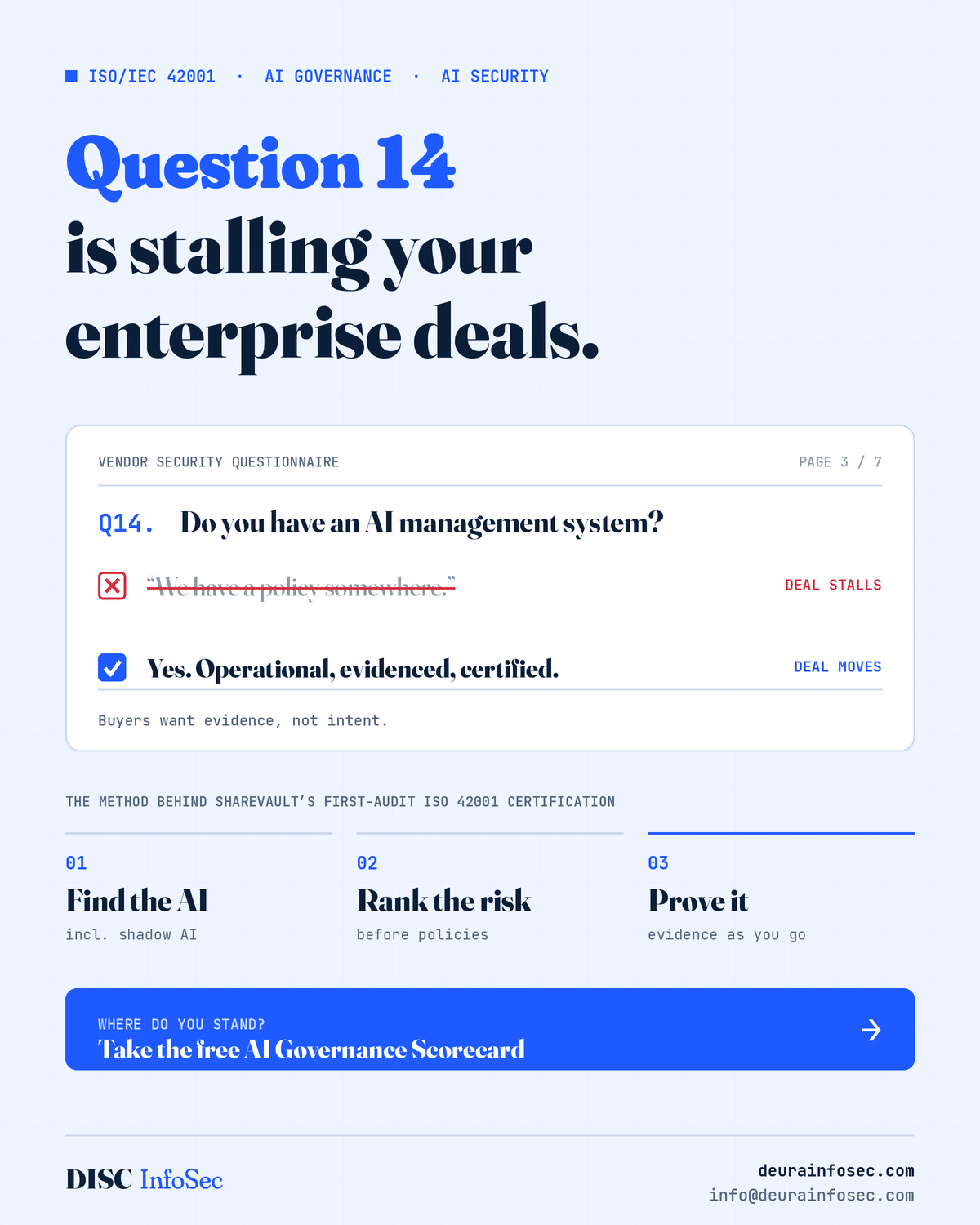
Your biggest enterprise customer just sent a security questionnaire. Question 14 reads: “Do you have an AI management system?”
If your honest answer is “we have a policy somewhere,” the deal can stall. Procurement wants proof, not intent. Their security team wants to know which AI touches their data, who owns the risk, and what happens when it goes wrong.
Most companies already use AI everywhere: in the product, in support, in sales tools and in browser plug-ins nobody approved. Very few can show that it is governed. That gap is now showing up in revenue, not just in audits.
Paper AIMS vs operational AIMS
An operational AI management system is one that runs every week and leaves evidence behind. A paper AIMS is a set of documents that describe a system nobody operates.
ISO/IEC 42001 makes the difference testable. Clauses 4 to 10 are mandatory, and an auditor will ask for records, not slides. Enterprise buyers increasingly ask the same questions.
| What gets asked | Paper AIMS answer | Operational AIMS answer |
| Which AI systems do you use? (Clause 4) | A list from last year | A live AI system register, including shadow AI, with an owner per system |
| Who is accountable? (Clause 5) | “The CTO, generally” | A signed AI policy and named owners for each system and risk |
| How do you assess AI risk? (Clause 6) | A generic risk matrix | An AI risk register and impact assessments tied to real use cases |
| How do you control AI in production? (Clause 8) | A policy says so | Change records, supplier AI reviews, human-oversight checks, incident logs |
| How do you know it works? (Clause 9) | We’d find out | Metrics, internal audit reports and management review minutes |
| What do you fix? (Clause 10) | Ad hoc | A corrective action log with closure dates |
If your answers sit in the middle column, you do not have an AIMS yet. You have its outline.
Why it matters now
Four forces are turning AI governance from a nice-to-have into a sales requirement.
Buyers are asking. AI questions now sit in standard vendor assessments next to SOC 2 and ISO 27001. A vague answer adds weeks of follow-up, legal review and, sometimes, a lost deal.
AI threats move fast. In our recent post on the Optimizely attack, one poisoned vendor script reached 178 major brands in a single day. AI chat widgets, copilots and agents are embedded the same way, and they see what users type. Prompt injection, data leakage and excessive agency are no longer lab problems.
AI risk hides in plain sight. Shadow AI is the norm: staff paste contracts, code and customer data into tools security never reviewed. You cannot govern what you have not found.
Regulation has arrived. The EU AI Act, the Colorado AI Act and sector rules for financial services all expect documented risk management and human oversight. ISO 42001 gives you one management system that maps to all of them, and it integrates with the ISO 27001 program you may already run.
How ShareVault certified on the first audit
We helped ShareVault, a virtual data room for M&A and financial due diligence, certify to ISO 42001 on its first audit. Financial data rooms are the hard mode of compliance: sensitive documents, demanding clients and AI built into the product. Three moves made the difference.
- We mapped AI use cases first, including shadow AI. Before any policy, we built the AI system register: product features, internal tools, vendor AI and the unofficial tools staff actually used. We also settled the scoping question early, because ShareVault is both an AI provider and an AI user. That register became the backbone of Clause 4 and of every control that followed.
- We built the risk register before writing policies. Policies written first tend to be generic and hard to evidence. We ran the AI risk assessment and impact assessments (Clause 6.1) against real use cases, then wrote policies to treat the risks we actually found. Every policy had a reason an auditor could trace.
- We collected audit evidence as we went, not at the end. Evidence production is where most programs fail. Decisions, reviews, supplier assessments and training records were captured as the work happened. When the auditor asked “show me,” the answer already existed.
The pattern is simple: see the AI, rank the risk, then govern and prove it. Read the full ShareVault ISO 42001 case study or the requirements mapped to ShareVault.
Self-check: is your AIMS operational?
Answer these honestly. Each “no” is a gap a buyer or auditor will find.
- ☐ We can list every AI system in use today, including tools staff adopted on their own.
- ☐ Each AI system has a named owner and a documented intended purpose.
- ☐ We have an AI risk register with ratings, treatments and review dates.
- ☐ AI system impact assessments exist for systems that affect customers or individuals.
- ☐ AI vendors are assessed before onboarding and reviewed after.
- ☐ We test AI features for prompt injection, data leakage and misuse.
- ☐ AI incidents have a defined response path, and we have practiced it.
- ☐ Leadership reviews AI risk on a schedule, and the minutes prove it.
If you ticked fewer than six of these eight, your answer to the AI question on your next customer questionnaire is a risk to your pipeline
My perspective
I have yet to see an AI governance program fail for lack of a policy. I have seen many stall because nobody could prove the policy was followed.
ISO 42001 was new when we took ShareVault through Stage 2, and there was little audit precedent to lean on. What carried us was not clever documents. It was a management system that already ran, so the audit became a demonstration rather than a scramble.
That is my advice to every SaaS and financial services leader facing Question 14. Do not start with a policy template. Start by finding your AI, then rank its risk, then build the controls and the evidence together. A defensible answer is closer than you think, and it pays for itself the first time a deal does not stall.
How DISC InfoSec builds an operational AIMS
We turn AI governance requirements into operating controls, evidence and accountable decisions. One practitioner across AI governance, AI security and compliance, with a first-audit ISO 42001 certification behind the method.
| Where you are | Start here | What you get |
| Not sure where you stand | AI Governance Scorecard (free, 8 questions) | Instant maturity score and your top 3 priority gaps |
| Need an answer for buyers fast | AI Governance Quick-Start | A defensible position in 10 days, not 4 quarters |
| Planning ISO 42001 certification | ISO 42001 gap assessment (2 weeks) | Clause 4–10 and Annex A gaps with a prioritized remediation roadmap |
| Ready to build | AIMS implementation | AI system register, risk register, policies and audit evidence built together |
| Need ongoing leadership | vCAIO services | AI governance leadership without a full-time hire |
Every engagement follows the ShareVault pattern: find the AI, rank the risk, then govern and prove it. It also covers AI security, including prompt injection and AI supply chain risk, mapped to ISO 42001, ISO 27001, NIST AI RMF and the EU AI Act.
Take the 8-question AI Governance Scorecard to see where you stand. Then book a free 30-minute call at calendly.com/hd-deurainfosec or email hd@deurainfosec.com. Learn more on our AIMS and ISO 42001 page.
“DiscInfosec” HD – AICP, CISSP, CISM, ISO/IEC 42001 and 27001 Lead Implementer, is Principal Consultant at DISC InfoSec, a PECB Authorized Training Partner.
#ISO42001 #AIGovernance #AISecurity #AIRisk #Compliance