
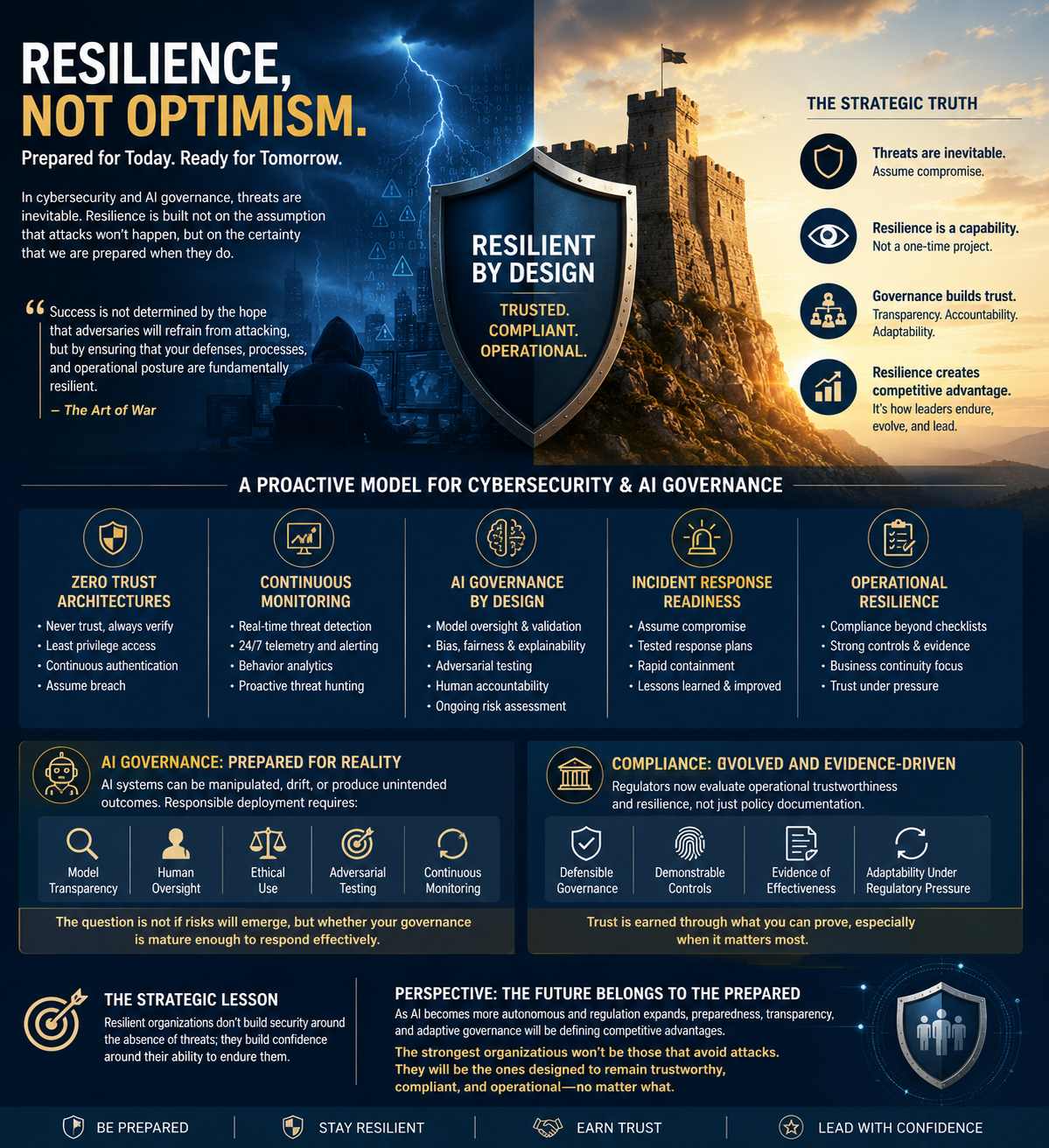
In today’s cybersecurity and AI governance landscape, resilience is not built on optimism — it is built on preparedness. A core principle echoed throughout modern security frameworks is that organizations should never rely on the assumption that threats will not materialize. Instead, they must invest in the readiness, controls, and governance structures necessary to withstand inevitable attacks and disruptions.
This perspective closely aligns with a timeless strategic principle from The Art of War: success is not determined by the hope that adversaries will refrain from attacking, but by ensuring that your defenses, processes, and operational posture are fundamentally resilient.
For information security leaders, this translates into adopting a proactive security model:
- Zero Trust architectures instead of perimeter assumptions
- Continuous monitoring rather than periodic audits
- AI governance frameworks that anticipate misuse, bias, and regulatory scrutiny
- Incident response capabilities that assume compromise scenarios
- Compliance programs designed for operational resilience, not checkbox certification
In AI governance specifically, organizations cannot assume that AI systems will always behave predictably or ethically under real-world conditions. Responsible deployment requires rigorous model oversight, transparency controls, human accountability, adversarial testing, and ongoing risk assessments. The question is no longer if systems will face manipulation, drift, or misuse — but whether governance structures are mature enough to respond effectively.
Similarly, modern compliance has evolved beyond static policy documentation. Regulators increasingly evaluate whether organizations can demonstrate operational trustworthiness, cyber resilience, and defensible governance practices under pressure.
The strategic lesson is clear: resilient organizations do not build security around the absence of threats; they build confidence around their ability to endure them.
Perspective
The future of cybersecurity and AI governance will favor organizations that institutionalize resilience as a business capability rather than treat security as a reactive function. As AI systems become more autonomous and regulatory expectations continue to expand, preparedness, transparency, and adaptive governance will become defining competitive advantages.
In this environment, the strongest organizations will not be those that avoid attacks entirely — they will be the ones designed to remain trustworthy, compliant, and operational even when attacks inevitably occur.
The AI Governance Quick-Start: Defensible in 10 Days, Not 4 Quarters
DISC InfoSec is an active ISO 42001 implementer and PECB Authorized Training Partner specializing in AI governance for B2B SaaS and financial services organizations.
AI Vulnerability Scorecard: Discover Your AI Attack Surface Before Attackers Do
Your Shadow AI Problem Has a Name-And Now It Has a Score
Most AI Security Tools Won’t Pass an Audit. Here’s a 15-Minute Way to Find Out.

InfoSec services | InfoSec books | Follow our blog | DISC llc is listed on The vCISO Directory | ISO 27k Chat bot | Comprehensive vCISO Services | ISMS Services | AIMS Services | Security Risk Assessment Services | Mergers and Acquisition Security
- You can’t put a human in the loop of a system that kills its agents every 3 minutes
- Human Oversight vs Human Control: Where the Human Sits in AI Execution
- A signed two-page policy beats a fifty-page draft. Every time…
- We have guardrails for that is not a control – Here’s the difference
- Point-in-time remediation is dead against a persistent adversary



May 16th, 2026 11:07 am
[…] AI Governance and Cybersecurity: Designing for the Inevitable Attack […]