
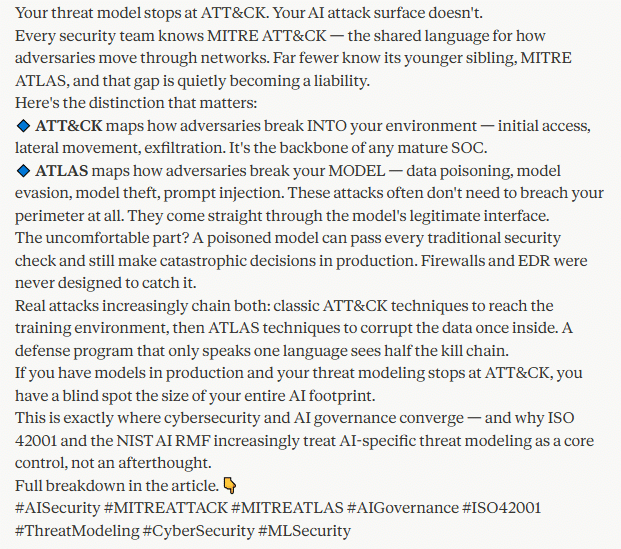
MITRE ATLAS (Adversarial Threat Landscape for Artificial-Intelligence Systems) is specifically about attacks on AI and machine learning systems — things like data poisoning, model evasion, model extraction, and prompt injection. It’s modeled on the ATT&CK structure (tactics and techniques) but applied to the AI/ML attack surface. The description in your source looks like it may have been confused with a generic threat-intel sharing platform.
This actually makes for a much stronger post for your audience — because the real distinction between ATT&CK and ATLAS sits right at the intersection of cybersecurity and AI governance, which is your whole positioning. Here’s the blog post built on the accurate framing:
ATT&CK vs. ATLAS: Why Securing AI Systems Needs Its Own Playbook
Every security leader knows MITRE ATT&CK. It’s the shared language we use to describe how adversaries move through our environments — the periodic table of attacker behavior. But fewer people have met its younger sibling, MITRE ATLAS, and that gap is becoming a liability. As organizations rush to deploy AI and machine learning into production, they’re discovering that the attack surface has quietly expanded into territory ATT&CK was never built to cover. If ATT&CK tells you how an adversary breaks into your network, ATLAS tells you how an adversary breaks your model. Understanding the difference isn’t academic — it’s the line between an AI governance program that looks good on paper and one that actually holds up when someone tries to poison your training data.
MITRE ATT&CK: The Map of Adversary Behavior
ATT&CK (Adversarial Tactics, Techniques, and Common Knowledge) is a globally adopted knowledge base of real-world attacker behavior. It’s organized around the lifecycle of an intrusion — the tactics an adversary uses and the specific techniques under each. The framework walks through the full arc of an attack: Initial Access, Execution, Persistence, Privilege Escalation, Defense Evasion, Credential Access, Discovery, Lateral Movement, Collection, Exfiltration, and Command and Control.
Its power is that it gives defenders a shared vocabulary. Threat hunters use it to map suspicious activity to known techniques. Incident responders use it to anticipate an attacker’s next move. Red teams use it to structure engagements, and security architects use it to test whether their controls actually cover the techniques they claim to. When someone says “we detected T1566 phishing leading to T1055 process injection,” everyone in the room knows exactly what happened.
MITRE ATLAS: The Map of AI-Specific Threats
ATLAS (Adversarial Threat Landscape for Artificial-Intelligence Systems) borrows ATT&CK’s structure but points it at a different target entirely: machine learning and AI systems. It catalogs the tactics and techniques adversaries use to attack models rather than networks — and these threats behave nothing like traditional intrusions.
ATLAS covers techniques such as data poisoning (corrupting training data so the model learns the wrong things), model evasion (crafting inputs designed to fool a deployed model), model extraction or theft (reconstructing a proprietary model by probing its outputs), membership inference (determining whether specific data was in the training set), and — increasingly relevant in the LLM era — prompt injection and manipulation of generative systems. It’s grounded in real-world case studies of AI systems being attacked, not hypotheticals. Crucially, an attacker doesn’t need to breach your perimeter to exploit many of these; they can attack the model through its legitimate interface.
When to Reach for Each
The two aren’t competitors — they’re complementary layers of the same defensive posture.
Reach for ATT&CK when you’re defending infrastructure, endpoints, identities, and networks: threat hunting, incident response, control validation, and red team planning against conventional adversary behavior. It remains the backbone of any mature SOC.
Reach for ATLAS when AI or ML systems are part of what you’re protecting: threat modeling a model before deployment, assessing the AI-specific attack surface, red teaming a machine learning pipeline, or building an AI risk register. If your organization is deploying models that make or influence decisions, ATLAS is where the relevant threats actually live.
The Overlap Is Where It Gets Interesting
Here’s the nuance most people miss: real attacks on AI systems often chain both. An adversary might use classic ATT&CK techniques to gain access to your training environment, then pivot to ATLAS techniques to poison the data once inside. The perimeter breach is ATT&CK; the model corruption is ATLAS. A defense program that only speaks one language will see half the kill chain and miss the other half entirely. Mature organizations use ATT&CK and ATLAS together, mapping how a traditional intrusion can become the delivery mechanism for an AI-specific attack.
My Perspective
For years, “AI security” was treated as a subset of application security — protect the servers, secure the API, encrypt the data, and you’re covered. ATLAS exists because that assumption is dangerously incomplete. The model itself is now an attack surface, and it fails in ways firewalls and EDR were never designed to catch. A poisoned model can pass every traditional security check and still make catastrophic decisions in production.
This is exactly where cybersecurity and AI governance converge — and why frameworks like ISO 42001 and the NIST AI RMF increasingly point toward AI-specific threat modeling as a core control, not an afterthought. In my own work implementing AI Management Systems, ATLAS has become the natural bridge: it translates abstract AI risk into concrete, testable adversary techniques that a security team can actually assess and mitigate. My advice to security leaders is simple — don’t wait for an incident to discover this gap. If you have models in production and your threat modeling stops at ATT&CK, you have a blind spot the size of your entire AI footprint. Add ATLAS to the toolkit now, while your AI attack surface is still something you can get ahead of rather than something you’re cleaning up after.
AI Vulnerability Scorecard: Discover Your AI Attack Surface Before Attackers Do
Your Shadow AI Problem Has a Name-And Now It Has a Score
Most AI Security Tools Won’t Pass an Audit. Here’s a 15-Minute Way to Find Out.
InfoSec services | InfoSec books | Follow our blog | DISC llc is listed on The vCISO Directory | ISO 27k Chat bot | Comprehensive vCISO Services | ISMS Services | AIMS Services | Security Risk Assessment Services | Mergers and Acquisition Security
- US Banks Are Blocking Third-Party AI Agents from Customer Accounts
- Traditional vs. Agent Frameworks: Same Dimensions, Different Liabilities
- The Controls Are Still Being Written: Governing AI When the Technology Outruns the Audit
- If Your Frontier Model Vanished for 3 Weeks, Would Your Business Stop?
- The Evidence Lifecycle: Which Organizational Events to Log for Liability — and How Long to Keep Them
DISC InfoSec blog | DISC InfoSec Site





