
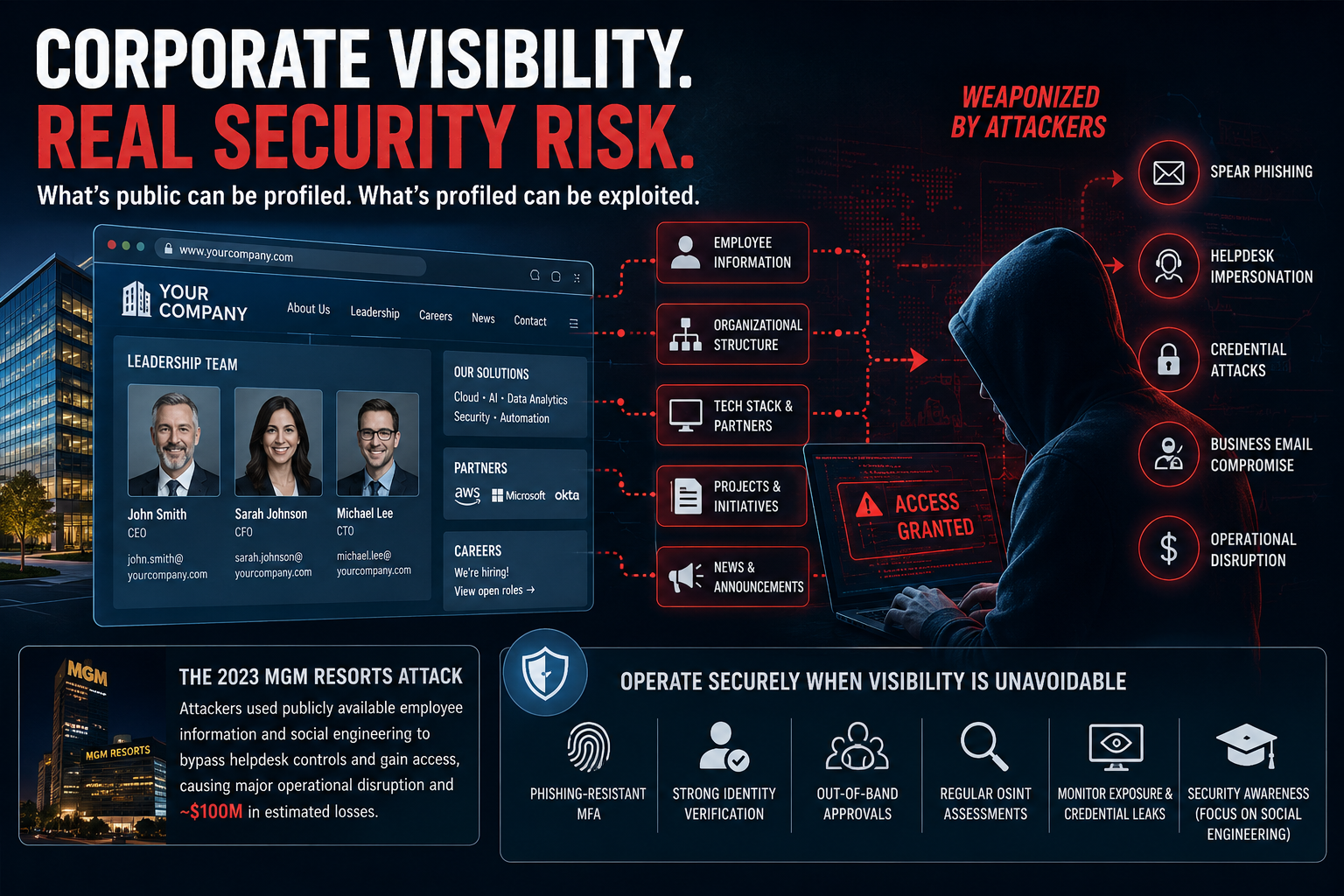
Corporate visibility has become a business requirement rather than a marketing choice. Organizations publish employee profiles, leadership pages, technical blogs, social links, and recruiting content to build trust, attract talent, and improve customer confidence. However, every piece of public information expands the organization’s attack surface and creates intelligence opportunities for adversaries. The challenge is no longer whether to be visible, but how to operate securely while visible.
Security risks from corporate visibility are primarily reconnaissance-driven. Public information allows threat actors to identify key employees, map reporting structures, discover technology stacks, and understand operational processes before ever touching the network perimeter. Modern attacks increasingly target people and workflows rather than infrastructure vulnerabilities, making visibility management a core risk management function rather than just a branding consideration.
Corporate websites typically expose much more than organizations realize. Common examples include employee names, job titles, leadership bios, headshots, email address patterns, social media links, customer references, technology disclosures in job postings, project announcements, and partner ecosystems. Even seemingly harmless details such as organizational charts or department structures help attackers prioritize targets and craft convincing attack paths. Exposure becomes particularly problematic when public data can be correlated with breached credential repositories or social media activity.
This information becomes weaponized through open-source intelligence (OSINT) aggregation. Attackers combine public corporate data with social media, breach datasets, and AI-assisted analysis to create personalized phishing campaigns, helpdesk impersonation attempts, credential attacks, and business email compromise scenarios. The effectiveness comes from context: an email referencing a real manager, recent project, conference appearance, or customer relationship appears legitimate because the attacker already understands the organization. Personalized phishing and social engineering campaigns consistently outperform generic attacks because they exploit trust rather than technical weaknesses.
The rise of generative AI significantly accelerates this process. What previously required days or weeks of manual reconnaissance can now be automated in hours. AI systems can scrape websites, correlate identities, summarize relationships, generate targeted phishing content, and even imitate communication styles. This lowers attacker costs while increasing scale, meaning organizations should assume adversaries can rapidly build highly accurate organizational profiles from publicly available information.
The 2023 attack against MGM Resorts International demonstrates how corporate visibility intersects with operational failure. Threat actors associated with Scattered Spider reportedly used publicly available employee information and social engineering techniques to impersonate staff members during helpdesk interactions. By manipulating identity verification processes, attackers gained elevated access that eventually disrupted casino operations, digital services, and hotel operations, creating an estimated $100 million business impact. The attack highlighted that the primary weakness was not public information itself, but weak verification controls around sensitive processes.
The lesson from MGM is that identity assurance matters more than secrecy. Many security practitioners and incident observers noted that helpdesk workflows, MFA recovery procedures, and privileged account processes became the real attack surface. Attackers exploited human workflows because those controls failed under realistic social engineering pressure. Organizations often invest heavily in technology stacks while underinvesting in identity proofing, helpdesk security, and process resilience.
Operating securely when visibility is unavoidable requires layered controls. Organizations should assume attackers already possess employee names, reporting structures, and technology information. Recommended controls include phishing-resistant MFA, stronger helpdesk identity verification, out-of-band approval processes, role-based exposure reviews, periodic OSINT assessments, monitoring for credential exposure, and security awareness programs focused specifically on personalized social engineering. Security programs should shift from “prevent exposure” to “operate securely despite exposure.”
My perspective as a security risk professional is that corporate risk in the AI era is shifting from perimeter defense toward identity, trust, and context protection. AI amplifies attacker capabilities by making reconnaissance, impersonation, and influence operations faster and cheaper. Organizations that still treat public visibility as a branding problem rather than a risk management problem are underestimating how quickly AI-enabled adversaries can build organizational intelligence. The future control objective is not reducing visibility to zero; it is building security architectures, governance processes, and human workflows that remain resilient when attackers already know who your people are, what technologies you use, and how your business operates.
The AI Governance Quick-Start: Defensible in 10 Days, Not 4 Quarters
DISC InfoSec is an active ISO 42001 implementer and PECB Authorized Training Partner specializing in AI governance for B2B SaaS and financial services organizations.
AI Vulnerability Scorecard: Discover Your AI Attack Surface Before Attackers Do
Your Shadow AI Problem Has a Name-And Now It Has a Score
Most AI Security Tools Won’t Pass an Audit. Here’s a 15-Minute Way to Find Out.

InfoSec services | InfoSec books | Follow our blog | DISC llc is listed on The vCISO Directory | ISO 27k Chat bot | Comprehensive vCISO Services | ISMS Services | AIMS Services | Security Risk Assessment Services | Mergers and Acquisition Security
- The cheapest security control you’ll ever implement is the component you decided not to build
- AI Handoffs: How Uncertainty Propagates—and How to Fix It
- The Security Risks Hiding in AI Agent Memory
- AI Log Retention: Why Every AI Log Doesn’t Deserve the Same Shelf Life
- The AI Agent Harness Is the New Security Boundary





