Why Local LLMs Matter for Security, Privacy, and AI Governance – Make sure to check out METATRON in the final thoughts section.
Artificial Intelligence is rapidly becoming part of everyday business operations. From drafting policies and summarizing meetings to analyzing contracts and automating workflows, Large Language Models (LLMs) are now embedded into enterprise decision-making. But as organizations adopt AI at scale, a critical question emerges:
Should your AI run in the cloud — or on your own infrastructure?
For many organizations, especially in cybersecurity, compliance, healthcare, finance, legal, and government sectors, running LLMs locally is no longer just a technical experiment. It is becoming a strategic business decision.
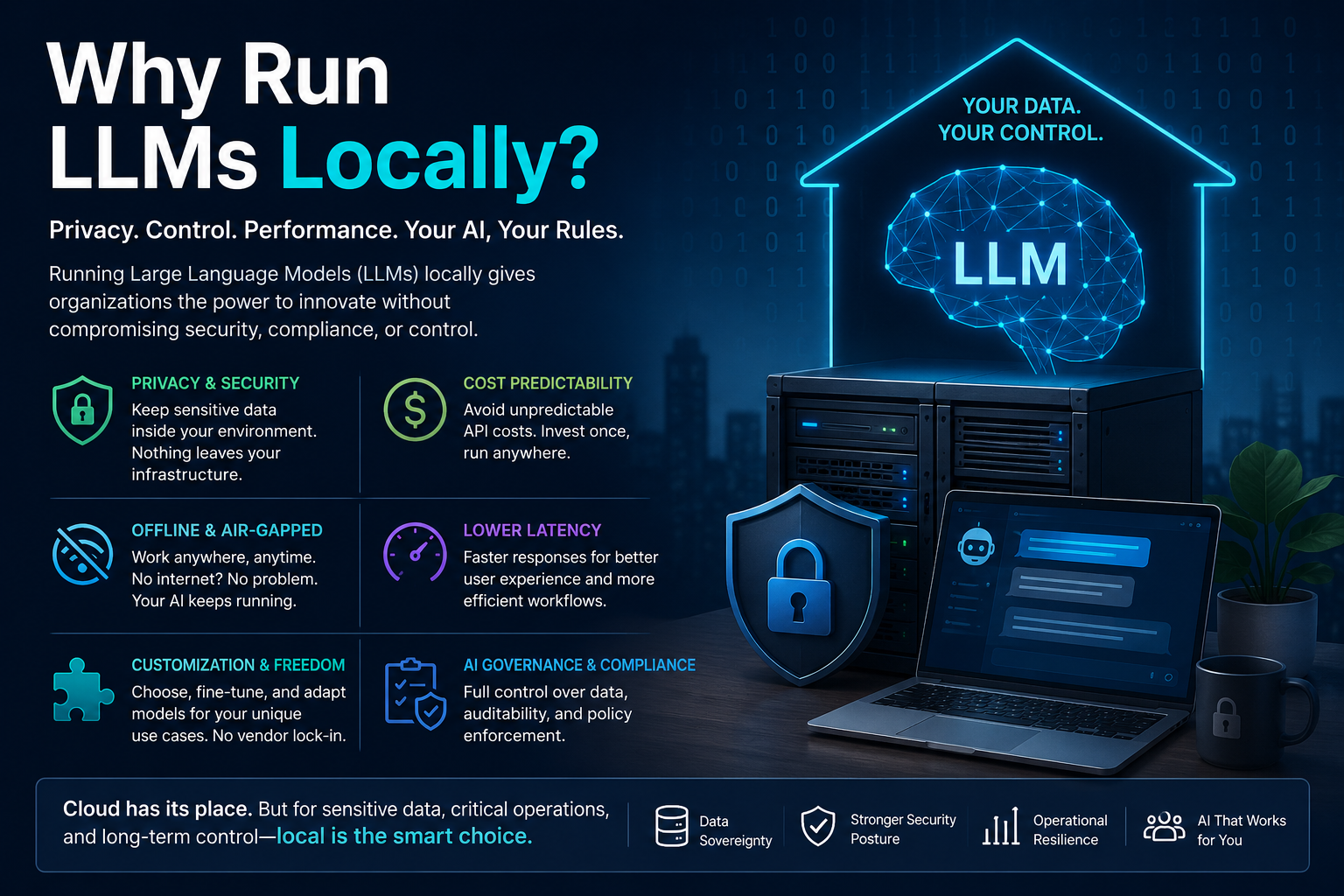
Cloud AI platforms offer convenience and instant scalability, but they also introduce concerns around privacy, data sovereignty, operational costs, and dependency on external providers. Local LLMs shift that control back to the organization.
According to the ApXML guide on local LLMs, one of the biggest advantages of running models locally is that prompts and outputs never need to leave your environment, significantly improving privacy and control over sensitive information.
Privacy and Data Security
Privacy is the primary driver behind the rise of local AI deployments.
When users interact with cloud-based AI systems, prompts, uploaded documents, and generated outputs are often processed on third-party infrastructure. Even when providers promise strong security controls, organizations still face concerns around:
- sensitive intellectual property exposure
- regulated data handling
- insider threats
- cross-border data transfers
- vendor retention policies
Running LLMs locally keeps the data inside your own security perimeter.
This matters enormously for:
- legal contracts
- patient records
- internal audit reports
- source code
- financial forecasts
- security investigations
- AI governance documentation
Recent enterprise AI research also highlights growing concerns around data leakage in Retrieval-Augmented Generation (RAG) systems and fine-tuned enterprise assistants. Researchers argue that deterministic access control and local governance mechanisms are essential for protecting confidential enterprise information.
For InfoSec and compliance teams, local AI aligns naturally with:
- zero trust architectures
- data residency requirements
- AI governance programs
- confidential computing initiatives
- internal audit controls
Cost Predictability
Cloud AI services typically charge based on tokens, requests, storage, or inference time. Initially this appears inexpensive, but costs can escalate rapidly once AI becomes embedded into daily workflows.
Organizations using AI for:
- large-scale document analysis
- internal copilots
- AI agents
- coding assistants
- customer support
- automated compliance reviews
often discover that API expenses become difficult to forecast.
Running LLMs locally changes the economics. Instead of recurring token-based billing, organizations invest in infrastructure once and gain predictable operational costs afterward.
This becomes especially valuable for:
- high-volume workloads
- long-context processing
- internal enterprise AI tools
- continuous experimentation
- multi-agent systems
For startups and SMBs, local AI can also reduce dependence on expensive subscription ecosystems.
Offline Access and Air-Gapped Operations
Cloud AI fails when internet access fails.
Local LLMs continue functioning even:
- during outages
- in restricted environments
- on isolated networks
- in field deployments
- inside air-gapped systems
This capability is increasingly important for:
- defense contractors
- manufacturing facilities
- critical infrastructure
- healthcare environments
- regulated enterprises
Many organizations cannot legally or operationally send sensitive information to external AI providers. In these cases, local AI is not merely preferred — it becomes mandatory.
Lower Latency and Faster Internal Workflows
Local inference often delivers lower latency because requests do not travel across the internet to external providers.
For internal enterprise tools, this can significantly improve:
- coding assistants
- SOC analyst workflows
- security triage systems
- AI-powered search
- desktop copilots
- document retrieval systems
Local models can feel more responsive and predictable because organizations fully control the infrastructure and workload prioritization.
Customization and Model Freedom
Cloud providers usually limit users to a curated set of models and APIs. Local deployment opens access to the broader open-source ecosystem.
Organizations can experiment with:
- Meta Llama
- Alibaba Cloud Qwen
- Mistral AI Mistral
- fine-tuned domain-specific models
- quantized lightweight models
- multimodal architectures
This flexibility enables organizations to:
- optimize models for specific workflows
- fine-tune on proprietary datasets
- enforce internal AI governance policies
- create specialized AI agents
- integrate custom security controls
Local deployment also reduces vendor lock-in, allowing teams to evolve their AI stack without depending entirely on a single provider.
AI Governance and Compliance Advantages
AI governance is becoming one of the strongest arguments for local deployment.
As regulations evolve, organizations increasingly need to demonstrate:
- where data is processed
- who accessed the AI system
- how prompts are retained
- how outputs are audited
- whether inference occurred securely
Recent discussions around Confidential AI and verifiable inference show that enterprises now expect not only secure AI systems, but proof that sensitive data remained protected during inference.
Local AI environments simplify:
- auditability
- logging controls
- access management
- compliance mapping
- risk assessments
- retention governance
For AI GRC teams, this becomes a foundational capability rather than a convenience.
Better Learning and AI Engineering Maturity
Running LLMs locally forces organizations to understand how AI systems actually work.
Teams gain practical experience with:
- GPUs
- quantization
- inference optimization
- vector databases
- orchestration frameworks
- model routing
- AI security controls
Interestingly, many AI engineers argue that local models encourage better system architecture design because developers must think carefully about workflows, modularity, and resource optimization rather than relying entirely on brute-force cloud inference.
This often produces more resilient and scalable AI systems in the long run.
The Trade-Offs
Local LLMs are not perfect.
Organizations must still address:
- GPU costs
- infrastructure management
- model updates
- operational maintenance
- performance tuning
- scalability
- security hardening
Cloud AI platforms still dominate when organizations prioritize:
- simplicity
- rapid deployment
- frontier-model performance
- elastic scalability
For many enterprises, the future will likely be hybrid:
- sensitive workloads run locally
- non-sensitive workloads use cloud AI
- governance policies determine routing dynamically
This hybrid strategy balances innovation with control.
Final Thoughts
Running LLMs locally is not about rejecting cloud AI. It is about strategic control.
As AI becomes deeply integrated into enterprise operations, organizations are realizing that:
- privacy matters
- governance matters
- auditability matters
- predictability matters
- ownership matters
Local AI deployment transforms LLMs from external services into internal infrastructure.
For cybersecurity leaders, compliance professionals, and AI governance teams, that shift is profound.
The organizations that master local AI today will likely have a significant advantage tomorrow — not just in security and compliance, but in resilience, innovation, and long-term AI independence.
🚨 METATRON is an emerging open-source AI-powered penetration testing assistant designed for fully offline security assessments. Built for Parrot OS and other Debian-based Linux distributions, it combines automated reconnaissance tools with locally hosted LLM analysis, removing the dependency on cloud APIs or third-party services. Written in Python 3, this CLI-based framework can autonomously coordinate recon and vulnerability assessment tasks against target IPs or domains, making it an interesting addition for security researchers and red teams exploring private, local AI-driven offensive security workflows.
The AI Governance Quick-Start: Defensible in 10 Days, Not 4 Quarters
DISC InfoSec is an active ISO 42001 implementer and PECB Authorized Training Partner specializing in AI governance for B2B SaaS and financial services organizations.
AI Vulnerability Scorecard: Discover Your AI Attack Surface Before Attackers Do
Your Shadow AI Problem Has a Name-And Now It Has a Score
Most AI Security Tools Won’t Pass an Audit. Here’s a 15-Minute Way to Find Out.

InfoSec services | InfoSec books | Follow our blog | DISC llc is listed on The vCISO Directory | ISO 27k Chat bot | Comprehensive vCISO Services | ISMS Services | AIMS Services | Security Risk Assessment Services | Mergers and Acquisition Security
- The cheapest security control you’ll ever implement is the component you decided not to build
- AI Handoffs: How Uncertainty Propagates—and How to Fix It
- The Security Risks Hiding in AI Agent Memory
- AI Log Retention: Why Every AI Log Doesn’t Deserve the Same Shelf Life
- The AI Agent Harness Is the New Security Boundary