
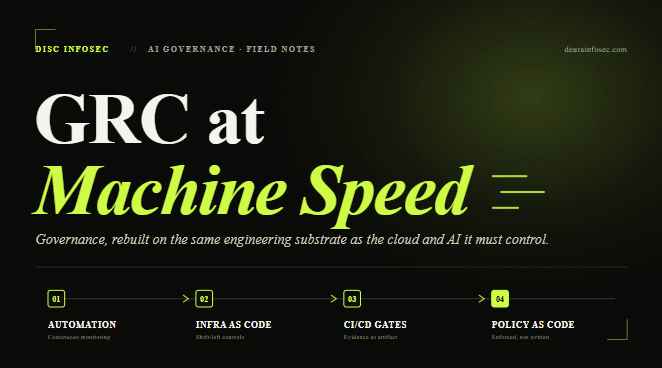
GRC at Machine Speed: Four Anchors Reshaping Governance in the Cloud and AI Era
For most of its history, Governance, Risk, and Compliance has run at the speed of paper. Spreadsheets tracked controls. Evidence arrived by email the week before an audit. Risk registers were reviewed quarterly, if that. The whole discipline was built around a point-in-time snapshot — a photograph of how secure and compliant an organization happened to be on the day the auditor showed up.
That model is now broken, and the cloud broke it. When infrastructure can be created and destroyed in seconds, when a single misconfigured storage bucket can expose millions of records, and when a developer can stand up a production-grade AI model over a long lunch, an annual audit cycle is no longer a control. It is a fiction we agree to maintain.
The organizations getting this right are not buying more GRC software to track the same manual work faster. They are rebuilding governance itself on the same engineering substrate that runs the rest of the modern enterprise. Four anchors define that shift: automation, infrastructure as code, CI/CD integration, and policy as code. Taken together, they move GRC from a function that observes the business after the fact to one that is wired into how the business is built.
The Threat Landscape Demands It
Before the anchors, a word on why this is not optional. The dominant threats in cloud and AI environments are not exotic. The single largest cause of cloud breaches remains misconfiguration — public buckets, over-permissioned IAM roles, exposed management interfaces, secrets committed to repositories. These are governance failures, not zero-days. They happen because the gap between a written policy and the actual running configuration is invisible until someone exploits it.
AI widens that gap dramatically. Shadow AI — employees feeding sensitive data into ungoverned tools — has become the new shadow IT, except the data may leave the building permanently. Model supply chains introduce poisoned weights and unvetted dependencies. Inference endpoints are vulnerable to prompt injection and data exfiltration. And the velocity of AI development means models reach production faster than any review board can convene.
A GRC program that responds to all of this with a quarterly control review and a manually updated risk register is bringing a clipboard to a gunfight. The four anchors are how it learns to keep pace.
Anchor One: Automation
Automation is the foundation the other three stand on. At its simplest, it means replacing the human labor of evidence collection, control testing, and risk scoring with continuous, machine-driven processes.
The practical expression is continuous control monitoring. Instead of asking an engineer to attest once a year that encryption is enabled, the control queries the environment continuously and flags drift the moment it occurs. Evidence stops being something you scramble to assemble before an audit and becomes a byproduct of normal operations — automatically collected, timestamped, and stored. Audit preparation collapses from weeks to a query.
For ongoing risk assessment, automation is transformative. A risk register fed by live telemetry — vulnerability scan results, configuration state, access anomalies, AI model drift — stops being a stale document and becomes a real-time picture of organizational exposure. Risk scores recalculate as conditions change rather than waiting for the next review meeting. In AI environments, automated model inventories, fairness and bias evaluations, and drift detection can feed governance dashboards directly, surfacing problems while there is still time to act.
The caution here is that automation amplifies whatever you point it at. Automate a thoughtful control framework and you get continuous assurance. Automate a sloppy one and you get continuous false confidence at scale. Automation is a force multiplier, not a substitute for judgment about what is worth measuring.
Anchor Two: Infrastructure as Code
In a cloud environment, the control surface is no longer a data center you can walk through. It is declarative code — Terraform, CloudFormation, Pulumi, Bicep — that describes the desired state of every resource. This is the most significant gift the cloud era has given GRC, and most programs have not fully claimed it.
When infrastructure is code, controls become testable assertions. The requirement that all storage be encrypted at rest is no longer a sentence in a policy document; it is a rule that can be checked against the Terraform plan before a single resource is provisioned. Tools like Checkov, tfsec, KICS, and Terrascan scan infrastructure definitions for misconfigurations and policy violations before deployment — shifting governance left, to the point where fixing an issue costs minutes instead of an incident.
This produces something auditors have always wanted and rarely had: reproducible evidence. Immutable, code-defined infrastructure means the configuration you reviewed is the configuration that runs, and the configuration that runs is documented by definition. Drift detection catches the moment reality diverges from the declared state. A risk register can now reference the exact resource definitions that mitigate a given risk, with the code as living proof.
For AI specifically, the data pipelines, feature stores, and model-serving infrastructure that underpin a system are increasingly defined as code as well. That means the lineage and configuration of an AI system — the very things ISO 42001 and the NIST AI RMF ask you to govern — become auditable artifacts rather than tribal knowledge held by one overworked ML engineer.
Anchor Three: CI/CD Integration
If infrastructure as code is the surface, the CI/CD pipeline is where governance decisions get made or missed. Every change to a modern system flows through a pipeline before it reaches production. Embedding governance into that pipeline turns compliance from a gate at the end into a continuous condition of shipping anything at all.
In practice, this means compliance becomes a pipeline stage. Software composition analysis checks dependencies. Static and dynamic testing catch vulnerabilities. Software bills of materials are generated automatically. Build provenance is captured and artifacts are signed and attested, following frameworks like SLSA and tooling like Sigstore’s cosign, so the chain of custody from code to production is verifiable. Crucially, all of this evidence is produced as a natural byproduct of the build — not reconstructed under deadline pressure.
For AI, this is where MLOps and governance converge. A model should not reach production without passing eval gates, generating a model card, clearing bias and safety checks, and surviving red-team probes — all enforced as pipeline stages. This maps cleanly onto the AI lifecycle controls in ISO 42001, which expect organizations to manage models through development, validation, deployment, and monitoring. The pipeline becomes the place where those lifecycle commitments are enforced rather than merely documented.
The payoff for threat combat is direct: the detection-to-remediation window shrinks to the duration of a build. A vulnerable dependency or a non-compliant configuration never reaches production because the pipeline refuses to promote it.
Anchor Four: Policy as Code
The final anchor closes the oldest gap in the profession — the distance between what the policy says and what the system actually does. Policy as code expresses governance rules in a machine-enforceable, versioned, testable form. Open Policy Agent’s Rego, Kyverno for Kubernetes, AWS Cedar, HashiCorp Sentinel, and service control policies all let you encode a rule once and enforce it everywhere.
This is the bridge between the clause and the runtime. A policy document might state that production workloads may only use approved AI models from an internal registry, that no resource may be deployed outside an approved region for data residency, or that PII may never flow to an unapproved processor. As policy as code, those statements become guardrails that the platform enforces automatically — denying the non-compliant action rather than discovering it during next year’s audit.
Policy as code is also where multi-framework compliance becomes tractable. A single set of versioned policies can be mapped to ISO 27001 controls, SOC 2 criteria, ISO 42001 clauses, and EU AI Act obligations simultaneously. Change the policy once, and the crosswalk updates everywhere it is referenced. For an organization juggling overlapping frameworks — which is now nearly everyone operating in AI — this is the difference between a maintainable program and an unmanageable one.
For AI governance, policy as code is arguably the single highest-leverage anchor. It is what lets you enforce approved-model registries, usage restrictions, data handling rules, and access boundaries as actual technical controls — turning the governance intent of ISO 42001 and the NIST AI RMF into something the infrastructure honors by default.
My Perspective
I have spent the last stretch of my career implementing ISO 42001 through a live Stage 2 audit at a financial data room platform — not theorizing about it, but standing it up and putting it in front of an external auditor in a high-stakes environment. That experience has convinced me the four anchors are not a future trend. They are the present condition for any GRC program that intends to remain credible.
But the deeper shift is about what the GRC professional becomes. For decades the role was custodial: keep the documents, collect the evidence, survive the audit. The four anchors retire that role and replace it with something closer to a governance engineer — a control architect who is bilingual, fluent in the language of clauses and frameworks and the language of Terraform, pipelines, and Rego. The professionals who can translate a compliance requirement into an enforced technical control, and explain an enforced technical control back to an auditor, will be the ones who matter.
I will offer one note of caution against the obvious failure mode. The promise of all this automation is seductive enough that some organizations will mistake instrumentation for governance. Code can enforce a policy flawlessly and the policy can still be wrong. A pipeline can generate immaculate evidence for a control that addresses the wrong risk. The irreducible human work of GRC — deciding what matters, accepting or rejecting risk, exercising judgment about novel AI harms that no rule yet anticipates — does not go away. It becomes more important, because it is the only part of the job a machine cannot do. The four anchors do not replace the GRC professional. They free that professional from clerical work so they can finally spend their time on the thinking that was always the point.
GRC at Machine Speed: How AI Is Reshaping Governance, Risk, and Compliance
GRC Engineering Is the Future of Cloud Compliance
The AI Governance Quick-Start: Defensible in 10 Days, Not 4 Quarters
DISC InfoSec is an active ISO 42001 implementer and PECB Authorized Training Partner specializing in AI governance for B2B SaaS and financial services organizations.
AI Vulnerability Scorecard: Discover Your AI Attack Surface Before Attackers Do
Your Shadow AI Problem Has a Name-And Now It Has a Score
Most AI Security Tools Won’t Pass an Audit. Here’s a 15-Minute Way to Find Out.
InfoSec services | InfoSec books | Follow our blog | DISC llc is listed on The vCISO Directory | ISO 27k Chat bot | Comprehensive vCISO Services | ISMS Services | AIMS Services | Security Risk Assessment Services | Mergers and Acquisition Security
- The cheapest security control you’ll ever implement is the component you decided not to build
- AI Handoffs: How Uncertainty Propagates—and How to Fix It
- The Security Risks Hiding in AI Agent Memory
- AI Log Retention: Why Every AI Log Doesn’t Deserve the Same Shelf Life
- The AI Agent Harness Is the New Security Boundary





