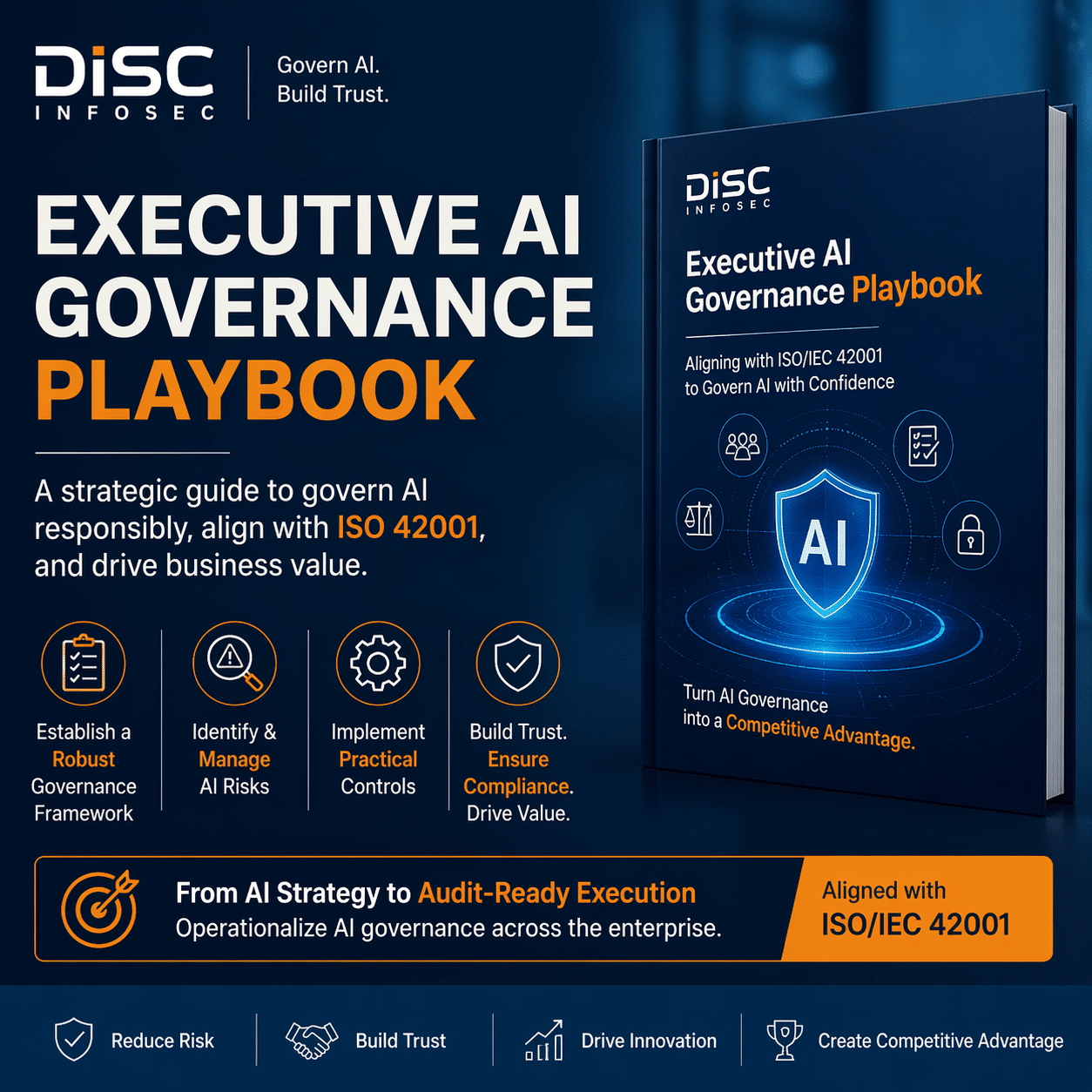
The executive AI governance positions AI not just as a technology shift, but as a strategic business transformation that requires structured oversight. It emphasizes that organizations must balance innovation with risk by embedding governance into how AI is designed, deployed, and monitored—not as an afterthought, but as a core operating principle.
At its foundation, the post highlights that effective AI governance requires a clear operating model—including defined roles, accountability, and cross-functional coordination. AI governance is not owned by a single team; it spans leadership, risk, legal, engineering, and compliance, requiring alignment across the enterprise.
A central theme AI governance enforcement is the need to move beyond high-level principles into practical controls and workflows. Organizations must define policies, implement control mechanisms, and ensure that governance is enforced consistently across all AI systems and use cases. Without this, governance remains theoretical and ineffective.
Importance of building a complete inventory of AI systems. Companies cannot manage what they cannot see, so maintaining visibility into all AI models, vendors, and use cases becomes the starting point for risk assessment, compliance, and control implementation.
Risk management is presented as use-case specific rather than generic. Each AI application carries unique risks—such as bias, explainability issues, or model drift—and must be assessed individually. This marks a shift from traditional enterprise risk models toward more granular, AI-specific governance practices.
Another key focus is aligning governance with emerging standards like ISO/IEC 42001, NIST AI RMF, EU AI Act, Colorado AI Act which provides a structured framework for managing AI responsibly across its lifecycle. Which explains that adopting such standards helps organizations demonstrate trust, improve operational discipline, and prepare for evolving global regulations.
Technology plays a critical role in scaling governance. The post highlights how platforms like DISC InfeSec can centralize AI intake, automate compliance mapping, track risks, and monitor controls continuously, enabling organizations to move from manual processes to scalable, real-time governance.
Ultimately, the AI governance as a business enabler rather than a compliance burden. When done right, it builds trust with customers, reduces operational surprises, and creates a competitive advantage by allowing organizations to scale AI confidently and responsibly.
My perspective
Most guides—get the structure right but underestimate the execution gap. The real challenge isn’t defining governance—it’s operationalizing it into evidence-based, audit-ready controls, AI governance enforcement. In practice, many organizations still sit in “policy mode,” while regulators are moving toward proof of control effectiveness.
If DISC positions itself not just as a governance framework but as a control execution + evidence engine (AI risk → control → proof), that’s where the real market differentiation is.
The 2026 AI Compliance Checklist: 60 Controls Across 10 Domains
AI Vulnerability Scorecard: Discover Your AI Attack Surface Before Attackers Do
Your Shadow AI Problem Has a Name-And Now It Has a Score

InfoSec services | InfoSec books | Follow our blog | DISC llc is listed on The vCISO Directory | ISO 27k Chat bot | Comprehensive vCISO Services | ISMS Services | AIMS Services | Security Risk Assessment Services | Mergers and Acquisition Security
- “Sorry, Typo”: Why a Markdown File Is Not a Security Control
- Security against defeat implies defensive tactics; ability to defeat the enemy means taking the offensive
- ISO 27001 Got You in the Door. ISO 42001 Keeps You There
- The Batch Model Is Broken: Vulnerability Management in the Era of AI-Accelerated Discovery
NIST CSF 2.0 and ISO 27001: Why the Strongest Programs Use Both