Cyber Attack Hits Major Websites: 178 Brands, One Trusted Script, Zero Breaches of Their Own
Nov 17, 2026 · @disc
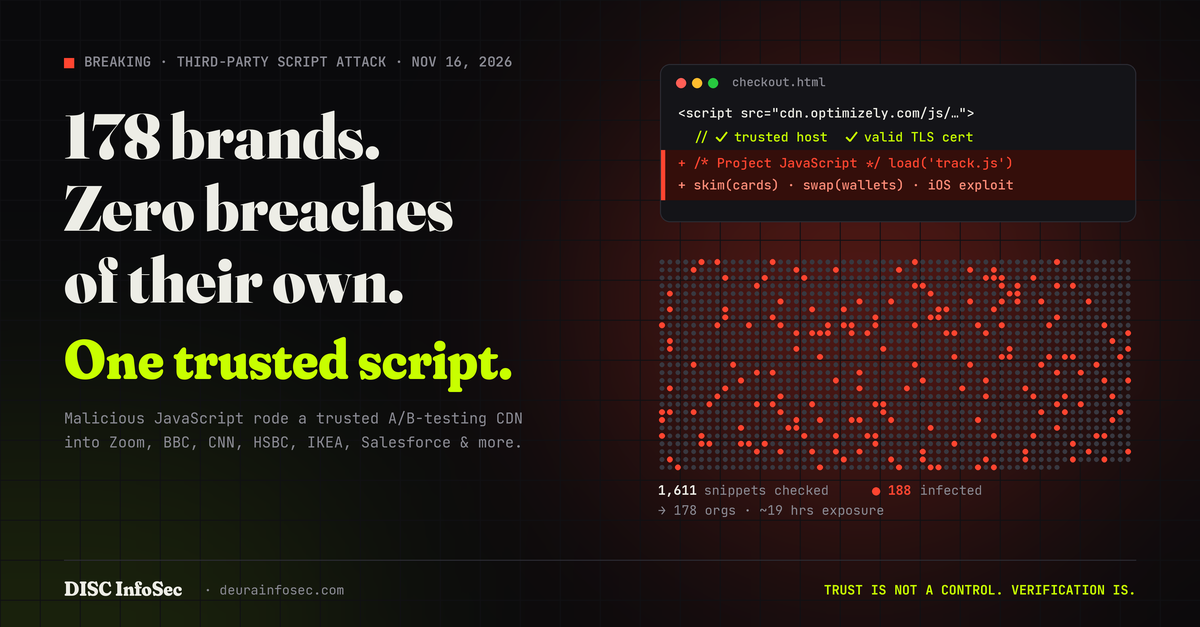
On Monday, November 16, visitors to Zoom, the BBC, CNN, HSBC, IKEA, Salesforce, Equifax, GitLab and roughly 170 other brands were served malicious JavaScript. None of those companies had their own servers breached. The code arrived through a tool they all trusted: Optimizely, the A/B testing platform their marketing teams use to tweak web pages.
That is the lesson worth sitting with. These organizations spend millions on firewalls, EDR, pentests and audits. The attacker skipped all of it and walked in through a script the browser was already told to trust. If your website loads code from someone else’s server, your attack surface includes that someone else’s signup page.
What happened
Scott Helme and the team at Report URI spotted the attack the same day. They pulled 1,611 distinct Optimizely snippets and found malicious code in 188 of them, belonging to 178 organizations. They believe the real number is higher, because they could only check the snippets they found in time (Report URI).
| Time (UTC, Nov 16) | Event |
| 02:21 | Last clean capture of the BBC’s Optimizely snippet |
| 04:21 | First injected snippet observed |
| 08:28 | Main payload seen loading on bbc.com |
| 21:52 | One infected organization still serving the code |
| 23:11 | Every monitored file clean |
The payload was a multi-tool. It swapped cryptocurrency wallet addresses for the attacker’s own, skimmed payment card fields, and collected cookies and page screenshots. iPhone and iPad visitors were pushed toward iOS exploit kits, though successful exploitation has not been demonstrated (SecurityWeek). By Monday evening, wallets tied to the attack had collected about $7,040, mostly in Bitcoin (CoinDesk).
Optimizely says it fixed the flaw and removed the code. What nobody can say yet is how many card numbers or credentials were taken. Salesforce, for one, disabled Optimizely scripts as a precaution while it investigates (The Next Web).
How it worked: one flaw, 178 victims
The attacker did not hack 178 companies. They found one weakness and let the vendor’s own distribution network do the rest.
Optimizely says an unauthorized party exploited a flaw in its account signup flow to insert code into customer projects (CoinDesk). The code went into the optional “Project JavaScript” field, which runs on every page that loads the snippet. Everything else in the snippet stayed untouched (The Hacker News).
That design detail is what made it so effective. The tampered file was still served from cdn.optimizely.com, with Optimizely’s own certificate, from a host every affected site had already allow-listed. Even companies that self-host the snippet on their own domain were hit, because the content came from the same compromised project (Security Affairs). Optimizely’s own website and login portal were on the infected list (The Register).
Read that root cause again: a signup flaw that let an outsider write into other customers’ projects. That is not exotic. It is a broken authorization and business-logic bug, the same class of defect that shows up in multi-tenant SaaS assessments every month.
Why this matters: your browser is part of your supply chain
Most third-party risk programs look at vendors that hold your data or touch your network. Few look at the vendors whose code runs inside your customers’ browsers on every page view. Analytics tags, chat widgets, tag managers, personalization and A/B testing tools all fall in that blind spot. They are usually bought by marketing, installed with one line of JavaScript, and never reviewed by security.
The Register put it bluntly: all that money spent securing corporate websites, and the way in was a tool marketing uses to tinker with pages. A clean pentest of your own code would not have caught this. Neither would a SOC 2 report on your infrastructure.
The controls already exist. Regulators have simply moved faster than most programs:
- PCI DSS v4.0.1 Requirement 6.4.3 requires an inventory of every script on payment pages, a written justification for each, and a method to confirm integrity.
- PCI DSS v4.0.1 Requirement 11.6.1 requires a mechanism to detect unauthorized changes to payment page content and HTTP headers, and to alert on them.
- ISO/IEC 27001:2022 A.5.19 to A.5.22 cover supplier relationships, security in supplier agreements, ICT supply chain security, and monitoring of supplier services.
- ISO/IEC 27001:2022 A.8.28 and A.8.29 cover secure coding and security testing, which is where client-side integrity controls belong.
If an auditor asked you tomorrow which third-party scripts run on your checkout page, who approved them, and how you would know if one changed at 04:21 UTC, could you answer?
The AI angle: the same pattern, with more autonomy
There is no evidence AI was involved in this attack. But the pattern it exploited is exactly the one AI is multiplying across every organization: trusted third-party components that load and execute instructions at runtime, outside your change control.
Think about what now sits in that position. AI personalization and chat widgets embedded in customer-facing pages. Copilots and plugins pulling content from vendor endpoints. MCP servers and agent tools whose manifests and behavior can change after you approve them. Agentic browsers that read web pages and act on what they find. Swap “malicious JavaScript in a trusted snippet” for “malicious instructions in a trusted tool or page” and you have indirect prompt injection and tool poisoning, both on the OWASP Top 10 lists for LLM and agentic applications.
The difference is consequence. A skimmer steals what a visitor types. A compromised agent tool can act with whatever permissions you gave the agent: move data, send messages, change records. The blast radius of a trusted-component compromise grows with the autonomy you grant.
That is why AI governance and supplier security are now the same conversation:
- ISO/IEC 42001 A.10.3 requires you to manage suppliers of AI systems and components, not just sign their contracts.
- NIST AI RMF GOVERN 6 addresses third-party AI risk, including software and data supply chains, and MAP 4 asks you to map those components’ risks.
- EU AI Act Article 26 puts monitoring duties on deployers, even when the model or tool comes from someone else.
The Optimizely incident is a preview. Today it is a card skimmer in an A/B testing script. Tomorrow it is a poisoned tool definition in the agent that handles your customer support queue.
What to do now
If you visited an affected site on November 16: review card statements for unfamiliar charges, and ask your bank about a replacement card if you paid online that day. If you sent cryptocurrency, check that the receiving address matched the one you intended. Update iPhones and iPads to the latest iOS. Report URI’s post lists all 178 organizations and their domains.
If you run a website or SaaS product, this week:
- Inventory every third-party script on your site, starting with login, checkout and account pages. Include who owns each one and why it is there.
- If you use Optimizely Web, review your Project JavaScript field and audit project access and change history for November 16.
- Remove scripts nobody can justify. Load the rest only on the pages that need them, not site-wide.
- Deploy a Content Security Policy that restricts script sources and outbound connections, starting in report-only mode, and use Subresource Integrity for static third-party files.
- Monitor scripts on payment pages for unauthorized changes, as PCI DSS 11.6.1 already requires.
This quarter:
- Bring marketing and analytics tools into your vendor risk program. A one-line tag is still a supplier with code execution in your customers’ browsers.
- Extend the same inventory to AI components: models, plugins, MCP servers, agent tools and AI widgets, with owners and approved versions.
- Test your own multi-tenant boundaries. The Optimizely root cause was a signup and authorization flaw. Ask whether a new account on your platform could write into another customer’s data or configuration.
My take as a practitioner
When I walk into a new engagement, I ask for the list of third-party scripts on the login and payment pages. I almost never get one on the first try. I get the list of vendors in procurement, and the two lists rarely match.
The Optimizely attack is not a story about one vendor’s bad day. Optimizely had already disclosed a separate vishing-related breach in February. Every SaaS provider will have a bad day eventually. The story is about how many organizations had no way to notice, for up to 19 hours, that code running on their own domain had changed.
The fix is not exotic either. Know what runs. Know who approved it. Know when it changes. Test your own authorization boundaries as hard as an attacker would test your vendor’s. And as AI agents and tools join your stack, apply the same discipline before they get permissions, not after.
Trust is not a control. Verification is.
Find the flaw before someone else does: DISC InfoSec Application Security Assessment
The attack on 178 organizations started with one flaw in one application’s signup flow. That is exactly the kind of weakness our application assessments are built to find.
DISC InfoSec uncovers potential vulnerabilities in your web applications using comprehensive automated and manual testing. We specialize in identifying weaknesses in authentication, authorization, business logic, APIs, configuration and session management. Automated scans give coverage. In-depth manual testing finds the logic flaws scanners miss, like a new account that can reach into another tenant’s data.
We use Burp Suite Pro and OWASP ZAP for cloud-based web application testing, combining AI automated tools with targeted manual testing of application logic. You get personalized expert guidance at every stage of the engagement, with a special focus on remediation, so findings become fixes rather than a report on a shelf.
For teams shipping AI features, we extend the same rigor to the AI layer, mapping findings to ISO/IEC 27001, ISO/IEC 42001 and the NIST AI RMF so your test results double as audit evidence.
Your AI Is Live. Your Site Is Your Shop. Who’s Answering for Either
https://www.deurainfosec.com/cybersecurity-compliance-services/
Contact us to schedule your test today. Discounts are available for first-time customers and for recurring assessments.
Hugh “Disc” Deura, CISSP, CISM, ISO/IEC 42001 and ISO/IEC 27001 Lead Implementer, is Principal Consultant at DISC InfoSec. Book a call at calendly.com/hd-deurainfosec.
Sources
- Report URI: World’s largest brands infected with malware via Optimizely
- Newsweek: Cyber attack hits 178 major websites
- SecurityWeek: Optimizely vulnerability exploited to serve malware
- The Hacker News: Hijacked Optimizely scripts served card skimmer and iOS exploit kits
- CoinDesk: Hackers planted crypto-stealing code on 178 organizations’ sites
- Security Affairs: OPTIMJACK
- The Register: Optimizely hack turns world’s biggest websites into malware dispensers
- The Next Web: Hackers used Optimizely to plant malware
- 178 Brands. Zero Breaches of Their Own. One Trusted Script
- Your AI Policy Covers Launch Day. Who Governs Everything After?
- The Reporting Clock: How Long Until Anyone Knows Your AI Agent Went Out of Bounds?
- You Can’t Fence Off Superintelligence: AI Governance Starts With You
- Your AI Policy Isn’t Evidence. Here’s What Auditors Actually Sample