The AI System Lifecycle: 7 Stages Where AI Governance Is Won or Lost
Nov 16, 2026 · @disc
Governance that lives in a binder never touches the model
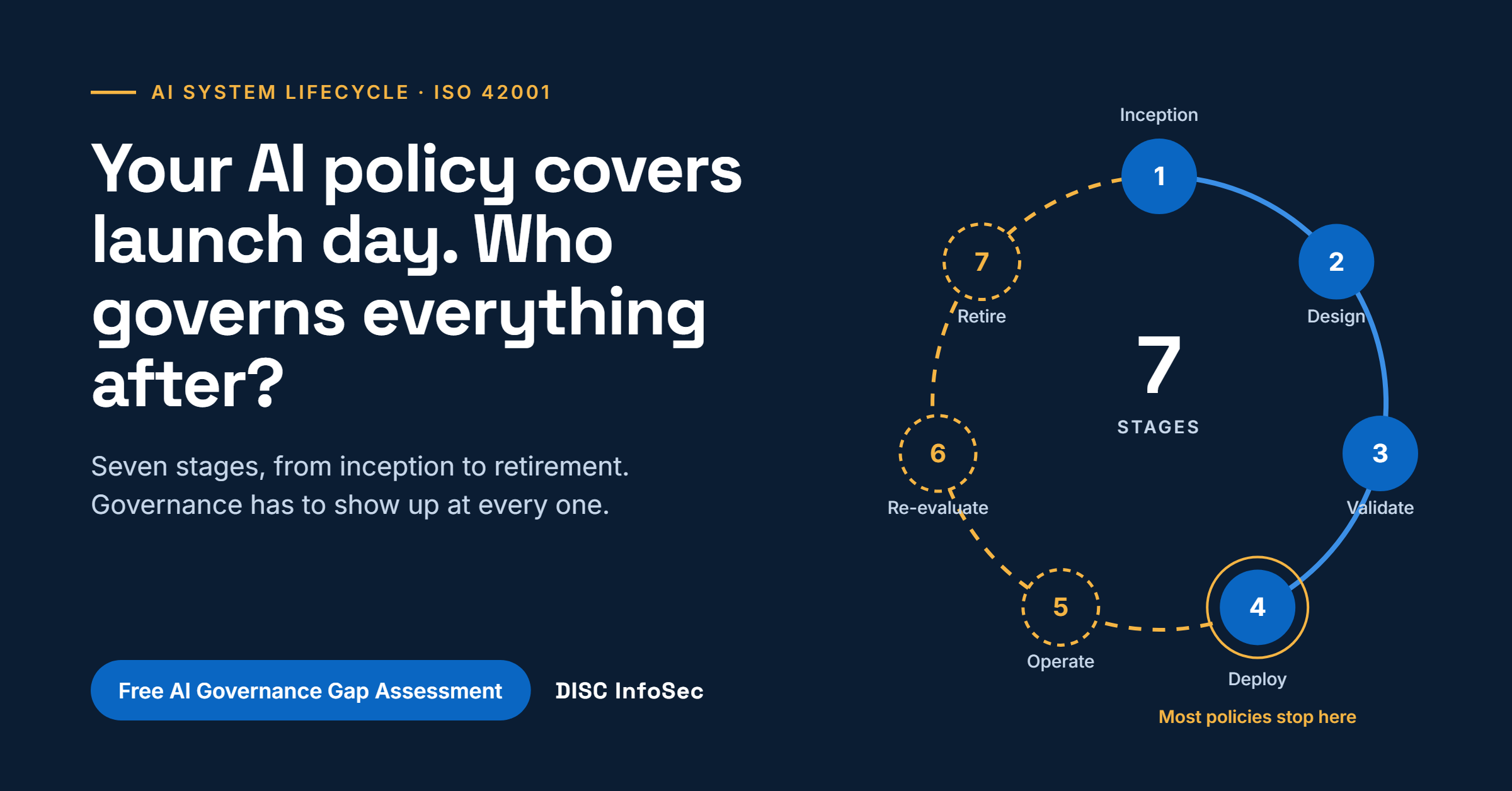
Most AI governance programs fail in the same place: they govern a moment, not a lifecycle. A policy gets approved, a risk assessment gets filed at launch, and then the model keeps changing while the paperwork does not.
AI systems are not static software. Their data shifts, their behavior drifts, their vendors switch on new features, and their agents pick up new permissions. A control that was true on launch day can be false six weeks later.
ISO/IEC 22989 is an international standard developed by ISO/IEC JTC 1/SC 42 that establishes foundational concepts and shared terminology for artificial intelligence (AI).
ISO/IEC 22989, the AI concepts and terminology standard, describes seven stages every AI system passes through. Dejan Kosutic walks through them in Advisera’s 7 Stages of the AI System Lifecycle for AI Governance video, and they are the right backbone for an ISO/IEC 42001 AI management system. Below, I map each stage to the risk it creates, the threat that exploits it, and the control and evidence that close it.
In our last post we argued that AI is a shared civilizational challenge, and that stewardship starts with the people who build and run these systems. The lifecycle is where that stewardship becomes operational.
The 7 stages, and what governance must do at each
1. Inception
The organization decides whether an AI system should exist at all: the problem, the intended purpose, the stakeholders, and the success criteria.
- Risk: a use case nobody assessed. This is where shadow AI is born, when a team buys a tool or wires up an API without the question ever reaching governance.
- Control: intake and approval for every new AI use case, an AI system impact assessment, and a regulatory applicability check (EU AI Act risk tier, Colorado AI Act, sector rules).
- Evidence: an AI inventory entry with a named owner, the documented intended purpose, and the impact assessment.
2. Design and development
Requirements, architecture, data sourcing, model selection or training, and for agents, the tools and permissions they will hold.
- Risk: biased or unrepresentative data, unvetted third-party models, and agents designed with more access than any human would get.
- Threats: data poisoning, supply chain compromise of models, libraries and MCP servers, and backdoored open-weight models.
- Control: data provenance and quality requirements, vendor and model due diligence, threat modeling (STRIDE plus MITRE ATLAS), least-privilege agent design with scoped credentials and tool allowlists.
- Evidence: design documentation, data lineage records, supplier assessments, and the threat model.
3. Verification and validation
Proving the system was built right (verification) and that it is the right system for its purpose (validation) before anyone relies on it.
- Risk: testing accuracy on clean data while ignoring fairness, robustness, and adversarial behavior.
- Threats: prompt injection, jailbreaks, sensitive data leakage, and excessive agency from the OWASP Top 10 for LLM Applications.
- Control: documented acceptance criteria, bias and robustness testing, AI red teaming, and a formal go/no-go sign-off.
- Evidence: test plans and results, red-team findings with dispositions, and the release approval.
4. Deployment
The system moves into its production environment and reaches real users, data, and decisions.
- Risk: configuration drift between test and production, missing transparency notices, and no rollback plan.
- Control: change management, secure configuration and secrets handling, user disclosure where AI interacts with people, human oversight design, and a tested rollback.
- Evidence: the change record, deployment checklist, and published AI disclosures.
5. Operation and monitoring
The longest stage, and the one most programs neglect. The system runs, learns from new inputs, and meets a world that keeps changing.
- Risk: model drift, degraded output quality, silent vendor changes, and oversight that decays into a checkbox.
- Threats: runtime prompt injection through retrieved content, model extraction, API abuse, and agents acting outside their intended scope.
- Control: performance and drift monitoring, agent action logging that shows what was done and on whose behalf, AI incident response, and human reviewers who log what they saw, changed, and why.
- Evidence: monitoring dashboards, event logs, incident tickets, and oversight records.
6. Re-evaluation
A deliberate checkpoint: is the system still meeting its objectives, still compliant, and still worth the risk?
- Risk: “set and forget” systems that outlive the assumptions they were approved under.
- Control: scheduled and event-triggered reviews (after incidents, model updates, new regulations, or a vendor change), refreshed risk and impact assessments, and internal audit.
- Evidence: review minutes, updated risk register entries, and management review outputs.
7. Retirement
The system is decommissioned, replaced, or its use is ended.
- Risk: zombie endpoints still answering requests, orphaned API keys and agent credentials, and training data or logs kept longer than allowed.
- Control: a decommissioning plan covering access revocation, data retention and deletion, model and artifact archival, and stakeholder notice.
- Evidence: the retirement record, credential revocation proof, and data disposal confirmation.
The stages form a loop, not a line. Re-evaluation sends a system back to design for changes, forward to operation as-is, or out to retirement.
One lifecycle, three frameworks
The lifecycle is also the cleanest way to see how ISO/IEC 42001, the NIST AI RMF, and the EU AI Act fit together. Each framework expects governance across the whole life of the system, not just at launch.
| Stage | ISO/IEC 42001 (Annex A) | NIST AI RMF | EU AI Act (high-risk) |
| 1. Inception | A.5 impact assessment; A.6.1 objectives for responsible AI | Govern, Map | Art. 6 classification; Art. 9 risk management |
| 2. Design and development | A.6.2.2–A.6.2.3 requirements and design; A.7 data; A.10 suppliers | Map, Measure | Art. 10 data governance; Art. 11 technical documentation |
| 3. Verification and validation | A.6.2.4 verification and validation | Measure | Art. 15 accuracy, robustness, cybersecurity |
| 4. Deployment | A.6.2.5 deployment; A.8 information for interested parties | Manage | Art. 13 transparency; Art. 14 human oversight |
| 5. Operation and monitoring | A.6.2.6 operation and monitoring; A.6.2.8 event logs | Manage, Measure | Art. 12 record-keeping; Art. 72 post-market monitoring |
| 6. Re-evaluation | Clause 9 performance evaluation and internal audit; Clause 10 improvement | Govern, Manage | Art. 9 continuous, iterative risk management |
| 7. Retirement | A.6.2.2 lifecycle requirements; A.7 data retention | Govern, Manage | Art. 18–19 documentation and log retention |
The pattern is the point: ISO 42001 gives you the management system, the NIST AI RMF gives you the risk vocabulary, and the EU AI Act tells you which evidence a regulator will ask for. A lifecycle-based AIMS lets one set of controls satisfy all three. Verify clause references against the current texts before an audit.
Where lifecycle governance breaks in practice
When I took ShareVault through ISO 42001 certification on the first audit attempt, inside a financial data room where every control is tested hard, the auditors did not dwell on our policy. They followed systems through their lifecycle and asked for the record at each step.
Three breaks show up in nearly every engagement:
- Systems that skip inception. The first discovery sweep almost always finds AI that never went through intake: a vendor feature switched on by default, a browser extension, an agent wired to production with a shared key. You cannot govern a lifecycle that started without you.
- Monitoring without evidence. Teams say a human reviews outputs. Ask for proof and you get a checkbox. A checkbox records what the reviewer said they did, not what they saw, changed, or why. Regulators and plaintiffs will ask for the second.
- No exit plan. Almost nobody plans retirement. Old endpoints keep answering, credentials keep working, and data outlives its retention period.
The fix is not more policy. It is a lifecycle gate at each stage, with an owner and an artifact. If the artifact does not exist, the control does not either.
Find your weakest stage: free AI Governance Gap Assessment
Before you build lifecycle gates, find out which stages are already leaking. Our free AI Governance Gap Assessment runs in your browser and gives you:
- 15 questions on how AI is actually governed in your organization today
- An instant maturity score
- A detailed PDF report you can take to leadership
- Your top 3 priority gaps, so you know where to start
Take it with your lifecycle in mind. If your lowest scores sit around inventory and ownership, your problem starts at inception. If they sit around oversight and monitoring, it starts at operation. Either way, you will know which gate to build first.
Take the free AI Governance Gap Assessment
Governing the whole lifecycle with DISC InfoSec
DISC InfoSec turns lifecycle requirements into operating controls, evidence, and accountable decisions, one expert across AI governance, InfoSec, and regulatory compliance.
| Service | Lifecycle stages covered | What you get |
| AI Governance Quick-Start | 1, 5 | AI and agent discovery, shadow AI review, risk register with named owners, and a remediation roadmap in 7–10 days |
| ISO 42001 Control Gap Assessment | 1–7 | A 2-week gap analysis against ISO 42001 with a prioritized remediation roadmap |
| AI Security Risk Assessment | 2, 3, 5 | Threat modeling, prompt injection and agent permission review mapped to OWASP LLM Top 10 and MITRE ATLAS |
| ISO 42001 implementation | 1–7 | A full AIMS with lifecycle gates that produce audit evidence, integrated with ISO 27001 |
| AI Governance Readiness Assessment | 1, 6 | A 10-day fixed-fee review of compliance, risk posture, and EU AI Act and Colorado AI Act readiness |
| vCAIO advisory | 6 and ongoing | Fractional AI governance leadership for management reviews, re-evaluations, and NIST AI RMF alignment |
See every service on our AIMS-ISO 42001 & AI Governance page, or book a 30-minute strategy call.
DISC InfoSec is a boutique AI governance and cybersecurity consultancy in Petaluma, California, and a PECB Authorized Training Partner. Credentials: AICP, CISSP, CISM, ISO/IEC 42001 and ISO/IEC 27001 Lead Implementer. Contact: info@deurainfosec.com | (707) 998-5164.
Sources
- Dejan Kosutic, Advisera: 7 Stages of the AI System Lifecycle for AI Governance (YouTube, Feb 13, 2026). Stage names and the ISO 22989 framing come from this video; the risk, threat, and control mapping is DISC InfoSec’s.
https://www.deurainfosec.com/disc-infosec-home/aims-iso42001-ai-governance/
- 178 Brands. Zero Breaches of Their Own. One Trusted Script
- Your AI Policy Covers Launch Day. Who Governs Everything After?
- The Reporting Clock: How Long Until Anyone Knows Your AI Agent Went Out of Bounds?
- You Can’t Fence Off Superintelligence: AI Governance Starts With You
- Your AI Policy Isn’t Evidence. Here’s What Auditors Actually Sample